

Daily Vocabulary from International Newspapers and Publications
Expand Your Vocabulary with Wordpandit’s Global Vocabulary Hub
At Wordpandit, we are committed to helping you develop a truly global vocabulary by drawing from some of the most respected international publications. This section is designed to keep you ahead of the curve by introducing you to words that define global conversations and trends.
The Power of Global Sources
To help you think and communicate on a global scale, we curate vocabulary from renowned international sources, such as:
- The New York Times
- The Washington Post
- BBC
- The Guardian
- The Economist
- Scientific American
- Psychology Today
- And many more...
Stay Global, Stay Competitive
Our daily updates from international publications ensure you are consistently exposed to new words that reflect global news and developments, making sure your vocabulary is not only current but also globally relevant.
Enhance Your Global Perspective
Whether you’re preparing for international exams, aiming to excel in global business communication, or want to enhance your language skills for personal growth, Wordpandit offers the resources you need to thrive in a global context.
Effective Learning, Global Reach
Our learning methodology combines global examples, memory aids, and interactive activities, allowing you to internalize new words effectively and apply them in real-world scenarios.
Begin Your Global Vocabulary Journey Now!

Why Choose Wordpandit?
Practical Learning: Focus on words you'll actually encounter in real-world reading, enhancing your comprehension and communication skills.
Diverse Content: From current affairs to scientific breakthroughs, our varied sources expose you to vocabulary across multiple domains.
Effortless Integration: Make Wordpandit a part of your daily routine. Just a few minutes each day can significantly boost your lexicon over time.
Your Path to Vocabulary Mastery
- Visit our Daily Vocabulary section regularly
- Explore new words and their usage in context
- Practice incorporating these words into your own writing and speech
- Track your progress as your vocabulary expands
Start Your Journey Today
Embark on your vocabulary enhancement journey with Wordpandit. By consistently engaging with our daily posts, you'll build a robust vocabulary that serves you well in academic, professional, and personal contexts.
Remember, a word a day keeps linguistic limitations at bay. Make Wordpandit your daily companion in the quest for vocabulary excellence!
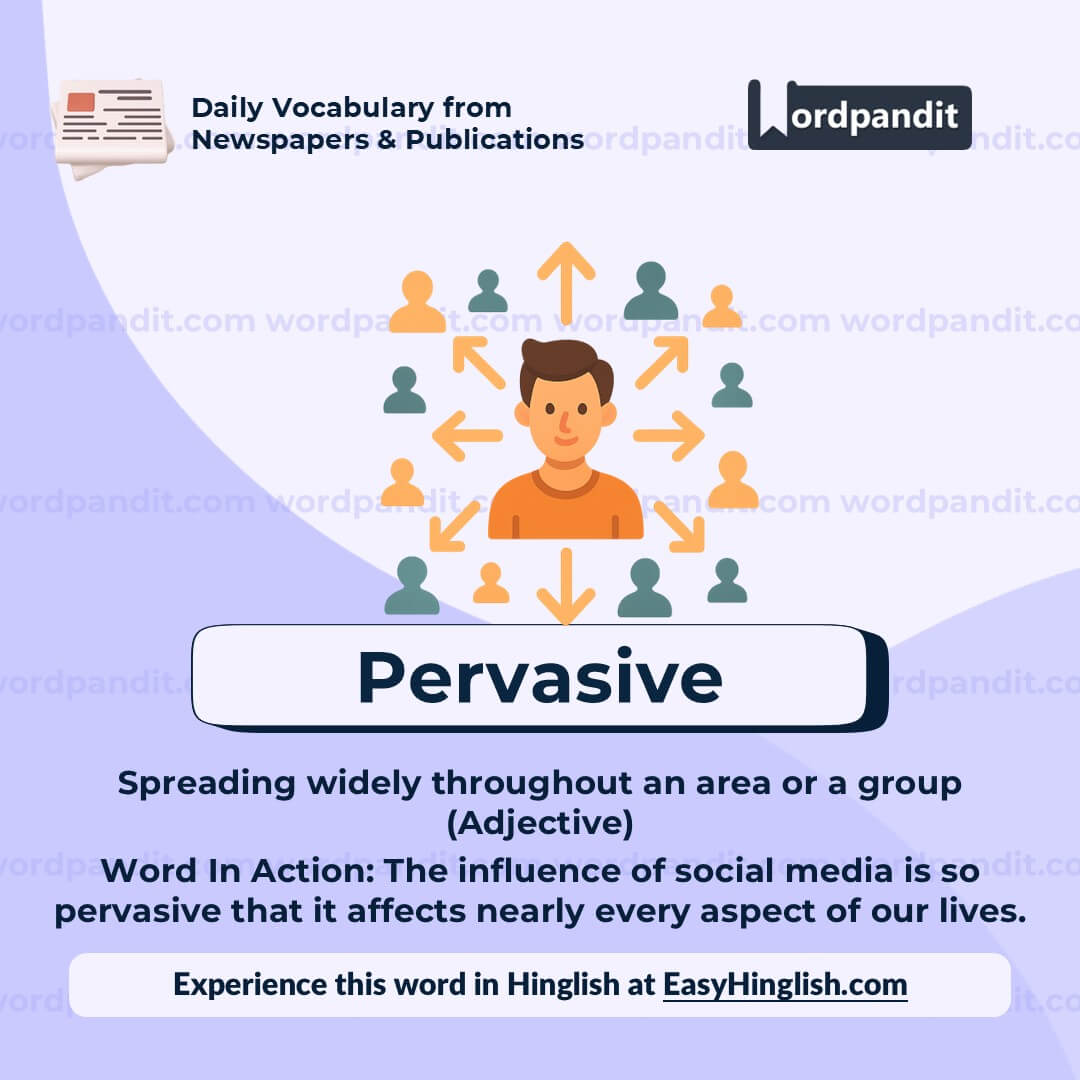
WORD-1: Pervasive
Context:
"It’s still far more pervasive than white Americans can easily appreciate." - Washington Post
Explanatory Paragraph:
The word pervasive describes something that is widespread, present everywhere, or spreading throughout an area or group. It often refers to ideas, feelings, conditions, or problems that are so common or deeply rooted that they seem to exist everywhere, even if not always visible on the surface.
Meaning: Spreading widely throughout an area or a group (Adjective)
Pronunciation: per-VAY-siv
Difficulty Level: ⭐⭐⭐ Intermediate
Etymology: From Latin pervasus, the past participle of pervadere, meaning "to spread through" (per- = through + vadere = to go).
Prashant Sir's Notes:
Think of "pervasive" as something that creeps into every corner. Whether it's a smell, an idea, or a feeling, if it’s pervasive, it’s hard to escape from.
Synonyms & Antonyms:
Synonyms: widespread, omnipresent, prevalent, universal, all-encompassing
Antonyms: limited, rare, scarce, confined, restricted
Usage Examples:
- The pervasive influence of technology can be felt in every aspect of our daily lives.
- A sense of fear was pervasive in the town after the recent incidents.
- The smell of freshly baked bread was so pervasive that it drew people from the streets into the bakery.
- Corruption can become pervasive if left unchecked in political systems.
Cultural Reference:
"The idea that media shapes public opinion is pervasive in modern society." - Communication Studies Commentary
Think About It:
Can something be so pervasive that people stop noticing it altogether, even though it still affects them?
Quick Activity:
Write down three things in modern life that you think are pervasive (e.g., social media, advertising, or stress). Try to explain why you chose them.
Memory Tip:
Think of "pervasive" as "per-vasive" = "per" (through) + "vasive" (invading). Something pervasive invades everything around it.
Real-World Application:
The term "pervasive" is often used in discussions of social issues, technology, and culture. For example, educators may talk about the pervasive use of smartphones in classrooms, or activists might describe pervasive inequality in society.
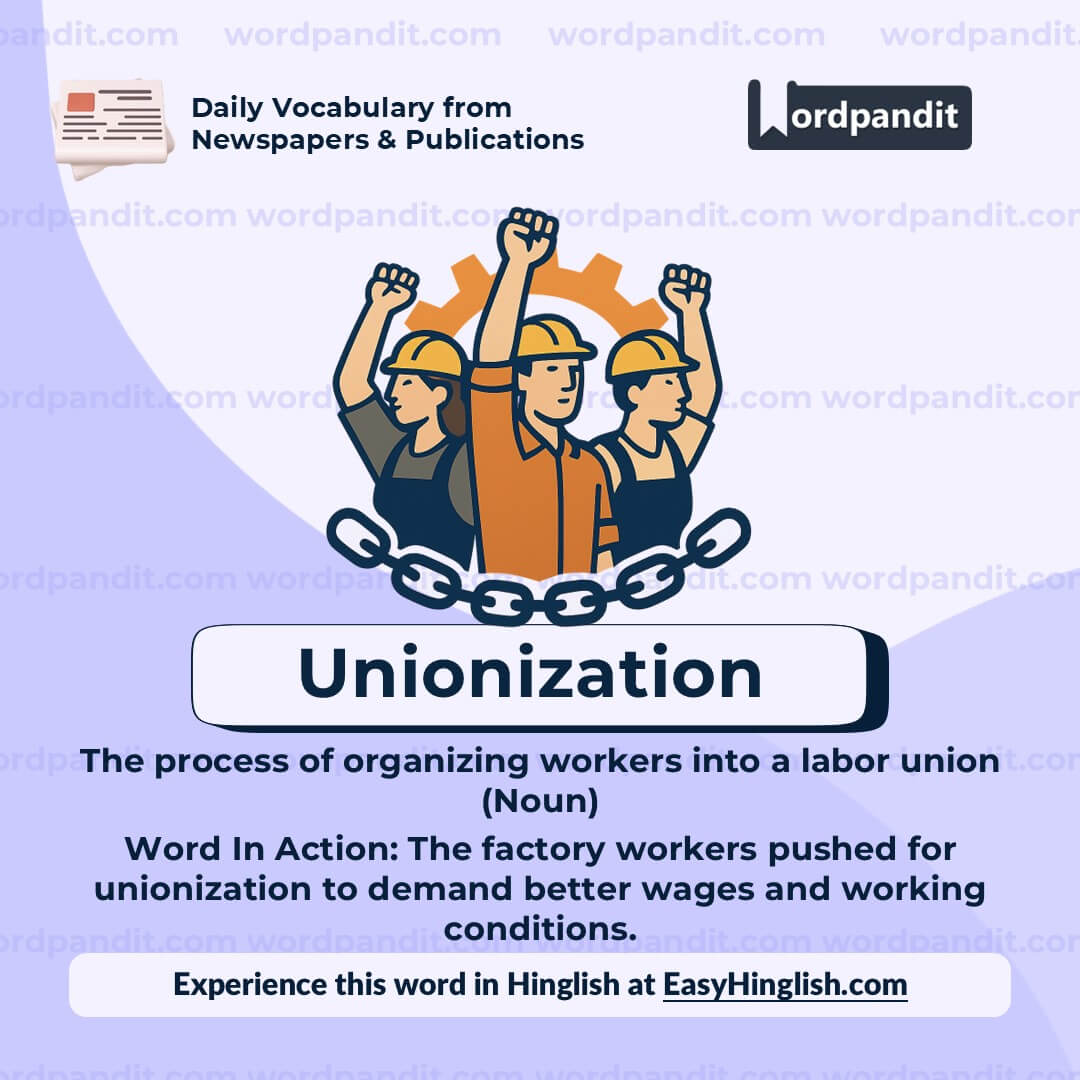
WORD-2: Unionization
Context:
"Unions won some victories, and fear of unionization may have pushed some employers to increase pay." - New York Times
Explanatory Paragraph:
Unionization refers to the process of workers coming together to form or join a labor union. The main purpose is to collectively negotiate with employers for better wages, improved working conditions, benefits, and job security. It represents the idea that employees have more power when they act together rather than individually.
Meaning: The process of organizing workers into a labor union (Noun)
Pronunciation: you-nee-uh-nuh-ZAY-shun
Difficulty Level: ⭐⭐⭐ Intermediate
Etymology: From "union" (Latin unio, meaning "oneness, unity") + "-ization" (a suffix forming nouns that express processes or actions).
Prashant Sir's Notes:
Think of unionization as teamwork at the workplace. Individually, workers may struggle to negotiate, but through unionization, they amplify their voice and bargaining power.
Synonyms & Antonyms:
Synonyms: organization, collective bargaining, labor organizing
Antonyms: individualism, disbandment, deregulation
Usage Examples:
- The push for unionization grew stronger after the company refused to address safety concerns.
- Unionization efforts often face resistance from large corporations.
- Successful unionization can lead to fairer wages and better working conditions.
- Some industries have a long history of unionization, while others are just beginning the process.
Cultural Reference:
"The unionization wave among tech workers is being compared to the labor movements of the early 20th century." - Labor History Discussions
Think About It:
Do you think unionization is still as necessary in the modern workplace where companies often emphasize employee-friendly cultures?
Quick Activity:
Imagine you and your classmates want better facilities in school. Write down three arguments you could make if you were "unionizing" to present your demands.
Memory Tip:
Break the word into "union" (together) + "ization" (process). So, unionization is the process of coming together as one.
Real-World Application:
Unionization is frequently discussed in industries such as manufacturing, education, healthcare, and now even technology. It is relevant whenever employees seek better working conditions or protections by uniting.

WORD-3: Penchant
Context:
"Trump has an unbelievable number of negatives going against him, from people’s potent memories of Jan. 6 to his own penchant for disaster and the fact that it will be very challenging for him to stick to the “Mr. Stable Genius” message for long." - New York Times
Explanatory Paragraph:
The word penchant refers to a strong liking, preference, or tendency toward something. It often implies a habitual attraction or inclination, whether positive (a penchant for art) or negative (a penchant for trouble). It highlights what someone naturally gravitates toward.
Meaning: A strong or habitual liking for something; a tendency to do something (Noun)
Pronunciation: PEN-shant or PON-shon (French-influenced)
Difficulty Level: ⭐⭐⭐ Intermediate
Etymology: From French pencher meaning "to lean or incline," reflecting the idea of leaning toward something.
Prashant Sir's Notes:
When you hear "penchant," think of a natural tilt or bias—something you can’t help but lean toward, like a taste, hobby, or habit.
Synonyms & Antonyms:
Synonyms: liking, fondness, preference, inclination, tendency, proclivity
Antonyms: dislike, aversion, indifference, disinterest
Usage Examples:
- She has a penchant for collecting rare stamps from around the world.
- His penchant for late-night snacking often disrupts his sleep schedule.
- The professor’s penchant for storytelling made lectures more engaging.
- Despite his penchant for risk-taking, he always manages to land on his feet.
Cultural Reference:
"Steve Jobs had a penchant for perfection, which shaped Apple’s reputation for design excellence." - Business Biographies
Think About It:
Do you think a "penchant" is something people are born with, or can it be developed through experiences and environment?
Quick Activity:
Write down two positive penchants you have (e.g., reading, helping others) and one negative penchant (e.g., procrastination). How do they shape your daily life?
Memory Tip:
Think of "penchant" as a “pen” that always “chants” the same tune—it leans toward something over and over.
Real-World Application:
The word is often used in personality descriptions, journalism, and literature. For example, someone might have a penchant for fashion, technology, or controversy—indicating their consistent attraction to it.
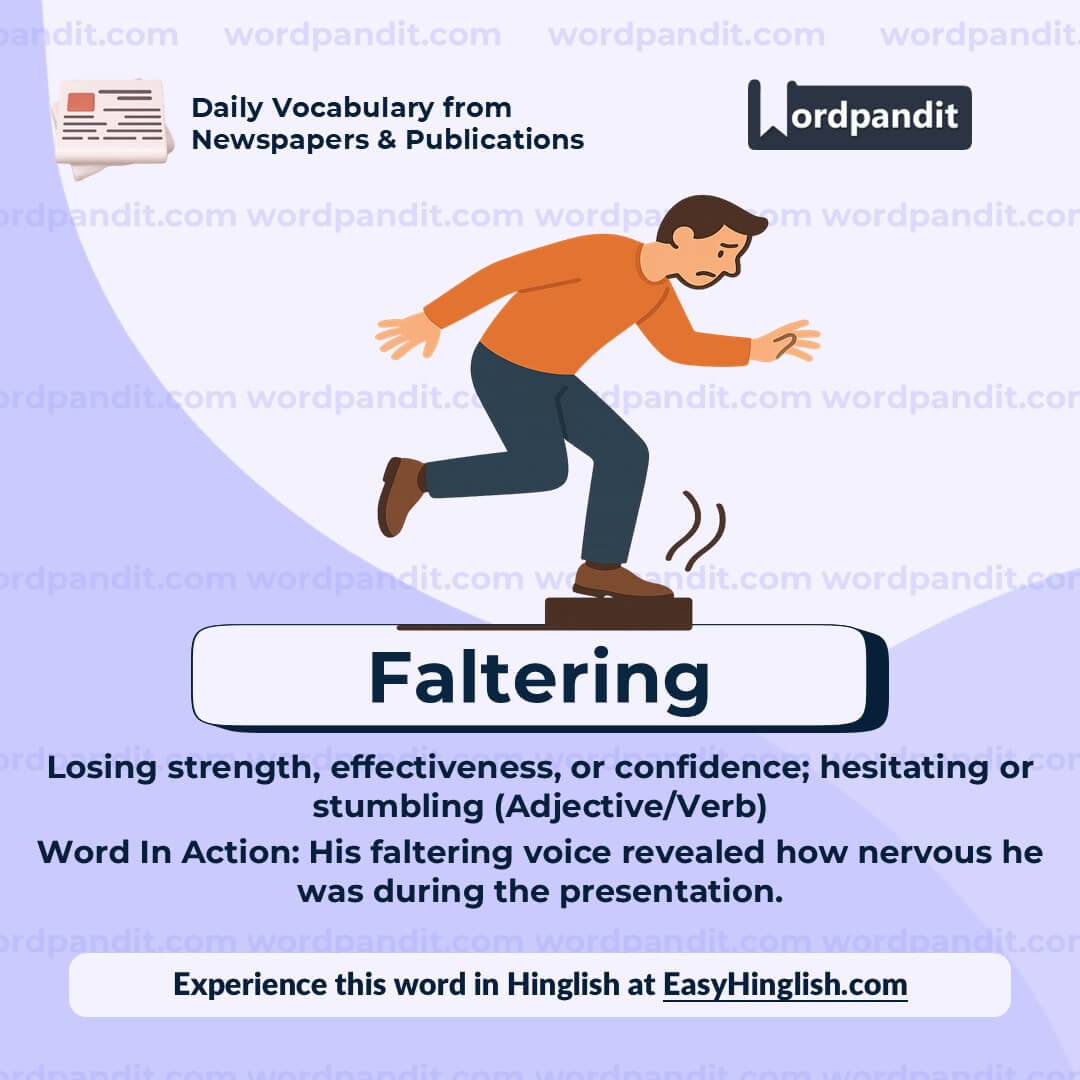
WORD-4: Faltering
Context:
"If Republicans get to autumn and Trump is their nominee and faltering badly, you will probably see some rose-colored glasses, “aah, if only we had nominated DeSantis instead, we should have given him a chance” wish casting emerging." - New York Times
Explanatory Paragraph:
The word faltering suggests hesitation, weakness, or loss of strength, momentum, or confidence. When someone or something is faltering, they are struggling to move forward effectively—whether it’s a person stumbling while walking, a business losing stability, or a leader showing signs of decline. It often implies uncertainty and failure to maintain steady progress.
Meaning: Losing strength, effectiveness, or confidence; hesitating or stumbling (Adjective/Verb)
Pronunciation: FAWL-ter-ing
Difficulty Level: ⭐⭐ Easy
Etymology: From Middle English faltren, possibly connected to Old Norse faltrask meaning "to be hindered or hesitant."
Prashant Sir's Notes:
Think of a person trying to walk on shaky ground—taking uncertain steps, slowing down, or almost stumbling. That’s exactly what "faltering" means in ideas, confidence, or performance.
Synonyms & Antonyms:
Synonyms: stumbling, wavering, hesitating, weakening, struggling, uncertain
Antonyms: steady, confident, strong, determined, resolute
Usage Examples:
- The faltering economy has led to widespread job insecurity.
- She gave a faltering smile, unsure of how to respond.
- The team’s faltering performance cost them the championship.
- He kept going despite faltering steps and heavy exhaustion.
Cultural Reference:
"Many empires in history collapsed after years of faltering leadership and internal decline." - Historical Studies
Think About It:
Do you think faltering is always a sign of failure, or can it sometimes be a natural part of growth and resilience?
Quick Activity:
Write two short sentences: one describing a faltering person (emotionally or physically) and one describing a faltering system (like an economy or company).
Memory Tip:
Think of "falter" as “fault in power”—when something falters, it loses steady power or momentum.
Real-World Application:
"Faltering" is often used in political, economic, and personal contexts—such as describing faltering leadership, a faltering market, or even a faltering voice during an emotional speech.
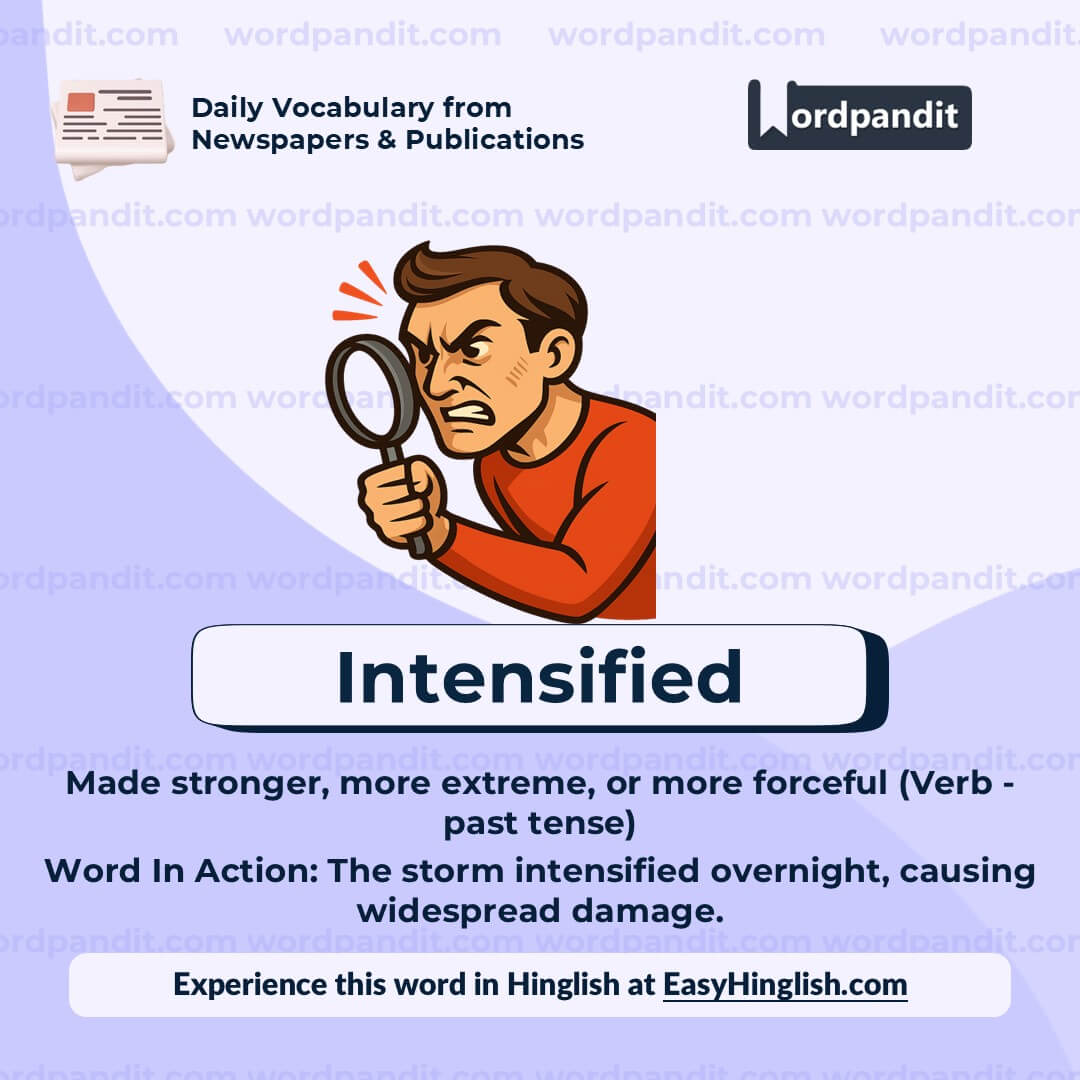
WORD-5: Intensified
Context:
"He has intensified his multiyear campaign to undermine the rule of law and the democratic process." - New York Times
Explanatory Paragraph:
The word intensified means to make something stronger, more forceful, or more extreme. When an effort, feeling, or action is intensified, it increases in strength, urgency, or severity. It can apply to emotions (intensified anger), natural phenomena (intensified storms), or human actions (intensified campaigns).
Meaning: Made stronger, more extreme, or more forceful (Verb - past tense)
Pronunciation: in-TEN-suh-fyd
Difficulty Level: ⭐⭐ Easy
Etymology: From Latin intensus ("stretched, strained") + English suffix "-fy" (to make) → "intensify" → intensified.
Prashant Sir's Notes:
Whenever you see "intensified," think of turning up the heat on a stove—whatever is happening becomes hotter, stronger, or harder to ignore.
Synonyms & Antonyms:
Synonyms: strengthened, heightened, escalated, deepened, increased, magnified
Antonyms: weakened, reduced, diminished, lessened, softened
Usage Examples:
- The storm intensified overnight, causing widespread flooding.
- Her determination intensified after facing repeated failures.
- The company intensified its marketing efforts before launching the new product.
- Tensions between the two nations have intensified in recent months.
Cultural Reference:
"The civil rights movement intensified during the 1960s as protests and demands for equality grew stronger." - History Texts
Think About It:
Can intensification always be considered negative, or can it sometimes be the driving force behind positive change?
Quick Activity:
Think of one situation where emotions intensified for you (anger, joy, excitement). Write a short sentence describing it using the word "intensified."
Memory Tip:
Picture a "lens" that magnifies light. Just like a lens intensifies sunlight, the word means making something stronger or more powerful.
Real-World Application:
The word "intensified" is often used in news reports, history, and everyday language to describe worsening conflicts, stronger efforts, or heightened feelings—for example, "intensified protests," "intensified studies," or "intensified emotions."


