

Daily Vocabulary from International Newspapers and Publications
Expand Your Vocabulary with Wordpandit’s Global Vocabulary Hub
At Wordpandit, we are committed to helping you develop a truly global vocabulary by drawing from some of the most respected international publications. This section is designed to keep you ahead of the curve by introducing you to words that define global conversations and trends.
The Power of Global Sources
To help you think and communicate on a global scale, we curate vocabulary from renowned international sources, such as:
- The New York Times
- The Washington Post
- BBC
- The Guardian
- The Economist
- Scientific American
- Psychology Today
- And many more...
Stay Global, Stay Competitive
Our daily updates from international publications ensure you are consistently exposed to new words that reflect global news and developments, making sure your vocabulary is not only current but also globally relevant.
Enhance Your Global Perspective
Whether you’re preparing for international exams, aiming to excel in global business communication, or want to enhance your language skills for personal growth, Wordpandit offers the resources you need to thrive in a global context.
Effective Learning, Global Reach
Our learning methodology combines global examples, memory aids, and interactive activities, allowing you to internalize new words effectively and apply them in real-world scenarios.
Begin Your Global Vocabulary Journey Now!

Why Choose Wordpandit?
Practical Learning: Focus on words you'll actually encounter in real-world reading, enhancing your comprehension and communication skills.
Diverse Content: From current affairs to scientific breakthroughs, our varied sources expose you to vocabulary across multiple domains.
Effortless Integration: Make Wordpandit a part of your daily routine. Just a few minutes each day can significantly boost your lexicon over time.
Your Path to Vocabulary Mastery
- Visit our Daily Vocabulary section regularly
- Explore new words and their usage in context
- Practice incorporating these words into your own writing and speech
- Track your progress as your vocabulary expands
Start Your Journey Today
Embark on your vocabulary enhancement journey with Wordpandit. By consistently engaging with our daily posts, you'll build a robust vocabulary that serves you well in academic, professional, and personal contexts.
Remember, a word a day keeps linguistic limitations at bay. Make Wordpandit your daily companion in the quest for vocabulary excellence!
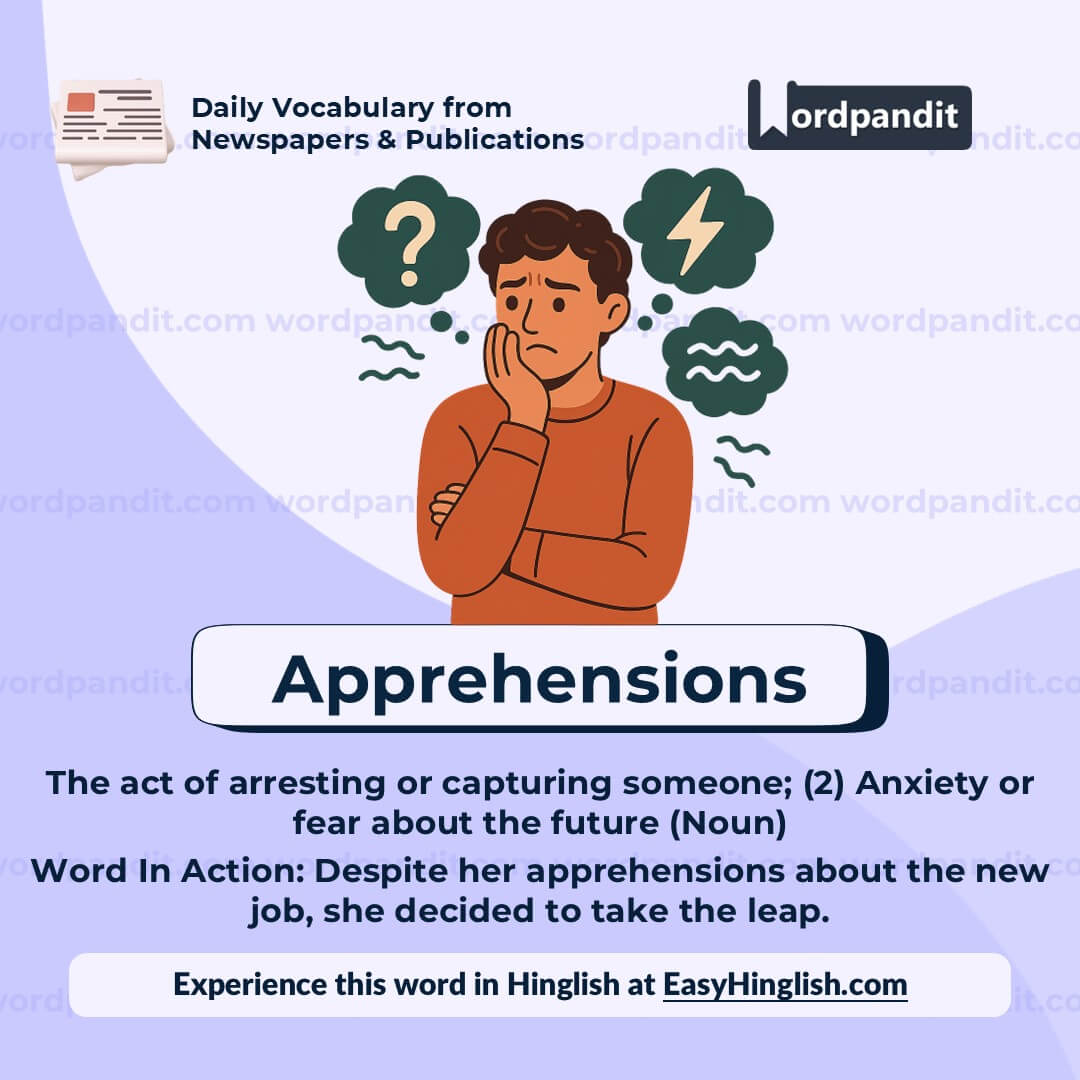
WORD-1: Apprehensions
Context:
"There was a 90 percent increase in migrant apprehensions along the southern border compared to the year before." - New York Times
Explanatory Paragraph:
The word "apprehensions" has two distinct but related meanings. In law enforcement, it refers to the act of catching or arresting someone, such as in border or police reports. In everyday conversation, it refers to worry or fear about something that might happen in the future. The correct meaning depends on the context in which the word appears.
Meaning: (1) The act of arresting or capturing someone; (2) Anxiety or fear about the future (Noun)
Pronunciation: ap-ri-HEN-shuns
Difficulty Level: ⭐⭐⭐ Intermediate
Etymology: From Latin apprehendere, meaning "to seize" or "to grasp," which later expanded to cover both physical capture and mental anticipation.
Prashant Sir's Notes:
This word is a good reminder of why context is king. In legal texts, "apprehensions" almost always means arrests. In personal or emotional writing, it usually points to worry or fear. Train your eye to pick the right meaning based on situation.
Synonyms & Antonyms:
Synonyms: arrest, capture, detention, anxiety, unease, concern
Antonyms: release, freedom, confidence, calmness, assurance
Usage Examples:
- The police announced several apprehensions after the late-night raid. (arrest meaning)
- She couldn’t shake her apprehensions about starting a new job in a different city. (anxiety meaning)
- Border security reported record apprehensions at key crossing points. (arrest meaning)
- Despite his apprehensions, he spoke up in the meeting and shared his ideas. (anxiety meaning)
Cultural Reference:
In U.S. media, "apprehensions" is commonly used in discussions about immigration policy, where it specifically means the number of individuals detained while attempting to cross the border.
Think About It:
How does the dual meaning of "apprehensions" reflect both physical and mental "seizing"? Does knowing both meanings help you understand how language evolves?
Quick Activity:
Create two sentences: one using "apprehensions" as "arrests" and another using it as "worries." Compare them to see how context changes interpretation.
Memory Tip:
Link "apprehend" with "to grab"—you can grab a person (arrest) or grab hold of a thought in your mind (worry about the future).
Real-World Application:
In newspapers, "apprehensions" often signals arrests, especially in law and border contexts. In daily speech, it more commonly describes personal fears, doubts, or nervousness about upcoming events.
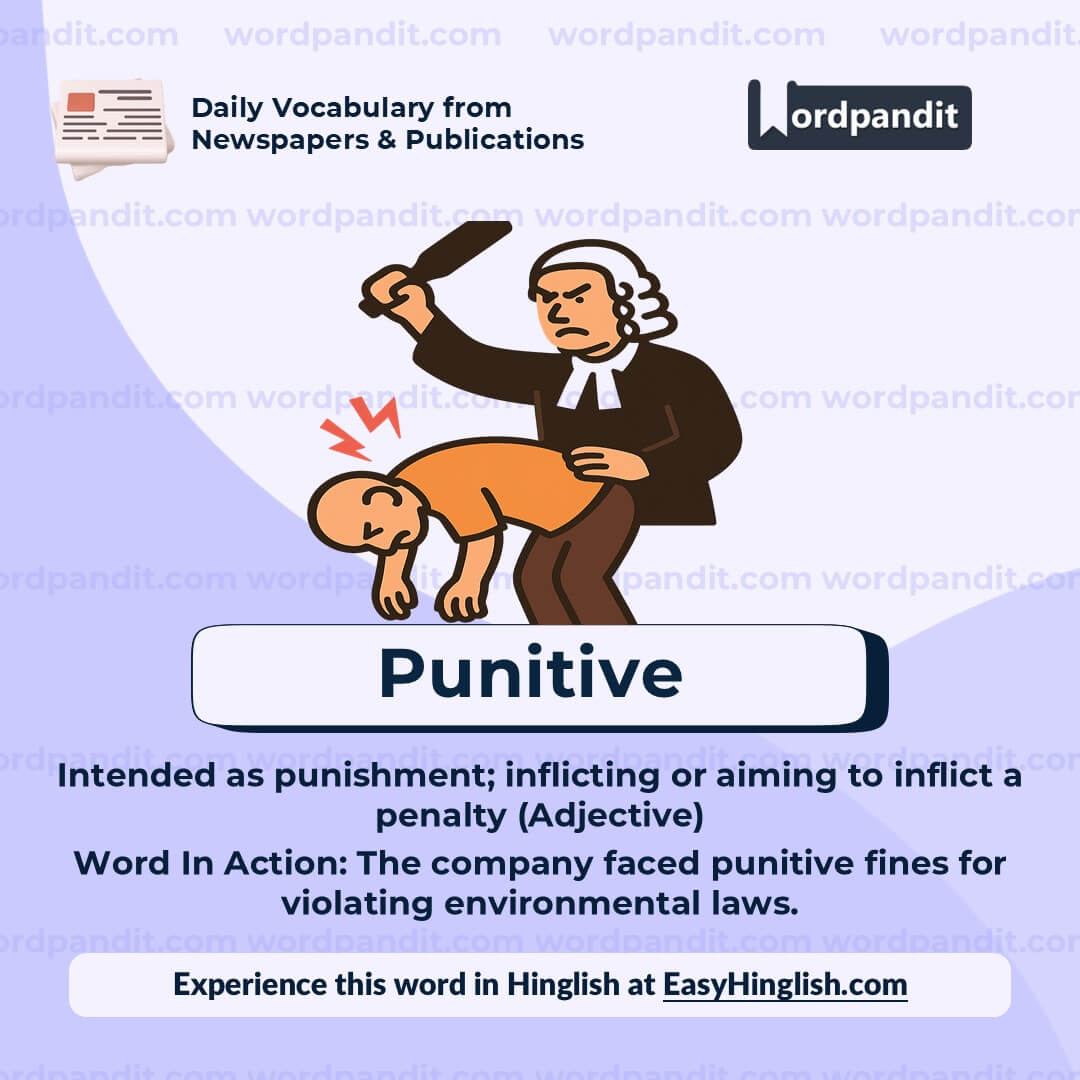
WORD-2: Punitive
Context:
"Democrats may think that it is worth embracing punitive immigration policies for the hope of improving Mr. Biden’s polling numbers." - New York Times
Explanatory Paragraph:
The word "punitive" describes actions, rules, or policies that are meant to punish rather than to guide or rehabilitate. It is often associated with strict or harsh consequences, whether in law, politics, education, or workplaces. In the provided context, "punitive immigration policies" suggests measures designed to impose strict penalties on immigrants rather than offering supportive or humane solutions.
Meaning: Intended as punishment; inflicting or aiming to inflict a penalty (Adjective)
Pronunciation: PYOO-ni-tiv
Difficulty Level: ⭐⭐⭐ Intermediate
Etymology: Derived from Latin punire, meaning "to punish," which itself comes from poena, meaning "penalty" or "pain."
Prashant Sir's Notes:
"Punitive" is almost always negative in tone. It highlights harshness and focuses on the act of punishment. When you see this word in news or academic texts, ask: is the writer criticizing something as being too harsh?
Synonyms & Antonyms:
Synonyms: disciplinary, retributive, corrective, harsh, penal
Antonyms: lenient, forgiving, rehabilitative, permissive
Usage Examples:
- The jury awarded punitive damages to set an example against corporate misconduct.
- Teachers debated whether punitive rules for late homework were fair to students.
- The government’s punitive trade tariffs strained international relations.
- Her punitive remarks left the team feeling discouraged rather than motivated.
Cultural Reference:
In American law, "punitive damages" are well known as a way courts go beyond simple compensation, punishing wrongdoers to deter future misconduct. This makes "punitive" a powerful legal and financial term.
Think About It:
When do punitive actions backfire, creating resentment instead of reform? Can you think of an example from society or personal life?
Quick Activity:
Use "punitive" in two different contexts: (1) in a sentence about law, (2) in a sentence about school or family life.
Memory Tip:
Associate "punitive" with "penalty" and "punish"—all three share the "pun-" root, which signals consequences or discipline.
Real-World Application:
Governments, businesses, and educators often debate whether to adopt punitive strategies (like fines, suspensions, or strict rules) or supportive approaches that focus on learning, reform, or guidance.
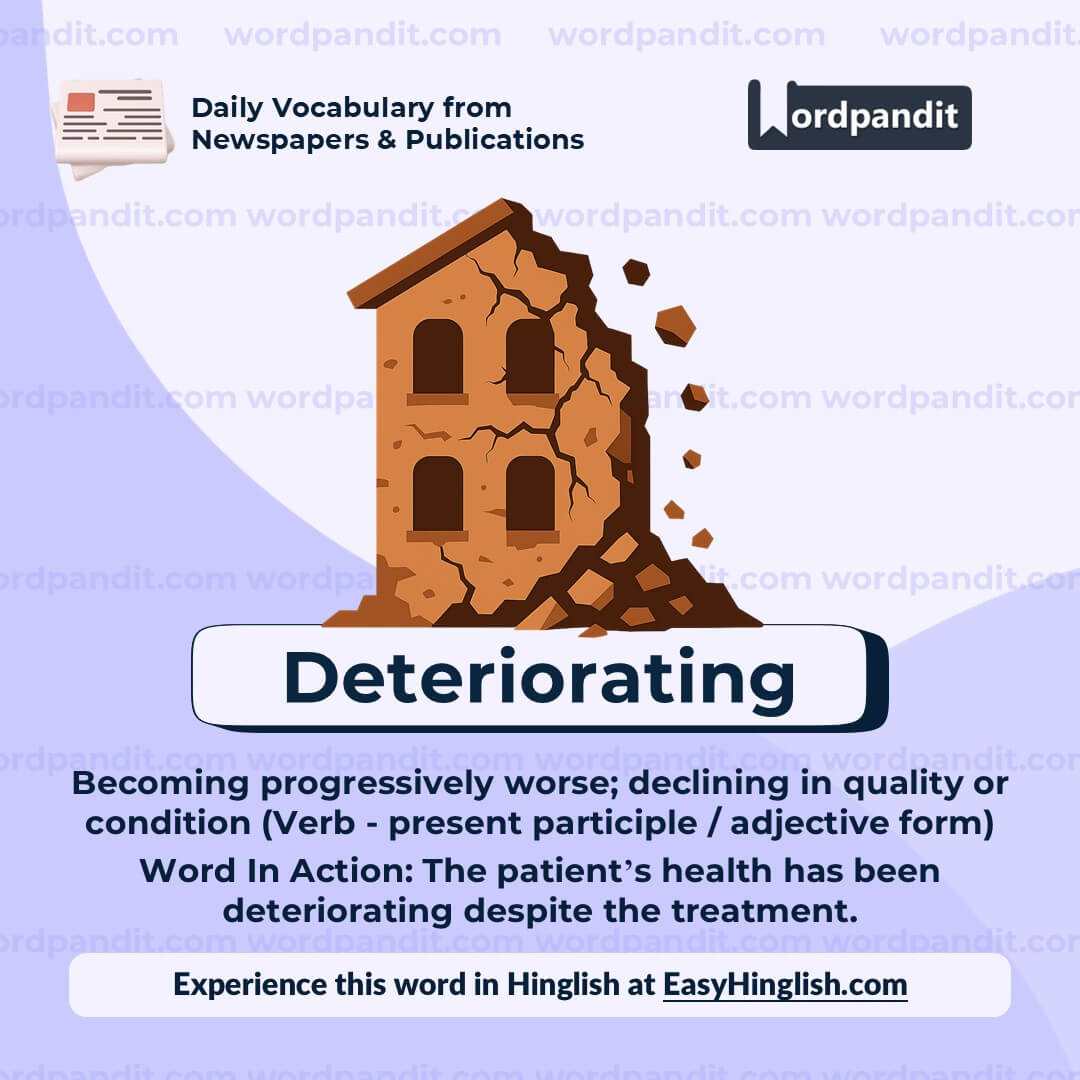
WORD-3: Deteriorating
Context:
"Deteriorating conditions in Latin America and the Caribbean guarantee that more migrants will be forced to seek refuge in the United States." - New York Times
Explanatory Paragraph:
The word "deteriorating" describes something that is gradually getting worse. It can be applied to health, relationships, infrastructure, political situations, or living conditions. In the given context, it refers to worsening social and economic circumstances in Latin America and the Caribbean, which drive people to migrate in search of safety or better opportunities.
Meaning: Becoming progressively worse; declining in quality or condition (Verb - present participle / adjective)
Pronunciation: dih-TEER-ee-uh-ray-ting
Difficulty Level: ⭐⭐ Easy
Etymology: From Latin deterior, meaning "worse," which developed into "deteriorate" in English, capturing the idea of decline or decay over time.
Prashant Sir's Notes:
Think of "deteriorating" as a slow but steady decline. Unlike sudden collapse, it signals ongoing worsening, whether in trust, health, environment, or international peace.
Synonyms & Antonyms:
Synonyms: worsening, declining, weakening, degrading, collapsing
Antonyms: improving, strengthening, recovering, advancing, progressing
Usage Examples:
- The doctor expressed concern over his rapidly deteriorating condition.
- Deteriorating infrastructure caused frequent water and power outages in the city.
- The talks ended without progress due to deteriorating trust between both sides.
- Her positive attitude remained intact despite the deteriorating job market around her.
Cultural Reference:
The phrase "deteriorating climate conditions" is often used in global discussions about climate change, highlighting the worsening impact of human activity on weather patterns, ecosystems, and resources.
Think About It:
Why do societies often wait until situations are deteriorating badly before taking action? What prevents early intervention?
Quick Activity:
Write two original sentences: one using "deteriorating" to describe health, and another to describe a country’s political situation.
Memory Tip:
Link "deteriorating" with "deterior" = "worse." Think: moving step by step towards something worse.
Real-World Application:
In daily life and media, "deteriorating" is a go-to word to describe gradual decline, whether in global politics, the economy, environmental issues, or even personal health conditions.
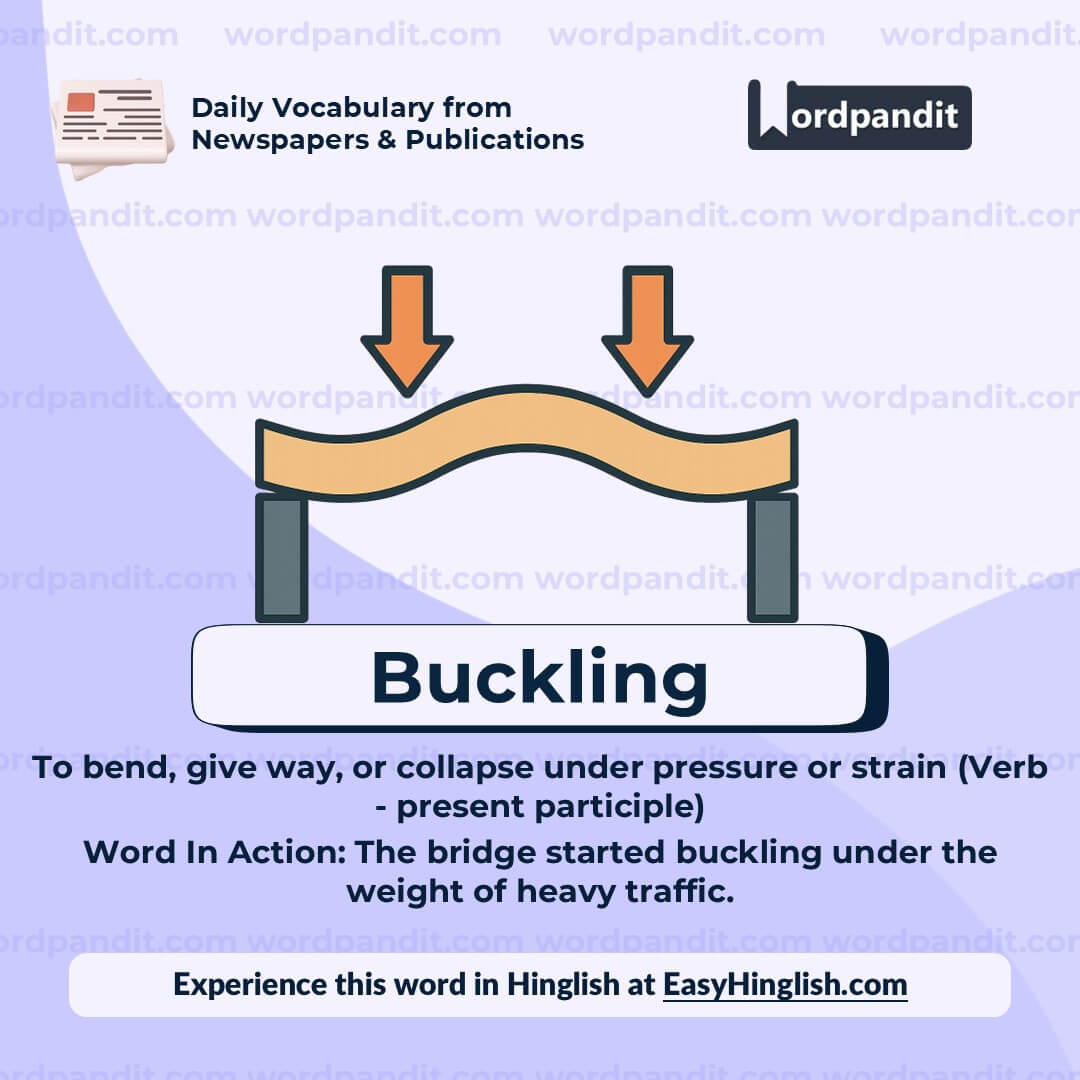
WORD-4: Buckling
Context:
"They make their way to the border and develop a federal response to help cities buckling under the strain of absorbing tens of thousands of migrants." - New York Times
Explanatory Paragraph:
"Buckling" refers to something bending, collapsing, or giving way under pressure. It can be used literally, such as a bridge buckling under heavy loads, or figuratively, such as a person, system, or city struggling to cope with extreme stress. In the context above, cities are "buckling" because they cannot easily handle the overwhelming responsibility of supporting large numbers of migrants.
Meaning: To bend, collapse, or give way under pressure or strain (Verb - present participle)
Pronunciation: BUHK-ling
Difficulty Level: ⭐⭐ Easy
Etymology: From Middle English bokelen ("to bend"), linked to Old French bouccler ("to bulge or bend"), rooted in Latin buccula ("small shield" or "cheek").
Prashant Sir's Notes:
When you hear "buckling," visualize something straining and bending under weight. Writers often use it metaphorically to describe systems, societies, or people under stress. It doesn’t always mean total failure—it signals intense pressure that might or might not break something fully.
Synonyms & Antonyms:
Synonyms: collapsing, caving in, yielding, giving way, crumbling
Antonyms: standing firm, resisting, holding up, enduring, stabilizing
Usage Examples:
- The metal beam started buckling under the intense heat of the fire. (literal)
- His confidence was buckling under the pressure of constant criticism. (figurative)
- Hospitals are buckling due to the surge in emergency cases. (figurative)
- The old wooden floor began buckling as the heavy furniture was dragged across it. (literal)
Cultural Reference:
During the COVID-19 pandemic, global media often described healthcare systems as "buckling under pressure," capturing the immense strain on hospitals, doctors, and nurses dealing with overwhelming patient numbers.
Think About It:
If a system is buckling under stress, should leaders focus on reducing the pressure, or on strengthening the system’s resilience? Which approach works better long-term?
Quick Activity:
Write two sentences: (1) where "buckling" is used to describe a physical object, (2) where it describes an emotional or social situation.
Memory Tip:
Think of a belt buckle snapping open when it’s under too much pressure—that image will help you remember what "buckling" means.
Real-World Application:
News articles often describe cities, economies, or infrastructures as "buckling" under strain, making the word useful in understanding both literal physical stress and metaphorical social or political pressure.
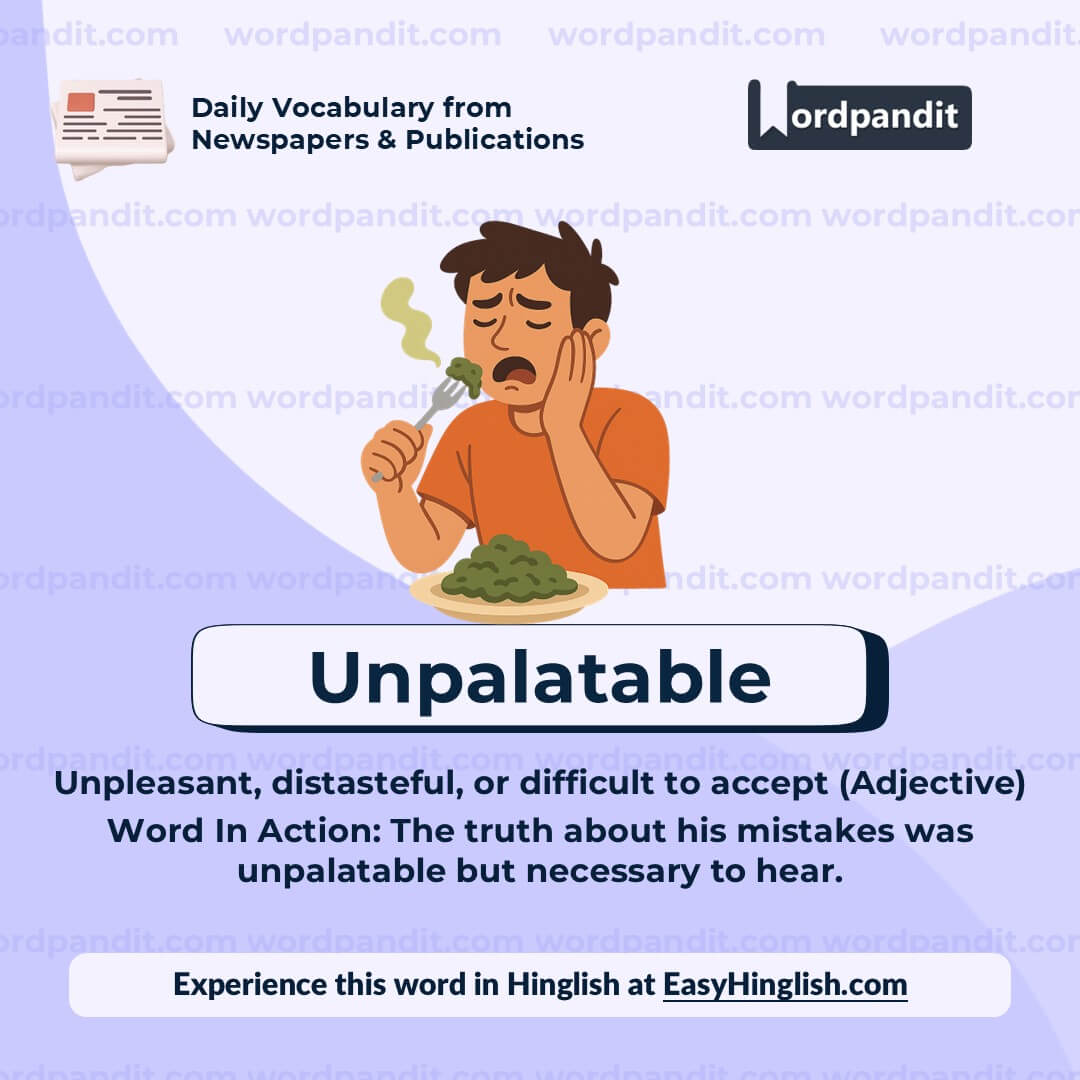
WORD-5: Unpalatable
Context:
"As unpalatable as a second Trump term would be, many pundits who tackle this question have ignored a striking fact." - New York Times
Explanatory Paragraph:
The word "unpalatable" literally describes food or drink that is unpleasant to taste. Figuratively, it is often used to describe truths, facts, or ideas that are difficult to accept. In the provided sentence, the idea of another Trump presidency is described as "unpalatable," meaning it is highly undesirable or hard to digest emotionally or politically.
Meaning: Unpleasant, distasteful, or difficult to accept (Adjective)
Pronunciation: un-PAL-uh-tuh-bul
Difficulty Level: ⭐⭐⭐ Intermediate
Etymology: From Latin palatum ("palate," referring to the roof of the mouth or sense of taste). Adding the prefix "un-" creates the opposite meaning: "not suitable for the palate," extending from taste to broader life situations.
Prashant Sir's Notes:
Remember that in advanced writing, "unpalatable" is rarely about food. It is a metaphor for truths, policies, or realities that are mentally or emotionally hard to "digest."
Synonyms & Antonyms:
Synonyms: distasteful, unpleasant, disagreeable, intolerable, unacceptable
Antonyms: palatable, pleasant, agreeable, tolerable, acceptable
Usage Examples:
- The unpalatable soup was left untouched by most of the guests. (literal)
- She had to face the unpalatable truth that her plan had failed. (figurative)
- The unpalatable reality of job cuts shook the entire office. (figurative)
- For many voters, both candidates represented unpalatable options. (figurative)
Cultural Reference:
The phrase "unpalatable truths" is common in journalism and literature, where writers use the metaphor of unpleasant taste to describe social or political realities that people find hard to accept.
Think About It:
Why do writers often compare hard-to-accept truths with bitter or unpalatable food? What does this metaphor suggest about how we experience information emotionally?
Quick Activity:
Create two sentences: (1) using "unpalatable" for an actual taste, (2) using it for a difficult reality.
Memory Tip:
Associate "unpalatable" with "palate" (taste). If your palate rejects something, it is "unpalatable"—whether that’s bitter food or a bitter truth.
Real-World Application:
In politics, business, and daily life, "unpalatable" is often used to describe unpleasant but unavoidable realities, such as budget cuts, election results, or controversial decisions.


