

Daily Vocabulary from Indian Newspapers and Publications
Welcome to Wordpandit’s Indian Vocabulary Hub
At Wordpandit, we understand the importance of staying rooted in the local context while expanding your language skills. This section focuses on enriching your vocabulary with words and phrases drawn from India’s leading newspapers and publications, ensuring you're learning vocabulary that is practical, relevant, and uniquely Indian.
Why Indian Sources Matter
We believe that the best way to master any language is by immersing yourself in local content. That’s why we carefully curate vocabulary from top Indian publications, including:
- The Hindu
- The Times of India
- The Economic Times
- Hindustan Times
- Live Mint
- The Indian Express
- And many others...
Stay Updated, Stay Relevant
With daily updates from Indian news sources, you’ll be consistently learning words that reflect the trends and shifts in Indian society and culture. Our focus is to provide vocabulary that enhances your understanding of the language in an Indian context.
How Wordpandit Supports Your Goals
Whether you’re preparing for exams, aiming to improve your professional communication, or simply want to stay connected with the latest Indian vocabulary, Wordpandit is here to guide you every step of the way.
Learn with a Practical Approach
Our interactive learning methodology includes real-world examples, engaging activities, and context-specific usage to ensure that every word becomes part of your active vocabulary.
Dive into Indian Vocabulary Today!

Why Choose Wordpandit?
Practical Learning: Focus on words you'll actually encounter in real-world reading, enhancing your comprehension and communication skills.
Diverse Content: From current affairs to scientific breakthroughs, our varied sources expose you to vocabulary across multiple domains.
Effortless Integration: Make Wordpandit a part of your daily routine. Just a few minutes each day can significantly boost your lexicon over time.
Your Path to Vocabulary Mastery
- Visit our Daily Vocabulary section regularly
- Explore new words and their usage in context
- Practice incorporating these words into your own writing and speech
- Track your progress as your vocabulary expands
Start Your Journey Today
Embark on your vocabulary enhancement journey with Wordpandit. By consistently engaging with our daily posts, you'll build a robust vocabulary that serves you well in academic, professional, and personal contexts.
Remember, a word a day keeps linguistic limitations at bay. Make Wordpandit your daily companion in the quest for vocabulary excellence!
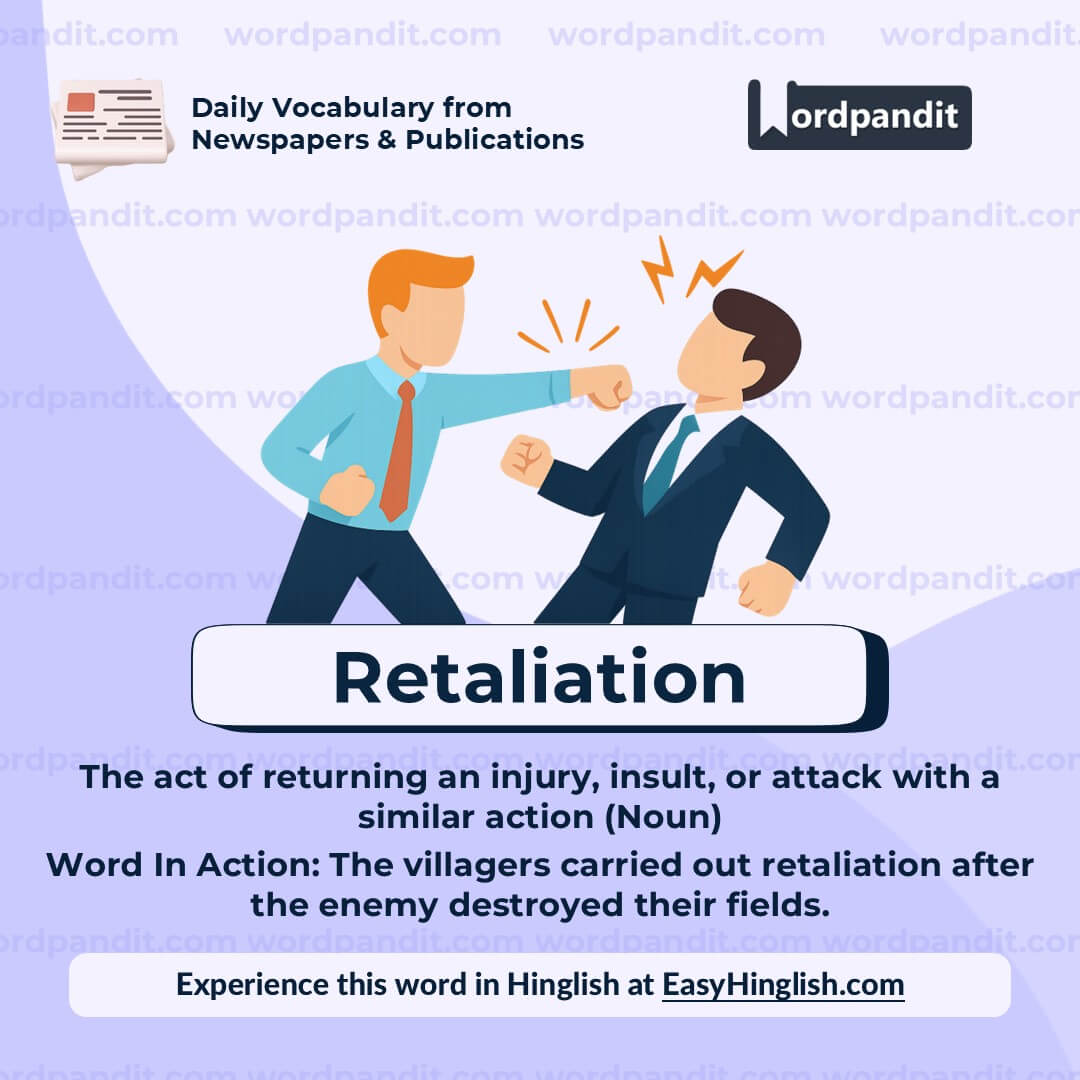
WORD-1: Retaliation
Context:
"India, which got off relatively lightly with a 26% Trump tariff on Wednesday, was looking at $8-10bn in lost export earnings over six months. But China’s strong retaliation has increased uncertainty to a different level." – The Times of India
Explanatory Paragraph:
The word retaliation refers to an action taken in response to a perceived harm, injury, or injustice, often with the intention of getting back at the other party. It conveys the idea of striking back or returning a similar kind of action, usually negative, to balance or punish the original offense. In politics, business, or personal disputes, retaliation is a way of showing resistance or sending a strong message.
Meaning: The act of returning an injury, insult, or attack with a similar action (Noun)
Pronunciation: reh-tal-ee-AY-shun
Difficulty Level: ⭐⭐⭐ Intermediate
Etymology: Derived from the Latin word retaliare meaning “to pay back in kind,” with roots in talis meaning “such” or “of that kind.”
Prashant Sir's Notes:
Think of retaliation as the “boomerang effect” — when one action provokes an equal and opposite response. It helps to connect this to international trade wars, sports rivalries, or even personal arguments.
Synonyms & Antonyms:
Synonyms: revenge, reprisal, payback, counterattack, retribution
Antonyms: forgiveness, pardon, mercy, reconciliation
Usage Examples:
- The company announced its retaliation by filing a lawsuit against its rival.
- His retaliation to the criticism was both sharp and immediate.
- The army prepared for retaliation after the unexpected attack on their base.
- Retaliation rarely leads to peace; it often creates a cycle of conflict.
Cultural Reference:
"An eye for an eye will leave the whole world blind" — a quote often attributed to Mahatma Gandhi, highlighting the futility of endless retaliation.
Think About It:
Do you think retaliation strengthens one’s position, or does it trap both parties in a cycle of conflict?
Quick Activity:
Write two sentences: one where retaliation is used in an international context (like trade wars), and another where it is used in a personal relationship context.
Memory Tip:
Break the word into “re-” (again) + “taliate” (from Latin ‘talio’ meaning punishment in kind). Think of it as “punishment again” — an act of hitting back.
Real-World Application:
Retaliation is often discussed in global politics, especially in trade disputes, military strategies, and diplomatic standoffs. It’s also commonly seen in workplace conflicts and competitive industries where one action prompts a counteraction.
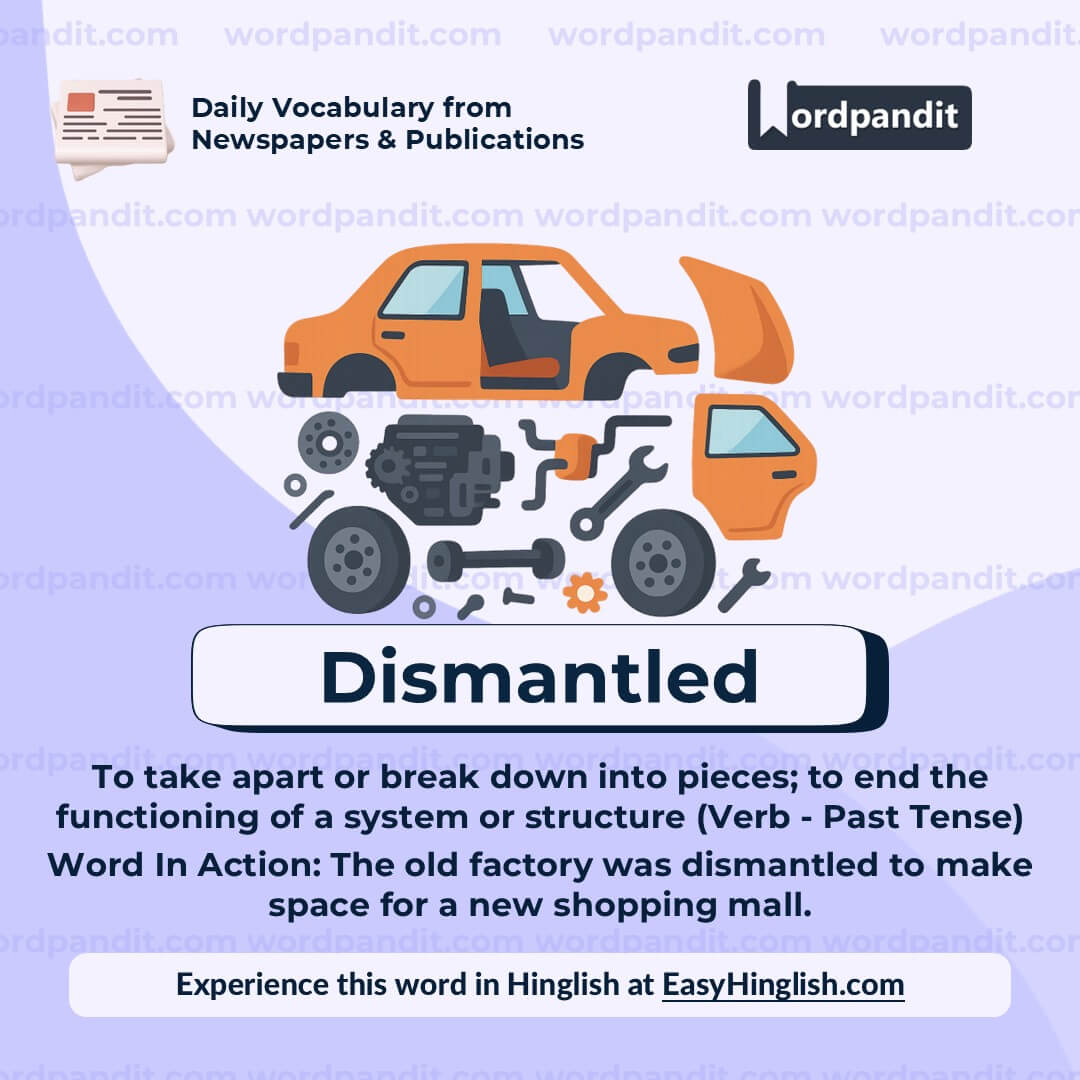
WORD-2: Dismantled
Context:
"On August 15, Nixon stunned the world by announcing the “temporary suspension” of the U.S. dollar’s convertibility into gold. This effectively dismantled the Bretton Woods framework that was worked out quite unilaterally in 1944, which led to the setting up of the World Bank and the International Monetary Fund." - The Hindu
Explanatory Paragraph:
The word dismantled means to take something apart, remove its important parts, or break down a structure, system, or organization so that it no longer functions as it originally did. While it can be used literally (like dismantling a machine), it is often used metaphorically in contexts such as laws, institutions, or agreements being broken down or rendered ineffective.
Meaning: To take apart or break down into pieces; to end the functioning of a system or structure (Verb - Past Tense)
Pronunciation: dis-MAN-tuhld
Difficulty Level: ⭐⭐ Basic to Intermediate
Etymology: From Old French desmanteler meaning "to tear down," derived from des- (reverse) + manteler (to cloak, cover). Originally, it meant "to strip the cloak or defense" of a fortress.
Prashant Sir's Notes:
Link dismantled with “taking apart layer by layer.” Imagine removing the pieces of a Lego structure until nothing remains. In politics and economics, it refers to breaking down agreements, laws, or systems.
Synonyms & Antonyms:
Synonyms: demolish, disassemble, break down, destroy, abolish
Antonyms: assemble, construct, establish, build, reinforce
Usage Examples:
- The government dismantled outdated policies to make way for reform.
- Workers dismantled the old factory machinery to replace it with modern equipment.
- The peace agreement dismantled decades of hostility between the two nations.
- His argument dismantled the opposition’s claims point by point.
Cultural Reference:
After the fall of the Berlin Wall in 1989, many Eastern European communist structures—both physical and political—were dismantled, symbolizing the collapse of authoritarian regimes.
Think About It:
Is dismantling an old system always necessary for progress, or can reform within the system achieve the same goals?
Quick Activity:
Think of one real-life example (school, workplace, politics, or history) where something was dismantled. Write a short sentence using the word to describe that event.
Memory Tip:
Think of “dis-” (reverse) + “mantle” (cover or cloak). To dismantle is to “uncover by taking apart” — like stripping a machine of its parts.
Real-World Application:
The word dismantled is often used in news, politics, and history to describe the breaking down of policies, trade agreements, or systems, such as dismantling colonial rule, dismantling discriminatory laws, or dismantling nuclear weapons programs.
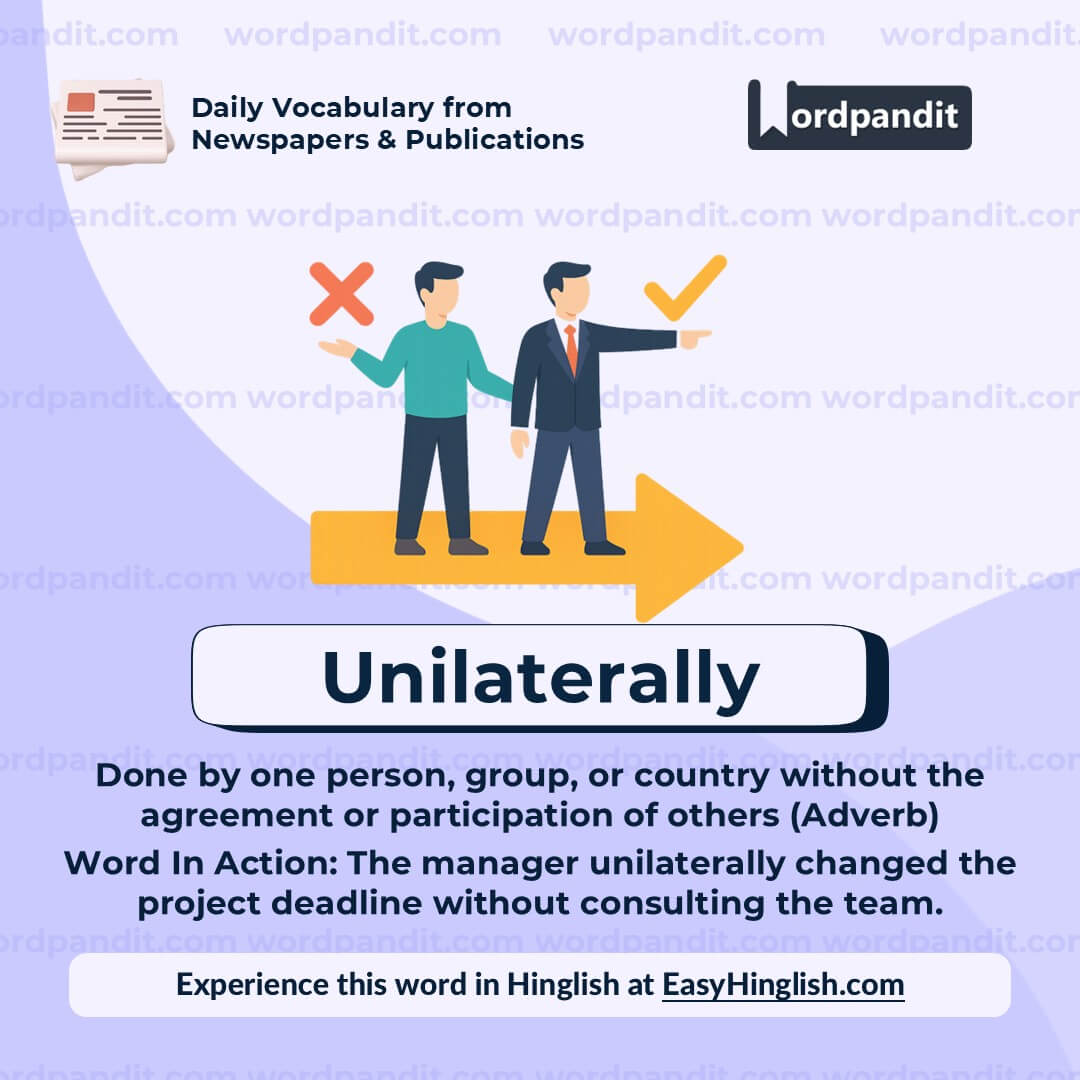
WORD-3: Unilaterally
Context:
"On August 15, Nixon stunned the world by announcing the “temporary suspension” of the U.S. dollar’s convertibility into gold. This effectively dismantled the Bretton Woods framework that was worked out quite unilaterally in 1944, which led to the setting up of the World Bank and the International Monetary Fund." - The Hindu
Explanatory Paragraph:
The word unilaterally means doing something independently, without consulting or seeking approval from others. It is often used when one party makes a decision or takes action without agreement, cooperation, or participation from the other side. In international relations, politics, and law, the term is frequently associated with decisions made by a single government or authority without negotiation or partnership.
Meaning: Done by one person, group, or country without the agreement or participation of others (Adverb)
Pronunciation: yoo-nih-LAT-uh-ruh-lee
Difficulty Level: ⭐⭐⭐ Intermediate
Etymology: From Latin uni- meaning “one” and latus meaning “side.” The idea is “one-sided action.”
Prashant Sir's Notes:
Think of unilateral decisions as “one-sided decisions.” If two friends are supposed to plan a trip, but one books tickets without consulting the other, that’s acting unilaterally. It highlights lack of collaboration.
Synonyms & Antonyms:
Synonyms: independently, one-sidedly, autonomously, solely
Antonyms: bilaterally, multilaterally, jointly, cooperatively
Usage Examples:
- The company unilaterally changed the contract terms without informing its employees.
- The country decided to act unilaterally, imposing sanctions without consulting its allies.
- Parents shouldn’t unilaterally impose rules without discussing them with their children.
- The manager unilaterally approved the plan, leaving the rest of the team frustrated.
Cultural Reference:
In global politics, the U.S. invasion of Iraq in 2003 is often criticized as a unilateral action, since it was carried out without broad international support from the United Nations.
Think About It:
When is it acceptable to act unilaterally, and when should collaboration or consensus be mandatory?
Quick Activity:
Write two short sentences using the word unilaterally: one in a personal context (family/friends) and one in a political context.
Memory Tip:
Break the word into uni (one) + lateral (side) → “one-sided.” Remember it as “only one side acting.”
Real-World Application:
Unilaterally is a key term in international diplomacy, trade negotiations, and workplace policies. It is used to describe when one party makes a move without consultation, often creating disputes or imbalances.

WORD-4: Pinnacle
Context:
"Effective communication, it is widely believed, is among the most efficient tools in resolving human conflict. It takes people years of trial and error, maybe a therapist or two, to perfect the art. Yet, human beings have long held the arrogant belief that they are the pinnacle of evolution. Turns out, their close evolutionary cousins, bonobos, are also capable of complex meaning-making, previously thought of as a uniquely human ability." - The Indian Express
Explanatory Paragraph:
The word pinnacle refers to the highest point or the peak of something, whether literally, like the top of a mountain, or figuratively, like the peak of success, achievement, or development. It symbolizes the ultimate level that can be reached, often after a long journey or struggle. In the given context, it highlights the human belief of being the topmost product of evolution.
Meaning: The highest point of achievement, development, or success; a peak (Noun)
Pronunciation: PIN-uh-kul
Difficulty Level: ⭐⭐ Basic to Intermediate
Etymology: From Latin pinnaculum meaning "small wing, gable," later evolving to mean "peak or summit" in Old French before entering English in the 14th century.
Prashant Sir's Notes:
Think of “pinnacle” as the tip of a mountain. It is often used metaphorically to describe the highest point in someone’s career, life, or even human history. Visualizing a mountain peak helps fix the word in memory.
Synonyms & Antonyms:
Synonyms: peak, summit, apex, climax, acme, zenith
Antonyms: base, bottom, nadir, low point
Usage Examples:
- Winning the Nobel Prize was the pinnacle of her career.
- The mountain climbers finally reached the pinnacle after days of struggle.
- The company’s success in global markets marked the pinnacle of its growth story.
- He mistakenly believed his wealth was the pinnacle of happiness.
Cultural Reference:
The phrase "pinnacle of success" is often used in award ceremonies, such as the Oscars or Nobel Prizes, to highlight the highest honor or recognition in a particular field.
Think About It:
Do you think there is truly a "pinnacle" of human achievement, or is progress a never-ending journey with no final peak?
Quick Activity:
Fill in the blank: “Graduating from college was the ______ of her life so far.”
Memory Tip:
Associate “pinnacle” with “pin” — like the sharp top of a pin, representing the highest point.
Real-World Application:
Pinnacle is commonly used in motivational speeches, business presentations, and sports commentary to describe reaching the ultimate level of success or performance.
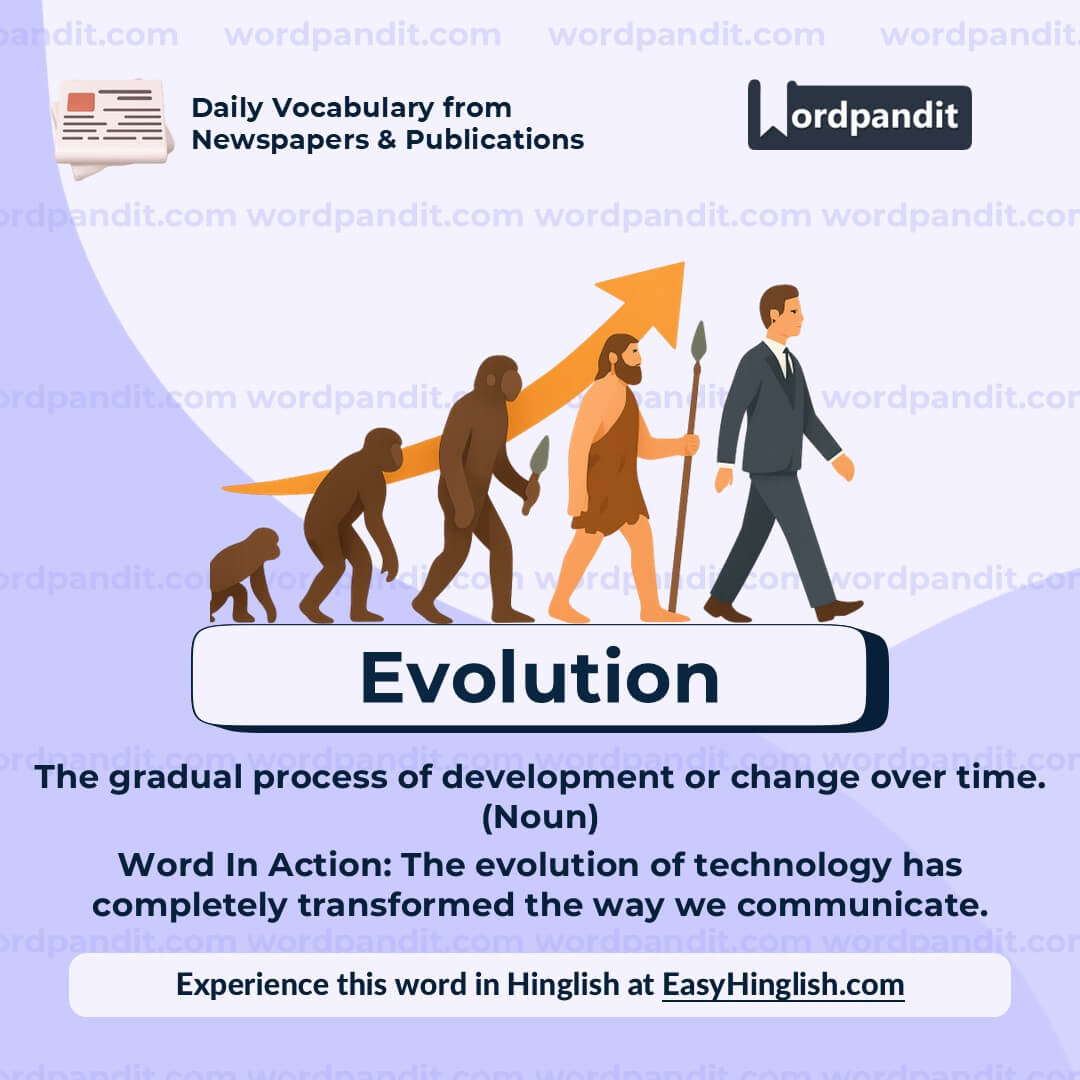
WORD-5: Evolution
Context:
"Effective communication, it is widely believed, is among the most efficient tools in resolving human conflict. It takes people years of trial and error, maybe a therapist or two, to perfect the art. Yet, human beings have long held the arrogant belief that they are the pinnacle of evolution. Turns out, their close evolutionary cousins, bonobos, are also capable of complex meaning-making, previously thought of as a uniquely human ability." - The Indian Express
Explanatory Paragraph:
The word evolution refers to a gradual process of development and change over time. In biology, it specifically means the way living species adapt and transform across generations, often leading to new forms of life. Beyond science, evolution is also used in general contexts to describe progress or transformation, such as the evolution of technology, ideas, or culture.
Meaning: The gradual process of development or change over time. (Noun)
Pronunciation: eh-vuh-LOO-shun / ee-vuh-LOO-shun
Difficulty Level: ⭐⭐⭐ Intermediate
Etymology: From Latin evolutio meaning "unrolling, unfolding," based on evolvere ("to roll out"). Originally used in the sense of "unfolding of events," it later gained its scientific meaning in biology in the 19th century.
Prashant Sir's Notes:
Evolution is about change with time. Remember Darwin’s theory of evolution in biology. But also think of personal growth — like how your skills evolve over years of practice.
Synonyms & Antonyms:
Synonyms: development, growth, progress, transformation, advancement
Antonyms: regression, decline, stagnation, deterioration
Usage Examples:
- The evolution of smartphones has changed the way people live and work.
- Darwin’s theory of evolution revolutionized the scientific understanding of life.
- Her personal evolution from a shy student to a confident speaker was inspiring.
- The evolution of democracy has been shaped by centuries of struggle and reform.
Cultural Reference:
Charles Darwin’s book On the Origin of Species (1859) is a landmark in human history, introducing the theory of natural selection as the driving force of evolution.
Think About It:
Do you think human cultural and technological evolution is happening faster than our biological evolution? What might be the consequences?
Quick Activity:
Write one sentence each about the evolution of: (a) technology, (b) your personal skills, and (c) human society.
Memory Tip:
Think of “evolution” as something “unfolding” or “rolling out” slowly over time — like a story being revealed chapter by chapter.
Real-World Application:
The concept of evolution is central not only in biology but also in history, business, and technology. It explains how ideas, systems, and even personal habits change and improve over time.


