

Daily Vocabulary from International Newspapers and Publications
Expand Your Vocabulary with Wordpandit’s Global Vocabulary Hub
At Wordpandit, we are committed to helping you develop a truly global vocabulary by drawing from some of the most respected international publications. This section is designed to keep you ahead of the curve by introducing you to words that define global conversations and trends.
The Power of Global Sources
To help you think and communicate on a global scale, we curate vocabulary from renowned international sources, such as:
- The New York Times
- The Washington Post
- BBC
- The Guardian
- The Economist
- Scientific American
- Psychology Today
- And many more...
Stay Global, Stay Competitive
Our daily updates from international publications ensure you are consistently exposed to new words that reflect global news and developments, making sure your vocabulary is not only current but also globally relevant.
Enhance Your Global Perspective
Whether you’re preparing for international exams, aiming to excel in global business communication, or want to enhance your language skills for personal growth, Wordpandit offers the resources you need to thrive in a global context.
Effective Learning, Global Reach
Our learning methodology combines global examples, memory aids, and interactive activities, allowing you to internalize new words effectively and apply them in real-world scenarios.
Begin Your Global Vocabulary Journey Now!

Why Choose Wordpandit?
Practical Learning: Focus on words you'll actually encounter in real-world reading, enhancing your comprehension and communication skills.
Diverse Content: From current affairs to scientific breakthroughs, our varied sources expose you to vocabulary across multiple domains.
Effortless Integration: Make Wordpandit a part of your daily routine. Just a few minutes each day can significantly boost your lexicon over time.
Your Path to Vocabulary Mastery
- Visit our Daily Vocabulary section regularly
- Explore new words and their usage in context
- Practice incorporating these words into your own writing and speech
- Track your progress as your vocabulary expands
Start Your Journey Today
Embark on your vocabulary enhancement journey with Wordpandit. By consistently engaging with our daily posts, you'll build a robust vocabulary that serves you well in academic, professional, and personal contexts.
Remember, a word a day keeps linguistic limitations at bay. Make Wordpandit your daily companion in the quest for vocabulary excellence!
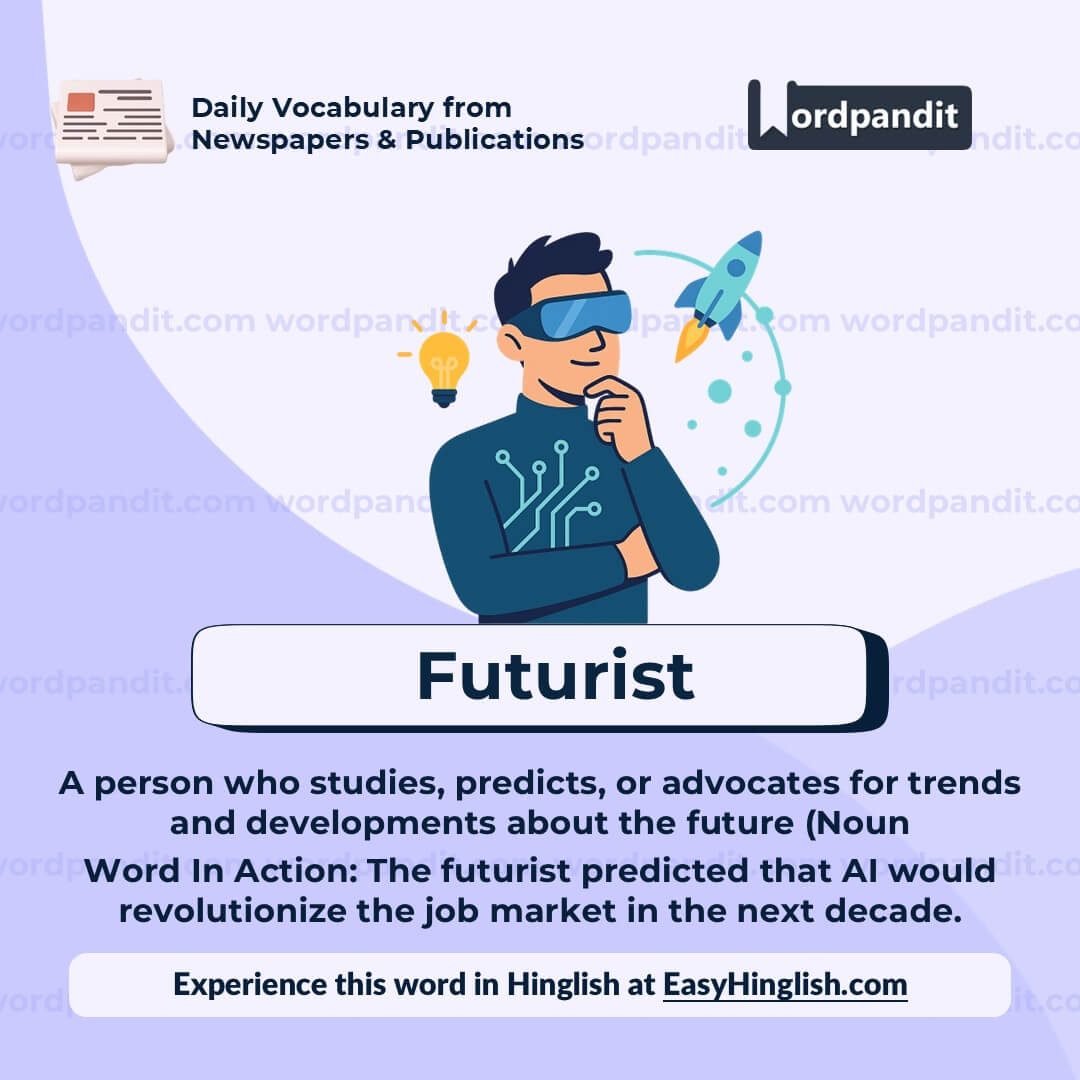
WORD-1: Futurist
Context:
"Mr. Musk has long presented himself to the world as a futurist. Yet, notwithstanding the gadgets — the rockets and the robots and the Department of Government Efficiency Musketeers, carrying backpacks crammed with laptops, dreaming of replacing federal employees with large language models — few figures in public life are more shackled to the past." - The New York Times
Explanatory Paragraph:
A futurist is someone who studies, predicts, or envisions possibilities about the future, especially in technology, society, or culture. Futurists often focus on trends, innovations, and potential scenarios that could shape the world ahead. The term can also refer to people who actively design or promote futuristic ideas and solutions.
Meaning: A person who studies, predicts, or advocates for trends and developments about the future (Noun)
Pronunciation: FYOO-chuh-rist
Difficulty Level: ⭐⭐ (Basic-Intermediate)
Etymology: From "future" + suffix "-ist," first popularized in the early 20th century, influenced by the Italian artistic and social movement "Futurism."
Prashant Sir's Notes:
The word is easy to connect with because of its root “future.” A futurist is someone who is forward-looking, but context matters: it can be used for dreamers, visionaries, or even exaggerators who sell unrealistic futures.
Synonyms & Antonyms:
Synonyms: visionary, innovator, dreamer, predictor, forward-thinker
Antonyms: traditionalist, conservative, historian, realist
Usage Examples:
- The conference invited a well-known futurist to speak about the impact of artificial intelligence on jobs.
- Her futurist ideas about cities powered entirely by renewable energy inspired young engineers.
- Some critics dismiss him as more of a marketer than a true futurist.
- The futurist movement in art rejected tradition and embraced speed, technology, and change.
Cultural Reference:
"The Italian Futurist movement of the early 20th century celebrated technology, speed, and modernity, influencing both art and politics." - Encyclopedia of Modern Art
Think About It:
Do you think being a futurist requires scientific accuracy, or is it more about inspiring people with bold visions?
Quick Activity:
Write down one idea about the world in 2050. Share whether your prediction makes you more of a realist or a futurist.
Memory Tip:
Connect “futurist” with “future.” Just as a pianist plays the piano, a futurist “plays with” or works on the future.
Real-World Application:
Futurists are often hired by governments, tech companies, and think tanks to analyze trends and help prepare for challenges such as automation, climate change, and population growth.
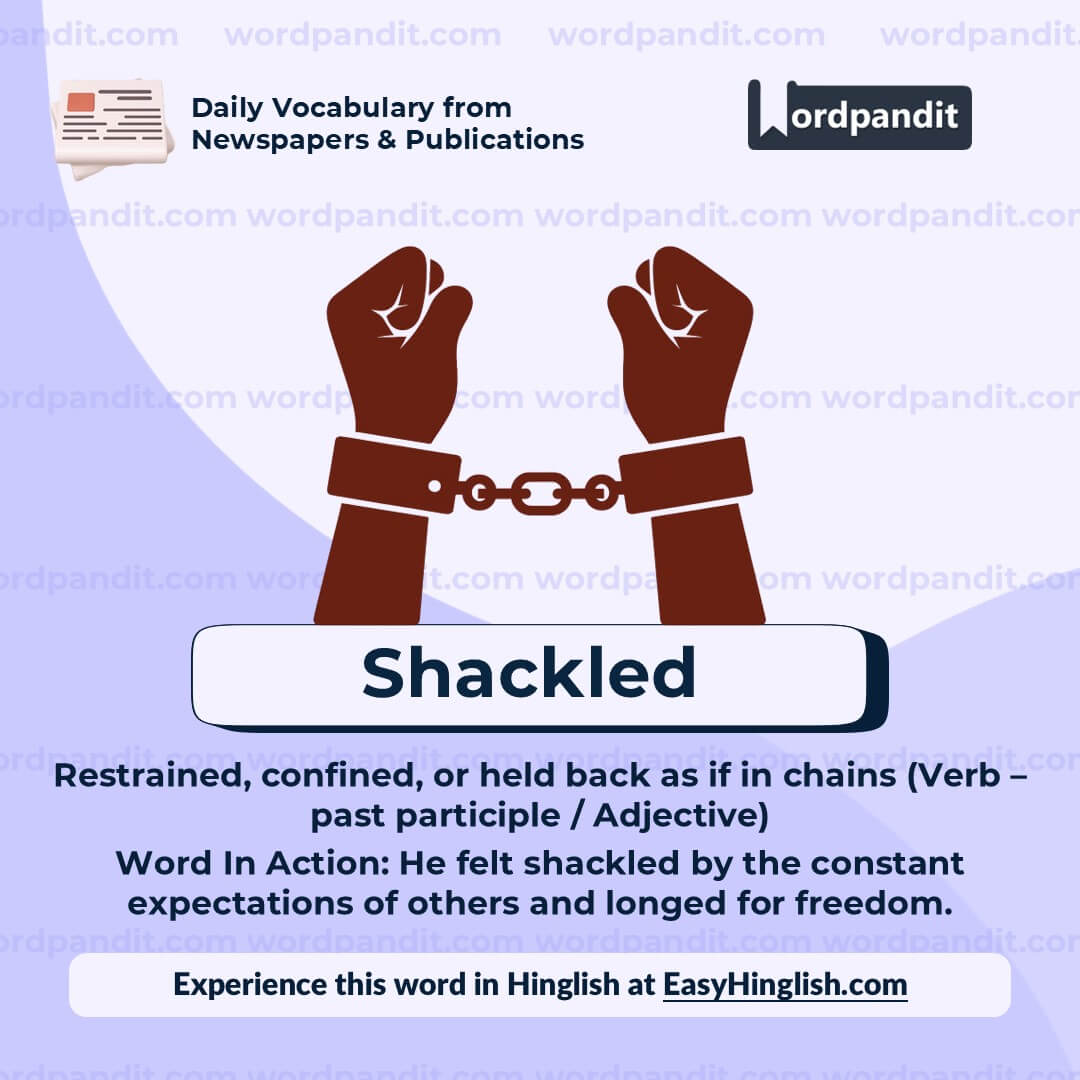
WORD-2: Shackled
Context:
"Mr. Musk has long presented himself to the world as a futurist. Yet, notwithstanding the gadgets — the rockets and the robots and the Department of Government Efficiency Musketeers, carrying backpacks crammed with laptops, dreaming of replacing federal employees with large language models — few figures in public life are more shackled to the past." - The New York Times
Explanatory Paragraph:
The word shackled comes from the image of being bound by chains or restraints. Literally, it refers to being physically confined, such as prisoners in handcuffs or leg irons. Figuratively, it means being restricted, limited, or held back by something—such as traditions, fears, or old systems. In the given context, it suggests being trapped in the past despite claiming to be forward-looking.
Meaning: Restrained, confined, or held back as if in chains (Verb – past participle / Adjective)
Pronunciation: SHAK-uhld
Difficulty Level: ⭐⭐ (Basic-Intermediate)
Etymology: From Old English sceacul meaning “fetter or chain,” related to the Proto-Germanic root for “to restrain.”
Prashant Sir's Notes:
This word is powerful when used metaphorically. While literally about chains, writers often use “shackled” to describe restrictions in thinking, progress, or emotions. Remember: shackled = chained = held back.
Synonyms & Antonyms:
Synonyms: bound, chained, restrained, restricted, confined
Antonyms: free, liberated, unbound, released
Usage Examples:
- The prisoner was shackled at the wrists and ankles.
- Her creativity felt shackled by rigid corporate rules.
- Many societies remain shackled by outdated traditions.
- Technology has the power to unshackle people from monotonous tasks.
Cultural Reference:
"Shackles have historically symbolized slavery and oppression, often used in literature and film as a metaphor for lack of freedom." - Cultural History Archives
Think About It:
What do you think shackles represent more strongly in today’s world—physical control or mental and social limitations?
Quick Activity:
Write a sentence using “shackled” in a metaphorical sense (e.g., “shackled by doubt”).
Memory Tip:
Think of the word “shack” (a small hut) + “locked” → someone locked inside a shackle. This helps recall its meaning of being confined.
Real-World Application:
The term “shackled” is often used in social, political, and motivational contexts—such as being shackled by poverty, old systems, or negative thinking—making it a strong metaphor in persuasive writing and speeches.
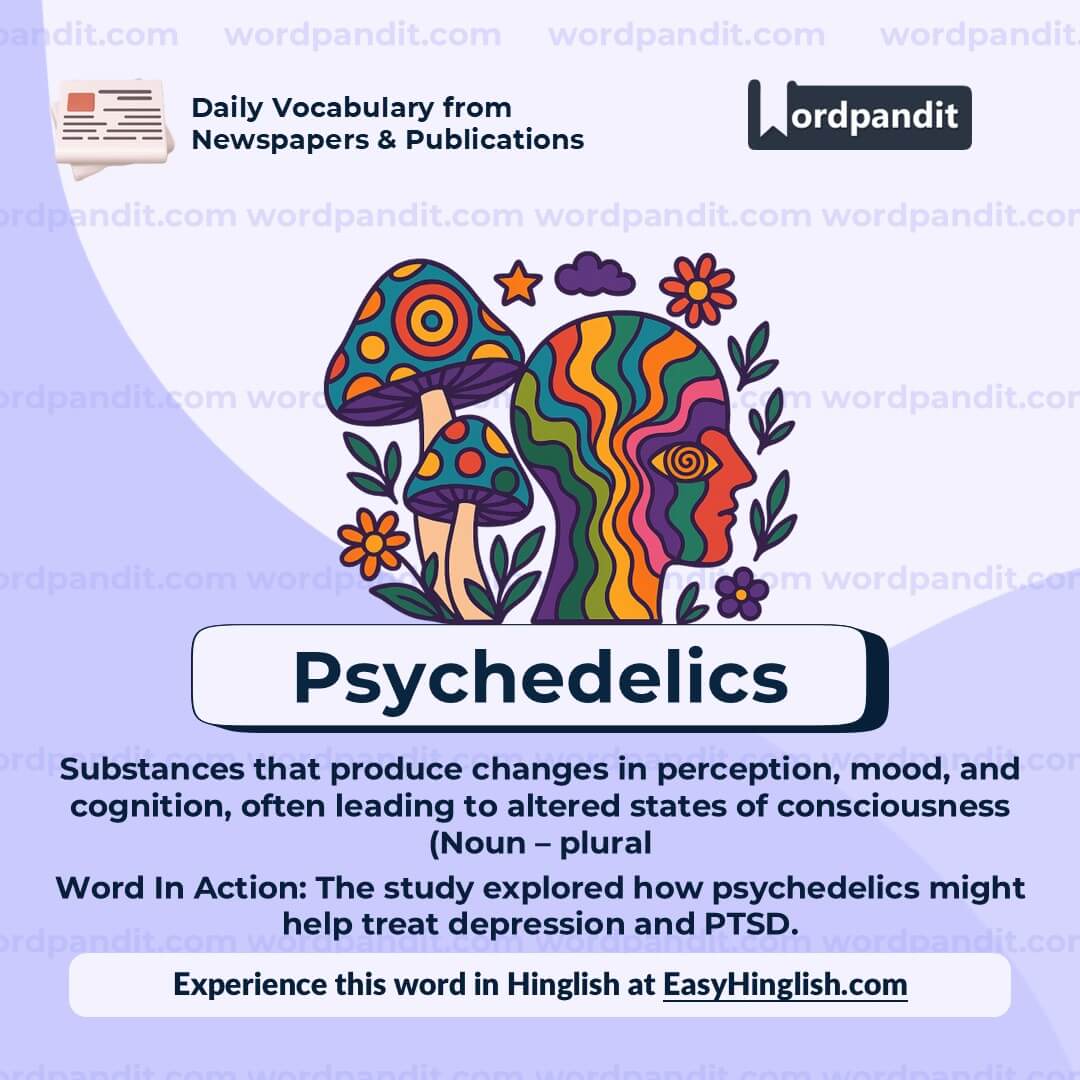
WORD-3: Psychedelics
Context:
"Psychedelics can produce awe, insight, healing, and sometimes terror. What they rarely offer is predictability. A U.S. biotech company wants to change that. Mindstate Design Labs, a Y Combinator startup, is combining machine learning with human expertise to map how psychedelic compounds shape conscious experience." - Big Think
Explanatory Paragraph:
Psychedelics are a class of substances—often drugs or natural compounds—that profoundly alter perception, mood, and thought processes. They can cause hallucinations, heightened sensory awareness, and shifts in consciousness. While once associated mainly with counterculture movements of the 1960s, psychedelics are now being researched for their potential therapeutic benefits, such as treating depression, anxiety, and PTSD.
Meaning: Substances that produce changes in perception, mood, and cognition, often leading to altered states of consciousness (Noun – plural)
Pronunciation: SAI-kuh-DEL-iks
Difficulty Level: ⭐⭐⭐ (Intermediate-Advanced)
Etymology: From Greek roots psyche (mind, soul) + delos (to manifest, reveal), coined in the 1950s to mean “mind-manifesting.”
Prashant Sir's Notes:
The word has moved from counterculture slang to scientific vocabulary. Always note the dual use: one cultural (hippie, spiritual exploration) and one medical (therapeutic research). Context decides the tone.
Synonyms & Antonyms:
Synonyms: hallucinogens, mind-altering drugs, entheogens
Antonyms: depressants, sedatives, tranquilizers
Usage Examples:
- Researchers are studying psychedelics for their potential to treat depression and PTSD.
- In the 1960s, psychedelics became symbols of rebellion and spiritual exploration.
- Some artists credit psychedelics with expanding their creative imagination.
- The effects of psychedelics vary greatly from person to person and even from one session to another.
Cultural Reference:
"The 'psychedelic era' of the 1960s, marked by colorful art, music, and social movements, was heavily influenced by the use of substances like LSD and psilocybin." - Cultural History of the 20th Century
Think About It:
Should psychedelics be embraced for their therapeutic potential, or do their risks outweigh their benefits?
Quick Activity:
List three words that come to mind when you think of the term “psychedelic.” Then, decide whether your associations are more cultural or scientific.
Memory Tip:
Break the word into “psyche” (mind) + “delic” (reveal). Psychedelics “reveal the mind.”
Real-World Application:
Psychedelics are now at the center of medical research, with clinical trials exploring their role in mental health treatments. They are also part of ongoing legal and ethical debates worldwide.
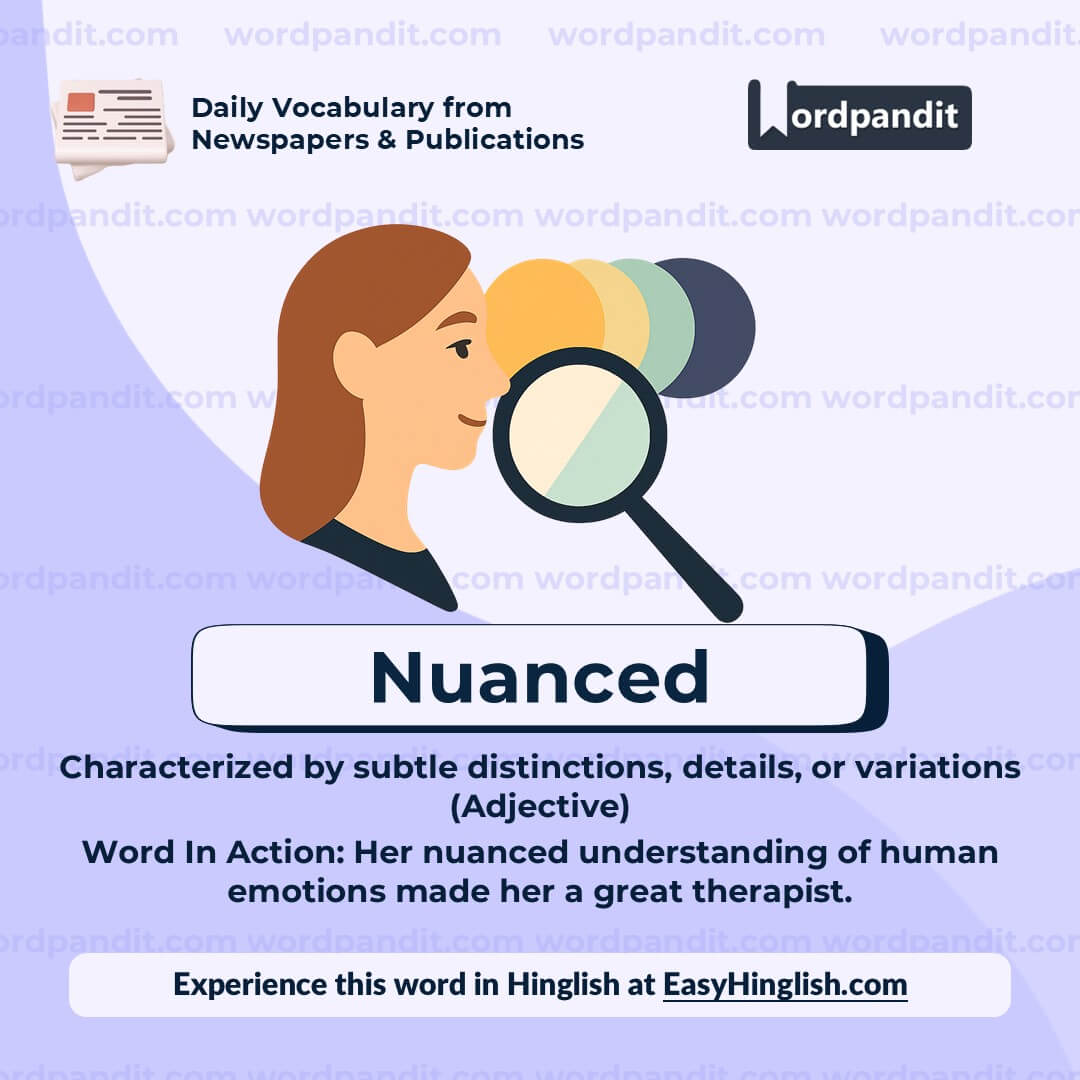
WORD-4: Nuanced
Context:
"The judgment presents a nuanced interpretation of constitutional provisions governing center-state relations." - India Legal
Explanatory Paragraph:
Nuanced describes something that is subtle, detailed, and carefully distinguished. A nuanced interpretation or argument acknowledges the fine shades of meaning rather than treating everything in simple, black-and-white terms. It shows sensitivity to complexity and avoids oversimplification.
Meaning: Characterized by subtle distinctions, details, or variations (Adjective)
Pronunciation: NOO-ahnst / NYOO-ahnst
Difficulty Level: ⭐⭐⭐ (Intermediate-Advanced)
Etymology: From French nuance meaning “a slight difference in shade or tone,” derived from Latin nubes (cloud). Adopted into English in the late 18th century.
Prashant Sir's Notes:
This is a favorite academic and journalistic word. Use it to impress—when you want to show sensitivity to fine distinctions. But be careful: calling something “nuanced” means you accept it is not simplistic, and therefore, you must also write with depth.
Synonyms & Antonyms:
Synonyms: subtle, refined, delicate, detailed, sophisticated
Antonyms: blunt, simplistic, obvious, crude
Usage Examples:
- The professor offered a nuanced analysis of the political crisis.
- Her painting captures a nuanced play of light and shadow.
- The diplomat’s nuanced words prevented escalation of the conflict.
- Good literature often provides a nuanced view of human emotions.
Cultural Reference:
"In international relations, nuanced diplomacy is often praised, as it values subtle choices over aggressive moves." - Foreign Policy Review
Think About It:
Why do you think nuanced perspectives are harder to communicate in today’s fast, social-media-driven world?
Quick Activity:
Rewrite the statement: “The film was good” in a nuanced way, adding subtle detail about what exactly made it good.
Memory Tip:
Think of “nuance” as “new-aunts” — every aunt has her own subtle, slightly different personality. Together, they represent fine shades of difference!
Real-World Application:
Nuanced thinking is crucial in law, diplomacy, academia, literature, and leadership, where oversimplification can distort truth or lead to poor decisions.
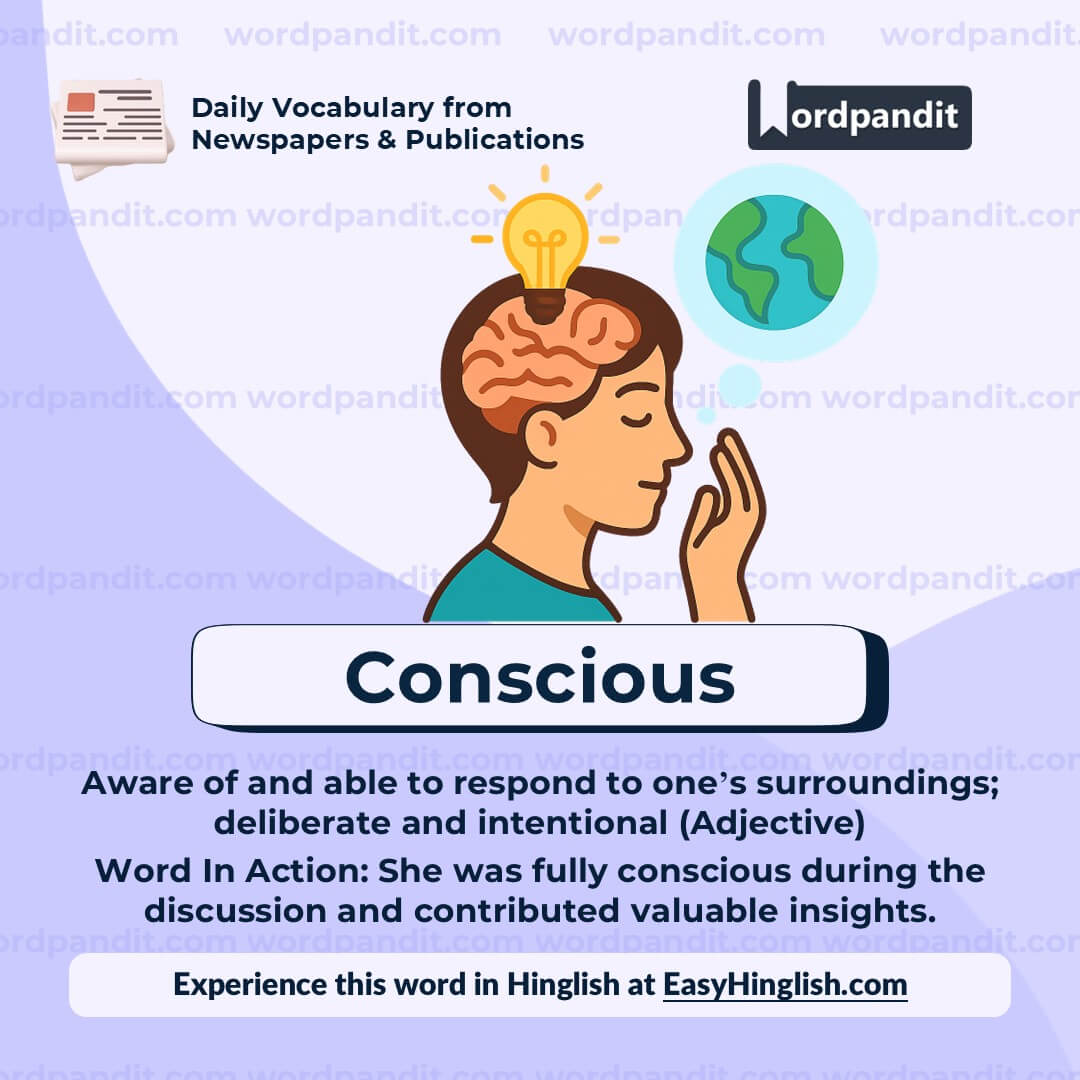
WORD-5: Conscious
Context:
"Psychedelics can produce awe, insight, healing, and sometimes terror. What they rarely offer is predictability. A U.S. biotech company wants to change that. Mindstate Design Labs, a Y Combinator startup, is combining machine learning with human expertise to map how psychedelic compounds shape conscious experience." - Big Think
Explanatory Paragraph:
Conscious refers to being aware of and responsive to one’s surroundings, thoughts, and feelings. It can describe both the state of being awake and the deliberate awareness of actions or decisions. In deeper contexts, it often relates to human consciousness — the ability to reflect, think, and experience self-awareness.
Meaning: Aware of and able to respond to one’s surroundings; deliberate and intentional (Adjective)
Pronunciation: KON-shus
Difficulty Level: ⭐⭐ (Basic-Intermediate)
Etymology: From Latin conscius meaning “knowing with others or oneself,” formed from con- (together) + scire (to know).
Prashant Sir's Notes:
Always remember, conscious = aware. Don’t confuse with “conscience” (moral sense of right and wrong). Also, “self-conscious” means overly aware of oneself, usually with nervousness.
Synonyms & Antonyms:
Synonyms: aware, mindful, alert, deliberate, intentional
Antonyms: unconscious, unaware, oblivious, careless
Usage Examples:
- She was fully conscious during the entire surgery.
- We must be conscious of how our choices affect the environment.
- He made a conscious effort to improve his public speaking skills.
- Psychedelics are said to expand conscious experience in unique ways.
Cultural Reference:
"Eastern philosophies like Buddhism have long explored conscious awareness through meditation, aiming to quiet the mind and heighten presence." - Philosophy and Mind Studies Journal
Think About It:
If artificial intelligence could become conscious, would it deserve rights similar to humans?
Quick Activity:
Write two sentences: one where “conscious” means awake/aware, and another where it means deliberate/intentional.
Memory Tip:
Break it as “con” (with) + “scious” (knowledge) → being conscious means “with knowledge” or “with awareness.”
Real-World Application:
The word is common in everyday use (e.g., “environmentally conscious”), in medicine (e.g., “patient is conscious”), and in philosophy/psychology (e.g., “states of consciousness”).


