

Daily Vocabulary from International Newspapers and Publications
Expand Your Vocabulary with Wordpandit’s Global Vocabulary Hub
At Wordpandit, we are committed to helping you develop a truly global vocabulary by drawing from some of the most respected international publications. This section is designed to keep you ahead of the curve by introducing you to words that define global conversations and trends.
The Power of Global Sources
To help you think and communicate on a global scale, we curate vocabulary from renowned international sources, such as:
- The New York Times
- The Washington Post
- BBC
- The Guardian
- The Economist
- Scientific American
- Psychology Today
- And many more...
Stay Global, Stay Competitive
Our daily updates from international publications ensure you are consistently exposed to new words that reflect global news and developments, making sure your vocabulary is not only current but also globally relevant.
Enhance Your Global Perspective
Whether you’re preparing for international exams, aiming to excel in global business communication, or want to enhance your language skills for personal growth, Wordpandit offers the resources you need to thrive in a global context.
Effective Learning, Global Reach
Our learning methodology combines global examples, memory aids, and interactive activities, allowing you to internalize new words effectively and apply them in real-world scenarios.
Begin Your Global Vocabulary Journey Now!

Why Choose Wordpandit?
Practical Learning: Focus on words you'll actually encounter in real-world reading, enhancing your comprehension and communication skills.
Diverse Content: From current affairs to scientific breakthroughs, our varied sources expose you to vocabulary across multiple domains.
Effortless Integration: Make Wordpandit a part of your daily routine. Just a few minutes each day can significantly boost your lexicon over time.
Your Path to Vocabulary Mastery
- Visit our Daily Vocabulary section regularly
- Explore new words and their usage in context
- Practice incorporating these words into your own writing and speech
- Track your progress as your vocabulary expands
Start Your Journey Today
Embark on your vocabulary enhancement journey with Wordpandit. By consistently engaging with our daily posts, you'll build a robust vocabulary that serves you well in academic, professional, and personal contexts.
Remember, a word a day keeps linguistic limitations at bay. Make Wordpandit your daily companion in the quest for vocabulary excellence!
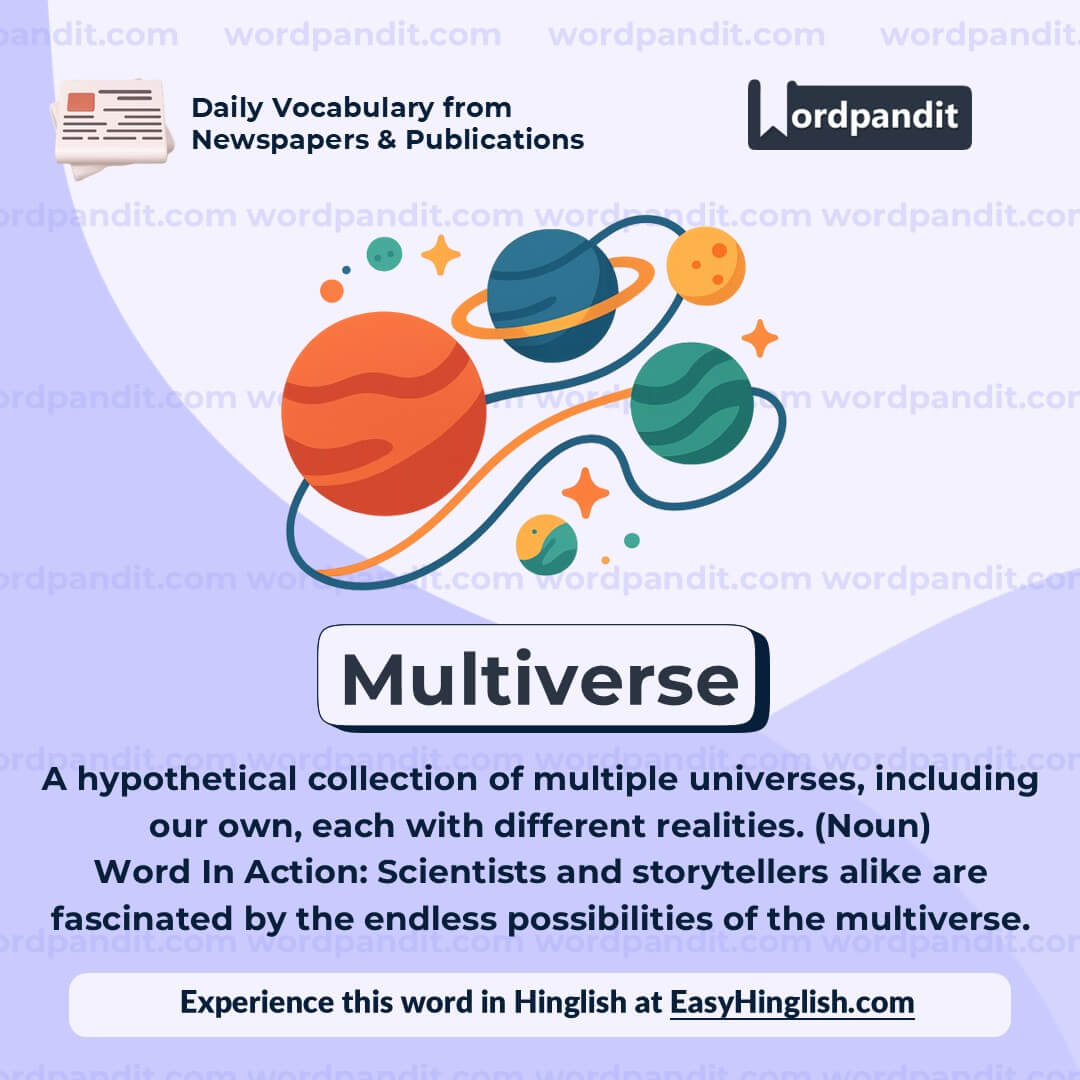
WORD-1: Multiverse
Context:
"Bring up the concept of the Multiverse, and you’re likely to get a variety of responses. Some will look to it as an idea full of hope: the hope that there’s a version of you out there that made a bolder choice, had a better outcome, or avoided a critical blunder at some point along your life path." - Big Think
Explanatory Paragraph:
The term "Multiverse" refers to the theoretical existence of multiple or even infinite universes that exist alongside our own. In this idea, each universe may have its own version of reality, differing in laws of physics, events, or personal choices. It is a concept often found in cosmology, quantum physics, and science fiction. For many, the multiverse offers a fascinating framework to imagine what might have happened if life’s choices had turned out differently — a hopeful or even philosophical lens on fate, identity, and possibility.
Meaning: A hypothetical group of multiple universes, including the one we live in. (Noun)
Pronunciation: mul-ti-verse
Difficulty Level: ⭐⭐⭐ Intermediate
Etymology: From Latin "multi-" meaning "many" and "universe" meaning "all that exists", coined in the 20th century in cosmological discussions.
Prashant Sir's Notes:
This word bridges science, philosophy, and fiction. It helps us imagine alternative outcomes and realities. An important term in both theoretical physics and storytelling.
Synonyms & Antonyms:
Synonyms: alternate realities, parallel universes, many-worlds
Antonyms: singularity, one reality, unicity
Usage Examples:
- The movie explores a multiverse where every decision creates a new timeline.
- Some physicists believe the multiverse theory could explain quantum inconsistencies.
- In the multiverse of her imagination, she was a rock star, an astronaut, and a queen.
- Writers love the multiverse concept for creating stories with infinite possibilities.
Cultural Reference:
"In Marvel’s cinematic universe, the multiverse is a recurring theme, allowing different versions of characters and timelines to coexist." - Marvel Studios
Think About It:
If the multiverse exists, how would it change the way we perceive our decisions and responsibilities?
Quick Activity:
Write a short paragraph imagining a version of yourself in an alternate universe. What one key decision changed, and how did it affect your life?
Memory Tip:
Break it down: "Multi" (many) + "verse" (universe) = Multiverse — many universes!
Real-World Application:
In physics, the multiverse theory is studied in the context of cosmology and quantum mechanics. In entertainment, it is widely used in movies, books, and games to explore alternate timelines and character developments.
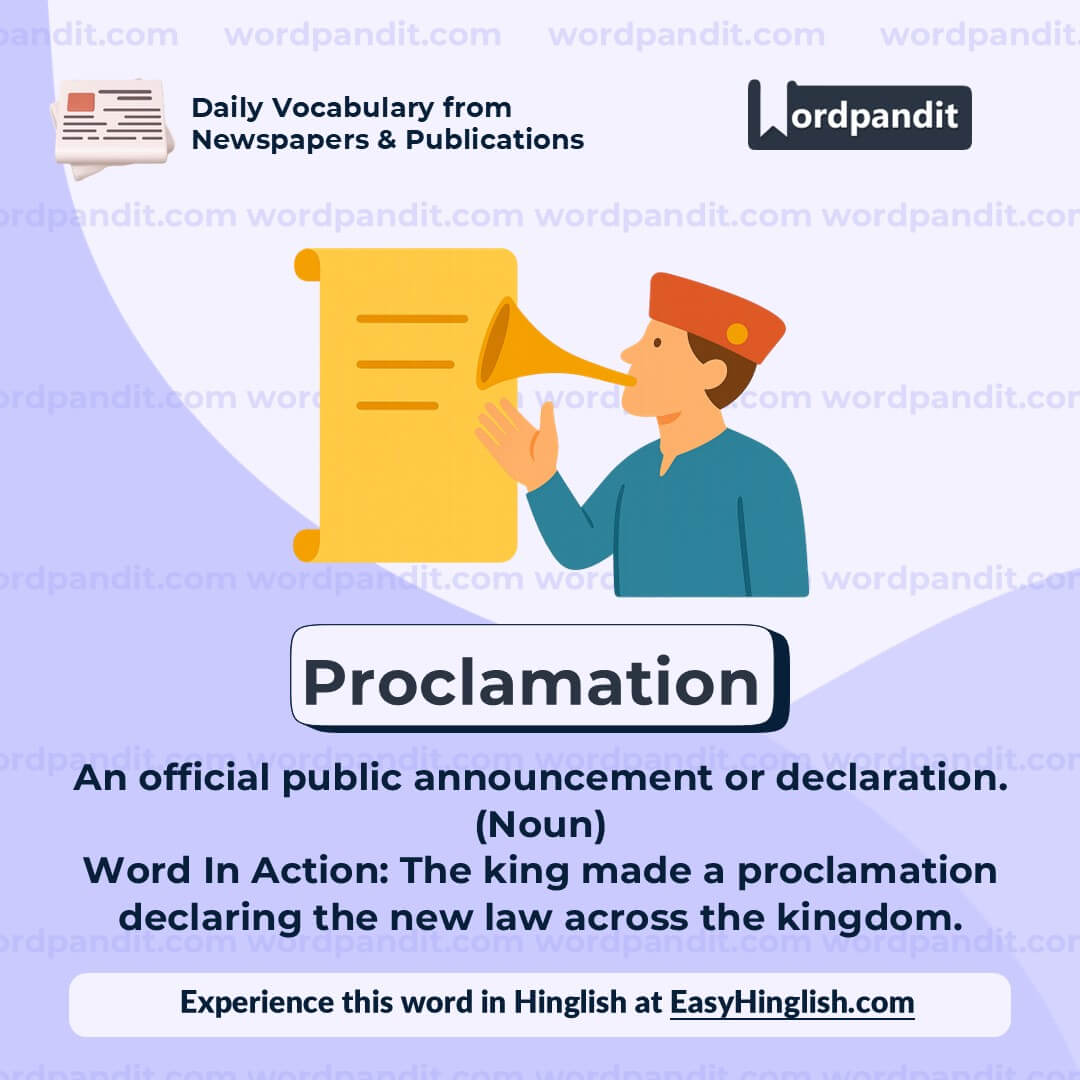
WORD-2: Proclamation
Context:
"Given the head-spinning pace of President Trump’s proclamations and executive orders, it is not surprising that yesterday’s shock is continually being buried under today’s awe. Take Ukraine, for example. Even before coming back to the White House, Trump said he wanted a quick end to the war, starting with a 30-day cease-fire." - The New York Times
Explanatory Paragraph:
A proclamation is a formal public announcement or declaration, often made by someone in authority, like a government official or leader. It is typically used to make laws known, mark important events, or communicate major decisions. Proclamations carry a tone of importance and formality and are meant to inform the public about actions or intentions. In modern usage, especially in political contexts, proclamations often refer to presidential or governmental orders.
Meaning: A formal public statement or official announcement. (Noun)
Pronunciation: pro-kluh-may-shun
Difficulty Level: ⭐⭐ Beginner
Etymology: From Latin "proclamare," meaning "to cry out publicly"; "pro-" (forth) + "clamare" (to shout).
Prashant Sir's Notes:
Think of a proclamation as a loudspeaker from the top – it's how leaders declare decisions. It's more official and formal than just making a statement. Common in legal, political, and ceremonial contexts.
Synonyms & Antonyms:
Synonyms: declaration, announcement, decree, statement, edict
Antonyms: silence, retraction, denial
Usage Examples:
- The president issued a proclamation declaring a state of emergency.
- The king’s proclamation was read aloud in every town square.
- In a public proclamation, the mayor announced new climate policies.
- The holiday was made official through a government proclamation.
Cultural Reference:
"The Emancipation Proclamation, issued by Abraham Lincoln in 1863, declared all slaves in Confederate states to be free." - U.S. National Archives
Think About It:
How does the tone of a proclamation differ from a regular announcement, and why might that matter in politics or history?
Quick Activity:
Write your own proclamation about a cause or idea you believe in. Begin with: “I hereby proclaim...”
Memory Tip:
“Proclamation” has “claim” in it—think of someone boldly claiming something publicly and officially.
Real-World Application:
Proclamations are used by governments to communicate laws, holidays, and national events. They're also used in international diplomacy and public relations to signal official positions.
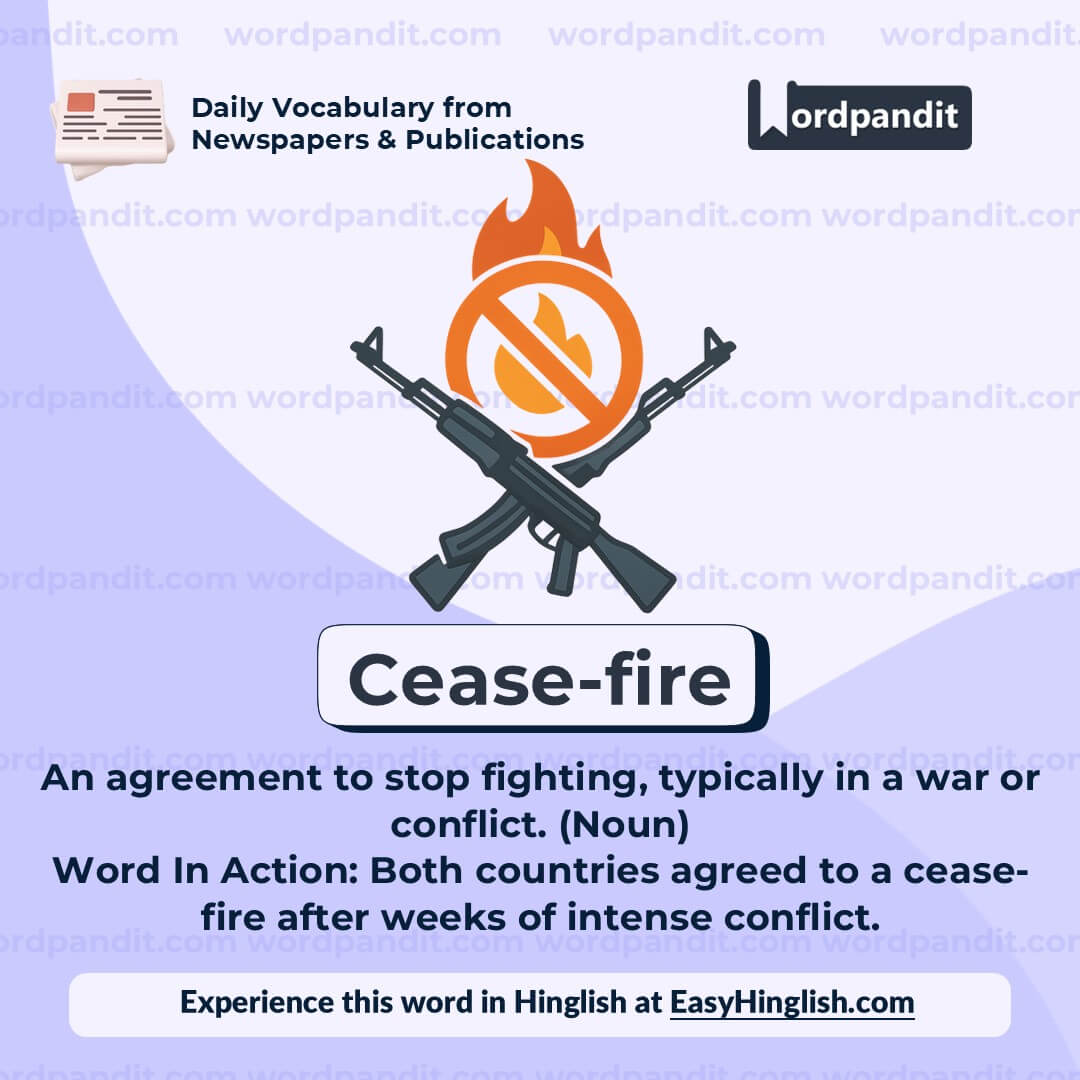
WORD-3: Cease-fire
Context:
"Given the head-spinning pace of President Trump’s proclamations and executive orders, it is not surprising that yesterday’s shock is continually being buried under today’s awe. Take Ukraine, for example. Even before coming back to the White House, Trump said he wanted a quick end to the war, starting with a 30-day cease-fire." - The New York Times
Explanatory Paragraph:
A cease-fire is a temporary agreement between warring parties to stop fighting. It is often proposed to allow for peace talks, humanitarian aid, or simply to pause violence for a specific time. While not a permanent peace treaty, a cease-fire is an essential first step toward resolution in many conflicts. It can be fragile, and violations are unfortunately common, but it still plays a vital role in de-escalating violence and creating space for diplomacy.
Meaning: A temporary suspension of fighting, typically one agreed to by opposing sides in a war or conflict. (Noun)
Pronunciation: sees-fy-er
Difficulty Level: ⭐⭐ Beginner
Etymology: From the phrase “cease fire,” literally meaning “stop firing.” The term came into use during early 20th-century military conflicts.
Prashant Sir's Notes:
Think of a cease-fire as pressing the "pause" button during a war. It doesn’t mean peace has arrived, but it’s a hopeful signal. Important in both political negotiation and international diplomacy.
Synonyms & Antonyms:
Synonyms: truce, armistice, pause in hostilities, suspension of fighting
Antonyms: escalation, attack, conflict, combat
Usage Examples:
- The two sides agreed to a cease-fire to allow humanitarian aid into the war zone.
- Negotiators pushed for a cease-fire to prevent further civilian casualties.
- Despite the cease-fire, occasional gunfire could still be heard in the distance.
- A 48-hour cease-fire was declared during the peace talks in Geneva.
Cultural Reference:
"On Christmas Eve during World War I, an unofficial cease-fire occurred between British and German troops. Soldiers even exchanged gifts and played football." - BBC History
Think About It:
Why do you think cease-fires are often temporary, and what factors prevent them from becoming permanent peace agreements?
Quick Activity:
Imagine two groups in conflict. Write a short dialogue where they agree on the terms of a cease-fire. Focus on what each side wants in return.
Memory Tip:
Break the word: “Cease” = stop, “Fire” = fighting — Cease-fire = stop fighting.
Real-World Application:
Cease-fires are common tools in conflict zones like Ukraine, Syria, and Sudan, often used to create safe corridors for civilians or to begin peace negotiations. They are also monitored by international organizations such as the United Nations.
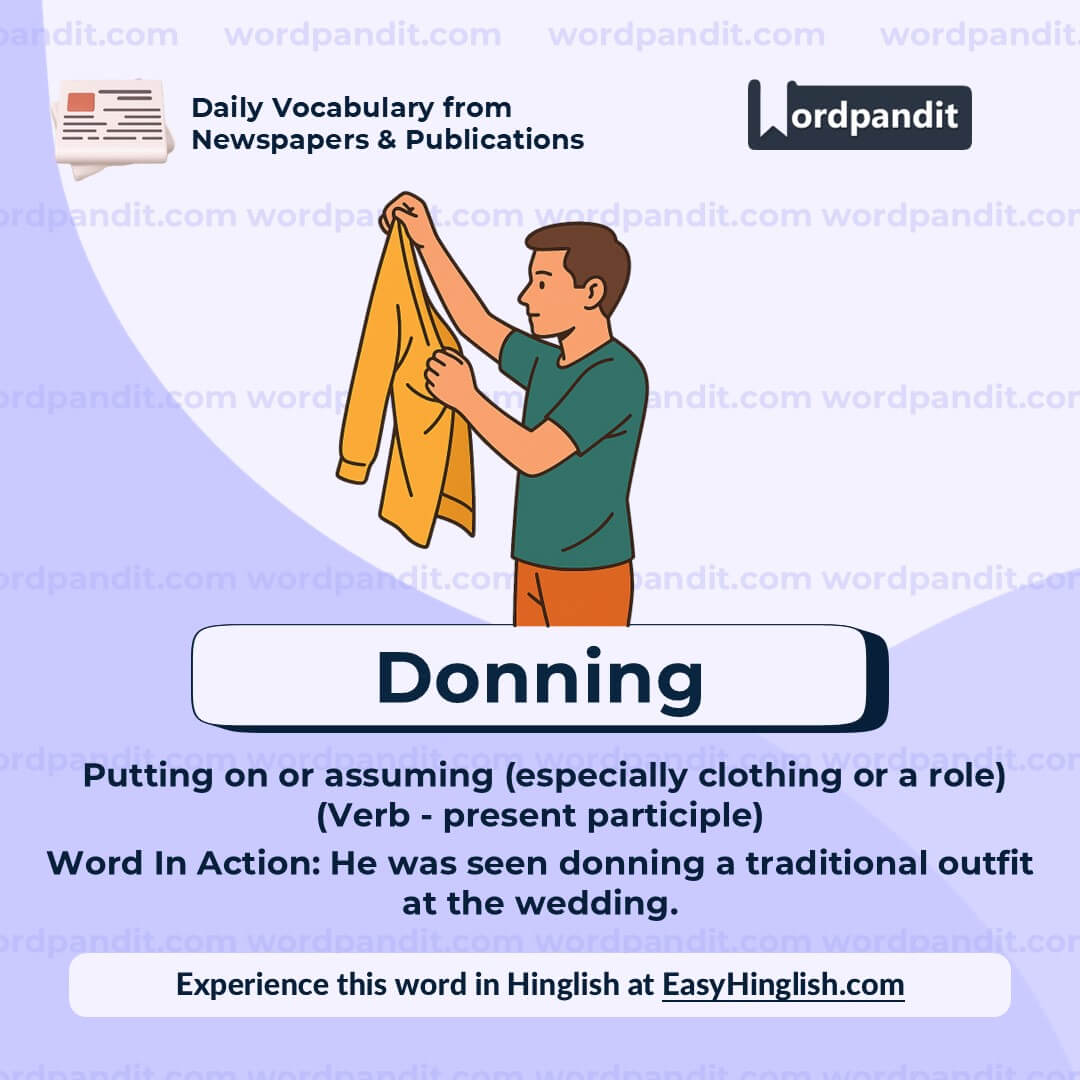
WORD-4: Donning
Context:
"Trump did offer one last comment on the tariffs before donning his big-boy golf pants. 'The operation is over,' he said. 'The patient lived, and is healing. The prognosis is that the patient will be far stronger, bigger, better and more resilient than ever before.'" - The Guardian
Explanatory Paragraph:
“Donning” is a formal or slightly humorous word that means putting on clothes or an item of clothing. It comes from the verb “to don,” which is the opposite of “to doff” (to take off). Though not commonly used in everyday speech, it often appears in writing or speech when describing someone putting on attire for a specific purpose or occasion. In the context of the quote, the word is used with a playful tone to emphasize the moment of switching to a more relaxed or familiar outfit.
Meaning: The act of putting on clothing or apparel. (Verb – present participle)
Pronunciation: don-ing
Difficulty Level: ⭐⭐ Beginner
Etymology: From Middle English "don" (to put on), a contraction of "do on", dating back to the 14th century.
Prashant Sir's Notes:
Think of “donning” as a stylish or formal way to say "putting on clothes." It often adds a visual or dramatic flair in writing. Use it when you want your description to sound elegant or ironic.
Synonyms & Antonyms:
Synonyms: putting on, dressing in, slipping into, wearing
Antonyms: removing, taking off, doffing
Usage Examples:
- She was donning a red velvet gown for the charity gala.
- The soldiers were donning protective gear before entering the danger zone.
- He took pride in donning his grandfather’s old military uniform for the parade.
- Before heading to the beach, they were donning sunglasses and hats.
Cultural Reference:
"Donning a cape, Clark Kent transformed into Superman to save the day." – Comic Book Iconography
Think About It:
Why do certain clothing choices carry symbolic meaning, and how does the act of "donning" something sometimes signify a transformation?
Quick Activity:
Write a short sentence where “donning” is used in a ceremonial or dramatic context (e.g., a knight donning armor).
Memory Tip:
Think “don = do on.” You’re *doing on* your clothes — that is, putting them on!
Real-World Application:
“Donning” is used in formal or descriptive writing, especially when discussing uniforms, costumes, or symbolic attire — such as doctors donning scrubs, or actors donning costumes before a play.
WORD-5: Prognosis
Context:
"Trump did offer one last comment on the tariffs before donning his big-boy golf pants. “The operation is over,” he said. “The patient lived, and is healing. The prognosis is that the patient will be far stronger, bigger, better and more resilient than ever before.”" - The Guardian
Explanatory Paragraph:
“Prognosis” is a term used to predict the likely outcome of a situation, especially in the context of medical recovery. While it originates from healthcare, it's also used metaphorically in business, politics, or everyday life to suggest what might happen next. In the quoted context, “prognosis” is used metaphorically: the economy is compared to a patient recovering from an operation, and the forecast (or prognosis) is that it will become stronger and more resilient. This word often reflects analysis, expertise, and some degree of uncertainty about the future.
Meaning: A forecast or prediction about the likely outcome of a situation, especially relating to health or recovery. (Noun)
Pronunciation: prog-noh-sis
Difficulty Level: ⭐⭐⭐ Intermediate
Etymology: From Greek “prognōsis” — “pro” (before) + “gnōsis” (knowledge), meaning “foreknowledge” or prediction.
Prashant Sir's Notes:
Prognosis is a future-looking word. Originally medical, it's now widely used to describe expected outcomes in any situation. When you hear “prognosis,” think: What’s likely to happen next?
Synonyms & Antonyms:
Synonyms: prediction, forecast, outlook, expectation
Antonyms: hindsight, uncertainty, unpredictability
Usage Examples:
- The doctor gave an optimistic prognosis after the surgery.
- Economists offered a gloomy prognosis for the upcoming quarter.
- The prognosis for peace in the region remains uncertain.
- Her quick recovery surprised everyone, surpassing the initial prognosis.
Cultural Reference:
"In House M.D., a popular medical drama, much of the tension centers around figuring out a patient’s diagnosis and offering a prognosis that often changes with new symptoms." – Fox Television
Think About It:
How does using medical metaphors like “prognosis” shape the way we understand political or economic situations?
Quick Activity:
Think of a current global issue (like climate change or inflation). Write one sentence offering your “prognosis” for its future.
Memory Tip:
Prognosis = Pro (before) + Gnosis (knowledge) → knowledge before something happens = prediction of the outcome.
Real-World Application:
“Prognosis” is often used in medicine to discuss a patient’s chances of recovery, but it is also useful in economics, politics, climate science, and business to describe expected outcomes based on current trends.


