

Daily Vocabulary from International Newspapers and Publications
Expand Your Vocabulary with Wordpandit’s Global Vocabulary Hub
At Wordpandit, we are committed to helping you develop a truly global vocabulary by drawing from some of the most respected international publications. This section is designed to keep you ahead of the curve by introducing you to words that define global conversations and trends.
The Power of Global Sources
To help you think and communicate on a global scale, we curate vocabulary from renowned international sources, such as:
- The New York Times
- The Washington Post
- BBC
- The Guardian
- The Economist
- Scientific American
- Psychology Today
- And many more...
Stay Global, Stay Competitive
Our daily updates from international publications ensure you are consistently exposed to new words that reflect global news and developments, making sure your vocabulary is not only current but also globally relevant.
Enhance Your Global Perspective
Whether you’re preparing for international exams, aiming to excel in global business communication, or want to enhance your language skills for personal growth, Wordpandit offers the resources you need to thrive in a global context.
Effective Learning, Global Reach
Our learning methodology combines global examples, memory aids, and interactive activities, allowing you to internalize new words effectively and apply them in real-world scenarios.
Begin Your Global Vocabulary Journey Now!

Why Choose Wordpandit?
Practical Learning: Focus on words you'll actually encounter in real-world reading, enhancing your comprehension and communication skills.
Diverse Content: From current affairs to scientific breakthroughs, our varied sources expose you to vocabulary across multiple domains.
Effortless Integration: Make Wordpandit a part of your daily routine. Just a few minutes each day can significantly boost your lexicon over time.
Your Path to Vocabulary Mastery
- Visit our Daily Vocabulary section regularly
- Explore new words and their usage in context
- Practice incorporating these words into your own writing and speech
- Track your progress as your vocabulary expands
Start Your Journey Today
Embark on your vocabulary enhancement journey with Wordpandit. By consistently engaging with our daily posts, you'll build a robust vocabulary that serves you well in academic, professional, and personal contexts.
Remember, a word a day keeps linguistic limitations at bay. Make Wordpandit your daily companion in the quest for vocabulary excellence!
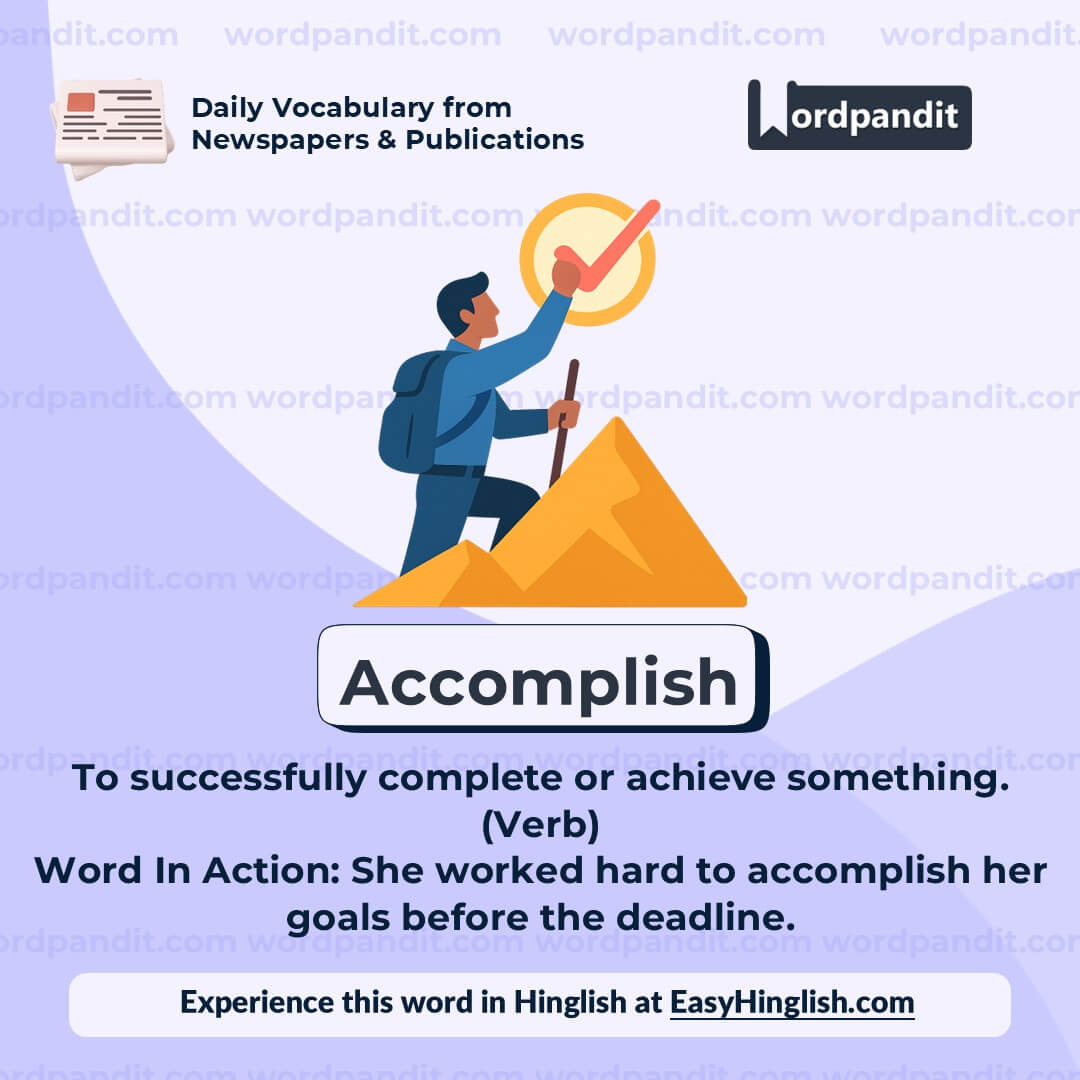
WORD-1: Accomplish
Context:
"There are two related theories of what Donald Trump’s dramatic revision of the global trade system is intended to accomplish. First, the goal is to revitalize American manufacturing, our capacity to build at home and export to the world." - The New York Times
Explanatory Paragraph:
The word accomplish means to successfully complete or achieve something, often after effort or planning. It refers to bringing a task, goal, or project to a successful conclusion. When someone accomplishes something, it suggests that they have overcome obstacles or put in effort to see results.
Meaning: To achieve or successfully carry out (Verb)
Pronunciation: uh-KOM-plish
Difficulty Level: ⭐⭐ Beginner–Intermediate
Etymology: From Old French "acomplir," meaning "to fulfill, to complete," derived from Latin "complere" (to complete).
Prashant Sir's Notes:
A very practical and useful verb. Often used in academic, professional, and motivational contexts. Think of it as the positive end-result word—what you set out to do and finish successfully.
Synonyms & Antonyms:
Synonyms: achieve, complete, execute, fulfill, attain
Antonyms: fail, abandon, neglect, give up
Usage Examples:
- She worked hard to accomplish her dream of starting her own company.
- By the end of the week, the team had accomplished more than they had expected.
- Running a marathon is a major goal to accomplish for many athletes.
- The new policy is designed to accomplish long-term environmental sustainability.
Cultural Reference:
"What you get by achieving your goals is not as important as what you become by accomplishing them." – A popular motivational saying
Think About It:
Do you think people feel more satisfaction from the process of working toward something or from the moment they finally accomplish it?
Quick Activity:
Write down three things you want to accomplish this month—one personal, one academic/professional, and one fun goal.
Memory Tip:
Think of “accomplish” as “a-complete”—you complete what you set out to do.
Real-World Application:
The word “accomplish” is common in resumes, goal-setting sessions, and motivational talks. For example, job seekers often list what they have accomplished in previous roles to highlight their achievements.
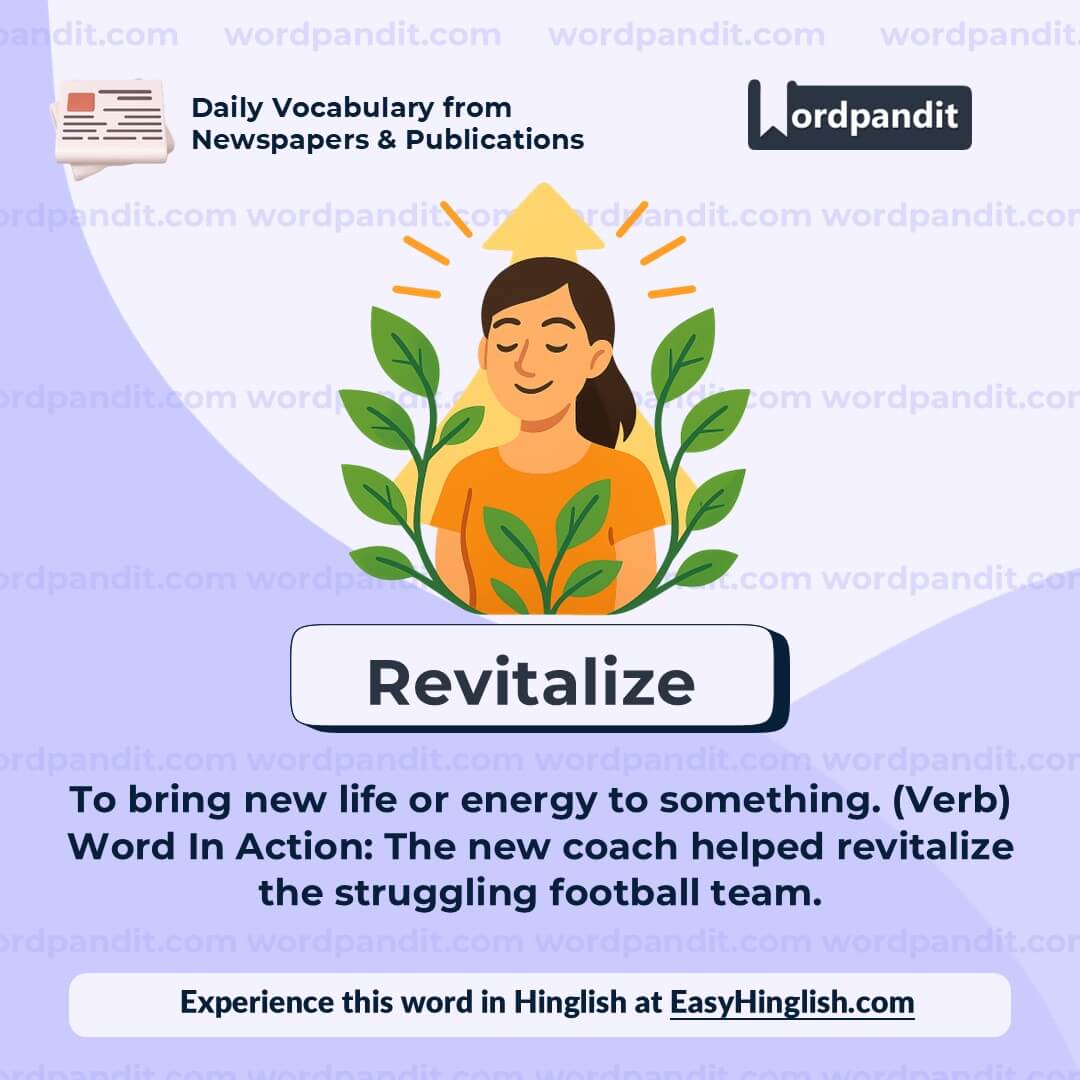
WORD-2: Revitalize
Context:
"There are two related theories of what Donald Trump’s dramatic revision of the global trade system is intended to accomplish. First, the goal is to revitalize American manufacturing, our capacity to build at home and export to the world." - The New York Times
Explanatory Paragraph:
The word revitalize means to bring new life, strength, or energy into something that has weakened, declined, or lost its vigor. It is often used when describing efforts to improve industries, cities, organizations, or even personal energy. To revitalize something is to make it active, fresh, and effective again.
Meaning: To give new life, energy, or strength to something (Verb)
Pronunciation: ree-VY-tuh-lize
Difficulty Level: ⭐⭐⭐ Intermediate
Etymology: From Latin "vita" meaning "life" + "re-" meaning "again," combined to mean "to bring life again." First used in modern English in the 20th century.
Prashant Sir's Notes:
A powerful word often used in economics, urban development, or personal growth contexts. Think of "revitalize" as pressing the reset button that adds fresh energy or life to something declining.
Synonyms & Antonyms:
Synonyms: rejuvenate, renew, restore, refresh, regenerate
Antonyms: weaken, exhaust, drain, diminish
Usage Examples:
- The new community project aims to revitalize the downtown area.
- Regular exercise can revitalize your energy and improve your mood.
- The government plans to revitalize the tourism industry after the slowdown.
- A short vacation helped revitalize her creative spirit.
Cultural Reference:
Urban planners often speak of “revitalizing” old neighborhoods by improving infrastructure, parks, and businesses to bring back vibrancy and attract new residents.
Think About It:
What do you think is harder: creating something new from scratch, or revitalizing something that has declined over time?
Quick Activity:
Pick one area of your daily routine (such as studying, exercising, or relaxing). Write down one action you can take this week to revitalize that part of your life.
Memory Tip:
Break the word into “re-” (again) + “vitalize” (give life). Revitalize = give life again.
Real-World Application:
“Revitalize” is commonly used in business, politics, and health contexts. For example, governments talk about revitalizing economies, companies aim to revitalize brands, and individuals look for ways to revitalize their energy or careers.

WORD-3: Obsessed
Context:
"We know that Trump has always been obsessed with starkly simple numbers. Network TV ratings. The overall trade balance in goods (not services)." - The Guardian
Explanatory Paragraph:
The word obsessed describes a state of being completely preoccupied with or constantly thinking about someone or something. When a person is obsessed, their thoughts, actions, or emotions revolve excessively around that focus, sometimes to the point where it becomes unhealthy or extreme.
Meaning: To be overly focused on or preoccupied with something (Adjective/Verb form: past participle)
Pronunciation: uhb-SESST
Difficulty Level: ⭐⭐⭐ Intermediate
Etymology: From Latin "obsidere," meaning "to besiege," through Old French "obseder" and Middle English "obsess," later evolving to mean "to occupy the mind excessively."
Prashant Sir's Notes:
Obsessed is a strong word. It is not just about liking something but being consumed by it. It’s commonly used in casual language ("I’m obsessed with this song!") as well as in psychology, where it can indicate unhealthy fixation.
Synonyms & Antonyms:
Synonyms: fixated, preoccupied, consumed, addicted, engrossed
Antonyms: indifferent, detached, uninterested, unconcerned
Usage Examples:
- He became obsessed with winning the competition, practicing day and night.
- She is obsessed with mystery novels and reads one every week.
- The designer is obsessed with details, ensuring perfection in every piece.
- Sometimes being obsessed with success can harm your health and relationships.
Cultural Reference:
In pop culture, fans often say they are "obsessed" with a celebrity, TV show, or fashion trend, showing how the word has shifted from a negative psychological term to an expression of enthusiasm.
Think About It:
Do you think obsession is always harmful, or can being “obsessed” with something sometimes drive positive achievements?
Quick Activity:
Write down one thing you are currently “obsessed” with (positively or negatively). Reflect on whether it helps or distracts you.
Memory Tip:
Think of “obsessed” as being “possessed” by a thought—it completely controls your mind.
Real-World Application:
“Obsessed” is widely used in everyday conversations, social media, marketing (e.g., “Obsessed with quality”), and psychology, where it describes compulsive thinking patterns.
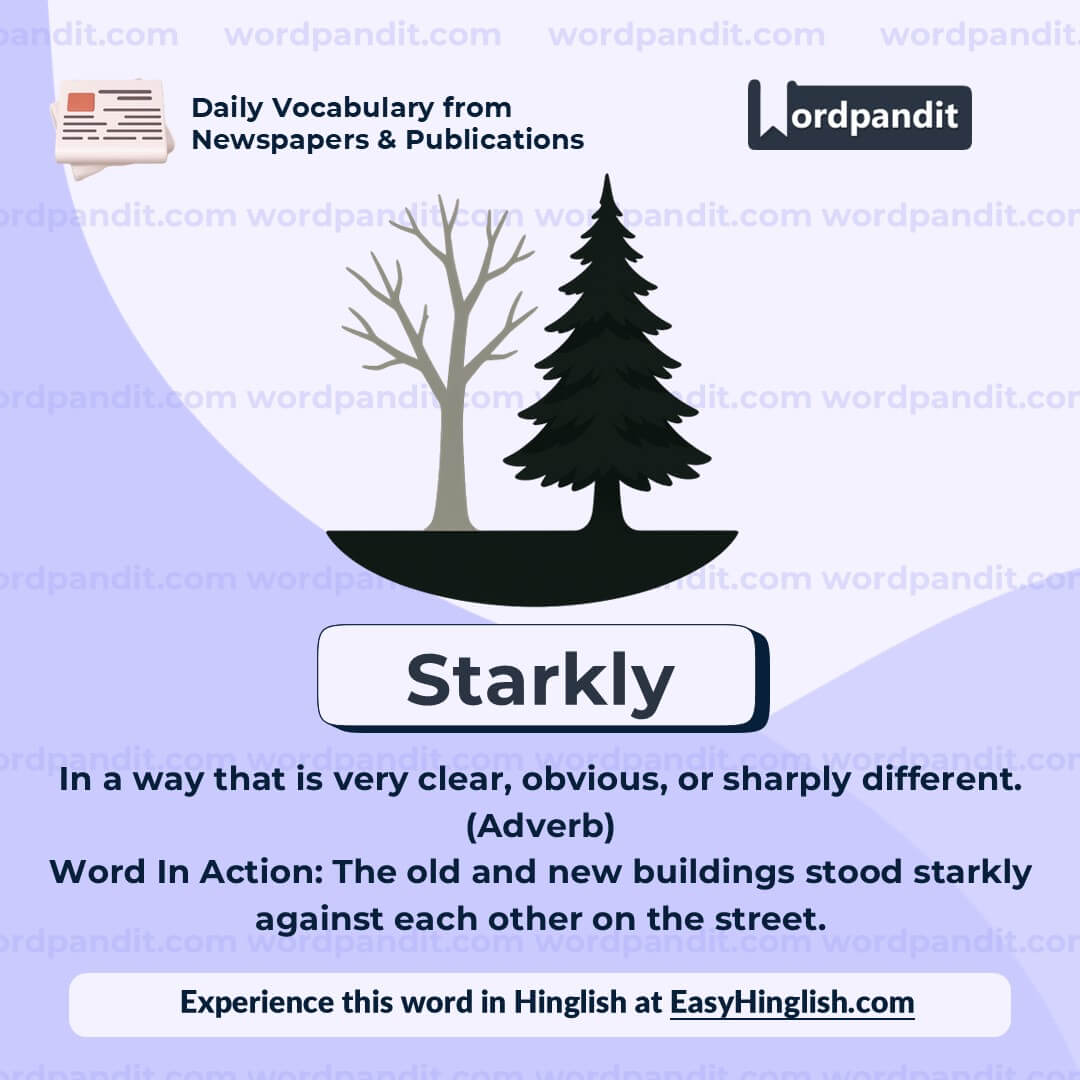
WORD-4: Starkly
Context:
"We know that Trump has always been obsessed with starkly simple numbers. Network TV ratings. The overall trade balance in goods (not services)." - The Guardian
Explanatory Paragraph:
The word starkly is an adverb that emphasizes something in a very clear, strong, and sometimes harsh or extreme way. When something is described starkly, it is shown without softening, decoration, or subtlety—it is plain, striking, and impossible to ignore. In the sentence, "starkly simple numbers" suggests numbers that are presented in a very plain, clear, and direct manner, leaving no room for complication.
Meaning: In a way that is clear, harsh, plain, or extreme (Adverb)
Pronunciation: STAHRK-lee
Difficulty Level: ⭐⭐⭐ Intermediate
Etymology: From Old English "stearc," meaning "stiff, severe, rigid," later developing into "stark" meaning "plain, strong, absolute." Adding "-ly" makes it an adverb.
Prashant Sir's Notes:
"Starkly" is often used to highlight contrasts, differences, or the raw, unsoftened reality of something. It adds power to descriptions by removing any sense of gentleness or decoration.
Synonyms & Antonyms:
Synonyms: bluntly, plainly, severely, harshly, distinctly
Antonyms: softly, subtly, gently, mildly
Usage Examples:
- The two cities are starkly different in terms of wealth and development.
- The film portrays the hardships of war starkly, without any sugarcoating.
- She spoke starkly about the consequences of ignoring climate change.
- The mountain stood starkly against the bright blue sky.
Cultural Reference:
In literature and journalism, "starkly" is frequently used to highlight sharp contrasts, such as between wealth and poverty, peace and war, or hope and despair. It emphasizes the rawness of reality.
Think About It:
Why do you think authors and journalists often choose to present things starkly instead of softening the truth—does it lead to greater awareness or unnecessary harshness?
Quick Activity:
Write two contrasting sentences using "starkly." For example, one about differences in lifestyle, and another about a natural scene.
Memory Tip:
Think of “starkly” as showing something in a “stark” (bare, plain, absolute) way, without decoration—just the raw truth.
Real-World Application:
"Starkly" is commonly used in journalism, reports, and academic writing to describe contrasts or truths that stand out clearly—for example, "income is starkly divided between the rich and poor."
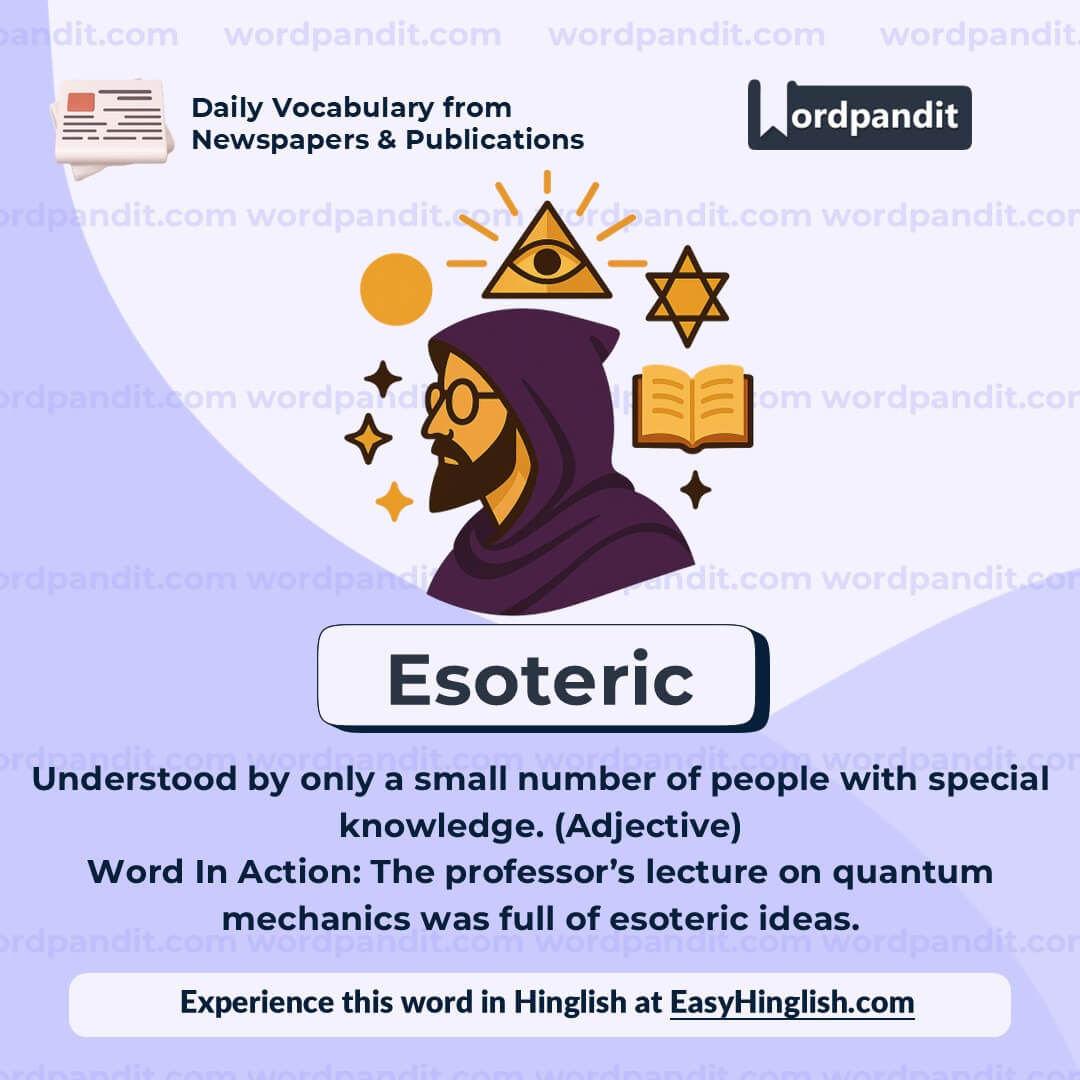
WORD-5: Esoteric
Context:
"I have DJed at some impressively esoteric weddings in my time. I started playing clubs in 1999, but in the mid-2000s I started advertising myself as a wedding DJ on the era-defining digital noticeboard Gumtree." - The Guardian
Explanatory Paragraph:
The word esoteric describes something that is intended for or likely to be understood by only a small group of people with specialized knowledge or interests. It often refers to concepts, practices, or tastes that are unusual, niche, or highly specialized, making them inaccessible or puzzling to the general public.
Meaning: Known or understood by only a small, specialized group; obscure or unusual (Adjective)
Pronunciation: eh-soh-TER-ik
Difficulty Level: ⭐⭐⭐⭐ Advanced
Etymology: From Greek "esōterikos," meaning "inner" or "belonging to an inner circle," derived from "esō" (within). Originally used to describe secret teachings reserved for a select few.
Prashant Sir's Notes:
"Esoteric" is the opposite of "mainstream" or "popular." If something is esoteric, only a small group appreciates it—like a rare philosophy, a niche art form, or a very unusual hobby. A great word for describing exclusivity and obscurity.
Synonyms & Antonyms:
Synonyms: obscure, cryptic, abstruse, niche, arcane
Antonyms: common, popular, mainstream, accessible, familiar
Usage Examples:
- The professor’s lecture was filled with esoteric references that only experts understood.
- She has an esoteric taste in music, enjoying underground genres few have heard of.
- The novel explores esoteric philosophies that may confuse casual readers.
- His artwork was admired for its esoteric symbolism, appreciated by critics more than the general public.
Cultural Reference:
Esoteric traditions exist in many cultures, such as mystical branches of religion or secret societies, where teachings are reserved only for an initiated few.
Think About It:
Do you think esoteric knowledge should remain exclusive to a select group, or should it be made more accessible to the wider public?
Quick Activity:
List three hobbies or interests that you think could be described as "esoteric." For example, collecting ancient coins, studying rare languages, or experimental electronic music.
Memory Tip:
Think of "esoteric" as "inside-only" knowledge—something that stays within a small circle and is not open to everyone.
Real-World Application:
The word “esoteric” is often used in academic, artistic, and cultural contexts to describe specialized knowledge or tastes. For example, a company’s technical manual might be considered esoteric because only experts in the field can fully understand it.


