

Daily Vocabulary from Indian Newspapers and Publications
Welcome to Wordpandit’s Indian Vocabulary Hub
At Wordpandit, we understand the importance of staying rooted in the local context while expanding your language skills. This section focuses on enriching your vocabulary with words and phrases drawn from India’s leading newspapers and publications, ensuring you're learning vocabulary that is practical, relevant, and uniquely Indian.
Why Indian Sources Matter
We believe that the best way to master any language is by immersing yourself in local content. That’s why we carefully curate vocabulary from top Indian publications, including:
- The Hindu
- The Times of India
- The Economic Times
- Hindustan Times
- Live Mint
- The Indian Express
- And many others...
Stay Updated, Stay Relevant
With daily updates from Indian news sources, you’ll be consistently learning words that reflect the trends and shifts in Indian society and culture. Our focus is to provide vocabulary that enhances your understanding of the language in an Indian context.
How Wordpandit Supports Your Goals
Whether you’re preparing for exams, aiming to improve your professional communication, or simply want to stay connected with the latest Indian vocabulary, Wordpandit is here to guide you every step of the way.
Learn with a Practical Approach
Our interactive learning methodology includes real-world examples, engaging activities, and context-specific usage to ensure that every word becomes part of your active vocabulary.
Dive into Indian Vocabulary Today!

Why Choose Wordpandit?
Practical Learning: Focus on words you'll actually encounter in real-world reading, enhancing your comprehension and communication skills.
Diverse Content: From current affairs to scientific breakthroughs, our varied sources expose you to vocabulary across multiple domains.
Effortless Integration: Make Wordpandit a part of your daily routine. Just a few minutes each day can significantly boost your lexicon over time.
Your Path to Vocabulary Mastery
- Visit our Daily Vocabulary section regularly
- Explore new words and their usage in context
- Practice incorporating these words into your own writing and speech
- Track your progress as your vocabulary expands
Start Your Journey Today
Embark on your vocabulary enhancement journey with Wordpandit. By consistently engaging with our daily posts, you'll build a robust vocabulary that serves you well in academic, professional, and personal contexts.
Remember, a word a day keeps linguistic limitations at bay. Make Wordpandit your daily companion in the quest for vocabulary excellence!
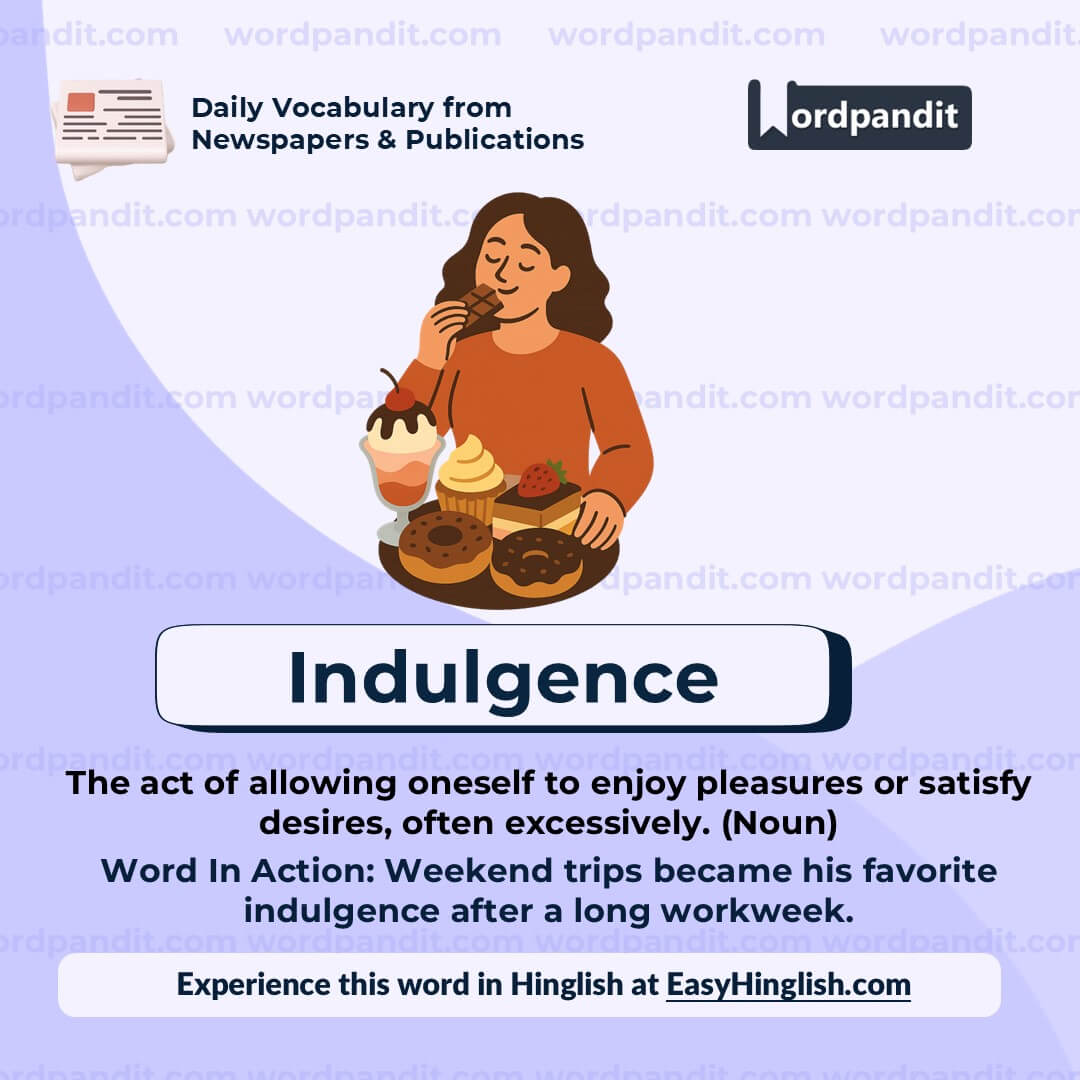
WORD-1: Indulgence
Context:
"Art is not just an aesthetic indulgence; it is a deeply personal and emotional expression of the human experience. Every brushstroke, every frame, and every line tells a story — one that carries the weight of culture, history, and personal struggles. But today, art is being reduced to a mere social media trend, mass-produced with a single click." - The Indian Express
Explanatory Paragraph:
Indulgence meaning in English is 'the act of allowing yourself or someone else to enjoy something pleasurable, often excessively or without restraint.' This word is used when describing situations where people permit themselves luxuries, pleasures, or behaviors that might be considered unnecessary or excessive. Indulgence is commonly used in formal writing, lifestyle articles, and competitive exam passages to discuss self-gratification, lenient behavior, or treating something as a luxury rather than a necessity.
Meaning: The act of allowing oneself to enjoy the pleasure of something, often excessively; lenient or permissive treatment (Noun)
Pronunciation: in-DUL-jens
Difficulty Level: ⭐⭐ Basic to Intermediate
Etymology: Indulgence comes from Latin 'indulgere' meaning 'to be kind, yield, or give oneself up to.' The word traveled through French 'indulgence' and initially carried religious connotations in medieval times, referring to the remission of sins. Over centuries, it evolved to describe any act of permitting pleasure or showing leniency, moving from spiritual forgiveness to personal gratification.
Prashant Sir's Notes:
Many students confuse 'indulgence' with 'luxury'—while both relate to pleasure, indulgence usage in English specifically emphasizes the act of allowing or permitting something, often with a hint of excess. The difference between indulgence and luxury is that luxury is the expensive thing itself, while indulgence is the behavior of allowing yourself that thing. For CAT and GRE aspirants, when you see 'indulgence' in RC passages, it often signals the author's critique of excess or self-gratification. In Indian English newspapers, you'll frequently encounter phrases like 'an indulgence India cannot afford' when discussing fiscal policies or social behaviors—this construction always implies something is a luxury beyond practical necessity.
Synonyms & Antonyms:
Synonyms: gratification, luxury, treat, extravagance, pampering, leniency, tolerance, permissiveness, self-gratification, excess
Antonyms: restraint, discipline, denial, austerity, strictness, moderation
Usage Examples:
- The Union Budget debate highlighted whether spending on metro projects was essential infrastructure or an indulgence for urban elites.
- Priya's parents showed remarkable indulgence toward her younger brother, allowing him privileges they never granted her during her childhood.
- Critics argue that expensive destination weddings in Dubai and Italy represent an indulgence that showcases wealth disparity in Indian society.
- After months of strict dieting, Rohan decided a single chocolate pastry from his favorite Pune bakery was a reasonable indulgence.
Cultural Reference:
"In Zindagi Na Milegi Dobara, the three friends' luxury trip to Spain represents an indulgence they gift themselves to break free from routine and rediscover life's pleasures." - Bollywood cinema reference
Think About It:
In a country where millions still struggle with basic necessities, where should we draw the line between reasonable comfort and excessive indulgence? Is occasional self-indulgence necessary for mental health, or does it reflect privilege and insensitivity?
Quick Activity:
Write two sentences: one describing an indulgence you consider harmless and enjoyable, and another describing an indulgence you believe society should avoid. Notice how your personal values shape what you consider acceptable indulgence.
Memory Tip:
Think of 'Indulgence' as 'IN-DULL-GENCE'—imagine someone saying "Come IN, don't be DULL, enjoy this GENEROUS treat!" Remember: when you indulge, you're inviting yourself IN to something pleasurable without holding back, being generous (GENCE) to yourself.
Real-World Application:
In editorial writing and opinion pieces, 'indulgence' is frequently used to critique government spending, corporate perks, or social behaviors perceived as excessive. Business journalists use it when analyzing consumer trends or luxury markets. For competitive exam essays, how to use indulgence effectively involves demonstrating critical thinking about resource allocation, privilege, and societal priorities—particularly relevant for UPSC ethics papers and CAT essay sections where balanced argumentation is essential.
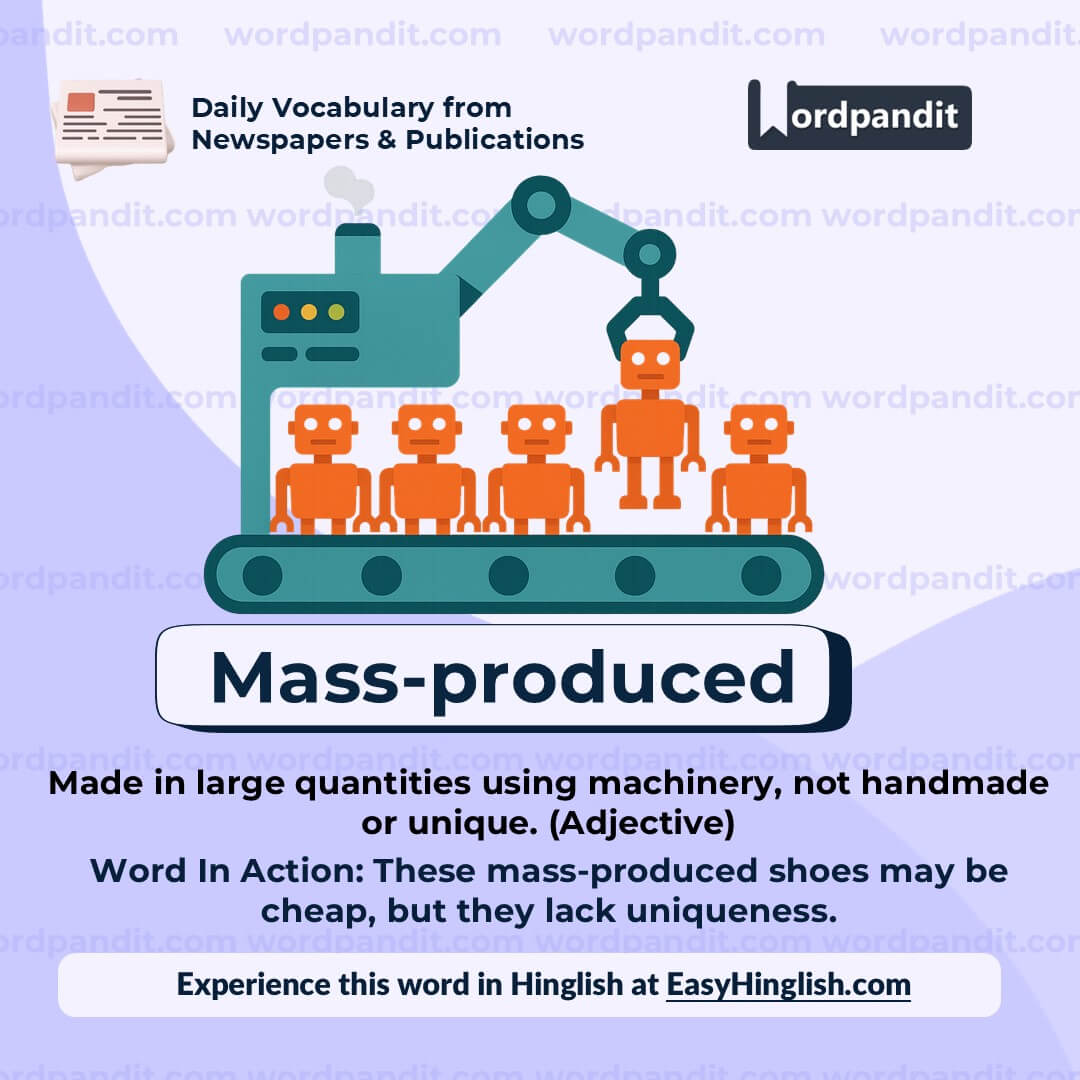
WORD-2: Mass-produced
Context:
"Art is not just an aesthetic indulgence; it is a deeply personal and emotional expression of the human experience. Every brushstroke, every frame, and every line tells a story — one that carries the weight of culture, history, and personal struggles. But today, art is being reduced to a mere social media trend, mass-produced with a single click." - The Indian Express
Explanatory Paragraph:
Mass-produced meaning in English is 'manufactured in large quantities using standardized designs and automated processes, often at the expense of individual uniqueness or quality.' This term is used when describing goods, content, or ideas that are created in bulk rather than individually crafted. Mass-produced is commonly used in business articles, economic discussions, and competitive exam passages to critique uniformity, discuss industrial manufacturing, or contrast automation with handcrafted quality.
Meaning: Manufactured or created in large quantities by standardized mechanical processes (Adjective/Verb - past participle)
Pronunciation: MASS-proh-DOOSD
Difficulty Level: ⭐⭐ Basic to Intermediate
Etymology: Mass-produced is a compound term combining 'mass' from Latin 'massa' meaning 'lump or bulk' and 'produced' from Latin 'producere' meaning 'to bring forth.' The term emerged during the Industrial Revolution in the late 19th and early 20th centuries when assembly line manufacturing transformed production methods. Henry Ford's automobile factories popularized the concept, making it synonymous with efficiency but also loss of individual craftsmanship.
Prashant Sir's Notes:
Students often ask: what is the difference between mass-produced and handmade? Mass-produced items emphasize quantity and uniformity, while handmade suggests uniqueness and personal craftsmanship. For CAT and GRE reading comprehension, when authors use 'mass-produced,' they're usually critiquing something—notice the negative connotation. How to use mass-produced in sentences: it typically appears with objects, content, or ideas that have lost authenticity through repetition. In Indian English business writing, you'll see 'mass-produced goods flooding the market' when discussing competition from China, or 'mass-produced content' when critiquing social media's impact on creativity. The hyphenated form is standard when used as an adjective before a noun.
Synonyms & Antonyms:
Synonyms: factory-made, manufactured in bulk, industrially produced, standardized, assembly-line produced, commercially manufactured, produced en masse, cookie-cutter (informal)
Antonyms: handmade, handcrafted, artisanal, bespoke, custom-made, one-of-a-kind, individually crafted
Usage Examples:
- While mass-produced smartphones dominate the Indian market, luxury brands still offer limited-edition models for collectors willing to pay premium prices.
- Khadi clothing represents India's resistance to mass-produced textiles, symbolizing self-reliance and the value of hand-spun fabric over factory efficiency.
- Social media influencers often share mass-produced motivational quotes without understanding their original context or deeper philosophical meaning.
- Rajesh's grandmother lamented that mass-produced sweets from supermarkets could never match the taste and love of homemade laddoos prepared during festivals.
Cultural Reference:
"Gandhi's spinning wheel (charkha) was a powerful symbol rejecting mass-produced British textiles, advocating instead for swadeshi—locally made, handcrafted goods that preserved Indian livelihoods and dignity." - Indian independence movement
Think About It:
In an age where AI can create artwork, write poetry, and compose music instantly, are we entering an era where even creativity itself is mass-produced? What do we lose when efficiency replaces the human touch?
Quick Activity:
Look around your room and identify three mass-produced items and one handmade or unique item. Reflect on the difference in value you assign to each. Does something being mass-produced make it less meaningful to you?
Memory Tip:
Think of 'Mass-produced' as 'MASS (crowd) + PRODUCED (created)'—imagine a huge factory with identical products rolling off the assembly line, like thousands of identical Parle-G biscuit packets being made every minute. The hyphen connects 'mass' and 'produced' just like an assembly line connects different production stages into one continuous process.
Real-World Application:
In business journalism and economic analysis, 'mass-produced' appears frequently when discussing manufacturing sectors, Make in India initiatives, or debates about industrialization versus traditional crafts. Marketing professionals use it to position products—either emphasizing affordability and accessibility of mass-produced goods or highlighting the premium exclusivity of non-mass-produced alternatives. For UPSC essay writing, understanding mass production's impact on employment, culture, and sustainability is crucial. In CAT RC passages, authors often use 'mass-produced' critically when discussing authenticity, quality, or cultural homogenization.
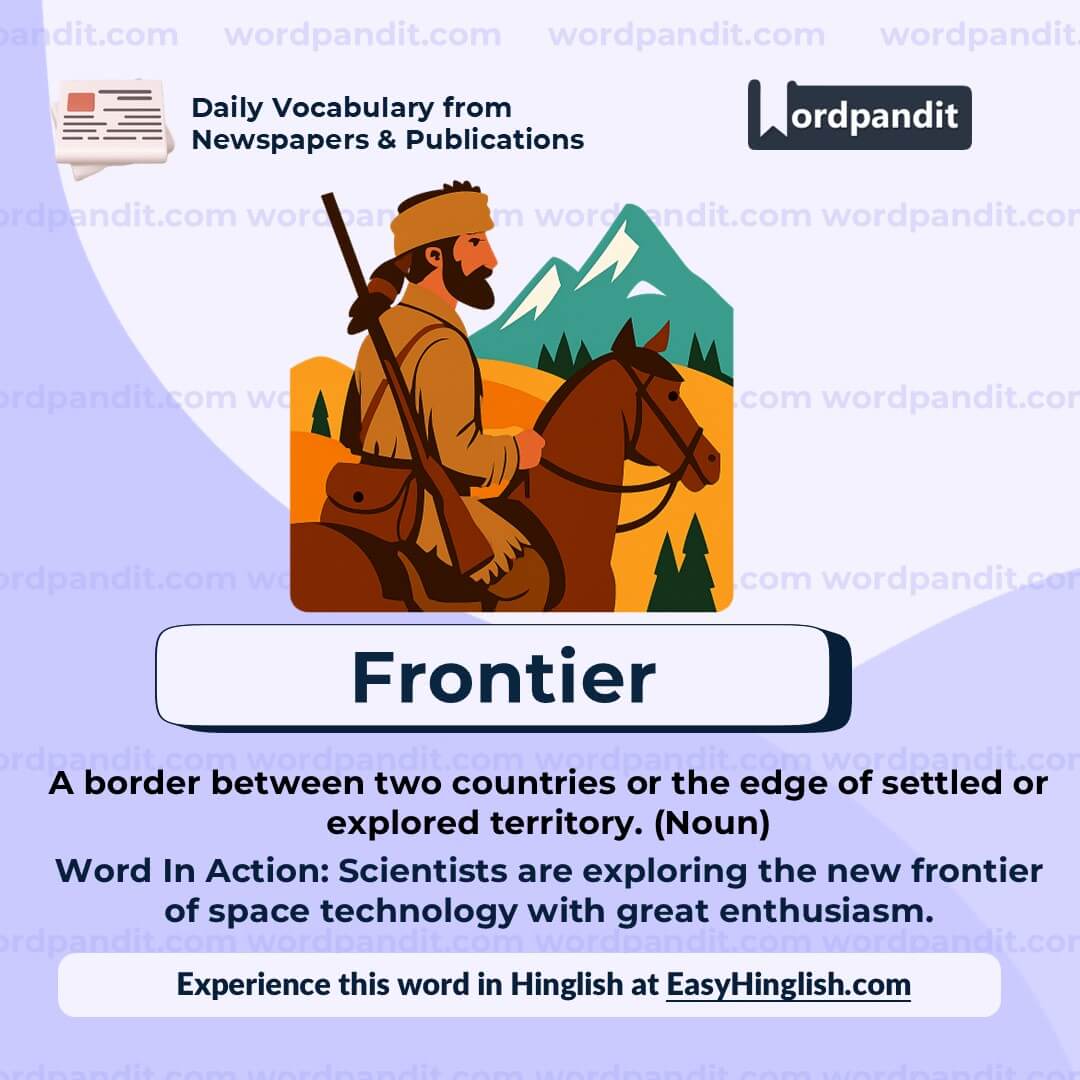
WORD-3: Frontier
Context:
"Space, the ultimate frontier, has fascinated humankind for centuries. Yet, for decades, it remained an arena dominated by men. However, that is changing, and women have been steadily carving their rightful place in the cosmos." - The Hindu
Explanatory Paragraph:
Frontier meaning in English is 'the extreme limit of understanding, achievement, or development in a particular field; also, a border between two countries or the edge of settled territory.' This word is used when describing unexplored areas, cutting-edge fields of research, or boundaries that represent new challenges and opportunities. Frontier is commonly used in academic writing, scientific articles, and competitive exam passages to discuss innovation, exploration, or the boundaries of human knowledge and territorial limits.
Meaning: The extreme limit of settled land or understanding; a region that forms the edge of explored territory or knowledge; a border between countries (Noun)
Pronunciation: frun-TEER or FRUN-teer
Difficulty Level: ⭐⭐⭐ Intermediate
Etymology: Frontier comes from Old French 'frontiere' meaning 'border or boundary,' derived from Latin 'frons' meaning 'forehead or front.' The word originally referred to military frontlines and geographical borders between territories. During American westward expansion in the 19th century, 'frontier' took on romantic associations with unexplored wilderness and new opportunities. Today, it's used metaphorically for any field at the cutting edge of discovery, from "the frontiers of science" to "digital frontiers."
Prashant Sir's Notes:
Many students confuse 'frontier' with 'border'—while both relate to boundaries, frontier usage in English carries deeper connotations of exploration, challenge, and未知 territories waiting to be conquered. The difference between frontier and border is that border is simply a dividing line, while frontier suggests opportunity, adventure, and the edge of current capabilities. For GRE and CAT aspirants, when you encounter 'frontier' in RC passages about science or technology, it signals innovation and breakthrough potential. In Indian English newspapers, phrases like "the new frontiers of artificial intelligence" or "India's frontiers in space exploration" appear regularly, always emphasizing pioneering achievement. Remember: frontier isn't just about physical space—it's equally powerful when describing intellectual, technological, or social boundaries being pushed forward.
Synonyms & Antonyms:
Synonyms: border, boundary, edge, limit, periphery, borderland, cutting edge (metaphorical), forefront, vanguard, threshold, uncharted territory
Antonyms: interior, heartland, center, core, settled area, established territory
Usage Examples:
- ISRO's Chandrayaan missions have positioned India at the frontier of lunar exploration, competing with spacefaring nations like the United States and China.
- Artificial intelligence and machine learning represent the new frontiers where Indian startups from Bengaluru and Hyderabad are making global breakthroughs.
- The Line of Actual Control between India and China remains a disputed frontier where both nations maintain vigilant military presence.
- Dr. Sharma's groundbreaking cancer research pushes the frontiers of medical science, offering hope where traditional treatments have failed.
Cultural Reference:
"Star Trek's famous opening—'Space, the final frontier'—captures humanity's eternal desire to explore the unknown, echoing India's own space ambitions from Aryabhata to Gaganyaan missions." - Popular science fiction and Indian space program
Think About It:
As technology advances exponentially, what are the new frontiers that India should prioritize—quantum computing, deep ocean exploration, or perhaps the frontiers of social equality and education access? Which frontier promises the greatest transformation for our nation?
Quick Activity:
Identify three modern frontiers being explored in India today—one technological, one scientific, and one social. Write one sentence about each, explaining why it represents a frontier rather than just an ongoing activity.
Memory Tip:
Remember 'Frontier' by thinking of 'FRONT-TIER'—imagine standing at the FRONT of a TIER or level, looking out at unexplored territory ahead. Like India's soldiers at the Siachen Glacier, the highest frontier, standing at the front tier of national defense. The front is always where new territory begins and old territory ends.
Real-World Application:
In scientific journals and research papers, 'frontier' commonly describes cutting-edge areas of investigation, as in "frontiers in neuroscience" or "the frontiers of climate research." Business publications use it when discussing emerging markets and innovative sectors—"fintech frontiers" or "renewable energy frontiers." For UPSC mains essays, how to use frontier effectively means connecting it to India's developmental aspirations, whether discussing geographical borders or knowledge boundaries. In CAT reading comprehension, passages featuring 'frontier' often explore themes of progress, discovery, and human achievement, requiring you to understand both literal and metaphorical meanings.
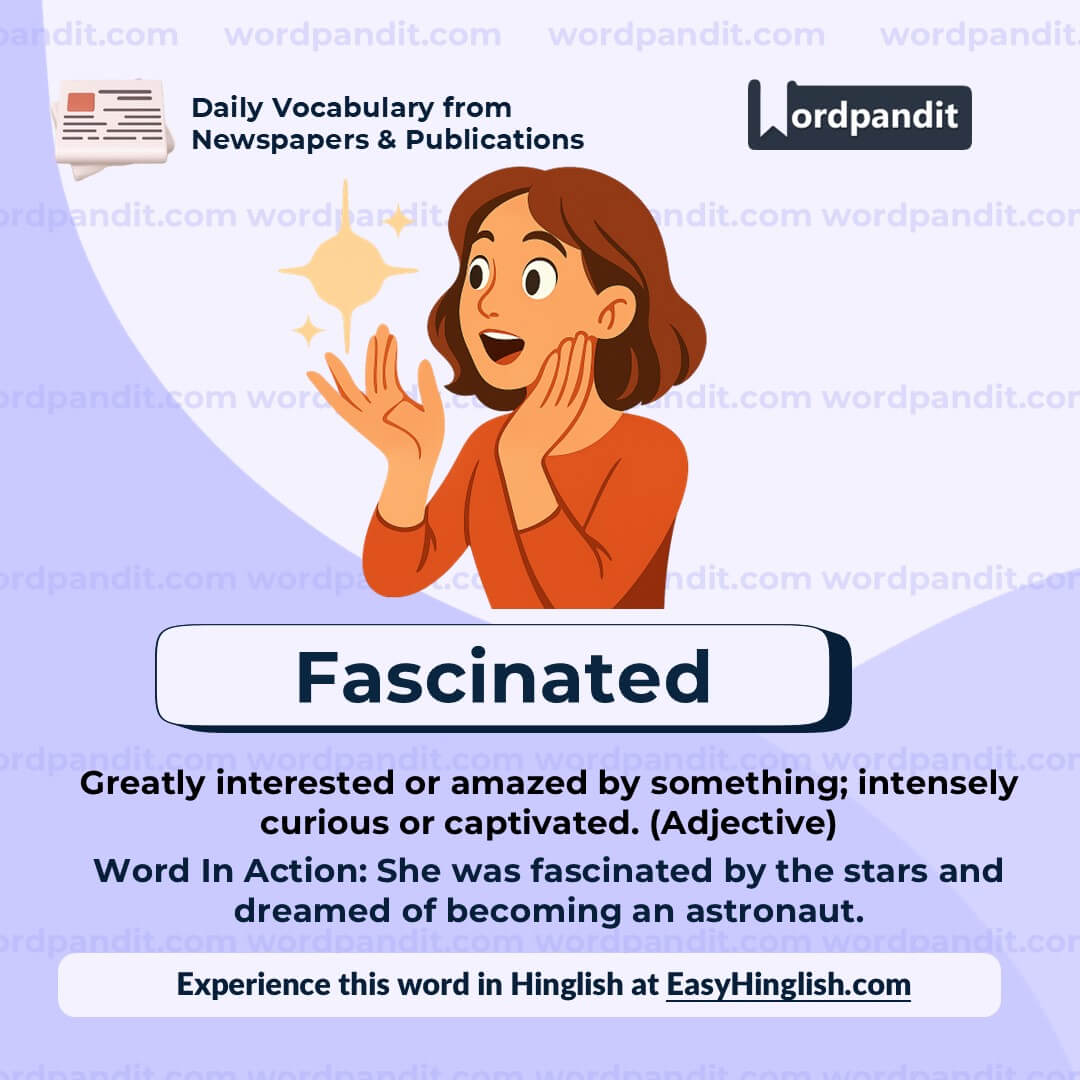
WORD-4: Fascinated
Context:
"Space, the ultimate frontier, has fascinated humankind for centuries. Yet, for decades, it remained an arena dominated by men. However, that is changing, and women have been steadily carving their rightful place in the cosmos." - The Hindu
Explanatory Paragraph:
Fascinated meaning in English is 'intensely interested or attracted to something in a way that captures complete attention and curiosity.' This word is used when describing a strong, almost magical attraction or deep engagement with a subject, person, or phenomenon. Fascinated is commonly used in descriptive writing, personal narratives, and competitive exam passages to convey powerful interest, wonder, or captivation that goes beyond casual curiosity or mild interest.
Meaning: Strongly attracted and interested; held spellbound by something captivating (Adjective/Verb - past participle)
Pronunciation: FAS-ih-nay-ted
Difficulty Level: ⭐⭐ Basic to Intermediate
Etymology: Fascinated comes from Latin 'fascinare' meaning 'to bewitch or enchant,' derived from 'fascinum' meaning 'a spell or witchcraft.' In ancient Rome, fascinum also referred to a phallic charm used to ward off evil spirits. The word entered English through French in the late 16th century, initially carrying supernatural connotations of being under a spell. Over time, it evolved to describe any intense captivation or attraction, losing its magical associations but retaining the sense of being powerfully drawn to something beyond rational control.
Prashant Sir's Notes:
Students often ask: what is the difference between fascinated and interested? While both show attraction, fascinated usage implies a much deeper, almost irresistible pull—think of it as interest multiplied by wonder and intensity. How to use fascinated correctly: it's typically followed by 'by' or 'with' (fascinated by space, fascinated with the idea). For CAT and GRE reading comprehension, when authors describe someone as 'fascinated,' they're emphasizing profound engagement, not casual interest. In Indian English writing, you'll commonly see "Indians have long been fascinated by cricket" or "students fascinated with UPSC preparation"—the word captures obsessive interest. Remember: you can be interested in many things simultaneously, but fascination demands your complete attention and emotional investment in that moment.
Synonyms & Antonyms:
Synonyms: captivated, mesmerized, enthralled, spellbound, enchanted, absorbed, engrossed, intrigued, riveted, transfixed
Antonyms: bored, indifferent, uninterested, disengaged, apathetic, unmoved
Usage Examples:
- Priya remained fascinated by Bharatanatyam since childhood, spending hours watching her guru's graceful movements and intricate mudras during practice sessions.
- Indian audiences have been fascinated with courtroom dramas ever since shows like "Adaalat" brought legal battles into living rooms across the country.
- Rajiv was so fascinated by the street magician's card tricks at Connaught Place that he forgot about his meeting completely.
- Scientists remain fascinated by the Indus Valley Civilization, constantly uncovering new mysteries about Harappa and Mohenjo-daro that challenge existing historical theories.
Cultural Reference:
"In 3 Idiots, Rancho's fascination with learning for knowledge's sake rather than grades inspired a generation of Indian students to question rote memorization and pursue genuine understanding." - Bollywood reference
Think About It:
What fascinates you so deeply that you lose track of time when engaged with it? Is fascination something we choose, or does it choose us? Can genuine fascination be taught, or must it be discovered?
Quick Activity:
Write two sentences: one describing something that fascinated you as a child, and another describing what fascinates you now. Notice how your fascinations reveal what you value at different life stages.
Memory Tip:
Break 'Fascinated' into 'FAST-SINNED'—imagine being so FAST and completely absorbed in something that time itself seems to have SINNED against you by passing too quickly! Like when you're fascinated by a cricket match and suddenly realize five hours have vanished. The feeling is so intense, it's almost like being under a spell.
Real-World Application:
In feature articles and human interest stories, 'fascinated' helps writers convey deep emotional engagement with subjects, making narratives more compelling. Marketing professionals use it to describe ideal customer relationships—brands want consumers "fascinated" with their products, not merely satisfied. For competitive exam essays, how to use fascinated effectively means showing genuine intellectual curiosity and passion rather than superficial interest. In CAT RC passages, when characters or researchers are described as "fascinated," it signals motivation, dedication, and the driving force behind discoveries or life choices. Academic writing uses it to acknowledge the compelling nature of research questions that drive scientific inquiry forward.
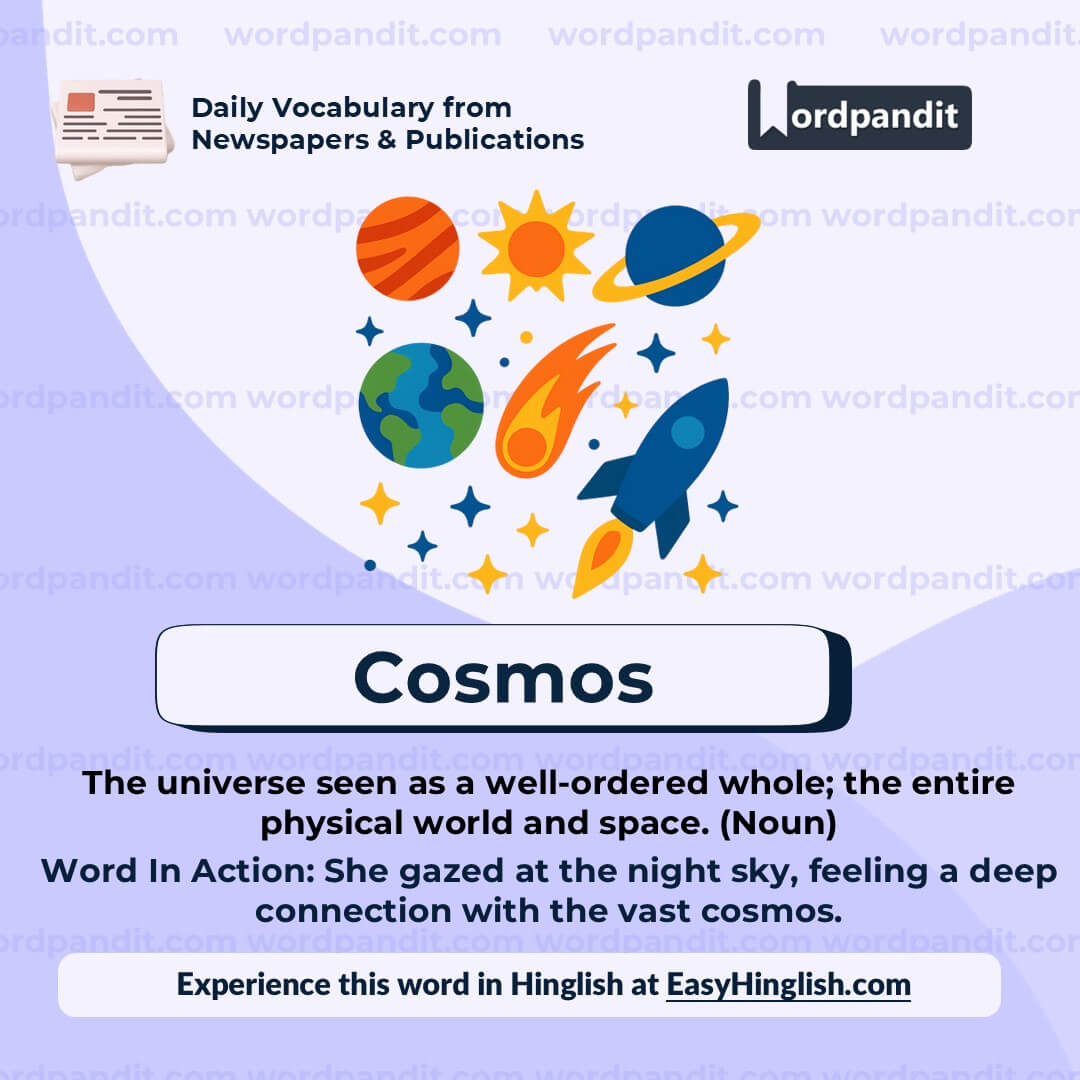
WORD-5: Cosmos
Context:
"Space, the ultimate frontier, has fascinated humankind for centuries. Yet, for decades, it remained an arena dominated by men. However, that is changing, and women have been steadily carving their rightful place in the cosmos." - The Hindu
Explanatory Paragraph:
Cosmos meaning in English is 'the universe viewed as a complex and orderly system; the entirety of space, time, matter, and energy functioning as a harmonious whole.' This word is used when referring to the universe in its totality, often emphasizing its orderly nature and interconnected systems rather than just empty space. Cosmos is commonly used in scientific writing, philosophical discussions, and competitive exam passages to convey the grandeur and organized structure of the universe, distinguishing it from chaos or randomness.
Meaning: The universe regarded as an orderly, harmonious whole; all of space, time, and matter functioning as an integrated system (Noun)
Pronunciation: KOZ-mos or KOZ-muhs
Difficulty Level: ⭐⭐⭐ Intermediate
Etymology: Cosmos comes from ancient Greek 'kosmos' meaning 'order, world, or ornament,' contrasting with 'chaos' meaning disorder. Greek philosopher Pythagoras first used 'kosmos' to describe the universe around 6th century BCE, emphasizing its mathematical harmony and beauty. The word entered English in the 13th century through Latin 'cosmos.' Interestingly, 'cosmetic' shares the same root—both cosmos and cosmetics relate to order and beauty. The term gained renewed popularity when astronomer Carl Sagan's 1980s TV series "Cosmos" introduced millions to astronomy, making it synonymous with the wonder of space exploration.
Prashant Sir's Notes:
Many students confuse 'cosmos' with 'space' or 'universe'—while related, cosmos usage in English specifically emphasizes order, harmony, and interconnectedness rather than just physical expanse. The difference between cosmos and universe is subtle but important: universe is neutral and scientific, while cosmos carries philosophical weight, suggesting meaning and structure. For GRE and CAT aspirants, when authors choose 'cosmos' over 'space,' they're highlighting humanity's place in something vast yet organized. In Indian English newspapers, particularly science columns, you'll encounter "India's journey into the cosmos" when discussing ISRO missions—the word elevates space exploration from technical achievement to philosophical endeavor. Remember: cosmos isn't just where stars exist; it's the grand, orderly system that ancient Indian astronomers like Aryabhata studied when they calculated planetary movements with remarkable precision.
Synonyms & Antonyms:
Synonyms: universe, space, creation, heavens, macrocosm, outer space, the celestial sphere, all of existence
Antonyms: chaos, disorder, microcosm (in terms of scale), earthly realm, terrestrial world
Usage Examples:
- Ancient Indian texts like the Vedas contemplated humanity's relationship with the cosmos long before modern telescopes revealed galaxies billions of light-years away.
- Kalpana Chawla's journey aboard the Space Shuttle Columbia represented not just a personal achievement but India's expanding presence in the cosmos.
- The documentary explored how every atom in our bodies originated from stars exploding across the cosmos millions of years ago.
- Dr. Mehta's lecture at IIT Delhi examined whether the cosmos operates according to deterministic laws or possesses an element of fundamental randomness.
Cultural Reference:
"Carl Sagan's famous quote—'The cosmos is within us. We are made of star-stuff'—resonates with ancient Hindu philosophy's concept that Brahman (universal consciousness) exists both in the infinite cosmos and within each individual soul." - Science and philosophy convergence
Think About It:
If the cosmos is ordered and harmonious as the word suggests, what does that imply about our place in it? Are we accidents in a vast mechanism, or integral parts of a meaningful whole? How does your worldview change when you think of 'cosmos' versus 'empty space'?
Quick Activity:
Go outside tonight and look at the stars for two minutes. Then write one sentence describing your feelings using the word 'cosmos' rather than 'sky' or 'space.' Notice how the word choice changes the emotional tone of your observation.
Memory Tip:
Remember 'Cosmos' by connecting it to 'COS-MOST'—the universe is the MOST complete system, where everything from the tiniest COS-mic particle to the largest galaxy functions together. Or think of the Cosmos flower that blooms in organized, symmetrical patterns—just as the cosmos itself demonstrates order and beauty. The opposite of cosmos is chaos—both words starting with 'C' but representing order versus disorder.
Real-World Application:
In scientific journalism and space exploration articles, 'cosmos' appears when writers want to convey wonder and philosophical significance beyond technical details—'venturing into the cosmos' sounds more inspiring than 'going to space.' Documentary filmmakers and science communicators prefer cosmos for its poetic resonance, making complex astrophysics accessible to general audiences. For UPSC essays on science and technology, how to use cosmos effectively means connecting India's space achievements to broader questions about humanity's quest for knowledge and our place in existence. In CAT reading comprehension, passages featuring 'cosmos' often explore themes of order, meaning, and humanity's relationship with the vast universe, requiring you to appreciate both literal and philosophical dimensions.


