

Daily Vocabulary from Indian Newspapers and Publications
Welcome to Wordpandit’s Indian Vocabulary Hub
At Wordpandit, we understand the importance of staying rooted in the local context while expanding your language skills. This section focuses on enriching your vocabulary with words and phrases drawn from India’s leading newspapers and publications, ensuring you're learning vocabulary that is practical, relevant, and uniquely Indian.
Why Indian Sources Matter
We believe that the best way to master any language is by immersing yourself in local content. That’s why we carefully curate vocabulary from top Indian publications, including:
- The Hindu
- The Times of India
- The Economic Times
- Hindustan Times
- Live Mint
- The Indian Express
- And many others...
Stay Updated, Stay Relevant
With daily updates from Indian news sources, you’ll be consistently learning words that reflect the trends and shifts in Indian society and culture. Our focus is to provide vocabulary that enhances your understanding of the language in an Indian context.
How Wordpandit Supports Your Goals
Whether you’re preparing for exams, aiming to improve your professional communication, or simply want to stay connected with the latest Indian vocabulary, Wordpandit is here to guide you every step of the way.
Learn with a Practical Approach
Our interactive learning methodology includes real-world examples, engaging activities, and context-specific usage to ensure that every word becomes part of your active vocabulary.
Dive into Indian Vocabulary Today!

Why Choose Wordpandit?
Practical Learning: Focus on words you'll actually encounter in real-world reading, enhancing your comprehension and communication skills.
Diverse Content: From current affairs to scientific breakthroughs, our varied sources expose you to vocabulary across multiple domains.
Effortless Integration: Make Wordpandit a part of your daily routine. Just a few minutes each day can significantly boost your lexicon over time.
Your Path to Vocabulary Mastery
- Visit our Daily Vocabulary section regularly
- Explore new words and their usage in context
- Practice incorporating these words into your own writing and speech
- Track your progress as your vocabulary expands
Start Your Journey Today
Embark on your vocabulary enhancement journey with Wordpandit. By consistently engaging with our daily posts, you'll build a robust vocabulary that serves you well in academic, professional, and personal contexts.
Remember, a word a day keeps linguistic limitations at bay. Make Wordpandit your daily companion in the quest for vocabulary excellence!
WORD-1: Stoutly
Context:
"Unsurprisingly, the three wise men of the re-constituted Commission did not disappoint their mentor. In a year that saw several important polls, they stoutly refused to check hate speech, including the obnoxious." - The Wire
Explanatory Paragraph:
The word stoutly is used to describe doing something in a firm, determined, and unwavering manner. When someone acts stoutly, they are not easily swayed, and they stand by their position with courage or conviction. In the context provided, it emphasizes the Commission’s firm refusal to act, despite pressure or expectation.
Meaning: In a resolute, firm, or determined way (Adverb)
Pronunciation: stowt-lee
Difficulty Level: ⭐⭐ (Basic–Intermediate)
Etymology: Derived from Middle English stoute (strong, proud, resolute), which came from Old French estout, ultimately from the Germanic root meaning "bold" or "strong."
Prashant Sir's Notes:
Think of “stoutly” as someone standing their ground with firmness, like a soldier refusing to retreat. It is about determination, whether positive (bravery) or negative (stubbornness).
Synonyms & Antonyms:
Synonyms: firmly, resolutely, steadfastly, boldly, determinedly
Antonyms: weakly, timidly, hesitantly, faintly
Usage Examples:
- She stoutly defended her friend against the unfair accusations.
- The villagers stoutly resisted the idea of cutting down the forest.
- He stoutly declared that he would not change his decision under any circumstances.
- The athlete stoutly continued the race despite an injury.
Cultural Reference:
"She stood stoutly against tyranny, refusing to bend even under pressure." — often used in historical and political narratives to show unwavering resistance.
Think About It:
When does standing stoutly by one’s beliefs become admirable, and when can it turn into dangerous stubbornness?
Quick Activity:
Fill in the blank: "He _______ opposed the proposal, even though everyone else supported it." (Hint: Use today’s word.)
Memory Tip:
Think of “stout” as “strong and solid.” Add “-ly,” and it becomes “strongly or firmly.”
Real-World Application:
You can use “stoutly” in everyday conversation to describe how someone firmly resists or defends something — for example, “She stoutly refused junk food during her diet.”
WORD-2: Calamities
Context:
"Twenty years after one of the most devastating calamities in history struck south Asia, my memories are as fresh as yesterday." - The Wire
Explanatory Paragraph:
The word calamities refers to disastrous events that cause great harm, suffering, or destruction. These can be natural, such as earthquakes and floods, or man-made, such as wars and accidents. The use of the word in the given context highlights the lasting emotional impact of a large-scale tragedy in South Asia.
Meaning: Great misfortunes, disasters, or catastrophes (Noun – plural)
Pronunciation: kuh-LAM-uh-teez
Difficulty Level: ⭐⭐ (Basic–Intermediate)
Etymology: From Middle French calamité, from Latin calamitas meaning "damage, loss, disaster."
Prashant Sir's Notes:
Think of calamities as large-scale misfortunes that affect many people at once. The word has a serious tone, often connected with natural disasters or tragic events. It is bigger in scope than personal problems—it’s about collective suffering.
Synonyms & Antonyms:
Synonyms: disasters, catastrophes, tragedies, misfortunes, afflictions
Antonyms: blessings, miracles, fortunes, prosperity
Usage Examples:
- The earthquake and floods were among the worst calamities the country had ever faced.
- History is filled with calamities that reshaped civilizations.
- The pandemic brought unexpected calamities to families and businesses worldwide.
- Despite the calamities, the community came together with courage and resilience.
Cultural Reference:
The 2004 Indian Ocean tsunami is often remembered as one of the most devastating calamities of the modern era, affecting millions across multiple countries.
Think About It:
Do calamities always bring only destruction, or can they also lead to unity, innovation, and change in societies?
Quick Activity:
Make a list of three calamities (natural or man-made) that have changed the course of history. Write one sentence each on how they impacted people’s lives.
Memory Tip:
Link “calamity” with “calamari” (squid). Imagine a giant squid causing chaos in a city—easy way to recall disaster and destruction.
Real-World Application:
The word “calamities” is frequently used in news reports, history books, and humanitarian discussions to describe large-scale tragedies. Knowing this word helps you better understand global events and discussions on resilience.

WORD-3: Enthrall
Context:
"As a year that saw the Adanis and Ambanis capture disproportionate media space by employing the ancient Roman principle, panem et circenses, or bread and circuses, to enthrall the paparazzi and pauper alike." - The Wire
Explanatory Paragraph:
The word enthrall means to captivate, fascinate, or hold someone’s full attention, almost as if they are spellbound. Originally, it meant being enslaved or bound, but over time, it shifted toward the sense of being so deeply absorbed that one feels captivated. In the given context, it suggests how spectacle and entertainment can hold the attention of both the wealthy and the poor equally.
Meaning: To captivate or hold the attention of someone completely (Verb)
Pronunciation: en-THRAWL
Difficulty Level: ⭐⭐⭐ (Intermediate)
Etymology: From Old English thrall (slave, serf). Originally meant “to enslave” but evolved into “to captivate” or “to hold in fascination.”
Prashant Sir's Notes:
Think of “enthrall” as being so interested in something that you forget everything else—like being in a trance. It carries a strong emotional pull, often used for stories, performances, or even powerful leaders.
Synonyms & Antonyms:
Synonyms: captivate, mesmerize, fascinate, enchant, bewitch
Antonyms: bore, repel, disinterest, disgust
Usage Examples:
- The magician’s tricks enthralled the children in the audience.
- Her storytelling ability enthralls everyone at family gatherings.
- The breathtaking scenery enthralled the travelers as they reached the mountain peak.
- The leader’s speech enthralled the crowd, holding them in complete silence.
Cultural Reference:
Shakespeare often used language and plots designed to enthrall audiences, making his plays timeless and captivating even centuries later.
Think About It:
Is being “enthralled” always positive, or can it sometimes blind people to reality, as in propaganda or manipulation?
Quick Activity:
Write a short two-line description of something that has enthralled you recently (a book, movie, place, or person).
Memory Tip:
Break it into “en + thrall.” Imagine being “in-thrall”—completely under the spell of something. This makes it easy to remember its meaning of deep fascination.
Real-World Application:
“Enthrall” is a useful word for describing experiences in art, literature, travel, or public speaking. It helps convey how something completely captures attention and emotion.
WORD-4: Salvage
Context:
"An old fisherwoman shouted at me to run as she herself ran barefoot, clutching a small bundle of clothes, the little relief she had managed to salvage of her life." - The Wire
Explanatory Paragraph:
The word salvage refers to saving something valuable from loss, ruin, or destruction. It is often used in the context of disasters, where people try to rescue what they can from damage. In the given sentence, the fisherwoman managed to salvage a few belongings from the devastation, highlighting the effort to preserve even a small part of her life after tragedy.
Meaning: To rescue, save, or recover something from damage or loss (Verb); also refers to what has been saved (Noun)
Pronunciation: SAL-vij
Difficulty Level: ⭐⭐ (Basic–Intermediate)
Etymology: From Old French salver (“to save”), based on Latin salvare (“to make safe”). The noun form “salvage” was first used in the sense of compensation given to those who saved a ship or its cargo at sea.
Prashant Sir's Notes:
Remember “salvage” as “to save from wreckage.” Whether it’s saving objects from a fire, a reputation from scandal, or even time from being wasted, the word always has a sense of rescuing value from damage.
Synonyms & Antonyms:
Synonyms: rescue, recover, retrieve, save, reclaim
Antonyms: abandon, lose, destroy, forfeit
Usage Examples:
- Firefighters managed to salvage important documents from the burning office.
- He tried to salvage his reputation after the scandal by apologizing publicly.
- The company salvaged parts from old machines to reuse in new projects.
- Even in defeat, the team salvaged pride by scoring a late goal.
Cultural Reference:
During World War II, salvage operations were common, where people were encouraged to collect scrap metal, rubber, and other materials to support the war effort.
Think About It:
Can “salvaging” something—like pride, reputation, or dignity—be as important as salvaging physical possessions?
Quick Activity:
Fill in the blank: “After the storm, the family worked together to _______ what was left of their home.”
Memory Tip:
Think of “salvage” as connected to “save.” Both start with “sa-” and deal with keeping something safe from harm.
Real-World Application:
The word “salvage” is widely used in disaster recovery, recycling industries, and even personal life when people try to save something valuable—be it material, emotional, or reputational—from loss.
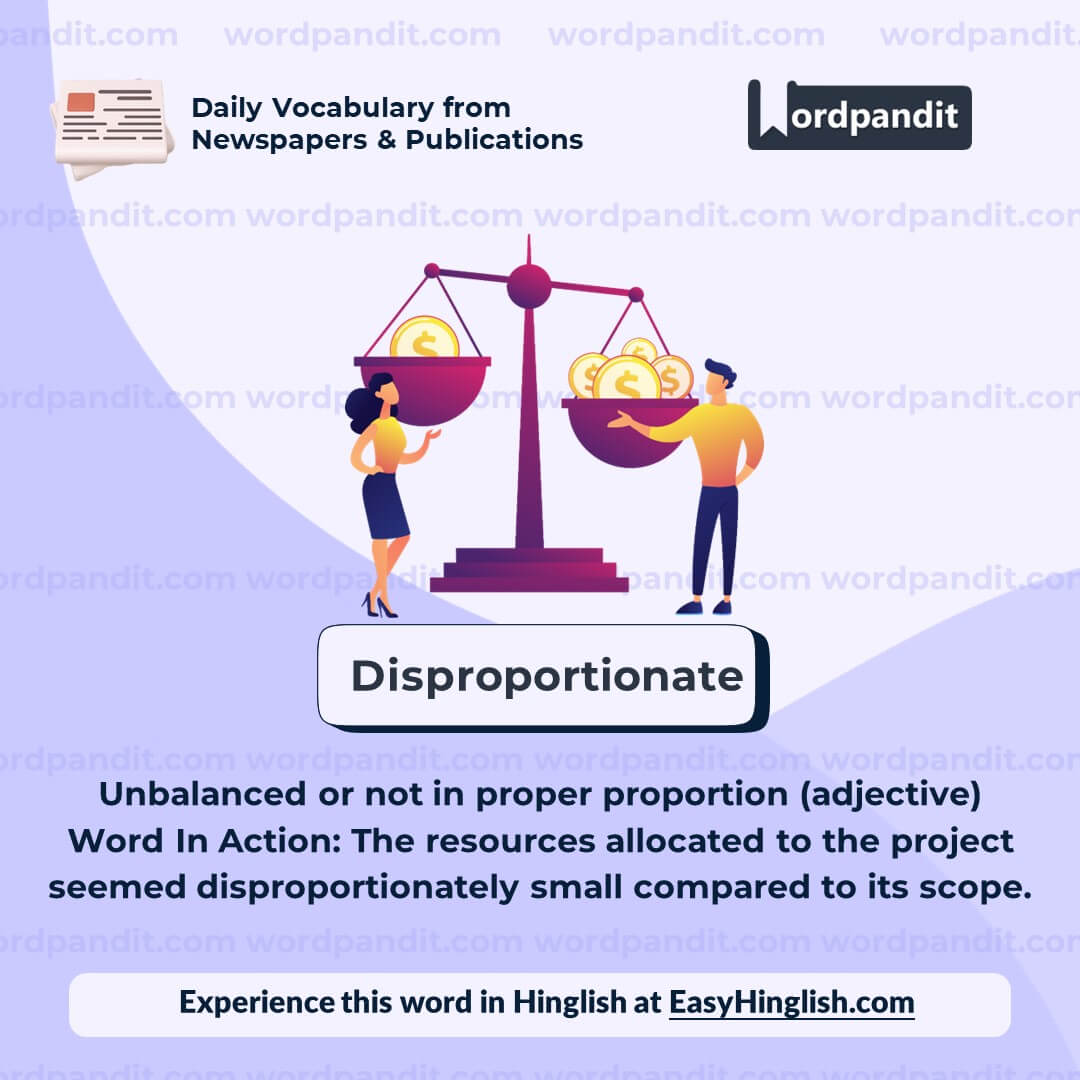
WORD-5: Disproportionate
Context:
"As a year that saw the Adanis and Ambanis capture disproportionate media space by employing the ancient Roman principle, panem et circenses, or bread and circuses, to enthrall the paparazzi and pauper alike." - The Wire
Explanatory Paragraph:
The word disproportionate describes something that is not balanced or not in the right proportion. It indicates an amount, size, or level that is too large or too small when compared to something else. In the context provided, it suggests that the media coverage given to certain business families was much larger than what was reasonable or fair compared to others.
Meaning: Too large or too small in comparison with something else; lacking proper balance (Adjective)
Pronunciation: dis-pro-POHR-shuh-nit
Difficulty Level: ⭐⭐ (Basic–Intermediate)
Etymology: From Latin dis- (apart, not) + proportio (proportion, relation), literally meaning “not in proportion.”
Prashant Sir's Notes:
“Disproportionate” is about imbalance. Whenever one side outweighs the other unfairly—whether in power, wealth, punishment, or attention—this word fits perfectly. It’s useful in both academic and real-world contexts like law, economics, and media.
Synonyms & Antonyms:
Synonyms: excessive, uneven, imbalanced, unequal, overblown
Antonyms: balanced, fair, equal, proportionate, moderate
Usage Examples:
- The punishment was disproportionate to the minor mistake he made.
- Media attention was disproportionate compared to the actual importance of the event.
- The wealth in the city is distributed in a highly disproportionate manner.
- The fear of failure was disproportionate to the actual risk involved.
Cultural Reference:
Discussions of “disproportionate force” are common in global politics, especially when analyzing conflicts where one side uses excessive power compared to the other.
Think About It:
In what areas of society do you see the most disproportionate distribution—wealth, opportunities, or media attention—and why?
Quick Activity:
Write a sentence using “disproportionate” to describe something in your own daily life (e.g., study time vs. leisure time).
Memory Tip:
Break it into “dis + proportionate.” If something is “not proportionate,” it is disproportionate. Think of a scale with one side heavily outweighing the other.
Real-World Application:
This word is frequently used in law, journalism, and economics—for example, describing disproportionate punishments, disproportionate media coverage, or disproportionate income gaps.


