

Daily Vocabulary from Indian Newspapers and Publications
Welcome to Wordpandit’s Indian Vocabulary Hub
At Wordpandit, we understand the importance of staying rooted in the local context while expanding your language skills. This section focuses on enriching your vocabulary with words and phrases drawn from India’s leading newspapers and publications, ensuring you're learning vocabulary that is practical, relevant, and uniquely Indian.
Why Indian Sources Matter
We believe that the best way to master any language is by immersing yourself in local content. That’s why we carefully curate vocabulary from top Indian publications, including:
- The Hindu
- The Times of India
- The Economic Times
- Hindustan Times
- Live Mint
- The Indian Express
- And many others...
Stay Updated, Stay Relevant
With daily updates from Indian news sources, you’ll be consistently learning words that reflect the trends and shifts in Indian society and culture. Our focus is to provide vocabulary that enhances your understanding of the language in an Indian context.
How Wordpandit Supports Your Goals
Whether you’re preparing for exams, aiming to improve your professional communication, or simply want to stay connected with the latest Indian vocabulary, Wordpandit is here to guide you every step of the way.
Learn with a Practical Approach
Our interactive learning methodology includes real-world examples, engaging activities, and context-specific usage to ensure that every word becomes part of your active vocabulary.
Dive into Indian Vocabulary Today!

Why Choose Wordpandit?
Practical Learning: Focus on words you'll actually encounter in real-world reading, enhancing your comprehension and communication skills.
Diverse Content: From current affairs to scientific breakthroughs, our varied sources expose you to vocabulary across multiple domains.
Effortless Integration: Make Wordpandit a part of your daily routine. Just a few minutes each day can significantly boost your lexicon over time.
Your Path to Vocabulary Mastery
- Visit our Daily Vocabulary section regularly
- Explore new words and their usage in context
- Practice incorporating these words into your own writing and speech
- Track your progress as your vocabulary expands
Start Your Journey Today
Embark on your vocabulary enhancement journey with Wordpandit. By consistently engaging with our daily posts, you'll build a robust vocabulary that serves you well in academic, professional, and personal contexts.
Remember, a word a day keeps linguistic limitations at bay. Make Wordpandit your daily companion in the quest for vocabulary excellence!
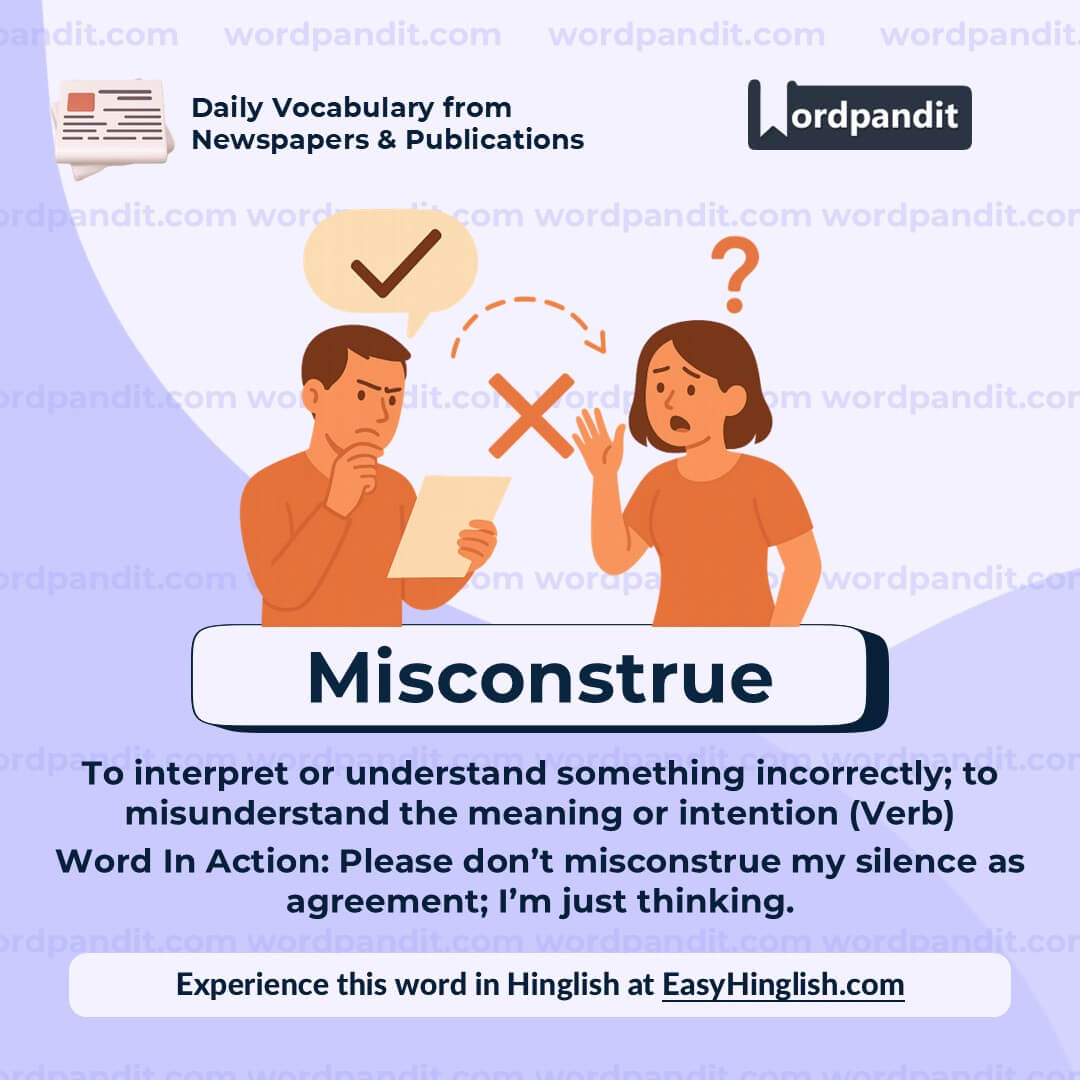
WORD-1: Misconstrue
Context:
"Protectionists seriously misconstrue so-called "trade deficits." Protectionists don't understand the principle of comparative advantage." - The Daily Economy
Explanatory Paragraph:
Misconstrue meaning in English is 'to interpret something incorrectly or understand it in the wrong way.' This word is used when someone misinterprets facts, statements, or situations, often leading to wrong conclusions. How to use misconstrue correctly matters especially in formal writing, legal contexts, and competitive exam passages where precise interpretation is crucial. Misconstrue appears frequently in CAT Reading Comprehension and GRE passages where understanding author's intent and avoiding misinterpretation is tested.
Meaning: To interpret or understand something incorrectly; to misunderstand the meaning or intention (Verb)
Pronunciation: mis-kuhn-STROO
Difficulty Level: ⭐⭐⭐ Intermediate
Etymology: Misconstrue comes from the prefix 'mis-' meaning 'wrongly' combined with 'construe' from Latin 'construere' meaning 'to build or interpret.' The word entered English in the late 14th century, originally used in legal contexts where proper interpretation of laws and contracts was essential. Over time, it evolved to describe any situation where someone misinterprets or misunderstands information, intentions, or statements.
Prashant Sir's Notes:
Many students confuse misconstrue with misunderstand—while both involve getting something wrong, the difference between misconstrue and misunderstand is that misconstrue specifically means interpreting or analyzing something incorrectly, while misunderstand is broader and simpler. For CAT and GRE aspirants, misconstrue frequently appears in Reading Comprehension passages testing your ability to identify when authors discuss misinterpretation or faulty reasoning. Misconstrue usage in sentences typically follows the pattern: "Someone misconstrues something as something else." In Indian English newspapers, you'll often see "critics misconstrue the policy" or "opponents misconstrue the government's intentions"—this is especially common in political and economic analysis where interpretation of actions and statements is debated.
Synonyms & Antonyms:
Synonyms: misinterpret, misunderstand, misread, misjudge, distort, take the wrong way, get wrong, twist, miscalculate, misapprehend
Antonyms: understand correctly, interpret accurately, comprehend, grasp, perceive clearly, construe properly
Usage Examples:
- Opposition leaders often misconstrue the government's economic reforms as anti-poor, when the actual intention is long-term growth and stability.
- Priya's silence during the meeting was misconstrued as agreement, though she actually disagreed with the entire proposal being discussed.
- Critics misconstrue India's foreign policy shifts as weakness, failing to recognize the nuanced diplomacy required in complex geopolitical situations.
- Don't misconstrue my feedback as criticism—I'm genuinely trying to help you improve your presentation skills for the upcoming client meeting.
Cultural Reference:
"In cricket commentary, experts often warn viewers not to misconstrue a defensive batting approach as lack of intent—sometimes patience is the strategy needed to build a strong foundation." - Common theme in Indian cricket analysis
Think About It:
How often do we misconstrue someone's actions or words based on our own biases and assumptions rather than seeking their actual intent?
Quick Activity:
Think of a recent news headline you read. Write two sentences explaining how different groups might misconstrue the same event based on their political or social perspectives.
Memory Tip:
Break 'Misconstrue' into 'MIS + CONSTRUE'—think of 'MIS' as 'mistake' and 'CONSTRUE' as 'construct meaning.' When you misconstrue something, you construct the WRONG meaning or interpretation, like building a house with the wrong blueprint.
Real-World Application:
Misconstrue is commonly used in legal documents, business communications, and academic writing to highlight misinterpretation or faulty reasoning. In newspaper editorials and opinion pieces, writers use this word to point out when opponents or critics are interpreting policies, statements, or actions incorrectly. For competitive exam essays and formal reports, using 'misconstrue' demonstrates sophisticated vocabulary and shows your ability to discuss nuanced interpretation and understanding of complex issues.
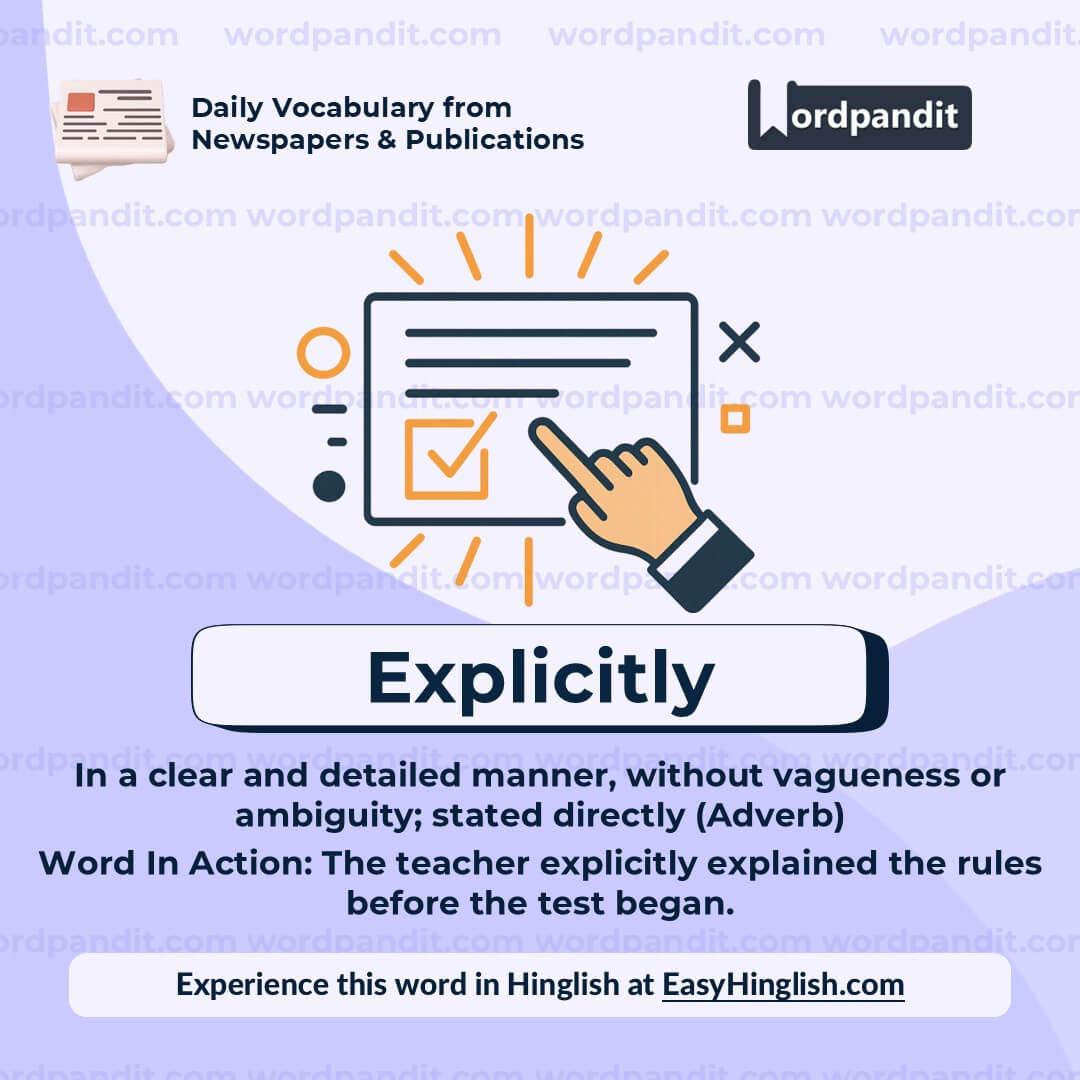
WORD-2: Explicitly
Context:
"We analyze such beliefs by more consciously and explicitly comparing our beliefs logically to concrete analysis of relevant data and established theory." - Overcoming Bias
Explanatory Paragraph:
Explicitly meaning in English is 'in a clear and detailed manner, leaving no room for confusion or doubt.' This word is used when something is stated directly and precisely, without being vague or implied. How to use explicitly matters greatly in academic writing, legal documents, and competitive exams where clarity and precision are essential. Explicitly appears frequently in UPSC essays, CAT Reading Comprehension passages, and GRE analytical writing where distinguishing between what is directly stated versus what is implied becomes crucial for correct interpretation.
Meaning: In a clear and detailed manner, without vagueness or ambiguity; stated directly (Adverb)
Pronunciation: ik-SPLIS-it-lee
Difficulty Level: ⭐⭐ Basic to Intermediate
Etymology: Explicitly comes from Latin 'explicitus' meaning 'unfolded or unraveled,' from 'explicare' meaning 'to unfold or explain clearly.' The word entered English through French in the 17th century, initially used in scholarly and legal contexts where absolute clarity was necessary. Over centuries, it evolved to describe any communication that is direct, clear, and leaves nothing to interpretation, becoming essential in modern academic and professional discourse.
Prashant Sir's Notes:
Many students confuse explicitly with implicitly—these are actually opposites! The difference between explicitly and implicitly is fundamental: explicitly means clearly stated in direct words, while implicitly means suggested or understood without being directly stated. For CAT, GRE, and UPSC aspirants, this distinction is critical because RC passages often test whether information is explicitly mentioned or only implied. Explicitly usage in sentences typically follows patterns like "explicitly stated," "explicitly mentioned," or "explicitly defined." In Indian English newspapers, especially in legal and policy reporting, you'll see phrases like "the guidelines explicitly prohibit" or "the minister explicitly clarified"—this signals that something was said directly, not hinted at. Remember: if you can point to the exact sentence where something is said, it's explicit; if you have to infer or read between lines, it's implicit.
Synonyms & Antonyms:
Synonyms: clearly, directly, unambiguously, precisely, specifically, plainly, openly, categorically, unequivocally, distinctly
Antonyms: implicitly, vaguely, ambiguously, indirectly, obscurely, unclearly
Usage Examples:
- The Supreme Court judgment explicitly stated that citizens have the right to privacy, removing any ambiguity about this fundamental protection.
- Rahul's manager explicitly told him to focus on the Mumbai project, yet he continued spending time on other assignments instead.
- The UPSC notification explicitly mentions that candidates must have a degree from a recognized university to be eligible for the examination.
- My parents never explicitly forbade late-night outings, but their disapproving looks made their feelings quite clear nonetheless.
Cultural Reference:
"In Indian cricket, when the captain explicitly signals for a review, there's no confusion about the decision—unlike subtle gestures that fielders might misinterpret." - Common observation in cricket commentary about clear communication
Think About It:
Why do people sometimes prefer implicit communication over explicitly stating their thoughts, especially in Indian cultural contexts where directness might be seen as rude?
Quick Activity:
Write two sentences: one where a rule is explicitly stated, and another where expectations are only implicit. Notice how the clarity differs between both approaches.
Memory Tip:
Think of 'Explicitly' as 'EX-PLAIN-IT-LY'—when you explain something explicitly, you PLAIN it out clearly with no hidden meanings. Imagine a teacher writing instructions on the blackboard in big, bold letters—that's explicit communication, nothing hidden or unclear!
Real-World Application:
Explicitly is essential in legal documents, business contracts, academic research papers, and policy guidelines where absolute clarity prevents misinterpretation. In corporate emails and professional communication, using 'explicitly' helps avoid confusion about instructions or expectations. For competitive exam essays, particularly in UPSC and GRE analytical writing, using 'explicitly' versus 'implicitly' demonstrates sophisticated understanding of textual analysis. Journalists use this word to distinguish between what officials directly stated versus what reporters inferred, making it crucial for media literacy and critical reading skills.
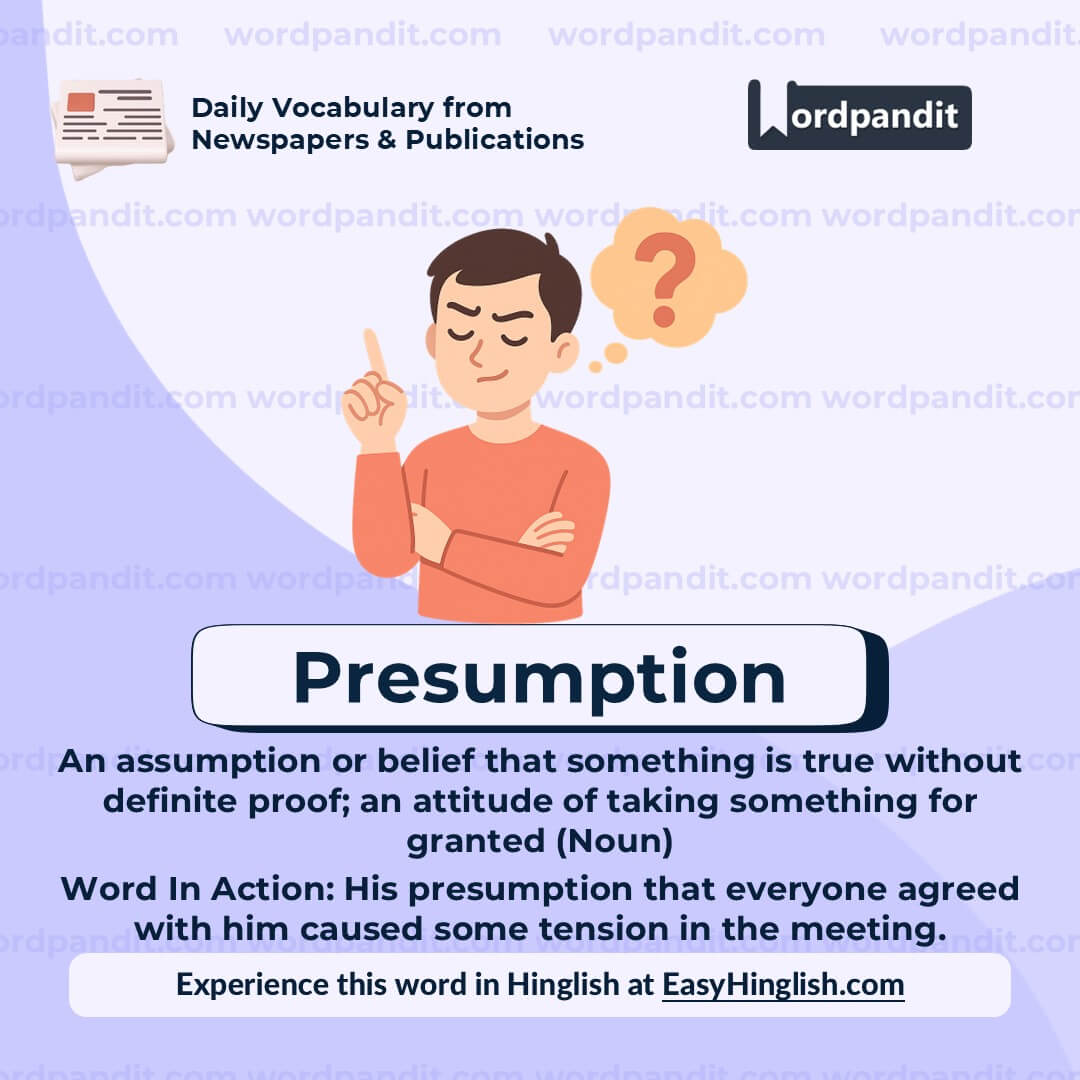
WORD-3: Presumption
Context:
"But I instead want to focus on one infrequently mentioned protectionist fallacy – namely, the protectionist presumption that their fellow citizens regularly spend and invest their own money stupidly." - The Daily Economy
Explanatory Paragraph:
Presumption meaning in English is 'an assumption that something is true without having proof, or the act of believing something based on probability rather than certainty.' This word is used when someone takes something for granted or makes judgments without complete evidence. Presumption is commonly used in legal contexts, formal debates, and competitive exam passages to describe assumptions, beliefs, or attitudes that may or may not be justified. How to use presumption correctly is important for CAT, GRE, and UPSC aspirants as it frequently appears in argumentative passages and critical reasoning questions.
Meaning: An assumption or belief that something is true without definite proof; an attitude of taking something for granted (Noun)
Pronunciation: pri-ZUMP-shuhn
Difficulty Level: ⭐⭐⭐ Intermediate
Etymology: Presumption comes from Latin 'praesumptio,' from 'praesumere' meaning 'to take beforehand or anticipate,' combining 'prae' (before) and 'sumere' (to take). The word entered English in the 13th century through Old French, initially used in legal contexts to describe assumptions made in the absence of complete evidence. It evolved to encompass both the act of assuming something and the attitude of overconfidence or audacity in making such assumptions, making it particularly useful in describing logical fallacies and unwarranted beliefs.
Prashant Sir's Notes:
Students often ask: what is the difference between presumption and assumption? While closely related, presumption carries a slightly stronger connotation—it suggests not just assuming something, but assuming it with some confidence or authority, often without adequate justification. For CAT and GRE aspirants, presumption frequently appears in critical reasoning passages where you need to identify flawed logic or unwarranted beliefs. Presumption usage in arguments typically signals weak reasoning: "The author's presumption that X leads to Y" indicates a logical gap. In Indian English newspapers, particularly in legal and political reporting, you'll see phrases like "presumption of innocence" (a legal principle) or "the presumption that citizens are uninformed"—this word helps identify underlying beliefs that drive arguments. Remember: in RC passages, spotting the author's presumptions is key to understanding their argument's strengths and weaknesses.
Synonyms & Antonyms:
Synonyms: assumption, supposition, belief, conjecture, premise, hypothesis, postulation, inference, preconception, surmise
Antonyms: certainty, proof, evidence, fact, verification, confirmation, knowledge
Usage Examples:
- The presumption that rural Indians lack financial literacy ignores the sophisticated informal credit systems that have existed in villages for centuries.
- Priya challenged her colleague's presumption that younger employees were more tech-savvy, pointing out that skill depends on learning, not age.
- The government's policy was based on the presumption that subsidies would reach intended beneficiaries, though leakage remained a persistent problem.
- Rahul's presumption that his friend would lend him money without asking created an awkward situation when he actually needed to make the request.
Cultural Reference:
"In legal proceedings, the presumption of innocence until proven guilty is a cornerstone of Indian justice, famously emphasized in landmark Supreme Court judgments protecting individual rights." - Fundamental principle in Indian constitutional law
Think About It:
How many of our daily decisions are based on presumptions about others' thoughts, abilities, or intentions rather than actual evidence or communication?
Quick Activity:
Identify three presumptions you made today about people or situations. Write down what evidence you actually had versus what you simply assumed was true.
Memory Tip:
Break 'Presumption' into 'PRE-SUMPTION'—think of it as 'pre-consuming' or taking something BEFORE you have it. Like assuming you'll get the job before the interview results, or presuming someone agrees before asking them. You're jumping to conclusions before having the complete picture!
Real-World Application:
Presumption is crucial in legal writing, academic arguments, policy analysis, and critical thinking. In law, phrases like "presumption of innocence" and "rebuttable presumption" are foundational concepts. In business communication and strategic planning, identifying presumptions helps assess risk and challenge unexamined beliefs. For competitive exam essays, especially UPSC and GRE analytical writing, recognizing and articulating presumptions in arguments demonstrates advanced critical thinking. Journalists and analysts use this word to critique policies or arguments built on unverified assumptions, making it essential for media literacy and persuasive writing.
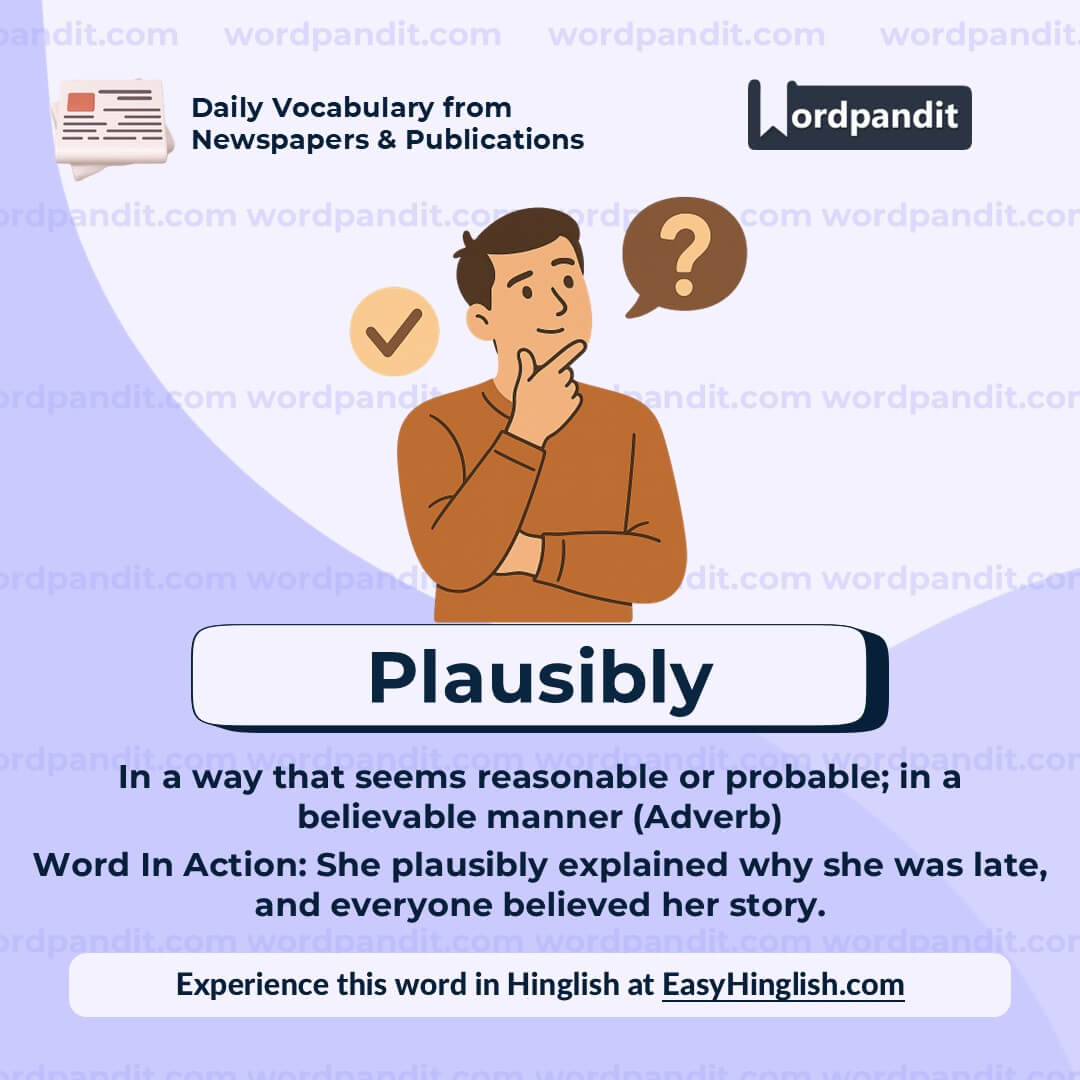
WORD-4: Plausibly
Context:
"Even when that's not what most experts themselves do. Yes, they plausibly achieve social ends from that behavior which I forgo." - Overcoming Bias
Explanatory Paragraph:
Plausibly meaning in English is 'in a manner that seems reasonable or probable, though not necessarily proven or certain.' This word is used when something appears believable or credible on the surface, even if complete evidence is lacking. Plausibly is commonly used in academic writing, analytical discussions, and competitive exam passages to describe explanations, theories, or claims that sound reasonable but may require further verification. How to use plausibly effectively is important for GRE, CAT, and UPSC aspirants, as it frequently appears in passages discussing hypotheses, arguments, and logical reasoning.
Meaning: In a way that seems reasonable or probable; in a believable manner (Adverb)
Pronunciation: PLAW-zuh-blee
Difficulty Level: ⭐⭐⭐ Intermediate
Etymology: Plausibly comes from Latin 'plausibilis' meaning 'deserving applause or approval,' from 'plaudere' meaning 'to clap or applaud.' The word entered English in the 16th century, originally carrying the sense of something worthy of approval. Over time, its meaning evolved to describe something that appears worthy of belief or acceptance—not necessarily true, but reasonable enough to be considered credible. This evolution reflects the subtle distinction between what seems convincing and what is actually proven, making it particularly valuable in academic and analytical discourse.
Prashant Sir's Notes:
Many students confuse plausibly with possibly or probably—here's the key difference: plausibly means something seems reasonable or believable based on available information, while possibly means it could happen (without commenting on believability), and probably means it's likely to be true. The difference between plausibly and probably matters enormously in CAT and GRE Reading Comprehension. When an author says something "plausibly explains" a phenomenon, they're saying it sounds reasonable but aren't fully committing to it being true. For UPSC essay writing, using plausibly shows sophisticated thinking—you're acknowledging that an explanation sounds good without claiming certainty. In Indian English newspapers, you'll often see "this could plausibly lead to" in economic or political analysis, signaling that journalists are presenting reasonable scenarios without making definitive predictions. Pro tip: in RC passages, "plausibly" is often your clue that the author is presenting one possible explanation among several, not the definitive answer.
Synonyms & Antonyms:
Synonyms: believably, credibly, reasonably, conceivably, feasibly, convincingly, probably, seemingly, apparently, arguably
Antonyms: implausibly, unbelievably, incredibly, unconvincingly, unreasonably, impossibly
Usage Examples:
- The economist argued that reducing interest rates could plausibly stimulate manufacturing growth, though several other factors would also need to align favorably.
- Aditi plausibly explained her delay by citing Mumbai's unpredictable traffic, and her boss accepted the explanation without further questions.
- Historians suggest that trade connections could plausibly account for the cultural similarities between ancient civilizations separated by vast distances.
- The startup's business model plausibly projects profitability within three years, assuming customer acquisition costs remain stable and market conditions don't deteriorate.
Cultural Reference:
"In cricket analysis, commentators often say a team could plausibly chase 350 runs on a flat pitch with dew—it sounds achievable, though still challenging and far from guaranteed." - Common in IPL and international cricket commentary
Think About It:
How often do we accept explanations simply because they sound plausible, without questioning whether they're actually true or supported by evidence?
Quick Activity:
Think of a recent news story or claim you encountered. Write two sentences: one explaining what was plausibly true about it, and another questioning what evidence was actually missing.
Memory Tip:
Connect 'Plausibly' to 'APPLAUSE-ibly'—from its Latin root 'plaudere' (to applaud). When something is plausible, it's worthy of a mental applause because it sounds good and reasonable, like when you hear an explanation and think "that makes sense!" even if you're not 100% sure it's true.
Real-World Application:
Plausibly is essential in academic writing, research papers, and analytical reports where scholars present theories or explanations that seem reasonable but require further verification. In business strategy documents and consulting reports, professionals use "plausibly" to present scenarios and projections that sound credible without claiming certainty. For competitive exam essays, particularly GRE analytical writing and UPSC mains, using "plausibly" demonstrates nuanced thinking—you're acknowledging reasonable explanations while maintaining intellectual honesty about uncertainty. Journalists and opinion writers use this word to present possible explanations for events without making definitive claims, making it crucial for credible analysis and balanced reporting.
WORD-5: Epitomize
Context:
"the graceful Sharmila Tagore who epitomizes elegance, dignity and intellect. Being a die-hard fan of this lady with beauty and brains I was prompted to watch the show." - India Times
Explanatory Paragraph:
Epitomize meaning in English is 'to be a perfect example or representation of a particular quality or type.' This word is used when someone or something perfectly embodies or represents specific characteristics or ideals. Epitomize is commonly used in descriptive writing, character analysis, and competitive exam essays to highlight how something serves as the quintessential example of a concept. How to use epitomize effectively is crucial for CAT, GRE, and UPSC aspirants, as it appears frequently in passages analyzing people, movements, cultures, or historical periods that exemplify particular traits or values.
Meaning: To be a perfect example of something; to represent or embody the essential characteristics of something (Verb)
Pronunciation: ih-PIT-uh-myz
Difficulty Level: ⭐⭐⭐ Intermediate
Etymology: Epitomize comes from Greek 'epitome' meaning 'a summary or abridgment,' from 'epitemnein' meaning 'to cut short,' combining 'epi' (upon) and 'temnein' (to cut). The word entered English in the 16th century, originally meaning to make an abstract or summary of something. Over time, its meaning shifted from creating a condensed version to being a perfect representation or embodiment of qualities—essentially becoming the living summary of certain characteristics. This evolution makes it particularly powerful for describing people, events, or things that capture the essence of larger concepts.
Prashant Sir's Notes:
Students often confuse epitomize with symbolize or represent—while all three involve standing for something, the difference between epitomize and symbolize is crucial. Epitomize means to be the perfect, quintessential example of something, while symbolize means to stand for or represent something through association. For example, Sharmila Tagore epitomizes grace (she IS the perfect example), while a dove symbolizes peace (it represents peace through cultural association). For CAT and GRE aspirants, epitomize frequently appears in biographical passages and cultural analysis where authors discuss figures who perfectly embody certain qualities. Epitomize usage in sentences typically follows the pattern: "X epitomizes Y quality/concept." In Indian English newspapers and magazines, you'll see phrases like "Sachin Tendulkar epitomizes dedication" or "the Taj Mahal epitomizes eternal love"—these aren't just symbols but perfect embodiments. Pro tip for essays: use epitomize when you want to elevate your description and show that something isn't just an example but THE definitive example of a quality.
Synonyms & Antonyms:
Synonyms: embody, exemplify, personify, represent, typify, incarnate, characterize, encapsulate, illustrate, manifest
Antonyms: contradict, oppose, misrepresent, distort, belie
Usage Examples:
- M.S. Dhoni epitomizes calmness under pressure, finishing countless matches with his trademark composure even in the most intense situations.
- The Bengaluru traffic problem epitomizes the challenges of rapid urbanization without adequate infrastructure planning that many Indian cities now face.
- Kiran Bedi's career epitomizes breaking gender barriers, as she became the first woman IPS officer and paved the way for thousands who followed.
- My grandmother's simple lifestyle epitomizes contentment—she finds joy in small things rather than constantly chasing material possessions and status symbols.
Cultural Reference:
"Amitabh Bachchan's character in 'Deewar' epitomized the 'angry young man' phenomenon of 1970s Indian cinema, perfectly capturing the frustration and rebellion of an entire generation." - Common observation in Bollywood film analysis
Think About It:
Which contemporary Indian figure epitomizes the qualities you most admire, and what specific actions or characteristics make them the perfect embodiment of those values?
Quick Activity:
Choose three public figures from different fields (sports, cinema, politics, business). Write one sentence for each explaining what quality they epitomize and why they're the perfect example of it.
Memory Tip:
Think of 'Epitomize' as 'EPIC-TOME-ize'—when someone epitomizes something, they're like the EPIC TOME (definitive book) on that quality. Just as Sachin Tendulkar is the epic tome on cricket dedication, or just as the Taj Mahal is the epic tome on architectural beauty—they ARE the perfect, complete example!
Real-World Application:
Epitomize is essential in biographical writing, cultural analysis, character descriptions, and critical essays where writers need to identify perfect examples of qualities or concepts. In business case studies and leadership articles, professionals use "epitomize" to highlight individuals or companies that perfectly embody certain values or approaches. For competitive exam essays, particularly UPSC mains and GRE analytical writing, using "epitomize" elevates your analysis by showing you can identify quintessential examples rather than just listing ordinary instances. Magazine profiles, film reviews, and cultural commentary frequently employ this word to capture how certain figures or works perfectly represent broader trends, movements, or ideals in society.


