

Daily Vocabulary from International Newspapers and Publications
Expand Your Vocabulary with Wordpandit’s Global Vocabulary Hub
At Wordpandit, we are committed to helping you develop a truly global vocabulary by drawing from some of the most respected international publications. This section is designed to keep you ahead of the curve by introducing you to words that define global conversations and trends.
The Power of Global Sources
To help you think and communicate on a global scale, we curate vocabulary from renowned international sources, such as:
- The New York Times
- The Washington Post
- BBC
- The Guardian
- The Economist
- Scientific American
- Psychology Today
- And many more...
Stay Global, Stay Competitive
Our daily updates from international publications ensure you are consistently exposed to new words that reflect global news and developments, making sure your vocabulary is not only current but also globally relevant.
Enhance Your Global Perspective
Whether you’re preparing for international exams, aiming to excel in global business communication, or want to enhance your language skills for personal growth, Wordpandit offers the resources you need to thrive in a global context.
Effective Learning, Global Reach
Our learning methodology combines global examples, memory aids, and interactive activities, allowing you to internalize new words effectively and apply them in real-world scenarios.
Begin Your Global Vocabulary Journey Now!

Why Choose Wordpandit?
Practical Learning: Focus on words you'll actually encounter in real-world reading, enhancing your comprehension and communication skills.
Diverse Content: From current affairs to scientific breakthroughs, our varied sources expose you to vocabulary across multiple domains.
Effortless Integration: Make Wordpandit a part of your daily routine. Just a few minutes each day can significantly boost your lexicon over time.
Your Path to Vocabulary Mastery
- Visit our Daily Vocabulary section regularly
- Explore new words and their usage in context
- Practice incorporating these words into your own writing and speech
- Track your progress as your vocabulary expands
Start Your Journey Today
Embark on your vocabulary enhancement journey with Wordpandit. By consistently engaging with our daily posts, you'll build a robust vocabulary that serves you well in academic, professional, and personal contexts.
Remember, a word a day keeps linguistic limitations at bay. Make Wordpandit your daily companion in the quest for vocabulary excellence!
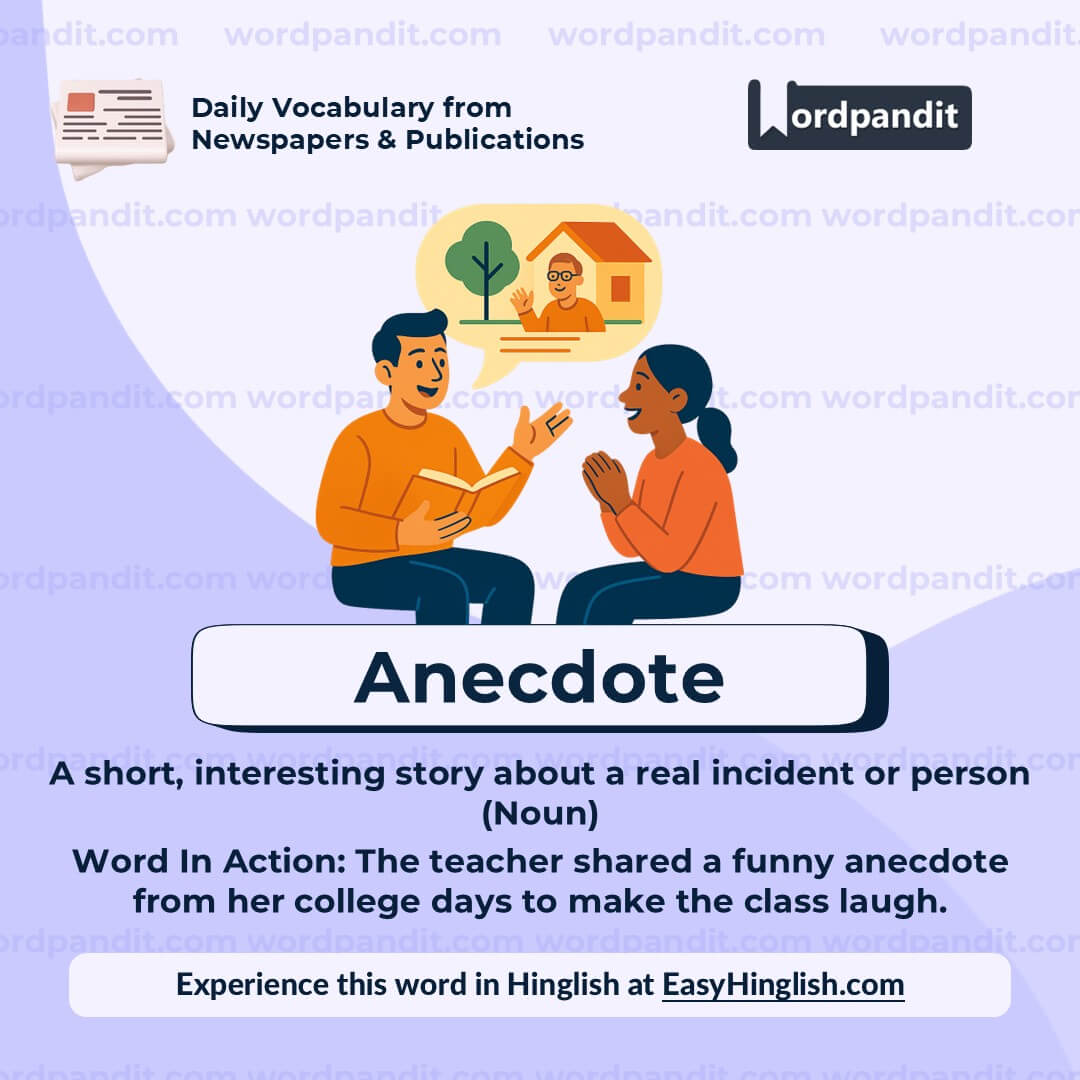
WORD-1: Anecdote
Context:
"Among the several anecdotes of her personal and professional life that she narrated, there was one which struck a chord in me." - India Times
Explanatory Paragraph:
Anecdote meaning in English is a short, interesting, or amusing story about a real incident or person. This word is used when someone shares a brief personal experience to illustrate a point or entertain listeners. How to use anecdote effectively appears frequently in formal speeches, creative writing, and competitive exam essays where candidates need to support arguments with real-life examples. Anecdotes make abstract concepts relatable and memorable.
Meaning: A short, interesting story about a real incident or person (Noun)
Pronunciation: AN-ik-doht
Difficulty Level: ⭐⭐ Basic to Intermediate
Etymology: Anecdote comes from Greek 'anekdota' meaning 'things unpublished,' derived from 'an-' (not) and 'ekdotos' (published). Originally, it referred to secret or private stories not meant for publication. Over time, the meaning shifted to describe any brief, entertaining story shared in conversation or writing.
Prashant Sir's Notes:
Many students confuse anecdote with 'antidote'—the pronunciation is similar but the meanings are completely different! The difference between anecdote and example is important for essay writing: an anecdote is always a story-based illustration with characters and events, while an example can be just a fact or statistic. For CAT and UPSC essay writing, knowing how to use anecdote correctly gives you a powerful tool—examiners love when candidates open essays with compelling personal anecdotes that connect to broader themes. In Indian English newspapers, you'll often see politicians and celebrities sharing anecdotes during interviews to build relatability with readers.
Synonyms & Antonyms:
Synonyms: story, tale, narrative, account, sketch, vignette, reminiscence, yarn (informal), incident, episode
Antonyms: fact, data, statistic, evidence, documentation, record
Usage Examples:
- The keynote speaker opened her TED talk with a touching anecdote about her grandmother's struggle during the Partition.
- Rajesh shared an amusing anecdote from his college days to lighten the mood during the tense board meeting.
- The author's memoir is filled with anecdotes that reveal the hidden challenges of building a startup in Bangalore.
- During family gatherings, my uncle loves sharing anecdotes about his days working on the Indian Railways.
Cultural Reference:
"In '3 Idiots,' Rancho's anecdotes about real learning versus rote memorization became iconic moments that resonated with students across India." - Commentary on Indian cinema's impact on education discourse
Think About It:
Why do anecdotes often convince people more effectively than statistics and data, especially in Indian family discussions and political debates?
Quick Activity:
Write a brief anecdote (4-5 sentences) about a memorable moment from your school or college life that taught you an important lesson.
Memory Tip:
Think of 'Anecdote' as "AN-ek-DOST" (one friend in Hindi)—imagine that one friend in every group who always has interesting stories to share at chai sessions!
Real-World Application:
Anecdote is commonly used in motivational speeches, business presentations, and personal essays to make abstract concepts concrete and relatable. Journalists use anecdotes as leads to humanize complex news stories, while teachers share anecdotes to make lessons memorable. In competitive exam essays for UPSC and CAT, opening with a relevant anecdote immediately engages evaluators and demonstrates sophisticated writing skills.
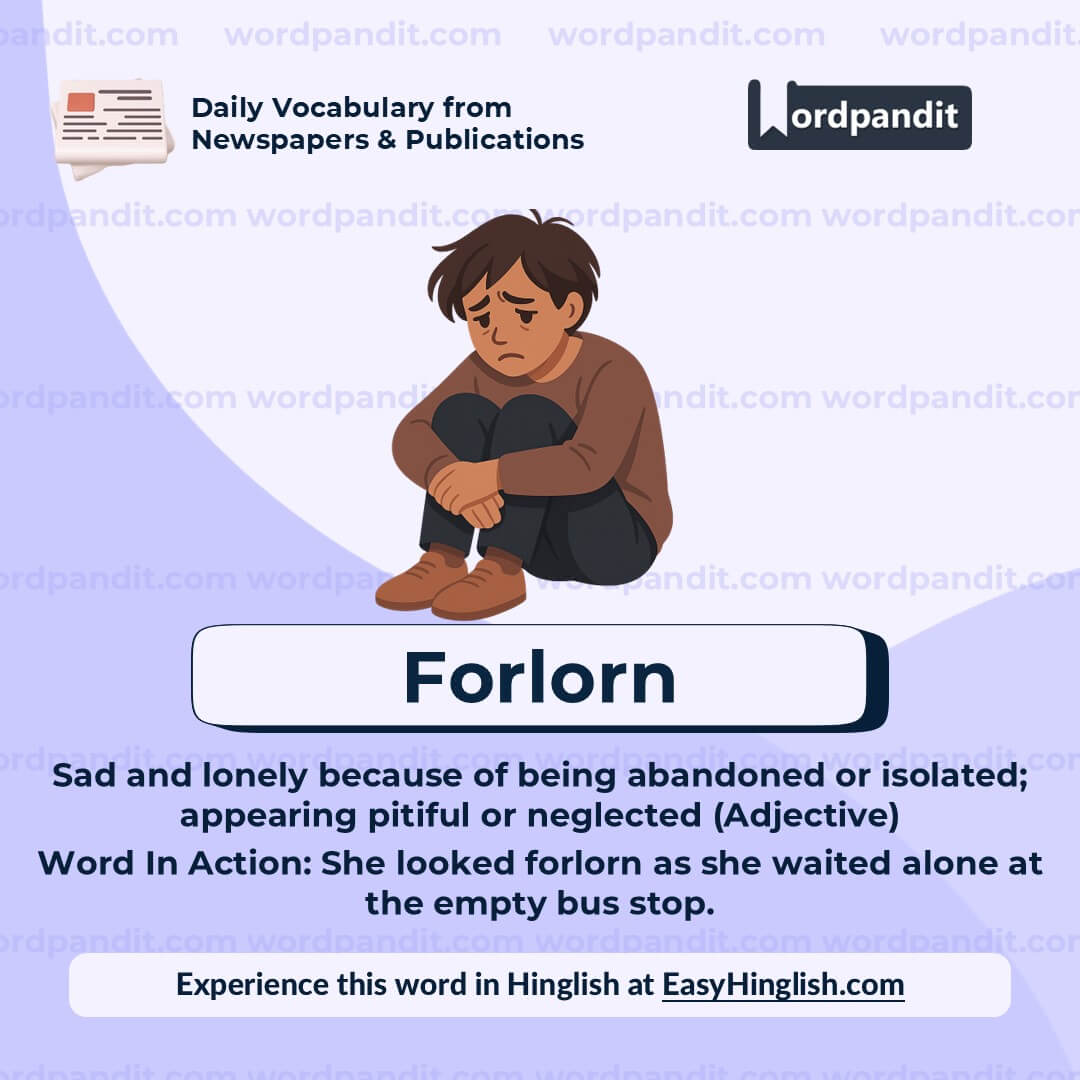
WORD-2: Forlorn
Context:
"Sharmila Tagore cited the example of the 1966 film Anupama in which her character supposed to be dejected and forlorn is nevertheless donning a pompous buffon or bouffant as the French termed it!!" - India Times
Explanatory Paragraph:
Forlorn meaning in English is feeling sad, lonely, and abandoned, or appearing pitiful and uncared for. This word is used when describing someone in a state of deep sadness or something that looks neglected and hopeless. How to use forlorn appears frequently in literature, film reviews, and competitive exam passages to convey emotional desolation or physical abandonment. Forlorn carries a sense of both sadness and hopelessness together.
Meaning: Sad and lonely because of being abandoned or isolated; appearing pitiful or neglected (Adjective)
Pronunciation: for-LORN
Difficulty Level: ⭐⭐⭐ Intermediate
Etymology: Forlorn comes from Old English 'forloren,' the past participle of 'forleosan' meaning 'to lose completely' or 'to abandon.' The prefix 'for-' intensified the meaning of 'lorn' (lost), creating a word that conveys utter abandonment. Over centuries, it evolved to describe both emotional states of loneliness and physical states of neglect.
Prashant Sir's Notes:
Students often ask: what is the difference between forlorn and lonely? While both indicate sadness, forlorn usage in sentences specifically suggests abandonment and hopelessness—it's loneliness with no expectation of improvement. For GRE and CAT reading comprehension, forlorn frequently appears in passages describing characters in despair or abandoned places. The word works for both people and places: a forlorn person feels abandoned, while a forlorn building looks neglected. In Indian English literature, you'll often see forlorn used to describe monsoon scenes—"forlorn streets after the rain"—which perfectly captures that melancholic, empty atmosphere we all recognize.
Synonyms & Antonyms:
Synonyms: abandoned, deserted, lonely, desolate, forsaken, dejected, hopeless, pitiful, wretched, woebegone, bereft
Antonyms: cheerful, hopeful, cared-for, cherished, optimistic, joyful
Usage Examples:
- The forlorn puppy sat outside the closed pet shop in Mumbai, waiting for someone to notice him.
- After failing the UPSC interview for the third time, Meera felt utterly forlorn and questioned her life choices.
- The abandoned textile mill in Ahmedabad stood forlorn, a reminder of the city's once-thriving industrial past.
- He made a forlorn attempt to reconcile with his family after years of estrangement, but they refused to meet him.
Cultural Reference:
"In Devdas, Shah Rukh Khan's character exemplifies the forlorn lover—abandoned by society, drowning in hopelessness, and unable to escape his misery despite multiple chances." - Analysis of iconic Bollywood portrayals of despair
Think About It:
Why do forlorn characters in Indian cinema often evoke more sympathy than angry or rebellious ones? What does this reveal about our cultural attitudes toward suffering?
Quick Activity:
Describe a forlorn place you've seen in your city—an abandoned building, empty playground, or closed shop. Write three sentences capturing both its physical appearance and the emotion it evokes.
Memory Tip:
Break 'Forlorn' into "FOR-LONE"—imagine someone who is left alone FOR a very long time, feeling sad and abandoned. The "lone" part reminds you it's about loneliness and isolation.
Real-World Application:
Forlorn is commonly used in literary analysis, film reviews, and descriptive journalism to convey deep emotional or physical abandonment. Writers use forlorn to describe neglected urban spaces, characters in despair, or hopeless situations in news features. In competitive exam essays for CAT and GRE, using forlorn instead of just "sad" demonstrates vocabulary sophistication and adds emotional depth to your writing, particularly when discussing social issues or character analysis.
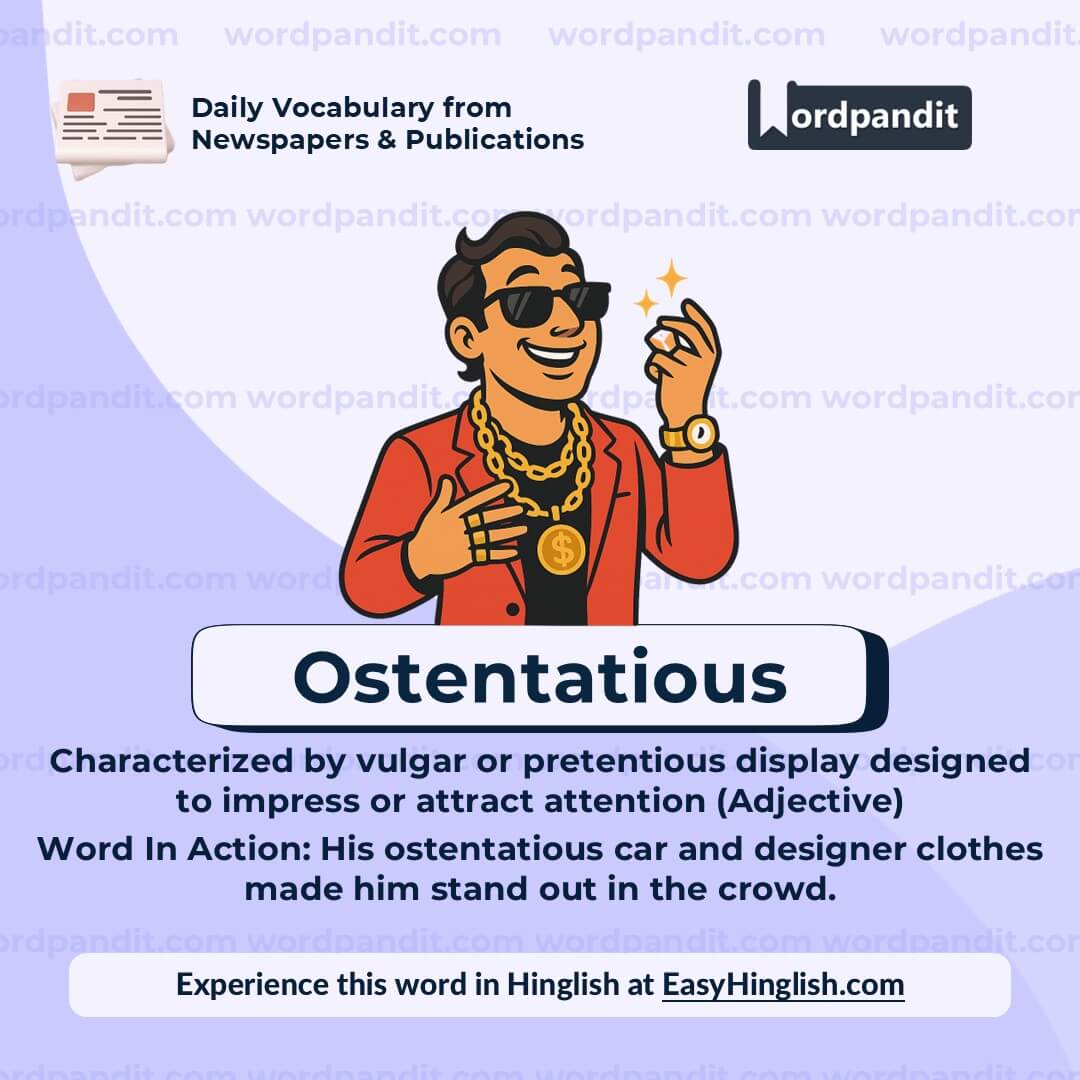
WORD-3: Ostentatious
Context:
"Mala Sinha to name a few eminent artists were given very ostentatious hairstyles even though the script did not require it." - India Times
Explanatory Paragraph:
Ostentatious meaning in English is characterized by showy, vulgar, or excessive display designed to impress others. This word is used when describing behavior, possessions, or appearances that are deliberately flashy to attract attention and demonstrate wealth or importance. How to use ostentatious appears frequently in social commentary, literature, and competitive exam passages discussing materialism or pretentious behavior. Ostentatious always carries a negative connotation of showing off inappropriately.
Meaning: Characterized by vulgar or pretentious display designed to impress or attract attention (Adjective)
Pronunciation: os-ten-TAY-shus
Difficulty Level: ⭐⭐⭐ Intermediate
Etymology: Ostentatious comes from Latin 'ostentare' meaning 'to display or exhibit,' which itself derives from 'ostendere' (to show). The word entered English through French 'ostentatieux' in the mid-17th century. Originally neutral in meaning simply referring to display, it gradually acquired its current negative sense of excessive or inappropriate showing off, reflecting social attitudes toward modesty and restraint.
Prashant Sir's Notes:
Many students confuse ostentatious with 'luxurious'—but there's a crucial difference between ostentatious and expensive. Something can be expensive without being ostentatious, but ostentatious always implies showing off. For CAT and GRE critical reasoning passages, ostentatious usage in sentences signals the author's disapproval of excessive display. The key is intention: ostentatious people want others to notice and be impressed. In Indian English context, you'll often see ostentatious used to describe big fat weddings with unnecessary extravagance—"ostentatious celebrations" is a common phrase in editorials criticizing lavish spending. Remember: if it's meant to show off wealth or importance, it's ostentatious!
Synonyms & Antonyms:
Synonyms: showy, flashy, flamboyant, pretentious, gaudy, extravagant, conspicuous, vulgar (in display), garish, loud
Antonyms: modest, understated, humble, simple, plain, discreet, subtle, restrained
Usage Examples:
- The businessman's ostentatious display of wealth—with gold-plated cars and diamond-studded watches—made everyone uncomfortable at the charity event.
- Despite her family's riches, Priya preferred simple jewelry and avoided the ostentatious lifestyle her cousins embraced.
- The actor's ostentatious mansion in Bandra, complete with a private helipad, became a symbol of Bollywood excess.
- Critics called the wedding ostentatious and wasteful, especially given the widespread poverty in the surrounding areas of the venue.
Cultural Reference:
"In 'Crazy Rich Asians,' the ostentatious wealth displays mirror what we often see in Indian weddings—where celebrations become competitions to showcase family status rather than genuine joy." - Commentary on cross-cultural displays of wealth
Think About It:
Why has ostentatious display become more common in Indian society with social media, where every celebration and purchase is photographed and shared online?
Quick Activity:
List three examples of ostentatious behavior you've observed on social media or in real life. What made each example cross the line from simply nice to unnecessarily showy?
Memory Tip:
Think of 'Ostentatious' as "OH-STAN-TENSIONS"—imagine someone who creates TENSION at gatherings by constantly showing off, making everyone say "OH!" in annoyance at their display. The "show" sound in the word reminds you it's about showing off.
Real-World Application:
Ostentatious is commonly used in social criticism, lifestyle journalism, and opinion pieces to critique excessive displays of wealth or status. Business writers use it when discussing corporate culture or marketing strategies that focus too heavily on flashy presentations. In competitive exam essays for UPSC and CAT, using ostentatious effectively demonstrates your ability to analyze social behavior critically, particularly when writing about consumerism, inequality, or changing cultural values in modern India.
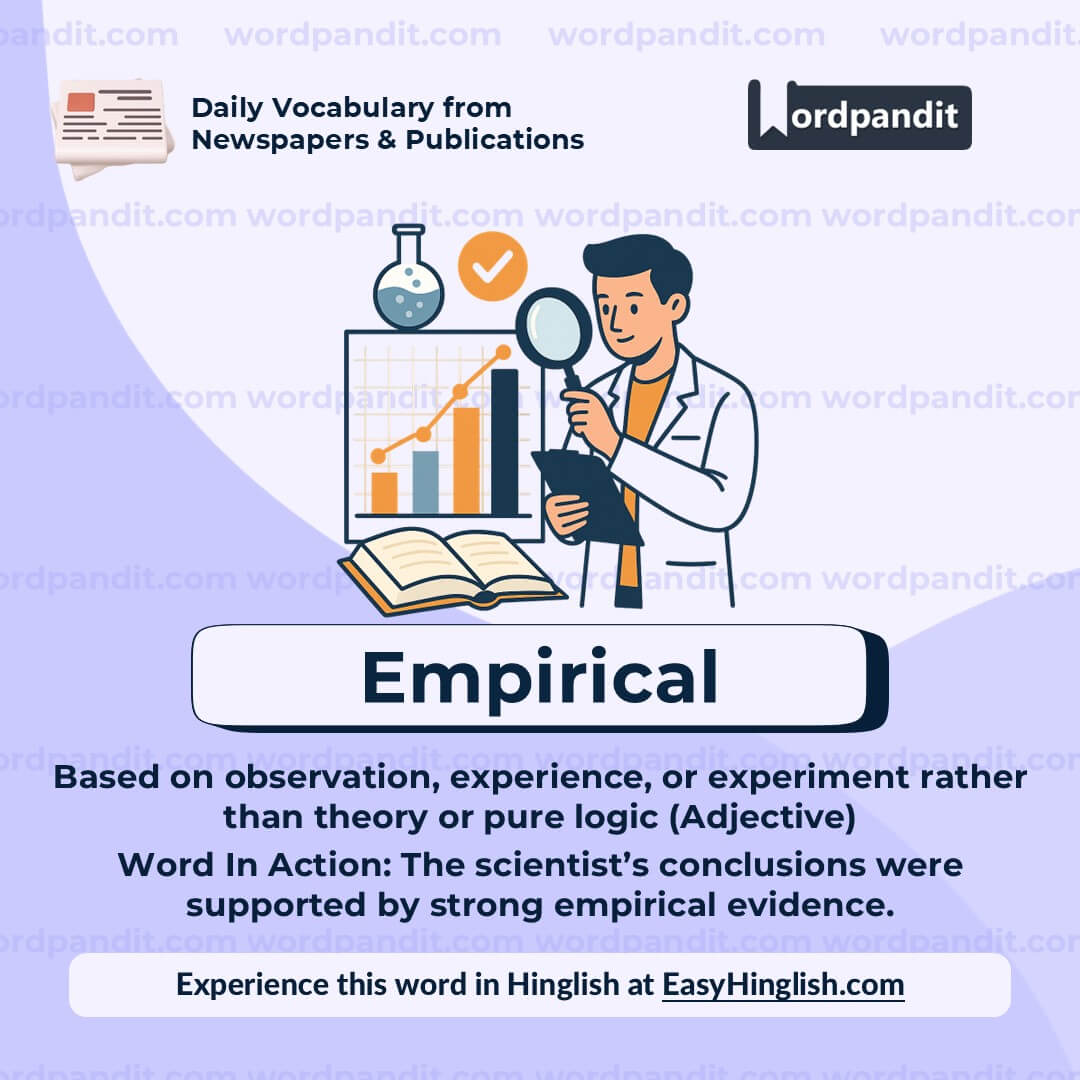
WORD-4: Empirical
Context:
"Their facial features, their normal height, and their natural tresses! To construct empirical structures on their heads with ribbons, wires, bands, laces, frills." - India Times
Explanatory Paragraph:
Empirical meaning in English is based on observation, experience, or experiment rather than theory or pure logic. This word is used when describing knowledge, evidence, or methods that rely on actual data collected from the real world. How to use empirical appears frequently in scientific writing, research papers, and competitive exam passages discussing methodology and evidence-based conclusions. Empirical evidence is considered more reliable than speculation or theoretical assumptions alone.
Meaning: Based on observation, experience, or experiment rather than theory or pure logic (Adjective)
Pronunciation: em-PEER-ih-kul
Difficulty Level: ⭐⭐⭐ Intermediate to Advanced
Etymology: Empirical comes from Greek 'empeirikos' meaning 'experienced,' derived from 'empeiria' (experience) which combines 'en-' (in) and 'peira' (trial or attempt). The term entered English through Latin 'empiricus' in the 16th century, originally referring to physicians who relied on practical experience rather than medical theory. It evolved to describe any knowledge gained through direct observation and experimentation.
Prashant Sir's Notes:
Students often ask: what is the difference between empirical and theoretical? Empirical research involves collecting actual data through observation or experiments, while theoretical work relies on logical reasoning and existing concepts. For GRE and UPSC aspirants, empirical frequently appears in passages about scientific methodology—phrases like "empirical evidence" or "empirical study" signal that conclusions are backed by real-world data. In CAT reading comprehension, when you see "empirical," the author is emphasizing facts over opinions. In Indian academic writing, "empirical analysis" has become essential vocabulary—whether discussing economic policies, social research, or medical studies, proving claims with empirical data gives credibility to arguments.
Synonyms & Antonyms:
Synonyms: observational, experiential, experimental, evidence-based, practical, factual, data-driven, verifiable, observable
Antonyms: theoretical, speculative, hypothetical, conjectural, abstract, unproven, anecdotal
Usage Examples:
- The ICMR conducted an empirical study across twelve states to assess the effectiveness of the new vaccination program.
- Rather than relying on assumptions, the startup gathered empirical data from customer surveys before launching their product in Bengaluru.
- The economist's theory about inflation sounded convincing, but it lacked empirical evidence from actual market conditions.
- Dr. Sharma's research provided empirical proof that traditional Ayurvedic practices could complement modern medicine in treating certain ailments.
Cultural Reference:
"In 'Rocket Boys,' Homi Bhabha and Vikram Sarabhai's insistence on empirical research over imported theories laid the foundation for India's space program—proving that homegrown observation and experimentation could achieve remarkable results." - Historical commentary on Indian scientific achievements
Think About It:
In the age of social media where opinions spread rapidly, why is empirical evidence more important than ever for making informed decisions about health, politics, and social issues?
Quick Activity:
Find one claim made in today's news that is supported by empirical evidence and one that appears to be based on speculation. What makes the difference clear?
Memory Tip:
Think of 'Empirical' as "EM-PEER-AT-REAL"—imagine you're peering at REAL data and actual observations, not just theories. The "peer" part reminds you to look closely at real evidence!
Real-World Application:
Empirical is essential vocabulary in academic writing, research papers, and scientific journalism to distinguish evidence-based findings from theoretical speculation. Policy makers use "empirical evidence" to justify decisions, while researchers emphasize "empirical studies" to establish credibility. In competitive exam essays for UPSC and GRE, using empirical correctly demonstrates your understanding of research methodology and strengthens arguments about topics requiring factual validation—from economic policies to climate change discussions.
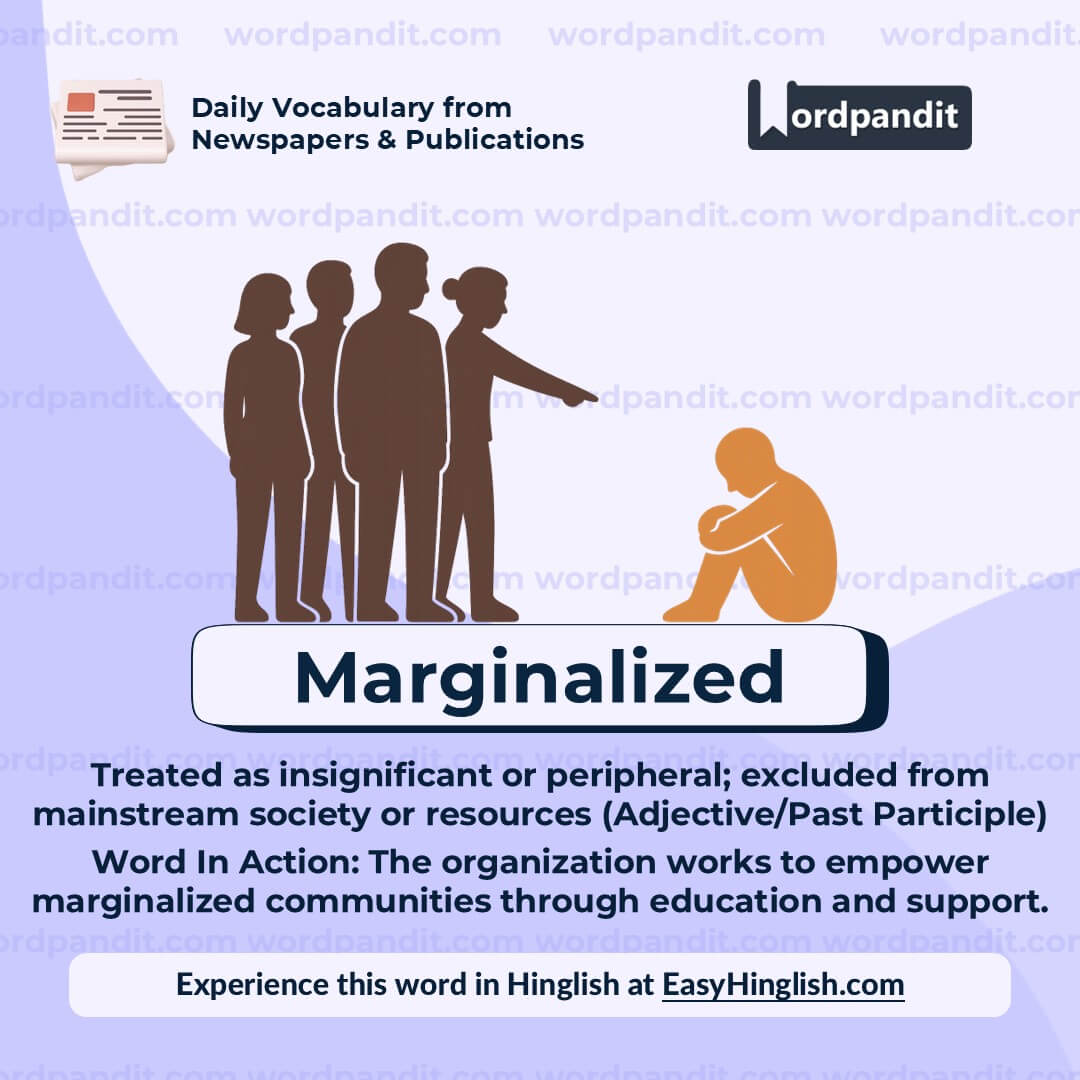
WORD-5: Marginalized
Context:
"The same platforms that spread falsehoods can also amplify marginalized voices, expose injustice, and create solidarity." - The Daily Economy
Explanatory Paragraph:
Marginalized meaning in English is treated as insignificant or pushed to the edges of society, excluded from mainstream social, economic, or political participation. This word is used when describing groups or individuals who lack power, representation, or access to resources due to systemic discrimination. How to use marginalized appears frequently in social commentary, policy discussions, and competitive exam passages addressing inequality and social justice. Marginalized communities face barriers that prevent them from fully participating in society.
Meaning: Treated as insignificant or peripheral; excluded from mainstream society or resources (Adjective/Past Participle)
Pronunciation: MAR-jin-uh-lyzd
Difficulty Level: ⭐⭐⭐ Intermediate
Etymology: Marginalized comes from Latin 'margo' meaning 'edge' or 'border,' which evolved into 'marginal' (at the edge). The verb 'marginalize' emerged in the 1970s during social justice movements to describe the process of pushing groups to the margins of society. The word captures both the spatial metaphor of being pushed to the edges and the social reality of being denied access to power, resources, and opportunities.
Prashant Sir's Notes:
Many students confuse marginalized with 'minority'—but the difference between marginalized and minority is crucial. A group can be numerically large yet still marginalized (like women globally), while some minorities hold significant power. For UPSC essay writing and GRE issue essays, marginalized usage signals systemic exclusion, not just small numbers. The word works as both adjective and verb: "marginalized communities" (adjective) or "society has marginalized them" (verb). In Indian English discourse, you'll frequently see "marginalized sections" referring to Dalits, Adivasis, religious minorities, and economically weaker sections—the term has become essential vocabulary in policy documents and social welfare discussions. CAT RC passages often use marginalized when discussing social reform or inclusive development.
Synonyms & Antonyms:
Synonyms: excluded, sidelined, disenfranchised, disadvantaged, oppressed, underrepresented, peripheral, alienated, ostracized, neglected
Antonyms: empowered, included, mainstream, privileged, centered, represented, integrated, valued
Usage Examples:
- The government launched a new scholarship program specifically designed to support marginalized students from rural areas and tribal communities.
- Social media has given marginalized voices a platform to share their experiences and challenge dominant narratives about caste and gender.
- The documentary highlighted how transgender individuals in India remain marginalized despite legal protections, facing discrimination in employment and healthcare.
- Urban planning often ignores the needs of marginalized groups, resulting in slums lacking basic amenities while luxury apartments receive infrastructure priority.
Cultural Reference:
"Films like 'Article 15' and 'Jai Bhim' brought mainstream attention to the struggles of marginalized communities in India, forcing conversations about caste discrimination that were previously ignored in popular cinema." - Analysis of socially conscious Indian cinema
Think About It:
How has digital technology both helped and hindered marginalized communities in India—has the internet truly democratized voices, or simply created new forms of exclusion?
Quick Activity:
Identify two marginalized groups in your city or region. Write three sentences explaining what barriers they face and one concrete step that could improve their inclusion in mainstream society.
Memory Tip:
Think of 'Marginalized' as "MARGIN-REALIZED"—imagine groups pushed to the MARGINS of a page, barely visible, their existence barely REALIZED by those in the center. The margin of a page is where marginalized people are forced to exist in society.
Real-World Application:
Marginalized is essential vocabulary in policy analysis, social science research, journalism covering inequality, and advocacy writing. NGOs and government reports use "marginalized sections" to identify target beneficiaries for welfare schemes. In competitive exam essays for UPSC, using marginalized demonstrates sophisticated understanding of social stratification and inequality. For CAT and GRE analytical writing, the term helps discuss topics ranging from education access to healthcare disparities, showing awareness of systemic barriers beyond individual circumstances.


