

Daily Vocabulary from Indian Newspapers and Publications
Welcome to Wordpandit’s Indian Vocabulary Hub
At Wordpandit, we understand the importance of staying rooted in the local context while expanding your language skills. This section focuses on enriching your vocabulary with words and phrases drawn from India’s leading newspapers and publications, ensuring you're learning vocabulary that is practical, relevant, and uniquely Indian.
Why Indian Sources Matter
We believe that the best way to master any language is by immersing yourself in local content. That’s why we carefully curate vocabulary from top Indian publications, including:
- The Hindu
- The Times of India
- The Economic Times
- Hindustan Times
- Live Mint
- The Indian Express
- And many others...
Stay Updated, Stay Relevant
With daily updates from Indian news sources, you’ll be consistently learning words that reflect the trends and shifts in Indian society and culture. Our focus is to provide vocabulary that enhances your understanding of the language in an Indian context.
How Wordpandit Supports Your Goals
Whether you’re preparing for exams, aiming to improve your professional communication, or simply want to stay connected with the latest Indian vocabulary, Wordpandit is here to guide you every step of the way.
Learn with a Practical Approach
Our interactive learning methodology includes real-world examples, engaging activities, and context-specific usage to ensure that every word becomes part of your active vocabulary.
Dive into Indian Vocabulary Today!

Why Choose Wordpandit?
Practical Learning: Focus on words you'll actually encounter in real-world reading, enhancing your comprehension and communication skills.
Diverse Content: From current affairs to scientific breakthroughs, our varied sources expose you to vocabulary across multiple domains.
Effortless Integration: Make Wordpandit a part of your daily routine. Just a few minutes each day can significantly boost your lexicon over time.
Your Path to Vocabulary Mastery
- Visit our Daily Vocabulary section regularly
- Explore new words and their usage in context
- Practice incorporating these words into your own writing and speech
- Track your progress as your vocabulary expands
Start Your Journey Today
Embark on your vocabulary enhancement journey with Wordpandit. By consistently engaging with our daily posts, you'll build a robust vocabulary that serves you well in academic, professional, and personal contexts.
Remember, a word a day keeps linguistic limitations at bay. Make Wordpandit your daily companion in the quest for vocabulary excellence!
WORD-1: Outstripped
Context:
"Born in 1515, Sebastian Castellio lived in an age of execution. In terms of judicial killings in Europe, the period between 1500 and 1700 outstripped any era before or after." - Aeon
Explanatory Paragraph:
Outstripped meaning in English is to surpass, exceed, or move faster than someone or something else. This word is used when describing situations where one thing goes beyond another in speed, quantity, quality, or achievement. Outstripped is commonly used in formal writing, comparative analyses, business reports, and competitive exam passages to indicate that something has left others behind or grown beyond expectations.
Meaning: To surpass or exceed in performance, growth, or achievement (Verb - past tense of outstrip)
Pronunciation: out-STRIPT
Difficulty Level: ⭐⭐⭐ Intermediate
Etymology: Outstripped comes from the combination of 'out-' (beyond, surpassing) and 'strip' (derived from Middle English 'strippen' meaning 'to move swiftly'). The word emerged in the late 16th century with the literal meaning of running faster than others in a race, later expanding metaphorically to describe any form of surpassing or exceeding in various contexts like growth, performance, or numbers.
Prashant Sir's Notes:
Students often ask: what is the difference between outstripped and exceeded? While both mean surpassing, outstripped usage specifically suggests leaving something behind in a competitive or comparative context. Many students confuse outstripped with overtook—overtook implies catching up and passing, while outstripped emphasizes the gap created by surpassing. For CAT, GRE, and UPSC aspirants, outstripped frequently appears in passages about economic growth, technological advancement, or comparative statistics. How to use outstripped correctly: it typically follows the pattern "X outstripped Y" where X has grown beyond or faster than Y. In Indian newspapers, you'll see phrases like "demand outstripped supply," "inflation outstripped wage growth," or "Bengaluru's growth outstripped infrastructure development"—the word signals an imbalance created by unequal rates of progress.
Synonyms & Antonyms:
Synonyms: surpassed, exceeded, overtook, outpaced, outdid, transcended, eclipsed, left behind, outran, outperformed
Antonyms: lagged behind, trailed, fell short, underperformed, failed to match
Usage Examples:
- India's digital payment adoption has outstripped that of many developed nations, with UPI transactions reaching unprecedented volumes within just five years.
- The demand for engineering seats in IITs has consistently outstripped supply, leading to intense competition with lakhs of aspirants for thousands of seats.
- Priya's academic performance outstripped her classmates' expectations, as she scored 99 percentile in CAT despite working full-time throughout her preparation.
- Mumbai's population growth has outstripped its infrastructure development, creating severe challenges in housing, transportation, and civic amenities.
Cultural Reference:
"Like Dhoni's finishing ability that outstripped conventional expectations, India's space program achieved Mars orbit on its first attempt, surpassing nations with far larger budgets." - Common reference in discussions of India's cost-effective technological achievements
Think About It:
When technological progress outstrips ethical frameworks and regulations, what risks does society face in managing innovations like artificial intelligence?
Quick Activity:
Write two sentences about areas where growth in one sector has outstripped another in India, such as mobile phone adoption versus internet infrastructure or vehicle numbers versus road capacity.
Memory Tip:
Think of 'Outstripped' as "OUT-STRIPPED"—imagine runners in a race where one runner strips away from the pack and goes OUT ahead, leaving others behind. When something is outstripped, it's been left behind by something that raced ahead faster.
Real-World Application:
In economic reports and business analyses, outstripped is used to describe situations where demand exceeds supply, costs rise faster than revenues, or one company's growth surpasses competitors. Policy analysts use it to highlight imbalances requiring intervention, such as when urbanization outstrips infrastructure or enrollment outstrips educational capacity. In competitive exam essays on development or economics, outstripped effectively demonstrates sophisticated understanding of comparative growth rates and their implications for planning and resource allocation.
WORD-2: Dogmatic
Context:
"In the midst of this fear and uncertainty, Castellio, a professor of Greek, stepped back from the dogmatic clashes of the day." - Aeon
Explanatory Paragraph:
Dogmatic meaning in English is being inflexible in one's beliefs and refusing to consider alternative viewpoints or evidence. This word is used when describing people or attitudes that insist on their opinions as absolute truths without allowing room for doubt or discussion. Dogmatic is commonly used in formal writing, philosophical discussions, religious contexts, and competitive exam passages to characterize rigid, uncompromising thinking that lacks openness to debate or new information.
Meaning: Inclined to lay down principles as undeniably true without consideration of evidence or others' opinions (Adjective)
Pronunciation: dog-MAT-ik
Difficulty Level: ⭐⭐⭐ Intermediate
Etymology: Dogmatic comes from Greek 'dogmatikos,' from 'dogma' meaning 'opinion' or 'decree,' derived from 'dokein' (to seem good, think). Originally, 'dogma' referred to philosophical principles or decrees issued by authorities. The word entered English through Latin in the 17th century, evolving from neutral 'relating to doctrine' to its current negative connotation of stubborn adherence to beliefs regardless of evidence or reason.
Prashant Sir's Notes:
Many students confuse dogmatic with confident—the difference between dogmatic and confident is that confidence can coexist with open-mindedness, while dogmatic usage specifically indicates inflexible certainty that rejects alternative views. Students often ask: what is the difference between dogmatic and opinionated? While opinionated simply means having strong views, dogmatic implies treating those views as unquestionable truths. For CAT, GRE, and UPSC aspirants, dogmatic frequently appears in passages about religious conflicts, political ideologies, scientific debates, or educational philosophies. How to use dogmatic correctly: it's always somewhat critical—calling someone's approach dogmatic suggests they're too rigid and closed-minded. In Indian English newspapers, you'll see phrases like "dogmatic approach to policy," "dogmatic interpretation of religious texts," or "dogmatic adherence to outdated methods"—the word signals problematic inflexibility that prevents progress or dialogue.
Synonyms & Antonyms:
Synonyms: inflexible, rigid, opinionated, doctrinaire, authoritarian, unbending, intransigent, obstinate, categorical, assertive (in negative sense)
Antonyms: open-minded, flexible, tolerant, pragmatic, adaptable, receptive, questioning, undogmatic
Usage Examples:
- The professor's dogmatic teaching style frustrated students who wanted to explore alternative interpretations of literary texts rather than accept only one view.
- Ramesh's dogmatic insistence that only his marketing strategy would work prevented the team from testing innovative approaches that might have yielded better results.
- The committee criticized the ministry's dogmatic adherence to outdated regulations that ignored ground realities and stakeholder feedback from implementation agencies.
- Priya avoided dogmatic thinking in her research, constantly questioning her assumptions and remaining open to data that contradicted her initial hypotheses.
Cultural Reference:
"In 3 Idiots, Virus's dogmatic insistence on rote learning and traditional methods represents the inflexible educational approach that Rancho challenges with creative thinking." - Reference to the contrast between rigid and flexible educational philosophies in popular Indian cinema
Think About It:
Why do people become more dogmatic about beliefs they've held longer, and how can we maintain intellectual flexibility as we gain experience and expertise?
Quick Activity:
Write two sentences contrasting a dogmatic approach to problem-solving with a flexible, evidence-based approach in any field like education, business, or public policy.
Memory Tip:
Think of 'Dogmatic' as "DOG-MATIC"—imagine a stubborn dog that refuses to budge from its position no matter what. Just like that immovable dog, a dogmatic person sticks rigidly to their beliefs and won't shift their stance, even when presented with new information or alternative perspectives.
Real-World Application:
In academic discourse and policy debates, dogmatic is used to critique approaches that lack evidence-based flexibility. Editorial writers use it to challenge rigid ideological positions that ignore practical considerations. In UPSC ethics papers and essay writing, understanding dogmatic thinking helps analyze the balance between principled stands and pragmatic adaptability. Business analysts use it to describe management styles that resist necessary innovation, while educators use it to advocate for teaching methods that encourage critical thinking rather than unquestioning acceptance of authority.
WORD-3: Heretic
Context:
"After a careful investigation into the meaning of the term heretic,' he wrote, 'I can discover no more than this, that we regard those as heretics with whom we disagree.'" - Aeon
Explanatory Paragraph:
Heretic meaning in English is 'a person who holds beliefs that contradict established religious doctrine or widely accepted opinions, especially someone who publicly opposes orthodox teachings.' This word is used when describing individuals who challenge traditional beliefs, religious authorities, or established systems of thought. Understanding how to use heretic is important for competitive exams like CAT, GRE, and UPSC, as it frequently appears in passages about religious history, intellectual movements, and social reform. The word commonly signals conflict between individual thinking and institutional authority in formal writing, historical texts, and philosophical discussions.
Meaning: A person who holds beliefs contrary to established religious doctrine or accepted opinion (Noun)
Pronunciation: HAIR-uh-tik
Difficulty Level: ⭐⭐⭐⭐ Advanced
Etymology: Heretic comes from the Greek word 'hairetikos' meaning 'able to choose,' derived from 'hairein' (to choose). It entered English through Latin 'haereticus' in the 14th century. Originally, the word simply meant someone who made their own choices about beliefs, but as religious institutions grew powerful, it acquired a strongly negative connotation—heretics were seen as dangerous dissenters who threatened religious unity and were often persecuted or executed. The word's evolution reflects the historical tension between individual conscience and institutional authority.
Prashant Sir's Notes:
Students often ask: what is the difference between heretic and rebel? While both challenge authority, heretic specifically refers to religious or ideological dissent, whereas rebel is broader and can apply to any form of resistance. For CAT and UPSC aspirants, heretic frequently appears in history passages about the Protestant Reformation, Galileo's trial, or India's own reform movements where social reformers like Raja Ram Mohan Roy challenged orthodox practices. Heretic usage in sentences typically appears with words like "branded," "condemned," or "persecuted"—signaling that the person faced punishment for their beliefs. In Indian English writing, you'll see it used metaphorically: "considered a heretic in Bollywood for rejecting the three-film formula" or "an educational heretic for opposing rote learning." The word has softened over time—today, being called a heretic can sometimes be a compliment for innovative thinking!
Synonyms & Antonyms:
Synonyms: dissenter, nonconformist, apostate, unbeliever, skeptic, freethinker, iconoclast, maverick, renegade, deviant (in belief)
Antonyms: believer, conformist, orthodox follower, traditionalist, adherent, faithful
Usage Examples:
- During medieval Europe, Galileo was branded a heretic for claiming the Earth revolved around the Sun, challenging Church doctrine with scientific evidence.
- In conservative business circles, Ratan Tata was initially considered a heretic for proposing the one-lakh rupee Nano car when everyone believed cheap cars were impossible.
- The social reformer was labeled a heretic by orthodox priests when she questioned casteist practices and demanded temple entry for all communities.
- Aamir's professor called him a heretic for rejecting the standard economics textbook and arguing that Indian markets needed different theoretical frameworks.
Cultural Reference:
"In the film 'PK,' the alien character becomes a heretic in society's eyes by questioning religious rituals and godmen, challenging blind faith with innocent logic—much like historical heretics who questioned established dogma." - Analysis of Bollywood's social commentary
Think About It:
Were figures like Mahatma Phule, Savitribai Phule, or Dr. Ambedkar considered heretics in their time for challenging caste orthodoxy? Do today's reformers face similar resistance?
Quick Activity:
Think of one widely accepted belief in Indian society (about education, career, marriage, or tradition) and write two sentences from the perspective of someone who might be considered a heretic for questioning it. Consider why such questioning is important for progress.
Memory Tip:
Break 'Heretic' into "HERE-TICK"—imagine someone saying "HERE, let me TICK off all the beliefs I disagree with!" Like a checklist rebel who questions every orthodox teaching. Or think of it as "HEIR-REJECT"—an heir who rejects the traditional beliefs passed down, choosing their own path instead!
Real-World Application:
Heretic is commonly used in historical writing, religious studies, and discussions about intellectual freedom and social reform. Journalists use it when covering conflicts between innovation and tradition, or when describing reformers who challenge established systems. In academic essays for UPSC or GRE, using "heretic" demonstrates understanding of how societies label and often persecute those who think differently. The word is particularly valuable when analyzing historical turning points—scientific revolutions, religious reforms, or social movements—where today's accepted truths were once heretical ideas. In contemporary usage, it's often used metaphorically to describe business innovators or creative thinkers who break from industry conventions.
WORD-4: Abhorrence
Context:
"Castellio's abhorrence at heresy executions led him to question other traditional doctrines and practices within Christianity, including the Bible itself." - Aeon
Explanatory Paragraph:
Abhorrence meaning in English is 'a feeling of intense disgust, hatred, or extreme dislike toward something considered morally wrong or offensive.' This word is used when expressing the strongest possible rejection or revulsion toward actions, ideas, or behaviors that violate one's principles or sense of right and wrong. How to use abhorrence effectively is crucial for CAT, GRE, and UPSC exams, as it commonly appears in passages discussing moral philosophy, social justice, and ethical debates. Abhorrence is frequently used in formal writing, editorial columns, and legal contexts to convey deep moral opposition, making it stronger than simple dislike or disapproval.
Meaning: A feeling of intense disgust, hatred, or revulsion toward something; extreme loathing (Noun)
Pronunciation: ab-HOR-rence
Difficulty Level: ⭐⭐⭐⭐ Advanced
Etymology: Abhorrence comes from the Latin word 'abhorrere' meaning 'to shrink back in horror,' formed from 'ab-' (away from) and 'horrere' (to shudder or bristle with fear). The word entered English in the 16th century, carrying the physical sense of recoiling from something dreadful. Over time, it evolved to describe not just physical revulsion but profound moral and emotional rejection. The imagery of shrinking away in horror remains embedded in the word's modern usage, suggesting that what one abhors is so offensive that it provokes both emotional and moral recoil.
Prashant Sir's Notes:
Many students confuse 'abhorrence' with 'hatred'—while both express strong negative feelings, the difference between abhorrence and hatred is critical for UPSC and CAT reading comprehension. Abhorrence specifically involves moral or ethical disgust, often toward actions or principles rather than just people, while hatred can be more personal and emotional. For competitive exam aspirants, abhorrence usage in sentences typically appears in discussions of human rights violations, corruption, or social injustice—contexts where moral judgment is emphasized. In Indian English newspapers, you'll frequently see "abhorrence of violence," "abhorrence toward corruption," or "express abhorrence at" when editors condemn unethical practices. The word signals that the writer isn't just disagreeing but morally condemning something, which is crucial for understanding author's tone in RC passages.
Synonyms & Antonyms:
Synonyms: loathing, detestation, revulsion, repugnance, disgust, hatred, aversion, antipathy, repulsion, odium
Antonyms: admiration, affection, love, approval, fondness, attraction
Usage Examples:
- The nation expressed its abhorrence at the Delhi gang rape case, leading to massive protests and calls for stronger laws against violence toward women.
- Mahatma Gandhi's abhorrence of violence shaped his entire philosophy of Satyagraha, making non-violence the cornerstone of India's independence movement.
- Priya's abhorrence toward corruption made her refuse the bribe offered by the contractor, even though it cost her company the lucrative project.
- The editorial expressed strong abhorrence at the practice of manual scavenging, calling it a stain on India's claim to modernity and equality.
Cultural Reference:
"In the film 'Swades,' Shah Rukh Khan's character shows visible abhorrence when he witnesses the untouchability practiced in the village, prompting his decision to bring about social change." - Example of moral disgust driving action in Bollywood
Think About It:
Should there be universal sources of abhorrence that all humans share, like violence against children, or is moral disgust always culturally shaped? What practices once accepted in India now provoke abhorrence?
Quick Activity:
Write two sentences about a social issue or practice that evokes your abhorrence, explaining both what it is and why it provokes such strong moral opposition in you. Consider how you might work toward changing it.
Memory Tip:
Think of 'Abhorrence' as "AB-HORROR-ENCE"—imagine something so horrible that you want to move AB (away from) it in HORROR. Like watching a horror movie scene that makes you turn away in disgust—that physical recoil is abhorrence! Or remember: when you see Ab (away) + Horror, you feel intense moral disgust that makes you want to distance yourself.
Real-World Application:
Abhorrence is commonly used in opinion pieces, legal judgments, human rights reports, and political speeches to express strong moral condemnation. Journalists use it when covering social injustices, corruption scandals, or human rights violations where mere disapproval is insufficient. In Supreme Court judgments and official statements, "abhorrence" signals that something violates fundamental moral or constitutional principles. For competitive exam essays on topics like social reform, ethics, or justice, using "abhorrence" demonstrates sophisticated vocabulary and the ability to distinguish between degrees of negative emotion. It's particularly powerful in argumentative writing when you need to convey that something isn't just wrong but morally intolerable.
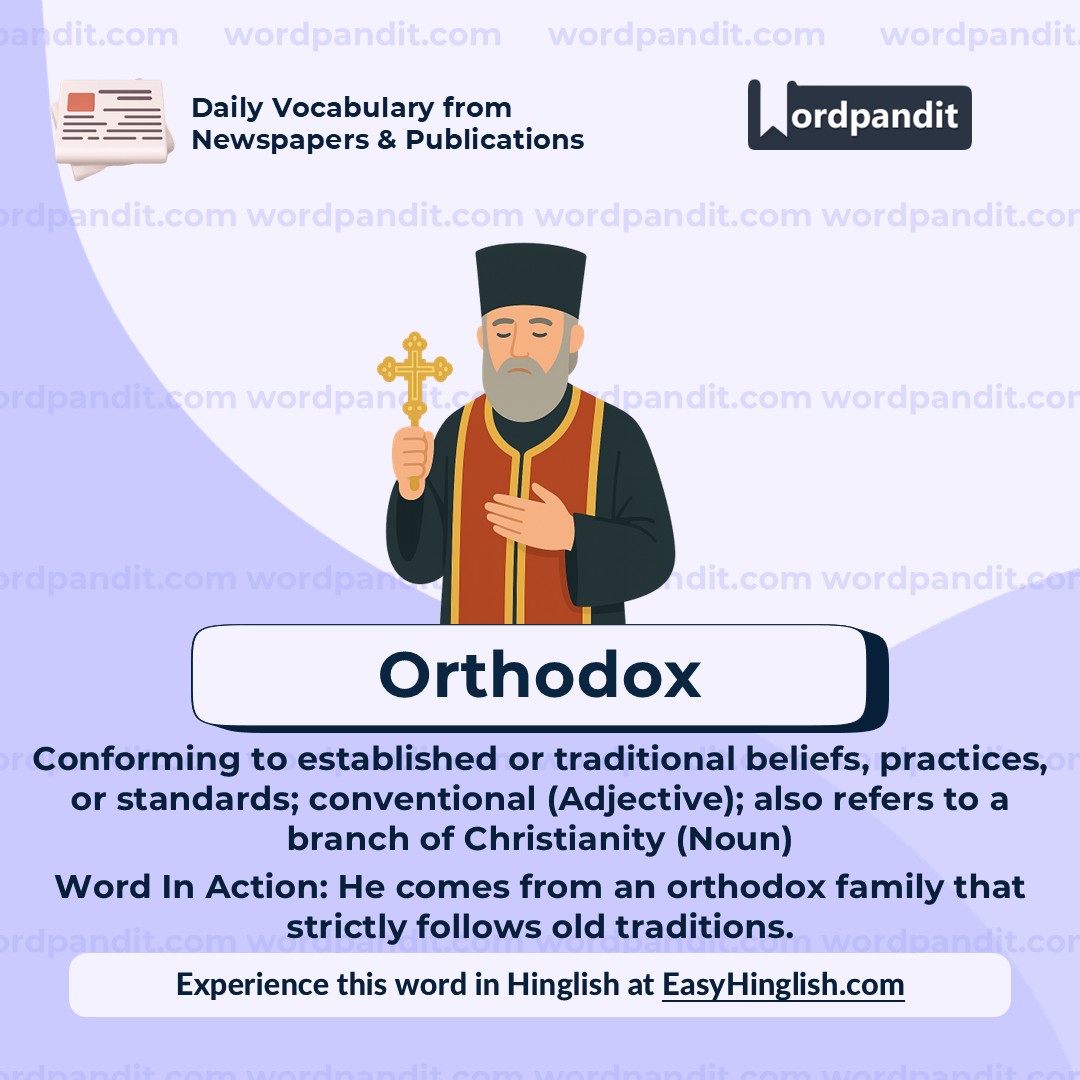
WORD-5: Orthodox
Context:
"Most terrifying for ordinary Christians was the fact that the standards of orthodox thought and behaviour shifted like the sand." - Aeon
Explanatory Paragraph:
Orthodox meaning in English is 'conforming to established, traditional, or widely accepted beliefs, practices, or standards, especially in religion or doctrine.' This word is used when describing ideas, behaviors, or approaches that follow conventional wisdom and resist change or innovation. How to use orthodox effectively matters for CAT, GRE, and UPSC exams, as it frequently appears in passages discussing tradition versus modernity, religious practices, scientific paradigms, and social norms. Orthodox commonly signals adherence to established thinking in formal writing, making it essential for understanding debates between conventional and progressive viewpoints in academic texts and news articles.
Meaning: Conforming to established or traditional beliefs, practices, or standards; conventional (Adjective); also refers to a branch of Christianity (Noun)
Pronunciation: OR-thuh-doks
Difficulty Level: ⭐⭐⭐ Intermediate
Etymology: Orthodox comes from the Greek words 'orthos' meaning 'straight, right, or correct' and 'doxa' meaning 'opinion or belief.' Combined, it literally means 'right belief' or 'correct opinion.' The word entered English in the 15th century primarily in religious contexts, referring to adherence to established Christian doctrine. Over time, its usage expanded beyond religion to describe any conventional or traditional approach in medicine, science, politics, or social practices. The word carries an interesting duality—it can be positive (suggesting reliability and wisdom) or negative (implying inflexibility and resistance to progress), depending on context.
Prashant Sir's Notes:
Students often ask: what is the difference between orthodox and traditional? While both refer to established practices, orthodox specifically emphasizes correctness or adherence to doctrine, especially in religious or ideological contexts, whereas traditional simply means customary or passed down through generations without the doctrinal element. For CAT and GRE aspirants, orthodox frequently appears in science passages about paradigm shifts—"orthodox scientific thinking" resisting new theories, or in social science texts about orthodox versus progressive approaches. Orthodox usage in Indian English newspapers is particularly interesting: "orthodox Hindu practices," "orthodox economic policies," or "orthodox medical treatment" versus alternative approaches. In UPSC ethics papers, understanding orthodox versus reformist thinking is crucial when analyzing social reform movements in India—were figures like Raja Ram Mohan Roy fighting orthodox practices or simply different traditions? This distinction matters for scoring well!
Synonyms & Antonyms:
Synonyms: conventional, traditional, established, accepted, standard, conformist, conservative, customary, mainstream, canonical
Antonyms: unorthodox, unconventional, progressive, radical, innovative, heterodox, nonconformist, reformist
Usage Examples:
- Many Indian startups succeed precisely because they reject orthodox business models, creating innovative solutions for uniquely Indian problems like digital payments in rural areas.
- Dr. Sharma's orthodox approach to medicine made him skeptical of Ayurvedic treatments, even though his patients reported benefits from integrating both systems.
- The film faced protests from orthodox community groups who felt it challenged traditional values, while progressive viewers praised its questioning of outdated customs.
- Rohit's orthodox batting technique, taught by his coach in Chennai, served him well in Test cricket but limited his effectiveness in T20 formats.
Cultural Reference:
"In 'Dangal,' Mahavir Singh Phogat challenges orthodox thinking in Haryana by training his daughters as wrestlers, proving that questioning traditional gender roles can lead to Olympic glory." - Example of unorthodox parenting in Bollywood inspiring social change
Think About It:
Is orthodox thinking always resistant to progress, or does it sometimes preserve valuable wisdom that prevents society from making reckless changes? When should we follow orthodox approaches and when should we challenge them?
Quick Activity:
Identify one orthodox belief or practice in your field of study or profession. Write two sentences: one explaining the orthodox approach, and another describing an unorthodox alternative that might offer advantages. Consider which approach serves better in different situations.
Memory Tip:
Break 'Orthodox' into "ORTHO-DOX"—think of ORTHO (straight, correct, like orthodontist who straightens teeth) + DOX (sounds like "DOCS" or documents). Orthodox means following the straight, correct documents or established rules! Or imagine an old DOCtor (DOX) who only follows the CORRECT, traditional (ORTHO) methods and refuses to try anything new.
Real-World Application:
Orthodox is essential in academic writing, comparative analyses, and discussions about innovation versus tradition across fields. In business journalism, it describes conventional strategies versus disruptive approaches—"orthodox retail models" failing against e-commerce. Medical literature uses it to distinguish evidence-based treatments from alternative therapies. For UPSC essays on topics like education reform, economic policy, or social change, "orthodox" helps articulate the tension between established systems and progressive reforms. In scientific writing, "orthodox theory" often appears before describing paradigm shifts. The word is particularly valuable when analyzing why certain approaches persist despite alternatives—orthodox thinking provides stability and predictability, even if it sometimes resists necessary innovation.


