

Daily Vocabulary from Indian Newspapers and Publications
Welcome to Wordpandit’s Indian Vocabulary Hub
At Wordpandit, we understand the importance of staying rooted in the local context while expanding your language skills. This section focuses on enriching your vocabulary with words and phrases drawn from India’s leading newspapers and publications, ensuring you're learning vocabulary that is practical, relevant, and uniquely Indian.
Why Indian Sources Matter
We believe that the best way to master any language is by immersing yourself in local content. That’s why we carefully curate vocabulary from top Indian publications, including:
- The Hindu
- The Times of India
- The Economic Times
- Hindustan Times
- Live Mint
- The Indian Express
- And many others...
Stay Updated, Stay Relevant
With daily updates from Indian news sources, you’ll be consistently learning words that reflect the trends and shifts in Indian society and culture. Our focus is to provide vocabulary that enhances your understanding of the language in an Indian context.
How Wordpandit Supports Your Goals
Whether you’re preparing for exams, aiming to improve your professional communication, or simply want to stay connected with the latest Indian vocabulary, Wordpandit is here to guide you every step of the way.
Learn with a Practical Approach
Our interactive learning methodology includes real-world examples, engaging activities, and context-specific usage to ensure that every word becomes part of your active vocabulary.
Dive into Indian Vocabulary Today!

Why Choose Wordpandit?
Practical Learning: Focus on words you'll actually encounter in real-world reading, enhancing your comprehension and communication skills.
Diverse Content: From current affairs to scientific breakthroughs, our varied sources expose you to vocabulary across multiple domains.
Effortless Integration: Make Wordpandit a part of your daily routine. Just a few minutes each day can significantly boost your lexicon over time.
Your Path to Vocabulary Mastery
- Visit our Daily Vocabulary section regularly
- Explore new words and their usage in context
- Practice incorporating these words into your own writing and speech
- Track your progress as your vocabulary expands
Start Your Journey Today
Embark on your vocabulary enhancement journey with Wordpandit. By consistently engaging with our daily posts, you'll build a robust vocabulary that serves you well in academic, professional, and personal contexts.
Remember, a word a day keeps linguistic limitations at bay. Make Wordpandit your daily companion in the quest for vocabulary excellence!
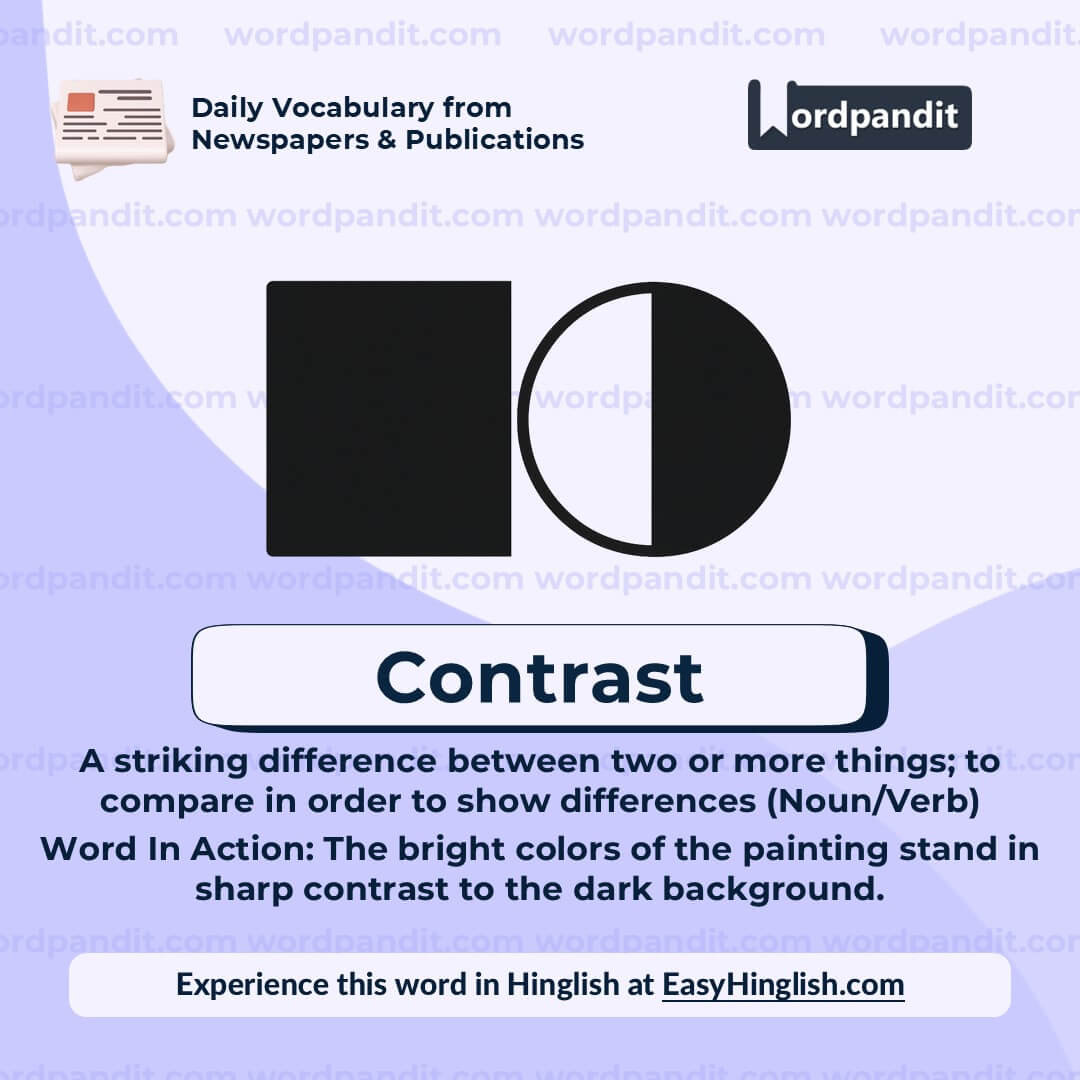
WORD-1: Contrast
Context:
"...the contrasting bitterness from the kasuri methi..." - The Indian Express
Explanatory Paragraph:
Contrast meaning in English is 'a striking difference between two or more things when compared or placed together.' This word is used when highlighting how two elements differ significantly from each other, making each stand out more clearly. Contrast is commonly used in formal writing, analytical essays, art criticism, and competitive exam passages to show differences, compare opposing ideas, or emphasize distinctions between concepts, flavors, colors, or viewpoints.
Meaning: A striking difference between two or more things; to compare in order to show differences (Noun/Verb)
Pronunciation: KON-trast (noun), kun-TRAST (verb)
Difficulty Level: ⭐⭐ Basic to Intermediate
Etymology: Contrast comes from Latin 'contra' meaning 'against' and 'stare' meaning 'to stand,' literally 'to stand against.' Through French 'contraster,' the word evolved to describe things that stand in opposition to each other, highlighting their differences when placed side by side.
Prashant Sir's Notes:
Students often ask: what is the difference between contrast and compare? While compare looks at both similarities and differences, contrast usage in formal writing specifically focuses only on the differences. For CAT and GRE aspirants, contrast frequently appears in Reading Comprehension passages where authors present opposing viewpoints or contrasting evidence. How to use contrast correctly: as a noun, the stress falls on the first syllable (CON-trast), but as a verb, shift the stress to the second syllable (con-TRAST). In Indian English newspapers, you'll often see "in stark contrast to" or "by contrast" as transition phrases that signal the writer is about to present an opposite perspective or contradictory information.
Synonyms & Antonyms:
Synonyms: difference, distinction, disparity, divergence, dissimilarity, opposition, contradistinction, juxtaposition, antithesis, variance
Antonyms: similarity, resemblance, likeness, uniformity, agreement, harmony
Usage Examples:
- The stark contrast between Mumbai's luxury high-rises and sprawling slums highlights India's growing economic inequality.
- Priya's calm, methodical approach contrasted sharply with Arjun's impulsive decision-making style during the business presentation.
- The author uses contrasting imagery of light and darkness throughout the novel to represent hope and despair.
- In contrast to last year's modest gains, this quarter showed exponential growth across all sectors of the company.
Cultural Reference:
"The contrasting personalities of the Pandavas and Kauravas in the Mahabharata serve to illustrate the eternal battle between dharma and adharma." - Common interpretation in Indian literary discussions
Think About It:
How does understanding contrasts in perspectives help us develop more balanced viewpoints on controversial social issues in India?
Quick Activity:
Write two sentences contrasting traditional Indian education methods with modern teaching approaches. Use the word "contrast" as both a noun and a verb.
Memory Tip:
Think of "Contrast" as "CON (opposite) + TRAST (trust)"—imagine two opposite viewpoints standing against each other, like contrasting opinions in a debate. Or visualize a black and white photograph where the sharp contrast makes everything stand out clearly.
Real-World Application:
In analytical essays and comparative studies, "contrast" is essential for presenting balanced arguments. Journalists use it to highlight policy differences between political parties, business analysts contrast quarterly performances, and exam essays frequently require students to contrast different theories or viewpoints. The phrase "in contrast to" serves as a powerful transition signal in formal writing, immediately alerting readers that opposing information follows.
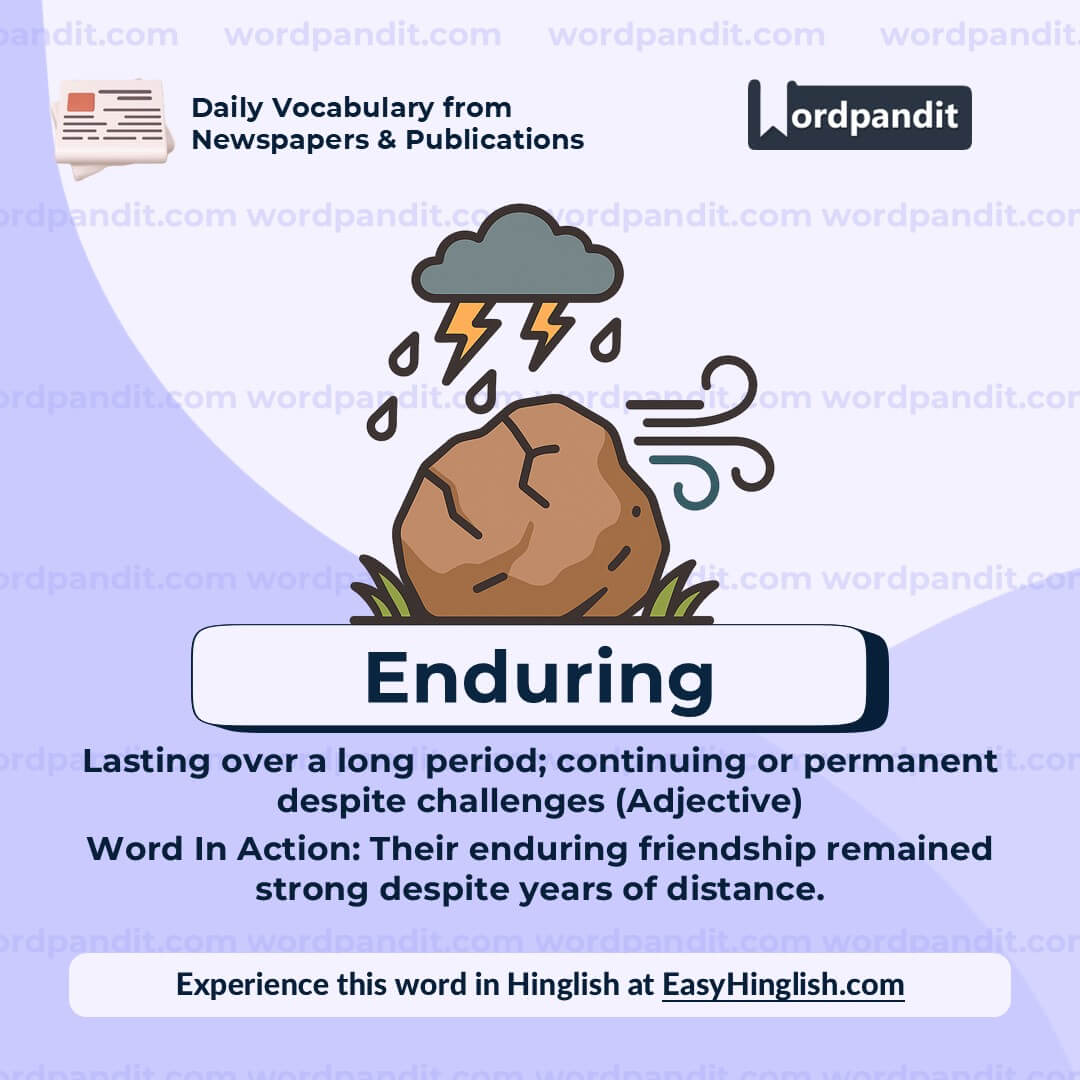
WORD-2: Enduring
Context:
"...that gives this dish its enduring grip on my palate." - The Indian Express
Explanatory Paragraph:
Enduring meaning in English is 'lasting for a long time; continuing or remaining despite difficulties or challenges.' This word is used when describing something that has permanence, resilience, or the ability to withstand the test of time. Enduring is commonly used in formal writing, literary analysis, and competitive exam passages to describe lasting qualities, persistent characteristics, or things that remain relevant across generations, from enduring friendships to enduring cultural traditions.
Meaning: Lasting over a long period; continuing or permanent despite challenges (Adjective)
Pronunciation: en-DYOOR-ing
Difficulty Level: ⭐⭐⭐ Intermediate
Etymology: Enduring comes from Latin 'indurare' meaning 'to make hard,' through Old French 'endurer' meaning 'to last or continue.' The word evolved from the physical sense of hardening or toughening to the metaphorical sense of lasting through time or persisting through difficulties, emphasizing resilience and permanence.
Prashant Sir's Notes:
Many students confuse enduring with endearing—while endearing means 'lovable or charming,' enduring usage specifically emphasizes longevity and persistence. The difference between enduring and lasting is subtle: enduring carries a stronger connotation of surviving challenges or hardships, while lasting simply means continuing over time. For UPSC and CAT aspirants, enduring frequently appears in passages about cultural heritage, historical significance, or timeless values. How to use enduring correctly: it typically precedes nouns that represent abstract qualities like "enduring legacy," "enduring appeal," or "enduring impact." In Indian English newspapers, you'll often see "enduring popularity of cricket" or "enduring influence of Gandhi"—contexts where something remains strong despite changing times.
Synonyms & Antonyms:
Synonyms: lasting, permanent, durable, persistent, continuing, timeless, abiding, perennial, immortal, everlasting
Antonyms: temporary, fleeting, transient, ephemeral, short-lived, passing
Usage Examples:
- The enduring appeal of Bollywood's classic films like Sholay continues to attract audiences even after five decades.
- Despite technological disruptions, Indian classical music has maintained an enduring presence in the cultural landscape of the country.
- Rabindranath Tagore's poetry carries an enduring message of humanism that resonates across generations and geographical boundaries.
- The enduring friendship between Ramesh and Sunil, forged during their college days, survived distance, career changes, and life's challenges.
Cultural Reference:
"The enduring legacy of Mahatma Gandhi's principles of non-violence continues to inspire social movements worldwide, decades after his death." - Common theme in Indian political discourse
Think About It:
What makes certain traditions, values, or relationships enduring while others fade away with time? Is it their inherent quality or the effort we invest in preserving them?
Quick Activity:
List three things in Indian culture that have shown enduring popularity despite modernization. Write one sentence explaining what makes each one enduring.
Memory Tip:
Break "Enduring" into "EN-DURING"—think of something that is still "during" (continuing) even after a long time has passed. Imagine the India Gate standing tall through decades—an enduring monument that has witnessed history but remains unchanged, symbolizing permanence and resilience.
Real-World Application:
In business writing and brand communications, "enduring" is crucial for describing long-term value propositions, legacy brands, or sustainable competitive advantages. Historians and cultural critics use it to analyze which aspects of civilization persist through changing eras. In GRE and CAT Reading Comprehension passages, identifying "enduring" helps you understand the author's perspective on what has lasting significance versus temporary trends. The word frequently appears in discussions about heritage conservation, timeless literature, and institutional stability.
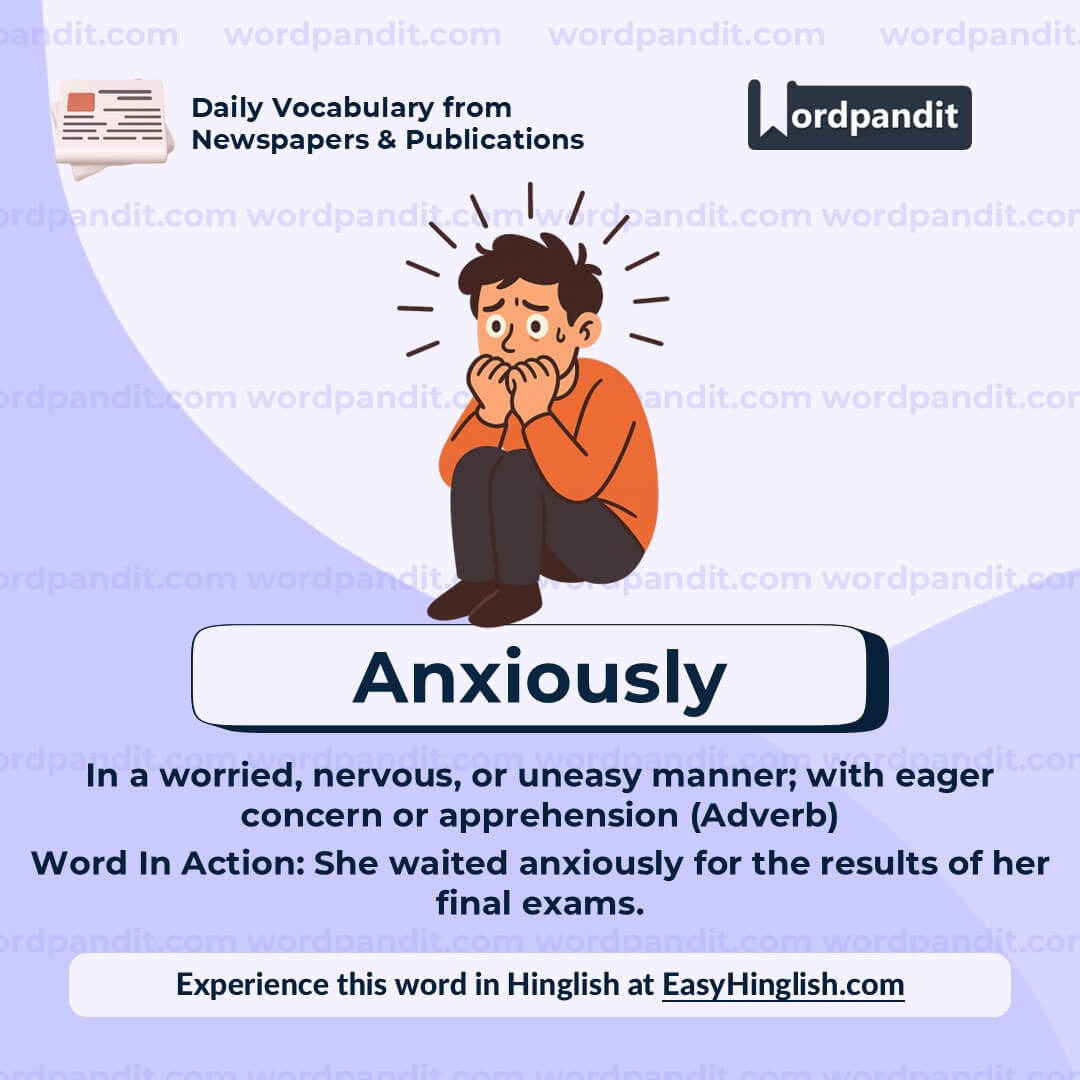
WORD-3: Anxiously
Context:
"...I have waited anxiously among the dark shadows..." - The Indian Express
Explanatory Paragraph:
Anxiously meaning in English is 'in a manner showing worry, nervousness, or unease about something with an uncertain outcome.' This word is used when describing actions performed with apprehension, eager concern, or restless anticipation. Anxiously is commonly used in narrative writing, descriptive passages, and competitive exam texts to convey emotional states of characters or situations where someone awaits results, news, or events with nervous tension and worry.
Meaning: In a worried, nervous, or uneasy manner; with eager concern or apprehension (Adverb)
Pronunciation: ANGK-shus-lee
Difficulty Level: ⭐⭐ Basic to Intermediate
Etymology: Anxiously comes from Latin 'anxius' meaning 'troubled or uneasy,' derived from 'angere' meaning 'to choke or cause distress.' Through Old French, the word evolved to describe the mental state of worry and unease. The '-ly' suffix transforms the adjective 'anxious' into an adverb, describing how an action is performed with nervous anticipation.
Prashant Sir's Notes:
Students often ask: what is the difference between anxiously and eagerly? While both involve anticipation, anxiously usage specifically carries worry or fear about negative outcomes, whereas eagerly expresses positive excitement. For CAT and GRE aspirants, anxiously frequently appears in narrative passages describing characters under stress or awaiting important decisions. How to use anxiously correctly: it typically modifies verbs like "waited," "watched," "checked," or "listened"—actions done while experiencing anxiety. In Indian English contexts, you'll see phrases like "parents anxiously awaited board exam results" or "investors anxiously monitored market fluctuations"—situations combining anticipation with apprehension. Remember that anxiously always implies some level of distress, not just simple waiting.
Synonyms & Antonyms:
Synonyms: nervously, worriedly, uneasily, apprehensively, restlessly, fearfully, tensely, agitatedly, concernedly, fretfully
Antonyms: calmly, confidently, peacefully, serenely, tranquilly, composedly
Usage Examples:
- Meera anxiously checked her phone every few minutes, waiting for the job interview callback from the multinational company.
- The cricket fans watched anxiously as India needed twelve runs from the last over to win the World Cup final.
- Students gathered anxiously outside the examination hall, discussing possible questions and reviewing last-minute notes before the UPSC prelims.
- Rajesh paced anxiously in the hospital corridor while his wife was in the operation theater for an emergency surgery.
Cultural Reference:
"During crucial India-Pakistan cricket matches, millions across both nations watch anxiously, their emotions riding on every ball bowled." - Common observation in sports commentary
Think About It:
Why do we often wait anxiously for results or outcomes that are already determined and beyond our control? Does anxious waiting change anything, or is it simply human nature?
Quick Activity:
Write two sentences describing situations where someone in your life waited anxiously for something. Use varied sentence structures and different verbs with "anxiously."
Memory Tip:
Connect "Anxiously" with "anxiety"—think of "ANX-iously" as acting while full of ANXiety. Visualize a student biting nails and checking the exam results website repeatedly, refreshing the page anxiously every few seconds. The physical restlessness captures the meaning perfectly.
Real-World Application:
In creative writing and journalistic narratives, "anxiously" effectively conveys emotional tension and builds suspense. News reporters use it to describe public sentiment during elections, exam seasons, or crisis situations. In business communications, it appears in contexts like "stakeholders anxiously await quarterly results" or "employees anxiously anticipate restructuring announcements." For competitive exam essays, using "anxiously" adds emotional depth when describing characters' mental states or societal reactions to uncertain situations, making your writing more vivid and engaging.
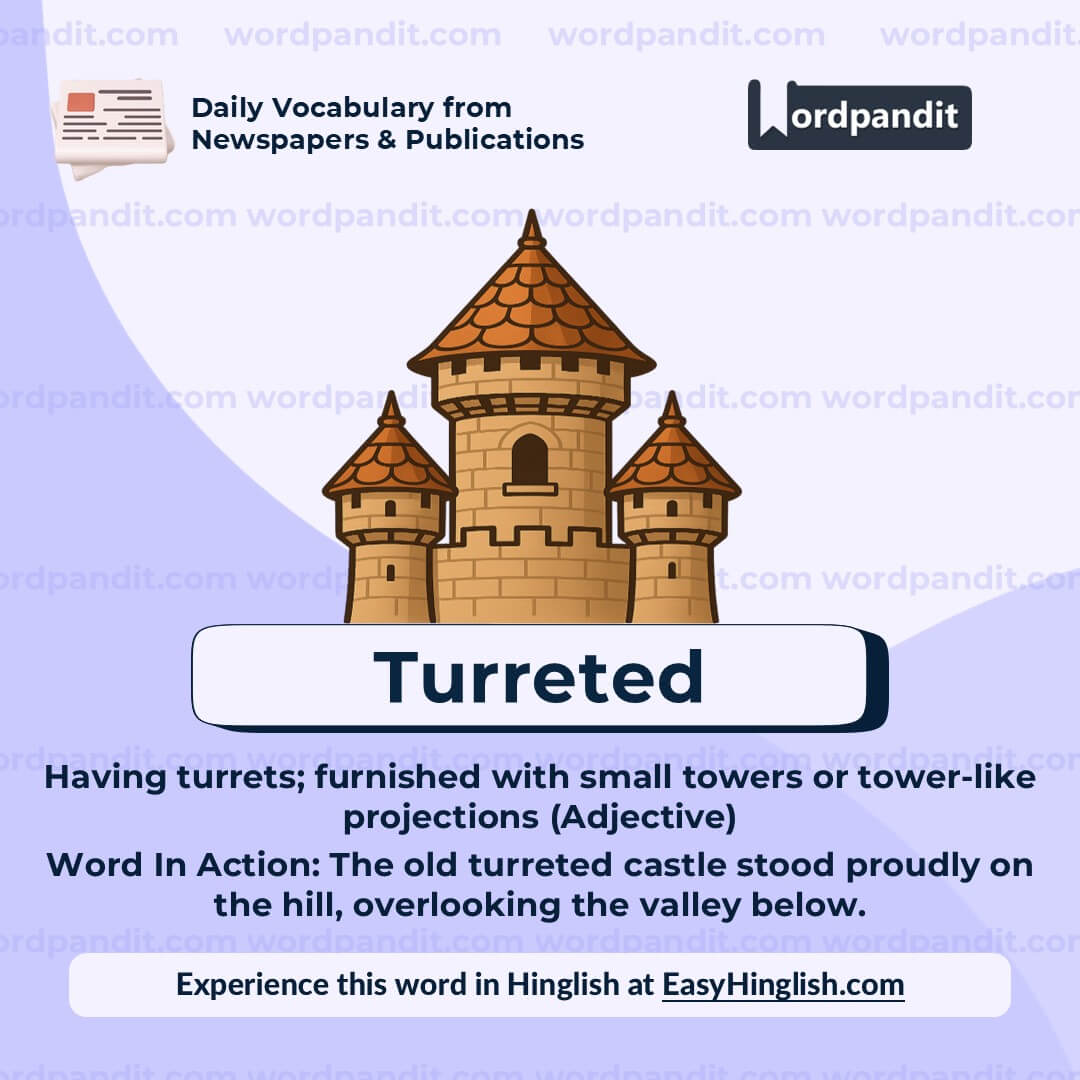
WORD-4: Turreted
Context:
"...the fake-historic turreted 'trucker's castle' near Frankfurt..." - The Indian Express
Explanatory Paragraph:
Turreted meaning in English is 'having turrets or small towers, typically found on castles, fortresses, or buildings designed in a medieval architectural style.' This word is used when describing structures that feature projecting tower-like structures, either for defensive purposes or decorative effect. Turreted is commonly used in architectural descriptions, travel writing, and literary passages to evoke images of castles, fortresses, or buildings with distinctive tower features that add grandeur or historical character to the structure.
Meaning: Having turrets; furnished with small towers or tower-like projections (Adjective)
Pronunciation: TUR-it-ed
Difficulty Level: ⭐⭐⭐ Intermediate
Etymology: Turreted comes from Latin 'turris' meaning 'tower,' through Old French 'tourette' (diminutive of 'tour' meaning tower). The word evolved in medieval architectural terminology to describe buildings featuring small defensive or decorative towers. The '-ed' suffix indicates the presence of these architectural features, transforming the noun 'turret' into a descriptive adjective for castle-like structures.
Prashant Sir's Notes:
Many students confuse turreted with towering—while towering means 'very tall or high,' turreted usage specifically describes buildings that have small tower-like projections or turrets as architectural features. For GRE and GMAT aspirants, turreted appears in descriptive passages about architecture, historical buildings, or metaphorical descriptions of imposing structures. How to use turreted correctly: it's primarily used as a pre-modifier before nouns like "turreted castle," "turreted mansion," or "turreted fortress." In Indian English contexts, you might encounter "turreted palace" when describing Rajasthani forts or "turreted colonial buildings" in descriptions of Indo-Gothic architecture. The word instantly evokes medieval imagery and adds a sense of grandeur or historical authenticity—or in the context example, ironic fake grandeur—to architectural descriptions.
Synonyms & Antonyms:
Synonyms: towered, castellated, fortified, battlemented, castle-like, fortress-like, medieval-style, tower-crowned
Antonyms: flat-roofed, plain, unadorned, simple, modern, minimalist
Usage Examples:
- The turreted Mysore Palace stands as a magnificent example of Indo-Saracenic architecture, attracting tourists from across the world.
- Wealthy industrialists in Mumbai built turreted mansions during the colonial era, mimicking European castle architecture to display their status.
- The author described the villain's headquarters as a turreted fortress perched menacingly on a cliff overlooking the stormy sea.
- Many heritage hotels in Rajasthan feature turreted structures that transport guests back to the era of maharajas and royal courts.
Cultural Reference:
"The turreted Mehrangarh Fort in Jodhpur, with its imposing ramparts and decorative turrets, represents the architectural grandeur of Rajputana heritage." - Common description in Indian tourism literature
Think About It:
Why do modern buildings sometimes incorporate turreted designs despite having no defensive purpose? What does this reveal about our fascination with historical architecture and symbolism of power?
Quick Activity:
Look up images of three famous Indian forts or palaces. Identify which ones are turreted and write one sentence describing how the turrets contribute to the overall appearance of each structure.
Memory Tip:
Think of "Turreted" as "TURRET-ed"—imagine a building that has been "turret-ted," meaning turrets have been added to it. Visualize the iconic Rajasthani forts with their distinctive small towers poking out at corners—those are turrets, making the building turreted. Or picture a chess rook piece, which looks like a turret!
Real-World Application:
In travel writing and architectural criticism, "turreted" efficiently conveys a specific visual image of medieval or castle-like structures. Real estate descriptions use it to add charm and historical appeal to properties with tower features. In literature, turreted buildings often symbolize power, mystery, or Gothic atmosphere—think of turreted castles in fantasy novels or horror stories. For competitive exam comprehension passages, recognizing "turreted" helps you visualize the setting and understand the author's tone, whether describing authentic historical architecture or, as in the context example, mocking fake-historic pastiche constructions.
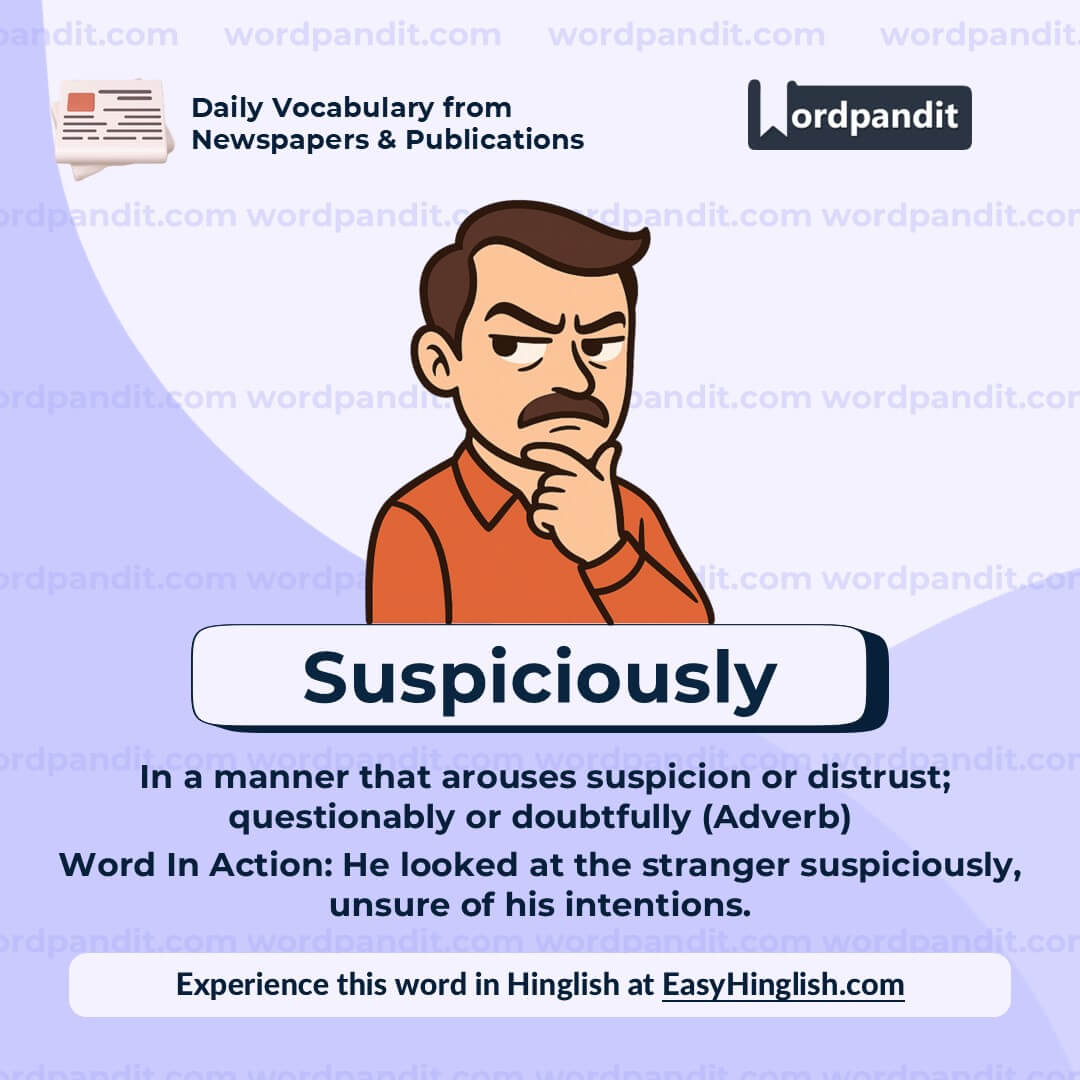
WORD-5: Suspiciously
Context:
"...the suspiciously watery maccher jhol..." - The Indian Express
Explanatory Paragraph:
Suspiciously meaning in English is 'in a manner that causes one to have an idea or impression of something wrong, questionable, or not as it should be.' This word is used when describing actions, appearances, or situations that arouse doubt or mistrust about their authenticity or quality. Suspiciously is commonly used in descriptive writing, investigative reports, and everyday conversations to express skepticism or indicate that something seems dubious, irregular, or potentially deceptive in nature.
Meaning: In a manner that arouses suspicion or distrust; questionably or doubtfully (Adverb)
Pronunciation: suh-SPISH-us-lee
Difficulty Level: ⭐⭐ Basic to Intermediate
Etymology: Suspiciously derives from Latin 'suspicere' meaning 'to look up at' or 'to mistrust,' formed from 'sub' (from below) and 'specere' (to look). Through Old French 'suspicion,' the word evolved to describe the act of viewing something with doubt or distrust. The '-ly' suffix creates an adverb describing how actions appear when they seem questionable or arouse mistrust.
Prashant Sir's Notes:
Students often confuse suspiciously with surprisingly—while surprisingly indicates unexpectedness, suspiciously usage specifically conveys doubt or mistrust about something seeming wrong. The difference between suspiciously and dubiously is subtle: suspiciously suggests something actively arousing suspicion, while dubiously implies the observer's skeptical attitude. For CAT and GRE aspirants, suspiciously frequently appears in passages involving detective stories, quality assessments, or situations where things aren't what they appear. How to use suspiciously correctly: it typically modifies adjectives ("suspiciously quiet"), verbs ("looked suspiciously"), or appears in phrases like "suspiciously similar" or "suspiciously convenient." In Indian English contexts, you'll often see it used humorously about food quality, exam questions that seem too easy, or deals that appear too good to be true—the context example perfectly captures this skeptical tone about substandard food preparation.
Synonyms & Antonyms:
Synonyms: questionably, dubiously, doubtfully, mistrustfully, skeptically, shadily, fishily (informal), oddly, strangely, peculiarly
Antonyms: trustingly, confidently, genuinely, authentically, legitimately, credibly
Usage Examples:
- The street vendor's mangoes were suspiciously cheap, making Kavita wonder if they were overripe or of poor quality.
- Rohit's suspiciously detailed explanation for being late to the meeting only made his colleagues doubt him more.
- The company's financial records showed suspiciously high profits during a quarter when market conditions were terrible for everyone else.
- The neighborhood became suspiciously quiet just before the surprise monsoon storm hit, as if nature itself was holding its breath.
Cultural Reference:
"When someone offers you a 'genuine' designer bag at one-tenth the price on Delhi's Janpath, it's suspiciously clear what you're actually getting." - Common observation about counterfeit markets
Think About It:
Why do we immediately become suspicious when something seems too good to be true? Is this skepticism a survival instinct, or does it sometimes prevent us from recognizing genuine opportunities?
Quick Activity:
Write two sentences describing situations where something appeared suspiciously wrong or questionable. Use different contexts—one serious and one humorous, like the food example in the context.
Memory Tip:
Break "Suspiciously" into "SUS-SPIC-iously"—think of it as "SUS" (suspicious, as in the popular "that's sus" slang) + "SPIC" (like spy checking). Imagine a detective suspiciously eyeing a scene, spying for clues because something seems off. Or picture watery dal at a restaurant—suspiciously thin, making you wonder if they're cutting corners!
Real-World Application:
In journalism and investigative reporting, "suspiciously" signals red flags that warrant deeper scrutiny—suspiciously timed announcements, suspiciously similar proposals, or suspiciously absent records. Consumer reviews frequently use it to warn others about questionable products or services. In business communication, it appears when discussing irregularities or concerns: "suspiciously low bids" or "suspiciously high employee turnover." For exam essays, using "suspiciously" adds critical thinking to your analysis, showing you can identify potentially problematic patterns or questionable claims in arguments or data presented in passages.


