

Daily Vocabulary from Indian Newspapers and Publications
Welcome to Wordpandit’s Indian Vocabulary Hub
At Wordpandit, we understand the importance of staying rooted in the local context while expanding your language skills. This section focuses on enriching your vocabulary with words and phrases drawn from India’s leading newspapers and publications, ensuring you're learning vocabulary that is practical, relevant, and uniquely Indian.
Why Indian Sources Matter
We believe that the best way to master any language is by immersing yourself in local content. That’s why we carefully curate vocabulary from top Indian publications, including:
- The Hindu
- The Times of India
- The Economic Times
- Hindustan Times
- Live Mint
- The Indian Express
- And many others...
Stay Updated, Stay Relevant
With daily updates from Indian news sources, you’ll be consistently learning words that reflect the trends and shifts in Indian society and culture. Our focus is to provide vocabulary that enhances your understanding of the language in an Indian context.
How Wordpandit Supports Your Goals
Whether you’re preparing for exams, aiming to improve your professional communication, or simply want to stay connected with the latest Indian vocabulary, Wordpandit is here to guide you every step of the way.
Learn with a Practical Approach
Our interactive learning methodology includes real-world examples, engaging activities, and context-specific usage to ensure that every word becomes part of your active vocabulary.
Dive into Indian Vocabulary Today!

Why Choose Wordpandit?
Practical Learning: Focus on words you'll actually encounter in real-world reading, enhancing your comprehension and communication skills.
Diverse Content: From current affairs to scientific breakthroughs, our varied sources expose you to vocabulary across multiple domains.
Effortless Integration: Make Wordpandit a part of your daily routine. Just a few minutes each day can significantly boost your lexicon over time.
Your Path to Vocabulary Mastery
- Visit our Daily Vocabulary section regularly
- Explore new words and their usage in context
- Practice incorporating these words into your own writing and speech
- Track your progress as your vocabulary expands
Start Your Journey Today
Embark on your vocabulary enhancement journey with Wordpandit. By consistently engaging with our daily posts, you'll build a robust vocabulary that serves you well in academic, professional, and personal contexts.
Remember, a word a day keeps linguistic limitations at bay. Make Wordpandit your daily companion in the quest for vocabulary excellence!
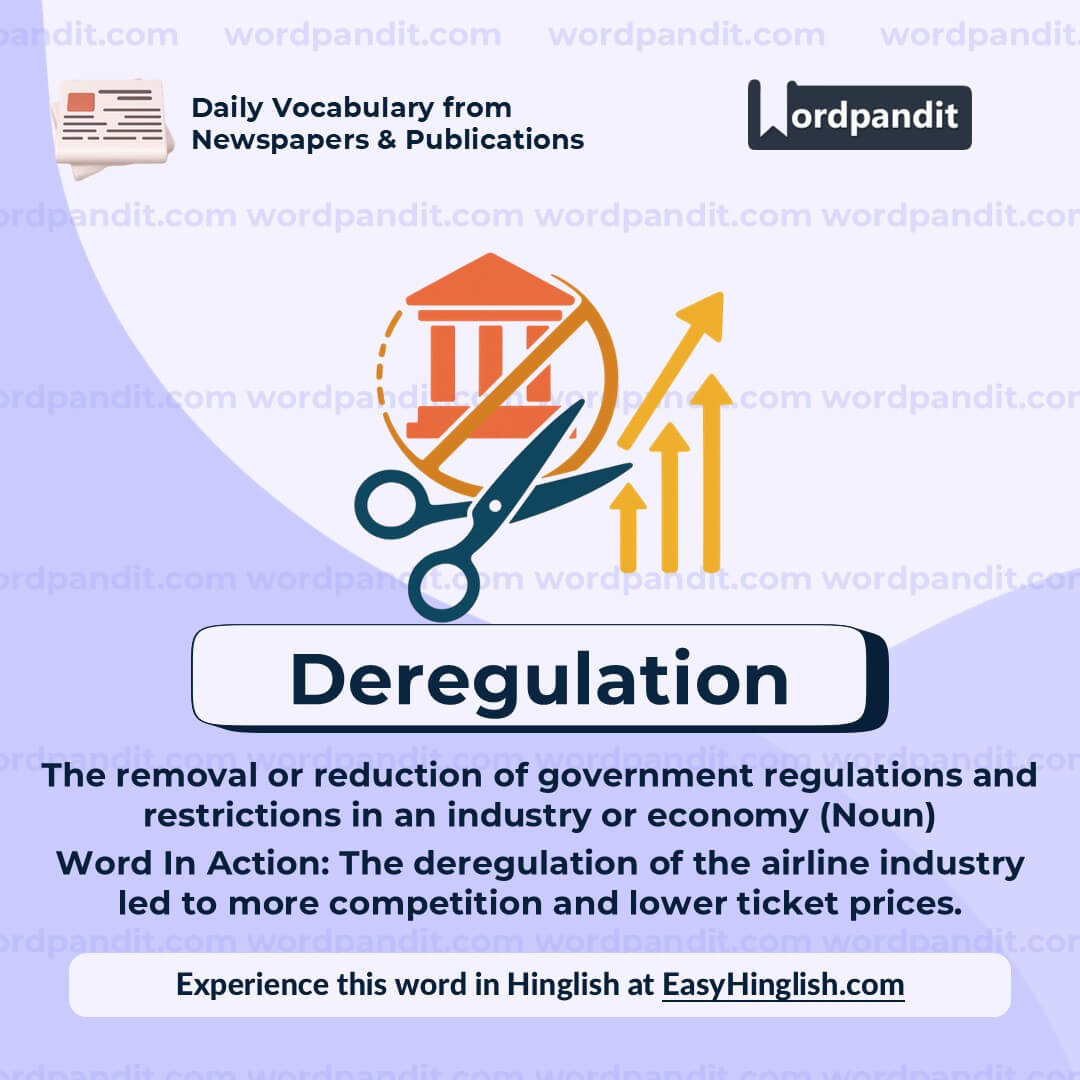
WORD-1: Deregulation
Context:
"...established a high-level committee on deregulation to improve ease of doing business." - Economic Times
Explanatory Paragraph:
Deregulation meaning in English is the removal or reduction of government rules and restrictions in a particular industry or sector. This word is used when governments decide to give businesses more freedom by eliminating unnecessary bureaucratic controls and compliance requirements. Deregulation is commonly used in economic news, business reports, and competitive exam passages related to governance reforms, making it essential vocabulary for CAT, UPSC, and banking exams where economic policy questions frequently appear.
Meaning: The removal or reduction of government regulations and restrictions in an industry or economy (Noun)
Pronunciation: dee-reg-yoo-LAY-shun
Difficulty Level: ⭐⭐⭐ Intermediate
Etymology: Deregulation combines the prefix 'de-' meaning 'removal' with 'regulation' from Latin 'regula' meaning 'rule.' The term gained prominence in the 1970s and 1980s when many countries, including India during the 1991 economic reforms, began removing government controls to allow market forces to operate more freely in various sectors like telecommunications, aviation, and banking.
Prashant Sir's Notes:
Many students confuse deregulation with privatization—while both involve reducing government control, the difference between deregulation and privatization is crucial for UPSC and economics questions. Deregulation means removing rules while keeping ownership patterns unchanged, whereas privatization means transferring government assets to private hands. For CAT aspirants, deregulation frequently appears in RC passages about economic reforms, especially when discussing India's 1991 liberalization. How to use deregulation correctly: it's always followed by 'of' when mentioning specific sectors—"deregulation of telecom" or "deregulation of aviation." In Indian business newspapers, you'll see this term constantly in discussions about ease of doing business rankings and startup ecosystem growth.
Synonyms & Antonyms:
Synonyms: liberalization, decontrol, relaxation of rules, removal of restrictions, free market reforms, decentralization, privatization (partial overlap), opening up
Antonyms: regulation, control, restriction, government oversight, nationalization, centralization
Usage Examples:
- The deregulation of India's aviation sector in the 1990s led to the emergence of multiple private airlines and significantly reduced ticket prices.
- Startup founders welcomed the government's deregulation initiatives, as they could now launch businesses without obtaining dozens of permissions and clearances.
- Critics argue that excessive deregulation of financial markets contributed to the 2008 global economic crisis by removing important safeguards.
- Priya's uncle benefited from telecom deregulation when he started his own internet service provider company in Bangalore without needing government approval.
Cultural Reference:
"The deregulation of Indian industries post-1991 marked a watershed moment, transforming India from a license-permit raj to a competitive market economy." - Common reference in discussions about India's economic liberalization
Think About It:
Does deregulation always benefit consumers and businesses, or are some government regulations necessary to protect public interest and prevent corporate exploitation?
Quick Activity:
List three sectors in India that have undergone deregulation in the past 30 years and note one positive and one negative effect of removing those regulations.
Memory Tip:
Think of "DE-regulation" as "DE-tangling" red tape—just as you remove tangles from hair to let it flow freely, deregulation removes government tangles to let businesses operate freely. Imagine cutting through bureaucratic knots with scissors!
Real-World Application:
Deregulation is commonly used in business journalism, economic policy documents, and UPSC essays on governance reforms. You'll encounter this term in newspaper editorials discussing ease of doing business, in corporate annual reports explaining favorable policy changes, and in competitive exam passages analyzing the pros and cons of market liberalization. Understanding deregulation is essential for anyone studying Indian economic history, particularly the transformative 1991 reforms that shaped modern India's business landscape.
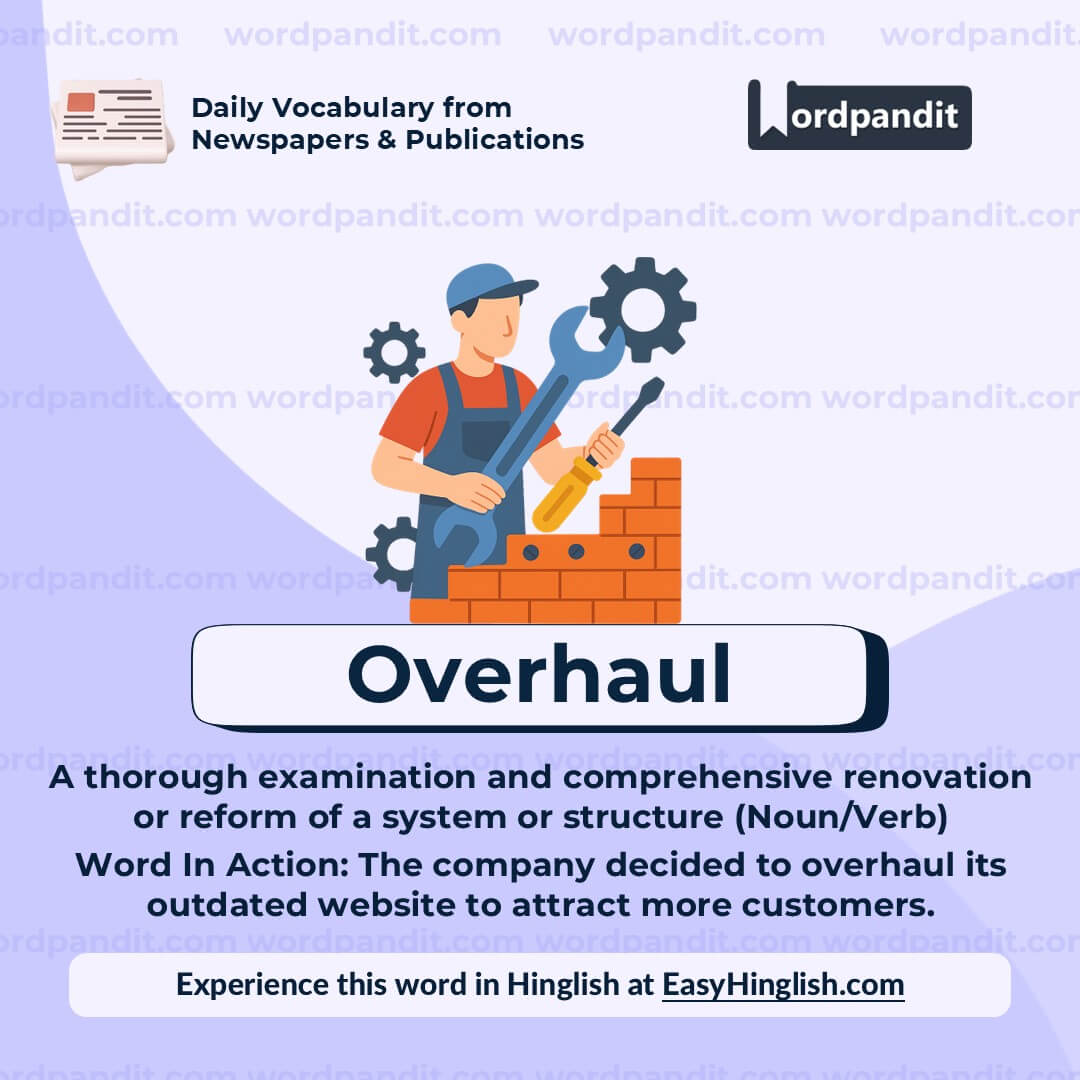
WORD-2: Overhaul
Context:
"...health sector regulations are in urgent need of an overhaul." - Economic Times
Explanatory Paragraph:
Overhaul meaning in English is a complete examination and renovation of a system, often involving major changes to improve its functioning. This word is used when something needs comprehensive reform rather than minor adjustments or superficial fixes. Overhaul is commonly used in business reports, government policy documents, and competitive exam passages discussing systemic changes, making it important vocabulary for CAT, GRE, and UPSC aspirants who encounter reform-related topics in reading comprehension sections.
Meaning: A thorough examination and comprehensive renovation or reform of a system or structure (Noun/Verb)
Pronunciation: OH-ver-hawl (noun), oh-ver-HAWL (verb)
Difficulty Level: ⭐⭐ Basic to Intermediate
Etymology: Overhaul originally comes from nautical terminology, combining 'over' meaning 'thoroughly' and 'haul' meaning 'to pull or drag.' Sailors would "overhaul" ropes by pulling them through blocks to examine and repair them completely. The term evolved from its maritime origins in the 1600s to mean any comprehensive examination and repair, eventually extending to systems, policies, and organizations requiring complete renovation rather than simple maintenance.
Prashant Sir's Notes:
Students often ask: what is the difference between overhaul and reform? While both mean improvement, overhaul specifically implies taking something apart completely and rebuilding it, whereas reform can mean gradual changes. How to use overhaul correctly in sentences: as a noun, it follows "needs an overhaul" or "underwent an overhaul"; as a verb, you "overhaul a system." For UPSC and CAT aspirants, overhaul frequently appears in passages about infrastructure development, judicial reforms, and education policy. In Indian English newspapers, you'll commonly see "complete overhaul," "major overhaul," or "urgent overhaul"—these collocations signal that incremental changes won't suffice and fundamental restructuring is necessary.
Synonyms & Antonyms:
Synonyms: renovation, revamp, restructuring, reformation, reorganization, transformation, complete reform, comprehensive review, radical change, makeover
Antonyms: maintenance, minor repair, preservation, conservation, status quo, superficial change
Usage Examples:
- The Indian railway system requires a complete overhaul to match international safety standards and improve passenger experience across the network.
- After losing three consecutive matches, the Mumbai cricket team decided to overhaul its entire training strategy and coaching methodology.
- The education ministry announced plans to overhaul the examination system, moving away from rote learning toward skill-based assessment methods.
- Rajesh's startup underwent a major overhaul after initial failures, changing everything from its business model to its leadership team structure.
Cultural Reference:
"Just as Team India overhauled its fielding standards under new coaching, institutions must completely rebuild outdated systems rather than applying temporary fixes." - Common analogy in Indian sports and management discussions
Think About It:
Which Indian system—education, healthcare, judiciary, or public transportation—do you think needs the most urgent overhaul, and what would a complete transformation look like?
Quick Activity:
Identify one area in your daily life (study routine, time management, fitness plan) that needs an overhaul rather than minor adjustments. Write two sentences explaining what a complete overhaul would involve.
Memory Tip:
Think of "OVER-haul" as hauling everything OVER—imagine flipping your entire desk over, emptying everything out, cleaning thoroughly, and reorganizing from scratch. That's what an overhaul does to systems—it turns them completely over and rebuilds them properly!
Real-World Application:
Overhaul is extensively used in policy documents, business strategy reports, and newspaper editorials discussing systemic reforms. You'll encounter this term in corporate presentations about organizational restructuring, government white papers on sector reforms, and competitive exam essays on modernization initiatives. For CAT and GRE reading comprehension, understanding overhaul helps identify passages discussing fundamental changes versus incremental improvements. In professional communication, using "overhaul" signals that you recognize the need for comprehensive solutions rather than quick fixes, demonstrating strategic thinking valued in business and administrative contexts.
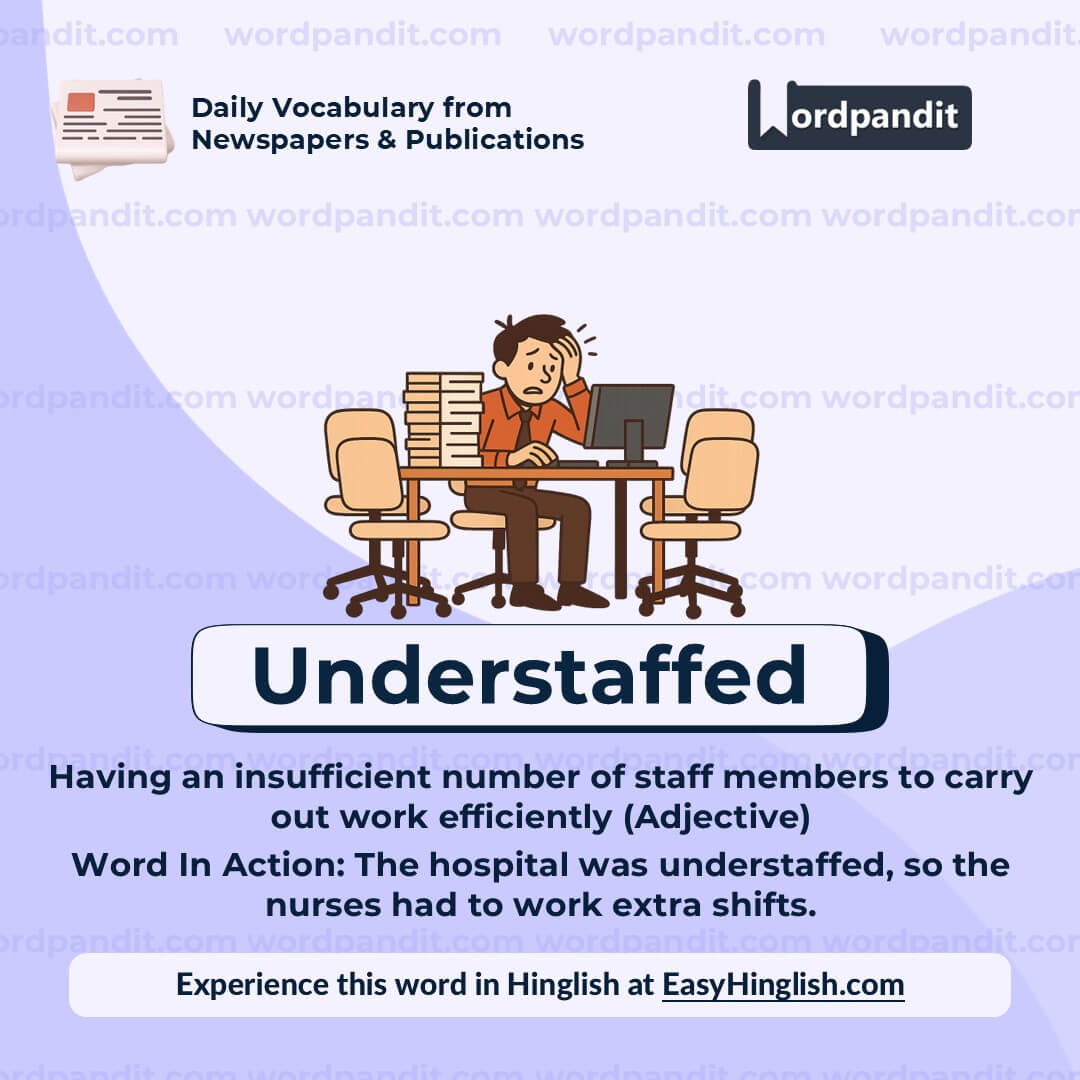
WORD-3: Understaffed
Context:
"India's regulatory ecosystem is also understaffed, under-skilled and under-resourced." - Economic Times
Explanatory Paragraph:
Understaffed meaning in English is having fewer employees or workers than necessary to operate efficiently and meet demands. This word is used when an organization, department, or institution lacks adequate human resources to handle its workload effectively. Understaffed is commonly used in workplace discussions, management reports, and competitive exam passages about organizational challenges, making it relevant vocabulary for business communication and exams like CAT, UPSC, and SSC where administrative issues are frequently discussed.
Meaning: Having an insufficient number of staff members to carry out work efficiently (Adjective)
Pronunciation: UN-der-staft
Difficulty Level: ⭐⭐ Basic to Intermediate
Etymology: Understaffed is formed by combining the prefix 'under-' meaning 'below the required level' with 'staffed' from the Old English 'stæf' meaning 'stick or rod,' which evolved to mean a group of officers or workers who support an organization. The word gained prominence during the Industrial Revolution when workforce management became critical, and it became particularly relevant in modern times as organizations struggle to balance budget constraints with operational efficiency.
Prashant Sir's Notes:
Many students confuse understaffed with undermanned—while both describe insufficient personnel, understaffed is the more formal and widely accepted term in professional contexts. The difference between understaffed and short-staffed is subtle: understaffed suggests a chronic, ongoing shortage, while short-staffed typically indicates a temporary situation. For CAT and GRE aspirants, understaffed frequently appears in RC passages discussing organizational inefficiencies, government departments, and public services. How to use understaffed in sentences: it's always used as an adjective, typically following "is understaffed" or "remains understaffed." In Indian administrative contexts, you'll constantly encounter this term when reading about police departments, hospitals, educational institutions, and regulatory bodies—understanding that being understaffed directly impacts service delivery and efficiency.
Synonyms & Antonyms:
Synonyms: short-staffed, undermanned, shorthanded, inadequately staffed, lacking personnel, resource-starved (in terms of human resources), thinly staffed
Antonyms: fully staffed, overstaffed, adequately manned, well-resourced, sufficiently staffed, properly manned
Usage Examples:
- The government hospital in Patna remains severely understaffed with only three doctors serving over 500 patients daily during peak hours.
- Despite increasing customer complaints, the call center stayed understaffed because management refused to approve new hiring budgets for the quarter.
- Police stations across rural Maharashtra are chronically understaffed, forcing officers to work double shifts and compromising investigation quality.
- Meera's school is so understaffed that teachers handle multiple subjects and administrative duties, leaving little time for individual student attention.
Cultural Reference:
"Like the Indian railway ticket counters during festival season—perpetually understaffed when demand is highest." - Common metaphor used in discussions about public service inefficiency
Think About It:
Why do critical public services like healthcare and education in India remain chronically understaffed despite growing populations and increasing demands?
Quick Activity:
Think of a public service or workplace you've experienced that was clearly understaffed. Write two sentences describing how the staff shortage affected service quality and employee workload.
Memory Tip:
Break "UNDER-staffed" into "UNDER the required STAFF"—imagine a restaurant with tables full of hungry customers but only one waiter running around frantically because they're UNDER the number of STAFF needed. That visual of chaos perfectly captures what understaffed means!
Real-World Application:
Understaffed is frequently used in HR reports, organizational audits, and news articles discussing public service delivery challenges. You'll encounter this term in business case studies analyzing operational inefficiencies, government committee reports on institutional capacity, and workplace complaints about excessive workload. For UPSC aspirants, understanding understaffed is crucial for essay writing on governance reforms, particularly when discussing police-to-population ratios, doctor-to-patient ratios, and teacher-to-student ratios in India. In professional emails and reports, describing a department as understaffed immediately communicates the need for additional hiring and explains performance gaps without blaming existing employees.
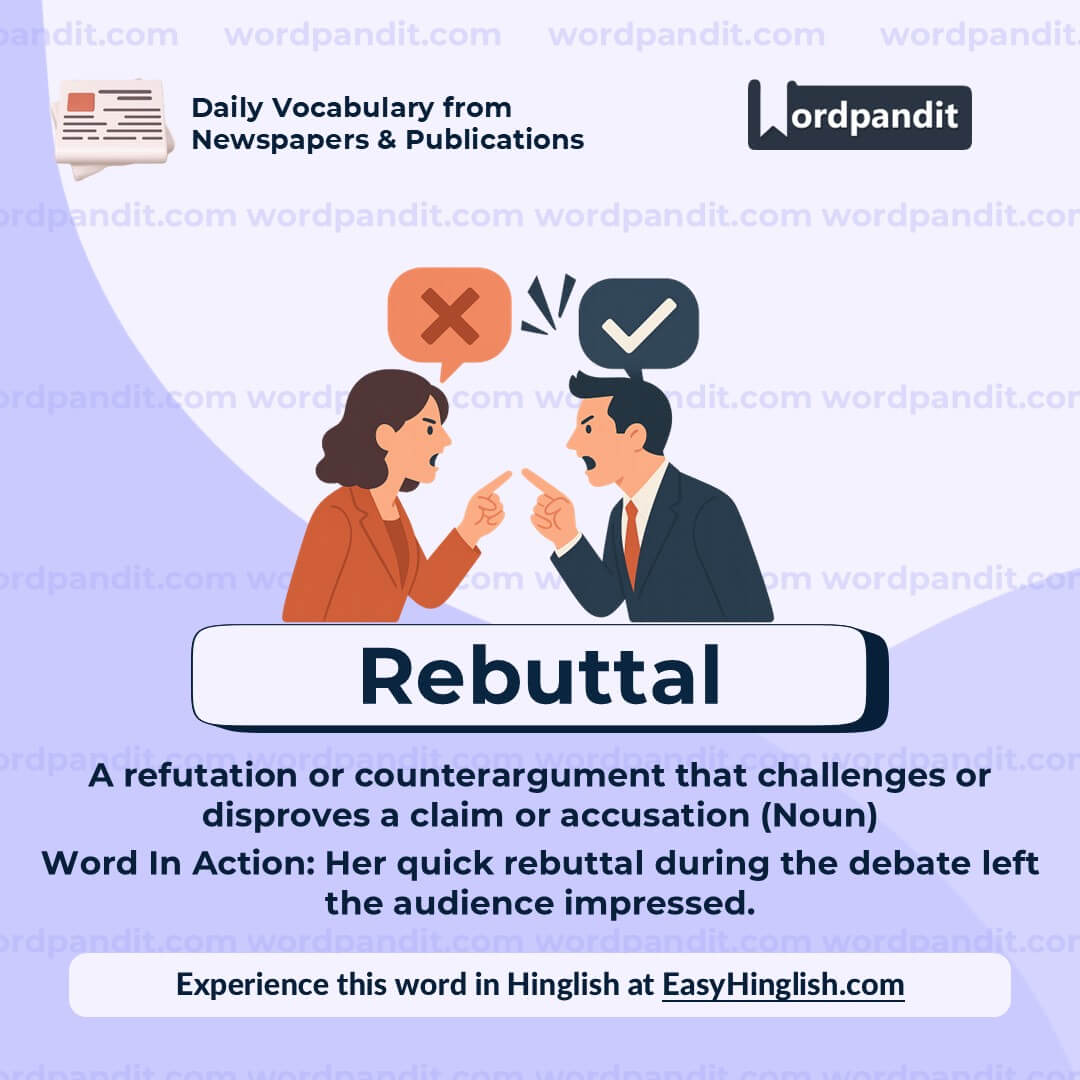
WORD-4: Rebuttal
Context:
"...between the first impression made by a fake and the moment a verified rebuttal reaches..." - Economic Times
Explanatory Paragraph:
Rebuttal meaning in English is a refutation or contradiction of evidence or arguments presented by opposing parties. This word is used when someone formally responds to counter claims, accusations, or statements made against them with facts and logical arguments. Rebuttal is commonly used in legal proceedings, debates, formal arguments, and competitive exam passages related to persuasive writing, making it essential vocabulary for CAT, GRE, UPSC, and IELTS aspirants who encounter argumentative texts and debate-related content.
Meaning: A refutation or counterargument that challenges or disproves a claim or accusation (Noun)
Pronunciation: rih-BUT-ul
Difficulty Level: ⭐⭐⭐ Intermediate
Etymology: Rebuttal comes from the Old French word 'reboter' meaning 'to thrust back' or 'to repel,' which itself derives from 're-' (back) and 'boter' (to thrust). The term entered English legal vocabulary in the 16th century, where it specifically referred to the defendant's answer to the plaintiff's surrejoinder in court. Over time, rebuttal expanded beyond legal contexts to encompass any formal contradiction or refutation of arguments, becoming standard terminology in debates, academic discourse, and public policy discussions.
Prashant Sir's Notes:
Students often ask: what is the difference between rebuttal and refutation? While both involve proving something wrong, rebuttal specifically refers to the formal response to an accusation or argument, whereas refutation is the broader act of disproving any claim. For CAT and GRE aspirants, rebuttal frequently appears in critical reasoning questions where you must identify counterarguments to strengthen or weaken given premises. How to use rebuttal correctly: it's typically preceded by articles—"a rebuttal," "the rebuttal"—or used with verbs like "issue a rebuttal," "provide a rebuttal," or "offer a rebuttal." In Indian legal and political contexts, you'll see this term constantly during election debates, court proceedings, and parliamentary discussions where politicians and lawyers systematically counter opponents' allegations with documented evidence and logical arguments.
Synonyms & Antonyms:
Synonyms: refutation, counterargument, contradiction, rejoinder, denial, response, disproof, counterclaim, confutation, answer
Antonyms: acceptance, agreement, confirmation, concurrence, endorsement, validation, affirmation, substantiation
Usage Examples:
- The defense lawyer presented a strong rebuttal to the prosecution's claims, providing CCTV footage that proved his client was elsewhere during the incident.
- After the opposition accused the government of economic mismanagement, the Finance Minister issued a detailed rebuttal with statistics showing GDP growth.
- Priya prepared her rebuttal carefully for the debate competition, anticipating every possible counterargument her opponents might raise about climate policy.
- The company's rebuttal to customer complaints on social media came too late, allowing negative publicity to damage its brand reputation significantly.
Cultural Reference:
"In the famous Lok Sabha debates, effective rebuttals often determine political careers—a single well-timed counterargument can dismantle hours of opposition rhetoric." - Common observation in Indian parliamentary discourse
Think About It:
In the age of social media where misinformation spreads instantly, why does a well-crafted rebuttal often fail to reach as many people as the original false claim?
Quick Activity:
Think of a common misconception about your city, college, or field of study. Write a two-sentence rebuttal that counters this misconception with facts or logical reasoning.
Memory Tip:
Think of "RE-BUTT-al" as "RE-BATTING" in cricket—when the opposition scores runs (makes accusations), you come back to BAT again (respond) and score your own runs (counterarguments). Just as a batsman rebuts the bowler's challenge, a rebuttal challenges false claims!
Real-World Application:
Rebuttal is extensively used in legal documents, debate competitions, academic papers, and political statements. You'll encounter this term in court judgments where lawyers present rebuttals to opposing counsel's arguments, in newspaper op-eds where writers counter previous articles, and in corporate communications where companies respond to allegations or criticism. For competitive exams, understanding rebuttal is crucial for critical reasoning sections in CAT and GRE, where identifying counterarguments strengthens analytical skills. In professional settings, mastering the art of constructing effective rebuttals—backed by evidence and delivered respectfully—is essential for lawyers, corporate spokespersons, policy advisors, and anyone involved in persuasive communication or conflict resolution.
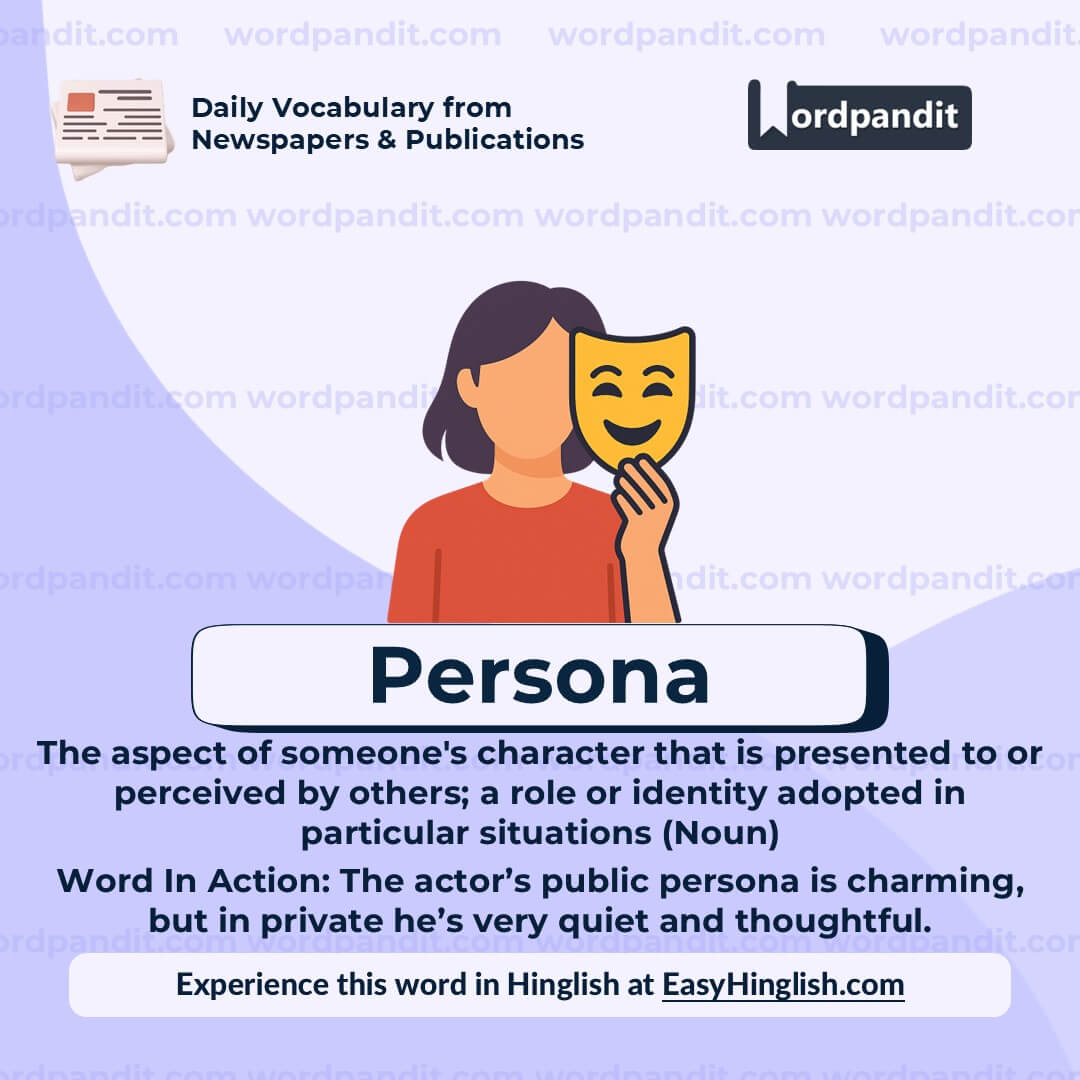
WORD-5: Persona
Context:
"...a persona carries economic value..." - Economic Times
Explanatory Paragraph:
Persona meaning in English is the image or personality that someone presents to the world, which may differ from their true private self. This word is used when describing the public face, character, or role that individuals adopt in social, professional, or digital contexts. Persona is commonly used in marketing strategies, psychology discussions, social media analysis, and competitive exam passages about identity and self-presentation, making it valuable vocabulary for CAT, GRE, IELTS, and management entrance exams where branding and communication concepts frequently appear.
Meaning: The aspect of someone's character that is presented to or perceived by others; a role or identity adopted in particular situations (Noun)
Pronunciation: per-SOH-nuh
Difficulty Level: ⭐⭐⭐ Intermediate
Etymology: Persona comes directly from Latin 'persona' meaning 'mask,' specifically the masks worn by actors in ancient Roman theater to represent different characters. In classical drama, actors would wear these masks to project specific identities to the audience. The term was adopted into psychology in the early 20th century by Carl Jung, who used it to describe the social face individuals present to the world. Today, persona has expanded into marketing and digital contexts, where brands create customer personas and influencers craft online personas that may differ significantly from their private selves.
Prashant Sir's Notes:
Many students confuse persona with personality—the difference between persona and personality is crucial for psychology and management exam questions. Personality is your actual, authentic character traits, while persona is the curated image you project publicly. For CAT and GRE aspirants, persona frequently appears in RC passages about marketing, social media influence, and brand management. How to use persona correctly: you "adopt a persona," "maintain a persona," or "create a persona"—it's something consciously constructed. In Indian digital marketing contexts, you'll constantly encounter "buyer persona," "target persona," and "brand persona"—these refer to fictional representations of ideal customers or brand identities. Understanding persona is particularly important for management students, as companies invest millions in crafting corporate personas that appeal to specific demographics while potentially masking less favorable realities.
Synonyms & Antonyms:
Synonyms: image, public face, character, role, facade, guise, mask, identity, alter ego, front, public identity
Antonyms: true self, authentic character, genuine nature, private identity, real personality, inner being
Usage Examples:
- The marketing team created detailed buyer personas representing different customer segments, including Delhi-based working professionals and Mumbai entrepreneurs seeking premium products.
- Many Bollywood celebrities carefully cultivate a family-friendly persona on social media while their private lives remain completely different from public perception.
- Rahul adopted a confident, authoritative persona during client presentations, though his colleagues knew him as humble and soft-spoken in office.
- Instagram influencers often struggle to maintain their curated persona when reality contradicts the perfect lifestyle they portray to followers.
Cultural Reference:
"Amitabh Bachchan's 'angry young man' persona in 1970s cinema became so powerful that it transcended individual films and shaped an entire generation's cultural identity." - Common reference in Indian film studies and marketing courses
Think About It:
In the social media age where everyone curates their online persona carefully, how much of what we see about people's lives is authentic versus strategically constructed image management?
Quick Activity:
Compare your social media persona with your actual daily life. Write two sentences identifying one way your online presence differs from your offline reality and why you maintain that difference.
Memory Tip:
Remember "PERSONA" by thinking of "PERSON-A"—like Person A and Person B in math problems. Just as actors play different characters, you might be "Person-A" (your public persona) at work and a completely different person privately. The word literally comes from theater masks, so imagine wearing different masks for different audiences!
Real-World Application:
Persona is extensively used in marketing strategy documents, brand management reports, psychology papers, and digital media analysis. You'll encounter this term in MBA case studies about brand positioning, in market research reports defining target customer personas with detailed demographics and preferences, and in social media strategy presentations. For competitive exams, understanding persona is crucial for RC passages discussing authenticity, identity politics, and consumer behavior. In professional contexts, creating accurate buyer personas helps businesses tailor products and messaging effectively, while understanding your own professional persona—how you're perceived in workplace settings—can significantly impact career advancement and leadership opportunities in corporate environments.


