

Daily Vocabulary from International Newspapers and Publications
Expand Your Vocabulary with Wordpandit’s Global Vocabulary Hub
At Wordpandit, we are committed to helping you develop a truly global vocabulary by drawing from some of the most respected international publications. This section is designed to keep you ahead of the curve by introducing you to words that define global conversations and trends.
The Power of Global Sources
To help you think and communicate on a global scale, we curate vocabulary from renowned international sources, such as:
- The New York Times
- The Washington Post
- BBC
- The Guardian
- The Economist
- Scientific American
- Psychology Today
- And many more...
Stay Global, Stay Competitive
Our daily updates from international publications ensure you are consistently exposed to new words that reflect global news and developments, making sure your vocabulary is not only current but also globally relevant.
Enhance Your Global Perspective
Whether you’re preparing for international exams, aiming to excel in global business communication, or want to enhance your language skills for personal growth, Wordpandit offers the resources you need to thrive in a global context.
Effective Learning, Global Reach
Our learning methodology combines global examples, memory aids, and interactive activities, allowing you to internalize new words effectively and apply them in real-world scenarios.
Begin Your Global Vocabulary Journey Now!

Why Choose Wordpandit?
Practical Learning: Focus on words you'll actually encounter in real-world reading, enhancing your comprehension and communication skills.
Diverse Content: From current affairs to scientific breakthroughs, our varied sources expose you to vocabulary across multiple domains.
Effortless Integration: Make Wordpandit a part of your daily routine. Just a few minutes each day can significantly boost your lexicon over time.
Your Path to Vocabulary Mastery
- Visit our Daily Vocabulary section regularly
- Explore new words and their usage in context
- Practice incorporating these words into your own writing and speech
- Track your progress as your vocabulary expands
Start Your Journey Today
Embark on your vocabulary enhancement journey with Wordpandit. By consistently engaging with our daily posts, you'll build a robust vocabulary that serves you well in academic, professional, and personal contexts.
Remember, a word a day keeps linguistic limitations at bay. Make Wordpandit your daily companion in the quest for vocabulary excellence!
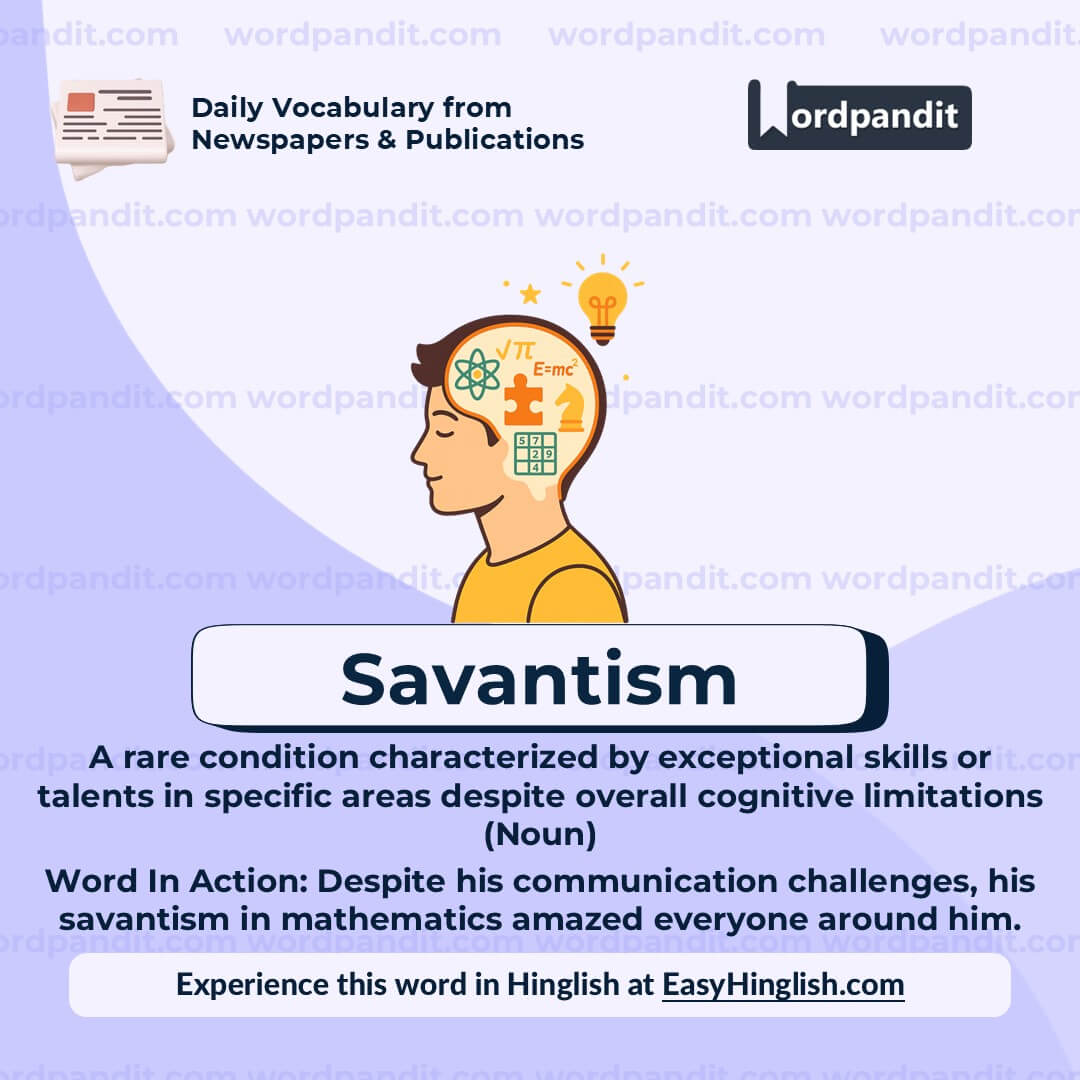
WORD-1: Savantism
Context:
"...trying to understand 'how they do it' still drives psychological research into savantism..." - Aeon
Explanatory Paragraph:
Savantism meaning in English is a rare condition where individuals demonstrate extraordinary abilities in specific areas, such as memory, mathematics, music, or art, often despite cognitive challenges in other domains. This word is used when describing people who possess remarkable talents that far exceed normal human capabilities in particular skills. How to use savantism correctly is important in psychological discussions, medical literature, and competitive exam passages that explore human cognitive abilities and neurological diversity.
Meaning: A rare condition characterized by exceptional skills or talents in specific areas despite overall cognitive limitations (Noun)
Pronunciation: suh-VAHN-tiz-um
Difficulty Level: ⭐⭐⭐⭐ Advanced
Etymology: Savantism derives from French 'savant' meaning 'learned person' or 'scholar,' which itself comes from Latin 'sapere' meaning 'to be wise.' The term was first used in medical contexts in the late 19th century to describe individuals with extraordinary abilities coexisting with developmental conditions. The word evolved to specifically describe this fascinating neurological phenomenon where genius-level skills emerge in isolated cognitive domains.
Prashant Sir's Notes:
Students often ask: what is the difference between savantism and genius? While both involve exceptional abilities, savantism usage in medical and psychological contexts specifically refers to extraordinary skills appearing alongside cognitive challenges or developmental conditions like autism. For CAT and GRE aspirants, savantism frequently appears in science and psychology passages exploring human cognition and neurological diversity. In Indian English newspapers, you'll see terms like 'savant syndrome' when covering stories about individuals with remarkable mathematical or musical abilities. Remember: every savant has exceptional skills in narrow areas, but not every genius is a savant—the key distinction is the contrast between exceptional ability and overall cognitive function.
Synonyms & Antonyms:
Synonyms: savant syndrome, exceptional ability syndrome, prodigious talent, extraordinary cognitive abilities, specialized genius, isolated brilliance
Antonyms: cognitive impairment, intellectual disability, general incompetence, mediocrity, ordinary abilities
Usage Examples:
- Research into savantism has revealed fascinating insights about how the human brain can develop extraordinary capabilities in specific domains while struggling with everyday tasks.
- Rajesh exhibited clear signs of savantism, calculating complex mathematical problems instantly while finding basic social interactions extremely challenging.
- The documentary explored cases of savantism in India, featuring a Mumbai teenager who could memorize entire cricket scorecards but needed assistance with routine activities.
- Understanding savantism helps teachers in Bangalore's special schools design education programs that nurture exceptional talents while supporting overall development.
Cultural Reference:
"The portrayal of savantism in films like 'Rain Man' and 'My Name Is Khan' has brought global attention to the extraordinary abilities some individuals possess despite developmental challenges." - Common observation in psychology and cinema studies
Think About It:
How does savantism challenge our traditional understanding of intelligence, and what can these extraordinary individuals teach us about the untapped potential of the human brain?
Quick Activity:
Research one famous case of savantism (Indian or international) and write three sentences describing the person's exceptional abilities and how they navigate daily life.
Memory Tip:
Think of 'Savantism' as 'SAVE-ANT-ism'—imagine an ant that can SAVE enormous amounts of information in one specific area (like finding food) but struggles with everything else. Just like how savants have amazing abilities in narrow areas but face challenges elsewhere.
Real-World Application:
Savantism is commonly used in psychological research papers, medical journals, and educational literature discussing neurodiversity and cognitive development. In competitive exam passages, particularly for UPSC and GRE, the term appears in science and psychology contexts exploring human potential and brain function. Educators and special education professionals use this term when developing individualized learning strategies that recognize and nurture exceptional talents while providing comprehensive support.
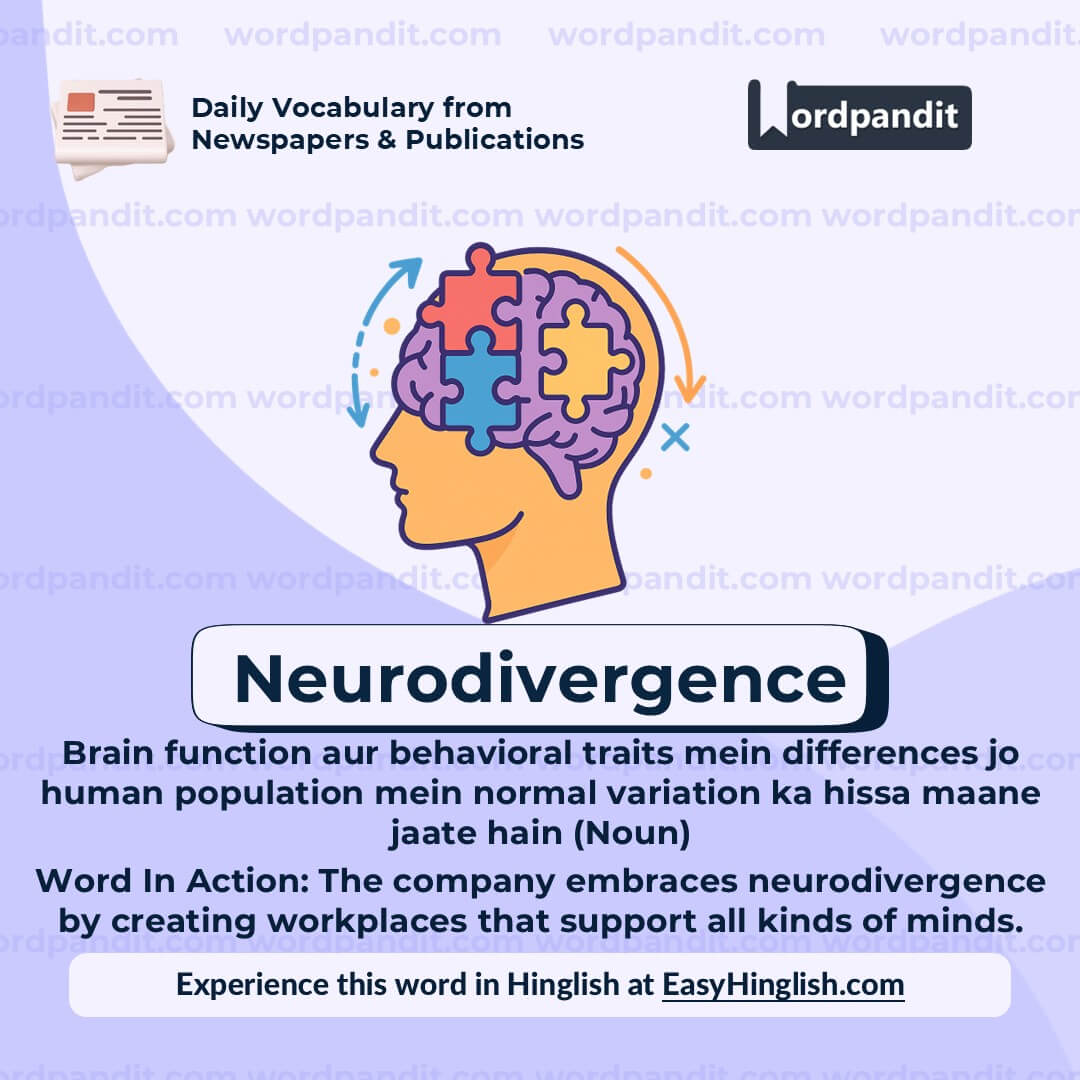
WORD-2: Neurodivergence
Context:
"...savantism is largely comprehended through the lens of neurodivergence..." - Aeon
Explanatory Paragraph:
Neurodivergence meaning in English is a variation in the human brain regarding sociability, learning, attention, mood, and other mental functions that differs from what is considered typical or neurotypical. This word is used when describing individuals whose neurological development and functioning differ from societal standards, encompassing conditions like autism, ADHD, dyslexia, and others. Neurodivergence is commonly used in educational psychology, inclusive workplace discussions, and competitive exam passages exploring diversity and cognitive differences in modern society.
Meaning: Differences in brain function and behavioral traits regarded as part of normal variation in the human population (Noun)
Pronunciation: NOOR-oh-dye-VUR-jens
Difficulty Level: ⭐⭐⭐ Intermediate to Advanced
Etymology: Neurodivergence comes from 'neuro-' meaning 'related to nerves or the nervous system' from Greek 'neuron,' and 'divergence' from Latin 'divergere' meaning 'to turn in different directions.' The term was coined in the late 1990s by sociologist Judy Singer as part of the neurodiversity movement, which reframes neurological differences as natural human variations rather than deficits. This empowering terminology has gained widespread acceptance in medical, educational, and social contexts globally.
Prashant Sir's Notes:
Many students confuse neurodivergence with mental illness—the difference between neurodivergence and mental illness is crucial: neurodivergence refers to natural variations in how brains work, while mental illness typically involves conditions requiring treatment. How to use neurodivergence correctly in exam essays shows your understanding of inclusive language and modern psychology. For UPSC aspirants, neurodivergence frequently appears in questions about disability rights, inclusive education policies, and workplace diversity initiatives in India. In Indian newspapers, you'll often see 'neurodivergent employees' or 'neurodivergent students' when discussing inclusive practices in companies like TCS, Infosys, or in IITs and NITs. Remember: neurodivergence is not about being 'broken'—it's about being different, and that difference often brings unique strengths.
Synonyms & Antonyms:
Synonyms: neurological difference, atypical neurology, non-neurotypical, cognitive variation, neurodiversity (related concept), alternative neurological wiring
Antonyms: neurotypical, typical neurology, standard brain function, conventional cognition, normative neurological development
Usage Examples:
- Many technology companies in Bengaluru are now actively recruiting neurodivergent employees, recognizing their exceptional pattern recognition and problem-solving abilities in coding and data analysis.
- Priya's neurodivergence meant she processed information differently from her classmates, but her unique perspective often led to innovative solutions in group projects.
- The new education policy emphasizes understanding neurodivergence rather than forcing all students to learn in identical ways, promoting inclusive classroom practices.
- Arjun disclosed his neurodivergence during the job interview, explaining how his ADHD actually enhanced his creativity and multitasking abilities in fast-paced environments.
Cultural Reference:
"Films like 'Taare Zameen Par' brought Indian audiences' attention to neurodivergence, particularly dyslexia, changing how society views children who learn differently." - Common discussion in Indian education reform circles
Think About It:
How can embracing neurodivergence as a natural human variation rather than a deficit transform our education systems, workplaces, and social structures in India?
Quick Activity:
List three ways your school, college, or workplace could become more inclusive of neurodivergent individuals. Think about communication styles, learning methods, and environment modifications.
Memory Tip:
Break 'Neurodivergence' into 'NEURO-DIVERGE-ENCE'—think of 'neuro' (brain) taking a different path or 'diverging' from the main highway. Just like Mumbai's traffic where different vehicles take different routes but all reach their destinations, neurodivergent brains take different pathways but are equally valid.
Real-World Application:
Neurodivergence is increasingly used in corporate diversity policies, educational accommodations documentation, and healthcare discussions across India and globally. In HR departments of major companies, the term appears in inclusive hiring initiatives and workplace accommodation policies. For competitive exam essays, particularly UPSC mains, understanding neurodivergence is essential when discussing disability rights, the Rights of Persons with Disabilities Act 2016, and inclusive development. Mental health professionals and educators use this term to promote acceptance and create supportive environments that recognize different cognitive styles as valuable rather than deficient.
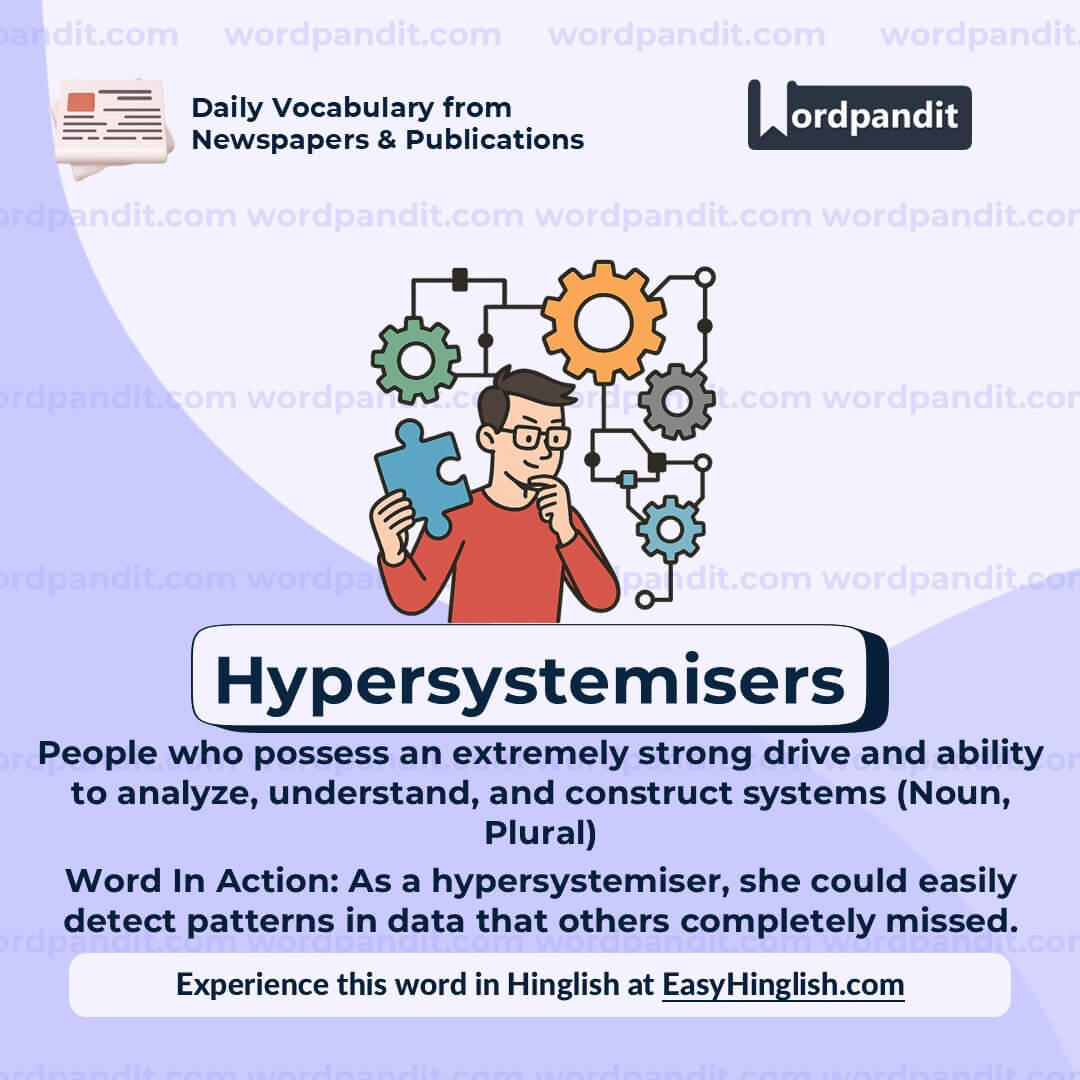
WORD-3: Hypersystemisers
Context:
"...such people are 'hypersystemisers', that is, they are especially good at identifying laws..." - Aeon
Explanatory Paragraph:
Hypersystemisers meaning in English refers to individuals with an exceptional ability to analyze systems, identify patterns, and understand the rules governing how things work. This word is used when describing people who have an intense drive to understand and construct systems, whether mechanical, abstract, numerical, or organizational. How to use hypersystemisers correctly is important in psychological literature, autism research, and discussions about cognitive styles, as this trait is often associated with fields like engineering, mathematics, and computer science.
Meaning: People who possess an extremely strong drive and ability to analyze, understand, and construct systems (Noun, Plural)
Pronunciation: HY-pur-SIS-tuh-my-zurs
Difficulty Level: ⭐⭐⭐⭐ Advanced
Etymology: Hypersystemisers is a compound word formed from Greek 'hyper' meaning 'over' or 'beyond,' combined with 'system' from Greek 'systema' meaning 'organized whole,' and the suffix '-iser' indicating a person who performs an action. The term was popularized by psychologist Simon Baron-Cohen in his research on autism and cognitive styles in the early 2000s. This technical term emerged from scientific study of how different minds process information and understand the world through patterns and rules.
Prashant Sir's Notes:
Students often ask: what is the difference between hypersystemisers and detail-oriented people? While both pay attention to specifics, hypersystemisers usage in psychology specifically describes individuals who compulsively seek underlying rules and patterns governing systems. For CAT and GRE aspirants, hypersystemisers frequently appears in passages about cognitive diversity, autism spectrum research, and career aptitudes. Many IIT and engineering students might actually be hypersystemisers without knowing the term—they're the ones who need to understand 'why' behind every formula rather than just memorizing it. In Indian context, think of those cricket statisticians who remember every ball-by-ball detail and can predict outcomes based on patterns—that's hypersystemising in action. This cognitive style explains why some students excel in subjects like physics and mathematics where identifying underlying laws is crucial.
Synonyms & Antonyms:
Synonyms: pattern-seekers, extreme analysts, rule-identifiers, system-builders, analytical thinkers, logical processors, detail-obsessed organizers
Antonyms: intuitive thinkers, empathizers, spontaneous individuals, unsystematic people, pattern-blind, disorganized thinkers
Usage Examples:
- Many successful software engineers at companies like Infosys and Wipro are hypersystemisers who excel at debugging code by identifying logical patterns and system failures.
- Rahul's tendency to create elaborate spreadsheets tracking every expense down to the rupee marked him as a hypersystemiser who found comfort in organized data.
- Research suggests that hypersystemisers are overrepresented in fields like mathematics, physics, and engineering, where understanding underlying laws is paramount to success.
- As a hypersystemiser, Meera could instantly spot inconsistencies in the company's accounting system that others had overlooked for months.
Cultural Reference:
"Characters like Sheldon Cooper from 'The Big Bang Theory' or Chatur from '3 Idiots' exemplify hypersystemisers—individuals obsessed with rules, patterns, and systematic understanding of their fields." - Popular culture analysis of cognitive types
Think About It:
Why might hypersystemisers excel in India's competitive exam system, and how does our education culture both support and sometimes limit their unique cognitive strengths?
Quick Activity:
Identify one hypersystemising behavior in yourself or someone you know. Write two sentences describing how this pattern-seeking tendency helps or hinders in daily situations.
Memory Tip:
Think of 'Hypersystemisers' as 'HYPER-SYSTEM-ISERS'—people who are HYPER (extremely) focused on SYSTEMS. Imagine someone organizing their entire bookshelf not just alphabetically but by author, genre, publication year, and color—that's hypersystemising! Picture a train schedule enthusiast who knows every railway system rule—that's your memory hook.
Real-World Application:
Hypersystemisers is commonly used in educational psychology research, career counseling, and workplace diversity training to identify cognitive strengths and optimal job fits. In recruitment for technical roles at companies like Google India, TCS, or ISRO, understanding hypersystemising tendencies helps match candidates to positions requiring intense analytical thinking and pattern recognition. For UPSC aspirants writing on education policy or disability rights, the term appears in discussions about neurodiversity and how different cognitive styles contribute to society. Mental health professionals use this concept when working with individuals on the autism spectrum, helping them leverage their hypersystemising strengths while developing complementary skills.

WORD-4: Manifested
Context:
"...how talent was manifested, and who could manifest it..." - Aeon
Explanatory Paragraph:
Manifested meaning in English is to show, display, or demonstrate something clearly, making it visible or evident to others. This word is used when describing how abstract qualities, emotions, talents, or conditions become apparent or visible in concrete ways. How to use manifested correctly is essential in formal writing, medical reports, psychological assessments, and competitive exam passages where describing the appearance or expression of qualities is needed.
Meaning: To display or show a quality, feeling, or condition clearly; to become apparent or visible (Verb, Past tense/Past participle)
Pronunciation: MAN-ih-fes-ted
Difficulty Level: ⭐⭐ Basic to Intermediate
Etymology: Manifested comes from Latin 'manifestus' meaning 'caught in the act' or 'evident,' which combines 'manus' (hand) and 'festus' (struck). The word evolved through Old French 'manifester' to English, carrying the meaning of making something clear or obvious. Originally used in religious contexts to describe divine revelation, the term expanded to describe any clear display or demonstration of qualities, emotions, or conditions becoming visible or apparent.
Prashant Sir's Notes:
Many students confuse manifested with 'showed' or 'appeared'—the difference between manifested and simply appeared is that manifested implies something internal or hidden becoming externally visible and clear. Manifested usage in formal writing specifically suggests a revealing or unfolding of qualities that were previously latent or potential. For CAT and GRE aspirants, this word frequently appears in psychology passages discussing how traits develop, medical texts describing symptom onset, or business contexts explaining how strategies produce results. In Indian English newspapers, you'll often see phrases like "the crisis manifested in protests" or "his leadership manifested during the emergency"—the word signals something becoming undeniably evident. Pro tip: when you see 'manifested' in RC passages, the author is usually explaining how abstract concepts became concrete realities.
Synonyms & Antonyms:
Synonyms: displayed, demonstrated, showed, revealed, exhibited, expressed, evidenced, materialized, appeared, became apparent
Antonyms: concealed, hidden, suppressed, obscured, disguised, masked, covered up
Usage Examples:
- Priya's leadership qualities manifested during the college festival crisis when she calmly coordinated fifty volunteers and resolved multiple conflicts simultaneously.
- The economic slowdown manifested in rising unemployment rates across major Indian cities, with IT hubs like Bengaluru and Pune experiencing significant job losses.
- His anxiety about the CAT exam manifested as sleepless nights and constant revision, even though he was already well-prepared for the test.
- The benefits of the new teaching method manifested within weeks as students began asking deeper questions and showing genuine curiosity about the subject.
Cultural Reference:
"In cricket, pressure manifests differently for each player—some thrive under it like MS Dhoni's calm finishing, while others crumble when chasing impossible targets." - Common sports commentary observation
Think About It:
How do stress and pressure manifest differently in students preparing for competitive exams like JEE, NEET, or UPSC, and what does this reveal about individual coping mechanisms?
Quick Activity:
Write two sentences describing how a particular quality or emotion (like courage, frustration, or creativity) manifested in a recent situation you experienced or observed.
Memory Tip:
Think of 'Manifested' as 'MAN-i-FEST-ed'—imagine a grand FEST or festival where talents are on MANIFEST display for everyone to see. When something is manifested, it's like putting on a festival where hidden qualities become visible performances that everyone can witness clearly.
Real-World Application:
Manifested is commonly used in medical reports to describe how diseases or symptoms appear, in psychological assessments explaining how mental conditions become evident, and in business analyses showing how strategies produce visible results. In academic writing and competitive exam essays, particularly for UPSC and CAT, the term helps explain how abstract concepts like social change, economic policies, or cultural movements become concrete realities. Journalists use 'manifested' when describing how tensions, trends, or developments become clearly visible in society, making it essential vocabulary for reading editorial pages in The Hindu, Indian Express, or Economic Times.
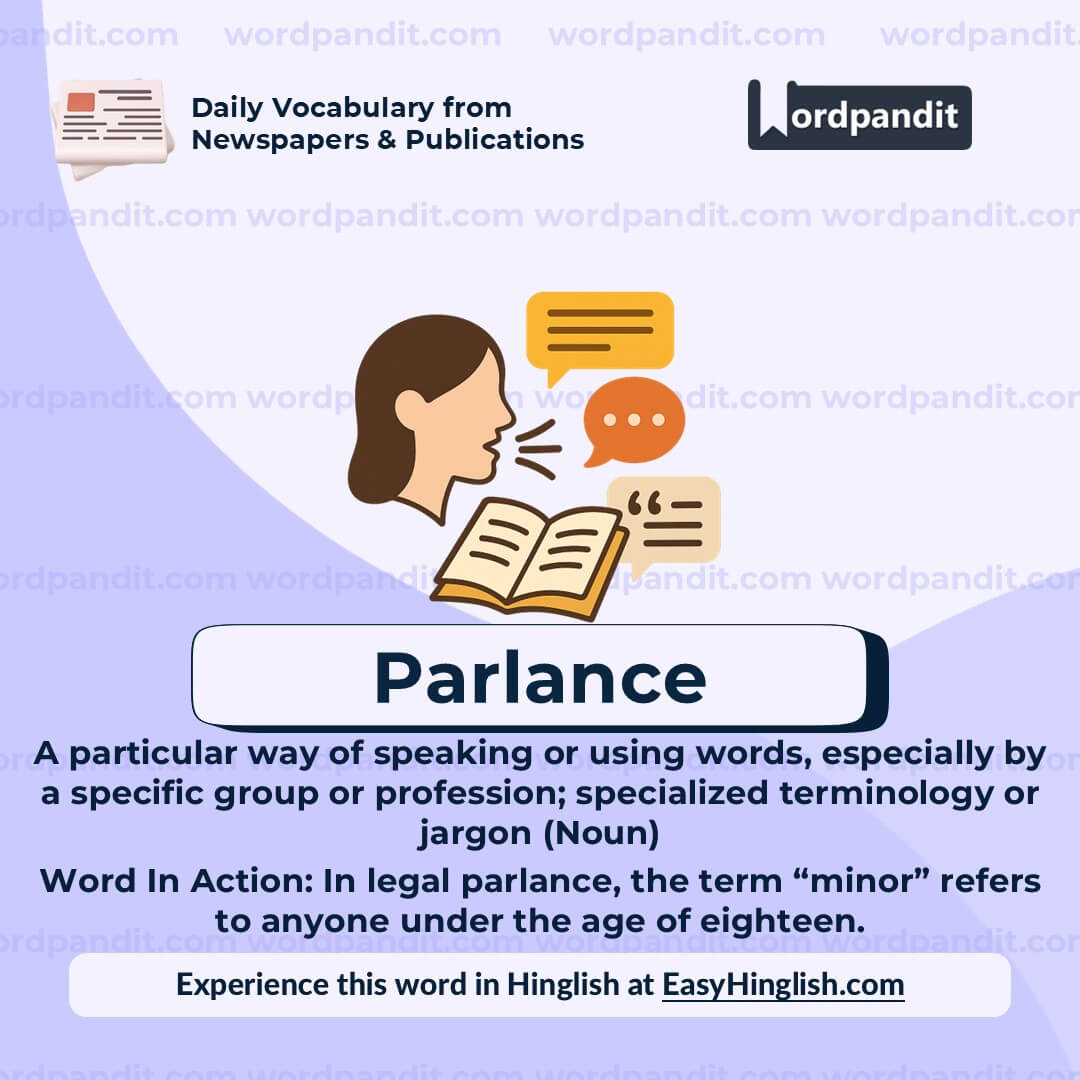
WORD-5: Parlance
Context:
"...considered an 'idiot' – in the medical parlance of the day..." - Aeon
Explanatory Paragraph:
Parlance meaning in English is a particular way of speaking or using words, especially within a specific group, profession, or context. This word is used when referring to the specialized vocabulary or manner of expression characteristic of a particular field, region, or time period. Parlance is commonly used in formal writing, academic texts, and competitive exam passages to indicate domain-specific language or terminology used by professionals, communities, or during specific historical periods.
Meaning: A particular way of speaking or using words, especially by a specific group or profession; specialized terminology or jargon (Noun)
Pronunciation: PAR-luns
Difficulty Level: ⭐⭐⭐ Intermediate
Etymology: Parlance comes from Old French 'parlance' meaning 'speech' or 'manner of speaking,' derived from 'parler' meaning 'to speak,' which traces back to Late Latin 'parabolare' meaning 'to talk.' The word entered English in the 16th century and has retained its meaning of specialized or characteristic speech patterns. Initially referring simply to manner of speaking, it evolved to emphasize the distinctive vocabulary and expressions used by particular professional, social, or regional groups.
Prashant Sir's Notes:
Students often ask: what is the difference between parlance and jargon? While both refer to specialized language, parlance usage is broader and more neutral—it simply means 'the way of speaking' in a particular context, whereas jargon specifically means technical terms that outsiders might not understand. How to use parlance correctly in essays: phrases like "in legal parlance," "in common parlance," or "in medical parlance" help you explain that you're using terminology specific to a field. For CAT and GRE aspirants, recognizing parlance in passages helps you understand when authors are signaling they're using domain-specific terms. In Indian English, you'll see "in bureaucratic parlance" when newspapers discuss government terminology, or "in cricket parlance" when explaining technical aspects of the game. Remember this pattern: "In [field] parlance, [term] means [explanation]"—this construction appears constantly in editorials and academic writing.
Synonyms & Antonyms:
Synonyms: terminology, jargon, vocabulary, vernacular, idiom, lingo, phraseology, lexicon, dialect, speech patterns
Antonyms: plain language, common speech, layman's terms, ordinary language, universal terminology
Usage Examples:
- In legal parlance, "anticipatory bail" refers to pre-arrest bail, a concept frequently discussed in Indian courts when high-profile cases make headlines.
- What we call "scoring a century" in common cricket parlance is technically defined as achieving one hundred runs in a single innings.
- In startup parlance popular in Bengaluru and Gurugram, terms like "unicorn," "burn rate," and "pivoting" have become everyday vocabulary for entrepreneurs and investors.
- The term "dowry" in social parlance carries negative connotations today, though historically it had different meanings across various Indian communities and time periods.
Cultural Reference:
"In Bollywood parlance, a 'multi-starrer' means a film featuring several lead actors, while 'masala movie' refers to films mixing action, comedy, romance, and drama—terms uniquely understood in Indian cinema circles." - Common film industry terminology
Think About It:
How does professional parlance sometimes create barriers between experts and the general public, and when is specialized terminology necessary versus unnecessarily exclusionary?
Quick Activity:
Identify three terms from your field of study or work that represent specialized parlance. Write one sentence explaining what each term means in common language.
Memory Tip:
Think of 'Parlance' as 'PAR-LANCE'—imagine a group of doctors having a "parlor conversation" using their special "lance" (language) that only they understand. Or remember: PARLE (like Parle-G biscuit) + ANCE = the way a particular group "talks" (parle in French means talk). Every profession has its own "Parle" or way of speaking!
Real-World Application:
Parlance is extensively used in academic writing, legal documents, and journalistic pieces to indicate when specialized terminology is being employed. In competitive exam essays for UPSC, CAT, or GRE, using phrases like "in economic parlance" or "in technical parlance" demonstrates sophisticated writing and helps clarify when you're using domain-specific terms. Indian newspapers regularly use constructions like "in bureaucratic parlance" when explaining government policies, or "in political parlance" when discussing electoral strategies. Understanding parlance helps readers recognize when authors shift between technical and common language, making it crucial for comprehending editorial articles in The Hindu, Economic Times, or Indian Express.


