

Daily Vocabulary from Indian Newspapers and Publications
Welcome to Wordpandit’s Indian Vocabulary Hub
At Wordpandit, we understand the importance of staying rooted in the local context while expanding your language skills. This section focuses on enriching your vocabulary with words and phrases drawn from India’s leading newspapers and publications, ensuring you're learning vocabulary that is practical, relevant, and uniquely Indian.
Why Indian Sources Matter
We believe that the best way to master any language is by immersing yourself in local content. That’s why we carefully curate vocabulary from top Indian publications, including:
- The Hindu
- The Times of India
- The Economic Times
- Hindustan Times
- Live Mint
- The Indian Express
- And many others...
Stay Updated, Stay Relevant
With daily updates from Indian news sources, you’ll be consistently learning words that reflect the trends and shifts in Indian society and culture. Our focus is to provide vocabulary that enhances your understanding of the language in an Indian context.
How Wordpandit Supports Your Goals
Whether you’re preparing for exams, aiming to improve your professional communication, or simply want to stay connected with the latest Indian vocabulary, Wordpandit is here to guide you every step of the way.
Learn with a Practical Approach
Our interactive learning methodology includes real-world examples, engaging activities, and context-specific usage to ensure that every word becomes part of your active vocabulary.
Dive into Indian Vocabulary Today!

Why Choose Wordpandit?
Practical Learning: Focus on words you'll actually encounter in real-world reading, enhancing your comprehension and communication skills.
Diverse Content: From current affairs to scientific breakthroughs, our varied sources expose you to vocabulary across multiple domains.
Effortless Integration: Make Wordpandit a part of your daily routine. Just a few minutes each day can significantly boost your lexicon over time.
Your Path to Vocabulary Mastery
- Visit our Daily Vocabulary section regularly
- Explore new words and their usage in context
- Practice incorporating these words into your own writing and speech
- Track your progress as your vocabulary expands
Start Your Journey Today
Embark on your vocabulary enhancement journey with Wordpandit. By consistently engaging with our daily posts, you'll build a robust vocabulary that serves you well in academic, professional, and personal contexts.
Remember, a word a day keeps linguistic limitations at bay. Make Wordpandit your daily companion in the quest for vocabulary excellence!

WORD-1: Summit
Context:
"Who reached the summit first — they were a team." - The Indian Express
Explanatory Paragraph:
Summit meaning in English is 'the highest point of a mountain or hill, or a meeting between high-level leaders.' This word is used when describing the peak of a mountain or when referring to important meetings between heads of state or organizational leaders. How to use summit correctly depends on context—in geography it means a physical peak, while in diplomacy and business it refers to high-level conferences. Summit appears frequently in news reports, competitive exam passages, and formal writing about achievements or international relations.
Meaning: The highest point of a mountain or hill; a meeting between heads of government or other high officials (Noun)
Pronunciation: SUM-it
Difficulty Level: ⭐⭐ Basic to Intermediate
Etymology: Summit comes from Old French 'somete,' derived from Latin 'summum' meaning 'highest.' The word originally referred only to mountain peaks, but by the 1950s, it evolved to describe high-level diplomatic meetings, as these gatherings were seen as the 'peak' of political interaction between nations.
Prashant Sir's Notes:
Many students confuse summit with 'peak'—while both can mean the top of a mountain, summit usage in formal writing often refers to important meetings between world leaders. What is the difference between summit and peak? Peak is purely geographical, while summit has dual meaning. For CAT and UPSC aspirants, summit frequently appears in Reading Comprehension passages about mountaineering achievements or international diplomacy. In Indian English newspapers, you'll see "G20 Summit in New Delhi" or "India-Africa Summit"—the political meaning dominates current usage. Remember: every summit (meeting) aims to reach a summit (peak) of agreement!
Synonyms & Antonyms:
Synonyms: peak, apex, pinnacle, top, crest, zenith, acme, climax, crown, vertex
Antonyms: base, bottom, foundation, nadir, foot, valley
Usage Examples:
- After weeks of grueling climbing, the Indian expedition team finally reached the summit of Mount Everest at dawn.
- Prime Minister Modi attended the climate summit in Paris to discuss India's renewable energy commitments and climate action plans.
- Reaching the summit of one's career requires not just talent but consistent hard work, strategic networking, and timely opportunities.
- The BRICS summit held in Goa brought together leaders from Brazil, Russia, India, China, and South Africa to strengthen economic cooperation.
Cultural Reference:
"Standing on the summit, looking down at the clouds below, one realizes how small our problems truly are compared to nature's grandeur." - Common sentiment expressed by mountaineers including Indian climbers like Bachendri Pal
Think About It:
Why do we use the same word 'summit' for both the highest point of a mountain and the most important meetings between world leaders? What does this reveal about how we view achievement and power?
Quick Activity:
Write two sentences using 'summit'—one describing a physical mountain peak and another describing a high-level meeting. Try to make them relate to Indian contexts like the Himalayas or recent diplomatic events.
Memory Tip:
Think of 'Summit' as 'SUM-it' all up at the top—whether you're summing up your climb at the mountain's highest point or summing up international discussions at a leaders' meeting, you're always at the peak!
Real-World Application:
Summit is commonly used in news articles covering international relations, adventure sports reporting, and business journalism to describe either geographical peaks or high-stakes meetings. In diplomatic coverage, phrases like "bilateral summit," "climate summit," or "economic summit" appear regularly. In corporate settings, "leadership summit" or "innovation summit" refers to important conferences where industry experts gather to discuss key challenges and opportunities.

WORD-2: Expedition
Context:
"The last surviving member of that famous expedition…" - The Indian Express
Explanatory Paragraph:
Expedition meaning in English is 'a journey or voyage undertaken by a group of people with a particular purpose, especially exploration, research, or military activity.' This word is used when describing organized trips that involve planning, preparation, and a clear objective beyond simple travel. How to use expedition in sentences typically involves mentioning the purpose—scientific expedition, military expedition, or mountaineering expedition. Expedition appears frequently in history texts, adventure narratives, competitive exam passages, and news articles about exploration and discovery.
Meaning: A journey undertaken by a group of people with a specific purpose, especially for exploration, research, or war (Noun)
Pronunciation: ek-spuh-DISH-un
Difficulty Level: ⭐⭐ Basic to Intermediate
Etymology: Expedition comes from Latin 'expeditionem,' meaning 'a setting forth, military campaign,' derived from 'expedire' meaning 'to free, make ready.' Originally used for military campaigns in the 15th century, the word gradually expanded to include any organized journey with a specific purpose, especially exploration and scientific research by the 18th century.
Prashant Sir's Notes:
Students often ask: what is the difference between expedition and excursion? An expedition is a serious, planned journey with specific goals (often dangerous or challenging), while an excursion is a short, casual trip for pleasure. Expedition usage in competitive exams like CAT and UPSC frequently appears in passages about historical exploration, scientific research, or mountaineering. For GRE aspirants, remember that expedition always implies organization and purpose—it's never just wandering around! In Indian English newspapers, you'll see "Antarctic expedition by Indian scientists" or "Everest expedition"—the word signals serious, well-planned journeys requiring expertise and resources.
Synonyms & Antonyms:
Synonyms: journey, voyage, mission, quest, exploration, campaign, safari, trek, excursion (less formal), undertaking
Antonyms: stay, settlement, residence, inactivity, rest
Usage Examples:
- The Indian Space Research Organisation launched a scientific expedition to study glacial formations in the Ladakh region last month.
- Priya joined a wildlife expedition to Kaziranga National Park to document the one-horned rhinoceros population for her research project.
- The British expedition to colonize India in the 17th century permanently altered the subcontinent's political and economic landscape.
- Our college organized a trekking expedition to Roopkund Lake, requiring months of physical training and logistical planning before departure.
Cultural Reference:
"The 1953 British expedition to Mount Everest, which included Tenzing Norgay, achieved what many thought impossible—standing atop the world's highest peak." - Reference to one of history's most celebrated mountaineering achievements
Think About It:
Why do we romanticize expeditions to remote places when modern technology allows us to see almost anywhere through screens? What drives humans to physically undertake dangerous expeditions even today?
Quick Activity:
Write two sentences describing an expedition you would like to join—one to a geographical location in India and another for a scientific or research purpose. Be specific about the expedition's goal.
Memory Tip:
Think of 'Expedition' as 'Exit-POSITION'—you're exiting your normal position to go on a planned journey with a purpose. Unlike a casual trip, an expedition means leaving your comfort zone for something important and organized!
Real-World Application:
Expedition is commonly used in academic writing, adventure journalism, historical texts, and scientific reports to describe organized journeys with specific objectives. In news coverage, phrases like "archaeological expedition," "polar expedition," or "military expedition" appear when reporting on planned missions. In corporate contexts, "market expedition" or "customer discovery expedition" metaphorically describes strategic research initiatives. Understanding expedition is crucial for UPSC aspirants studying colonial history and for CAT candidates tackling reading comprehension passages about exploration.

WORD-3: Fortitude
Context:
"A tribute to the spirit of adventure and human fortitude." - The Indian Express
Explanatory Paragraph:
Fortitude meaning in English is 'mental and emotional strength in facing difficulty, adversity, danger, or temptation courageously.' This word is used when describing someone's ability to endure hardship with dignity and resilience rather than physical strength. How to use fortitude correctly involves recognizing it refers to inner strength during prolonged challenges—not momentary bravery. Fortitude appears frequently in formal writing, motivational speeches, competitive exam essays, and biographical accounts where sustained courage through adversity is highlighted.
Meaning: Mental and emotional strength in facing difficulty, adversity, pain, or danger with courage (Noun)
Pronunciation: FOR-ti-tood
Difficulty Level: ⭐⭐⭐ Intermediate
Etymology: Fortitude comes from Latin 'fortitudo' meaning 'strength, bravery,' derived from 'fortis' meaning 'strong, brave.' The word entered English in the 12th century through Old French. Historically, fortitude was considered one of the four cardinal virtues in classical philosophy, representing the courage to persist through suffering and temptation while maintaining moral integrity.
Prashant Sir's Notes:
Many students confuse fortitude with courage—while both relate to bravery, the difference between fortitude and courage is crucial. Courage is facing immediate danger or fear, while fortitude is enduring long-term hardship without giving up. For CAT and UPSC aspirants, fortitude frequently appears in passages about historical figures, freedom fighters, or survival stories. How to use fortitude in essays: pair it with prolonged challenges, not single brave acts. In Indian English writing, you'll often see "fortitude of Mahatma Gandhi during the freedom struggle" or "fortitude shown by flood victims"—it always implies sustained mental strength through extended adversity, not a one-time heroic moment.
Synonyms & Antonyms:
Synonyms: resilience, endurance, courage, grit, determination, perseverance, strength of character, steadfastness, tenacity, resolve
Antonyms: weakness, cowardice, timidity, fragility, vulnerability, faintheartedness
Usage Examples:
- Cancer patients undergoing chemotherapy display remarkable fortitude, maintaining hope and dignity despite months of painful treatment and uncertainty.
- Kiran Bedi showed tremendous fortitude throughout her career, breaking barriers in a male-dominated police force while facing constant criticism.
- The farmer demonstrated fortitude by continuing to work his land despite three consecutive years of drought and failed crops.
- Preparing for UPSC requires not just intelligence but fortitude—the mental strength to study for eighteen months despite failures and setbacks.
Cultural Reference:
"It takes fortitude to stand alone when everyone else is sitting down." - Inspired by the courage shown by freedom fighters like Bhagat Singh and Chandrashekhar Azad who faced execution with unwavering resolve
Think About It:
Why is fortitude considered more admirable than a single act of bravery? Does our fast-paced, instant-gratification culture make it harder to develop true fortitude?
Quick Activity:
Think of someone in your life who has shown fortitude—a family member, teacher, or public figure. Write two sentences describing the prolonged challenge they faced and how their fortitude helped them endure.
Memory Tip:
Connect 'Fortitude' to 'FORT-attitude'—imagine a fort that stands strong through years of storms and attacks. A fort doesn't just survive one battle; it endures through time. Similarly, fortitude is the attitude that keeps you standing strong like a fort through prolonged difficulties!
Real-World Application:
Fortitude is commonly used in biographical writing, motivational literature, medical contexts, and formal speeches to describe sustained courage through adversity. In news coverage, journalists use fortitude when reporting on disaster survivors, chronic illness patients, or individuals overcoming systemic discrimination. In corporate settings, "leadership fortitude" describes executives who maintain vision during economic downturns. For competitive exam essays, fortitude is an excellent word when discussing historical leaders, social reformers, or personal resilience—it elevates your vocabulary while precisely capturing endurance through long-term challenges.
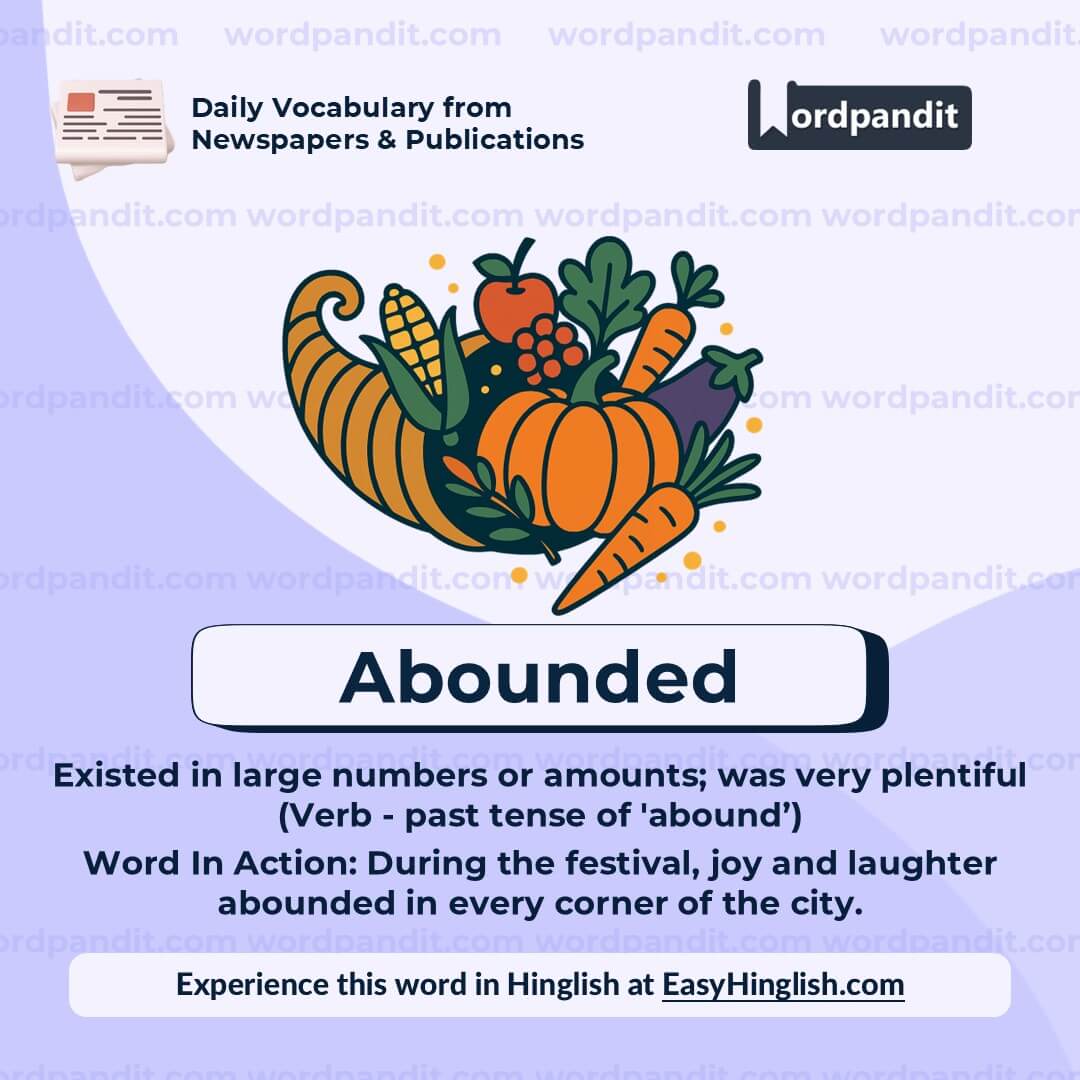
WORD-4: Abounded
Context:
"Speculation abounded until Tenzing put it to rest…" - The Indian Express
Explanatory Paragraph:
Abounded meaning in English is 'existed in large numbers or amounts; was very plentiful or abundant.' This word is used when describing situations where something was present in great quantity or occurred frequently. How to use abounded in sentences typically involves describing past situations where rumors, opportunities, resources, or problems were plentiful. Abounded appears frequently in historical writing, news analysis, formal reports, and competitive exam passages describing situations where something was widespread or numerous.
Meaning: Existed in large numbers or amounts; was very plentiful (Verb - past tense of 'abound')
Pronunciation: uh-BOWN-ded
Difficulty Level: ⭐⭐⭐ Intermediate
Etymology: Abounded comes from Latin 'abundare' meaning 'to overflow, be plentiful,' derived from 'ab-' (from) and 'unda' (wave). The imagery is of waves overflowing their boundaries. The word entered English through Old French 'abonder' in the 14th century, maintaining its core meaning of existing in great quantity or being richly supplied with something.
Prashant Sir's Notes:
Students often ask: what is the difference between abounded and abundant? Abounded is the past tense verb meaning 'existed in large quantities,' while abundant is an adjective meaning 'plentiful.' For CAT and GRE aspirants, abounded frequently appears in Reading Comprehension passages about historical periods or situations with plenty of something. How to use abounded correctly: it's always followed by 'with' or 'in' when specifying what was plentiful—"the garden abounded with flowers" or "opportunities abounded in the market." In Indian English newspapers, you'll see "rumors abounded during the election" or "corruption abounded in the regime"—it's perfect for describing widespread phenomena in the past.
Synonyms & Antonyms:
Synonyms: flourished, proliferated, thrived, prevailed, swarmed, teemed, overflowed, existed plentifully, was rife, was rampant
Antonyms: lacked, was scarce, was rare, was deficient, dwindled, diminished
Usage Examples:
- Conspiracy theories abounded on social media after the celebrity's sudden disappearance, with every news channel offering different explanations.
- During the 1990s economic liberalization, business opportunities abounded in India as multinational companies rushed to enter the market.
- Wildlife abounded in the Sundarbans region before rapid industrialization and human encroachment disrupted the delicate ecological balance.
- Confusion abounded among students when the exam board suddenly changed the syllabus just three months before the final examinations.
Cultural Reference:
"In the golden age of Bollywood during the 1950s and 60s, musical talent abounded—from Lata Mangeshkar to Mohammed Rafi, every film had unforgettable melodies." - Common observation about Hindi cinema's classic era
Think About It:
Why do rumors and misinformation seem to abound more in the digital age despite having access to more factual information than ever before?
Quick Activity:
Complete this sentence in two different ways: "During the pandemic lockdown, ________ abounded as people struggled to adjust to the new normal." Think of both positive and negative things that were plentiful during that time.
Memory Tip:
Think of 'Abounded' as 'A-BOUND-ed'—imagine something that has gone beyond its bounds, overflowing everywhere. When rumors abounded, they crossed all boundaries and spread everywhere. The word literally suggests overflowing abundance, like water that has exceeded its bounds!
Real-World Application:
Abounded is commonly used in historical writing, news analysis, and formal reports to describe past situations where something existed in large quantities. Journalists use phrases like "speculation abounded," "opportunities abounded," or "problems abounded" when describing periods of uncertainty, growth, or crisis. In academic writing, "evidence abounds" (present tense) or "examples abounded" (past tense) strengthens arguments by indicating plentiful support. For UPSC essay writing, using abounded when discussing historical periods adds sophistication—for example, "corruption abounded during the colonial administration" or "revolutionary fervor abounded in Bengal during the independence movement."

WORD-5: Arguably
Context:
"Time would, arguably, redress the balance…" - The Indian Express
Explanatory Paragraph:
Arguably meaning in English is 'as may be shown or supported by argument; it can be argued that something is true, though not everyone may agree.' This word is used when presenting an opinion or claim that has reasonable support but remains debatable or subject to different interpretations. How to use arguably in writing involves placing it before a statement to acknowledge that while you believe something is true, others might disagree. Arguably appears frequently in academic writing, opinion pieces, competitive exam essays, and formal debates where nuanced claims require careful qualification.
Meaning: It may be argued; used to express that something can be supported by argument though it is debatable (Adverb)
Pronunciation: AR-gyoo-uh-blee
Difficulty Level: ⭐⭐⭐ Intermediate
Etymology: Arguably is formed from 'arguable' (capable of being argued) plus the adverb suffix '-ly.' It derives from Latin 'arguere' meaning 'to make clear, prove, or accuse.' The word gained prominence in English during the 20th century, particularly in academic and journalistic writing, as a way to present claims with intellectual honesty while acknowledging alternative viewpoints.
Prashant Sir's Notes:
Many students confuse arguably with definitely or certainly—the key difference between arguably and certainly is that arguably always signals room for debate. Arguably usage in competitive exams like CAT, GRE, and UPSC appears frequently in Reading Comprehension passages where authors present debatable claims. For essay writing, arguably is a sophisticated hedge word that shows intellectual maturity—you're making a strong claim while acknowledging others might disagree. In Indian English newspapers, you'll see "Sachin Tendulkar is arguably the greatest batsman" or "Mumbai is arguably India's financial capital"—the word signals "I believe this is true and can defend it, but reasonable people might argue otherwise." Never use arguably for facts—don't say "India arguably gained independence in 1947."
Synonyms & Antonyms:
Synonyms: possibly, conceivably, debatably, perhaps, potentially, supposedly, presumably, it could be argued, one might say
Antonyms: definitely, certainly, undoubtedly, indisputably, unquestionably, undeniably, clearly, obviously
Usage Examples:
- Shah Rukh Khan is arguably Bollywood's most globally recognized actor, though Amitabh Bachchan's legacy might give him that title too.
- The introduction of GST was arguably the most significant tax reform in independent India's economic history, despite its controversial implementation.
- Bangalore is arguably India's startup capital, though Mumbai and Delhi-NCR investors might contest this claim with their own data.
- Online education arguably proved more accessible during the pandemic, yet many students struggled without proper internet connectivity and infrastructure.
Cultural Reference:
"Cricket is arguably India's true religion—more people follow the sport passionately than participate in many traditional festivals." - Common observation about India's cricket obsession
Think About It:
Why is the ability to use words like 'arguably' a sign of intellectual maturity? Does acknowledging different viewpoints make your argument stronger or weaker?
Quick Activity:
Write two sentences using 'arguably' about debatable topics—one about Indian culture or sports, and another about technology or education. Make sure your claim has merit but could reasonably be challenged.
Memory Tip:
Break 'Arguably' into 'ARGUE-ABLY'—something you are ABLE to ARGUE for, but others can argue against too! Whenever you use arguably, imagine two people debating—both have valid points, which is why the claim is arguable, not definite.
Real-World Application:
Arguably is essential in academic writing, opinion editorials, research papers, and formal debates where presenting nuanced positions is valued. Journalists use arguably when making subjective claims that have support but aren't universally accepted—"arguably the best," "arguably the most important." In CAT and GRE essay writing, using arguably demonstrates sophisticated thinking and prevents overstatement. For UPSC mains answers, arguably helps present balanced views: "Democracy is arguably the most effective governance system" shows you understand multiple perspectives. The word signals intellectual honesty—you're confident in your position but respect alternative viewpoints, which is crucial in persuasive writing.


