

Daily Vocabulary from Indian Newspapers and Publications
Welcome to Wordpandit’s Indian Vocabulary Hub
At Wordpandit, we understand the importance of staying rooted in the local context while expanding your language skills. This section focuses on enriching your vocabulary with words and phrases drawn from India’s leading newspapers and publications, ensuring you're learning vocabulary that is practical, relevant, and uniquely Indian.
Why Indian Sources Matter
We believe that the best way to master any language is by immersing yourself in local content. That’s why we carefully curate vocabulary from top Indian publications, including:
- The Hindu
- The Times of India
- The Economic Times
- Hindustan Times
- Live Mint
- The Indian Express
- And many others...
Stay Updated, Stay Relevant
With daily updates from Indian news sources, you’ll be consistently learning words that reflect the trends and shifts in Indian society and culture. Our focus is to provide vocabulary that enhances your understanding of the language in an Indian context.
How Wordpandit Supports Your Goals
Whether you’re preparing for exams, aiming to improve your professional communication, or simply want to stay connected with the latest Indian vocabulary, Wordpandit is here to guide you every step of the way.
Learn with a Practical Approach
Our interactive learning methodology includes real-world examples, engaging activities, and context-specific usage to ensure that every word becomes part of your active vocabulary.
Dive into Indian Vocabulary Today!

Why Choose Wordpandit?
Practical Learning: Focus on words you'll actually encounter in real-world reading, enhancing your comprehension and communication skills.
Diverse Content: From current affairs to scientific breakthroughs, our varied sources expose you to vocabulary across multiple domains.
Effortless Integration: Make Wordpandit a part of your daily routine. Just a few minutes each day can significantly boost your lexicon over time.
Your Path to Vocabulary Mastery
- Visit our Daily Vocabulary section regularly
- Explore new words and their usage in context
- Practice incorporating these words into your own writing and speech
- Track your progress as your vocabulary expands
Start Your Journey Today
Embark on your vocabulary enhancement journey with Wordpandit. By consistently engaging with our daily posts, you'll build a robust vocabulary that serves you well in academic, professional, and personal contexts.
Remember, a word a day keeps linguistic limitations at bay. Make Wordpandit your daily companion in the quest for vocabulary excellence!
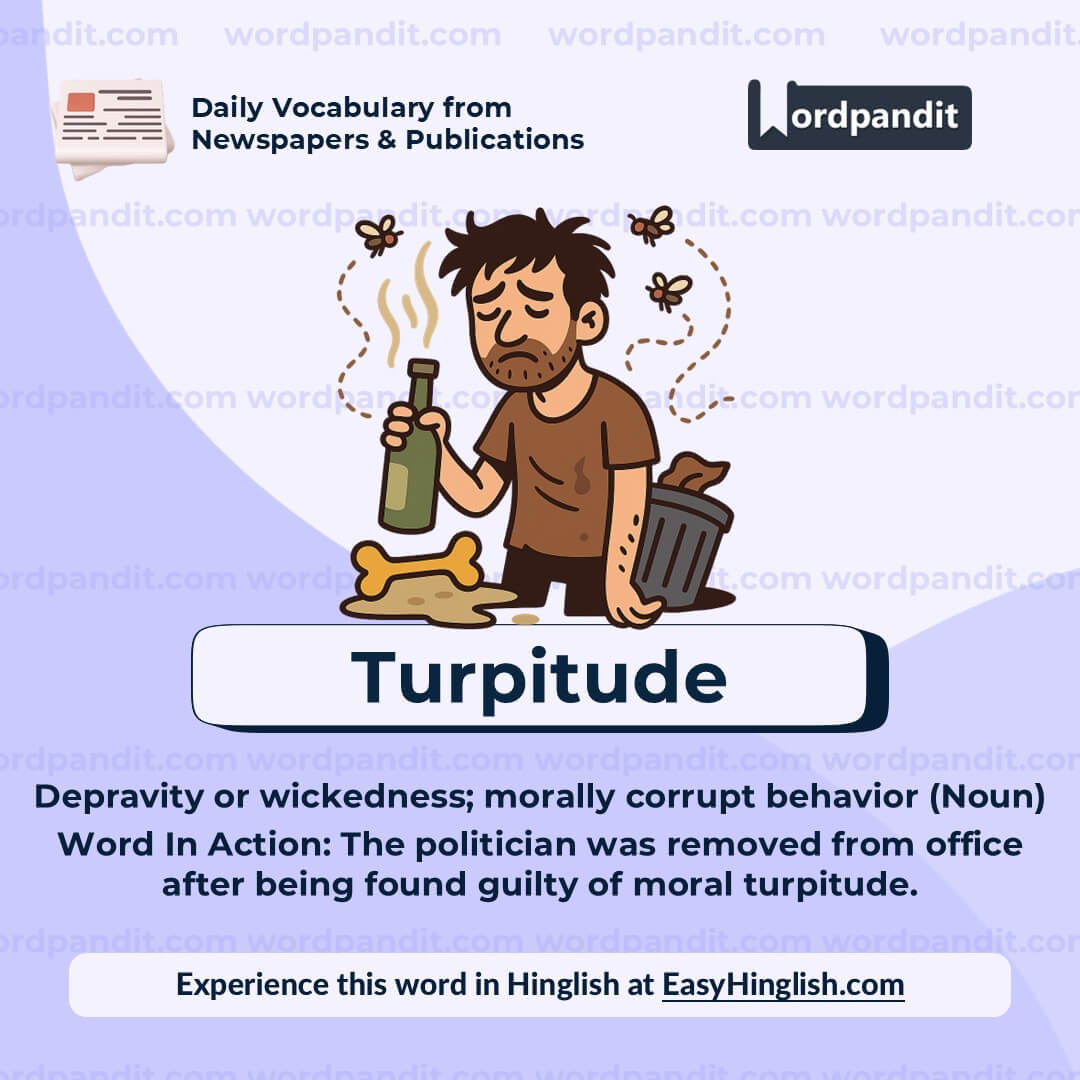
WORD-1: Turpitude
Context:
"The word comes from the Latin turpitudo, which means 'shameful' or 'disgraceful'." - The Hindu
Explanatory Paragraph:
Turpitude meaning in English is "depravity or extreme immorality, especially in behavior or character." This word is used when describing actions that are morally corrupt, shameful, or wicked in nature. How to use turpitude effectively: it appears most commonly in legal contexts, formal writing, and competitive exam passages when discussing ethical violations or morally reprehensible conduct. The phrase "moral turpitude" is particularly prevalent in legal and immigration discussions.
Meaning: Depravity or wickedness; morally corrupt behavior (Noun)
Pronunciation: TUR-pi-tood
Difficulty Level: ⭐⭐⭐⭐ Advanced
Etymology: Turpitude comes from Latin 'turpitudo' meaning 'baseness' or 'ugliness,' derived from 'turpis' meaning 'vile' or 'disgraceful.' The word entered English in the late 15th century through French influence, primarily used in legal and moral philosophy contexts. Over centuries, it retained its serious connotation, particularly cementing itself in the legal phrase "moral turpitude," which refers to conduct that is considered contrary to community standards of justice, honesty, or good morals.
Prashant Sir's Notes:
Many students confuse turpitude with turbulence or turbid—completely different words! The difference between turpitude and depravity is subtle: turpitude carries a formal, almost legal weight, while depravity sounds more dramatic and literary. For UPSC aspirants and law entrance exam students, turpitude frequently appears in questions about ethics, governance, and constitutional morality. How to use turpitude correctly: it's almost always preceded by "moral" in legal contexts, but can stand alone when describing shameful conduct. In Indian English newspapers covering corruption cases or political scandals, you'll often see phrases like "acts of turpitude" or "moral turpitude under the law"—this signals behavior serious enough to warrant legal consequences.
Synonyms & Antonyms:
Synonyms: depravity, wickedness, immorality, corruption, vileness, baseness, shamelessness, degeneracy, iniquity, vice
Antonyms: virtue, morality, righteousness, integrity, honor, decency
Usage Examples:
- The judge cited moral turpitude as the reason for denying the minister's bail application in the corruption case.
- Incidents of turpitude among public officials have eroded citizens' faith in democratic institutions across India.
- The CAT Reading Comprehension passage discussed how societies define turpitude differently based on cultural and historical contexts.
- Priya was shocked by her colleague's turpitude when she discovered he had been embezzling funds meant for charitable causes.
Cultural Reference:
"In legal proceedings, acts involving moral turpitude—fraud, theft, or violence—carry severe consequences including deportation and professional disqualification." - Common reference in Indian legal discourse
Think About It:
Why does Indian law distinguish between ordinary crimes and crimes involving moral turpitude, and how does this distinction affect public trust in the justice system?
Quick Activity:
Scan today's newspaper for any corruption or scandal story. Write one sentence using "turpitude" to describe the actions reported, and share how the word adds gravity to the description.
Memory Tip:
Think of 'Turpitude' as "TURn away in PITY for the DUDE"—imagine someone whose actions are so shameful that people literally turn away in disgust and pity. The word sounds heavy and serious, matching its meaning of deep moral corruption.
Real-World Application:
Turpitude is commonly used in legal documents, immigration proceedings, and formal journalism when describing serious ethical violations. In Indian legal contexts, it appears in disqualification cases for politicians, visa rejections, and professional misconduct hearings. Writers use "moral turpitude" to signal that certain actions aren't just illegal but fundamentally violate community standards of decency, making it essential vocabulary for law students, UPSC aspirants, and anyone reading serious news analysis.
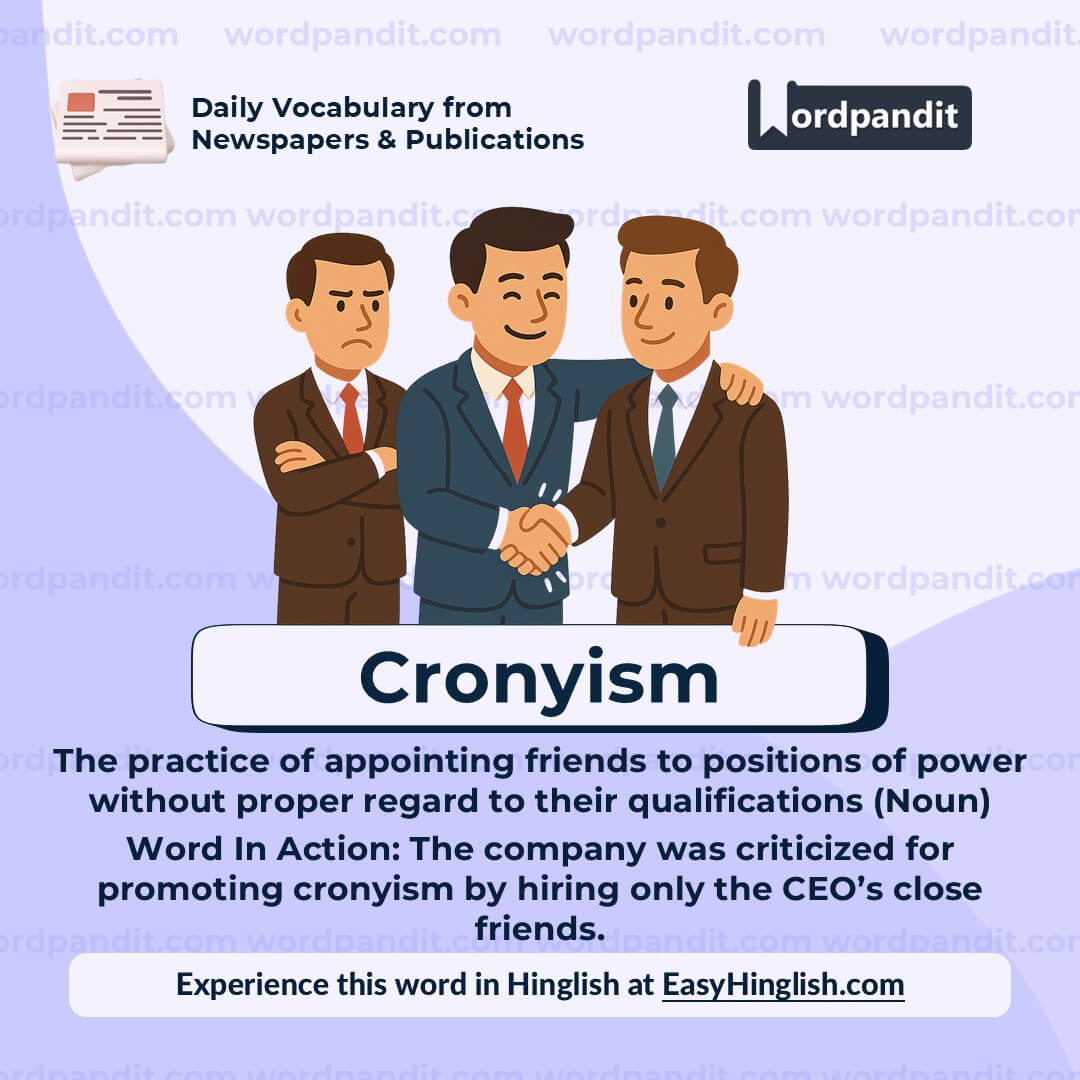
WORD-2: Cronyism
Context:
"But it would entail cronyism only if those who did not represent India's diverse business strengths also got selected, purely on the strength of personal equations with those in power." - The Economic Times
Explanatory Paragraph:
Cronyism meaning in English is "the practice of favoring friends or associates, especially by giving them jobs or advantages, regardless of their qualifications." This word is used when describing situations where personal relationships rather than merit determine appointments, contracts, or opportunities. Cronyism appears frequently in political discourse, business news, and competitive exam passages discussing governance, ethics, and economic policy. How to use cronyism: it typically describes systemic favoritism in organizations, governments, or institutions where connections matter more than competence.
Meaning: The practice of appointing friends to positions of power without proper regard to their qualifications (Noun)
Pronunciation: KROH-nee-iz-um
Difficulty Level: ⭐⭐⭐ Intermediate
Etymology: Cronyism comes from the Greek word 'chronios' meaning 'long-lasting,' which evolved into the English slang 'crony' in the 17th century at Cambridge University, referring to a long-time friend or companion. The suffix '-ism' was added in the 19th century to denote a system or practice. The word gained political prominence in the 20th century when used to criticize governments and businesses that prioritized personal loyalty over merit, becoming a central term in discussions about corruption and good governance.
Prashant Sir's Notes:
Students often ask: what is the difference between cronyism and nepotism? While both involve unfair favoritism, nepotism specifically refers to favoring family members, whereas cronyism usage applies to friends and associates. For CAT and UPSC aspirants, cronyism frequently appears in passages about economic reforms, corporate governance, and political ethics. In Indian English newspapers, you'll see phrases like "cronyism capitalism" or "allegations of cronyism" whenever there's controversy about government contracts awarded to business houses with political connections. How to use cronyism correctly in essays: pair it with words like "alleged," "rampant," or "systemic" to show you understand it's often a serious accusation that undermines meritocracy and public trust.
Synonyms & Antonyms:
Synonyms: favoritism, nepotism (related), patronage, partisanship, bias, preferential treatment, old boys' network, back-scratching
Antonyms: meritocracy, impartiality, fairness, objectivity, equal opportunity, transparency
Usage Examples:
- The opposition accused the government of cronyism after several infrastructure contracts were awarded to companies owned by the ruling party's associates.
- Rajesh lost faith in his company when he saw promotions going to the CEO's golf buddies rather than hardworking employees—a clear case of cronyism.
- The CAT passage discussed how cronyism in public sector banks led to massive loan defaults and economic losses during the 1990s.
- Despite her excellent qualifications, Anita suspected cronyism when someone with half her experience got the position simply because he knew the director personally.
Cultural Reference:
"In Bollywood too, debates about nepotism versus cronyism rage—while star kids get launched easily, even outsiders can succeed if they build the right friendships with producers and directors." - Common discussion in Indian entertainment industry
Think About It:
Is some level of cronyism inevitable in Indian business and politics, or can systems be designed to ensure merit always trumps personal connections?
Quick Activity:
Think of three situations from your college, workplace, or news where cronyism might have played a role. Write one sentence describing each situation using the word "cronyism" appropriately.
Memory Tip:
Remember 'Cronyism' by thinking "CRONY + ISM = favoring your CRONIES as a SYSTEM." Imagine a circle of friends (cronies) passing opportunities to each other like in a game of passing the parcel—but here, jobs and contracts are being passed instead of gifts, and qualifications don't matter.
Real-World Application:
Cronyism for CAT, UPSC, and GRE appears in reading comprehension passages about governance, economics, and organizational behavior. In Indian journalism, the term is crucial when analyzing government policy, corporate scandals, and regulatory failures. Business students encounter cronyism in case studies about corporate governance failures, while it's essential vocabulary for anyone writing about transparency, accountability, and institutional reform. Understanding the difference between healthy networking and harmful cronyism is vital for both exam success and professional awareness.

WORD-3: Sartorial
Context:
"The politician's sartorial choices became a talking point." - The Hindu
Explanatory Paragraph:
Sartorial meaning in English is "relating to tailoring, clothing, or style of dress." This word is used when discussing someone's fashion sense, wardrobe choices, or approach to dressing. How to use sartorial effectively: it appears in lifestyle articles, fashion commentary, and formal writing when describing clothing elegance or personal style. Sartorial is commonly found in newspapers, magazine profiles, and competitive exam passages that analyze public figures, adding a sophisticated touch when discussing attire rather than simply saying "clothing" or "dress."
Meaning: Relating to tailored clothing or style of dress; pertaining to fashion and tailoring (Adjective)
Pronunciation: sar-TOR-ee-ul
Difficulty Level: ⭐⭐⭐ Intermediate
Etymology: Sartorial comes from the Latin word 'sartor' meaning 'tailor,' which itself derives from 'sarcire' meaning 'to patch or mend.' The word entered English in the early 19th century, coinciding with the rise of men's fashion consciousness during the Regency and Victorian eras. Initially used primarily in British tailoring circles, 'sartorial' evolved to describe not just the technical craft of tailoring but the broader concept of personal style and dress sense, becoming a staple term in fashion journalism and cultural commentary.
Prashant Sir's Notes:
Many students confuse sartorial with 'ceremonial' or 'atorial'—remember, it's specifically about clothing and tailoring! The word sartorial usage in sentences almost always appears with words like "elegance," "choices," "style," or "splendor." For GRE and CAT aspirants, sartorial frequently appears in passages about cultural figures, political leaders, or historical personalities where clothing reflects status or identity. In Indian English newspapers, you'll see phrases like "sartorial statement" when describing how politicians like Nehru with his achkan or Modi with his kurtas use clothing strategically. How to use sartorial correctly: it's typically paired with nouns—"sartorial sense," "sartorial preference," "sartorial excellence"—and adds sophistication when describing someone's dress style rather than using basic words like "fashion" or "clothes."
Synonyms & Antonyms:
Synonyms: tailoring-related, fashion-conscious, stylish, dapper (informal), well-dressed, clothing-related, vestmental (formal), costume-related
Antonyms: unfashionable, slovenly, unkempt, disheveled, unstylish, casual (in some contexts)
Usage Examples:
- Amitabh Bachchan's sartorial elegance has made him a style icon across generations, from his bell-bottoms in the 1970s to his tailored suits today.
- The young entrepreneur's sartorial choices reflected his personality—bold colors, experimental cuts, and a mix of traditional and Western wear.
- The GRE passage discussed how Oscar Wilde's sartorial flamboyance was inseparable from his artistic identity and social commentary.
- Vikram invested in his sartorial wardrobe after realizing that dressing well boosted his confidence during client presentations and business meetings.
Cultural Reference:
"From Rajinikanth's signature style to Ranveer Singh's bold sartorial experiments, Indian cinema has always celebrated distinctive fashion statements that become part of a star's brand identity." - Common observation in Bollywood fashion commentary
Think About It:
Why do sartorial choices of public figures—politicians, actors, business leaders—receive so much attention, and what does clothing communicate beyond just covering the body?
Quick Activity:
Observe three people around you and write one sentence about each person's sartorial style using the word "sartorial" appropriately. What does their clothing choice say about them?
Memory Tip:
Think of 'Sartorial' as "SAR-TAILOR-ial"—imagine a TAILOR (sartor) carefully stitching clothes. The word literally means "related to a tailor," so whenever you see someone well-dressed, think "their sartorial sense is excellent" as if praising the invisible tailor behind their style.
Real-World Application:
Sartorial is commonly used in fashion journalism, lifestyle magazines, and cultural commentary when describing public figures' clothing choices. In Indian English media, it appears frequently in profiles of politicians, celebrities, and business leaders where appearance matters. For competitive exam aspirants, sartorial appears in reading comprehension passages about historical figures, cultural movements, and social commentary. Understanding this word helps you write more sophisticatedly about fashion, style, and personal presentation in formal essays and analyses, moving beyond basic vocabulary like "well-dressed" or "fashionable."
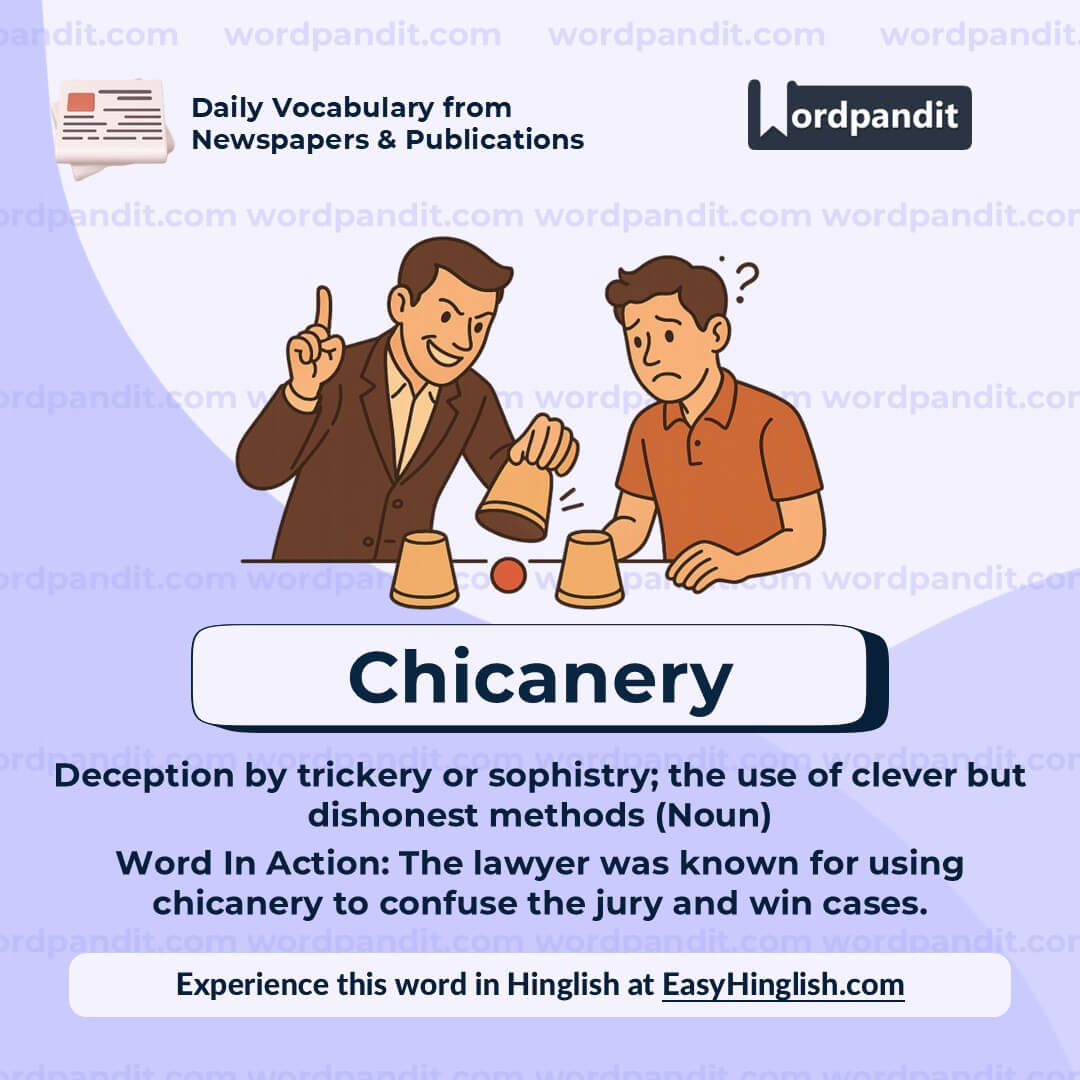
WORD-4: Chicanery
Context:
"The opposition accused the government of electoral chicanery." - The Hindu
Explanatory Paragraph:
Chicanery meaning in English is "the use of trickery or deception to achieve a goal, especially in legal or political matters." This word is used when describing clever but dishonest manipulation, often involving legal loopholes or misleading tactics. How to use chicanery: it appears in political discourse, legal commentary, and formal writing when exposing fraudulent schemes or deceptive practices. Chicanery is commonly found in newspapers covering scandals, competitive exam passages about ethics, and discussions where someone employs cunning deceit to gain an unfair advantage.
Meaning: Deception by trickery or sophistry; the use of clever but dishonest methods (Noun)
Pronunciation: shi-KAY-nuh-ree or chik-AY-nuh-ree
Difficulty Level: ⭐⭐⭐⭐ Advanced
Etymology: Chicanery comes from the French word 'chicanerie' meaning 'quibbling' or 'trickery,' which itself derived from 'chicaner' meaning 'to quibble' or 'to trick.' The term entered English in the early 17th century and was initially used in legal contexts to describe the use of clever but misleading arguments to win cases. Over time, its usage expanded beyond courtrooms to encompass any form of deceptive manipulation, particularly in politics and business. The word carries a sense of sophisticated dishonesty—not crude lying, but artful deception that exploits technicalities and loopholes.
Prashant Sir's Notes:
Many students confuse chicanery with 'trickery'—while trickery is general deception, chicanery specifically implies clever, sophisticated manipulation often involving legal or bureaucratic loopholes. The difference between chicanery and fraud is that chicanery sounds more cunning and artful, while fraud is straightforward criminal deception. For UPSC and CAT aspirants, chicanery frequently appears in passages about political maneuvering, corporate scandals, and legal ethics. In Indian English newspapers covering elections or governance issues, you'll see phrases like "electoral chicanery," "financial chicanery," or "bureaucratic chicanery"—this signals systematic manipulation rather than simple lying. How to use chicanery correctly: it often appears with verbs like "accused of," "engaged in," or "exposed," and it's more formal than saying "tricks" or "cheating," making it perfect for essay writing on governance and ethics topics.
Synonyms & Antonyms:
Synonyms: trickery, deception, duplicity, skulduggery, subterfuge, sophistry, manipulation, sharp practice, deceit, artifice
Antonyms: honesty, straightforwardness, integrity, candor, transparency, forthrightness, sincerity
Usage Examples:
- The auditor's report exposed the company's financial chicanery, revealing how they had manipulated balance sheets to hide losses for years.
- Voters grew tired of political chicanery when candidates made promises during elections but used legal technicalities to avoid fulfilling them later.
- The CAT passage analyzed how legal chicanery allowed corporations to avoid taxes while technically staying within the law's boundaries.
- Priya suspected chicanery when her landlord added obscure clauses to the rental agreement that significantly increased her obligations without clear explanation.
Cultural Reference:
"In the film 'Special 26,' Akshay Kumar's character exemplifies chicanery at its finest—conducting fake CBI raids with such sophistication that even government officials couldn't distinguish the deception from reality." - Reference to sophisticated trickery in Indian cinema
Think About It:
When does clever negotiation or strategic planning cross the line into chicanery, and who decides where that ethical boundary lies in Indian business and politics?
Quick Activity:
Read today's business or political news section. Identify one situation that might involve chicanery and write two sentences explaining what makes it deceptive rather than just strategic or clever.
Memory Tip:
Remember 'Chicanery' as "CHEAT-CANARY"—imagine a canary (a bird known for singing) that instead of singing honestly, CHEATs by imitating other birds to trick people. Just like this deceptive canary, chicanery is sophisticated trickery that makes dishonesty look legitimate and clever.
Real-World Application:
Chicanery is commonly used in political analysis, legal commentary, and business journalism when describing sophisticated fraud or manipulation. In Indian English newspapers, it appears in election coverage, corporate scandal reports, and bureaucratic investigations where loopholes are exploited. For UPSC aspirants writing ethics papers or CAT students analyzing business cases, chicanery is essential vocabulary that distinguishes between simple dishonesty and clever, systematic deception. The word adds gravitas to essays about governance, accountability, and institutional integrity, signaling an understanding of how power can be abused through sophisticated rather than crude means.

WORD-5: Zeitgeist
Context:
"The new cinema reflects the zeitgeist of urban alienation." - The Hindu
Explanatory Paragraph:
Zeitgeist meaning in English is "the defining spirit or mood of a particular period of history, as shown by the ideas and beliefs of the time." This word is used when describing the characteristic mindset, cultural atmosphere, or prevailing attitudes that define an era. How to use zeitgeist effectively: it appears in cultural criticism, historical analysis, and discussions about social trends when capturing what makes a particular time period unique. Zeitgeist is commonly found in film reviews, literary criticism, and competitive exam passages analyzing how art, politics, or social movements reflect their times.
Meaning: The defining spirit, mood, or general trend of thought characteristic of a particular period of time (Noun)
Pronunciation: ZYTE-gyst or TSYTE-gyst
Difficulty Level: ⭐⭐⭐⭐ Advanced
Etymology: Zeitgeist is a German word composed of 'Zeit' meaning 'time' and 'Geist' meaning 'spirit' or 'ghost.' The term was popularized by German philosopher Georg Hegel in the early 19th century as part of his philosophy of history, where he argued that each historical period has its own unique spirit or consciousness. The word entered English in the mid-19th century and became particularly popular in academic and cultural discourse. Unlike many borrowed words that change meaning, zeitgeist retained its precise German sense—capturing the intangible but powerful collective consciousness that defines an era and influences everything from art to politics to social values.
Prashant Sir's Notes:
Students often ask: what is the difference between zeitgeist and trend? While a trend is a specific popular movement, zeitgeist captures the entire spirit of an age—the underlying mood that produces multiple trends. For GRE and CAT aspirants, zeitgeist frequently appears in passages about cultural movements, historical periods, or artistic analysis. In Indian English newspapers discussing everything from startup culture to web series, you'll see phrases like "captures the zeitgeist" or "reflects the current zeitgeist"—for example, shows like 'Panchayat' or 'Gullak' capture the zeitgeist of small-town India's aspirations. How to use zeitgeist correctly: it's typically used with verbs like "captures," "reflects," "embodies," or "defines," and you don't need an article before it—say "reflects zeitgeist," not "reflects the zeitgeist" (though both are acceptable). This word elevates your writing instantly when discussing culture, history, or social change.
Synonyms & Antonyms:
Synonyms: spirit of the age, cultural climate, prevailing mood, tenor of the times, ethos, atmosphere, collective consciousness, cultural moment, spirit of the times
Antonyms: timelessness, anachronism, dated perspective, outdated thinking, untimeliness
Usage Examples:
- The rise of OTT platforms and web series in India perfectly captures the zeitgeist of a generation seeking diverse, unfiltered storytelling beyond mainstream cinema.
- Nehru's vision of scientific temper and industrialization embodied the zeitgeist of post-independence India, when the nation believed in progress through rationality and planning.
- The GRE passage examined how the Beatles didn't just create music but captured the zeitgeist of 1960s rebellion, freedom, and cultural transformation.
- Arjun's startup focused on sustainability and work-life balance, reflecting the zeitgeist of young Indian professionals who prioritize purpose over mere profits.
Cultural Reference:
"Films like 'Zindagi Na Milegi Dobara' and 'Yeh Jawaani Hai Deewani' captured the zeitgeist of millennial India—a generation balancing ambition with wanderlust, career with experiences, and tradition with contemporary aspirations." - Common analysis in Indian film criticism
Think About It:
What defines the zeitgeist of India in 2025—is it the startup boom, digital transformation, political polarization, or the clash between traditional values and modern aspirations?
Quick Activity:
Think about three movies, songs, or social media trends from the past year. Write one sentence explaining how one of them captures the current Indian zeitgeist and what it reveals about our collective mood.
Memory Tip:
Break 'Zeitgeist' into "ZEIT (TIME) + GEIST (GHOST)"—imagine the invisible GHOST of TIME hovering over every era, influencing how people think, create, and behave. Every time period has its own "time ghost" that haunts and shapes everything from fashion to politics. That's the zeitgeist!
Real-World Application:
Zeitgeist is commonly used in cultural journalism, historical analysis, film and book reviews, and academic writing when discussing how creative works or social movements reflect their times. In Indian English media, it appears in discussions about cinema, literature, political movements, and generational shifts. For CAT and GRE aspirants, understanding zeitgeist is crucial for reading comprehension passages about historical periods, artistic movements, or cultural analysis. Using this word in essays about social change, cultural trends, or historical events demonstrates sophisticated thinking—showing you can connect individual phenomena to broader historical consciousness and collective mood.


