

Daily Vocabulary from Indian Newspapers and Publications
Welcome to Wordpandit’s Indian Vocabulary Hub
At Wordpandit, we understand the importance of staying rooted in the local context while expanding your language skills. This section focuses on enriching your vocabulary with words and phrases drawn from India’s leading newspapers and publications, ensuring you're learning vocabulary that is practical, relevant, and uniquely Indian.
Why Indian Sources Matter
We believe that the best way to master any language is by immersing yourself in local content. That’s why we carefully curate vocabulary from top Indian publications, including:
- The Hindu
- The Times of India
- The Economic Times
- Hindustan Times
- Live Mint
- The Indian Express
- And many others...
Stay Updated, Stay Relevant
With daily updates from Indian news sources, you’ll be consistently learning words that reflect the trends and shifts in Indian society and culture. Our focus is to provide vocabulary that enhances your understanding of the language in an Indian context.
How Wordpandit Supports Your Goals
Whether you’re preparing for exams, aiming to improve your professional communication, or simply want to stay connected with the latest Indian vocabulary, Wordpandit is here to guide you every step of the way.
Learn with a Practical Approach
Our interactive learning methodology includes real-world examples, engaging activities, and context-specific usage to ensure that every word becomes part of your active vocabulary.
Dive into Indian Vocabulary Today!

Why Choose Wordpandit?
Practical Learning: Focus on words you'll actually encounter in real-world reading, enhancing your comprehension and communication skills.
Diverse Content: From current affairs to scientific breakthroughs, our varied sources expose you to vocabulary across multiple domains.
Effortless Integration: Make Wordpandit a part of your daily routine. Just a few minutes each day can significantly boost your lexicon over time.
Your Path to Vocabulary Mastery
- Visit our Daily Vocabulary section regularly
- Explore new words and their usage in context
- Practice incorporating these words into your own writing and speech
- Track your progress as your vocabulary expands
Start Your Journey Today
Embark on your vocabulary enhancement journey with Wordpandit. By consistently engaging with our daily posts, you'll build a robust vocabulary that serves you well in academic, professional, and personal contexts.
Remember, a word a day keeps linguistic limitations at bay. Make Wordpandit your daily companion in the quest for vocabulary excellence!

WORD-1: Riposte
Context:
"The film provides a sharp riposte to such lopsided developmental narratives by foregrounding the experiences of grassroots leaders, their movements, and their organisations, such as the Narmada Bachao Andolan and the Machimar Adhikar Sangharsh Sangathan." - The Wire
Explanatory Paragraph:
Riposte meaning in English is 'a quick, clever reply or counterargument, especially one that is sharp or witty.' This word is used when someone responds to criticism, an attack, or a statement with a swift and effective comeback. How to use riposte correctly depends on the context—it appears frequently in formal writing, opinion pieces, and competitive exam passages to describe verbal or intellectual counterattacks. In CAT Reading Comprehension and GRE verbal sections, riposte often signals a turning point in argumentative discourse.
Meaning: A quick, clever, or sharp reply to a criticism or attack; a verbal counterattack (Noun/Verb)
Pronunciation: rih-POST
Difficulty Level: ⭐⭐⭐ Intermediate to Advanced
Etymology: Riposte comes from French 'riposter,' which itself derives from Italian 'risposta' meaning 'response' or 'answer.' Originally a fencing term describing a quick thrust after parrying an opponent's attack, the word evolved into general usage to describe any swift, clever verbal or written counterattack that deflects criticism or challenges an argument.
Prashant Sir's Notes:
Many students confuse riposte with simply 'reply' or 'response'—the difference between riposte and reply is crucial for exam success. While any answer is a reply, riposte usage specifically indicates a sharp, clever comeback that turns the tables on the original speaker. What is the difference between riposte and retort? A retort can be angry or defensive, but a riposte is always calculated and skillful, like a fencer's precise counterstrike. For UPSC and CAT aspirants, when you see riposte in RC passages, it signals that someone is not just responding but mounting an intellectual counteroffensive. In Indian English newspapers like The Hindu and The Wire, you'll often see "sharp riposte" or "delivered a riposte" when describing how activists, politicians, or intellectuals counter mainstream narratives—exactly as in our context sentence about grassroots movements challenging development models.
Synonyms & Antonyms:
Synonyms: retort, comeback, rejoinder, repartee, counterargument, rebuttal, response, counter, answer back, quip (when witty)
Antonyms: silence, acceptance, agreement, capitulation, submission, question (rather than answer)
Usage Examples:
- The activist's documentary serves as a powerful riposte to corporate claims that the dam project benefits local communities.
- When accused of being anti-development, Medha Patkar delivered a sharp riposte highlighting the difference between growth and genuine progress.
- Priya's witty riposte to her colleague's criticism left the entire conference room in stunned silence and admiration.
- The opposition leader's speech was an effective riposte to the ruling party's economic narrative, backed by data and grassroots testimonies.
Cultural Reference:
"In courtroom dramas and political debates, the ability to deliver a timely riposte separates effective advocates from mediocre speakers." - Observation from Indian legal and political discourse
Think About It:
Why is a well-crafted riposte often more effective than a lengthy explanation in changing public opinion or winning debates?
Quick Activity:
Think of a recent news controversy where a public figure, activist, or organization delivered a riposte to criticism. Write one sentence describing their response using the word 'riposte.'
Memory Tip:
Think of 'Riposte' as 'RE-POST'—imagine someone posting a comeback on social media that cleverly counters someone else's attack. Just as fencers riposte (counter-thrust) after blocking, you're 're-posting' with a smart comeback that strikes back effectively.
Real-World Application:
Riposte is commonly used in opinion journalism, film reviews, academic papers, and policy debates to describe how alternative viewpoints challenge dominant narratives. In Indian media, you'll encounter it when writers describe how marginalized voices, documentaries, or research studies counter mainstream development models, corporate claims, or government positions. For competitive exam essay writing, using 'riposte' demonstrates sophisticated vocabulary when discussing debates, counterarguments, or intellectual discourse.

WORD-2: Ushered
Context:
"At the same time, it led to the privatisation of essential public services like health and education, reduced transparency in decision making, heightened state surveillance, and ushered in unabashed philanthro-capitalism under the pretext of charity." - The Wire
Explanatory Paragraph:
Ushered meaning in English is 'to bring in, introduce, or mark the beginning of something new, often a significant change or era.' This word is used when describing how events, policies, or actions initiate major transformations or new periods. How to use ushered effectively involves pairing it with 'in' or 'into' to show the introduction of new conditions, systems, or times. Ushered appears frequently in formal writing, historical analysis, and competitive exam passages to signal pivotal moments of transition or the beginning of significant changes.
Meaning: To bring in, introduce, or mark the beginning of something, especially a new era or significant change (Verb)
Pronunciation: USH-erd
Difficulty Level: ⭐⭐ Basic to Intermediate
Etymology: Usher comes from Old French 'huissier,' meaning 'doorkeeper' or 'porter,' which derives from Latin 'ostiarius' (from 'ostium' meaning 'door'). Originally referring to someone who showed people to their seats or guided them through doors, the word evolved metaphorically to mean guiding or introducing new periods, ideas, or systems—essentially opening the 'door' to something new.
Prashant Sir's Notes:
Many students ask: what is the difference between ushered and introduced? While both mean bringing something new, ushered usage specifically emphasizes a grand, sweeping change or the beginning of an entire era, not just presenting a single idea. For UPSC aspirants preparing for essays on economic reforms, you'll notice how historians write "the 1991 reforms ushered in liberalization"—this suggests a transformative shift, not just policy changes. In competitive exam RC passages, when you see "ushered in," pay attention because it signals the author is marking a major turning point. How to use ushered in sentences correctly: always pair it with 'in' or 'into' (ushered in a new era, ushered into the room). Indian newspapers frequently use phrases like "ushered in reforms," "ushered in prosperity," or as in our context, "ushered in philanthro-capitalism"—the word carries weight, suggesting consequential, often irreversible changes that reshape society or systems.
Synonyms & Antonyms:
Synonyms: introduced, brought in, initiated, inaugurated, heralded, marked the beginning of, launched, commenced, opened the door to, paved the way for
Antonyms: concluded, ended, closed, terminated, finished, prevented, blocked, hindered
Usage Examples:
- The 1991 economic reforms ushered in a new era of liberalization and globalization for India's economy and business landscape.
- The pandemic ushered in widespread adoption of remote work, fundamentally changing how Indian IT companies operate and hire talent.
- Narendra Modi's 2014 election victory ushered in a period of aggressive digital governance with initiatives like Digital India and Aadhaar expansion.
- The arrival of 4G networks in tier-2 cities ushered in the smartphone revolution, making internet access affordable for millions of Indians.
Cultural Reference:
"The Green Revolution of the 1960s ushered in self-sufficiency in food production, transforming India from a food-deficit nation into an agricultural powerhouse." - Common reference in Indian economic history
Think About It:
What major technological or policy change do you think will usher in the next transformative era for Indian society—artificial intelligence, electric vehicles, or something else entirely?
Quick Activity:
Write two sentences about historical events or innovations that ushered in significant changes in India—one from the past and one you predict for the future.
Memory Tip:
Think of an 'Usher' at a wedding or movie theater who guides you through a DOOR into a new space. Similarly, when something is 'ushered in,' it's being guided through the door into existence—opening the way for a new era or significant change to enter.
Real-World Application:
Ushered is essential vocabulary in historical analysis, policy discussions, business reports, and opinion journalism. In Indian media, you'll commonly encounter it when writers discuss how specific events, policies, or technologies introduced major societal shifts. For CAT and GRE essay writing, using 'ushered in' demonstrates sophisticated expression when discussing transitions, reforms, or the introduction of new systems. The phrase typically appears in contexts analyzing economic reforms, technological revolutions, political changes, or social transformations that mark clear before-and-after moments in history.
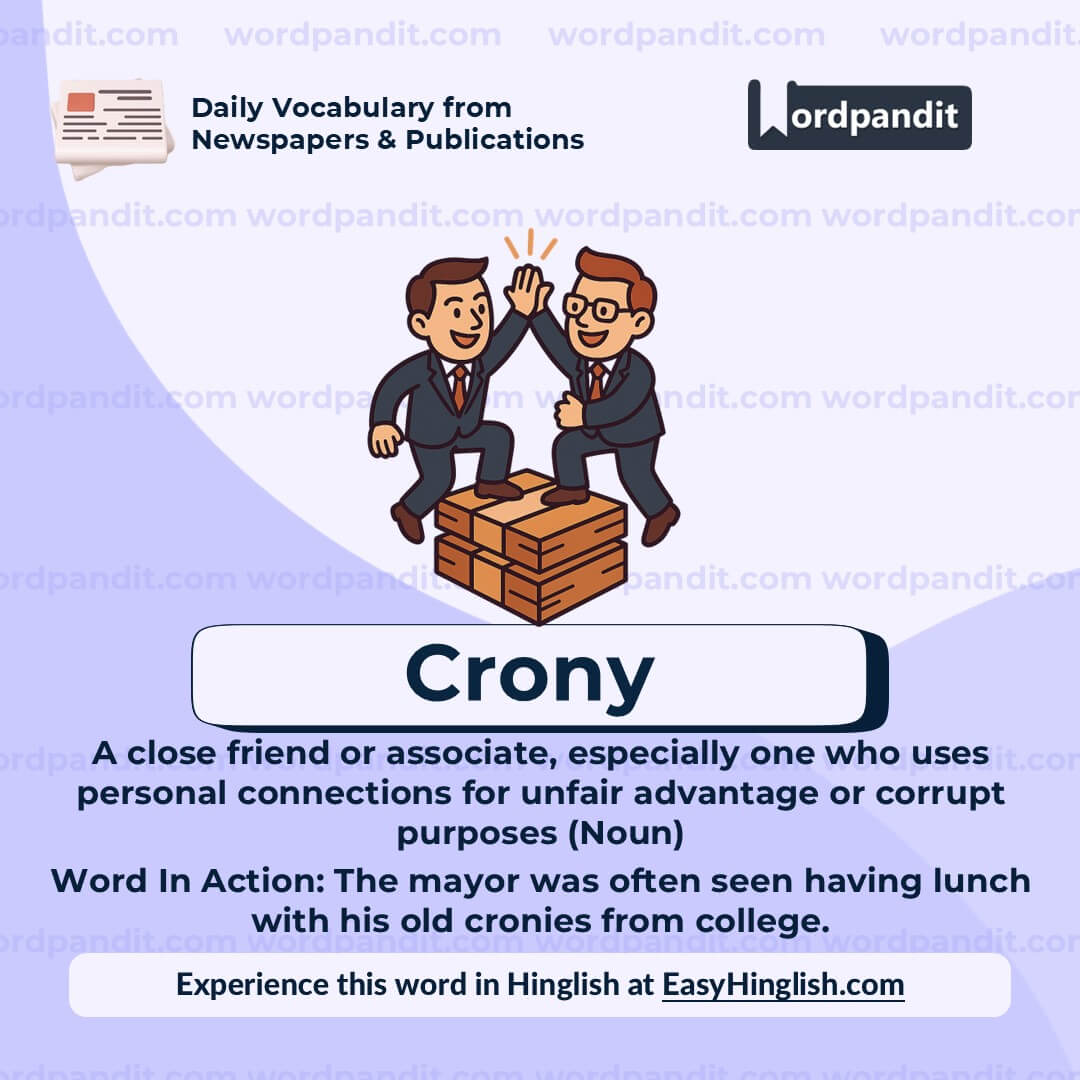
WORD-3: Crony
Context:
"The World Bank/IMF mediated reforms thus sowed the seeds of crony capitalism, monopolies and oligopolies: problems that are crushing the Indian economy today." - The Wire
Explanatory Paragraph:
Crony meaning in English is 'a close friend or companion, especially one involved in unethical or questionable dealings with people in power.' This word is used when describing relationships where personal connections override merit, fairness, or legal procedures. How to use crony correctly often involves political and business contexts where it highlights corruption or favoritism. Crony appears frequently in economics and political science discussions, particularly in the phrase 'crony capitalism,' and is common in UPSC essay topics, CAT Reading Comprehension passages, and editorial articles about governance and economic reforms.
Meaning: A close friend or associate, especially one who uses personal connections for unfair advantage or corrupt purposes (Noun)
Pronunciation: KROH-nee
Difficulty Level: ⭐⭐⭐ Intermediate
Etymology: Crony originated from 17th-century British university slang, possibly from Greek 'khronios' meaning 'long-lasting' or 'of long duration,' referring to longtime companions. Initially neutral, meaning simply a close friend or associate, the word gradually acquired negative connotations by the 20th century, especially in political and business contexts where it came to signify associates who benefit from corrupt or unethical favoritism rather than merit.
Prashant Sir's Notes:
Students often ask: what is the difference between crony and friend? While both mean companion, crony usage always carries a negative implication of using connections for unfair advantage. For UPSC and CAT aspirants, understanding 'crony capitalism' is crucial—it's an economic system where business success depends on political connections rather than competition. Many students confuse crony capitalism with regular capitalism, but the difference is that in crony capitalism, government favors, licenses, and contracts go to politically connected businesses, not the most efficient ones. In Indian context, you'll see this term in discussions about license raj, spectrum allocation scams, or coal block allocations. How to use crony in competitive exam essays: pair it with 'capitalism,' 'network,' or 'system' to critique corruption. In Indian newspapers like The Wire, The Hindu, and Economic Times, 'crony capitalism' frequently appears when analyzing issues like preferential bank loans to certain industrialists, policy decisions favoring specific business houses, or the nexus between political power and economic privilege.
Synonyms & Antonyms:
Synonyms: accomplice, associate, cohort, confederate, ally (negative context), partner in crime, sidekick, buddy (informal), pal (when implying questionable dealings), henchman
Antonyms: rival, competitor, enemy, opponent, stranger, independent operator, merit-based associate
Usage Examples:
- Several business cronies of the minister received lucrative government contracts without going through the competitive bidding process required by law.
- The investigation revealed that bank loans worth thousands of crores were written off for cronies of politically connected industrialists.
- Critics argue that India's telecom sector reforms benefited a few cronies rather than promoting genuine competition and consumer welfare.
- Raj knew that his promotion wasn't based on performance but on being a crony of the CEO's inner circle at the company.
Cultural Reference:
"The 2G spectrum scandal and coal block allocation controversy exposed how crony capitalism operated at the highest levels of Indian governance, leading to massive public outcry." - Reference from India's corruption scandals of 2010-2012
Think About It:
How does crony capitalism undermine economic growth and social equality, and what institutional reforms could break the nexus between political power and business privilege in India?
Quick Activity:
Find one recent news article discussing crony capitalism or cronyism in Indian business or politics. Write two sentences summarizing the issue using the word 'crony' or 'cronyism.'
Memory Tip:
Remember 'Crony' by thinking 'CORRUPT + CRONY'—both start with 'CR.' Imagine a corrupt official with his close cronies sitting in a circle (CR-ony = CiRcle), all benefiting from each other's positions through unfair means rather than merit.
Real-World Application:
Crony is essential vocabulary in economic analysis, political commentary, and business journalism. In Indian media, the term appears prominently in discussions about economic reforms, corporate governance, banking scandals, and government policy decisions. For UPSC essay and GS papers, understanding 'crony capitalism' is crucial for topics on economic development, corruption, and governance reforms. The word frequently appears in editorials analyzing how personal connections influence business licenses, bank loans, government contracts, and policy decisions—making it vital vocabulary for anyone following Indian economics and politics.

WORD-4: Perforce
Context:
"The Balance Sheet suggests that any meaningful economic reset must perforce rework India's entanglements with exploitative international financial arrangements." - The Wire
Explanatory Paragraph:
Perforce meaning in English is 'by necessity; as a result of unavoidable circumstances; something that must happen because there is no alternative.' This word is used when describing actions or situations that are compulsory or inevitable due to external constraints or logical necessity. How to use perforce effectively involves placing it before a verb to emphasize that something must necessarily occur. Perforce appears frequently in formal writing, academic discourse, legal documents, and competitive exam passages to indicate logical necessity or unavoidable conclusions, making it valuable vocabulary for UPSC essays and GRE Reading Comprehension.
Meaning: By necessity; unavoidably; as a matter of compulsion or logical requirement (Adverb)
Pronunciation: per-FORS
Difficulty Level: ⭐⭐⭐⭐ Advanced
Etymology: Perforce comes from Old French 'par force,' literally meaning 'by force' or 'by strength.' The phrase combined 'par' (by) and 'force' (strength/compulsion), originally indicating something done under compulsion or physical force. Over time, the meaning softened to indicate logical necessity or unavoidable circumstances rather than literal force, evolving into a formal literary term expressing inevitable consequences or requirements that cannot be avoided.
Prashant Sir's Notes:
Many students confuse perforce with 'therefore' or 'thus'—but the difference between perforce and therefore is crucial for competitive exams. While 'therefore' indicates logical conclusion, perforce usage specifically emphasizes unavoidable necessity or compulsion. What is the difference between perforce and necessarily? Both indicate something must happen, but perforce carries a stronger sense of being forced by circumstances beyond control. For CAT and UPSC aspirants, when you see perforce in RC passages, it signals that the author is highlighting an inevitable consequence or unavoidable requirement—there's no other option available. How to use perforce correctly: place it before the main verb, as in "must perforce accept" or "will perforce lead to." In Indian English newspapers, especially in policy analysis and economic commentary, you'll encounter perforce when writers discuss inevitable reforms or unavoidable policy changes. The Wire and The Hindu use it frequently in contexts like "India must perforce reconsider its stance" or "reforms will perforce require sacrifices"—indicating actions that cannot be avoided given the circumstances.
Synonyms & Antonyms:
Synonyms: necessarily, inevitably, unavoidably, of necessity, compulsorily, by force of circumstances, inescapably, as a matter of course, obligatorily, willy-nilly
Antonyms: optionally, voluntarily, freely, willingly, by choice, unnecessarily, avoidably
Usage Examples:
- With declining tax revenues and mounting debt, the government must perforce cut expenditure on several welfare schemes despite political opposition.
- As India's population grows and urbanization accelerates, city planners will perforce need to rethink infrastructure and housing policies fundamentally.
- Given the climate crisis and international pressure, coal-dependent states like Jharkhand and Chhattisgarh must perforce transition toward renewable energy sources.
- When his company relocated to Bangalore, Amit perforce had to leave his hometown Lucknow, though he preferred staying close to family.
Cultural Reference:
"After the 1991 balance of payments crisis, India perforce embraced economic liberalization, abandoning decades of socialist policies—necessity became the mother of reform." - Common observation in Indian economic history
Think About It:
What major global challenges will India perforce have to address in the coming decades, regardless of political ideology or economic philosophy—climate change, technological disruption, or demographic shifts?
Quick Activity:
Write two sentences about situations in your life or in Indian society where people must perforce accept changes they didn't initially want but circumstances made unavoidable.
Memory Tip:
Break 'Perforce' into 'PER + FORCE'—think "as PER the FORCE of circumstances." Imagine being pushed by an invisible force that you cannot resist—you PERFORCE must move in that direction. Or remember: when there's no choice left, you act PERFORCE (by force of necessity).
Real-World Application:
Perforce is sophisticated vocabulary commonly used in policy analysis, academic writing, legal arguments, and formal economic commentary. In Indian journalism, particularly in publications like The Wire, The Hindu, and Economic & Political Weekly, perforce appears when discussing inevitable policy changes, unavoidable economic reforms, or logically necessary consequences of current trends. For UPSC essays on governance, economy, or international relations, using perforce demonstrates advanced vocabulary when arguing that certain actions are unavoidable given the constraints. In GRE and CAT passages, recognizing perforce helps you understand the author's argument about necessity versus choice.
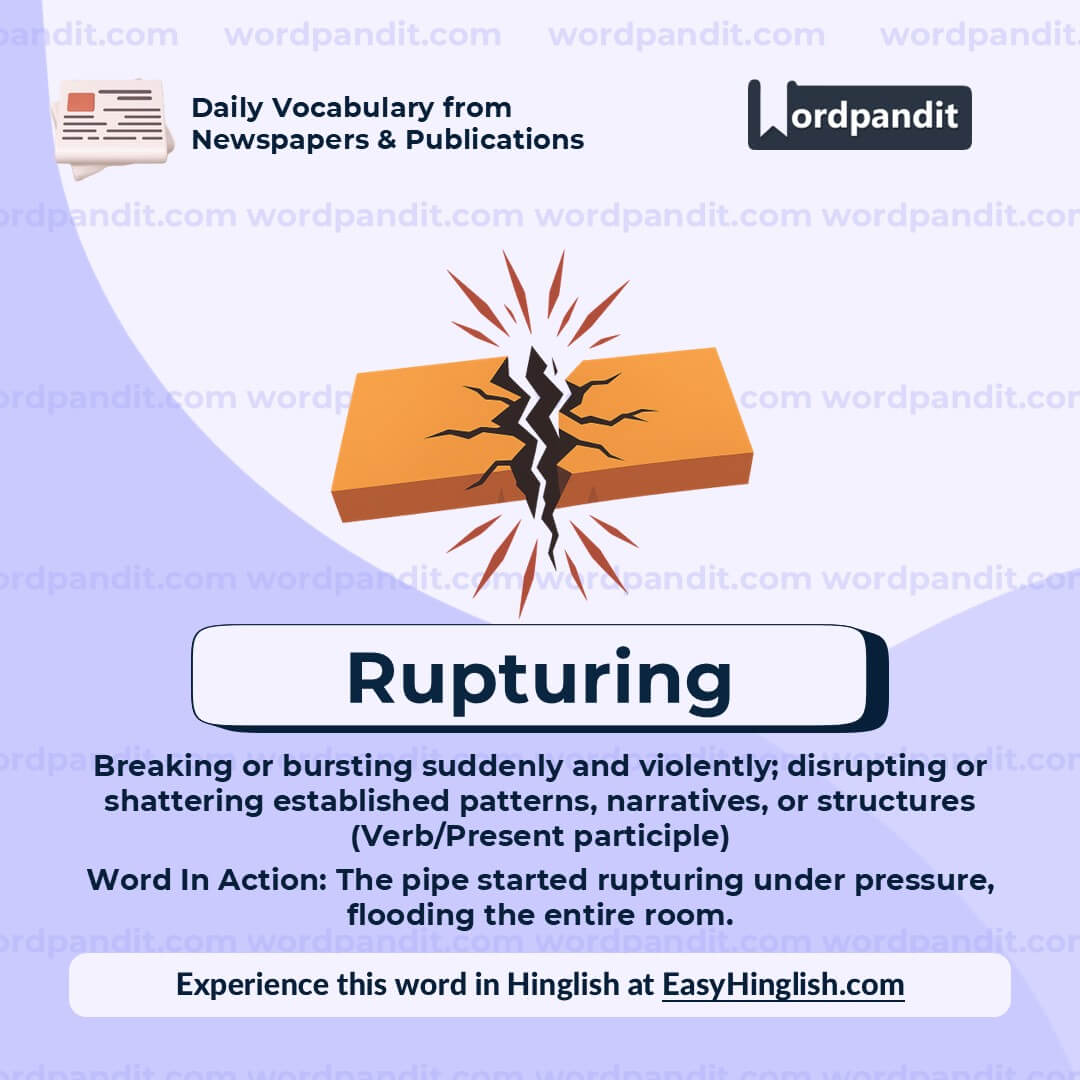
WORD-5: Rupturing
Context:
"Rupturing this narrative of normalisation of LPG, the film examines two World Bank sponsored projects in India – the Sardar Sarovar Project and the Tata Mundhra Project – through the voices of the affected communities." - The Wire
Explanatory Paragraph:
Rupturing meaning in English is 'breaking apart, disrupting, or causing something to burst or split suddenly and violently, either physically or metaphorically.' This word is used when describing dramatic breaks, disruptions, or the sudden shattering of established patterns, narratives, or relationships. How to use rupturing depends on whether you're describing physical breaks (like ruptured organs) or metaphorical disruptions (like rupturing narratives or social bonds). Rupturing appears frequently in academic writing, medical contexts, and social commentary in competitive exam passages to indicate forceful interruption or breaking of continuity, making it valuable for CAT, GRE, and UPSC preparation.
Meaning: Breaking or bursting suddenly and violently; disrupting or shattering established patterns, narratives, or structures (Verb/Present participle)
Pronunciation: RUP-chur-ing
Difficulty Level: ⭐⭐⭐ Intermediate to Advanced
Etymology: Rupture comes from Latin 'ruptura,' meaning 'a breaking or bursting,' derived from 'rumpere' meaning 'to break.' The word entered English through Old French 'rupture' in the 15th century, initially used in medical contexts to describe physical breaks or hernias. Over time, it expanded metaphorically to describe any sudden, forceful breaking—whether of social bonds, diplomatic relations, established narratives, or continuity. The present participle 'rupturing' emphasizes the active, ongoing process of breaking or disruption.
Prashant Sir's Notes:
Many students confuse rupturing with simply 'breaking' or 'disrupting'—but the difference between rupturing and breaking is significant for exam vocabulary. While 'breaking' can be gentle or gradual, rupturing usage always implies sudden, violent, or dramatic disruption. What is the difference between rupturing and shattering? Shattering suggests complete destruction into pieces, while rupturing emphasizes the act of tearing or bursting apart, often with something forceful emerging from within. For UPSC and CAT aspirants, when you see 'rupturing' in RC passages, especially in social science contexts, it signals that something is violently disrupting established norms or narratives—not just questioning them, but forcefully breaking them open. How to use rupturing in sentences: pair it with abstract nouns like 'narrative,' 'discourse,' 'equilibrium,' or 'relationship' to show forceful disruption. In Indian academic writing and critical journalism like The Wire, Economic & Political Weekly, and Frontline, you'll encounter 'rupturing' when scholars discuss how marginalized voices, alternative documentaries, or grassroots movements violently interrupt mainstream narratives—exactly as in our context where a film ruptures the normalized narrative of economic liberalization.
Synonyms & Antonyms:
Synonyms: breaking, bursting, shattering, disrupting, fracturing, tearing apart, splitting, severing, dismantling (for narratives), violating (for norms)
Antonyms: mending, healing, repairing, joining, connecting, maintaining, preserving, uniting, reinforcing
Usage Examples:
- The farmers' protests of 2020-21 succeeded in rupturing the government's narrative that agricultural reforms were universally beneficial for rural India.
- Dalit literature has been instrumental in rupturing the dominant caste narratives that have shaped Indian storytelling and literary canons for centuries.
- The sudden rupturing of diplomatic relations between the two nations caught international observers completely off guard and sent shockwaves through the region.
- Priya's documentary on manual scavengers aims at rupturing the comfortable silence that middle-class India maintains about caste-based discrimination in sanitation work.
Cultural Reference:
"Films like 'Article 15' and 'Jai Bhim' are rupturing Bollywood's traditional narratives by centering caste atrocities and systemic discrimination rather than love stories and family dramas." - Observation from contemporary Indian cinema criticism
Think About It:
Which voices or movements in contemporary India are successfully rupturing mainstream narratives about development, progress, or national identity, and why do such ruptures often face resistance?
Quick Activity:
Identify one recent book, film, or social movement that you believe is rupturing established narratives in Indian society. Write two sentences explaining what narrative it's breaking and how.
Memory Tip:
Think of 'Rupturing' as 'RUPee-TURING'—imagine tearing (rupturing) a rupee note in half with force. The violent 'RIP' sound and the torn note represent how rupturing means forcefully breaking something apart, whether it's paper, narratives, or social norms.
Real-World Application:
Rupturing is critical vocabulary in academic discourse, social criticism, film analysis, and political commentary. In Indian media and scholarly writing, particularly in publications like The Wire, Economic & Political Weekly, Seminar, and Caravan, rupturing appears when discussing how alternative voices, counter-narratives, or marginalized perspectives forcefully challenge mainstream discourses about development, nationalism, or social order. For UPSC essays on media, society, or governance, using 'rupturing' demonstrates sophisticated vocabulary when analyzing how dissenting voices disrupt dominant narratives. In GRE and CAT passages from social sciences, recognizing 'rupturing' helps identify moments where authors discuss fundamental challenges to established thinking rather than mere criticism.


