

Daily Vocabulary from International Newspapers and Publications
Expand Your Vocabulary with Wordpandit’s Global Vocabulary Hub
At Wordpandit, we are committed to helping you develop a truly global vocabulary by drawing from some of the most respected international publications. This section is designed to keep you ahead of the curve by introducing you to words that define global conversations and trends.
The Power of Global Sources
To help you think and communicate on a global scale, we curate vocabulary from renowned international sources, such as:
- The New York Times
- The Washington Post
- BBC
- The Guardian
- The Economist
- Scientific American
- Psychology Today
- And many more...
Stay Global, Stay Competitive
Our daily updates from international publications ensure you are consistently exposed to new words that reflect global news and developments, making sure your vocabulary is not only current but also globally relevant.
Enhance Your Global Perspective
Whether you’re preparing for international exams, aiming to excel in global business communication, or want to enhance your language skills for personal growth, Wordpandit offers the resources you need to thrive in a global context.
Effective Learning, Global Reach
Our learning methodology combines global examples, memory aids, and interactive activities, allowing you to internalize new words effectively and apply them in real-world scenarios.
Begin Your Global Vocabulary Journey Now!

Why Choose Wordpandit?
Practical Learning: Focus on words you'll actually encounter in real-world reading, enhancing your comprehension and communication skills.
Diverse Content: From current affairs to scientific breakthroughs, our varied sources expose you to vocabulary across multiple domains.
Effortless Integration: Make Wordpandit a part of your daily routine. Just a few minutes each day can significantly boost your lexicon over time.
Your Path to Vocabulary Mastery
- Visit our Daily Vocabulary section regularly
- Explore new words and their usage in context
- Practice incorporating these words into your own writing and speech
- Track your progress as your vocabulary expands
Start Your Journey Today
Embark on your vocabulary enhancement journey with Wordpandit. By consistently engaging with our daily posts, you'll build a robust vocabulary that serves you well in academic, professional, and personal contexts.
Remember, a word a day keeps linguistic limitations at bay. Make Wordpandit your daily companion in the quest for vocabulary excellence!
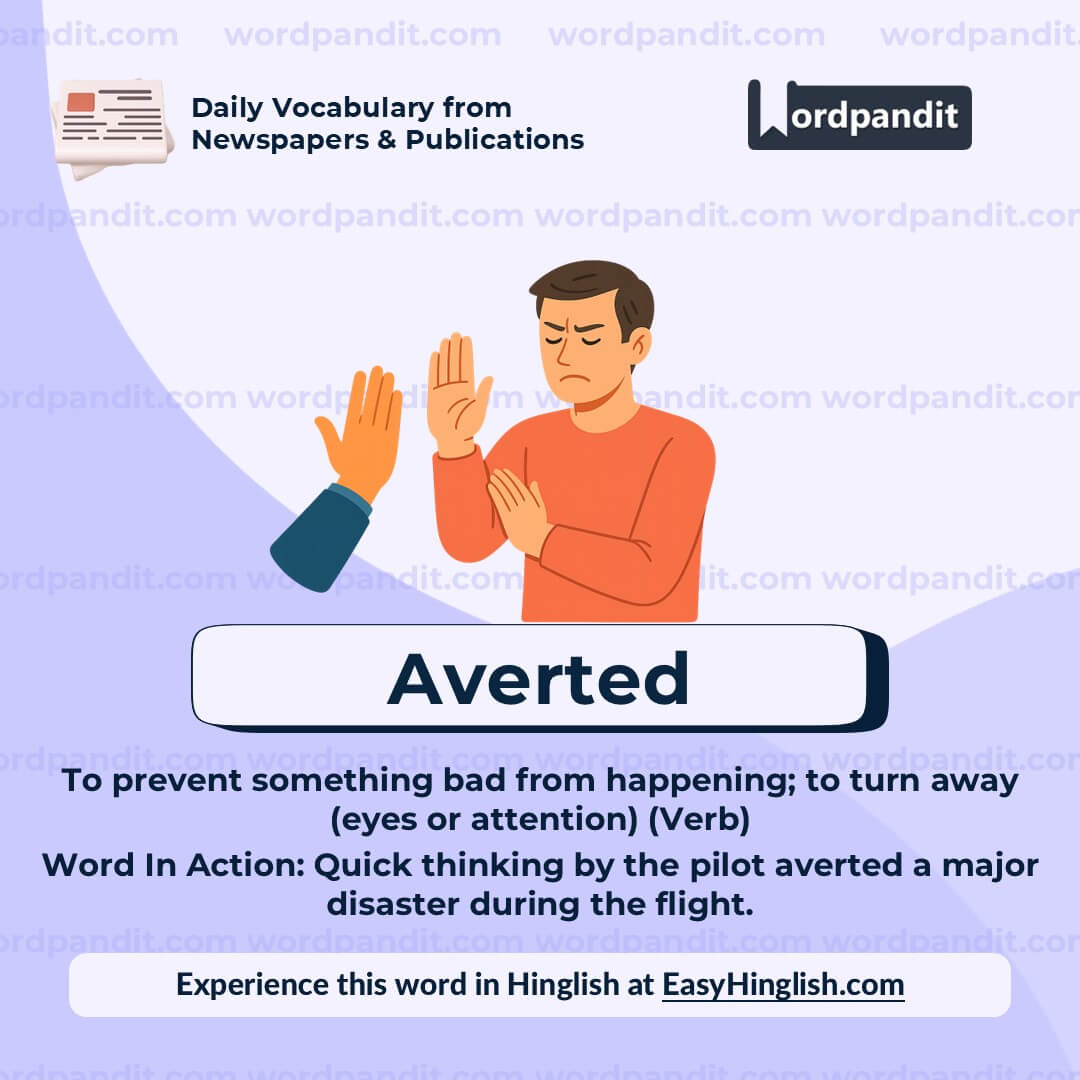
WORD-1: Averted
Context:
"If the sentence is about a crisis, disaster, or conflict, 'averted' likely means 'prevented'." - Aeon
Explanatory Paragraph:
Averted meaning in English is "to prevent something undesirable from happening or to turn away from something." This word is used when describing how disasters, crises, conflicts, or dangerous situations were stopped before they could cause harm. How to use averted correctly depends on the context—it can mean either preventing something negative or turning your eyes or attention away from something. Averted is commonly used in formal writing, news reports about narrowly avoided catastrophes, and competitive exam passages discussing crisis management or diplomatic interventions.
Meaning: To prevent something bad from happening; to turn away (eyes or attention) (Verb)
Pronunciation: uh-VUR-tid
Difficulty Level: ⭐⭐ Basic to Intermediate
Etymology: Averted comes from Latin 'avertere,' combining 'a-' (away) and 'vertere' (to turn). Originally meaning simply "to turn away," the word evolved to encompass the idea of turning away danger or disaster, thus preventing it. This dual meaning—both physical turning away and metaphorical prevention—remains in modern usage.
Prashant Sir's Notes:
Many students confuse averted with avoided—while both involve preventing something, the difference between averted and avoided is crucial for exam accuracy. Averted usage in sentences typically involves serious consequences or disasters that were narrowly prevented at the last moment, while avoided is more general. For CAT and GRE aspirants, when you see "crisis averted" or "disaster averted" in Reading Comprehension passages, it signals a turning point in the narrative where catastrophe was prevented through intervention. In Indian newspapers, especially in political and economic reporting, you'll often encounter phrases like "war averted through diplomacy" or "financial crisis averted by RBI intervention"—these indicate critical moments when disaster was stopped just in time.
Synonyms & Antonyms:
Synonyms: prevented, stopped, forestalled, deflected, warded off, turned away, diverted, thwarted, avoided, dodged
Antonyms: caused, invited, encouraged, facilitated, allowed, welcomed
Usage Examples:
- The Reserve Bank of India's timely intervention averted a major banking crisis that could have collapsed several financial institutions.
- Priya quickly averted her eyes when she accidentally walked into the wrong meeting room at the Bangalore office.
- The diplomatic negotiations between India and Pakistan averted what could have escalated into a full-scale military conflict.
- Ramesh averted disaster by backing up all company data just hours before the server crashed unexpectedly.
Cultural Reference:
"India has successfully averted numerous potential conflicts through diplomatic channels and strategic patience." - Common observation in discussions about Indian foreign policy
Think About It:
Can all crises truly be averted with proper planning and intervention, or are some disasters inevitable regardless of human effort?
Quick Activity:
Think of three recent news stories where a potential crisis was averted. Write one sentence describing each situation using the word "averted" correctly.
Memory Tip:
Think of "A-VERTED" as "A-VERTICAL turn"—imagine vertically turning away from danger at the last second, like a cricketer averting a bouncer aimed at his head. The "vert" root means "turn," so you're turning away disaster before it strikes.
Real-World Application:
Averted is commonly used in journalism, crisis management reports, and diplomatic communications to describe situations where disaster was narrowly prevented. In business writing and formal reports, particularly in risk assessment documents, the term appears when discussing how potential problems were identified and stopped before causing damage. For UPSC aspirants, understanding "averted" is essential when analyzing case studies about policy interventions, disaster management, and conflict resolution in governance and international relations papers.
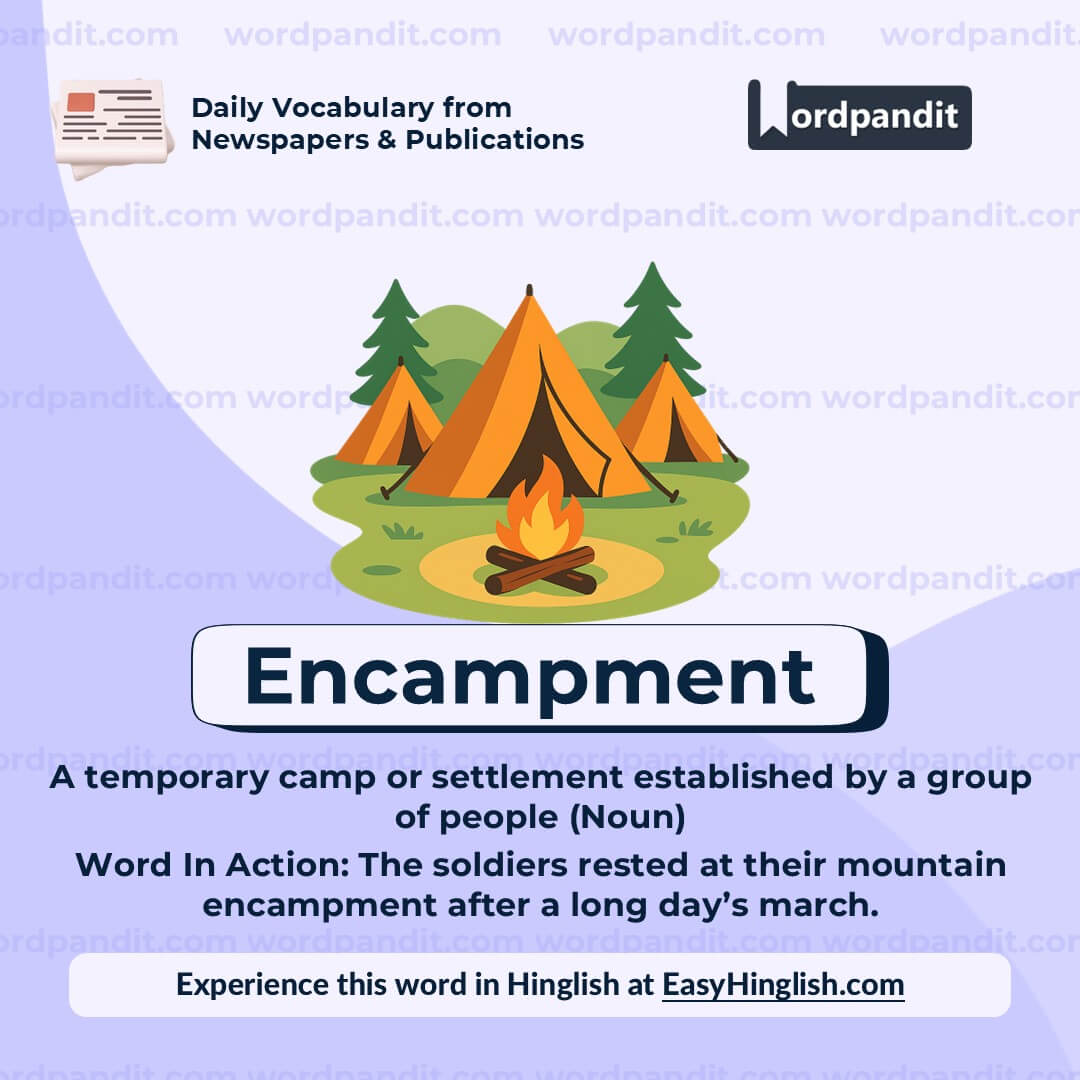
WORD-2: Encampment
Context:
"University students established an encampment to press their demands for institutional reform." - Washington Post
Explanatory Paragraph:
Encampment meaning in English is "a temporary camp or settlement, often established for a specific purpose such as protest, military operations, or shelter." This word is used when describing organized groups of people setting up temporary living spaces, typically tents or makeshift structures, in a particular location. How to use encampment depends on the context—it can refer to protest camps, military bases, refugee settlements, or any temporary communal living arrangement. Encampment is commonly used in news articles about social movements, military operations, humanitarian crises, and competitive exam passages discussing civil society activism or historical events.
Meaning: A temporary camp or settlement established by a group of people (Noun)
Pronunciation: en-KAMP-ment
Difficulty Level: ⭐⭐⭐ Intermediate
Etymology: Encampment comes from the French word 'camp' combined with the prefix 'en-' (meaning 'to put into') and the suffix '-ment' (indicating a state or action). The word emerged in the 16th century, originally used in military contexts to describe temporary bases where armies would set up tents. Over time, it expanded to include any organized temporary settlement, from protest camps to refugee shelters, while retaining the sense of purposeful, organized occupation of space.
Prashant Sir's Notes:
Students often ask: what is the difference between encampment and camp? While both refer to temporary settlements, encampment usage in formal writing specifically emphasizes the organized, purposeful nature of the settlement and often implies a longer duration or political significance. For UPSC and CAT aspirants, when you encounter "encampment" in Reading Comprehension passages about social movements or historical events, it signals organized collective action rather than casual camping. In Indian English newspapers, you'll frequently see "encampment" used when describing farmer protests at Delhi borders, student sit-ins at university campuses, or displaced communities during natural disasters—the word carries connotations of resistance, persistence, and collective determination. Many students confuse encampment with campsite, but campsite is for recreation while encampment implies purpose-driven occupation.
Synonyms & Antonyms:
Synonyms: camp, settlement, bivouac, campsite, temporary quarters, tent city, compound, base, outpost, cantonment
Antonyms: permanent residence, home, settlement (permanent), building, structure, fixed dwelling
Usage Examples:
- The farmers' encampment at the Singhu border continued for over a year, becoming a symbol of sustained resistance against agricultural reforms.
- JNU students set up an encampment outside the administration building to protest the hostel fee hike and demand dialogue with authorities.
- The military established an encampment near the Line of Actual Control to monitor cross-border activities during the tense standoff.
- After the floods displaced thousands in Kerala, temporary encampments were organized in schools and community centers across Ernakulam district.
Cultural Reference:
"The historic farmers' encampment at Delhi's borders in 2020-2021 redefined the scale and persistence of peaceful protest in modern India." - Commentary on contemporary Indian social movements
Think About It:
When does an encampment transition from being a temporary protest tactic to becoming a permanent settlement, and what does that say about unresolved social issues?
Quick Activity:
Find two recent news articles from Indian newspapers that mention encampments. Write one sentence explaining the purpose of each encampment and who established it.
Memory Tip:
Break "EN-CAMP-MENT" into parts: "EN" (to put into) + "CAMP" + "MENT" (state of being). Think of it as "entering camp mode"—when protestors or groups intentionally put themselves into camping mode for a purpose. Imagine students "entering campaign tent" outside their college gate, demanding change.
Real-World Application:
Encampment is commonly used in journalism covering social movements, political protests, humanitarian crises, and military operations. In news analysis and opinion pieces, particularly those discussing civil society activism, the term distinguishes purposeful collective occupation from casual camping. For UPSC aspirants preparing for General Studies papers on governance and social justice, understanding "encampment" is crucial when analyzing case studies about protest movements, disaster management, and the relationship between civil society and state institutions. The word frequently appears in passages about Gandhian satyagraha, contemporary farmers' movements, and refugee crises.

WORD-3: Ingratiating
Context:
"He adopted an ingratiating tone with the committee, hoping to secure their endorsement." - Washington Post
Explanatory Paragraph:
Ingratiating meaning in English is "behaving in a way that is intended to gain someone's approval or favor, often through excessive flattery or charm." This word is used when describing people who deliberately act pleasing or charming to win others' goodwill, sometimes in a way that seems insincere or manipulative. How to use ingratiating correctly involves recognizing its slightly negative connotation—it suggests calculated behavior rather than genuine warmth. Ingratiating is commonly used in formal writing, workplace descriptions, political commentary, and competitive exam passages analyzing character motivations and social dynamics.
Meaning: Intended to gain favor or approval through deliberate charm or flattery (Adjective)
Pronunciation: in-GRAY-shee-ay-ting
Difficulty Level: ⭐⭐⭐ Intermediate
Etymology: Ingratiating comes from the Latin 'in gratiam' meaning "into favor," combining 'in' (into) and 'gratia' (favor, grace). The word entered English through Italian 'ingraziare' in the 17th century. Originally neutral in meaning, it gradually acquired its current slightly negative connotation, suggesting behavior that is overly calculated or lacking in authenticity. The evolution reflects society's growing suspicion of those who too obviously seek favor through charm rather than merit.
Prashant Sir's Notes:
Many students confuse ingratiating with friendly or charming—the difference between ingratiating and genuinely friendly behavior is the underlying motive and sincerity. Ingratiating usage in sentences always carries a hint of calculation or artificiality that genuine friendliness lacks. For CAT and GRE aspirants, when you see "ingratiating" in Reading Comprehension passages, it's a red flag signaling the author's skepticism about someone's motives—it's never a compliment. In Indian corporate culture, you might observe ingratiating behavior during appraisal season when employees suddenly become overly agreeable with managers, or in political contexts when leaders adopt ingratiating tones with powerful allies. Students often ask: how to use ingratiating in critical analysis? Look for it when describing sycophantic behavior, calculated charm, or situations where someone is transparently trying too hard to please. The word itself almost always suggests disapproval from the writer.
Synonyms & Antonyms:
Synonyms: flattering, obsequious, sycophantic, fawning, unctuous, servile, toadying, bootlicking, pleasing, insinuating
Antonyms: genuine, sincere, authentic, straightforward, honest, direct, indifferent, aloof, proud
Usage Examples:
- Rajesh's ingratiating behavior toward the CEO during the company town hall was so obvious that his colleagues rolled their eyes in embarrassment.
- The politician delivered an ingratiating speech to the business community, promising tax cuts and regulatory relief to secure their campaign donations.
- Priya found her colleague's ingratiating emails to the project manager—filled with excessive praise and offers to help—quite transparent and insincere.
- The new intern adopted an ingratiating manner with senior partners at the Mumbai law firm, hoping to secure a permanent position after his internship ended.
Cultural Reference:
"Like Bollywood's classic 'chamcha' characters who constantly flatter powerful figures, ingratiating behavior in workplaces often masks ambition with artificial sweetness." - Common observation about workplace dynamics in Indian corporate culture
Think About It:
Where is the line between being genuinely polite and professional versus being ingratiating, and why does our instinct often detect the difference even when the behaviors seem similar?
Quick Activity:
Write two sentences describing a situation you've observed where someone behaved in an ingratiating manner. What gave away that their behavior was calculated rather than genuine?
Memory Tip:
Break "IN-GRATI-ATING" as "IN-GREAT-IATING"—imagine someone constantly saying "you're so GREAT!" to get INTO someone's good graces. Or think of "IN + GRATITUDE" but fake gratitude—someone showering excessive thanks and praise to win favor. The word sounds like "in grace eating"—eating humble pie to get into someone's grace.
Real-World Application:
Ingratiating is commonly used in business writing, performance reviews, political analysis, and literary criticism to describe calculated attempts to win favor. In workplace communications and professional assessments, the term helps identify manipulative behavior patterns that undermine authentic teamwork. For CAT and UPSC aspirants, understanding "ingratiating" is essential when analyzing character motivations in comprehension passages, particularly those dealing with organizational politics, social climbing, or power dynamics. The word frequently appears in passages examining workplace ethics, political maneuvering, and social psychology, where distinguishing genuine cooperation from calculated flattery is crucial to understanding the author's perspective.
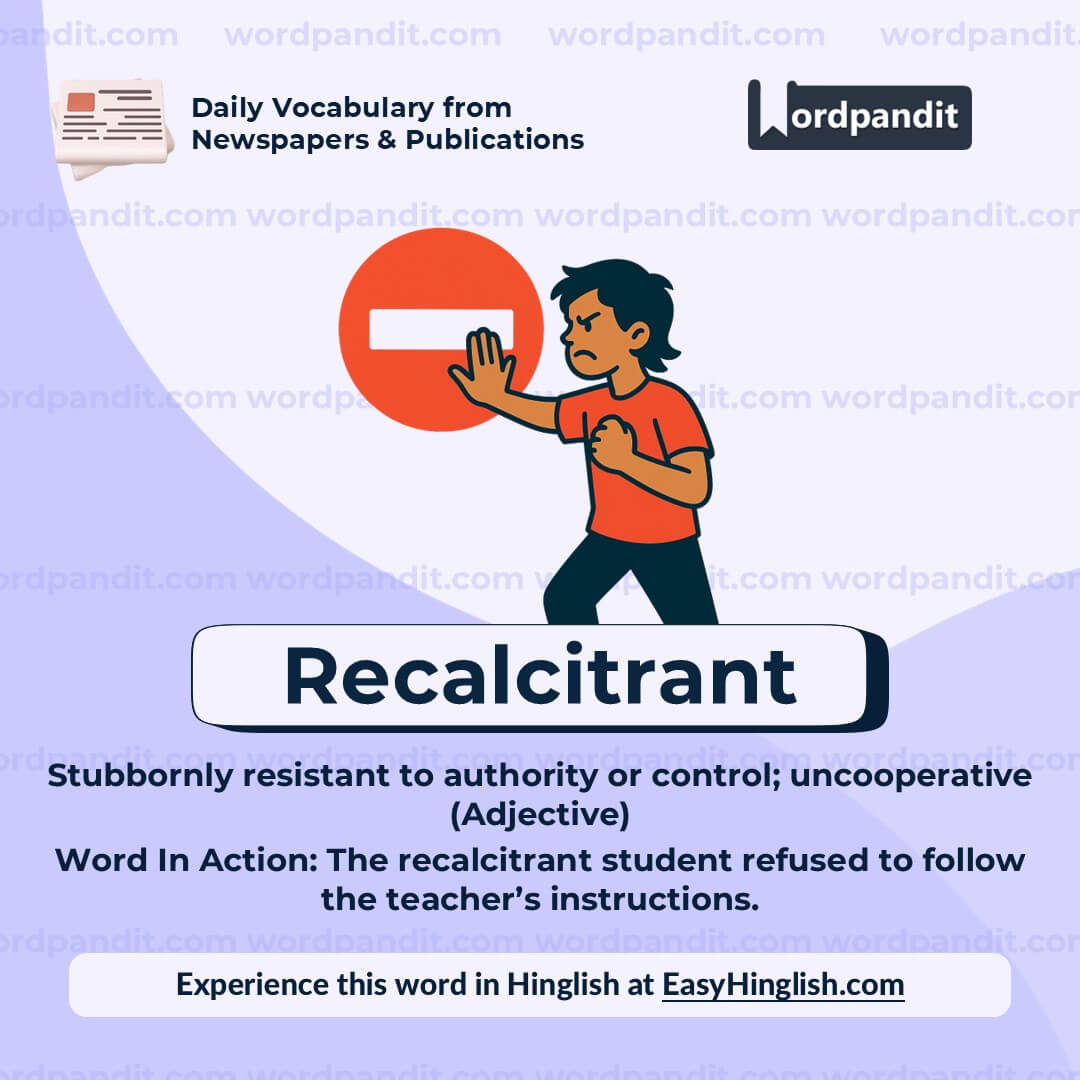
WORD-4: Recalcitrant
Context:
"Faced with a recalcitrant minority of protesters, the administration opted for a more conciliatory approach." - Washington Post
Explanatory Paragraph:
Recalcitrant meaning in English is "stubbornly resistant to authority, control, or guidance; refusing to obey rules or cooperate." This word is used when describing people, groups, or even things that persistently refuse to comply despite pressure, persuasion, or commands. How to use recalcitrant effectively involves recognizing that it carries a stronger sense of defiance than simple stubbornness—it suggests active resistance rather than passive reluctance. Recalcitrant is commonly used in formal writing, political discourse, legal contexts, and competitive exam passages discussing conflicts between authority and those who resist it.
Meaning: Stubbornly resistant to authority or control; uncooperative (Adjective)
Pronunciation: ree-KAL-si-trunt
Difficulty Level: ⭐⭐⭐⭐ Advanced
Etymology: Recalcitrant comes from Latin 'recalcitrare' meaning "to kick back," formed from 're-' (back) and 'calcitrare' (to kick), which derives from 'calx' (heel). The original image was of a horse kicking back against its rider or handler. This vivid metaphor entered English in the 19th century, bringing with it the powerful sense of not just resisting but actively fighting back against control. The word retains this combative quality, suggesting someone who doesn't merely disagree but actively kicks against authority.
Prashant Sir's Notes:
Many students confuse recalcitrant with stubborn or defiant—while all three involve resistance, the difference between recalcitrant and stubborn is significant for exam precision. Recalcitrant usage in formal writing specifically implies persistent, active resistance against legitimate authority or established rules, whereas stubborn can simply mean inflexible about personal preferences. For UPSC aspirants, when you encounter "recalcitrant" in governance passages, it typically describes entities that refuse to comply with regulations—recalcitrant states that won't implement central policies, recalcitrant bureaucrats who resist reforms. In Indian English newspapers, you'll often see phrases like "recalcitrant opposition parties" or "recalcitrant trade unions"—the word signals organized, determined resistance rather than casual non-cooperation. How to use recalcitrant for CAT RC: it always carries negative connotations from the authority's perspective, suggesting someone difficult to manage or control. The word itself sounds harsh and formal, matching its meaning perfectly.
Synonyms & Antonyms:
Synonyms: obstinate, uncooperative, defiant, refractory, intractable, stubborn, rebellious, disobedient, contrary, contumacious, unruly
Antonyms: obedient, compliant, cooperative, amenable, docile, tractable, submissive, agreeable, accommodating
Usage Examples:
- The recalcitrant state governments refused to implement the Goods and Services Tax reforms, creating complications for the central administration's fiscal policy.
- Despite repeated warnings from the principal, the recalcitrant student continued to violate the school's dress code and attendance policies.
- The company faced delays because a recalcitrant supplier refused to comply with the new quality standards mandated in their contract.
- Mumbai's civic authorities struggled with recalcitrant building owners who ignored multiple demolition notices for illegal constructions near coastal zones.
Cultural Reference:
"Like the rebellious characters in Hindi cinema who refuse to bow to unjust authority, recalcitrant individuals challenge the system—though the word itself doesn't judge whether their resistance is heroic or problematic." - Observation on the complexity of resistance narratives
Think About It:
When does being recalcitrant represent admirable principled resistance versus mere obstinacy, and who gets to decide which label applies?
Quick Activity:
Think of three contexts where someone might be described as recalcitrant. For each, write one sentence explaining whether their resistance seems justified or simply obstructive.
Memory Tip:
Break "RE-CALC-ITRANT" as "RE-KICK-ITRANT"—think of the Latin root 'calc' (heel) meaning to kick. Imagine a stubborn mule that keeps KICKING BACK (RE) whenever you try to lead it. Or remember "RE-CAL-CITRANT" as someone who refuses to answer your CALL repeatedly—they're recalcitrant, stubbornly not responding to authority's call for cooperation.
Real-World Application:
Recalcitrant is commonly used in legal documents, administrative reports, political analysis, and organizational communications to describe entities that persistently refuse to comply with rules or directives. In government and policy writing, the term helps distinguish between those who disagree with policies versus those who actively resist implementing them. For UPSC aspirants, understanding "recalcitrant" is crucial when analyzing case studies about center-state relations, bureaucratic resistance to reforms, or civil disobedience movements. The word frequently appears in passages examining governance challenges, regulatory enforcement, and organizational change management, where identifying patterns of resistance helps understand institutional dynamics and power relationships.
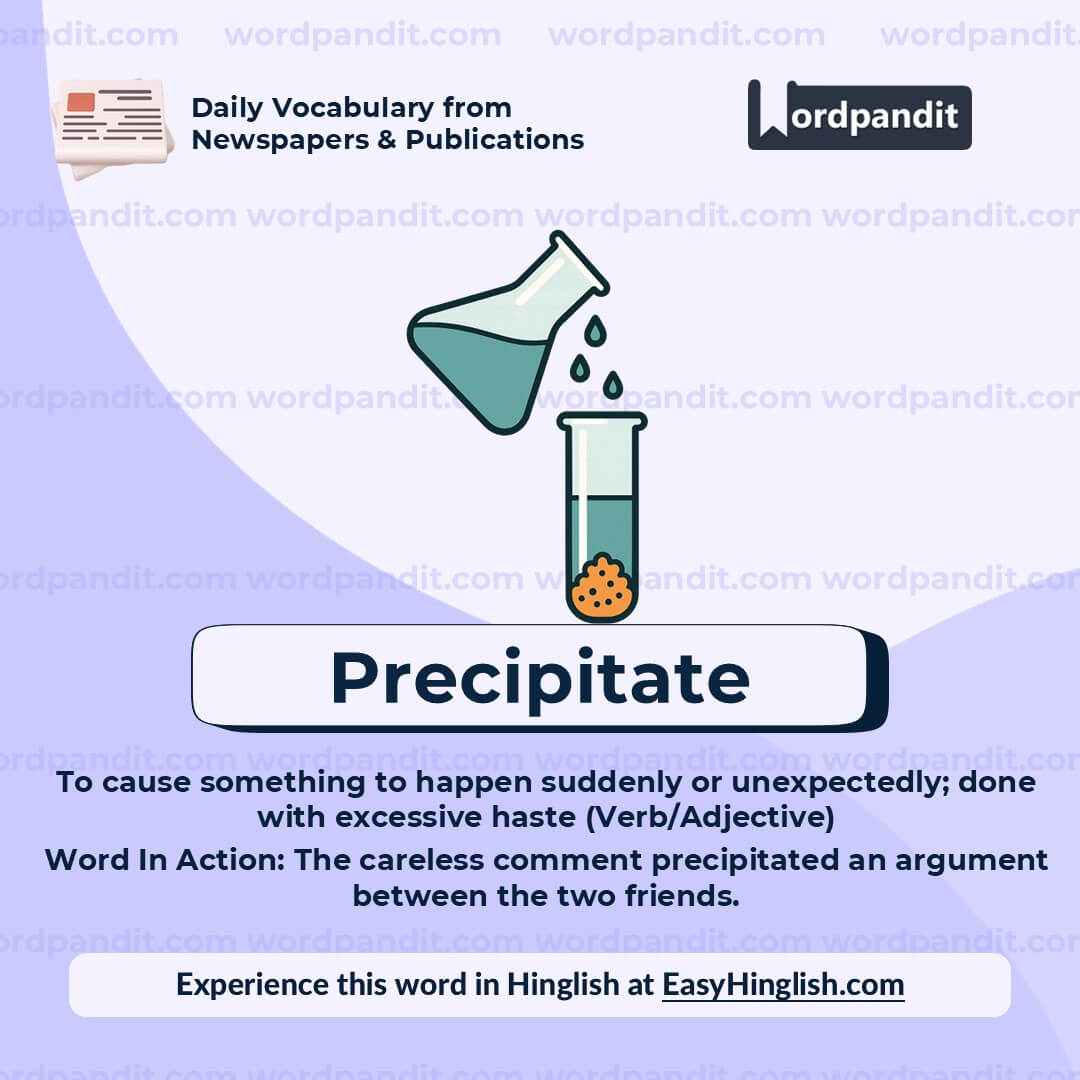
WORD-5: Precipitate
Context:
"The announcement precipitated a cascade of resignations among senior officials." - Washington Post
Explanatory Paragraph:
Precipitate meaning in English is "to cause something to happen suddenly or sooner than expected; to bring about abruptly." This word is used when describing events, actions, or decisions that trigger immediate consequences or cause rapid developments. How to use precipitate correctly depends on understanding that it emphasizes the sudden, often unexpected nature of what follows—something precipitates when it acts as a catalyst for swift change. Precipitate is commonly used in formal writing, news reports about crises, political analysis, and competitive exam passages discussing cause-and-effect relationships in complex situations.
Meaning: To cause something to happen suddenly or unexpectedly; done with excessive haste (Verb/Adjective)
Pronunciation: pri-SIP-i-tayt (verb); pri-SIP-i-tut (adjective)
Difficulty Level: ⭐⭐⭐ Intermediate to Advanced
Etymology: Precipitate comes from Latin 'praecipitare' meaning "to throw headlong," derived from 'praeceps' (headlong, steep), combining 'prae' (before, forward) and 'caput' (head). The original image was of throwing something or falling headfirst, emphasizing suddenness and lack of control. The word entered English in the 16th century with both its literal sense of falling rapidly and its metaphorical sense of causing sudden events. In chemistry, it also means to cause a substance to separate from a solution, retaining the core idea of sudden transformation.
Prashant Sir's Notes:
Students often ask: what is the difference between precipitate and cause? While both involve making something happen, precipitate usage specifically emphasizes suddenness and often unintended consequences. The difference between precipitate and trigger is subtle—precipitate suggests throwing events into motion quickly, often prematurely. For CAT and GRE aspirants, when you see "precipitated" in Reading Comprehension passages, it's a signal word indicating rapid cause-and-effect: one action immediately led to dramatic consequences. In Indian English newspapers covering politics and economics, you'll frequently encounter phrases like "the policy precipitated widespread protests" or "the scandal precipitated the government's downfall"—the word always suggests events spiraling quickly. Many students confuse precipitate (verb) with precipitous (adjective meaning steep or hasty), but remember: you precipitate a crisis (cause it suddenly), while a precipitous decision is one made too hastily. For UPSC preparation, understanding precipitate is crucial when analyzing how single events can trigger chain reactions in governance, diplomacy, or social movements.
Synonyms & Antonyms:
Synonyms: trigger, provoke, hasten, accelerate, bring about, spark, induce, cause, expedite, catalyze, instigate
Antonyms: delay, postpone, prevent, hinder, slow, impede, defer, forestall
Usage Examples:
- The sudden demonetization announcement in November 2016 precipitated chaos across India as people rushed to banks to exchange old currency notes.
- Rahul's critical email to the entire team precipitated an emergency meeting where long-simmering conflicts finally erupted into open confrontation.
- The controversial Supreme Court judgment precipitated nationwide debates about the balance between individual rights and religious sentiments in India.
- The CEO's unexpected resignation precipitated a 15% drop in the company's stock price within hours of the announcement on the Bombay Stock Exchange.
Cultural Reference:
"In cricket, a single controversial umpiring decision can precipitate a complete momentum shift—much like how one event in politics can suddenly change the entire game." - Common analogy used to explain rapid political changes in India
Think About It:
Can leaders ever truly predict what their decisions might precipitate, or are the cascading consequences of bold actions inherently unpredictable?
Quick Activity:
Find a recent news article about a major event. Write two sentences: one describing what precipitated the event, and another describing what consequences that event precipitated.
Memory Tip:
Think of "PRE-CIPI-TATE" as "PRE-SKIP-ITATE"—when you skip steps and jump straight into action, you precipitate events, making things happen suddenly. Or connect it to "precipitation" (rainfall)—just as rain suddenly falls from clouds, events precipitate (fall rapidly) when triggered. Imagine pushing the first domino—it precipitates a chain reaction of falling pieces, happening fast and suddenly.
Real-World Application:
Precipitate is commonly used in crisis management reports, political analysis, business communications, and scientific writing to describe rapid cause-and-effect relationships. In news reporting and opinion pieces, particularly those analyzing political or economic developments, the term helps explain how single events trigger cascading consequences. For UPSC aspirants preparing for essays and General Studies papers on governance and current affairs, understanding "precipitate" is essential when analyzing how policy decisions, diplomatic actions, or social movements can suddenly trigger widespread changes. The word frequently appears in passages examining historical turning points, market crashes, political crises, and social upheavals where one action rapidly sets multiple consequences in motion.


