
✨ Introduction
Mastering Reading Comprehension begins with mastering the words!
In this post, we dive deep into vocabulary taken directly from an actual CAT RC passage. Each word has been explained in a simple, easy-to-understand way, along with examples to help you grasp its usage in real contexts.
From words like "species" and "cognitive" to "subjection" and "paradise," strengthen your vocabulary one word at a time — and take your RC performance to the next level!
📚 What’s Inside This Vocabulary Post?
- 🔍 Words Sourced from an Actual CAT RC Passage: Directly pick up important vocabulary from real CAT exam material.
- 🧠 Meaningful Explanations: Understand the exact meaning and usage of each word in a simple, student-friendly way.
- ✍️ Context-Based Learning: Learn words with examples that reflect their actual usage in reading comprehension contexts.
- 🗂️ Quick Reference Format: Words are neatly listed with meanings, parts of speech, and example sentences for easy revision.
- 🚀 Boost Your RC and Verbal Ability Skills: Improve your understanding of tough passages by strengthening your vocabulary.
📝 Words Covered in This Article:
- Entanglement
- Onus
- Reckless
- Litterbugs
- Stewardship
- collapsing
- Greenwashing
- simultaneously
- Incentives
- Benevolent
WORD 1: Entanglement
Context:
(Inferred example: “His emotional entanglement with the issue made it hard for him to think objectively.”)
Explanatory Paragraph:
"Entanglement" refers to a complicated or difficult situation in which things—or people—are twisted together or deeply involved. It can describe literal physical tangling, like cords or nets, but is often used metaphorically in emotional, legal, or relational contexts. In science, especially quantum physics, "entanglement" refers to a mysterious connection between particles that remain linked even when separated by large distances. Whether personal or scientific, the word evokes ideas of complexity, connection, and difficulty in separation.
Meaning: A complex situation or condition of being twisted or deeply involved with something or someone (Noun)
Pronunciation: en-TANG-guhl-ment
Difficulty Level: ⭐⭐⭐ Intermediate
Etymology: From *entangle* (from Old French *entangler* = to twist or ensnare) + *-ment* (noun-forming suffix)
Prashant Sir's Notes:
“Entanglement” is a vivid word to describe complexity—be it emotional, legal, or scientific. In essays, use it to express situations that are not straightforward or that involve messy consequences. In advanced writing, it’s useful both literally and metaphorically. Ideal for relationship analysis, plot description, or even scientific explanation.
Synonyms & Antonyms:
Synonyms: complication, involvement, snarl, confusion, knot
Antonyms: clarity, simplicity, separation, detachment
Usage Examples:
- She found herself in an emotional entanglement that drained her energy.
- The wires under the desk were in such an entanglement it took an hour to sort them out.
- Quantum entanglement defies classical physics and suggests particles remain connected across space.
- The company’s legal entanglements delayed the product launch.
Cultural Reference:
In quantum physics, *entanglement* is one of the strangest and most fascinating phenomena, famously described by Einstein as “spooky action at a distance.” It has inspired both scientific innovation and metaphysical reflection. – Quantum Theory & Pop Science
Think About It:
When does connection become entanglement—and how can we tell the difference between a bond that supports us and one that traps us?
Quick Activity:
Write a sentence using “entanglement” in a physical sense (like wires or ropes) and another using it metaphorically (like emotions or politics).
Memory Tip:
Think of “entanglement” as something *tangled inside*—the deeper the connection, the harder it is to pull apart.
Real-World Application:
“Entanglement” appears in science, psychology, legal studies, literature, and relationships. It’s a high-utility word for discussing complex interconnections that resist easy resolution.

WORD 2: Benevolent
Context:
(Inferred example: “The benevolent teacher spent extra hours helping students who were falling behind.”)
Explanatory Paragraph:
"Benevolent" is an adjective that describes someone who is kind, generous, and has a desire to help others. It goes beyond simply being nice—it implies a deep sense of goodwill and selflessness. Often used to describe leaders, elders, donors, or characters in stories, it paints a picture of someone who acts out of compassion rather than for personal gain. It is a highly positive word associated with empathy, humanity, and moral strength.
Meaning: Kind and generous; motivated by a desire to do good for others (Adjective)
Pronunciation: buh-NEV-uh-luhnt
Difficulty Level: ⭐⭐ Basic
Etymology: From Latin *bene* (“well”) + *velle* (“to wish”) → “wishing well for others”
Prashant Sir's Notes:
“Benevolent” is a beautiful word to describe character, leadership, and social responsibility. Use it in essays about ideal role models, humanitarian efforts, or character analysis. It's also a great replacement for simpler adjectives like “kind” or “good” when writing at a higher level.
Synonyms & Antonyms:
Synonyms: kind-hearted, generous, compassionate, charitable, humane
Antonyms: cruel, selfish, malevolent, harsh, indifferent
Usage Examples:
- The benevolent leader donated his salary to support underprivileged students.
- Her benevolent smile made everyone feel welcome.
- The foundation was started by a group of benevolent businesspeople.
- In many stories, a benevolent king rules with wisdom and kindness.
Cultural Reference:
In literature, characters like Atticus Finch (*To Kill a Mockingbird*) are often described as benevolent figures—standing for justice and kindness in the face of societal hardship. – Literary Role Models
Think About It:
Is true benevolence ever completely selfless—or does kindness always carry some personal satisfaction or reward?
Quick Activity:
Write a short description of a benevolent person you know or admire. What actions make them deserving of this word?
Memory Tip:
“Benevolent” = *bene* (good) + *volent* (wishing) → someone who *wishes good* for others.
Real-World Application:
“Benevolent” is commonly used in character references, leadership descriptions, charitable writing, and moral essays. It adds emotional depth and moral weight to your vocabulary.
WORD 3: Onus
Context:
(Inferred example: “The onus is on the government to prove that the new policy will benefit the people.”)
Explanatory Paragraph:
"Onus" refers to a responsibility, duty, or burden placed on someone to take action or prove something. The word is commonly used in legal, academic, or formal settings to assign obligation. For example, in court, the “onus of proof” lies with the prosecution. It emphasizes accountability and is often used when someone is expected to justify or support a claim. Though formal, it is a strong and clear word for expressing where responsibility lies.
Meaning: A burden, duty, or responsibility, especially one that must be carried out or proven (Noun)
Pronunciation: OH-nuhs
Difficulty Level: ⭐⭐⭐ Intermediate
Etymology: From Latin *onus*, meaning “burden” or “load”
Prashant Sir's Notes:
“Onus” is a powerful, formal word that conveys responsibility. It’s excellent for academic essays, especially in legal, ethical, or argumentative writing. Use it when you want to clearly show who is responsible for an action, decision, or result. It’s more elegant than saying “it’s up to” or “they have to.”
Synonyms & Antonyms:
Synonyms: responsibility, burden, duty, obligation, accountability
Antonyms: exemption, freedom, privilege, relief
Usage Examples:
- The onus is on the applicant to provide accurate documentation.
- In debates, the onus is often on the speaker to persuade the audience with logic and facts.
- The court placed the onus of proof on the prosecution.
- The onus of keeping the environment clean rests with all citizens.
Cultural Reference:
In legal systems around the world, the phrase "onus probandi" (Latin for "burden of proof") determines who must present evidence to prove a case—an essential principle of justice and fairness. – Legal Philosophy & Jurisprudence
Think About It:
How can shifting the onus of responsibility change the outcome of a conversation, a debate, or even a legal case?
Quick Activity:
Write a sentence using “onus” to describe a responsibility in a group project or a family situation.
Memory Tip:
“Onus” = *own this* → it’s your duty or your burden to carry. The word sounds like ownership of responsibility.
Real-World Application:
“Onus” is widely used in law, business, journalism, politics, and formal writing. It signals clarity in assigning responsibility or expectation.
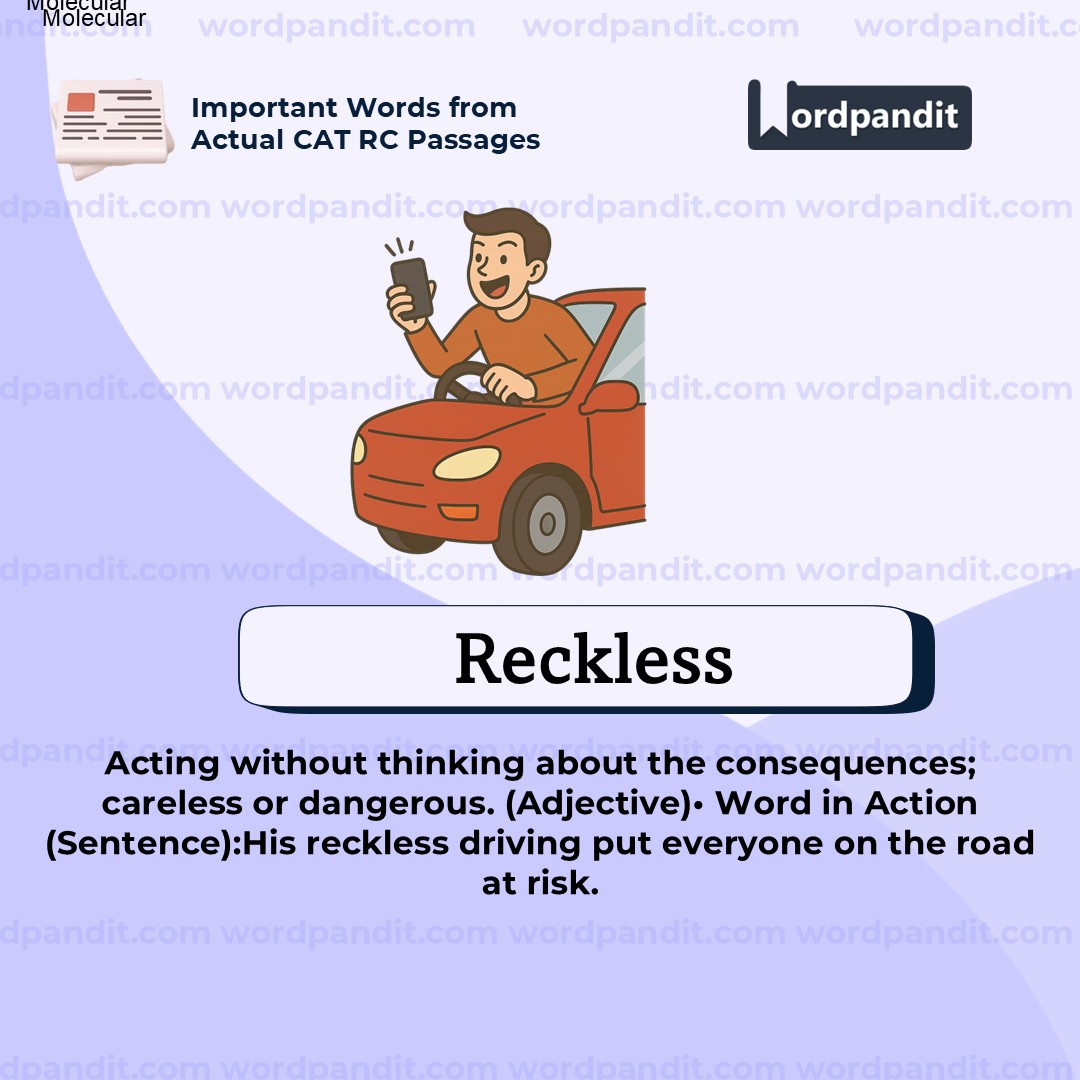
WORD 4: Reckless
Context:
(Inferred example: “His reckless driving endangered everyone on the road.”)
Explanatory Paragraph:
"Reckless" is an adjective that describes behavior done without thinking about the possible consequences or dangers. It often implies carelessness, irresponsibility, or impulsiveness. Whether it’s reckless spending, reckless driving, or reckless speech, the word emphasizes disregard for safety, rules, or the well-being of others. It has a strongly negative connotation and is frequently used in legal, moral, and emotional contexts to express disapproval of risky or thoughtless actions.
Meaning: Acting without care for consequences or danger; careless or rash (Adjective)
Pronunciation: REK-luhs
Difficulty Level: ⭐⭐ Basic
Etymology: From Old English *reccelēas* (“careless”), from *reccan* (“to care”) + *-less* (“without”)
Prashant Sir's Notes:
“Reckless” is a strong word for writing about dangerous, impulsive, or irresponsible actions. It's ideal for personal essays, news commentary, or character analysis. Use it when the subject ignores warnings, rules, or outcomes—especially when their actions harm others. It’s also frequently used in legal writing (e.g., “reckless endangerment”).
Synonyms & Antonyms:
Synonyms: careless, rash, thoughtless, irresponsible, impulsive
Antonyms: cautious, careful, responsible, prudent
Usage Examples:
- The company’s reckless investment led to its financial collapse.
- He made a reckless decision without considering the consequences.
- Reckless behavior on the hiking trail put the entire group at risk.
- The court charged her with reckless endangerment due to her actions.
Cultural Reference:
In films and literature, the "reckless hero" is a common trope—characters like James Dean in *Rebel Without a Cause* or Tony Stark in *Iron Man* often act boldly without thinking of the risks, creating both drama and danger. – Pop Culture & Character Archetypes
Think About It:
Is being reckless always negative—or can bold, risk-taking behavior sometimes lead to innovation or personal growth?
Quick Activity:
Write a sentence describing a reckless action and then rewrite it by replacing “reckless” with a synonym or antonym to observe the tone shift.
Memory Tip:
“Reckless” = *reck* (care) + *-less* → someone who acts *without care* or caution.
Real-World Application:
“Reckless” is used in journalism, legal reports, moral arguments, and personal writing. It conveys urgency, danger, and irresponsibility—making it effective in persuasive or cautionary language.
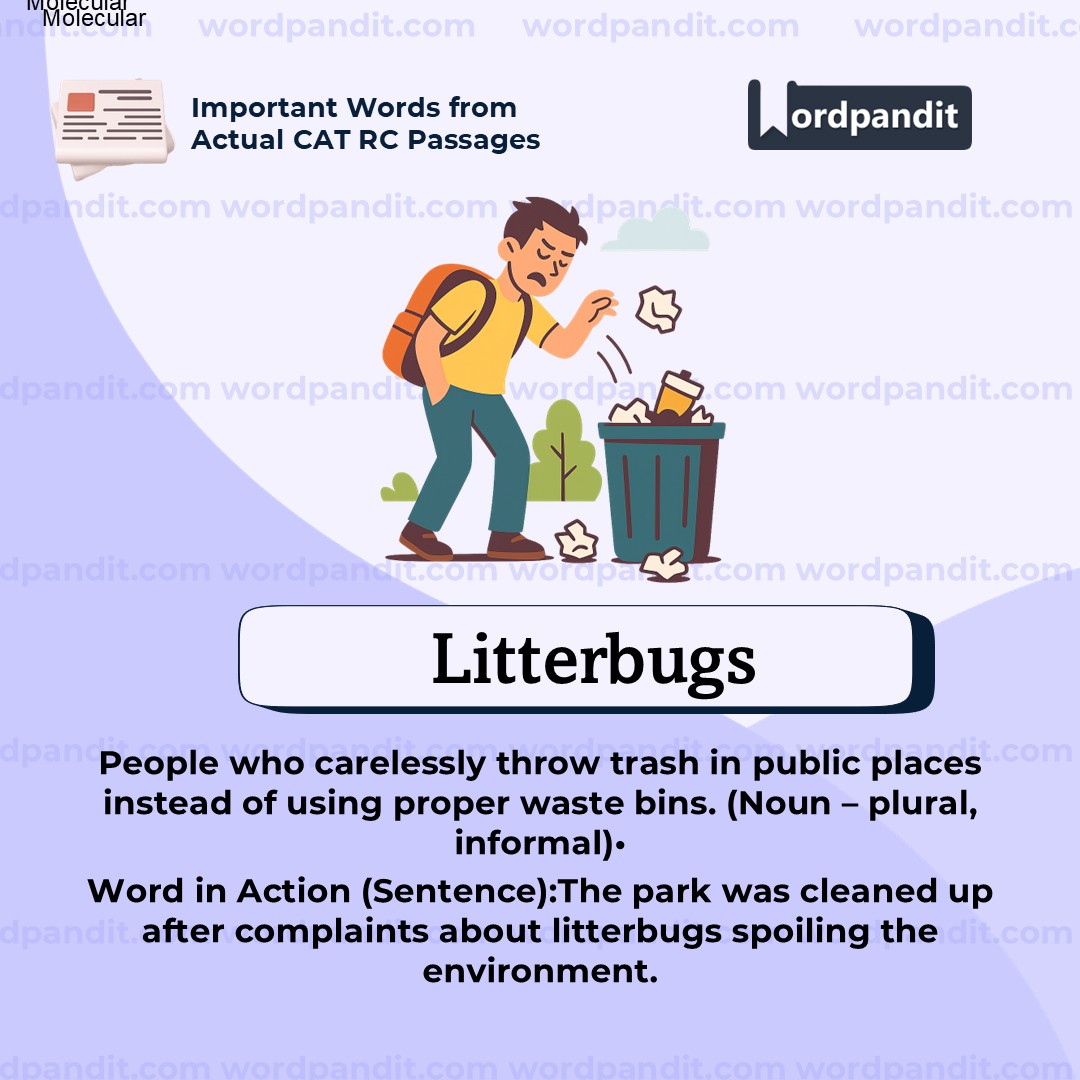
WORD 5: Litterbugs
Context:
(Inferred example: “The park installed signs to discourage litterbugs from tossing garbage on the ground.”)
Explanatory Paragraph:
"Litterbugs" is a casual, mildly critical term used to describe people who carelessly throw trash or garbage in public places instead of using a bin. The word is often used in environmental campaigns to raise awareness about pollution and personal responsibility. While the tone is not extremely harsh, it does express social disapproval of the habit of littering. It’s especially useful when teaching children or promoting community cleanliness without sounding too accusatory.
Meaning: People who irresponsibly throw garbage in public spaces (Noun – plural)
Pronunciation: LIT-er-buhgz
Difficulty Level: ⭐ Basic
Etymology: Coined in the mid-20th century, combining “litter” (to scatter trash) + “bug” (used playfully to refer to people)
Prashant Sir's Notes:
“Litterbugs” is a catchy and effective word for awareness campaigns. It’s great for writing about environmental behavior in a way that is easy for all ages to understand. Use it in speeches, posters, or articles that advocate for public cleanliness and civic sense. It pairs well with calls to action.
Synonyms & Antonyms:
Synonyms: polluters, trash-throwers, careless individuals (informal)
Antonyms: eco-conscious citizens, recyclers, environmental stewards
Usage Examples:
- The city launched a campaign to fine litterbugs caught on surveillance cameras.
- Only litterbugs could ruin such a beautiful beach with plastic waste.
- Volunteers cleaned the park after a weekend of careless litterbugs.
- Posters warned, “Don’t be a litterbug—keep our city clean!”
Cultural Reference:
The term “litterbug” gained popularity in the U.S. during the 1950s anti-littering movement, supported by public service announcements and cartoon characters that taught kids to respect public spaces. – Environmental Awareness Campaigns
Think About It:
Why do people continue to litter even when they know it's harmful—and how can public language like “litterbug” help change behavior?
Quick Activity:
Create a slogan or short sentence that uses the word “litterbugs” to encourage better habits in your school or neighborhood.
Memory Tip:
Think of a “bug” buzzing around and dropping trash everywhere—that’s a litterbug causing messes where they go!
Real-World Application:
“Litterbugs” is commonly used in environmental education, local government signage, school programs, and awareness campaigns. It helps make a serious issue accessible and action-oriented for the public.
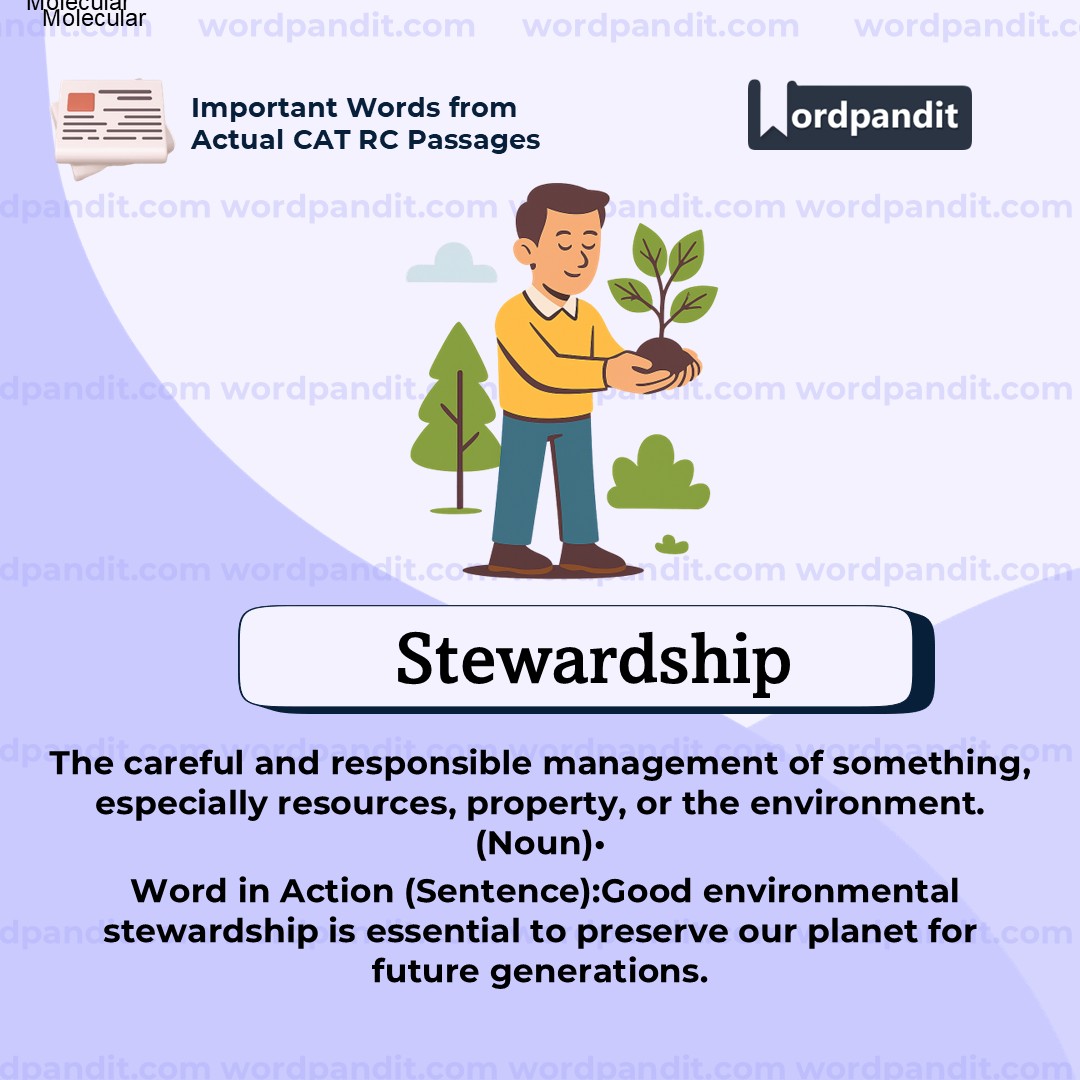
WORD 6: Stewardship
Context:
(Inferred example: “Good environmental stewardship means protecting the planet for future generations.”)
Explanatory Paragraph:
"Stewardship" refers to the responsible management and care of something that one has been entrusted with—be it the environment, finances, a community, or a task. It implies a sense of duty, long-term thinking, and ethical behavior. The concept often arises in environmental science, leadership, religion, and business, where individuals or groups are expected to act not just for their own benefit but for the well-being of others and the future.
Meaning: The responsible management and protection of something entrusted to one’s care (Noun)
Pronunciation: STOO-urd-ship / STYOO-urd-ship
Difficulty Level: ⭐⭐⭐ Intermediate
Etymology: From Old English *stiweard* (“house guardian”), later evolving into “steward” + *-ship* (denoting condition or quality)
Prashant Sir's Notes:
“Stewardship” is a powerful and respectful word, ideal for use in essays about leadership, sustainability, or social responsibility. It shows a mindset of accountability and care. Use it when you want to go beyond “management” and speak about ethical, thoughtful oversight of people, places, or ideas.
Synonyms & Antonyms:
Synonyms: guardianship, management, care, responsibility, custodianship
Antonyms: neglect, misuse, exploitation, carelessness
Usage Examples:
- His stewardship of the forest reserve helped preserve biodiversity for decades.
- Corporate stewardship includes not only financial success but also social impact.
- The charity praised her for her responsible stewardship of the donated funds.
- Stewardship of Earth’s resources is a duty we all share.
Cultural Reference:
The idea of *environmental stewardship* is central to Indigenous philosophies around the world, where humans are seen not as owners of the land, but as caretakers for future generations. – Environmental Ethics & Indigenous Knowledge
Think About It:
What are you a steward of in your own life—and how can you care for it more responsibly and meaningfully?
Quick Activity:
Write a sentence using “stewardship” to describe responsible care in one of these areas: the environment, leadership, finances, or education.
Memory Tip:
Think “stewardship” = *ship of a steward* → the role of guiding and protecting something as if it were your own.
Real-World Application:
“Stewardship” is used in environmental science, nonprofit work, leadership training, financial ethics, and religious teachings. It signals thoughtful care, integrity, and future-focused decision-making.
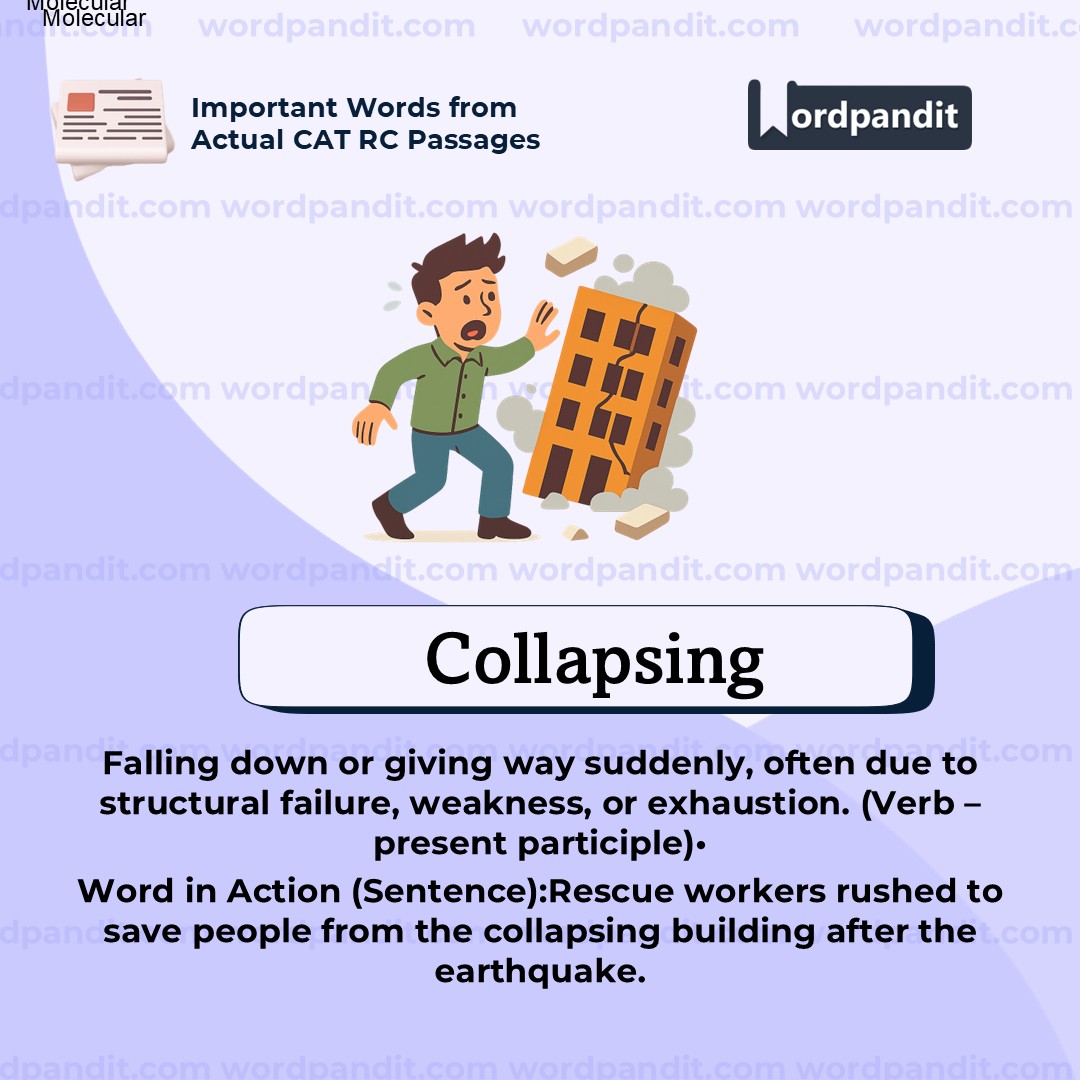
WORD 7: Collapsing
Context:
(Inferred example: “The bridge is at risk of collapsing if urgent repairs are not made.”)
Explanatory Paragraph:
"Collapsing" is the present participle of the verb "collapse," meaning to fall down suddenly, either physically or metaphorically. It can describe buildings, systems, people, or ideas breaking down due to pressure, weakness, or failure. The term evokes a strong image of destruction or loss of control—whether it's a collapsing economy, a collapsing structure, or someone emotionally or physically collapsing from exhaustion. It’s commonly used in journalism, science, psychology, and everyday speech to express rapid decline or failure.
Meaning: Falling apart, failing, or giving way suddenly (Verb – present participle / Adjective)
Pronunciation: kuh-LAP-sing
Difficulty Level: ⭐⭐ Basic
Etymology: From Latin *collapsus* (“fallen together”), past participle of *collabi* (“to fall in, cave in”)
Prashant Sir's Notes:
“Collapsing” is a dramatic and urgent word, useful in both literal and metaphorical contexts. Use it in essays to describe crises—whether environmental, emotional, structural, or societal. It adds a sense of movement, urgency, and consequence. Try pairing it with strong nouns like *system*, *structure*, *health*, or *trust* for impact.
Synonyms & Antonyms:
Synonyms: crumbling, falling, breaking down, caving in, deteriorating
Antonyms: standing, stabilizing, rebuilding, enduring
Usage Examples:
- The aging roof was on the verge of collapsing during the storm.
- The patient was collapsing from extreme dehydration and fatigue.
- Many believe the old political order is slowly collapsing under public pressure.
- Entire ecosystems are collapsing due to climate change and deforestation.
Cultural Reference:
In global news, phrases like “collapsing healthcare system” are often used to describe countries overwhelmed by war, pandemics, or economic crises—highlighting the urgency of reform and international support. – Global Affairs & Public Health
Think About It:
What warning signs do we often ignore before something—whether personal or societal—begins collapsing?
Quick Activity:
Write one sentence using “collapsing” in a literal physical sense, and another using it to describe a failing system or emotion.
Memory Tip:
“Collapsing” = *co-* (together) + *lapsing* (falling) → think of something suddenly folding in on itself under pressure.
Real-World Application:
“Collapsing” is widely used in science, engineering, mental health, economics, and journalism. It captures instability and urgency, making it a strong choice for crisis-focused writing or speech.
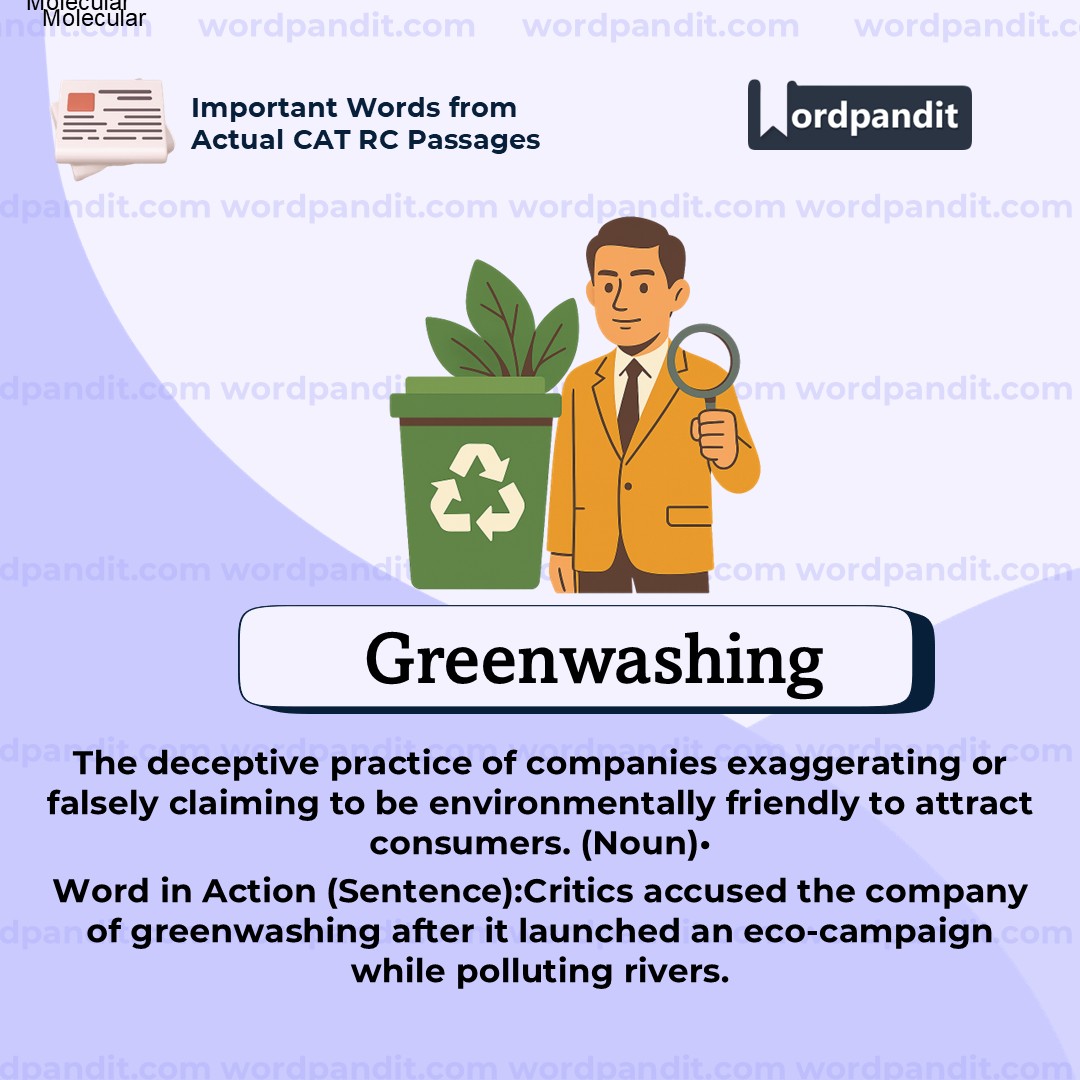
WORD 8: Greenwashing
Context:
(Inferred example: “Critics accused the company of greenwashing by exaggerating its commitment to sustainability in its advertising.”)
Explanatory Paragraph:
"Greenwashing" is a term used to describe the practice of companies or organizations misleading the public into believing they are more environmentally responsible than they actually are. This is often done through advertising, labels, or vague claims that suggest sustainability without meaningful action. Greenwashing undermines genuine environmental efforts and confuses consumers who want to make eco-friendly choices. It combines public relations with deception, often prioritizing image over impact.
Meaning: The act of falsely promoting environmental responsibility to appear eco-friendly without taking real action (Noun)
Pronunciation: GREEN-wosh-ing
Difficulty Level: ⭐⭐⭐ Intermediate
Etymology: Coined in the 1980s; a blend of “green” (environmentalism) + “whitewashing” (covering up faults)
Prashant Sir's Notes:
“Greenwashing” is an essential term for essays or discussions on corporate ethics, sustainability, and media literacy. Use it when analyzing marketing tactics that exploit environmental trends without genuine action. This word is particularly relevant in today’s climate-conscious world where consumers demand authenticity, not just promises.
Synonyms & Antonyms:
Synonyms: eco-deception, false advertising (in context), environmental hypocrisy
Antonyms: genuine sustainability, transparent action, eco-authenticity
Usage Examples:
- The brand was accused of greenwashing after launching a “green” line of plastic products.
- Many companies use vague eco-labels as part of their greenwashing strategy.
- Greenwashing misleads customers who are trying to shop sustainably.
- Environmental watchdogs expose greenwashing campaigns through fact-checking and reports.
Cultural Reference:
In 1986, environmentalist Jay Westerveld first used “greenwashing” to criticize hotels that asked guests to reuse towels “to save the environment” while ignoring broader ecological harm. – Environmental Movement History
Think About It:
How can consumers tell the difference between true environmental responsibility and greenwashing?
Quick Activity:
Find an ad or label that claims to be “green.” Analyze whether it provides real data—or could be an example of greenwashing.
Memory Tip:
“Greenwashing” = *green + whitewashing* → it’s when companies “paint themselves green” to cover up non-sustainable behavior.
Real-World Application:
“Greenwashing” is vital in environmental journalism, business ethics, and sustainability education. It’s a key term in identifying misleading marketing and advocating for transparency.

WORD 9: Simultaneously
Context:
(Inferred example: “The app allows users to stream music and browse the internet simultaneously.”)
Explanatory Paragraph:
"Simultaneously" is an adverb that means “at the same time.” It’s used to describe two or more actions or events occurring together without delay or separation. Whether describing technology, tasks, reactions, or real-world events, the word adds a sense of synchronization. It is especially useful in academic writing, science, and everyday communication when highlighting parallel actions or multitasking.
Meaning: Happening, existing, or being done at the same time (Adverb)
Pronunciation: SY-muhl-TAY-nee-uhs-lee
Difficulty Level: ⭐⭐⭐ Intermediate
Etymology: From Medieval Latin *simultaneus* (“occurring at the same time”), from Latin *simul* (“together”)
Prashant Sir's Notes:
“Simultaneously” is a great transition word for academic writing, particularly in science, history, or comparative essays. It helps express complexity and concurrency. Try using it to improve flow when describing parallel actions, experiments, or contrasting ideas that occur side by side in time or space.
Synonyms & Antonyms:
Synonyms: at once, concurrently, together, in unison, at the same time
Antonyms: sequentially, separately, consecutively, one after another
Usage Examples:
- The twins spoke simultaneously, confusing everyone in the room.
- The printer can scan and copy documents simultaneously to save time.
- Simultaneously, protests erupted in multiple cities across the country.
- She managed to listen to the lecture while simultaneously taking detailed notes.
Cultural Reference:
In physics, Einstein’s theory of relativity redefined the idea of simultaneity by showing that events that seem simultaneous in one frame of reference may not be in another—altering our understanding of time and space. – Modern Physics & Relativity
Think About It:
In a world where multitasking is often praised, is doing things simultaneously always more efficient—or can it reduce the quality of attention and focus?
Quick Activity:
Write a sentence that uses “simultaneously” to describe two events happening at once—one personal and one global or scientific.
Memory Tip:
“Simul-” = together + “-taneously” = time → *things happening together in time.* Think of synchronized swimmers!
Real-World Application:
“Simultaneously” is useful in academic writing, time management discussions, scientific descriptions, and tech or software documentation—anywhere timing and coordination matter.
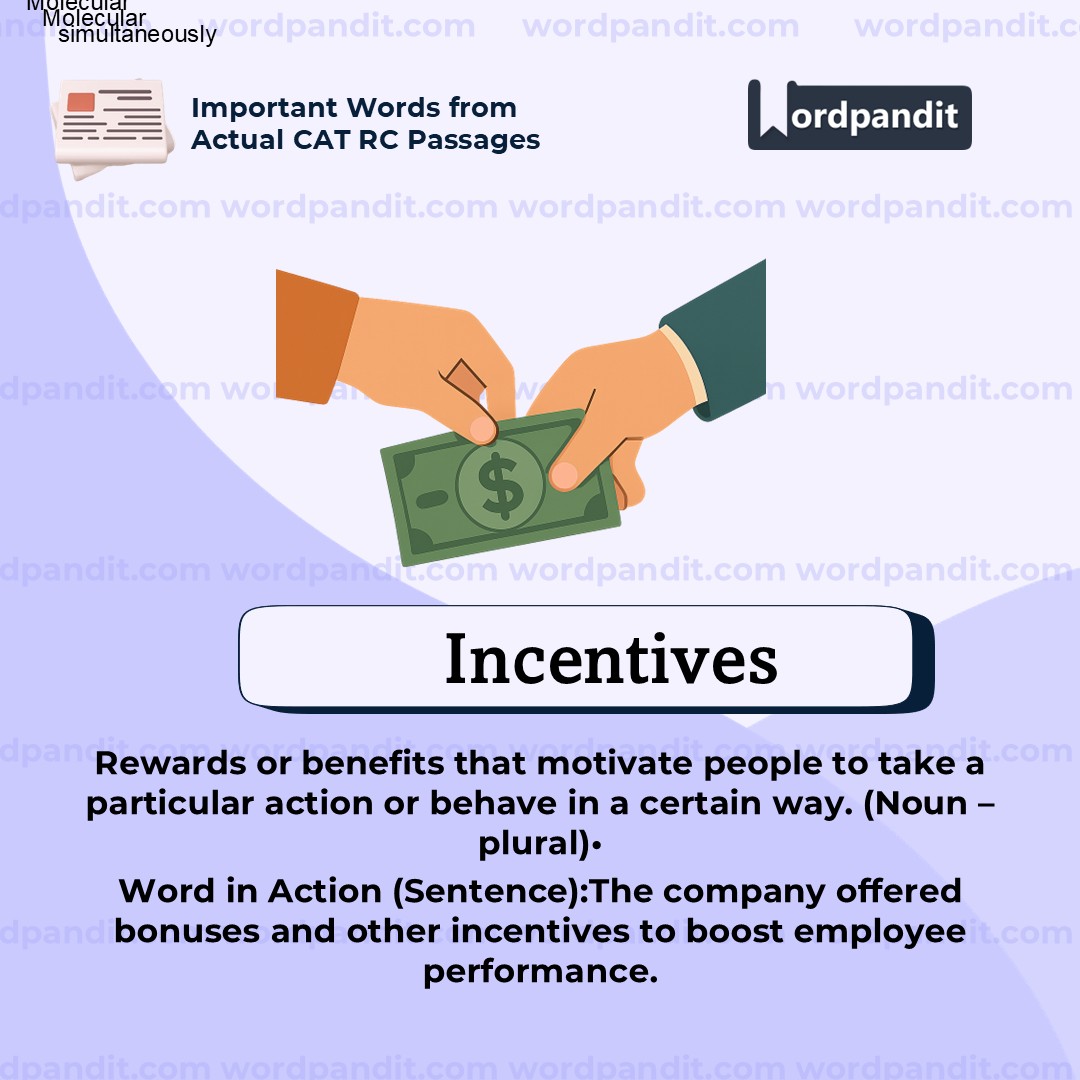
WORD 10: Incentives
Context:
(Inferred example: “The government offered tax incentives to encourage investment in renewable energy.”)
Explanatory Paragraph:
"Incentives" are rewards, benefits, or motivations that encourage someone to take a specific action or behave in a certain way. They can be financial (like bonuses or discounts), social (praise or recognition), or psychological (personal satisfaction or fulfillment). Widely used in economics, business, education, and policy-making, incentives are designed to shape behavior—whether it’s improving performance, increasing participation, or guiding public choices.
Meaning: Motivators or rewards that encourage a specific action or behavior (Noun – plural)
Pronunciation: in-SEN-tivz
Difficulty Level: ⭐⭐ Basic
Etymology: From Latin *incentivum* (“something that sets the tune”), from *incinere* (“to sing or sound in”) → implying a stimulus or trigger
Prashant Sir's Notes:
“Incentives” is a powerful academic and business word. Use it in essays about motivation, economics, policy, or productivity. It’s particularly useful when discussing systems that influence human behavior. Think: “What is the incentive here?”—this helps break down decision-making in real-life contexts.
Synonyms & Antonyms:
Synonyms: motivation, stimulus, reward, encouragement, inducement
Antonyms: deterrent, disincentive, penalty, discouragement
Usage Examples:
- Employees received incentives for meeting their monthly targets.
- Many schools use positive incentives to encourage good behavior.
- Tax incentives can promote innovation and clean energy investment.
- Without proper incentives, people may lack the motivation to act responsibly.
Cultural Reference:
Behavioral economists like Richard Thaler have shown how small incentives—financial or psychological—can "nudge" people toward better decisions, influencing public policy and consumer habits. – Behavioral Economics & Public Policy
Think About It:
Can incentives be too effective—encouraging people to do the right thing for the wrong reasons?
Quick Activity:
List two types of incentives: one from school or work, and another from a government or business setting. What behaviors are they trying to encourage?
Memory Tip:
“Incentives” = *incite + motive* → things that *invite* or *ignite* action.
Real-World Application:
“Incentives” is commonly used in economics, workplace strategy, education, health campaigns, and marketing. It helps explain what drives behavior and how systems can be designed to encourage good outcomes.


