
📘 What’s Inside This CAT Misfit Sentence/Odd One Out Question Post?
📝 Authentic CAT Misfit Sentence/Odd One Out Question: Practice with a real CAT Para-jumble Question from a previous CAT exam.
✅ Detailed Question with Step-by-Step Solution: Each question is explained thoroughly for better understanding.
📚 Vocabulary Enhancement: Top 5 words explained from the paragraph
Misfit Sentence/Odd One Out Question
Question 29: Five sentences related to a topic are given below in a jumbled order. Four of them form a coherent and unified paragraph. Identify the odd sentence that does not go with the four. Key in the number of the option that you choose.
1. Socrates told us that ‘the unexamined life is not worth living’ and that to ‘know thyself’ is the path to true wisdom.
2. It suggests that you should adopt an ancient rhetorical method favored by the likes of Julius Caesar and known as ‘illeism’ – or speaking about yourself in the third person.
3. Research has shown that people who are prone to rumination also often suffer from impaired decision making under pressure and are at a substantially increased risk of depression.
4. Simple rumination – the process of churning your concerns around in your head – is not the way to achieve self-realization.
5. The idea is that this small change in perspective can clear your emotional fog, allowing you to see past your biases.
Solution with Explanation
Answer: 1
Detailed explanation by Wordpandit:
After reading these sentence-options we can deduce that the resulting coherent paragraph is supposed to be about rumination not being the right method for self-realization, its ill-effects, and that illeism can be more beneficial instead.
The idea of rumination is introduced in Sentence-4, so it would begin the paragraph. Since Sentence-3 describes the results of research on rumination, it would be placed next. The “it” that Sentence-2 begins with refers to the research mentioned in Sentence-3, which suggests a better alternative called illeism – speaking about oneself in third person. As Sentence-5 explains how this small change in perspective can let you see past your biases, this will be placed next.
The option which does not fit this logical narrative is Sentence-1, as it introduces a different philosophical theme that is not connected to the rest. Hence, it is the odd one out.
Word-1: Rhetorical

Context:
"It suggests that you should adopt an ancient rhetorical method favored by the likes of Julius Caesar and known as ‘illeism’ – or speaking about yourself in the third person." - Unknown Source
Explanatory Paragraph:
The word "rhetorical" refers to language that is designed to be persuasive or impressive, often used in speech or writing to influence an audience. It's not always meant to get an answer but rather to provoke thought or make a point. In classical education, rhetorical methods were central to developing argumentation and public speaking skills.
Meaning: Related to the art of effective or persuasive speaking or writing (Adjective)
Pronunciation: reh-TAW-rih-kul
Difficulty Level: ⭐⭐ Beginner to Intermediate
Etymology: From Latin *rhetoricus*, from Greek *rhētorikos*, from *rhētōr* meaning "speaker, orator."
Prashant Sir's Notes:
“Rhetorical” is not just a fancy adjective—it’s a key concept in communication. Learn it well if you're preparing for debates, essays, or speeches. It also often appears in the phrase “rhetorical question,” which means a question asked for effect rather than to get an answer.
Synonyms & Antonyms:
Synonyms: persuasive, oratorical, eloquent, bombastic, flowery
Antonyms: plain, straightforward, unembellished
Usage Examples:
- The politician’s speech was full of rhetorical flourishes but lacked real substance.
- She asked a rhetorical question to make her point more impactful.
- In ancient Greece, rhetorical skills were essential for public life.
- His rhetorical style won him applause, even from his critics.
Cultural Reference:
"Julius Caesar was a master of rhetorical strategies, often referring to himself in the third person to seem objective and grand." - Historical Anecdote
Think About It:
How can rhetorical techniques influence our opinions without us even realizing it?
Quick Activity:
Write a rhetorical question you might ask in a persuasive essay on climate change. Then explain its intended effect.
Memory Tip:
Think of “rhetorical” as “write-oracle”—someone who writes or speaks like an oracle to influence others.
Real-World Application:
Understanding rhetorical techniques helps in analyzing political speeches, advertisements, and media, where persuasion is key.
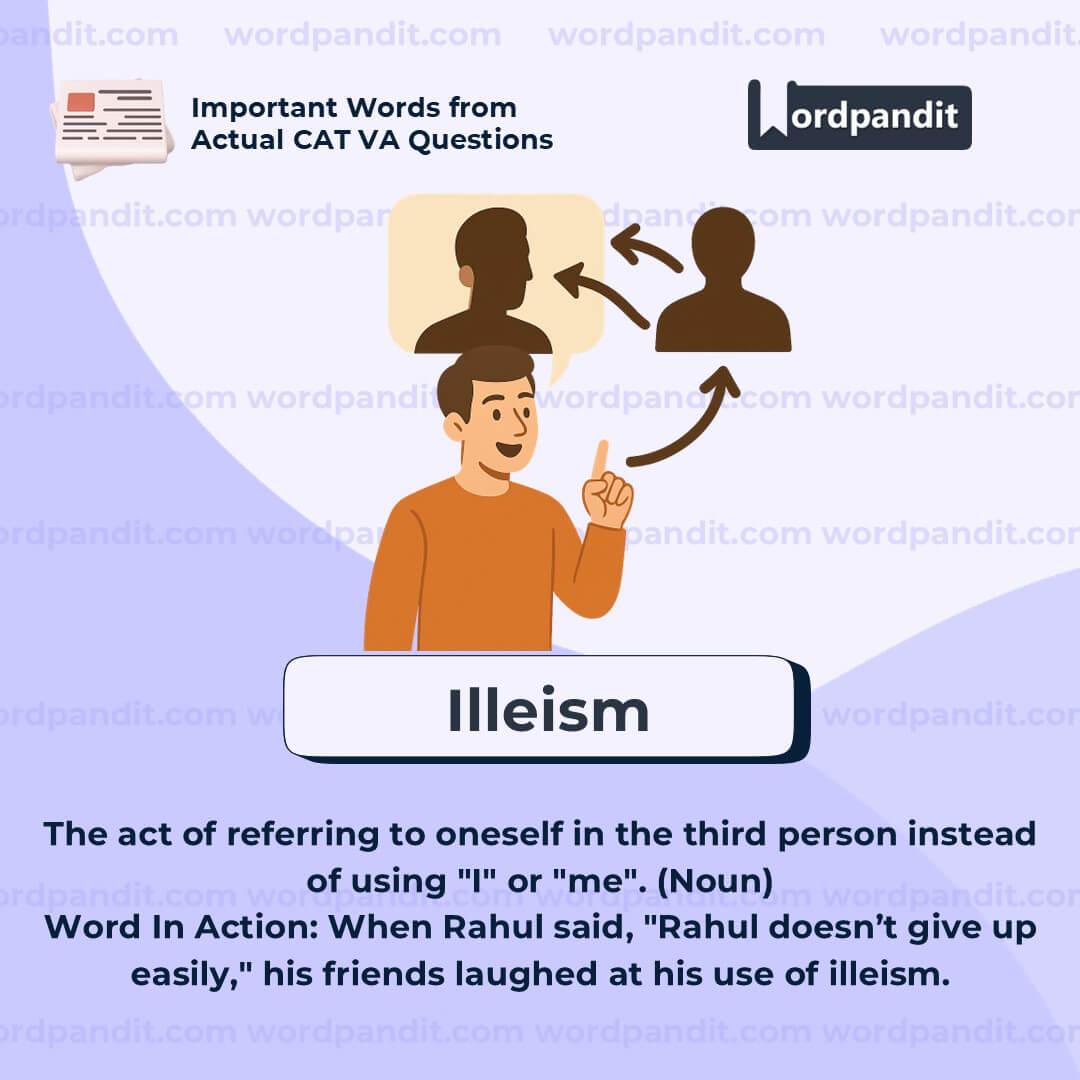
Word-2: Illeism
Context:
"It suggests that you should adopt an ancient rhetorical method favored by the likes of Julius Caesar and known as ‘illeism’ – or speaking about yourself in the third person." - Unknown Source
Explanatory Paragraph:
"Illeism" is the act of referring to oneself in the third person instead of using "I" or "me." This rhetorical strategy can make statements sound more objective, authoritative, or even theatrical. While sometimes seen as odd, it has been used effectively by famous leaders, authors, and athletes to create distance from the self or to emphasize their persona.
Meaning: The act of referring to oneself in the third person (Noun)
Pronunciation: IL-ee-iz-um
Difficulty Level: ⭐⭐⭐ Intermediate
Etymology: From Latin *ille*, meaning "he" or "that man", combined with the suffix *-ism* to indicate a practice or system.
Prashant Sir's Notes:
This word may sound obscure, but it's a fantastic rhetorical device. Use it to analyze character behavior in literature or public speaking. It also adds a layer of psychological insight—why would someone talk about themselves like an outsider?
Synonyms & Antonyms:
Synonyms: third-person self-reference
Antonyms: first-person self-reference
Usage Examples:
- When LeBron James said, “LeBron has to do what’s best for LeBron,” he was engaging in illeism.
- Julius Caesar’s writings are full of illeism, referring to himself simply as “Caesar.”
- Illeism can come across as pompous or theatrical, depending on the context.
- Some authors use illeism as a narrative technique to create distance from their personal views.
Cultural Reference:
"Caesar crossed the Rubicon" — a phrase famously written by Julius Caesar himself using illeism to elevate his historical presence. - Historical Texts
Think About It:
Why might a public figure choose to refer to themselves in the third person rather than using "I"?
Quick Activity:
Try writing 3 sentences about yourself using illeism. Example: "[Your Name] is ready to learn!"
Memory Tip:
Think “Ille” = “he” in Latin. So, illeism = talking about yourself as “he” or “she.”
Real-World Application:
Understanding illeism helps decode certain speech styles in politics, sports interviews, and literature, revealing personality traits or rhetorical strategies.
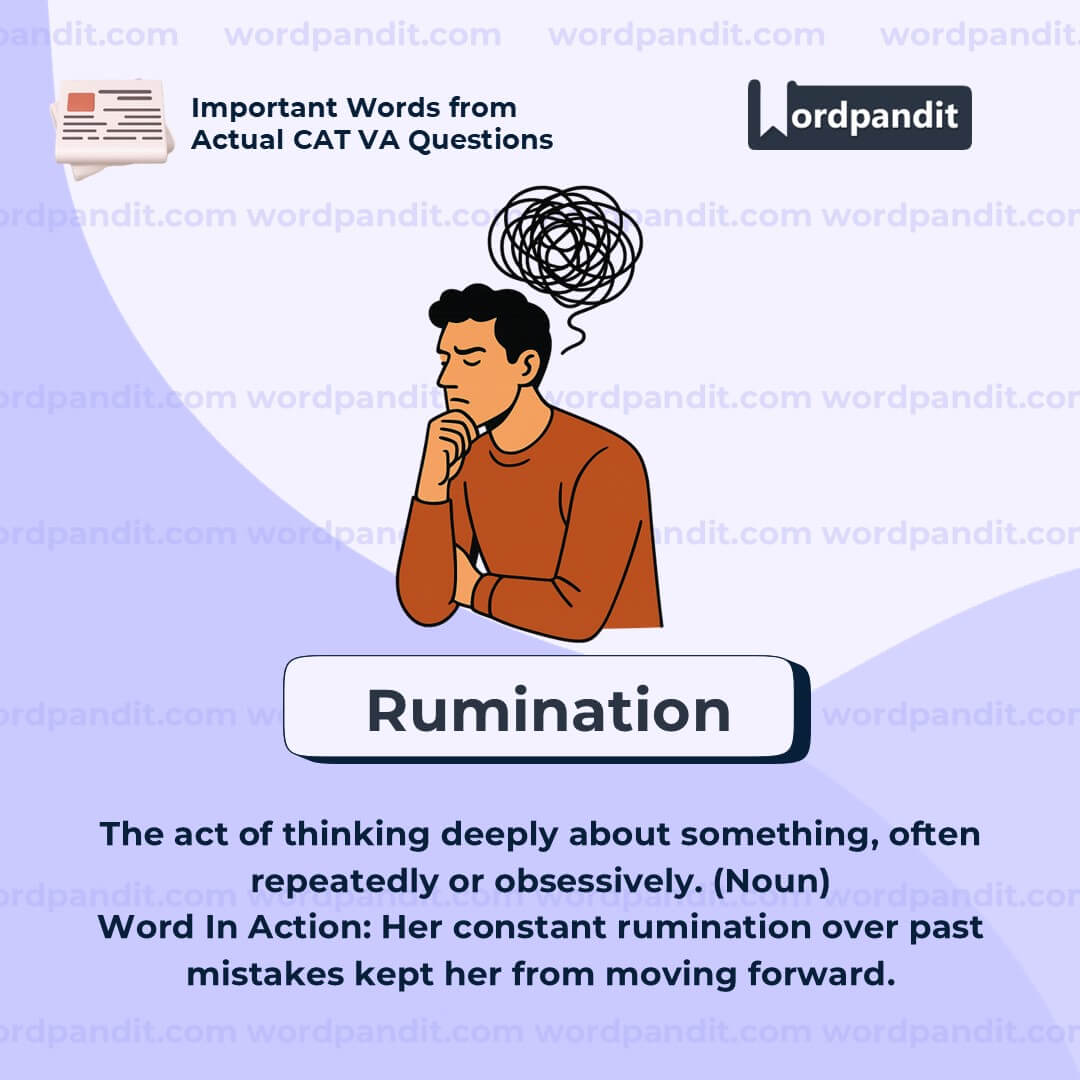
Word-3: Rumination
Context:
"Research has shown that people who are prone to rumination also often suffer from impaired decision making under pressure and are at a substantially increased risk of depression." - Unknown Source
Explanatory Paragraph:
Rumination refers to the act of continuously thinking about the same thoughts, often negative or distressing, without reaching a solution. It is like getting mentally stuck in a loop. While thinking deeply can be useful, rumination becomes harmful when it leads to anxiety, depression, or hinders decision-making abilities. It is a psychological pattern often associated with overthinking and emotional distress.
Meaning: Deep or repetitive thinking, especially about problems or distressing events (Noun)
Pronunciation: roo-muh-NAY-shun
Difficulty Level: ⭐⭐⭐ Intermediate
Etymology: From Latin *ruminare*, meaning “to chew the cud” (like a cow); later used metaphorically for deep or repetitive thinking.
Prashant Sir's Notes:
This is a psychologically loaded word. It comes up in discussions on mental health, mindfulness, and cognitive behavioral therapy (CBT). If you find yourself stuck thinking about the same problems over and over again, you are probably ruminating.
Synonyms & Antonyms:
Synonyms: overthinking, brooding, dwelling, obsessing
Antonyms: mindfulness, decisiveness, spontaneity, distraction
Usage Examples:
- Her rumination over past failures prevented her from enjoying present successes.
- Therapists often help patients break cycles of rumination through cognitive exercises.
- Rumination is not the same as healthy reflection—it tends to amplify anxiety.
- He recognized that his late-night rumination was affecting his sleep and productivity.
Cultural Reference:
"Rumination has been likened to 'chewing the cud' of thoughts, a metaphor borrowed from animal behavior and commonly used in mindfulness psychology." - Psychology Today
Think About It:
When does deep thinking become unhelpful rumination, and how can we learn to notice the difference?
Quick Activity:
List three thoughts you've revisited repeatedly this week. Reflect: are they helping you move forward or causing unnecessary stress?
Memory Tip:
Think of a cow "ruminating" or chewing cud repeatedly—just like your mind going over the same thoughts again and again.
Real-World Application:
Understanding rumination is crucial for managing mental health. It's frequently addressed in therapy and stress-reduction programs such as mindfulness and CBT.
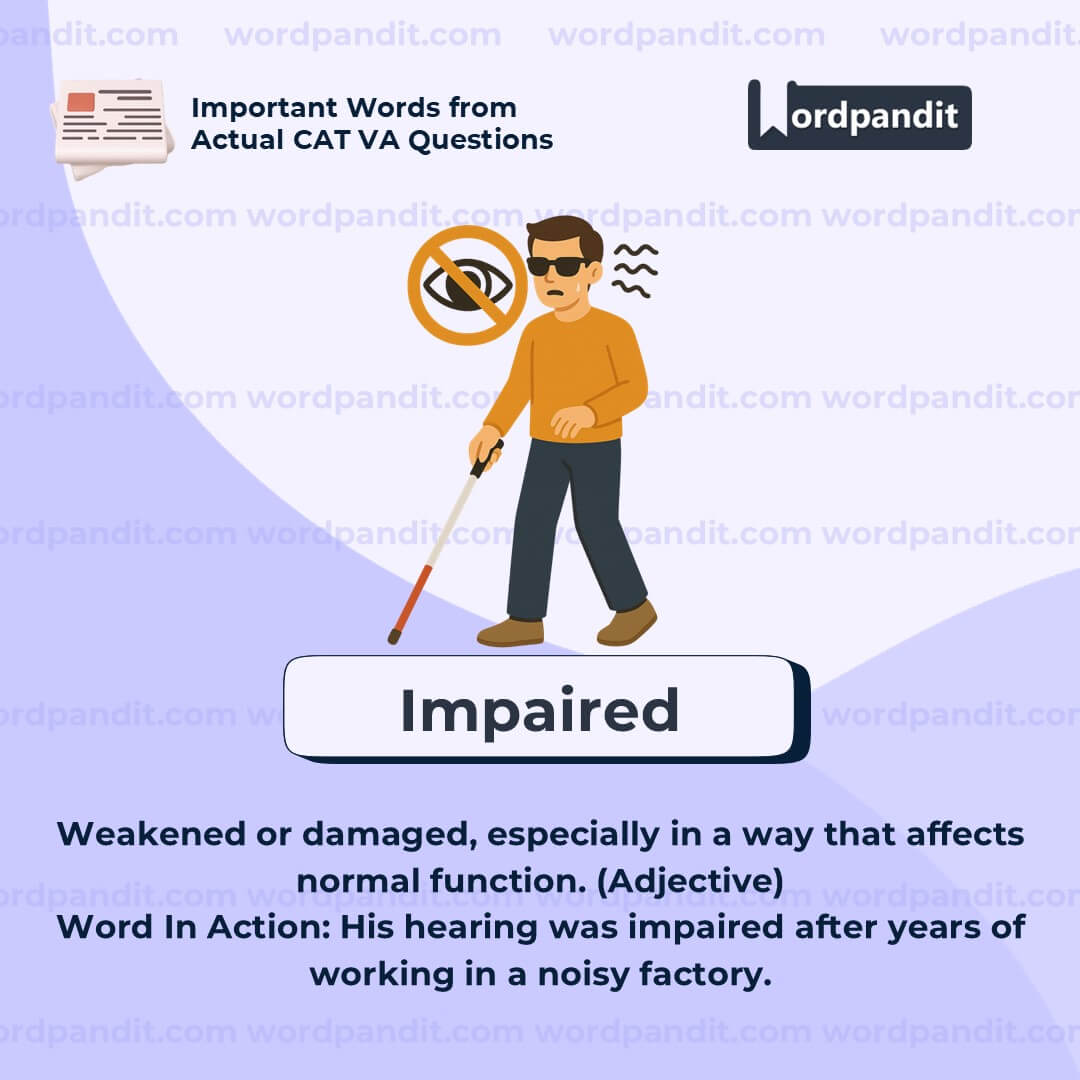
Word-4: Impaired
Context:
"Research has shown that people who are prone to rumination also often suffer from impaired decision making under pressure and are at a substantially increased risk of depression." - Unknown Source
Explanatory Paragraph:
“Impaired” describes something that has been weakened, damaged, or made less effective. It is commonly used in medical, psychological, or functional contexts to indicate a reduction in normal capability. Whether referring to impaired vision, impaired judgment, or impaired memory, the term implies that the usual function is not working at full capacity.
Meaning: Weakened, damaged, or functioning at less than full capacity (Adjective)
Pronunciation: im-PAIRD
Difficulty Level: ⭐⭐ Beginner to Intermediate
Etymology: From Latin *impedire*, meaning “to hinder,” later influenced by Middle English *impairen*, meaning “to make worse.”
Prashant Sir's Notes:
"Impaired" often shows up in exams and reading comprehension sections when describing decline or loss of ability. Remember that it doesn’t mean complete loss—just a reduction or limitation in function.
Synonyms & Antonyms:
Synonyms: weakened, damaged, hindered, compromised, degraded
Antonyms: enhanced, improved, healthy, functional, unbroken
Usage Examples:
- His impaired hearing made it difficult for him to follow the conversation.
- Decision-making can become impaired when one is under extreme stress.
- The medication may cause impaired motor skills.
- They tested her for cognitive impairment after the accident.
Cultural Reference:
"Driving while impaired" is a commonly used legal term in many countries to describe operating a vehicle under the influence of alcohol or drugs. - Legal Terminology
Think About It:
How can we support people with impairments so they can still contribute and thrive in society?
Quick Activity:
Think of five everyday situations where something being “impaired” would have serious consequences. Write them down and identify whether the impairment is physical, mental, or functional.
Memory Tip:
Impaired = "I'm paired down" — imagine losing part of your function and becoming “less than full.”
Real-World Application:
The term "impaired" is often used in healthcare, psychology, and legal contexts to assess someone's ability to function or perform tasks safely and effectively.
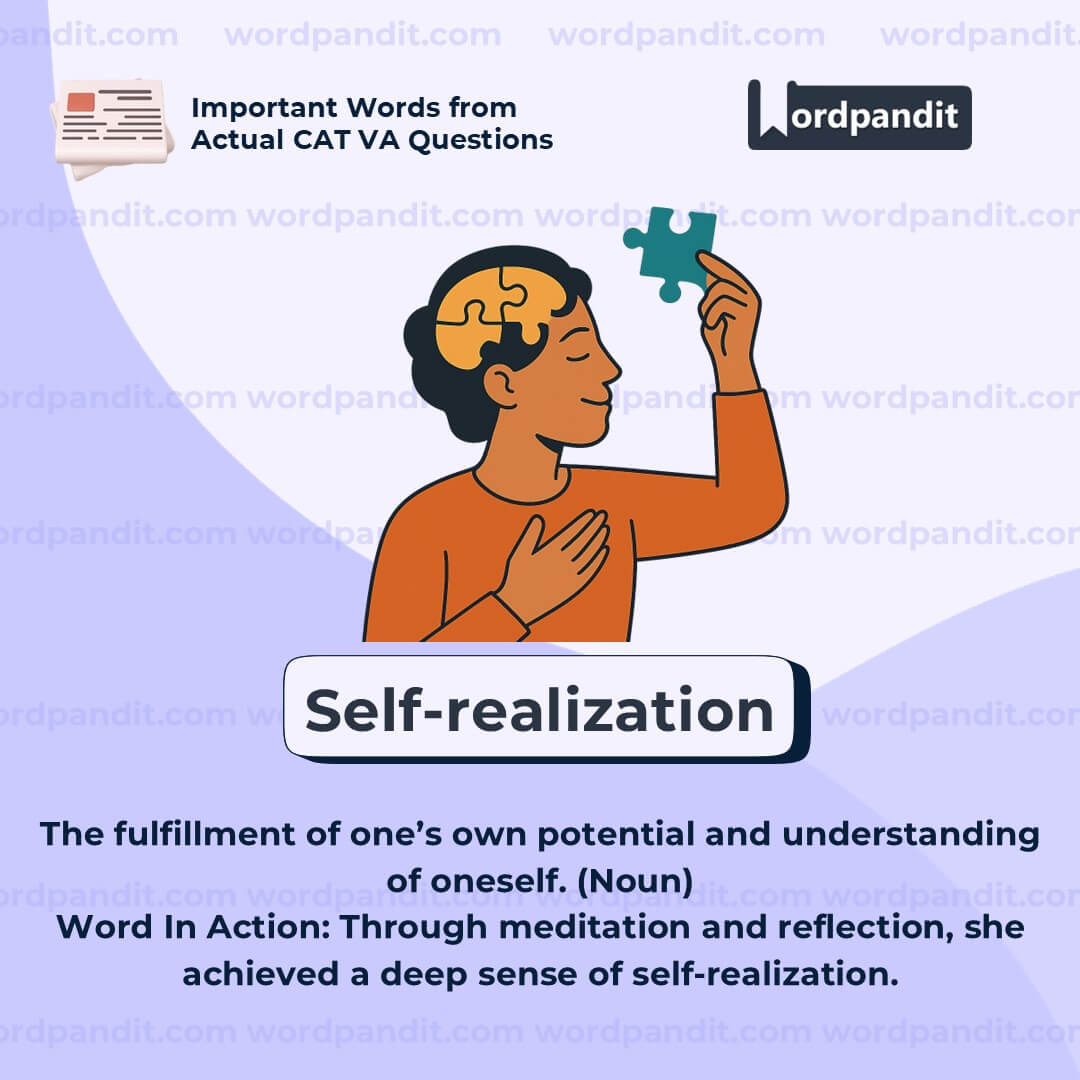
Word-5: Self-realization
Context:
"Simple rumination – the process of churning your concerns around in your head – is not the way to achieve self-realization." - Unknown Source
Explanatory Paragraph:
Self-realization refers to the full understanding or fulfillment of one’s own potential, identity, or purpose. It is often seen as a moment of awakening or deep personal insight. In psychology, it is linked to personal growth and self-awareness. In spiritual traditions, it often signifies the recognition of one’s true nature beyond the ego or superficial identity. Unlike aimless overthinking, self-realization involves clarity, acceptance, and meaningful transformation.
Meaning: The fulfillment of one's own potential or true self (Noun)
Pronunciation: self-ree-uh-lai-ZAY-shun
Difficulty Level: ⭐⭐⭐ Intermediate to Advanced
Etymology: From "self" + "realization," with roots in Latin *realis* (actual) and *-ation* (action or process); commonly adopted in philosophical and psychological texts.
Prashant Sir's Notes:
This is a deep and powerful term. Whether you’re discussing Maslow’s hierarchy of needs or Eastern spiritual philosophy, self-realization stands as the pinnacle of personal growth. It goes beyond knowledge—into wisdom, purpose, and true understanding of the self.
Synonyms & Antonyms:
Synonyms: enlightenment, self-awareness, self-actualization, self-discovery
Antonyms: confusion, self-ignorance, delusion, denial
Usage Examples:
- Through meditation and mindfulness, she gradually moved toward self-realization.
- Self-realization isn’t about becoming someone new, but recognizing who you truly are.
- Maslow considered self-realization the ultimate goal in his hierarchy of needs.
- He left his corporate job to pursue a life of travel and reflection in search of self-realization.
Cultural Reference:
"Self-realization is the knowing—in body, mind, and soul—that we are one with the omnipresence of God." - Paramahansa Yogananda
Think About It:
Is self-realization a destination you reach, or a journey you continue throughout life?
Quick Activity:
Write down three things that give you a strong sense of identity or purpose. Reflect on how they contribute to your journey of self-realization.
Memory Tip:
Think of “self-realization” as “realizing your true self”—recognizing who you are beyond your roles and doubts.
Real-World Application:
Self-realization plays a key role in personal development programs, therapy, leadership coaching, and spiritual retreats—it’s about becoming the best version of yourself with full awareness.
