
📘 What’s Inside This CAT Para-jumble Question Post?
📝 Authentic CAT Para-jumble Question : Practice with a real CAT Para-jumble Question from a previous CAT exam.
✅ Detailed Question with Step-by-Step Solution: Each question is explained thoroughly for better understanding.
📚 Vocabulary Enhancement: Top 5 words explained from the paragraph
Para-jumble Sentences
Question 33: The four sentences (labelled 1, 2, 3, 4) given below, when properly sequenced would yield a coherent paragraph. Decide on the proper sequence of the order of the sentences and key in the sequence of the four numbers as your answer.
1. To the uninitiated listener, atonal music can sound like chaotic, random noise.
2. Atonality is a condition of music in which the constructs of the music do not ‘live’ within the confines of a particular key signature, scale, or mode.
3. After you realize the amount of knowledge, skill, and technical expertise required to compose or perform it, your tune may change, so to speak.
4. However, atonality is one of the most important movements in 20th century music.
Solution with Explanation
Answer: 2143
Detailed explanation by Wordpandit:
After going through the sentence-options, we can gather that although atonal music might sound random and chaotic to those who are not aware of it, atonality requires a lot of knowledge and skill to master.
First, we need to find the right opening line. Sentences 1, 3 and 4 require a preceding statement to justify them, hence Sentence-2 should begin the paragraph by introducing the topic of atonality.
Sentence-1 explains how some people can misunderstand atonal music as random noise. Sentence-4 starts with ‘however’, and then explains a positive thing about atonality, which means that the preceding statement should mention something that sort of goes against atonal music. So, 1 and 4 form a logical ‘set’ following the introductory definition.
We are left with Sentence-3, which explains the amount of skill required, and that those who didn’t appreciate it will later change their perception. This makes for a perfect conclusion to the passage.
Hence, the correct sequence of sentences should be 2143.
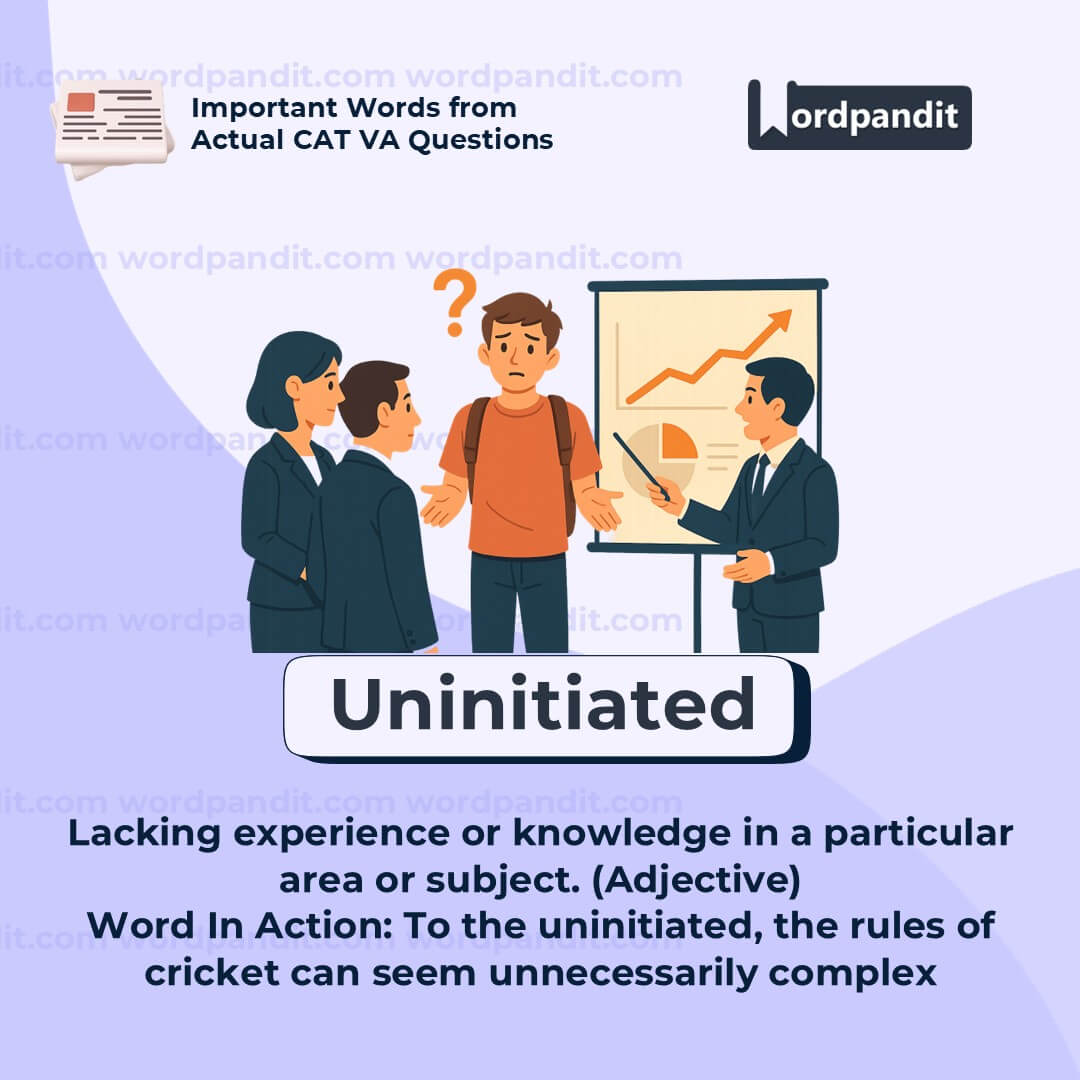
Word-1: Uninitiated
Context:
"To the uninitiated listener, atonal music can sound like chaotic, random noise." - Contextual Usage
Explanatory Paragraph:
"Uninitiated" refers to someone who lacks prior experience, knowledge, or familiarity with a particular subject or activity. In the context of the sentence, it implies that someone who hasn’t studied or been exposed to atonal music may find it confusing or unpleasant because they don't yet understand the structure or intention behind it. The word often carries a tone of mild sympathy or understanding toward those who are new to a topic.
Meaning: Not yet introduced to or familiar with a particular subject, activity, or group (Adjective)
Pronunciation: un-in-ISH-ee-ay-tid
Difficulty Level: ⭐⭐ Intermediate
Etymology: From Latin *initiatus*, meaning "to begin" or "to admit," with the prefix *un-* indicating "not."
Prashant Sir's Notes:
This word is especially helpful when describing novices or outsiders to a specialized field, tradition, or cultural practice. It’s commonly used in writing where a contrast is drawn between experts and beginners.
Synonyms & Antonyms:
Synonyms: inexperienced, novice, outsider, green
Antonyms: experienced, seasoned, knowledgeable, initiated
Usage Examples:
- To the uninitiated, quantum physics may seem like science fiction.
- She explained the rules slowly for the benefit of the uninitiated.
- The ancient ritual was baffling to the uninitiated tourists.
- The chef offered a beginner's tasting menu for the uninitiated foodies.
Cultural Reference:
In secret societies or ancient mystery cults, the “uninitiated” were those not yet inducted into sacred knowledge — a theme echoed in many novels, from *The Da Vinci Code* to *Harry Potter*.
Think About It:
Why do some communities use complex language or rituals that can exclude the uninitiated? Is this a way to preserve knowledge or create barriers?
Quick Activity:
List three topics or hobbies you once found confusing as an uninitiated person, but later understood. What changed your perspective?
Memory Tip:
“Un-initiated” = not initiated = not started or not introduced. Just think of someone outside the circle, looking in.
Real-World Application:
Used in education, arts, philosophy, and social commentary to describe those unfamiliar with specialized topics — encouraging more inclusive communication.
Word-2: Atonal
Context:
"To the uninitiated listener, atonal music can sound like chaotic, random noise." - Contextual Usage
Explanatory Paragraph:
“Atonal” refers to music that does not follow traditional rules of tonality — that is, it lacks a central key or tonal center. Most Western music is built around a key, giving listeners a sense of “home” or resolution. Atonal music deliberately avoids this, resulting in a sound that can feel disorganized or unsettling to someone unfamiliar with the style. It’s a hallmark of many modern and experimental composers who wanted to break free from conventional harmonic rules.
Meaning: Not written in any key or mode; lacking a tonal center (Adjective)
Pronunciation: AY-toh-nuhl
Difficulty Level: ⭐⭐⭐ Intermediate-Advanced
Etymology: From Greek prefix *a-* meaning "without" and *tonos* meaning "tone."
Prashant Sir's Notes:
Understanding "atonal" helps you grasp not only musical theory but also metaphors used in writing. It’s often used to describe something that feels out of harmony or lacks structure — in music, art, and even behavior.
Synonyms & Antonyms:
Synonyms: non-tonal, dissonant, arrhythmic (in some cases)
Antonyms: tonal, harmonic, melodic, consonant
Usage Examples:
- She composed an atonal piece that challenged traditional harmonic expectations.
- To many, atonal music sounds unpredictable and harsh.
- The film’s soundtrack used atonal elements to create a sense of unease.
- Some critics praised the atonal composition for its originality and emotional power.
Cultural Reference:
Composer Arnold Schoenberg was a pioneer of atonal music, developing the twelve-tone technique to organize atonal compositions systematically.
Think About It:
Why do some people find atonal music disturbing while others consider it groundbreaking? What does this say about our need for structure in art?
Quick Activity:
Listen to a short clip of an atonal music piece (e.g., by Schoenberg or Webern) and jot down three words that describe how it makes you feel.
Memory Tip:
“Atonal” = “a” (without) + “tonal” (tone) → without a regular tone or key — like music that doesn’t play by the usual rules.
Real-World Application:
Used in musical education, reviews, film scoring, and even metaphorically in writing (e.g., “an atonal speech” might describe something disorganized or lacking emotional resonance).
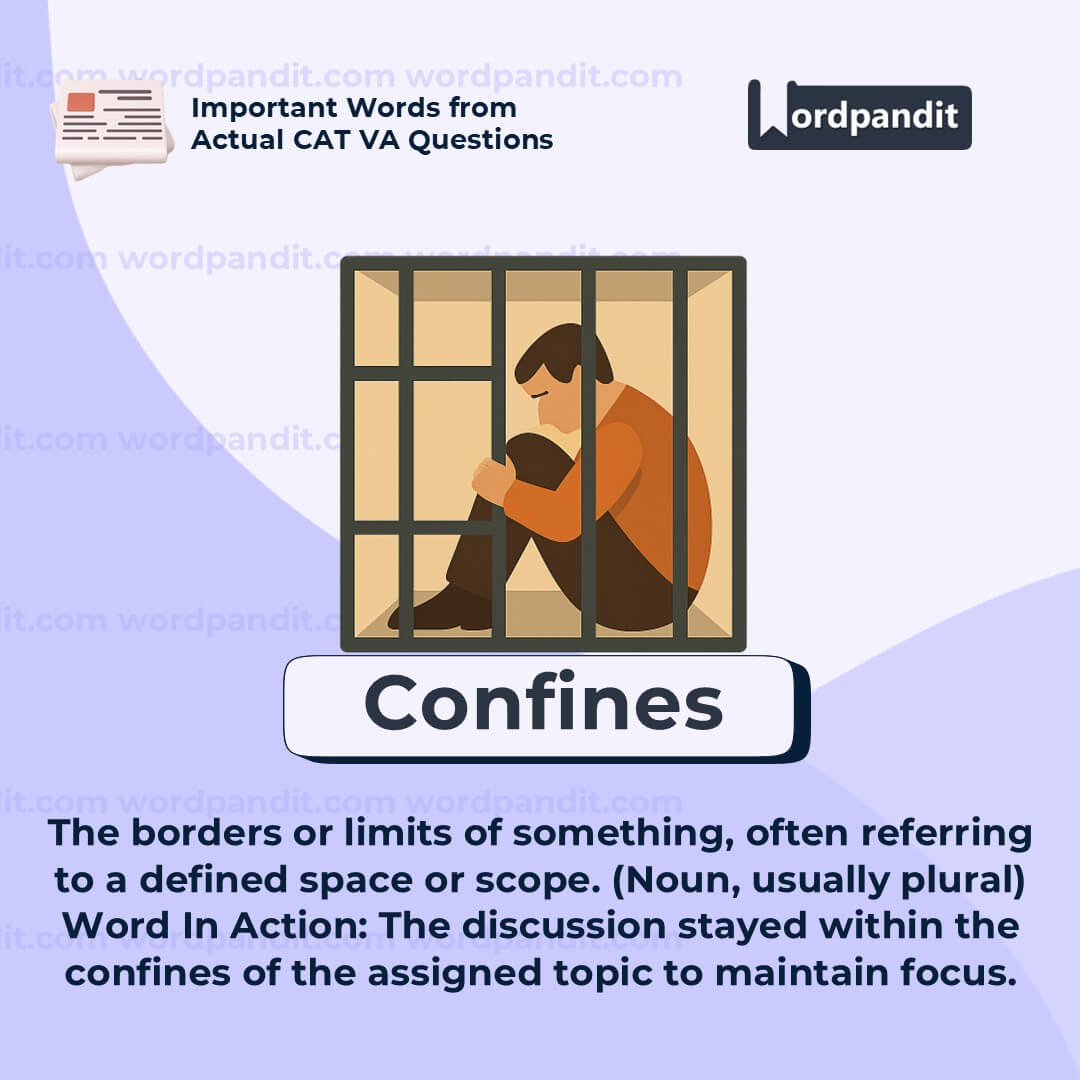
Word-3: Confines
Context:
"Atonality is a condition of music in which the constructs of the music do not ‘live’ within the confines of a particular key signature, scale, or mode." - Contextual Usage
Explanatory Paragraph:
“Confines” refers to the boundaries or limits within which something exists or operates. It often suggests restrictions or constraints that define the scope of an action or concept. In the sentence above, it describes the typical musical rules (like key signatures and scales) that usually limit or structure compositions — rules that atonality purposefully rejects. The use of “confines” here conveys the sense of creative boundaries that are being intentionally broken.
Meaning: The borders or limits of a space, subject, or activity (Noun, usually plural)
Pronunciation: KON-fynz
Difficulty Level: ⭐⭐ Intermediate
Etymology: From Latin *confinis*, meaning “bordering on,” related to *con* (together) and *finis* (end, limit).
Prashant Sir's Notes:
“Confines” is a powerful word when discussing limitations — whether physical, intellectual, artistic, or emotional. It frequently appears in essays and discussions about freedom, creativity, and rule-breaking.
Synonyms & Antonyms:
Synonyms: boundaries, limits, restrictions, edges
Antonyms: freedom, openness, infinity, expanses
Usage Examples:
- The discussion must remain within the confines of the agreed-upon topic.
- He felt trapped within the narrow confines of small-town life.
- The artist pushed beyond the traditional confines of portraiture.
- The law operates within the confines of constitutional authority.
Cultural Reference:
In *Dead Poets Society*, the character of Mr. Keating urges students to think beyond the confines of traditional education, inspiring a break from restrictive norms — a theme echoed in many works on innovation and creativity.
Think About It:
Are confines always negative, or can they help structure creativity? When is it important to challenge or step beyond them?
Quick Activity:
Write down two examples each of “confines” in a physical space and in an abstract context (like rules or expectations).
Memory Tip:
Think of “confines” as a fence around an idea or space — defining where something begins and ends.
Real-World Application:
Used in law, art, education, and philosophy to describe boundaries that may limit action or thinking — useful in both literal and metaphorical discussions.
Word-4: Expertise

Context:
"After you realize the amount of knowledge, skill, and technical expertise required to compose or perform it, your tune may change, so to speak." - Contextual Usage
Explanatory Paragraph:
“Expertise” refers to the high level of knowledge or skill that someone has in a particular area, usually as a result of training, study, and practice. In the sentence above, it emphasizes that creating or performing complex music demands not only talent but deep technical understanding — the kind of proficiency that only comes with time and dedication. The word carries a strong connotation of authority and professionalism in a specific domain.
Meaning: Specialized knowledge or skill in a particular field (Noun)
Pronunciation: eks-pur-TEEZ
Difficulty Level: ⭐⭐ Intermediate
Etymology: From French *expertise*, meaning "assessment or examination by an expert," derived from Latin *expertus* meaning "experienced."
Prashant Sir's Notes:
“Expertise” is a formal and widely applicable word. It fits beautifully in resumes, academic writing, and professional contexts. Use it instead of “skill” when you want to emphasize depth and specialization.
Synonyms & Antonyms:
Synonyms: mastery, proficiency, know-how, competence
Antonyms: ignorance, inexperience, ineptitude, amateurism
Usage Examples:
- She has extensive expertise in cybersecurity and data protection.
- The company hired him for his financial expertise.
- Expertise in classical music is essential for interpreting these compositions correctly.
- The project succeeded thanks to the combined expertise of the team members.
Cultural Reference:
In Malcolm Gladwell’s *Outliers*, he popularizes the “10,000-Hour Rule,” which suggests that true expertise in any field requires thousands of hours of deliberate practice.
Think About It:
Is expertise only about time spent, or does passion and curiosity also play a role? Can someone be an expert without formal training?
Quick Activity:
List three areas where you have some expertise. Then, write one sentence about how you gained each — was it through experience, study, or both?
Memory Tip:
Think of “expertise” as what an expert has — a high level of “-ise” (skill, precision, wise handling) in a particular field.
Real-World Application:
Commonly used in professional resumes, job interviews, academic research, and even legal or medical fields to highlight deep, specialized capability.
Word-5: Atonality
Context:
"However, atonality is one of the most important movements in 20th century music." - Contextual Usage
Explanatory Paragraph:
“Atonality” refers to a style of music that avoids establishing a key center, which is the foundation of most traditional Western music. Instead of relying on scales or tonal hierarchies (where some notes feel more “home-like” or resolved), atonal music treats all notes as equal, creating a sound that may feel unfamiliar or disorienting to untrained ears. In the context above, it’s described as a groundbreaking movement in 20th-century music, marking a shift away from conventional harmony.
Meaning: The absence of a tonal center or key in a piece of music (Noun)
Pronunciation: ay-toh-NAL-uh-tee
Difficulty Level: ⭐⭐⭐ Intermediate-Advanced
Etymology: From the prefix *a-* (without) and *tonality*, derived from Latin *tonus* (tone) + *-ality* (quality or state).
Prashant Sir's Notes:
Think of “atonality” as an artistic rebellion — a conscious move away from musical norms. It helps us understand how creative evolution often starts with breaking the rules. Great for discussions in music theory, modern art, and even literature as a metaphor for structurelessness.
Synonyms & Antonyms:
Synonyms: non-tonality, dissonance, tonal freedom
Antonyms: tonality, harmony, consonance, key-based music
Usage Examples:
- Atonality challenged the very foundation of classical music tradition.
- Many 20th-century composers explored atonality to express emotional complexity.
- The film’s soundtrack blends tonality and atonality to create tension.
- Atonality was pioneered by composers like Arnold Schoenberg and Alban Berg.
Cultural Reference:
Arnold Schoenberg, often called the father of atonality, revolutionized Western music by introducing the twelve-tone technique — a method that gives equal importance to all twelve notes of the chromatic scale.
Think About It:
Can breaking away from traditional rules — like tonality in music — lead to deeper expression, or does it alienate audiences? Where do we draw the line between innovation and chaos?
Quick Activity:
Listen to a short piece of atonal music and jot down your immediate feelings. Then, re-listen after reading a short description of the composer’s intention — did your impression change?
Memory Tip:
“Atonality” = “a” (without) + “tonality” (musical structure) — music that doesn’t follow the rules of keys or scales.
Real-World Application:
Used in musical theory, film scoring, avant-garde compositions, and academic discussions about the evolution of Western music styles in the 20th century.
