
📘 What’s Inside This CAT Paragraph Summary Question Post?
📝 Authentic CAT Paragraph Summary QuestionPractice with a real CAT Paragraph Summary Question from a previous CAT exam.
✅ Detailed Question with Step-by-Step SolutionEach question is explained thoroughly for better understanding.
🔍 In-Depth Paragraph AnalysisGain insights through line-by-line and paragraph-wise analysis
📚 Vocabulary Enhancement: Top 5 words explained from the paragraph
Paragraph Summary Questions
Question 25: The passage given below is followed by four alternate summaries. Choose the option that best captures the essence of the passage.
Privacy-challenged office workers may find it hard to believe, but open-plan offices and cubicles were invented by architects and designers who thought that to break down the social walls that divide people, you had to break down the real walls, too. Modernist architects saw walls and rooms as downright fascist. The spaciousness and flexibility of an open plan would liberate homeowners and office dwellers from the confines of boxes. But companies took up their idea less out of a democratic ideology than a desire to pack in as many workers as they could. The typical open-plan office of the first half of the 20th century was a white-collar assembly line. Cubicles were interior designers’ attempt to put some soul back in.
A. Wall-free office spaces did not quite work out the way their utopian inventors intended, as they became tools for the exploitation of labor.
B. Wall-free office spaces could have worked out the way their utopian inventors intended had companies cared for workers’ satisfaction.
C. Wall-free office spaces did not quite work out as companies don’t believe in democratic ideology.
D. Wall-free office spaces did not quite work out as desired and therefore cubicles came into being.
Solution with Explanation
Correct Answer: A
Detailed explanation by Wordpandit:
The author is basically conveying that wall-free offices were initially designed to break down social barriers, but now they are used by companies to “pack in as many workers as they could”.
Options B, C, and D miss out this crucial point about how companies exploit people by cramming them into a space. So, we can eliminate these options.
Only Option A captures the essence of the passage, hence it is the correct answer.
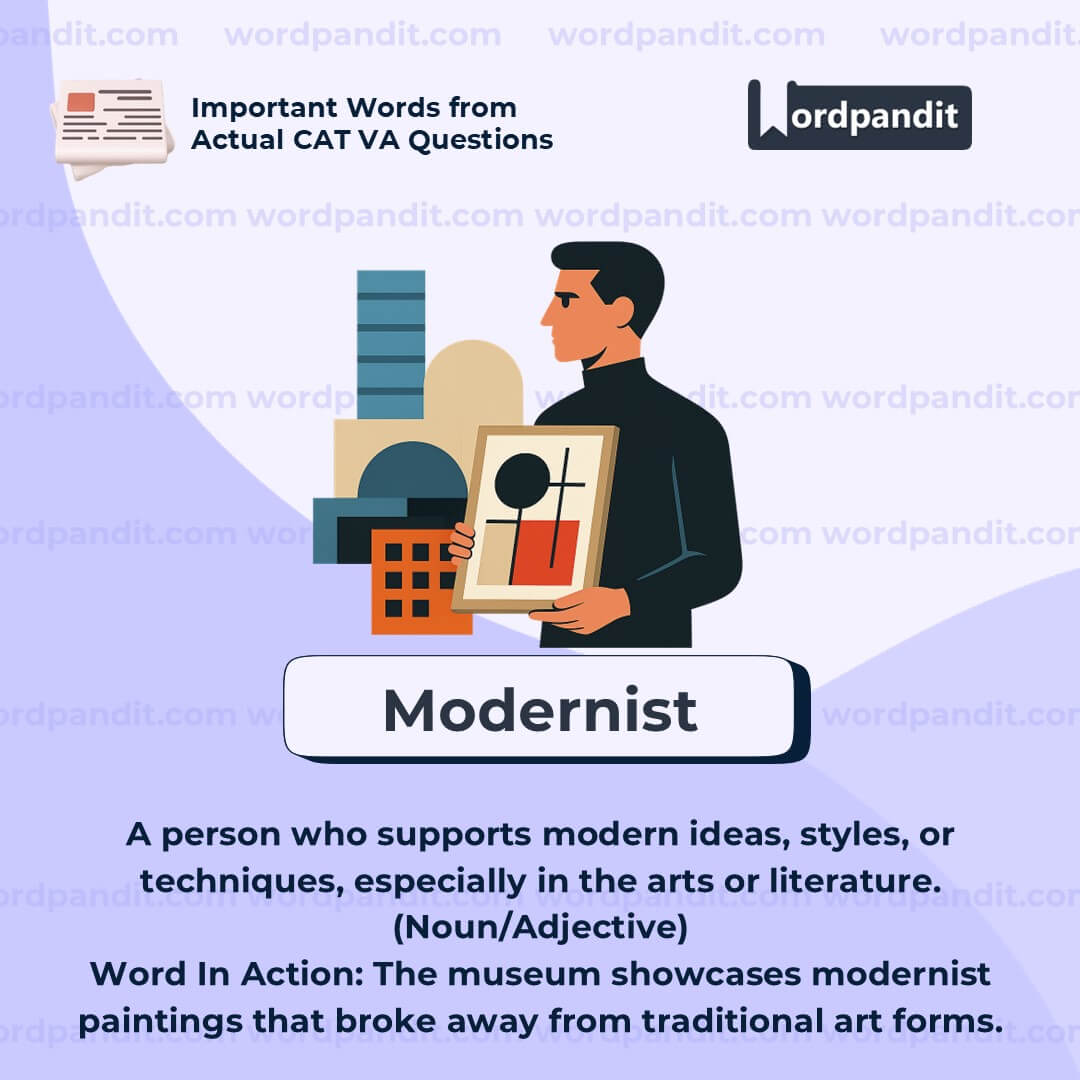
Word 1: Modernist
Context:
"Modernist architects saw walls and rooms as downright fascist. The spaciousness and flexibility of an open plan would liberate homeowners and office dwellers from the confines of boxes." - Architectural Digest
Explanatory Paragraph:
"Modernist" refers to someone or something that embraces modernism—a movement across various arts, particularly architecture, that emphasizes simplicity, functionality, and a break from traditional styles. In this context, modernist architects rejected conventional rooms and walls to create open, airy spaces that reflected new ideas of freedom and modern living. Their work aimed to express innovation, clarity, and a clean aesthetic that stood apart from historical ornamentation.
Meaning: A person who supports or practices modernism, especially in the arts or architecture (Noun)
Pronunciation: MOD-uh-nist
Difficulty Level: ⭐⭐ Easy
Etymology: Derived from "modern" + "-ist", meaning one who follows or supports modern ideas. The term became prominent in the late 19th and early 20th centuries during a cultural movement away from traditional forms.
Prashant Sir's Notes:
Remember that a "modernist" is not just someone who likes new things, but someone who actively supports the rejection of old forms and seeks innovation—especially in design, literature, and art. In exams, it's often connected to architectural or artistic styles.
Synonyms & Antonyms:
Synonyms: innovator, reformer, avant-gardist, progressive
Antonyms: traditionalist, conservative, classicist
Usage Examples:
- The museum’s new wing was designed by a renowned modernist who favors glass and steel over bricks.
- As a literary modernist, she experimented with fragmented narratives and inner monologues.
- The modernist approach to interior design prioritizes open spaces and clean lines.
- Modernist painters often rejected realism in favor of abstract expressions.
Cultural Reference:
"Less is more." – Ludwig Mies van der Rohe, a pioneer of modernist architecture
Think About It:
In what ways has the modernist movement changed how we live and interact with our physical spaces?
Quick Activity:
Look at three buildings around you. Can you identify which elements reflect modernist design and which reflect traditional styles?
Memory Tip:
Think “MOD” = “Modern” + “-ist” = someone who embraces the modern world and new ideas.
Real-World Application:
The term "modernist" is often used to describe architects, designers, and artists whose work breaks with tradition and explores new forms. Understanding this helps in appreciating art, literature, and design with a critical eye.
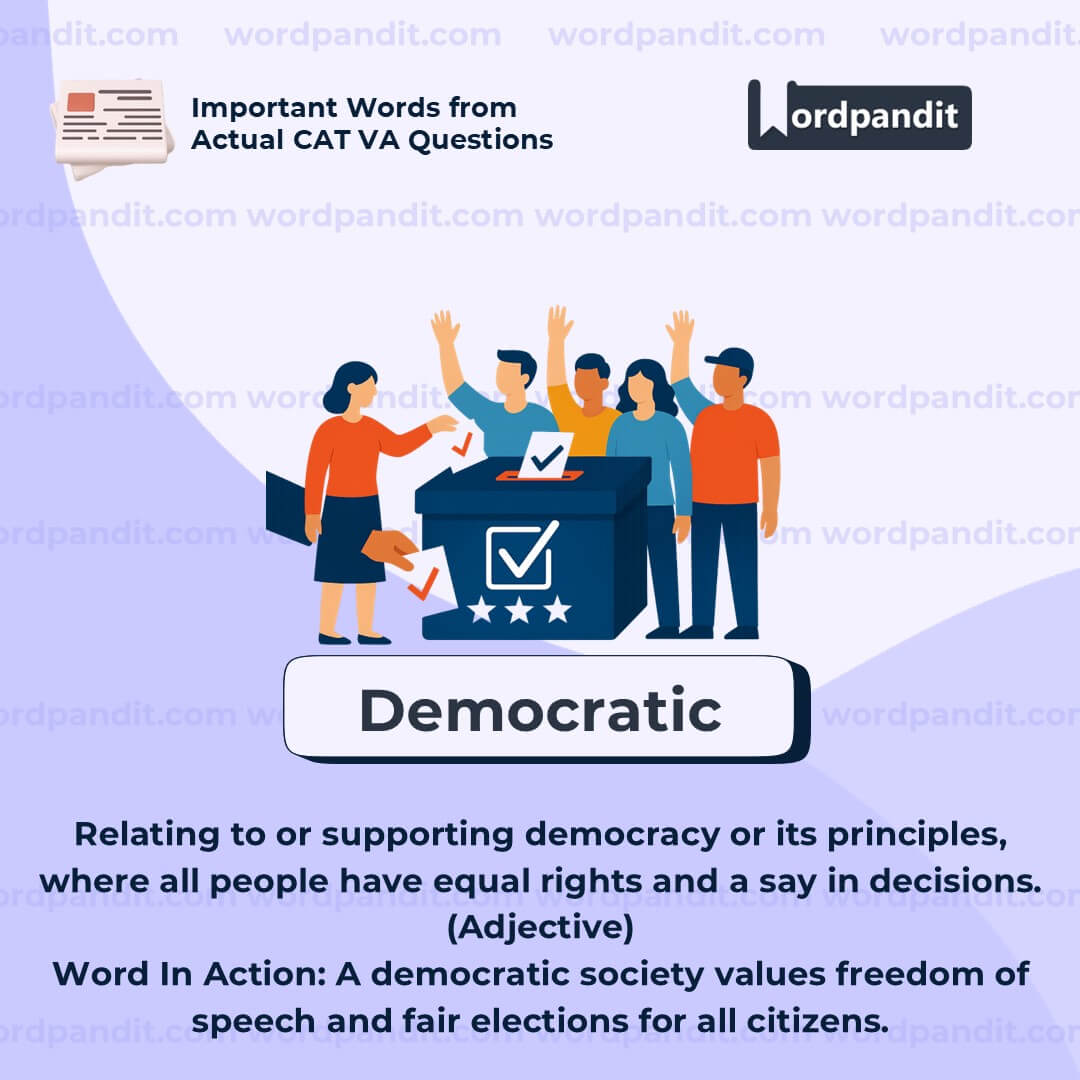
Word 2: Democratic
Context:
"But companies took up their idea less out of a democratic ideology than a desire to pack in as many workers as they could." - The Economist
Explanatory Paragraph:
The word "democratic" generally refers to something that aligns with or supports the principles of democracy—fairness, equality, and decision-making by the people. In the given context, it is used somewhat ironically: instead of embracing open office spaces to foster equality and openness (as a "democratic ideology" might suggest), companies were more interested in using them for efficiency and crowding more employees into smaller areas. Thus, the term here subtly critiques the disconnect between democratic ideals and corporate practices.
Meaning: Relating to the principles of democracy, such as equal rights and participation in decision-making (Adjective)
Pronunciation: dem-uh-KRA-tik
Difficulty Level: ⭐⭐ Easy
Etymology: From Greek *dēmokratikos*, from *dēmos* (people) + *kratos* (power or rule), literally meaning "rule by the people."
Prashant Sir's Notes:
Keep in mind that “democratic” can be used both literally—related to a political system—and metaphorically—to describe anything involving equality or shared power. In RC passages, look for such nuanced or ironic usage, as seen in this context.
Synonyms & Antonyms:
Synonyms: egalitarian, representative, participatory, inclusive
Antonyms: authoritarian, autocratic, dictatorial, elitist
Usage Examples:
- The club adopted a more democratic structure, allowing members to vote on decisions.
- She believes in democratic education where students have a say in what they learn.
- Open floor plans were once considered a democratic innovation in office design.
- The new law was criticized for being undemocratic and suppressing public opinion.
Cultural Reference:
"Democracy is the worst form of government – except for all the others that have been tried." – Winston Churchill
Think About It:
Can a system or design truly be democratic if it serves profit over people?
Quick Activity:
List three things in your life that you would describe as "democratic." What makes them so?
Memory Tip:
Think “demo” = “people” and “cratic” = “power” → power to the people. Like “demographics” (study of people).
Real-World Application:
Understanding the word “democratic” helps in interpreting news, politics, and social structures. Whether it's a voting process at school or how your workplace makes decisions, “democratic” describes systems where fairness and shared input matter.
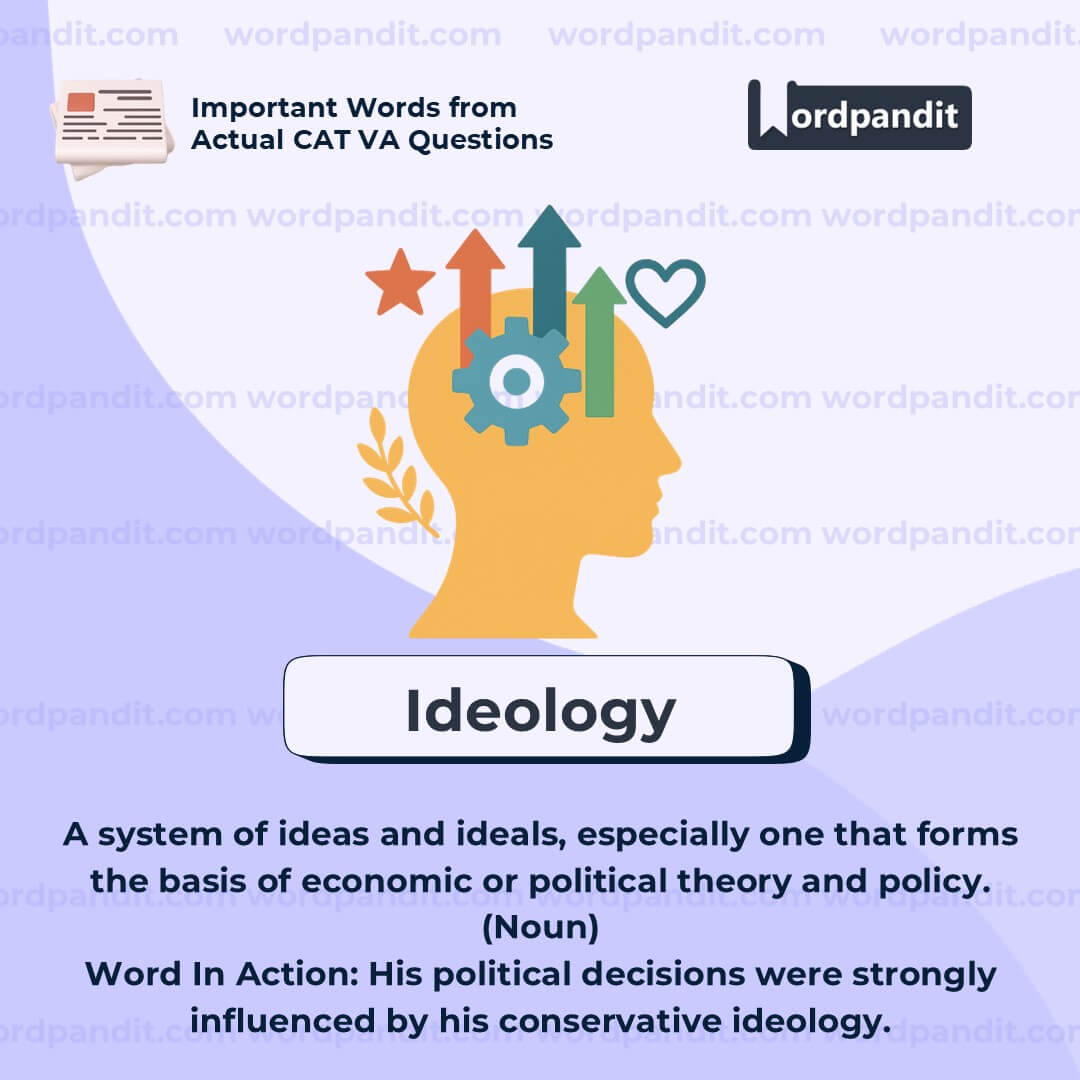
Word 3: Ideology
Context:
"But companies took up their idea less out of a democratic ideology than a desire to pack in as many workers as they could." - The Economist
Explanatory Paragraph:
"Ideology" refers to a system of ideas, beliefs, or principles that forms the basis of a political, economic, or social theory. In the given context, the word is used to suggest that companies didn’t adopt open-plan offices because they genuinely believed in democratic values (like equality or shared access), but rather because it allowed them to maximize space and cut costs. This highlights how ideologies can sometimes be used as a facade for more practical or self-serving motives.
Meaning: A system of ideas and ideals, especially one that forms the basis of economic or political theory and policy (Noun)
Pronunciation: eye-dee-OL-uh-jee
Difficulty Level: ⭐⭐⭐ Intermediate
Etymology: From French *idéologie*, coined during the French Revolution, based on Greek *idea* (form, pattern) + *-logy* (study of). Originally meant "science of ideas."
Prashant Sir's Notes:
Ideology is often used in RC passages to critique hidden agendas behind public actions. Watch for irony—sometimes what’s presented as an ideology is just a cover for more pragmatic reasons, as seen in this context.
Synonyms & Antonyms:
Synonyms: belief system, worldview, doctrine, philosophy
Antonyms: pragmatism, realism, practicality
Usage Examples:
- Her political ideology is rooted in environmental justice and sustainability.
- Many wars have been fought over conflicting ideologies.
- The company’s branding aligns with a progressive ideology of inclusion and innovation.
- He was criticized for promoting an ideology that lacked practical application.
Cultural Reference:
"The ruling ideas of each age have ever been the ideas of its ruling class." – Karl Marx, discussing ideology in *The German Ideology*
Think About It:
Can an ideology exist without being influenced by the people in power who promote it?
Quick Activity:
Write down an ideology you identify with and list its core beliefs. Now reflect—how do these beliefs show up in your daily actions?
Memory Tip:
Think of "idea" + "logy" (study of) → Ideology = study or system of ideas.
Real-World Application:
The term "ideology" is essential in understanding political debates, branding strategies, social movements, and even office layouts—as ideas often drive how organizations present themselves and operate.
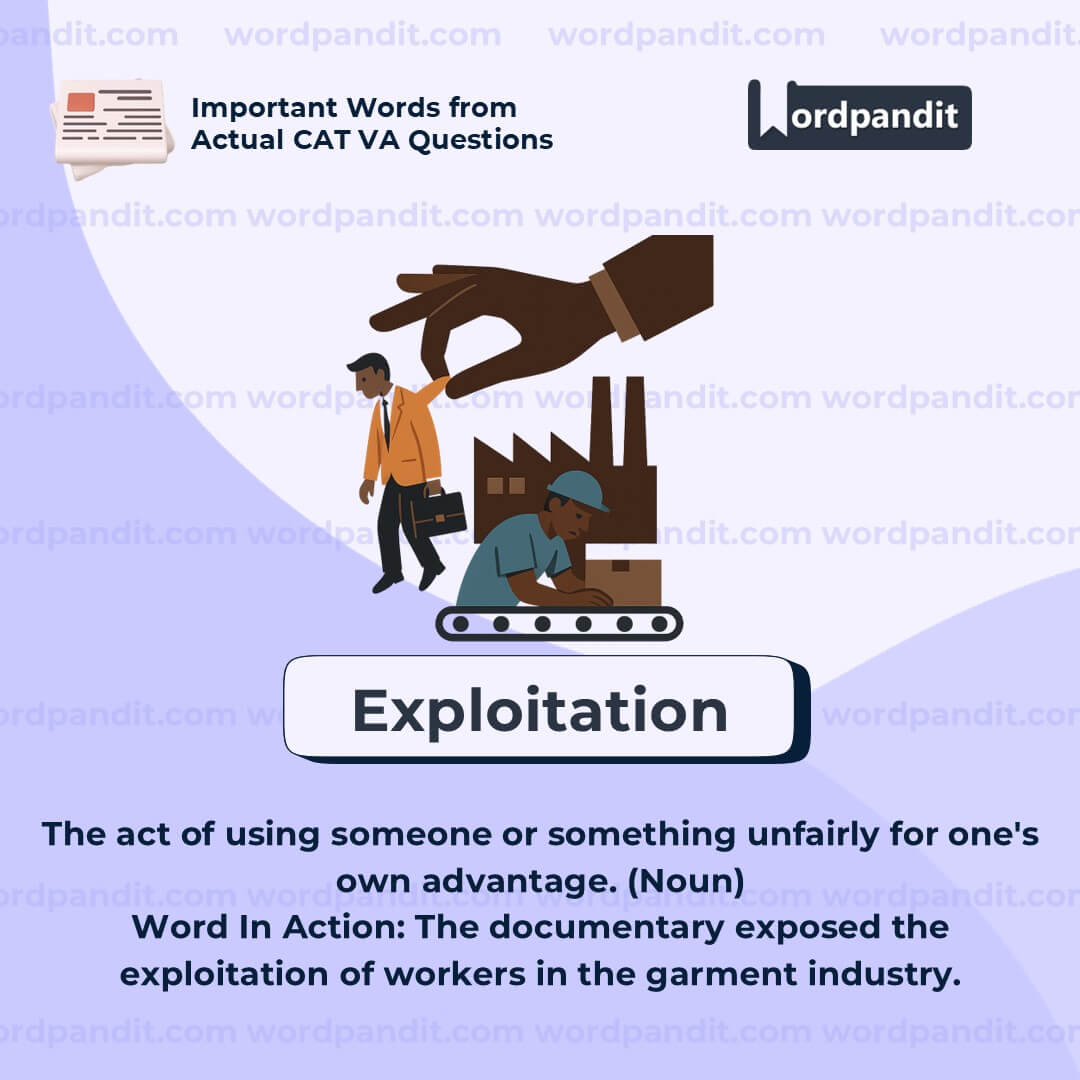
Word 4: Exploitation
Context:
"Wall-free office spaces did not quite work out the way their utopian inventors intended, as they became tools for the exploitation of labor." - The Economist
Explanatory Paragraph:
"Exploitation" refers to the act of using someone or something unfairly for one's own benefit. In the given context, the word highlights how open office designs—originally meant to promote openness and equality—were repurposed by corporations to control and overwork employees, often without proportional compensation. The term carries a strong negative connotation and implies abuse, particularly in contexts of labor, resources, or vulnerable individuals.
Meaning: The action of treating someone unfairly in order to benefit from their work or resources (Noun)
Pronunciation: ek-sploy-TAY-shun
Difficulty Level: ⭐⭐⭐ Intermediate
Etymology: From French *exploitation*, from Latin *exploitatio*, from *exploitare* meaning "to make use of."
Prashant Sir's Notes:
“Exploitation” often appears in critical discussions—especially in economics, politics, and social justice. When reading passages, look for whether the word is used neutrally (rare) or to indicate unfair advantage. Be sensitive to context; it almost always signals a critique.
Synonyms & Antonyms:
Synonyms: abuse, misuse, manipulation, oppression
Antonyms: fairness, equity, empowerment, respect
Usage Examples:
- There was widespread outrage over the exploitation of child labor in the garment industry.
- The documentary exposed the exploitation of natural resources in the region.
- Critics argue that gig economy jobs often lead to worker exploitation without benefits.
- Her novel tells a gripping story of emotional exploitation in a toxic relationship.
Cultural Reference:
"The history of all hitherto existing society is the history of class struggles." – Karl Marx, whose theory of capitalism centers on the exploitation of labor by capital
Think About It:
Is it possible for any economic system to completely eliminate exploitation, or is it an unavoidable part of power dynamics?
Quick Activity:
Think of a situation you've read about or seen in the news where exploitation was involved. Describe who benefited and who suffered—and why.
Memory Tip:
Think of “exploit” as “taking advantage of” and “-ation” as the action → Exploitation = the act of taking advantage of someone or something unfairly.
Real-World Application:
Understanding "exploitation" is crucial in analyzing labor laws, ethical business practices, human rights issues, and global development. Recognizing the signs of exploitation helps promote social justice and advocate for fair treatment in workplaces and communities.
Word 5: Utopian
Context:
"Wall-free office spaces could have worked out the way their utopian inventors intended had companies cared for workers’ satisfaction." - The Economist
Explanatory Paragraph:
"Utopian" describes ideas, plans, or visions that aim for a perfect society—often idealistic and impractical. In the context provided, the term refers to the original inventors of open office spaces, who imagined them as harmonious, collaborative environments free from hierarchy and walls. However, these idealistic dreams didn’t materialize because companies focused on efficiency over employee well-being. The word often carries a slight tone of skepticism, hinting that the dream might be admirable but unrealistic.
Meaning: Modeled on or aiming for a perfect society; idealistic and often impractical (Adjective)
Pronunciation: yoo-TOH-pee-uhn
Difficulty Level: ⭐⭐⭐ Intermediate
Etymology: From "Utopia", the fictional perfect island described by Sir Thomas More in 1516, from Greek *ou* (not) + *topos* (place), meaning "no place"—implying such a place does not exist in reality.
Prashant Sir's Notes:
Always watch for irony in how “utopian” is used. It’s often placed in contrast to harsh realities. In exams, if you see “utopian,” consider whether the author is endorsing or critiquing the ideal being discussed.
Synonyms & Antonyms:
Synonyms: idealistic, visionary, dreamy, perfect
Antonyms: realistic, pragmatic, dystopian, cynical
Usage Examples:
- The plan for a completely green city sounded utopian but lacked practical backing.
- Her utopian ideals often clashed with the corporate world's bottom-line mentality.
- Utopian novels often depict worlds free of poverty, war, and inequality.
- Some critics dismissed the proposal as a utopian fantasy that couldn’t be implemented.
Cultural Reference:
Sir Thomas More’s *Utopia* (1516) coined the term and imagined an ideal society with equality and justice—but hinted at the impossibility of such a place.
Think About It:
Is striving for a utopian ideal always naive, or can it serve as a necessary guidepost for progress?
Quick Activity:
Sketch or describe your version of a utopian classroom or office. What features would it have? Why?
Memory Tip:
“Utopian” comes from “Utopia,” which literally means “no place”—so remember, it’s about ideal dreams that may not exist in reality.
Real-World Application:
The term “utopian” is used in politics, literature, design, and social activism to describe goals or systems that aspire toward perfection. Understanding its connotations helps evaluate whether a vision is meant to inspire, criticize, or caution against impracticality.
