
📘 What’s Inside This CAT Paragraph Summary Question Post?
📝 Authentic CAT Paragraph Summary QuestionPractice with a real CAT Paragraph Summary Question from a previous CAT exam.
✅ Detailed Question with Step-by-Step SolutionEach question is explained thoroughly for better understanding.
🔍 In-Depth Paragraph AnalysisGain insights through line-by-line and paragraph-wise analysis
📚 Vocabulary Enhancement: Top 5 words explained from the paragraph
Paragraph Summary Questions
Question 26: The passage given below is followed by four alternate summaries. Choose the option that best captures the essence of the passage.
Language is an autapomorphy found only in our lineage, and not shared with other branches of our group such as primates. We also have no definitive evidence that any species other than Homo sapiens ever had language. However, it must be noted straightaway that ‘language’ is not a monolithic entity, but rather a complex bundle of traits that must have evolved over a significant time frame. Moreover, language crucially draws on aspects of cognition that are long established in the primate lineage, such as memory: the language faculty as a whole comprises more than just the uniquely linguistic features.
A. Language is not a single, uniform entity but the end result of a long and complex process of linguistic evolution.
B. Language is a distinctively human feature as there is no evidence of the existence of language in any other species.
C. Language evolved with linguistic features building on features of cognition such as memory.
D. Language, a derived trait found only in humans, has evolved over time and involves memory.
Solution with Explanation
Correct Answer: C
Detailed explanation by Wordpandit:Answer: C
Detailed explanation by Wordpandit:
As per the passage, language is only found in humans and not among other primates. The passage also states that language is “a bundle of traits… evolved over a significant time frame”. Moreover, the author states that memory and cognition play a crucial role, thus concluding that language comprises of more than just linguistic features.
Option A mentions a couple of key points, but misses out on the importance of memory and cognition, and how there is more than just linguistics. Hence, we can eliminate Option A.
Option B suggests that language is a distinctive human feature, which is true; but it fails to capture the rest of the key-points such as evolution of language or importance of cognition. So it is not the best summary among all the options.
The passage does not talk about language that has evolved over time as the primary focus. Hence, Option D is also ruled out.
Option C captures all the key-points, and summarises the core idea in a crisp manner, hence it is the correct answer.
Word 1: Autapomorphy
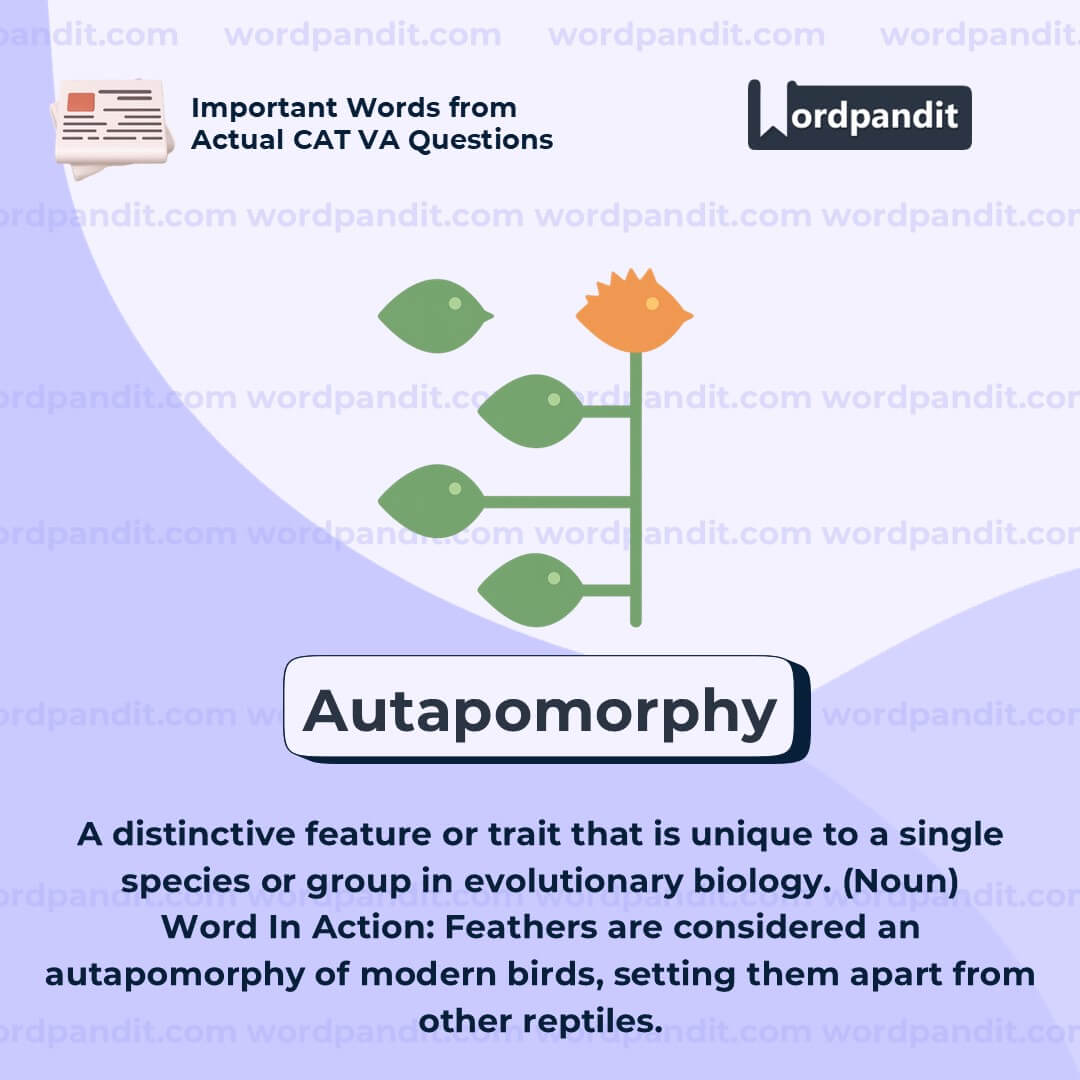
Context:
"Language is an autapomorphy found only in our lineage, and not shared with other branches of our group such as primates." - Source Unknown
Explanatory Paragraph:
“Autapomorphy” is a specialized term used in evolutionary biology and systematics to describe a distinctive feature or characteristic that is unique to a particular species or group. It is not shared with any others, even close relatives, making it a defining trait of that lineage. For example, human language is considered an autapomorphy because it is unique to humans and not found in our closest relatives like chimpanzees or gorillas.
Meaning: A distinctive feature, known as a derived trait, that is unique to a single lineage or species (Noun)
Pronunciation: aw-TA-puh-mor-fee
Difficulty Level: ⭐⭐⭐⭐ Advanced
Etymology: From Greek *autos* ("self") + *apo* ("away from") + *morphē* ("form, shape")
Prashant Sir's Notes:
This is a key term in evolutionary biology and taxonomy. Remember that “autapomorphy” marks what makes a species special in its evolutionary path. You’ll often see this contrasted with terms like synapomorphy (shared derived traits).
Synonyms & Antonyms:
Synonyms: unique trait, distinctive feature, derived character
Antonyms: shared trait, ancestral trait, plesiomorphy
Usage Examples:
- Feathers are considered an autapomorphy of birds, setting them apart from reptiles.
- The ability to walk upright is often cited as an autapomorphy of humans.
- When classifying species, scientists look for autapomorphies to define evolutionary branches.
- Some traits that were once believed to be autapomorphies are now known to be shared due to new genetic evidence.
Cultural Reference:
"Autapomorphy is to species what a signature move is to a wrestler — unique, defining, and inimitable." - Original Analogy
Think About It:
What are the potential risks of focusing too much on autapomorphies when trying to understand evolution and biodiversity?
Quick Activity:
List three characteristics you think are unique to humans. Then research whether each is truly an autapomorphy or shared with other species.
Memory Tip:
Break it down: “auto” (self) + “morph” (form) = a form unique to oneself or a group — that’s autapomorphy!
Real-World Application:
In evolutionary biology, identifying autapomorphies helps scientists draw phylogenetic trees and understand how species diverged over time.
Word 2: Definitive
Context:
"We also have no definitive evidence that any species other than Homo sapiens ever had language." - Source Unknown
Explanatory Paragraph:
The word “definitive” refers to something that is conclusive, decisive, or final — leaving no room for doubt or debate. It is often used to describe proof, judgments, statements, or versions that are regarded as authoritative or the most complete. In the given context, the absence of *definitive* evidence means there is no solid, unambiguous proof to support the claim that species other than Homo sapiens possessed language.
Meaning: Serving to provide a final solution or to end a situation; conclusive and authoritative (Adjective)
Pronunciation: dih-FI-nuh-tiv
Difficulty Level: ⭐⭐ Basic
Etymology: From Latin *definitivus* (“defining, limiting”), from *definire* (“to define”)
Prashant Sir's Notes:
“Definitive” is commonly used in academic and argumentative writing to indicate the strongest possible form of a statement or evidence. It often carries the idea of being the final word on a matter.
Synonyms & Antonyms:
Synonyms: conclusive, decisive, authoritative, absolute, final
Antonyms: tentative, uncertain, provisional, ambiguous
Usage Examples:
- The scientists failed to present definitive proof of their hypothesis.
- This book is considered the definitive guide to medieval history.
- We need a definitive answer before we proceed with the project.
- Although initial results are promising, they are not yet definitive.
Cultural Reference:
"The definitive edition of the novel includes the author’s handwritten notes and early drafts." – Publishing Industry Practice
Think About It:
In a world full of uncertainty and evolving knowledge, is it ever truly possible to have *definitive* evidence about complex topics like consciousness or language?
Quick Activity:
Write two sentences: one using "definitive" to describe a piece of evidence, and another using it to describe a book or guide.
Memory Tip:
Think “definitive = defines finally.” It defines something so clearly that no questions remain.
Real-World Application:
“Definitive” is frequently used in academic writing, journalism, medical diagnosis, and legal decisions to describe statements or findings that carry authority and finality.
Word 3: Monolithic
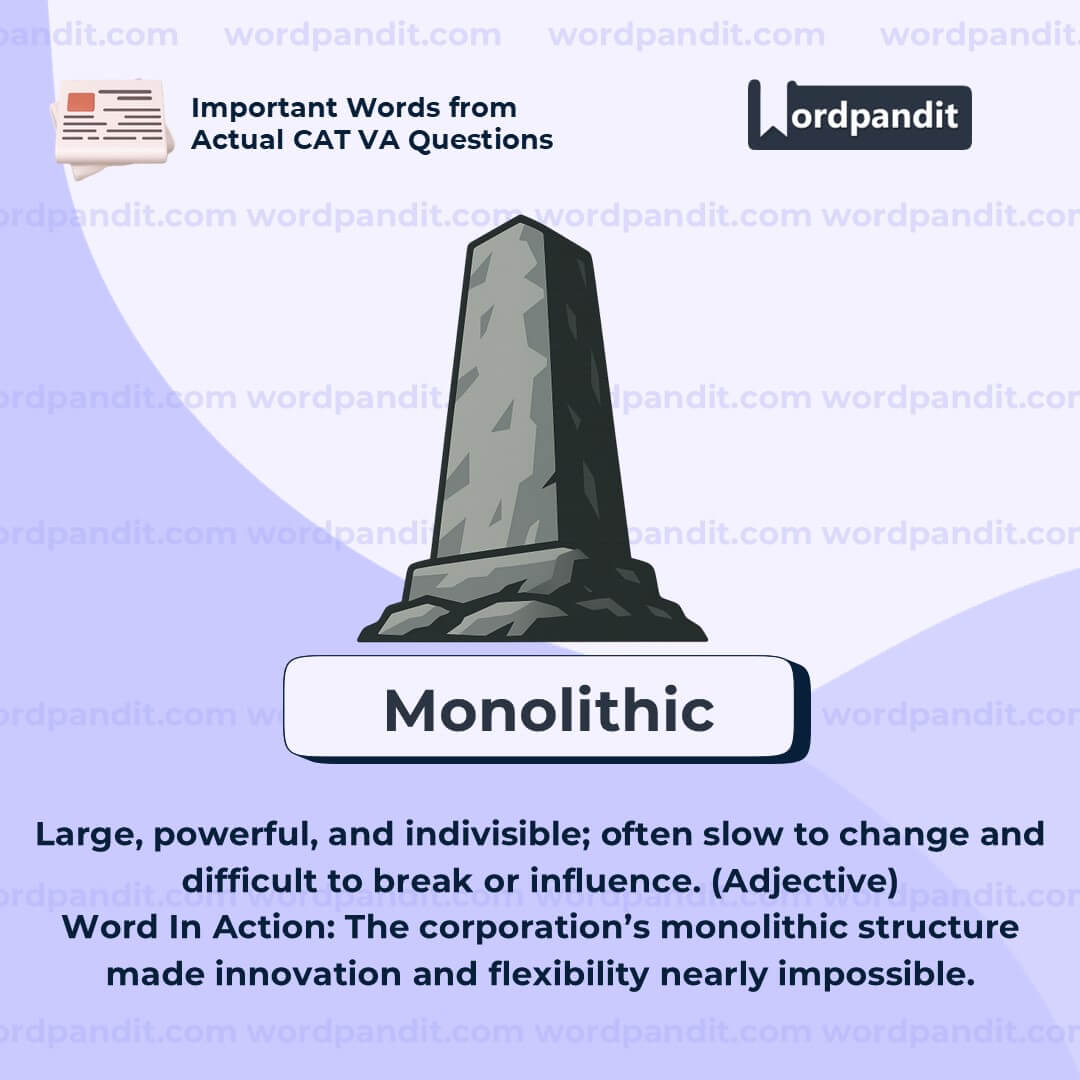
Context:
"However, it must be noted straightaway that ‘language’ is not a monolithic entity, but rather a complex bundle of traits that must have evolved over a significant time frame." - Source Unknown
Explanatory Paragraph:
The term “monolithic” is often used metaphorically to describe something that appears uniform, indivisible, and lacking internal complexity. Originally referring to massive, single-stone structures, it is now widely used to critique overly simplistic views of complex systems. In the given context, saying that language is *not* monolithic emphasizes that it is not a single, unified thing but a dynamic combination of many components — like syntax, semantics, and phonetics — that evolved independently over time.
Meaning: Large, powerful, indivisible, and often rigid or uniform in character (Adjective)
Pronunciation: mon-uh-LITH-ik
Difficulty Level: ⭐⭐⭐ Intermediate
Etymology: From Greek *monolithos*, from *monos* ("single") + *lithos* ("stone")
Prashant Sir's Notes:
Remember, “monolithic” is not just about physical structures. In academics or politics, it critiques anything assumed to be one-size-fits-all or overly simplistic. Use it to challenge assumptions of uniformity.
Synonyms & Antonyms:
Synonyms: uniform, rigid, unyielding, solid, massive
Antonyms: diverse, fragmented, varied, modular
Usage Examples:
- The corporation was once a monolithic entity, but now it’s divided into agile, smaller units.
- Critics argue that treating culture as a monolithic concept ignores internal diversity.
- Her explanation challenged the monolithic view of historical progress.
- Monolithic systems are harder to adapt than modular, flexible ones.
Cultural Reference:
"The monolith in *2001: A Space Odyssey* represents an alien intelligence — a single, imposing, mysterious structure that stands apart from human understanding." - Film Analysis
Think About It:
Why is it often misleading to view complex social, political, or cultural systems as monolithic?
Quick Activity:
Choose a complex concept (like “education” or “identity”) and write one sentence treating it as monolithic, and one sentence breaking it into diverse elements.
Memory Tip:
“Mono” means one, and “lithic” means stone — think of a giant single rock: strong but rigid and unchangeable.
Real-World Application:
“Monolithic” is often used in tech, politics, and sociology to critique systems that resist change or diversity, such as outdated software architectures or uniform policies in multicultural societies.
Word 4: Cognition
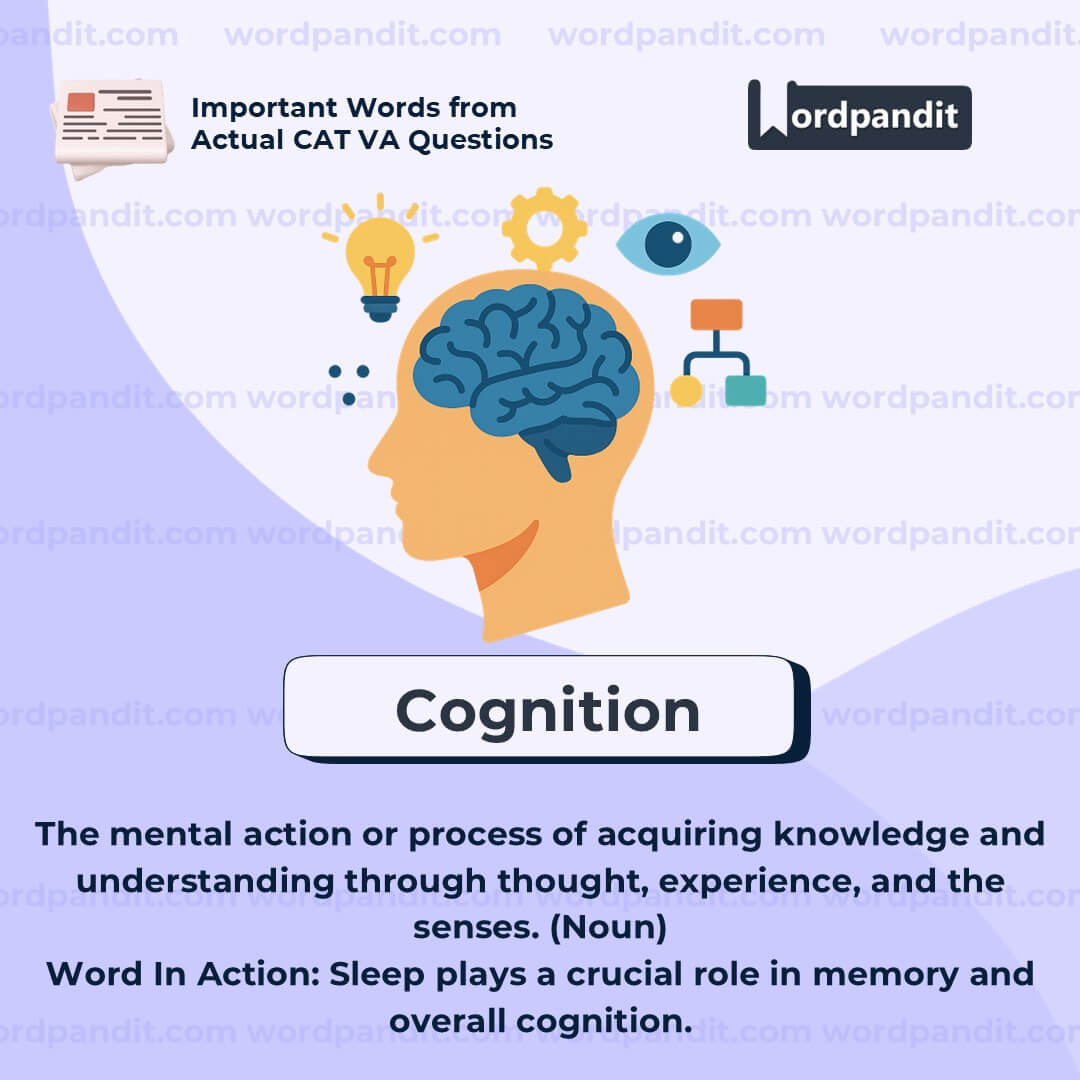
Context:
"Moreover, language crucially draws on aspects of cognition that are long established in the primate lineage, such as memory." - Source Unknown
Explanatory Paragraph:
“Cognition” refers to the mental processes involved in acquiring knowledge and understanding through thought, experience, and the senses. It includes functions like memory, attention, perception, reasoning, language, and problem-solving. In the given context, cognition is highlighted as a foundational system upon which language evolved, showing that our ability to speak and understand doesn’t emerge in isolation, but from deeper mental capabilities shared across species.
Meaning: The mental action or process of acquiring knowledge and understanding through thought, experience, and the senses (Noun)
Pronunciation: kog-NIH-shun
Difficulty Level: ⭐⭐ Basic
Etymology: From Latin *cognitio* (“a getting to know, knowledge”), from *cognoscere* (“to get to know”)
Prashant Sir's Notes:
This is a foundational word in psychology and neuroscience. Cognition underpins everything from decision-making to creativity. Remember, it's the *how* of knowing — not just the knowing itself.
Synonyms & Antonyms:
Synonyms: thinking, reasoning, perception, awareness, understanding
Antonyms: ignorance, unconsciousness, oblivion, misunderstanding
Usage Examples:
- Children develop cognition rapidly during their early years through play and exploration.
- The study focused on the effects of sleep deprivation on human cognition.
- Language and cognition are deeply interconnected in the human brain.
- Her cognitive abilities were tested using a series of puzzles and memory games.
Cultural Reference:
"Cognition is what separates us from machines — or at least, it used to." – Popular take from AI Ethics Debates
Think About It:
If cognition is present in animals, to what extent can we say they also possess forms of consciousness or even rudimentary language?
Quick Activity:
Make a list of at least five cognitive functions you use daily without realizing it. Reflect on how each supports your routine decisions.
Memory Tip:
“Cog” as in “gear” — your brain has many gears that help you *think*, *know*, and *understand*. That’s cognition!
Real-World Application:
Cognition is a major area of study in fields such as education, psychology, neuroscience, and AI development. Understanding cognitive processes helps in designing better learning systems, diagnosing mental health issues, and even building intelligent machines.
Word 5: Comprises
Context:
"The language faculty as a whole comprises more than just the uniquely linguistic features." - Source Unknown
Explanatory Paragraph:
“Comprises” means “consists of” or “is made up of.” It’s used when referring to the elements that form a whole. In formal writing, “comprise” typically introduces the whole first, followed by its parts. In the given context, it means that the entire language faculty includes more than just elements that are exclusive to language — it also involves other general cognitive or neurological components.
Meaning: To consist of or be made up of (Verb)
Pronunciation: kum-PRYZ
Difficulty Level: ⭐⭐ Basic
Etymology: From Late Latin *comprehendere* (“to include, contain”)
Prashant Sir's Notes:
Remember, in formal usage, “the whole comprises the parts.” Avoid using “is comprised of,” which is considered incorrect in traditional grammar. Use “composed of” instead if needed in the passive voice.
Synonyms & Antonyms:
Synonyms: consist of, include, encompass, contain
Antonyms: exclude, omit, lack
Usage Examples:
- The committee comprises ten members from different departments.
- The team comprises experts in AI, design, and psychology.
- This region comprises several small towns and rural communities.
- The exhibition comprises artworks from the 18th to the 21st century.
Cultural Reference:
"Europe comprises many nations, each with its own language, culture, and history." – Standard example in geography texts
Think About It:
Why is it important to understand that a system like language comprises more than just words and grammar?
Quick Activity:
Write two sentences: one correctly using “comprises” and another using “is composed of.” Notice the structure difference.
Memory Tip:
Think: *The whole comprises the parts.* Picture a puzzle — the completed image *comprises* all the little pieces.
Real-World Application:
“Comprises” is frequently used in academic, technical, and formal writing to describe systems, groups, or structures. Understanding its correct usage can enhance clarity and precision in professional communication.
