
📘 What’s Inside This CAT Paragraph Summary Question Post?
📝 Authentic CAT Paragraph Summary QuestionPractice with a real CAT Paragraph Summary Question from a previous CAT exam.
✅ Detailed Question with Step-by-Step SolutionEach question is explained thoroughly for better understanding.
🔍 In-Depth Paragraph AnalysisGain insights through line-by-line and paragraph-wise analysis
📚 Vocabulary Enhancement: Top 5 words explained from the paragraph
Paragraph Summary Questions
Question 27: The passage given below is followed by four alternate summaries. Choose the option that best captures the essence of the passage.
Social movement organizations often struggle to mobilize supporters from allied movements in their efforts to achieve critical mass. Organizations with hybrid identities—those whose organizational identities span the boundaries of two or more social movements, issues, or identities—are vital to mobilizing these constituencies. Studies of the post-9/11 U.S. antiwar movement show that individuals with past involvement in non-anti-war movements are more likely to join hybrid organizations than are individuals without involvement in non-anti-war movements. In addition, they show that organizations with hybrid identities occupy relatively more central positions in inter-organizational contact networks within the antiwar movement and thus recruit significantly more participants in demonstrations than do nonhybrid organizations.
A. Post 9/11 studies show that people who are involved in non anti-war movements are likely to join hybrid organizations.
B. Hybrid organizations attract individuals that are deeply involved in anti-war movements.
C. Movements that work towards social change often find it difficult to mobilize a critical mass of supporters.
D. Organizations with hybrid identities are able to mobilize individuals with different points of view.
Solution with Explanation
Answer: D
Detailed explanation by Wordpandit:
Option A only captures one fact explained in the passage, and leaves out the core message. Hence, it can be eliminated.
Option B completely misses the point, and misrepresents a fact explained in the passage, hence we can safely exclude this.
Option C is also incorrect because of two reasons. Firstly, it does not capture the gist of the passage. Secondly, the first line in the passage states that the struggle is just with mobilizing supporters from allied movements – there is a difference as it is not the same as a lack of supporters in general.
Only Option D succinctly summarizes all the key-points from the passage, hence it is the correct answer.
Word 1: Mobilize
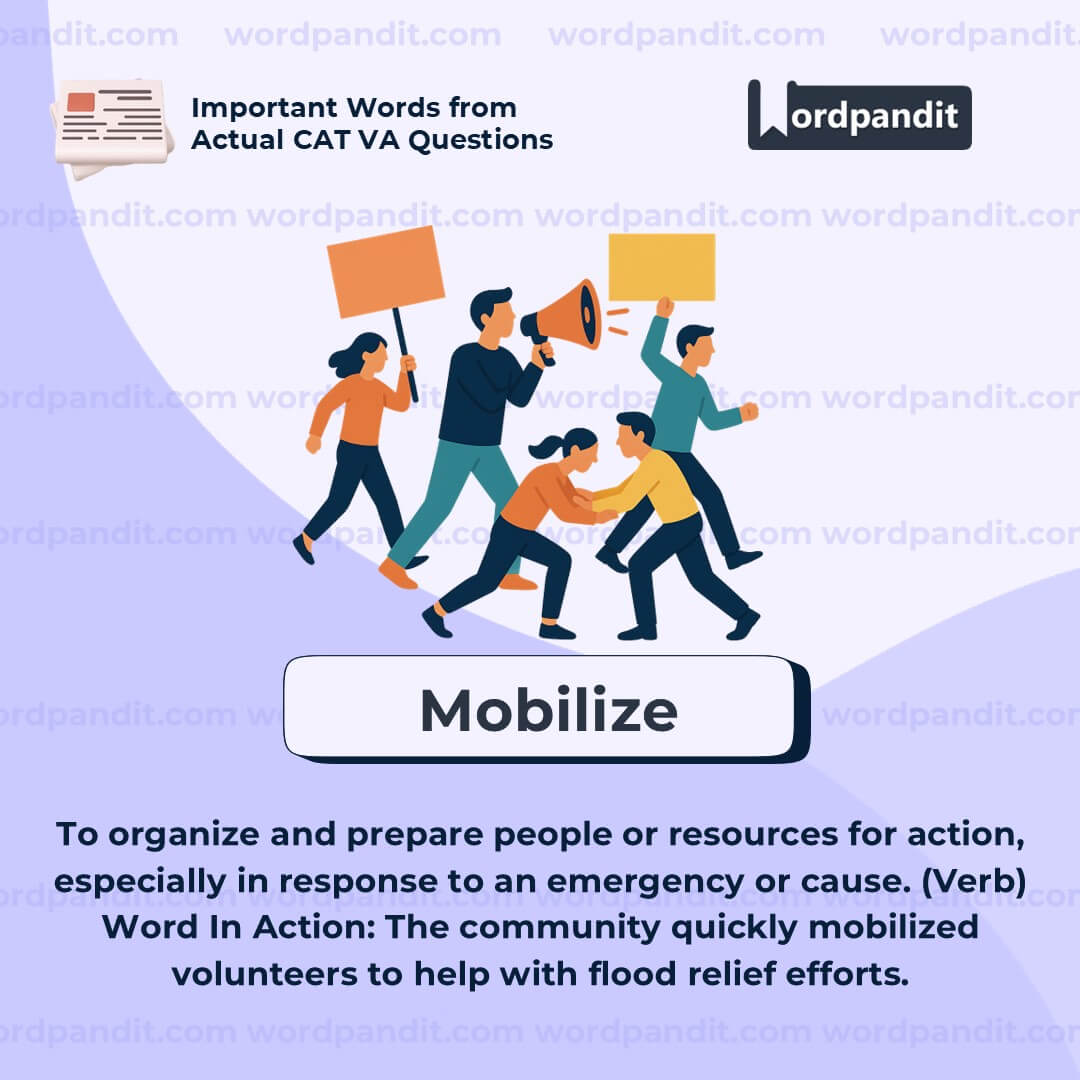
Context:
"Social movement organizations often struggle to mobilize supporters from allied movements in their efforts to achieve critical mass." - Academic Article
Explanatory Paragraph:
The word "mobilize" means to organize people or resources for action, especially in the context of political, social, or military efforts. In this case, it refers to how social movement organizations attempt to gather and energize supporters to reach a scale where their actions have significant impact. Mobilizing is essential when groups want to generate public awareness, push policy changes, or gain broader recognition for their causes.
Meaning: To organize and encourage people to act in a concerted way (verb)
Pronunciation: MOH-buh-lyze
Difficulty Level: ⭐⭐ Beginner
Etymology: From French "mobiliser," meaning "to render mobile," derived from Latin *mobilis* (movable)
Prashant Sir's Notes:
Remember, to "mobilize" is all about movement—bringing together people, ideas, or energy for a cause. Whether it’s a protest or a fundraising campaign, the idea is to get things moving and create momentum.
Synonyms & Antonyms:
Synonyms: rally, assemble, organize, marshal, activate
Antonyms: disband, demobilize, scatter, disperse, inactivate
Usage Examples:
- The leader managed to mobilize thousands of citizens to join the climate march.
- Governments often mobilize emergency services during natural disasters.
- The campaign hopes to mobilize young voters before the elections.
- Social media is a powerful tool used to mobilize support for causes globally.
Cultural Reference:
"We need to mobilize as if we are in a war – because we are." – Greta Thunberg, referring to climate action campaigns. - Public Speech
Think About It:
What factors determine whether people can be effectively mobilized for a cause they believe in?
Quick Activity:
Write down two situations in your community or school where people were successfully mobilized. What triggered the action?
Memory Tip:
Think of “mobilize” as putting something *in motion*—like cars being moved from garages into traffic for a rally. "Mob" sounds like a crowd—just remember, to mobilize is to move the mob!
Real-World Application:
The term is widely used in political campaigns, humanitarian efforts, and activism. NGOs and political groups often mobilize volunteers and resources to tackle issues ranging from disaster relief to social justice reforms.
Word 2: Hybrid
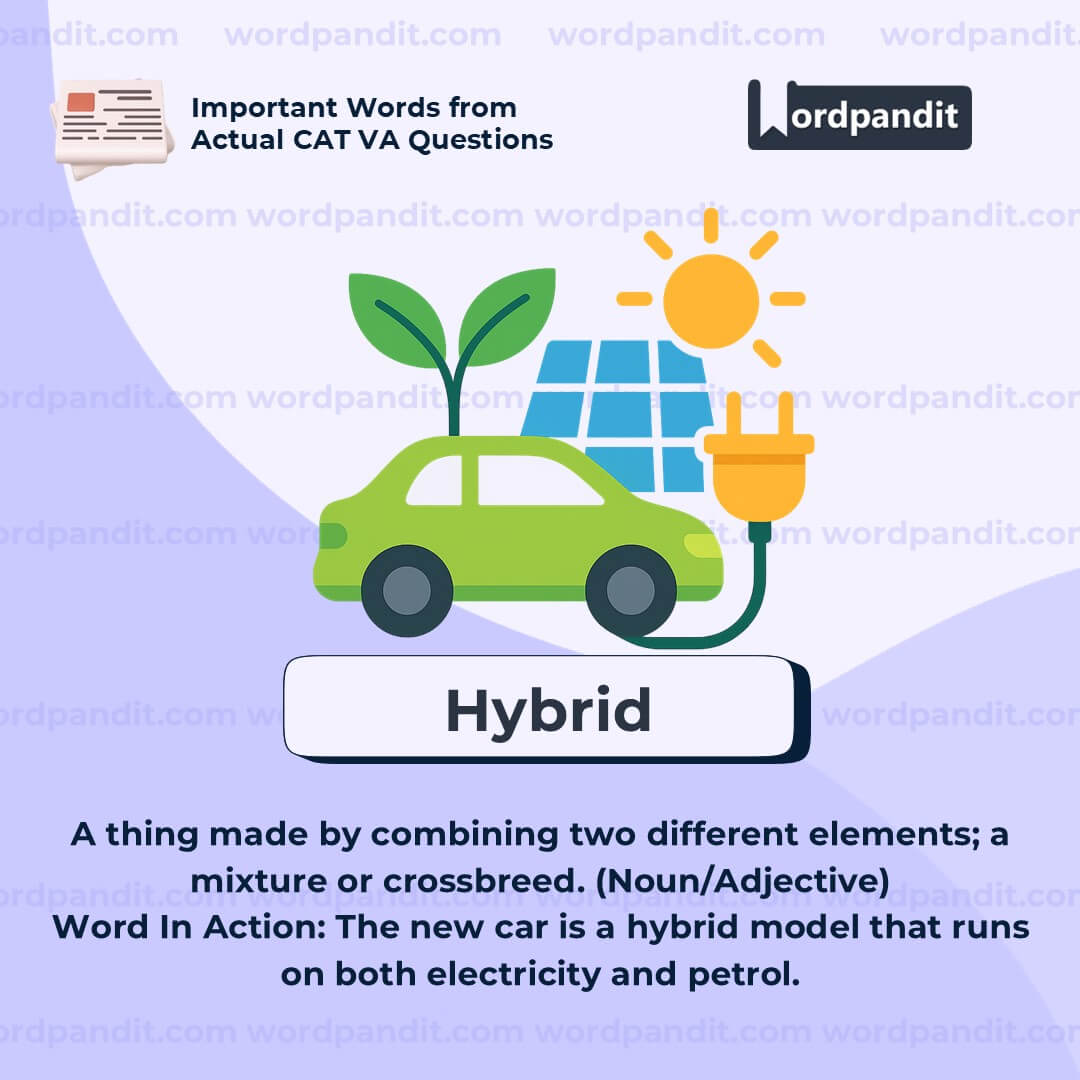
Context:
"Organizations with hybrid identities—those whose organizational identities span the boundaries of two or more social movements, issues, or identities—are vital to mobilizing these constituencies." - Academic Article
Explanatory Paragraph:
The word "hybrid" refers to something that is made by combining two or more different elements. In the context of organizations or identities, it describes entities that integrate diverse influences or functions—such as social, cultural, or ideological components. Hybrid organizations are often more adaptable and inclusive, capable of working across boundaries and bringing together different constituencies or causes to strengthen their collective impact.
Meaning: A thing made by combining two different elements (noun or adjective)
Pronunciation: HAI-brid
Difficulty Level: ⭐⭐ Beginner
Etymology: From Latin *hybrida*, meaning "offspring of a tame sow and wild boar", extended to mean "mixture of kinds"
Prashant Sir's Notes:
“Hybrid” is a powerful word when we talk about innovation. Whether it's a hybrid car, hybrid work model, or a hybrid organization, the key idea is combining strengths from different areas. These combinations often lead to flexibility, resilience, and creativity.
Synonyms & Antonyms:
Synonyms: composite, amalgam, fusion, mixture, blend
Antonyms: pure, singular, uniform, homogeneous
Usage Examples:
- Many companies now adopt a hybrid work model combining office and remote work.
- The organization’s hybrid identity allowed it to collaborate across environmental and social justice platforms.
- Hybrid vehicles use both gasoline and electric power to reduce emissions.
- The conference featured a hybrid format, with both in-person and virtual sessions.
Cultural Reference:
"Hybrid work is here to stay." – Satya Nadella, CEO of Microsoft, referring to post-pandemic workplace flexibility. - Interview
Think About It:
How can adopting a hybrid approach in your daily life or work lead to better outcomes?
Quick Activity:
List three things in your life (products, routines, or ideas) that are hybrids. What advantages do they offer over a single approach?
Memory Tip:
Think of a hybrid car—it “drives” the meaning home. It blends fuel and electric power, just like the word blends two or more identities or elements.
Real-World Application:
"Hybrid" is widely used in technology, business, education, and even biology. Hybrid events mix virtual and physical participation; hybrid models allow flexibility; and hybrid crops improve agricultural outcomes. Its versatility reflects the modern world's interconnected complexity.
Word 3: Constituencies
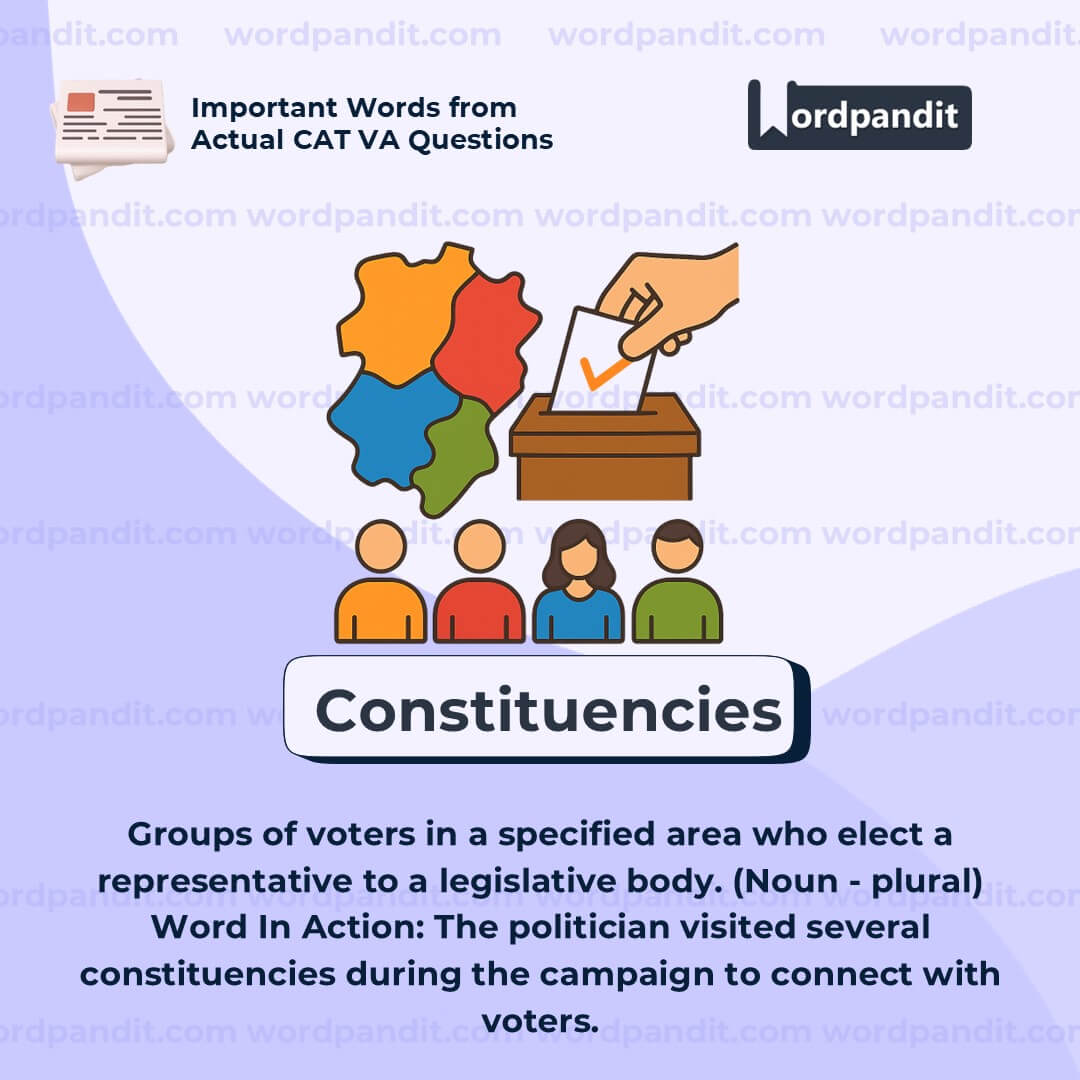
Context:
"Organizations with hybrid identities—those whose organizational identities span the boundaries of two or more social movements, issues, or identities—are vital to mobilizing these constituencies." - Academic Article
Explanatory Paragraph:
The word "constituencies" refers to groups of people who support or are represented by a particular organization, leader, or movement. In politics, it typically denotes the people who live in a specific area and vote for a representative. However, in broader social and organizational contexts, it can include stakeholders, supporters, or groups with shared interests. The sentence suggests that hybrid organizations are effective at engaging these different groups or communities in collective action.
Meaning: Groups of people who support, are served by, or are represented by an organization or leader (noun - plural)
Pronunciation: kun-STI-choo-en-seez
Difficulty Level: ⭐⭐⭐ Intermediate
Etymology: From Latin *constituere* meaning "to set up or establish" — related to forming or composing a group of supporters
Prashant Sir's Notes:
Think of constituencies as the "crowds" or "audiences" a leader or group speaks to or works for. In modern contexts, constituencies aren't just about geography—they’re about shared causes, needs, or identities.
Synonyms & Antonyms:
Synonyms: voter base, supporters, interest groups, stakeholders, followers
Antonyms: opponents, detractors, outsiders, adversaries
Usage Examples:
- The senator worked tirelessly to address the concerns of her rural constituencies.
- Different constituencies came together to protest the proposed environmental policy.
- NGOs often tailor their messages to resonate with specific constituencies such as youth or marginalized communities.
- Building trust among diverse constituencies requires consistent engagement and transparency.
Cultural Reference:
"Politicians have to balance the needs of multiple constituencies—economic, environmental, and cultural—to be truly representative." - Political Commentary
Think About It:
How do leaders effectively address the differing needs of multiple constituencies without alienating any group?
Quick Activity:
Identify two constituencies in your community or country. What are their primary concerns or demands?
Memory Tip:
Link “constituencies” to “constitute”—they’re the groups that *constitute* support for someone or something, like voters or backers of a cause.
Real-World Application:
Understanding constituencies is key in politics, marketing, and activism. Leaders, brands, and movements all need to engage their constituencies effectively to drive support, votes, donations, or participation.
Word 4: Inter-organizational
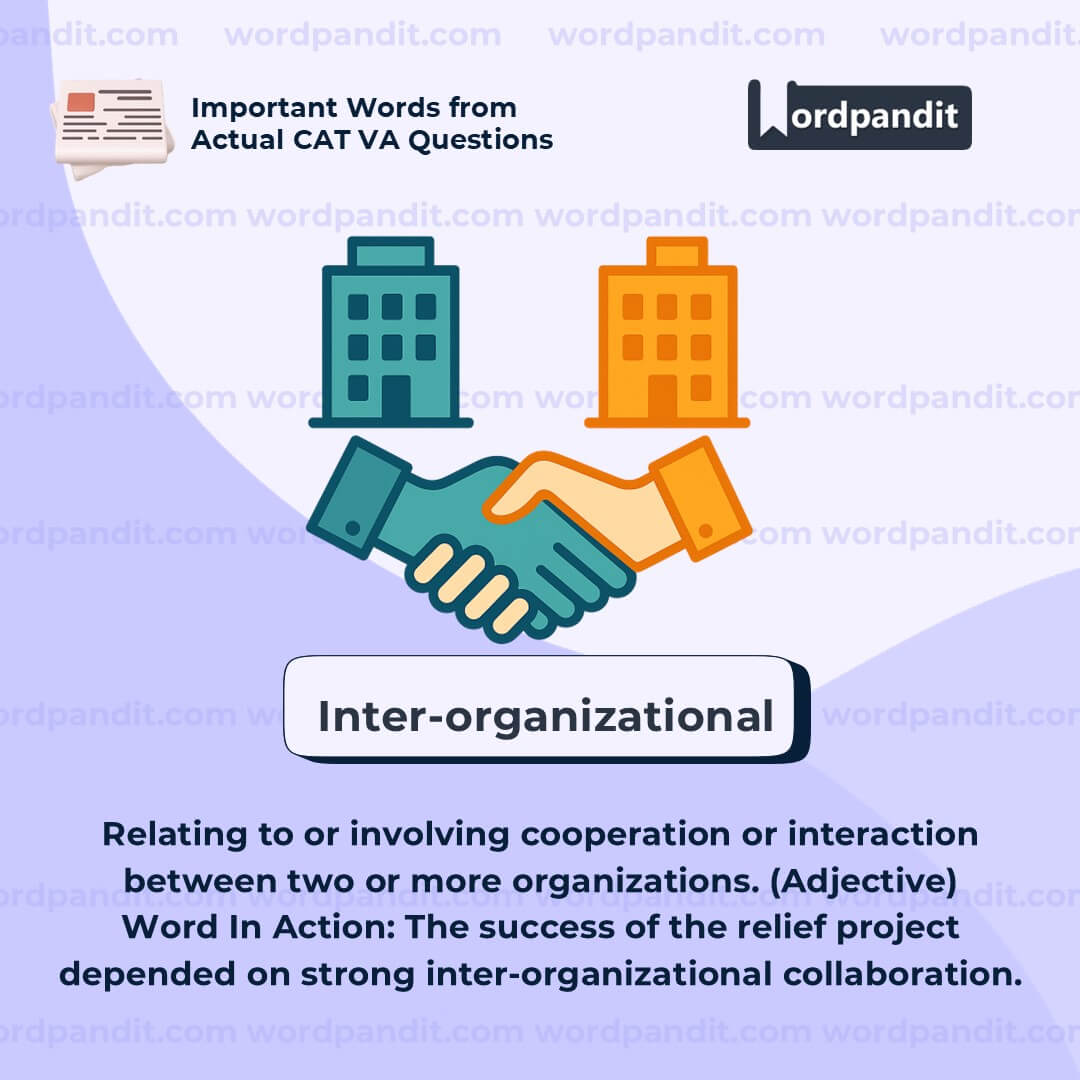
Context:
"In addition, they show that organizations with hybrid identities occupy relatively more central positions in inter-organizational contact networks within the antiwar movement." - Academic Article
Explanatory Paragraph:
The term "inter-organizational" refers to relationships, interactions, or collaborations that occur between different organizations. In the context of networks or systems, it describes the ways organizations communicate, coordinate, and share resources to achieve common goals. In the sentence provided, it highlights how hybrid organizations are deeply embedded in networks where multiple organizations are connected and working together—often sharing strategies, contacts, or influence within a broader movement like the antiwar cause.
Meaning: Occurring between or involving two or more organizations (adjective)
Pronunciation: in-ter-or-guh-nuh-ZAY-shuh-nuhl
Difficulty Level: ⭐⭐⭐ Intermediate
Etymology: Formed from prefix *inter-* meaning “between” and *organizational*, from Latin *organum* (tool or instrument)
Prashant Sir's Notes:
This word often pops up in academic and business writing when talking about cooperation between institutions. Think of it as a bridge word—it captures the idea of connection and partnership across organizational boundaries.
Synonyms & Antonyms:
Synonyms: cross-organizational, collaborative, cooperative, cross-sector
Antonyms: intra-organizational, isolated, independent, autonomous
Usage Examples:
- Inter-organizational collaboration between NGOs and government agencies led to a more effective relief effort.
- Trust and communication are vital for strong inter-organizational partnerships.
- The research highlights how inter-organizational networks increase innovation.
- Effective inter-organizational strategy can help avoid duplication of resources and effort.
Cultural Reference:
"The pandemic taught us the power of inter-organizational coordination across public and private sectors." – WHO Policy Brief
Think About It:
Why might inter-organizational relationships be more effective than isolated efforts in solving large-scale societal issues?
Quick Activity:
Think of two organizations in your city or country that could benefit from inter-organizational collaboration. What could they achieve together?
Memory Tip:
“Inter” means “between”—just like *international* means between nations. So “inter-organizational” means activities happening between organizations.
Real-World Application:
This term is key in sectors like disaster management, public health, education, and advocacy, where solving complex problems often requires alliances and joint strategies between different institutions.
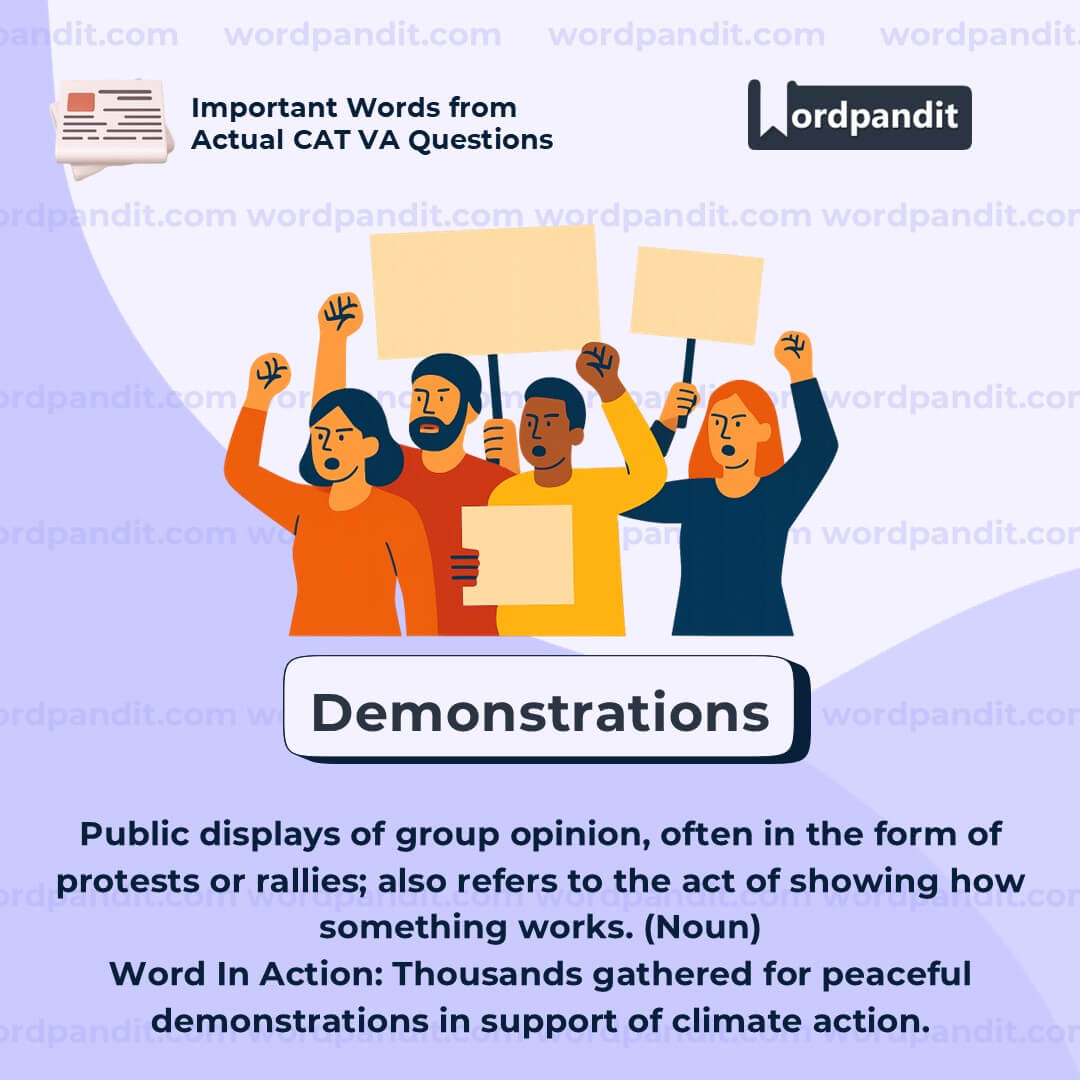
Word 5: Demonstrations
Context:
"...thus recruit significantly more participants in demonstrations than do nonhybrid organizations." - Academic Article
Explanatory Paragraph:
The word "demonstrations" refers to public gatherings where people express their opinions, often about political or social issues. These events are typically organized to protest against or support a cause and can take the form of marches, rallies, or sit-ins. In the provided sentence, it suggests that hybrid organizations are more effective at drawing crowds to such public events, indicating their strong influence and outreach capabilities.
Meaning: Public gatherings or marches to express opinions or protest (noun - plural)
Pronunciation: deh-mun-STRAY-shuns
Difficulty Level: ⭐⭐ Beginner
Etymology: From Latin *demonstrare*, meaning “to point out, show clearly”
Prashant Sir's Notes:
Think of demonstrations as *action with a purpose*. These are not just gatherings—they are deliberate, visible acts to express collective belief. The power of a demonstration lies in visibility, numbers, and message clarity.
Synonyms & Antonyms:
Synonyms: protest, rally, march, display, manifestation
Antonyms: silence, inactivity, apathy, retreat
Usage Examples:
- Thousands gathered in peaceful demonstrations to demand climate action.
- The government responded cautiously to the student-led demonstrations.
- Social media played a major role in organizing the demonstrations across cities.
- Demonstrations are often protected as a form of free speech in democratic societies.
Cultural Reference:
"The 1963 March on Washington was one of the largest political demonstrations in U.S. history and featured Dr. Martin Luther King Jr.’s 'I Have a Dream' speech." - History Channel
Think About It:
Can demonstrations still be effective in today’s digital-first world, or have online campaigns replaced their impact?
Quick Activity:
Write down two causes you feel strongly about. Imagine organizing a demonstration for one of them—what would your message or slogan be?
Memory Tip:
Think of “demonstrations” as *demonstrating* your feelings in public—you're showing what you stand for, loud and clear.
Real-World Application:
Demonstrations are used by activists, unions, students, and citizens to raise awareness, influence policy, and express solidarity. From civil rights movements to climate protests, they remain a key tool of public expression and advocacy.
