✨ Introduction
Mastering Reading Comprehension begins with mastering the words!
In this post, we dive deep into vocabulary taken directly from an actual CAT RC passage. Each word has been explained in a simple, easy-to-understand way, along with examples to help you grasp its usage in real contexts.
From words like "species" and "cognitive" to "subjection" and "paradise," strengthen your vocabulary one word at a time — and take your RC performance to the next level!
📚 What’s Inside This Vocabulary Post?
- 🔍 Words Sourced from an Actual CAT RC Passage: Directly pick up important vocabulary from real CAT exam material.
- 🧠 Meaningful Explanations: Understand the exact meaning and usage of each word in a simple, student-friendly way.
- ✍️ Context-Based Learning: Learn words with examples that reflect their actual usage in reading comprehension contexts.
- 🗂️ Quick Reference Format: Words are neatly listed with meanings, parts of speech, and example sentences for easy revision.
- 🚀 Boost Your RC and Verbal Ability Skills: Improve your understanding of tough passages by strengthening your vocabulary.
📝 Words Covered in This Article:
- Disgorging
- Bureaucrats
- Spurned
- Piecemeal
- Ascendant
- Proponents
- Decamping
- Decentralisation
- Attrition rates
- Ping
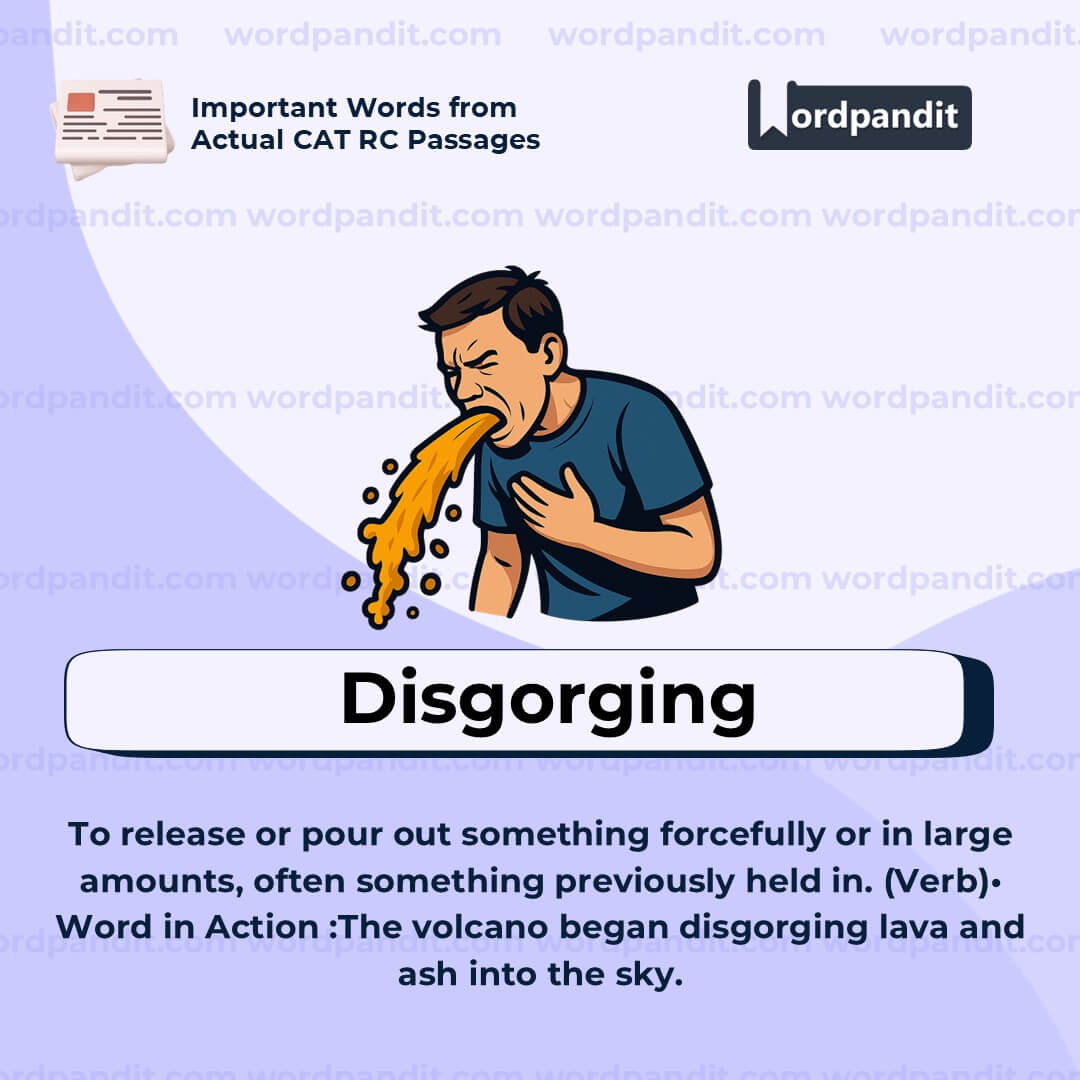
WORD-1: Disgorging
Context:
"The factory was disgorging thick black smoke into the sky, choking the nearby town." – Environmental Report, The Guardian
Explanatory Paragraph:
"Disgorging" refers to the forceful or uncontrolled release of something—whether physical, like smoke or liquid, or metaphorical, like information or emotion. It often implies an unappealing, overwhelming, or sudden release. The word carries a vivid, often unpleasant connotation, making it effective in writing that needs to convey a sense of urgency, excess, or chaos.
Meaning: Releasing or ejecting something forcefully, especially in a messy or excessive way. (Verb – present participle)
Pronunciation: dis-GOR-jing
Difficulty Level: ⭐⭐⭐ Intermediate
Etymology: From Old French *desgorgier*, meaning “to vomit,” formed from *des-* (apart) + *gorge* (throat). The root idea is of something being expelled from the throat or mouth.
Prashant Sir's Notes:
“Disgorging” is a great word when you want to convey excess, mess, or chaos—often used in environmental, dramatic, or intense descriptive writing. It’s vivid and slightly graphic, so use it with intent!
Synonyms & Antonyms:
Synonyms: spewing, ejecting, pouring out, vomiting, emitting
Antonyms: containing, absorbing, withholding, retaining
Usage Examples:
- The volcano began disgorging molten lava that scorched everything in its path.
- The stadium disgorged thousands of fans into the streets after the final whistle.
- The tanker was disgorging crude oil into the ocean, creating an ecological disaster.
- He was disgorging all his anger in a furious rant no one could interrupt.
Cultural Reference:
In classical mythology, the Titan Cronus was forced to disgorge his children after swallowing them—an image that captures both the physical and symbolic power of the word. – Greek Myth Retellings
Think About It:
Why do some powerful forces in nature—and in people—only become noticeable when they are disgorged suddenly? What does this say about containment and control?
Quick Activity:
Write a sentence using “disgorging” to describe a non-physical situation, like emotion or information being released.
Memory Tip:
Think: **dis-gorge** = “out of the throat” — something being spit out or poured forcefully from inside.
Real-World Application:
“Disgorging” is especially useful in environmental writing, dramatic narratives, journalism, and legal or financial contexts (e.g., "disgorgement of profits"). It adds intensity and clarity to descriptions of forced release.
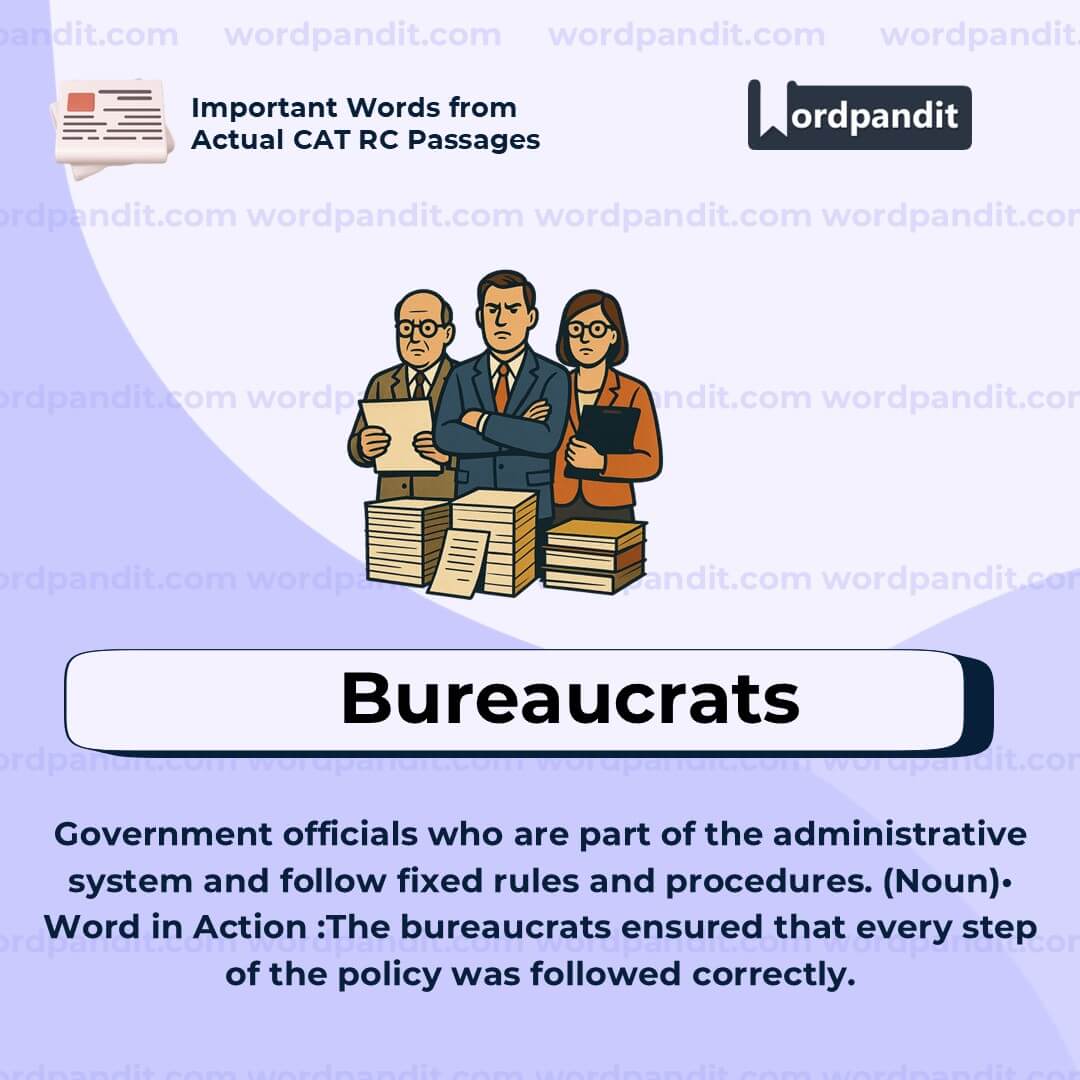
WORD-2: Bureaucrats
Context:
"The new policy was stalled for months as bureaucrats debated procedural details and paperwork requirements." – The Washington Post
Explanatory Paragraph:
“Bureaucrats” are government officials or administrators who work within a structured system of rules, procedures, and hierarchy—known as a bureaucracy. They are responsible for implementing policies and managing day-to-day operations of public administration. While they are essential for organizational functioning, the term is sometimes used negatively to describe people who rigidly follow rules without considering individual needs or common sense.
Meaning: Officials in a government or organization who follow rules and procedures to manage administrative tasks. (Noun – plural)
Pronunciation: BYUR-oh-krats
Difficulty Level: ⭐⭐⭐ Intermediate
Etymology: From French *bureaucratie* (government by desks/office), formed from *bureau* (desk) + *cratie* (rule or government).
Prashant Sir's Notes:
Use "bureaucrats" to discuss systems where processes matter more than people. It’s useful in essays about governance, efficiency, and public service—but be careful with tone, as it can sound critical.
Synonyms & Antonyms:
Synonyms: administrators, civil servants, officials, functionaries
Antonyms: reformers, outsiders, entrepreneurs (in context), private-sector leaders
Usage Examples:
- The bureaucrats enforced every regulation to the letter, regardless of circumstances.
- Many citizens grew frustrated with delays caused by layers of bureaucrats in the housing department.
- Effective reform often requires working with, not just around, the bureaucrats who know the system.
- The country's progress was slowed by inefficient bureaucrats more concerned with paperwork than people.
Cultural Reference:
In George Orwell’s *1984*, faceless bureaucrats symbolize oppressive control and loss of individual freedom—an extreme critique of overgrown government systems. – Dystopian Literature Studies
Think About It:
Are bureaucrats necessary for order, or do they often become obstacles to progress? How do we strike the right balance?
Quick Activity:
Describe a scenario (real or imagined) where bureaucracy helps—and another where it hinders—efficiency or justice.
Memory Tip:
Think: “bureau” = desk, and “crats” = rulers → bureaucrats = people who rule from behind desks!
Real-World Application:
Understanding bureaucrats is essential in public administration, policy analysis, and civic studies. Their role affects education, healthcare, infrastructure, and more.
WORD-3: Spurned
Context:
"She spurned his offer of help, determined to solve the problem on her own." – The New York Times
Explanatory Paragraph:
"Spurned" is the past tense of the verb "spurn," which means to reject something—especially with disdain, contempt, or a sense of superiority. It often conveys a strong emotional response, suggesting not just refusal but an active turning away from something perceived as unworthy, offensive, or unwanted. It's commonly used in literature, drama, and emotional contexts.
Meaning: Rejected something or someone with disdain or contempt. (Verb – past tense)
Pronunciation: spurn-d
Difficulty Level: ⭐⭐ Basic to Intermediate
Etymology: From Old English *spurnan*, meaning “to kick away” or “reject with the foot,” which gives the word its figurative tone of dismissiveness.
Prashant Sir's Notes:
“Spurned” carries emotional weight. It’s not just a casual ‘no’—it implies strong feelings, pride, or principle. Excellent for expressive writing, especially in describing conflict or dramatic rejection.
Synonyms & Antonyms:
Synonyms: rejected, rebuffed, snubbed, dismissed, refused
Antonyms: accepted, welcomed, embraced, received
Usage Examples:
- The prince was heartbroken after being spurned by the woman he loved.
- She spurned the lucrative job offer because it didn’t align with her values.
- Despite their efforts, the group’s proposal was spurned by the council.
- He spurned tradition in favor of forging his own path.
Cultural Reference:
In Shakespeare’s *Twelfth Night*, characters are often spurned in love, adding to the play’s comedic and emotional tension. – Literary Review Journal
Think About It:
What’s the difference between a polite rejection and being spurned? How do tone and intent change the meaning?
Quick Activity:
Write a short dialogue in which one character spurns another’s suggestion. Use tone and word choice to show emotional impact.
Memory Tip:
Think: *spurn* = *scornfully turn* something away. If you spurn, you don’t just say no—you push it away with pride.
Real-World Application:
“Spurned” is ideal for storytelling, critical analysis, and persuasive writing where emotional nuance and strong character reactions are being described.

WORD-4: Piecemeal
Context:
"The reforms were implemented in a piecemeal fashion, leading to confusion and inconsistency across departments." – The Economist
Explanatory Paragraph:
"Piecemeal" refers to something done gradually, one part at a time, rather than all at once. It suggests a fragmented, step-by-step approach, often used when discussing progress, reforms, or construction. While this method can reflect caution or pragmatism, it can also imply lack of coordination or thorough planning.
Meaning: Done or made in separate stages; step-by-step rather than all at once. (Adverb / Adjective)
Pronunciation: PEES-meel
Difficulty Level: ⭐⭐ Basic to Intermediate
Etymology: From Middle English *pecemeal* (piece + meal, where "meal" meant "measure") — literally meaning “measure by piece.”
Prashant Sir's Notes:
"Piecemeal" is useful in academic and analytical writing—especially when evaluating slow or disorganized change. It can describe everything from political reform to how someone cleans their room!
Synonyms & Antonyms:
Synonyms: gradually, bit by bit, step-by-step, fragmentary
Antonyms: wholesale, comprehensive, unified, all-at-once
Usage Examples:
- The building was renovated piecemeal over five years.
- The government’s piecemeal policies left many communities behind.
- She solved the puzzle in a piecemeal way, starting with the corners.
- Rather than tackle the problem head-on, they adopted a piecemeal approach.
Cultural Reference:
In public policy debates, critics often complain that climate change actions are being taken piecemeal—without a cohesive, global strategy. – United Nations Climate Reports
Think About It:
When might a piecemeal approach be more effective than a large-scale change? Can slow progress be better than rapid reform?
Quick Activity:
Choose a problem (e.g., education reform, organizing your home, preparing for exams) and write a quick plan for solving it piecemeal—what are the first 3 small steps?
Memory Tip:
“Piecemeal” = piece + meal → imagine eating a meal one bite at a time—not all at once!
Real-World Application:
Piecemeal strategies are common in education, policymaking, software updates, and personal habits. Understanding this word helps in evaluating the effectiveness of gradual vs. comprehensive approaches.
WORD-5: Ascendant
Context:
"With new leadership and a bold vision, the company is now ascendant in the global tech market." – Forbes
Explanatory Paragraph:
"Ascendant" describes someone or something that is rising in power, influence, or importance. It suggests upward movement—whether literal, social, or symbolic. It can refer to people, organizations, trends, or ideas that are gaining momentum, recognition, or dominance. The word evokes strength, growth, and emerging superiority.
Meaning: Rising in power, influence, or position; becoming more dominant or important. (Adjective/Noun)
Pronunciation: uh-SEN-duhnt
Difficulty Level: ⭐⭐⭐ Intermediate
Etymology: From Latin *ascendere* (“to climb, rise”), with the English form developing in the 14th century to describe power or position on the rise.
Prashant Sir's Notes:
“Ascendant” is a power word—it signals growth, momentum, and emerging dominance. Excellent for essays or articles about leadership, politics, social movements, and trends.
Synonyms & Antonyms:
Synonyms: rising, dominant, thriving, growing, triumphant
Antonyms: declining, falling, fading, waning, descending
Usage Examples:
- The startup is clearly ascendant in the field of AI innovation.
- Her ascendant career trajectory surprised even her mentors.
- The cultural movement became ascendant during the late 20th century.
- With public opinion shifting, the opposition party is now in an ascendant position.
Cultural Reference:
In astrology, the “ascendant” or rising sign is believed to shape one’s outward personality and social presence. It’s calculated by which zodiac sign was rising on the eastern horizon at the moment of birth. – Astrology Encyclopedia
Think About It:
What does it take for someone or something to become ascendant in a competitive world—skill, timing, or public perception?
Quick Activity:
Write 2–3 sentences describing a person, movement, or idea that is currently ascendant in your field of interest or country.
Memory Tip:
“Ascendant” = **ascending** + **dominant** — something or someone climbing toward dominance!
Real-World Application:
“Ascendant” is a powerful word for news writing, political commentary, trend analysis, and motivational speaking. It captures the moment when momentum shifts upward.
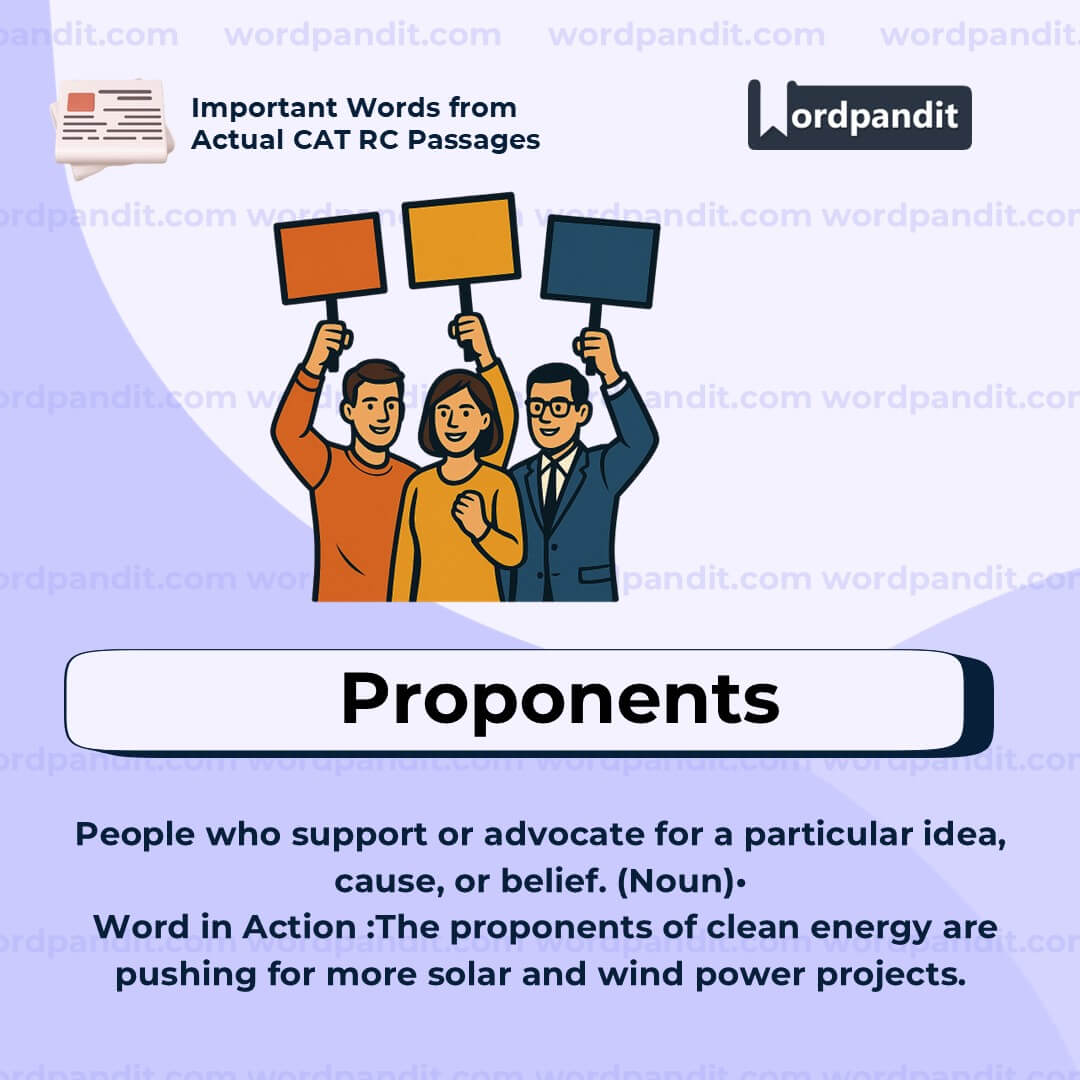
WORD-6: Proponents
Context:
"Proponents of renewable energy argue that it is both environmentally sustainable and economically beneficial in the long term." – National Geographic
Explanatory Paragraph:
"Proponents" are individuals or groups who actively support or advocate for a particular idea, cause, policy, or course of action. The word is commonly used in debates, academic writing, and journalism to identify people who are in favor of something, often presenting arguments or evidence to promote it. Being a proponent involves conviction and action, not just passive agreement.
Meaning: People who argue in favor of something or actively support a cause or idea. (Noun – plural)
Pronunciation: pruh-PO-nents
Difficulty Level: ⭐⭐ Basic to Intermediate
Etymology: From Latin *proponere* (to put forward), with the English form evolving to mean “one who puts forward an argument or plan.”
Prashant Sir's Notes:
"Proponents" is a formal, academic-friendly word often seen in debates, editorials, and essays. It’s a strong alternative to “supporters,” especially when referring to intellectual or ideological positions.
Synonyms & Antonyms:
Synonyms: advocates, champions, supporters, defenders, backers
Antonyms: opponents, critics, detractors, adversaries
Usage Examples:
- Proponents of artificial intelligence believe it will revolutionize industries and daily life.
- Education reform proponents argue for smaller class sizes and better teacher training.
- The proponents of the new law organized a campaign to raise public awareness.
- She emerged as one of the strongest proponents of women’s rights in her region.
Cultural Reference:
Proponents of net neutrality, including major tech companies and digital rights groups, have campaigned globally to ensure free and open access to the internet. – Digital Policy Journal
Think About It:
What makes someone become a strong proponent of a cause—personal experience, research, or a sense of justice?
Quick Activity:
Pick a cause or idea you believe in. Write a one-sentence argument as if you were a proponent trying to persuade others.
Memory Tip:
Think: **pro** = for, **ponent** = one who puts forward. A proponent is someone **for** an idea who puts it out there confidently.
Real-World Application:
Knowing how to use “proponents” accurately helps in academic writing, persuasive essays, and formal debates, especially when analyzing arguments on social, political, or environmental issues.
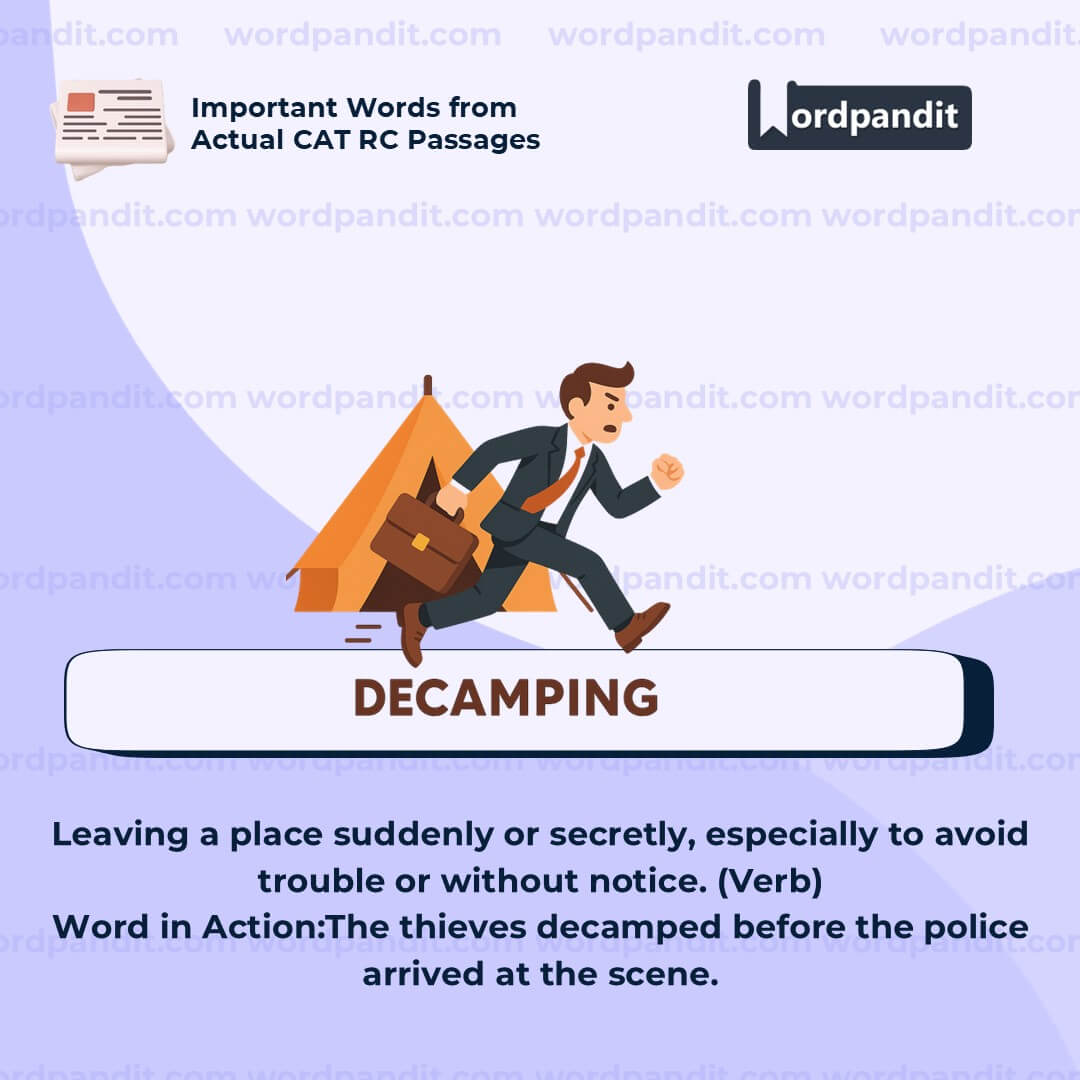
WORD-7: Decamping
Context:
"The rebels were seen decamping from their mountain base just before the arrival of government forces." – BBC World News
Explanatory Paragraph:
"Decamping" refers to the act of leaving a place suddenly or secretly, often to escape danger, avoid responsibility, or relocate quickly. Originally used in military contexts to describe troops packing up a camp, the word has since expanded to describe any abrupt or stealthy departure—from fleeing a situation to making a hasty exit from a conversation or company.
Meaning: Leaving a place quickly and often secretly, especially to relocate or escape. (Verb – present participle)
Pronunciation: dee-KAMP-ing
Difficulty Level: ⭐⭐ Basic to Intermediate
Etymology: From French *décamper* (“to break camp”), based on Latin *campus* (field). Originally a military term for leaving camp.
Prashant Sir's Notes:
“Decamping” is a lively, action-packed verb often used in both literal and figurative ways. It's great for narrative writing and current affairs analysis—especially when describing strategic withdrawals or secretive exits.
Synonyms & Antonyms:
Synonyms: flee, escape, withdraw, bolt, evacuate, vanish
Antonyms: settle, arrive, remain, enter, stay
Usage Examples:
- The suspects were seen decamping from the hideout just before the police raid.
- The celebrity decamped to a remote island to avoid media scrutiny.
- After the scandal, the executive quietly decamped from the company headquarters.
- Protesters began decamping once negotiations with officials were announced.
Cultural Reference:
During World War II, entire military units would decamp under cover of darkness to avoid enemy detection—giving the word a historical weight in strategy and secrecy. – Military History Archives
Think About It:
Is decamping always a sign of fear or failure—or can it be a bold, strategic move?
Quick Activity:
Write a short story (2–3 sentences) using “decamping” to describe someone leaving a situation in a clever or dramatic way.
Memory Tip:
“De-” means *off* or *away*, and “camp” refers to a place—so *decamping* literally means moving away from your place, often in a hurry.
Real-World Application:
“Decamping” is commonly used in journalism, fiction, and political commentary to describe exits—from military retreats to executives leaving companies or individuals fleeing situations.
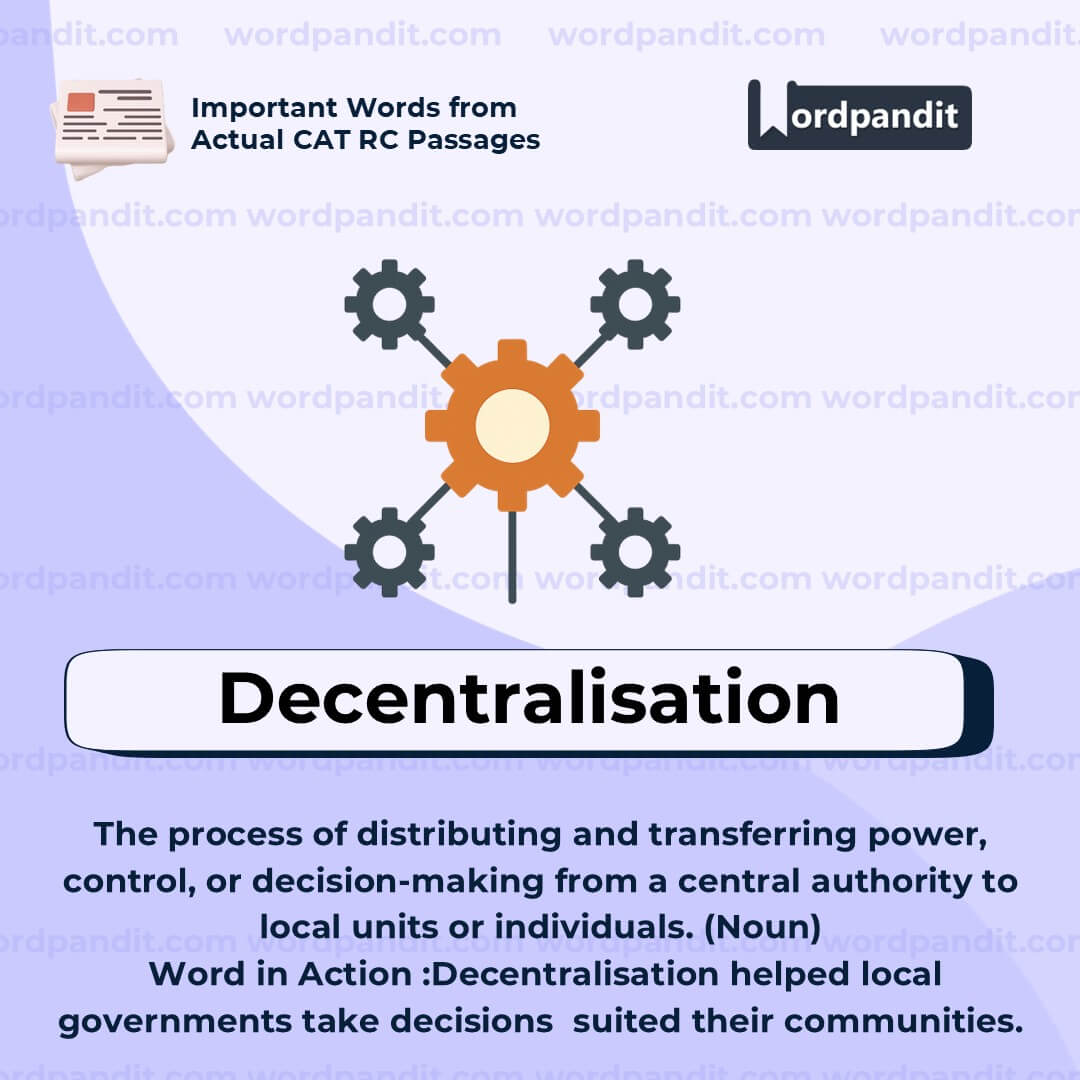
WORD-8: Decentralisation
Context:
"The country embraced decentralisation, granting more power to local governments to manage education, health, and infrastructure." – The Economist
Explanatory Paragraph:
"Decentralisation" refers to the process of distributing power, authority, or resources away from a central authority and toward regional, local, or individual units. It can be political, economic, or administrative in nature. The main idea is to empower smaller or more localised entities to make decisions, improving efficiency, participation, and responsiveness. It is often used in discussions about governance, corporate management, and technology (e.g., blockchain).
Meaning: The transfer or distribution of authority from a central body to local or regional branches. (Noun)
Pronunciation: dee-sen-truh-li-ZAY-shun
Difficulty Level: ⭐⭐⭐ Intermediate
Etymology: From *de-* (away from) + *centralisation*, meaning to take power away from a central authority. The term rose in political use during the 19th century.
Prashant Sir's Notes:
This word is crucial in civics, business, and tech. When you think of decentralisation, think of empowerment, flexibility, and reduced top-down control. It's a key term in governance debates, especially in federal systems and participatory models.
Synonyms & Antonyms:
Synonyms: distribution of power, delegation, devolution, dispersal
Antonyms: centralisation, concentration, consolidation, unification
Usage Examples:
- Decentralisation helped the country respond more effectively to regional health crises.
- The company adopted decentralisation to give regional managers more decision-making authority.
- Blockchain technology is praised for enabling financial decentralisation.
- Critics argued that too much decentralisation could lead to inconsistency and inequality.
Cultural Reference:
In India's Panchayati Raj system, decentralisation gives village councils (panchayats) the power to manage local affairs—a landmark in grassroots governance. – Indian Polity Handbook
Think About It:
When is decentralisation more effective than central control? What risks come with distributing power widely?
Quick Activity:
Pick a sector (e.g., education, healthcare, transport). Write one benefit and one challenge of decentralising its control.
Memory Tip:
“De-” = away, “central” = the center → decentralisation = moving **away from the center** toward shared control.
Real-World Application:
Decentralisation plays a crucial role in governance, corporate structure, and technology. It promotes local autonomy, faster decision-making, and community participation—especially important in diverse or large-scale systems.
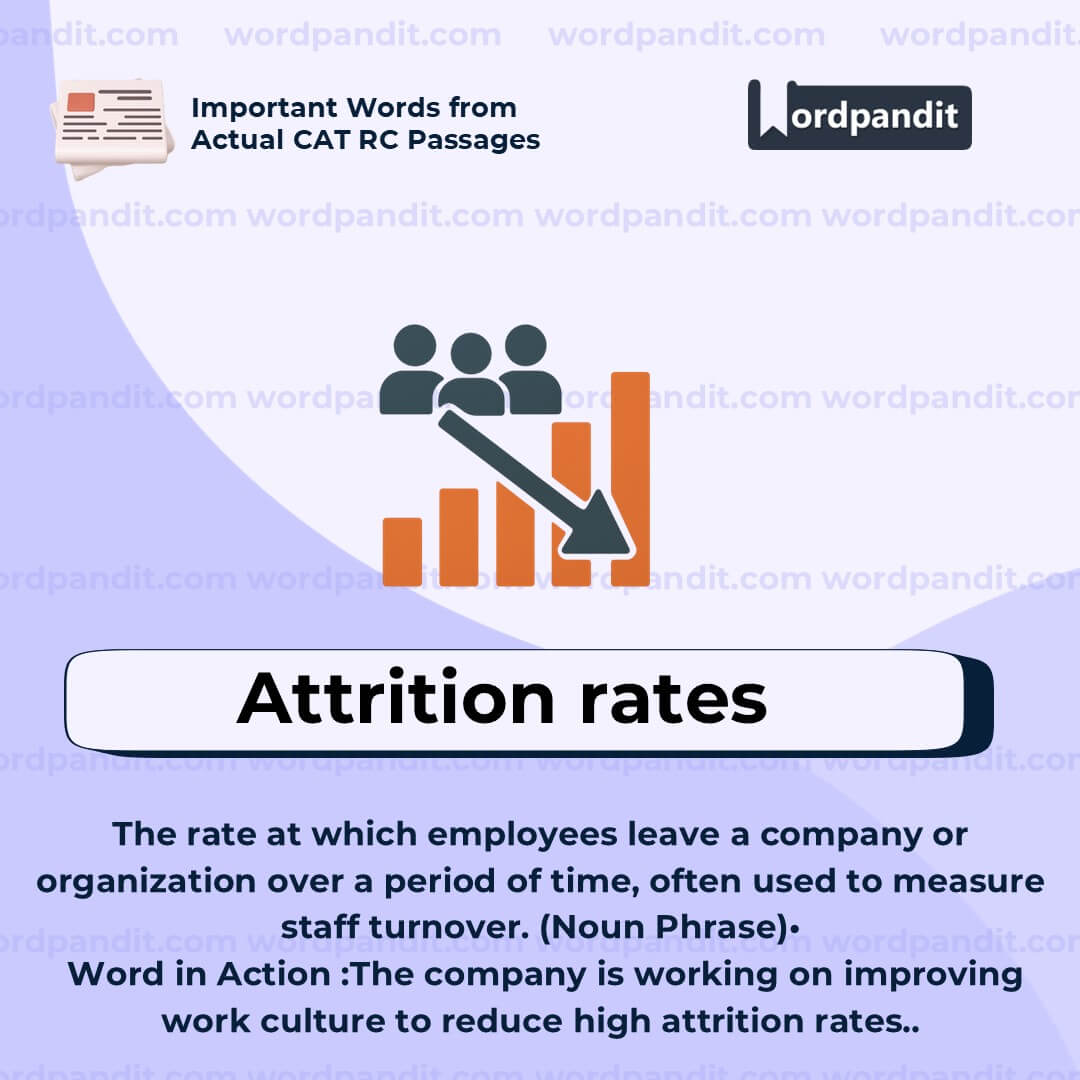
WORD-9: Attrition Rates
Context:
"The company’s high attrition rates raised concerns about employee satisfaction and long-term retention." – Harvard Business Review
Explanatory Paragraph:
"Attrition rates" refer to the rate at which people leave an organization, institution, or program over a specific period. It is commonly used in HR, education, and military contexts to measure how many employees, students, or members drop out or resign. High attrition rates can signal dissatisfaction, poor management, or structural issues, while low rates often reflect good retention strategies and workplace stability.
Meaning: The percentage of individuals who leave a group, organization, or institution over a given period. (Noun phrase)
Pronunciation: uh-TRIH-shun rayts
Difficulty Level: ⭐⭐⭐ Intermediate
Etymology: From Latin *attritio* (a rubbing away); in this context, it refers metaphorically to the gradual loss of people through resignation, withdrawal, or drop-out.
Prashant Sir's Notes:
"Attrition rates" are a key indicator in business and education. Always ask what’s causing the attrition—this word is not just a statistic, it’s a signal that something deeper may need attention.
Synonyms & Antonyms:
Synonyms: turnover rate, drop-out rate, resignation rate, loss rate
Antonyms: retention rate, stability rate, continuity, employee loyalty
Usage Examples:
- Tech firms often struggle with high attrition rates due to competitive job markets.
- Attrition rates in universities can indicate the effectiveness of student support services.
- The HR team introduced wellness initiatives to reduce attrition rates.
- A sharp rise in attrition rates signaled a potential issue in workplace culture.
Cultural Reference:
In corporate reports, companies like Google and Amazon closely monitor attrition rates to manage talent retention and identify systemic issues early. – Forbes Workplace Analytics
Think About It:
Is a high attrition rate always bad? Could it sometimes indicate healthy change or the filtering of unfit members?
Quick Activity:
Choose an industry (e.g., education, healthcare, tech). Research or guess what the typical attrition rate might be and list two reasons that could contribute to it.
Memory Tip:
Think: “Attrition” = a gradual **reduction** → "Attrition rate" tells you **how fast people are leaving**.
Real-World Application:
Understanding attrition rates is essential in HR, business strategy, education management, and workforce planning. It helps organizations retain talent and improve institutional health.
WORD-10: Ping
Context:
"She pinged her colleague a quick message to confirm the meeting details." – Slack Communication Guide
Explanatory Paragraph:
"Ping" is a modern, informal verb (and sometimes noun) that refers to sending a quick message, alert, or signal to someone, often electronically. Originating in computing, where it meant testing network connectivity, the word has evolved into everyday usage in tech and office communication, especially in chats or messaging apps like Slack, Teams, or WhatsApp. It suggests speed, brevity, and immediacy.
Meaning: To send a short, quick message or signal to someone, typically via a digital platform. (Verb/Noun – informal)
Pronunciation: ping
Difficulty Level: ⭐ Basic
Etymology: Originated from sonar and radar (imitating a high-pitched sound), later adopted by computer networks (1983), and now widely used in messaging contexts.
Prashant Sir's Notes:
“Ping” is casual and tech-savvy. It’s perfect for informal or professional environments where speed matters. Students and working professionals alike use it to replace longer phrases like “send a message” or “notify.”
Synonyms & Antonyms:
Synonyms: message, notify, alert, nudge, text
Antonyms: ignore, overlook, disconnect, remain silent
Usage Examples:
- Can you ping me when you’re done with the edits?
- He pinged the server to check the connection status.
- I'll just ping the client and confirm the call time.
- The device pings the GPS satellite every ten seconds to update its location.
Cultural Reference:
In tech culture, “ping me” has become standard jargon in workplaces like Google and Microsoft to request quick, informal check-ins. – Wired Tech Dictionary
Think About It:
Does constant pinging improve communication, or does it contribute to digital distraction and burnout?
Quick Activity:
Write two sentences—one where “ping” is used in a workplace setting, and one where it’s used in a personal tech context (like messaging a friend).
Memory Tip:
Think: **"Ping!"** — a sharp, quick sound → a short, fast message that gets someone’s attention.
Real-World Application:
“Ping” is essential in digital communication—especially in fast-paced environments like tech startups, remote teams, and customer support, where responsiveness is key.