
✨ Introduction
Mastering Reading Comprehension begins with mastering the words!
In this post, we dive deep into vocabulary taken directly from an actual CAT RC passage. Each word has been explained in a simple, easy-to-understand way, along with examples to help you grasp its usage in real contexts.
From words like "species" and "cognitive" to "subjection" and "paradise," strengthen your vocabulary one word at a time — and take your RC performance to the next level!
📚 What’s Inside This Vocabulary Post?
- 🔍 Words Sourced from an Actual CAT RC Passage: Directly pick up important vocabulary from real CAT exam material.
- 🧠 Meaningful Explanations: Understand the exact meaning and usage of each word in a simple, student-friendly way.
- ✍️ Context-Based Learning: Learn words with examples that reflect their actual usage in reading comprehension contexts.
- 🗂️ Quick Reference Format: Words are neatly listed with meanings, parts of speech, and example sentences for easy revision.
- 🚀 Boost Your RC and Verbal Ability Skills: Improve your understanding of tough passages by strengthening your vocabulary.
📝 Words Covered in This Article:
- Fragments
- Rudimentary
- exception
- Pliability
- Rhetoric
- Nonrestrictive
- Indispensable
- Deify
- Grasp
- Coherent
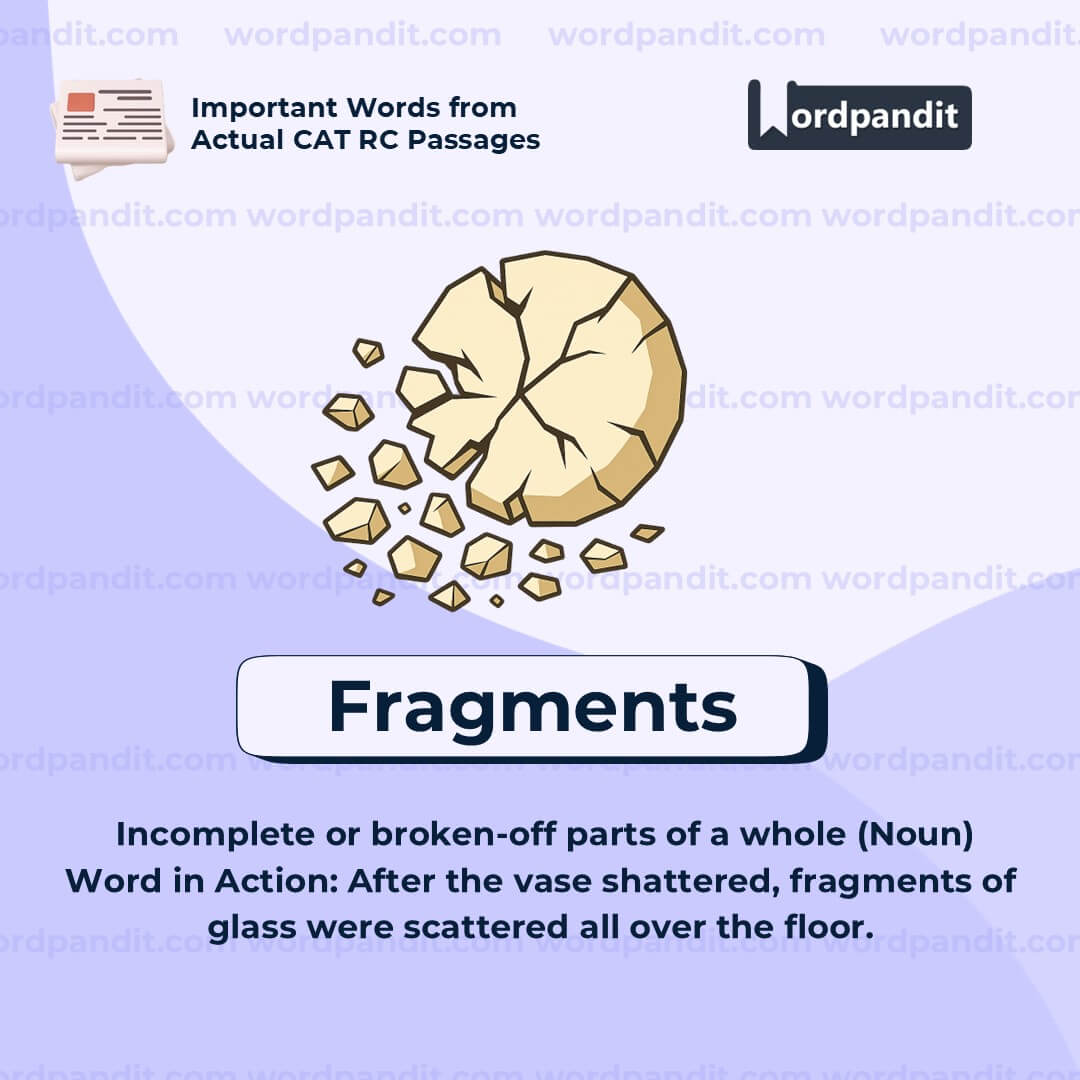
WORD-1: Fragments
Context:
"If your work consists only of fragments and floating clauses, the Grammar Police aren’t going to come and take you away." - Source Unknown
Explanatory Paragraph:
The word "fragments" refers to small parts that have broken off or are incomplete pieces of a whole. In writing, a fragment is a sentence that lacks a complete thought—typically missing a subject or a verb. This word is used to convey the idea of something that is partial or not entirely formed. It also hints at disconnection or a lack of coherence, particularly in structure or ideas.
Meaning: Incomplete or broken-off parts of a whole (Noun)
Pronunciation: FRAG-muhnts
Difficulty Level: ⭐⭐ Basic
Etymology: From Latin *fragmentum*, meaning "a broken piece or scrap," derived from *frangere*, "to break."
Prashant Sir's Notes:
Remember, in grammar, fragments are like thoughts that haven't fully formed into a sentence. They're useful stylistically in creative writing, but should be avoided in formal pieces.
Synonyms & Antonyms:
Synonyms: pieces, shards, splinters, bits, sections
Antonyms: whole, entirety, unity, totality
Usage Examples:
- Her speech was filled with fragments that left the audience confused.
- The archaeologists discovered fragments of ancient pottery at the site.
- He tried to recall the memory, but only fragments came to him.
- The story was written in fragments, adding to its mysterious tone.
Cultural Reference:
"I am large, I contain multitudes… I too am not a bit tamed—I too am untranslatable… I sound my barbaric yawp over the roofs of the world." — Walt Whitman often used poetic fragments to express freedom and individuality. - *Leaves of Grass*
Think About It:
Can fragments in writing sometimes say more than full sentences? Why might an author choose to use them?
Quick Activity:
Identify three fragments from your previous writing or a favorite book and rewrite them as complete sentences.
Memory Tip:
Think of a shattered vase—each piece is a “fragment” of the original whole. Likewise, fragments in writing are broken or incomplete parts of full sentences.
Real-World Application:
Understanding fragments helps improve writing clarity and coherence, particularly in academic and professional communication, where complete sentences are crucial.
WORD-2: Rudimentary
Context:
"If you don’t have a rudimentary grasp of how the parts of speech translate into coherent sentences, how can you be certain that you are doing well?" - Source Unknown
Explanatory Paragraph:
"Rudimentary" refers to something that is basic, simple, or in its early stages of development. It’s often used to describe foundational knowledge or skills that are necessary before moving on to more complex concepts. In this context, it highlights the importance of having a basic understanding of grammar in order to write correctly and confidently.
Meaning: Basic or elementary; relating to an undeveloped or early stage (Adjective)
Pronunciation: ROO-duh-men-tuh-ree
Difficulty Level: ⭐⭐⭐ Intermediate
Etymology: From Latin *rudimentum*, meaning "first attempt" or "beginning," derived from *rudis*, meaning "unformed" or "raw."
Prashant Sir's Notes:
Use this word to describe anything that is in the early or undeveloped phase. Especially useful in academic and learning contexts to point out a lack of depth or advancement.
Synonyms & Antonyms:
Synonyms: basic, elementary, primitive, initial, undeveloped
Antonyms: advanced, sophisticated, developed, complex
Usage Examples:
- She only has a rudimentary understanding of French but hopes to improve over time.
- The tribe used rudimentary tools made of stone and wood.
- Without a rudimentary grasp of coding, it’s hard to build a functional app.
- Even at a rudimentary level, the concept of gravity fascinated early scientists.
Cultural Reference:
"At the rudimentary level, every story is a conflict between desire and obstacle." — A principle emphasized in storytelling workshops and screenwriting classes. - Adapted from Robert McKee's teachings
Think About It:
Why is it essential to master rudimentary skills before progressing to advanced ones, and what happens when we skip foundational learning?
Quick Activity:
List three rudimentary skills required for effective communication, and reflect on how well you’ve mastered them.
Memory Tip:
“Rudimentary” sounds like “rude + elementary” — think of it as something that’s still in the crude, elementary phase of development.
Real-World Application:
Understanding rudimentary concepts is crucial in every field—from learning the alphabet before reading, to grasping basic math before tackling algebra. These basics build a solid foundation for future growth.
WORD-3: Rhetoric
Context:
"Even William Strunk, that Mussolini of rhetoric, recognized the delicious pliability of language." - Source Unknown
Explanatory Paragraph:
"Rhetoric" refers to the art of effective or persuasive communication, especially in speech or writing. It often involves the strategic use of language to influence or convince an audience. In classical education, rhetoric was one of the foundational subjects, emphasizing not just what is said but how it is said. In this context, the quote humorously suggests that even the most rigid rule-followers, like William Strunk, understood that language can be flexible and creative when used with rhetorical skill.
Meaning: The art of effective or persuasive speaking or writing (Noun)
Pronunciation: RET-uh-rik
Difficulty Level: ⭐⭐⭐⭐ Upper Intermediate
Etymology: From Greek *rhētorikē*, meaning "art of oratory," from *rhētōr*, "speaker, orator."
Prashant Sir's Notes:
Rhetoric isn't just about fancy language—it's about how you shape your argument. It’s a powerful tool in debates, speeches, and writing. Think of it as verbal strategy.
Synonyms & Antonyms:
Synonyms: oratory, eloquence, persuasion, discourse, grandiloquence
Antonyms: silence, inarticulateness, plain speech
Usage Examples:
- The politician’s speech was full of powerful rhetoric but lacked substance.
- Aristotle considered rhetoric one of the three key pillars of persuasion, along with logic and ethics.
- She studied rhetoric to improve her presentation skills and influence her audience more effectively.
- The debate coach emphasized the importance of clear rhetoric over emotional outbursts.
Cultural Reference:
"Ask not what your country can do for you—ask what you can do for your country." — John F. Kennedy's famous use of rhetorical inversion made this line unforgettable. - Inaugural Address, 1961
Think About It:
Can rhetoric be a force for both truth and manipulation? How do we draw the line between persuasion and deception?
Quick Activity:
Write a persuasive sentence using rhetorical devices such as repetition or contrast. Then, identify which rhetorical strategies you used.
Memory Tip:
“Rhetoric” sounds like “right-or-trick”—a reminder that it can be used to make things sound right, or to trick people with words.
Real-World Application:
Mastering rhetoric is invaluable in fields like law, marketing, politics, and teaching—anywhere that clear, persuasive communication is essential.
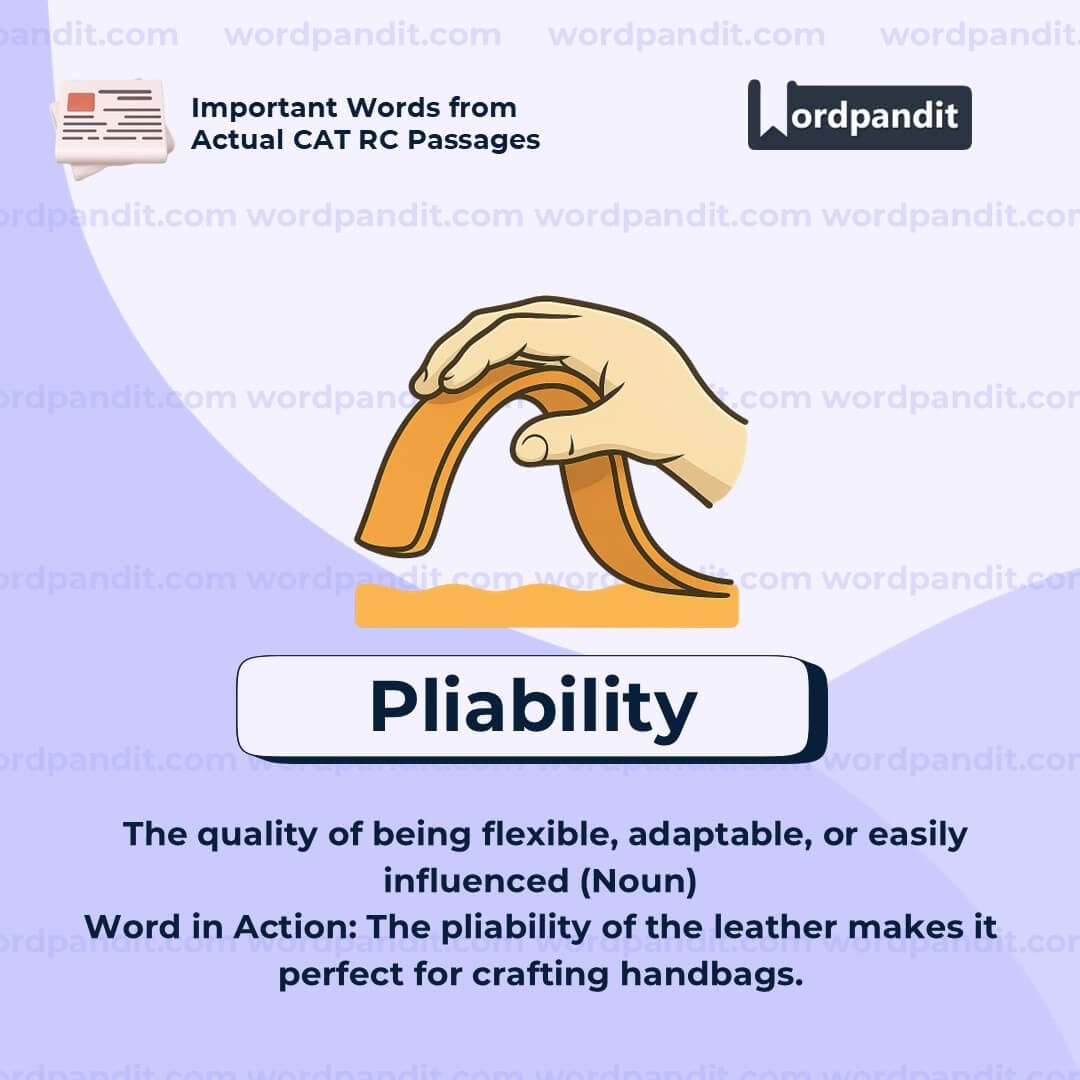
WORD-4: Pliability
Context:
"The Grammar Police aren’t going to come and take you away. Even William Strunk, that Mussolini of rhetoric, recognized the delicious pliability of language." - Source Unknown
Explanatory Paragraph:
"Pliability" refers to the capacity of something to be bent, shaped, or influenced easily—whether physically or metaphorically. In this context, it highlights the flexible, creative nature of language itself. Even the most rigid grammarians, like William Strunk, are portrayed as acknowledging that language can be playful and adaptable, not strictly bound to rules. This word suggests the beauty of flexibility in expression and communication.
Meaning: The quality of being flexible, adaptable, or easily influenced (Noun)
Pronunciation: ply-uh-BIL-uh-tee
Difficulty Level: ⭐⭐⭐ Intermediate
Etymology: From Latin *plicare* (“to fold”), evolving into Middle English *pliable* and later forming *pliability* as the noun form.
Prashant Sir's Notes:
This word is excellent for describing mental and structural flexibility. Use it to talk about anything that benefits from the ability to adapt—minds, language, even policies.
Synonyms & Antonyms:
Synonyms: flexibility, adaptability, suppleness, malleability
Antonyms: rigidity, inflexibility, stubbornness, firmness
Usage Examples:
- The delicious pliability of language allows poets to break rules and still make meaning.
- Pliability in leadership helps organizations adapt during times of crisis.
- Yoga promotes both physical strength and pliability.
- His pliability to peer pressure often got him into trouble.
Cultural Reference:
"The language is not a cage but a net—pliable, strong, and open." — Inspired by ideas in *The Language Instinct* by Steven Pinker
Think About It:
Is the pliability of language a strength that fosters creativity—or a danger that leads to miscommunication?
Quick Activity:
Take a common idiom or phrase and rewrite it in three different ways, exploring the pliability of expression.
Memory Tip:
Imagine *pliability* as a piece of soft clay—easy to mold, just like ideas or sentences when you're flexible with language.
Real-World Application:
Pliability is crucial in negotiation, education, and writing. People and ideas that are pliable tend to adapt and thrive in changing environments—whether in classrooms, boardrooms, or creative studios.
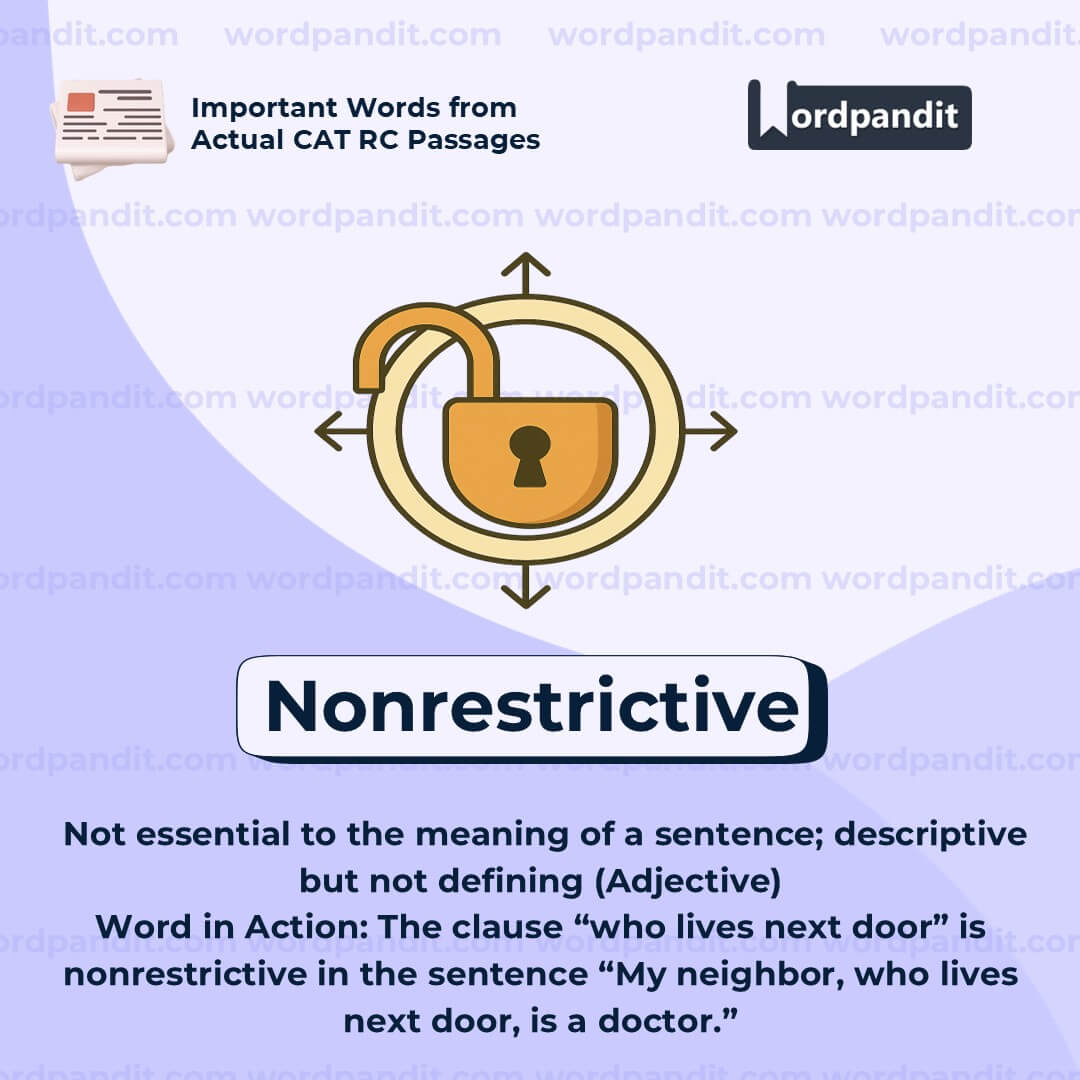
WORD-5: Nonrestrictive
Context:
"...but simple sentences provide a path you can follow when you fear getting lost in the tangles of rhetoric—all those restrictive and nonrestrictive clauses." - Source Unknown
Explanatory Paragraph:
"Nonrestrictive" is a grammatical term used to describe a clause that adds extra information to a sentence but is not essential to its basic meaning. These clauses are usually set off by commas. If removed, the main sentence still makes complete sense. In contrast to "restrictive" clauses, which limit or define the noun they describe, nonrestrictive clauses provide additional context or commentary.
Meaning: Not essential to the meaning of a sentence; descriptive but not defining (Adjective)
Pronunciation: non-ree-STRIK-tiv
Difficulty Level: ⭐⭐⭐ Intermediate
Etymology: From Latin *non-* (“not”) + *restringere* (“to bind tight”) → Late Latin *restrictivus* → English *restrictive* + prefix *non-* (not)
Prashant Sir's Notes:
Grammatically, nonrestrictive clauses are separated by commas. Think of them as little bonus facts—they’re nice to have but not essential. Use them wisely to add flair without losing clarity.
Synonyms & Antonyms:
Synonyms: descriptive, supplementary, parenthetical, optional
Antonyms: restrictive, defining, essential, limiting
Usage Examples:
- My sister, who lives in Paris, is visiting next week. ("who lives in Paris" is a nonrestrictive clause)
- Nonrestrictive clauses are often surrounded by commas to separate them from the main sentence.
- The old book, which was published in 1923, is still in excellent condition.
- Writers sometimes confuse restrictive and nonrestrictive clauses, leading to punctuation errors.
Cultural Reference:
Grammar guides like *The Elements of Style* by Strunk and White emphasize the correct use of nonrestrictive clauses, warning that misuse can lead to confusion in meaning.
Think About It:
Can the overuse of nonrestrictive clauses make writing elegant or excessive? Where is the balance between informative and distracting?
Quick Activity:
Write a sentence with a nonrestrictive clause. Then rewrite it without the clause and see if the meaning changes significantly.
Memory Tip:
“Nonrestrictive” = “not restricting.” It’s extra info—think of it as a decorative scarf, not a necessary coat!
Real-World Application:
In academic writing, journalism, and formal emails, mastering nonrestrictive clauses helps clarify ideas while adding nuance—without confusing your reader.

WORD-6: Explode
Context:
"Take any noun, put it with any verb, and you have a sentence. It never fails. Rocks explode. Jane transmits. Mountains float." - Source Unknown
Explanatory Paragraph:
The verb "explode" refers to a sudden and violent burst or expansion, often accompanied by noise and destruction. In literal use, it can describe bombs, volcanoes, or fireworks. Figuratively, it can also describe outbursts of emotion, rapid growth, or dramatic revelations. In the sentence provided, “Rocks explode” is an example of a simple, grammatically complete sentence, showcasing how any noun-verb pairing can form a sentence—even if it describes something unusual or imaginative.
Meaning: To burst or break apart suddenly and violently (Verb)
Pronunciation: ek-SPLOHD
Difficulty Level: ⭐⭐ Basic
Etymology: From Latin *explodere*, meaning “to drive out by clapping,” later shifting in English to mean “burst with noise” in the 17th century
Prashant Sir's Notes:
“Explode” is often a vivid, action-packed verb—great for energizing your writing. It's a classic example in grammar discussions because of its strong visual and auditory impact.
Synonyms & Antonyms:
Synonyms: detonate, erupt, burst, blow up, ignite
Antonyms: implode, extinguish, subside, deflate
Usage Examples:
- The bomb exploded seconds after the timer hit zero.
- Anger exploded in the crowd as the verdict was announced.
- Sales exploded after the product went viral on social media.
- When heated, the can may explode due to pressure buildup.
Cultural Reference:
“You wouldn’t like me when I’m angry.” — Bruce Banner (The Hulk), whose transformations into the Hulk often involve emotional and physical explosions. - *Marvel Comics*
Think About It:
What kinds of “explosions” happen in everyday life—emotionally, intellectually, or socially—and how do we manage them?
Quick Activity:
Write three short sentences like “Rocks explode.” Try to choose unusual nouns and dramatic verbs. How does it change the tone?
Memory Tip:
Think “explode” = "EXit with a PLODE" — an abrupt, noisy burst out of nowhere!
Real-World Application:
The word “explode” is frequently used in news headlines, scientific discussions, and emotional storytelling—making it a powerful verb in both literal and metaphorical language.
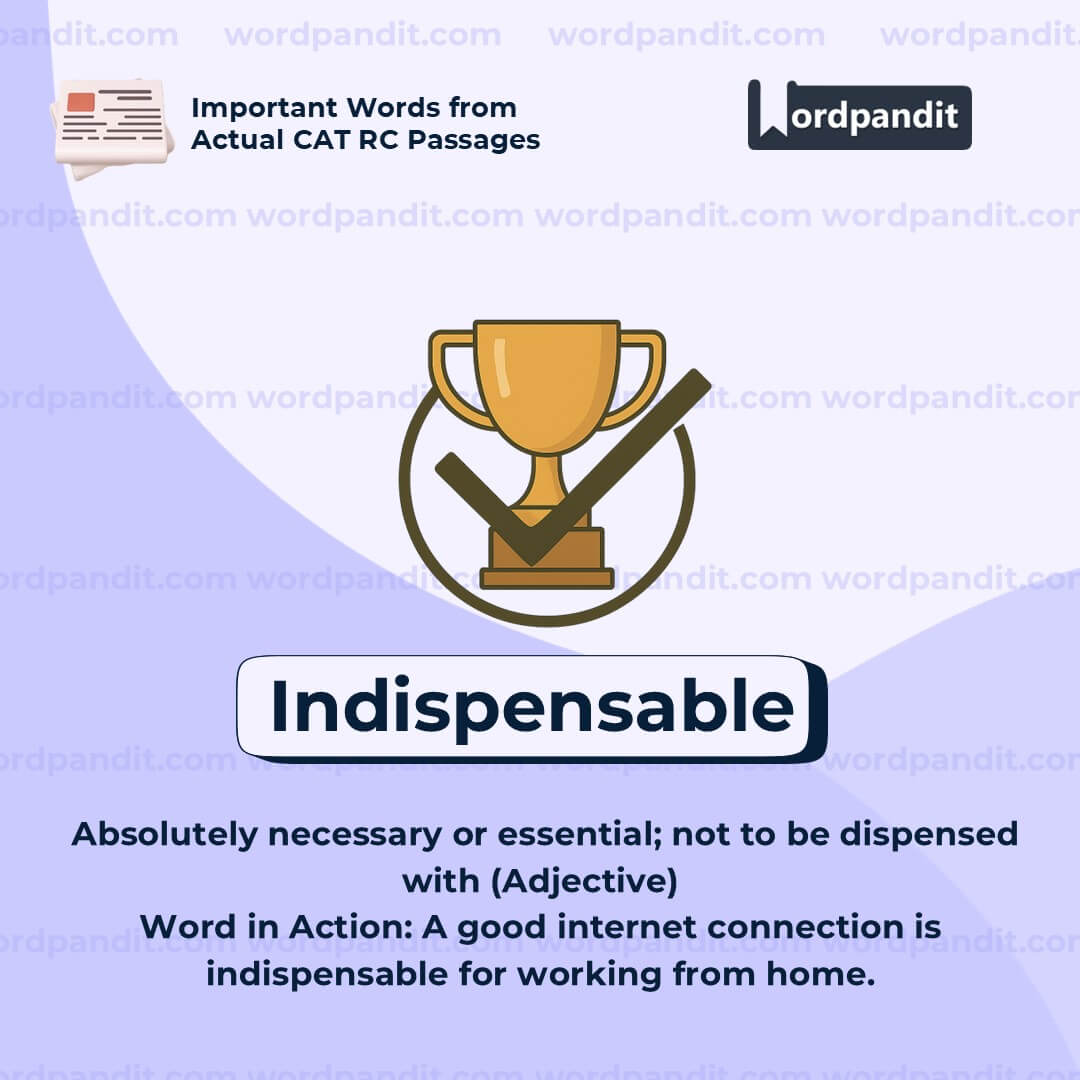
WORD-7: Indispensable
Context:
"Nouns and verbs are the two indispensable parts of writing. Without one of each, no group of words can be a sentence, since a sentence is, by definition, a group of words." - Source Unknown
Explanatory Paragraph:
"Indispensable" describes something so essential that it cannot be done without. In the given context, nouns and verbs are presented as indispensable components of writing—without them, you simply cannot form a grammatically complete sentence. This word often emphasizes necessity and fundamental importance, whether it's in language, teamwork, technology, or daily life.
Meaning: Absolutely necessary or essential; not to be dispensed with (Adjective)
Pronunciation: in-di-SPEN-suh-buhl
Difficulty Level: ⭐⭐⭐ Intermediate
Etymology: From Medieval Latin *indispensabilis*, meaning “not to be spared,” from Latin *in-* (“not”) + *dispensare* (“to distribute, manage”)
Prashant Sir's Notes:
This word is perfect for describing things you simply cannot do without. Use it in essays to emphasize something's critical role—be it ideas, people, or tools.
Synonyms & Antonyms:
Synonyms: essential, crucial, vital, necessary, mandatory
Antonyms: dispensable, unnecessary, optional, nonessential
Usage Examples:
- Good communication is indispensable in any healthy relationship.
- Water is indispensable for human survival.
- Her leadership was seen as indispensable during the crisis.
- The dictionary is an indispensable tool for language learners.
Cultural Reference:
"Do what you do so well that they will want to see it again and bring their friends." — Walt Disney, an indispensable figure in the world of animation and imagination. - Disney Archives
Think About It:
What’s one thing in your daily life that feels indispensable? Could you manage without it if you had to?
Quick Activity:
List five things you consider indispensable for effective learning. Then, try removing one—how would it impact your success?
Memory Tip:
“In-Dispensable” = "Not to be dispensed with" → If you can't toss it out, it's indispensable!
Real-World Application:
In job interviews or writing, describing a skill as “indispensable” can show its critical value. It’s a great term to highlight non-negotiable qualities in systems, teams, or roles.
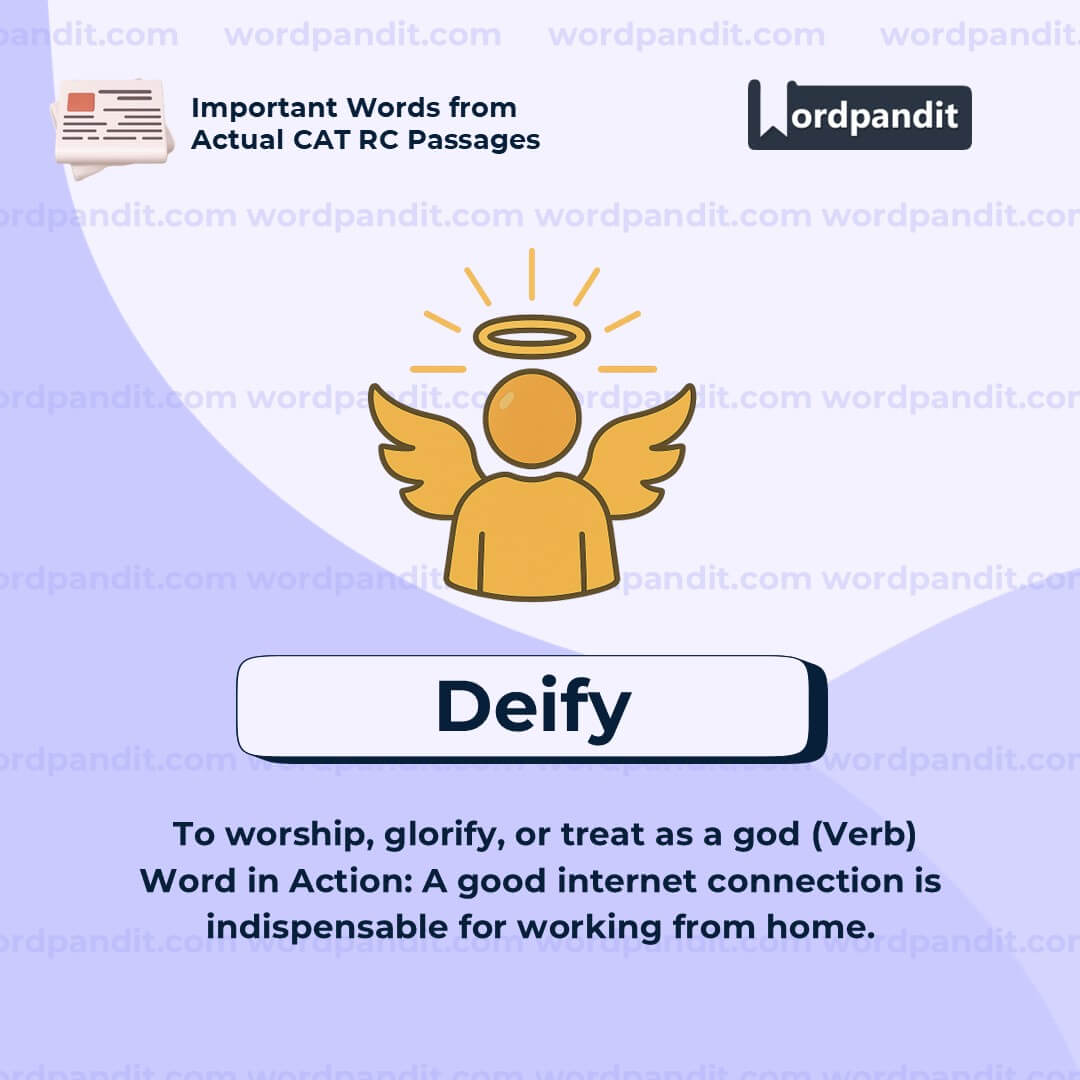
WORD-8: Deify
Context:
"Rocks explode, Jane transmits, mountains float, and plums deify. Grammar is . . . the pole you grab to get your thoughts up on their feet and walking." - Source Unknown
Explanatory Paragraph:
"Deify" means to treat or regard someone or something as a god—or to exalt them to a divine status. Literally, it implies making a god out of something; metaphorically, it can mean giving something exaggerated admiration or reverence. In the whimsical context of the sentence—“plums deify”—the word is playfully used to show that even the most unexpected nouns can be paired with dynamic verbs to form grammatically correct sentences. It emphasizes language's flexibility and the imagination behind even nonsensical grammar demonstrations.
Meaning: To worship, glorify, or treat as a god (Verb)
Pronunciation: DEE-uh-fy
Difficulty Level: ⭐⭐⭐ Intermediate
Etymology: From Latin *deus* (“god”) + *-ficare* (“to make”), meaning “to make into a god”
Prashant Sir's Notes:
Use this word with care—it can be literal (as in mythology or religion) or metaphorical (as in idolizing celebrities or ideas). Also great for discussing cultural or political phenomena.
Synonyms & Antonyms:
Synonyms: idolize, worship, exalt, glorify, venerate
Antonyms: demonize, condemn, belittle, disrespect
Usage Examples:
- Many ancient civilizations deified natural forces like the sun and wind.
- Some fans deify celebrities, treating them as infallible icons.
- He was deified in death, though controversial in life.
- We shouldn't deify technology—it's still a tool, not a savior.
Cultural Reference:
In Roman culture, emperors were often deified after death, turning political authority into divine worship. Julius Caesar was among the first to be officially deified. - Historical Records
Think About It:
Why do humans tend to deify certain figures or objects, even in modern secular cultures?
Quick Activity:
Make a list of three modern-day individuals or concepts that society often "deifies." How does this reverence affect objectivity?
Memory Tip:
“Deify” starts with “Dei”—think of “deity.” To deify something is to treat it like a deity.
Real-World Application:
Understanding the concept of "deify" helps in analyzing media, celebrity culture, political rhetoric, and even marketing—where products or people are elevated to near-godlike status to influence public perception.
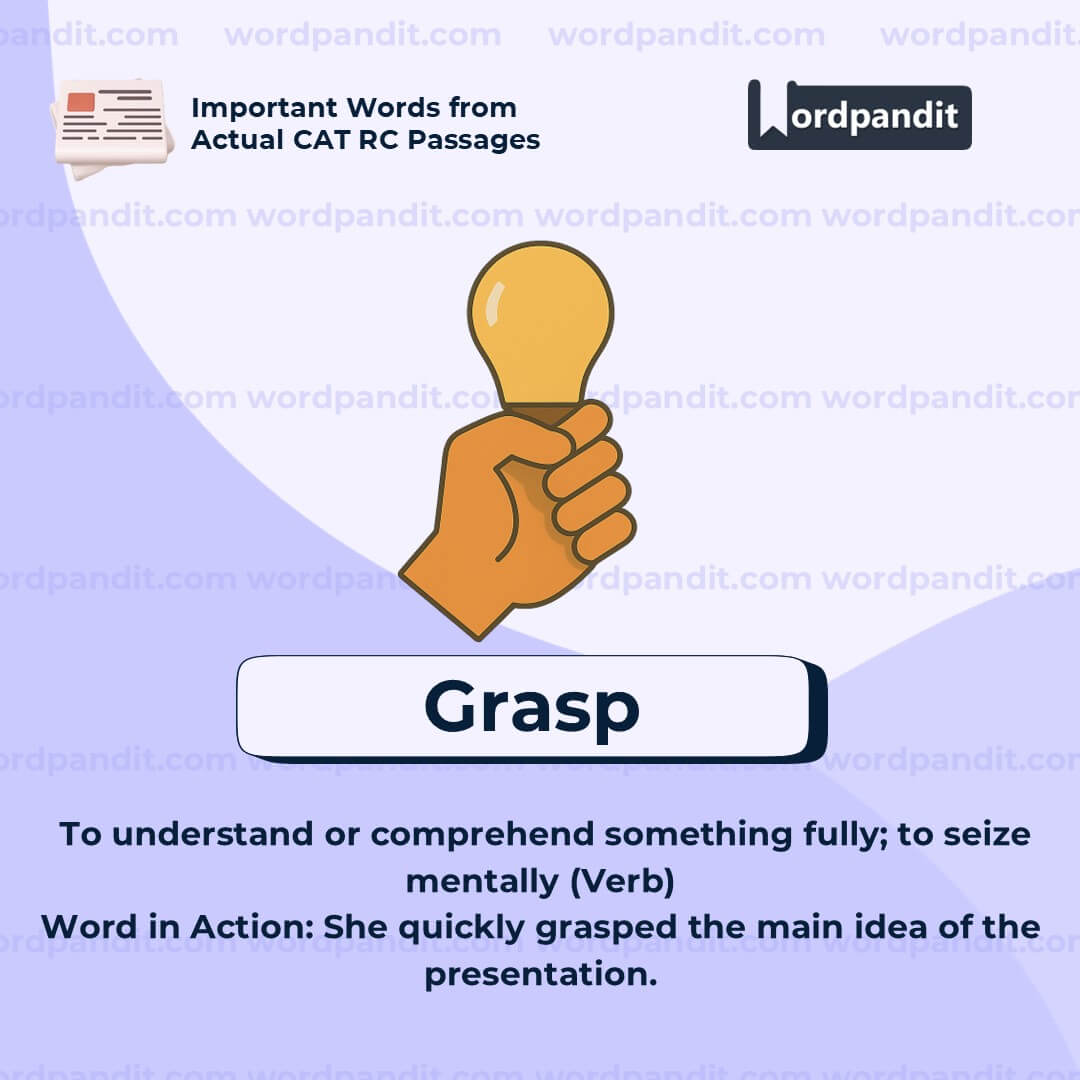
WORD-9: Grasp
Context:
"One who does grasp the rudiments of grammar finds a comforting simplicity at its heart, where there need be only nouns, the words that name, and verbs, the words that act." - Source Unknown
Explanatory Paragraph:
"Grasp" in this context refers to understanding or comprehending something—especially something foundational or conceptual like grammar. While the word can also mean physically holding something, in intellectual or metaphorical contexts it’s used to indicate mental clarity or mastery over a subject. Here, it implies that once a person understands the basics of grammar, they unlock a deeper, elegant simplicity within language.
Meaning: To understand or comprehend something fully; to seize mentally (Verb)
Pronunciation: grasp (rhymes with clasp)
Difficulty Level: ⭐⭐ Basic
Etymology: From Middle English *graspen*, possibly of Scandinavian origin; related to Old Norse *grípa*, meaning “to seize.”
Prashant Sir's Notes:
“Grasp” is one of those power verbs—simple yet versatile. It’s excellent when describing both mental and physical hold. In academic or learning contexts, use it to express comprehension.
Synonyms & Antonyms:
Synonyms: understand, comprehend, perceive, seize, fathom
Antonyms: misunderstand, overlook, ignore, misinterpret
Usage Examples:
- It took her a while to grasp the key concepts of quantum physics.
- Once you grasp the structure of a sentence, writing becomes more intuitive.
- He grasped the rope tightly to avoid falling.
- Despite repeated explanations, the student failed to grasp the logic behind the formula.
Cultural Reference:
“The more I read, the more I acquire, the more certain I am that I know nothing.” — Voltaire. A reminder that grasping knowledge is a lifelong pursuit, never truly complete. - Enlightenment Writings
Think About It:
Is there a difference between temporarily understanding something and truly grasping it at a deeper level? What does it take to turn short-term learning into lasting grasp?
Quick Activity:
Write down three concepts you feel you’ve truly grasped. How did you reach that level of understanding? Reflect on the process.
Memory Tip:
Imagine grasping a concept like grabbing a ball—once you have it in your hand (or mind), you control it fully.
Real-World Application:
Whether learning a language, mastering a skill, or preparing for an exam, the ability to fully grasp key ideas is what transforms passive information into practical knowledge.
WORD-10: Coherent
Context:
"If you don’t have a rudimentary grasp of how the parts of speech translate into coherent sentences, how can you be certain that you are doing well?" - Source Unknown
Explanatory Paragraph:
"Coherent" refers to something that is logical, clear, and consistent—particularly in speech or writing. In this context, it describes sentences that flow logically and make sense because the grammatical building blocks (like nouns and verbs) are correctly and effectively combined. A coherent sentence isn't just grammatically correct; it's also easy to follow and understand, forming a smooth path for ideas to travel from the writer to the reader.
Meaning: Logical and consistent; forming a unified whole (Adjective)
Pronunciation: koh-HEER-uhnt
Difficulty Level: ⭐⭐⭐ Intermediate
Etymology: From Latin *cohaerentem*, present participle of *cohaerere* (“to stick together”), formed from *com-* (“together”) + *haerere* (“to stick”)
Prashant Sir's Notes:
“Coherent” is a great word to describe clarity in thought or writing. Use it to evaluate arguments, essays, or even conversations. It's not just about being correct—it’s about making sense as a whole.
Synonyms & Antonyms:
Synonyms: logical, clear, consistent, intelligible, connected
Antonyms: incoherent, confusing, disjointed, illogical, rambling
Usage Examples:
- Her essay was well-structured and completely coherent from start to finish.
- The teacher praised him for presenting his argument in a coherent way.
- Without coherence, even a grammatically correct sentence can be hard to follow.
- The witness gave a coherent account of the incident, which helped the jury understand the sequence of events.
Cultural Reference:
“A writer’s job is to make the incoherent coherent.” — Adapted from David Foster Wallace, whose essays often grappled with complex, chaotic topics and rendered them accessible. - Literary Reflections
Think About It:
What makes a piece of writing or a speech feel truly coherent, and how do you recognize when something lacks coherence?
Quick Activity:
Take a paragraph you've written recently and evaluate its coherence. Does every sentence connect logically? Rewrite one section for improved clarity.
Memory Tip:
“Coherent” contains “here”—everything in a coherent sentence stays “here,” connected in the same place, sticking together logically.
Real-World Application:
In academic writing, job interviews, and public speaking, coherence ensures that your audience follows and understands your message. It’s a foundational skill for effective communication.


