
📘 What’s Inside This CAT Misfit Sentence/Odd One Out Question Post?
📝 Authentic CAT Misfit Sentence/Odd One Out Question: Practice with a real CAT Para-jumble Question from a previous CAT exam.
✅ Detailed Question with Step-by-Step Solution: Each question is explained thoroughly for better understanding.
📚 Vocabulary Enhancement: Top 5 words explained from the paragraph
Misfit Sentence/Odd One Out Question
Question 21: Five jumbled up sentences, related to a topic, are given below. Four of them can be put together to form a coherent paragraph. Identify the odd one out and key in the number of the sentence as your Answer:
1. You can observe the truth of this in every e-business model ever constructed: monopolise and protect data.
2. Economists and technologists believe that a new kind of capitalism is being created - different from industrial capitalism as was merchant capitalism.
3. In 1962, Kenneth Arrow, the guru of mainstream economics, said that in a free market economy the purpose of inventing things is to create intellectual property rights.
4. There is, alongside the world of monopolised information and surveillance, a different dynamic growing up: information as a social good, incapable of being owned or exploited or priced.
5. Yet information is abundant. Information goods are freely replicable. Once a thing is made, it can be copied and pasted infinitely.
Solution with Explanation
Answer: 2
Detailed explanation by Wordpandit:
The coherent theme running through sentences 1, 3, 4, and 5 is the nature of information in the context of intellectual property, digital abundance, and economic control. These sentences together build a logical paragraph around how information is treated in today's market — particularly in digital and e-business models.Let’s go through the sentences in detail:Sentence 3: This provides the foundation by citing economist Kenneth Arrow’s view that inventions in a free market are motivated by the creation of intellectual property rights. This introduces the concept of turning knowledge into proprietary, controlled assets.Sentence 1: Expands on this by pointing to real-world examples in e-business, where data is monopolized and protected — essentially putting Arrow’s theory into practice.Sentence 5: Introduces a contrast — although information is protected, it is actually abundant and easily replicable. This creates a tension between abundance and control.Sentence 4: Develops that tension further by suggesting an alternative perspective: that information is (or should be) a social good, not owned or priced.Together, these four form a rich, coherent paragraph discussing intellectual property, monopolization of information, and the competing idea of information as a free resource.Sentence 2: While it talks about a “new kind of capitalism,” it introduces an unrelated analogy to “merchant capitalism” and doesn’t connect clearly to the central discussion on data, information, or digital replication. It changes the focus of the paragraph from the treatment of information to economic systems at large, which breaks the logical flow.
Hence, Sentence 2 is the odd one out.
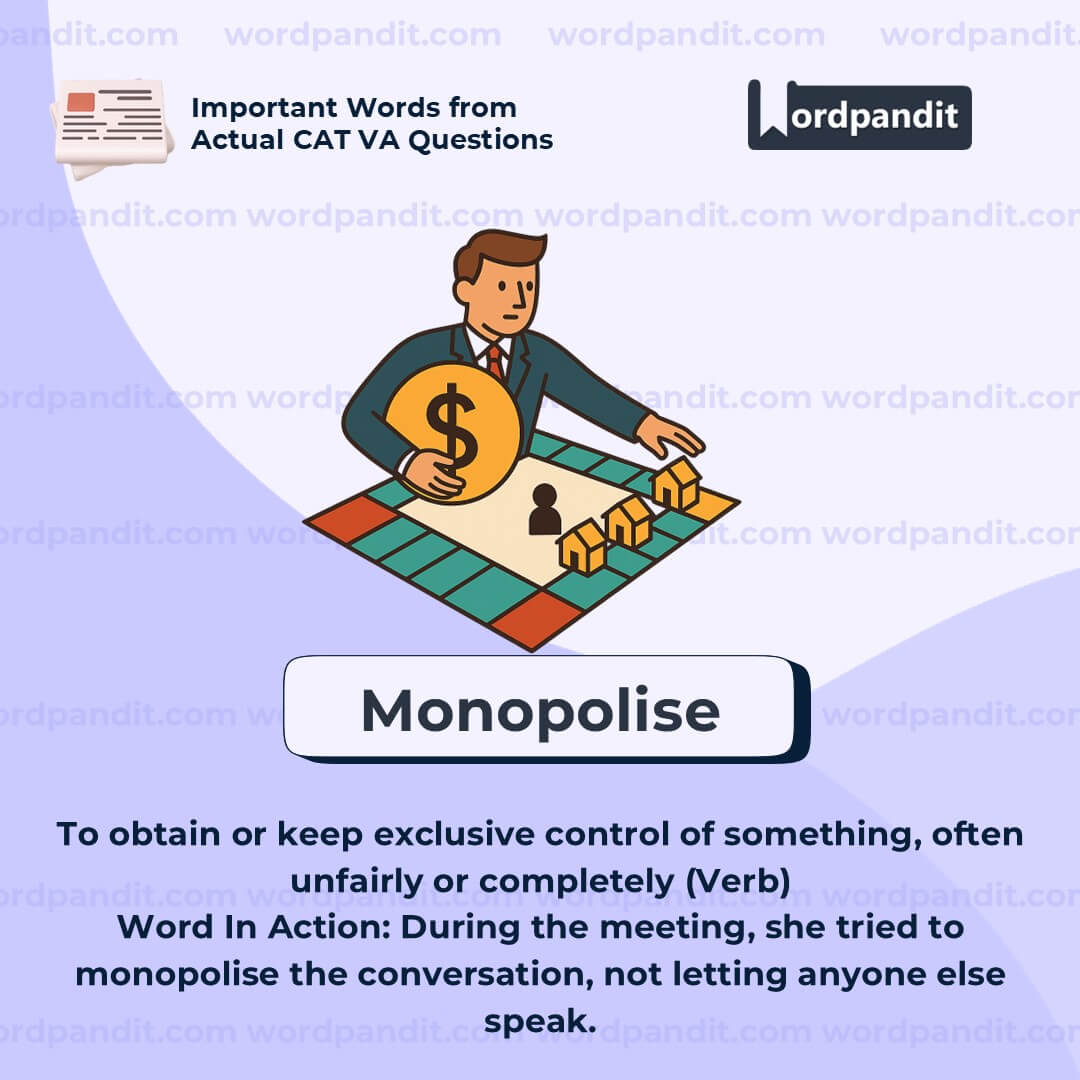
Word-1: Monopolise
Context:
"You can observe the truth of this in every e-business model ever constructed: monopolise and protect data." - Source Unknown
Explanatory Paragraph:
“Monopolise” means to take complete control or ownership of something, especially in a way that prevents others from accessing or using it. In economic and digital contexts, it often refers to the act of gaining exclusive control over a market or resource. In this example, digital companies are said to **monopolise data**, meaning they collect and guard user information to prevent competitors from benefiting—using it as a strategic asset to dominate the market.
Meaning: To obtain or keep exclusive control of something, often unfairly or completely (Verb)
Pronunciation: muh-NOP-uh-lyze (British spelling: monopolise; American: monopolize)
Difficulty Level: ⭐⭐ Beginner
Etymology: From Greek *monos* (alone) + *polein* (to sell); through Latin *monopolium* and French *monopole*.
Prashant Sir's Notes:
This word is highly relevant in business, technology, and political discussions. Companies that **monopolise** markets reduce competition, which often leads to higher prices or limited innovation. In essays, it can show an understanding of corporate power and digital control.
Synonyms & Antonyms:
Synonyms: dominate, control, corner the market, take over, command
Antonyms: share, distribute, democratize, decentralize, open access
Usage Examples:
- Big Tech companies monopolise vast amounts of user data to maintain competitive advantage.
- No single player should be allowed to monopolise public services.
- They tried to monopolise the conversation by speaking over everyone else.
- By monopolising supply chains, the firm was able to dictate market terms.
Cultural Reference:
The board game **Monopoly** is based on the idea of monopolising property to bankrupt opponents—mirroring real-world concerns about corporate monopolies like Amazon or Google dominating entire sectors.
Think About It:
Is it ever ethical to monopolise something essential—like knowledge, medicine, or communication platforms?
Quick Activity:
List two industries where companies are often accused of monopolising something. What are the consequences?
Memory Tip:
“Monopolise” = **mono** (one) + **polise** (power/control) → Think of one player controlling everything.
Real-World Application:
Understanding monopolisation is crucial in economics, law, and digital ethics—especially in debates about data privacy, platform power, and fair competition in global markets.
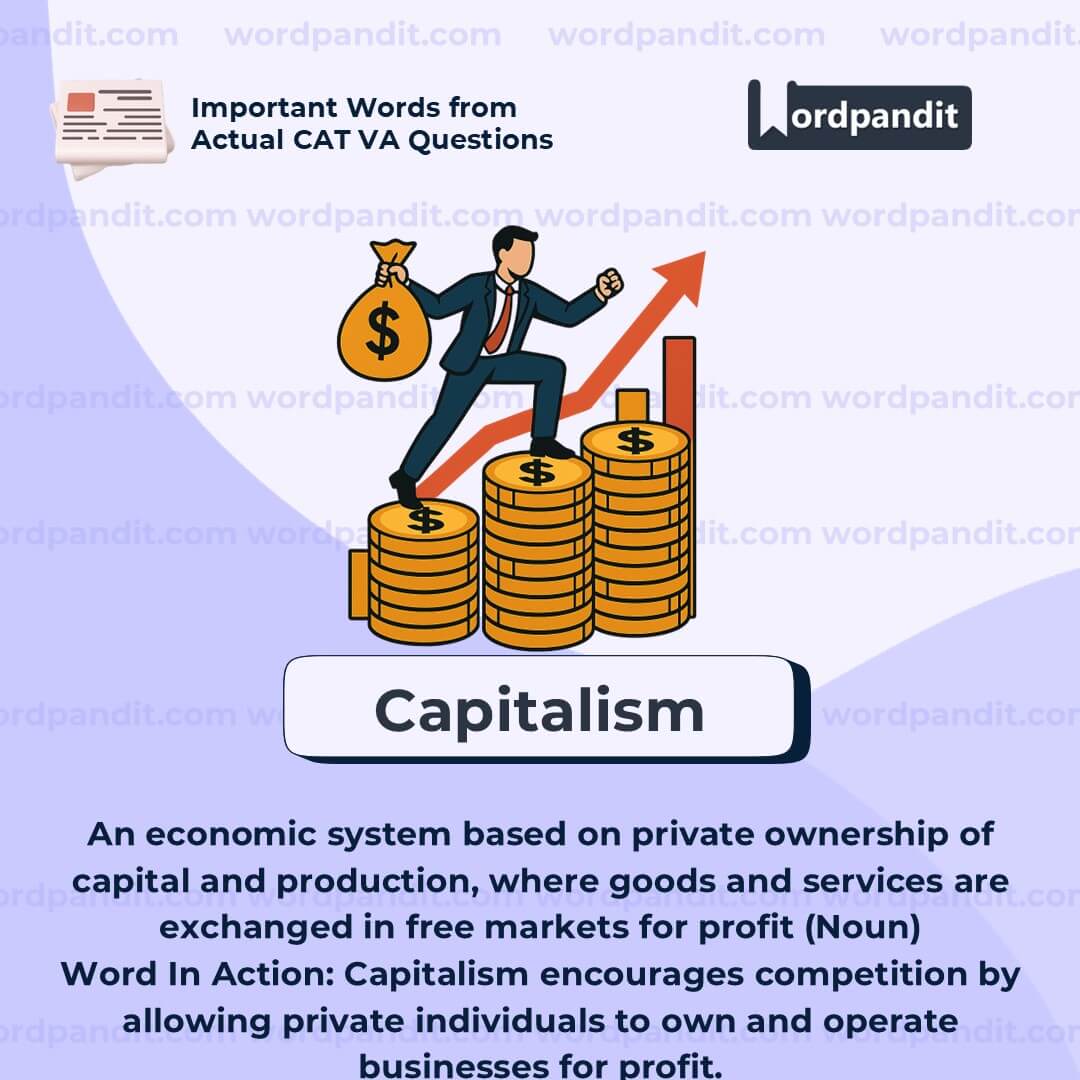
Word-2: Capitalism
Context:
"Economists and technologists believe that a new kind of capitalism is being created — different from industrial capitalism as was merchant capitalism." - Source Unknown
Explanatory Paragraph:
“Capitalism” is an economic and political system in which private individuals or corporations own and control property and businesses, rather than the state. Profit-making, free markets, competition, and private ownership are key features. In the context above, the author highlights the evolution of capitalism—from merchant capitalism (focused on trade), to industrial capitalism (based on factories and production), to a new form possibly driven by data, technology, and digital platforms. This suggests that **capitalism** is not static, but constantly adapting to new resources and power structures.
Meaning: An economic system based on private ownership of capital and production, where goods and services are exchanged in free markets for profit (Noun)
Pronunciation: KAP-ih-tuh-liz-um
Difficulty Level: ⭐⭐⭐ Intermediate
Etymology: From Latin *capitalis* (relating to the head or principal), through Middle French *capitalisme*, first used in the mid-19th century to describe systems based on capital accumulation.
Prashant Sir's Notes:
“Capitalism” is one of the most debated and analyzed terms in economics and political science. Make sure you understand not just its basic definition, but its variations—like surveillance capitalism or stakeholder capitalism. It’s essential vocabulary for critical writing and discussion.
Synonyms & Antonyms:
Synonyms: free-market economy, private enterprise, market economy
Antonyms: socialism, communism, state-controlled economy, collectivism
Usage Examples:
- Capitalism encourages competition and innovation but can also lead to inequality.
- The rise of tech giants reflects a shift toward digital capitalism.
- Critics of capitalism argue that it prioritizes profit over social welfare.
- This new form of capitalism relies on data rather than traditional labor or goods.
Cultural Reference:
Thinkers like **Adam Smith**, **Karl Marx**, and **Milton Friedman** have shaped modern debates about capitalism—praising its efficiency or critiquing its moral and social consequences.
Think About It:
Can capitalism adapt to meet the challenges of climate change, inequality, and data privacy? Or does it need fundamental restructuring?
Quick Activity:
List two strengths and two weaknesses of capitalism. Then write one sentence about how it's evolving in the digital age.
Memory Tip:
“Capitalism” is centered on **capital**—money, assets, and resources used to generate more wealth.
Real-World Application:
Capitalism affects everything from job markets and healthcare to technology, education, and global trade—understanding it is vital for analyzing modern economic and political systems.
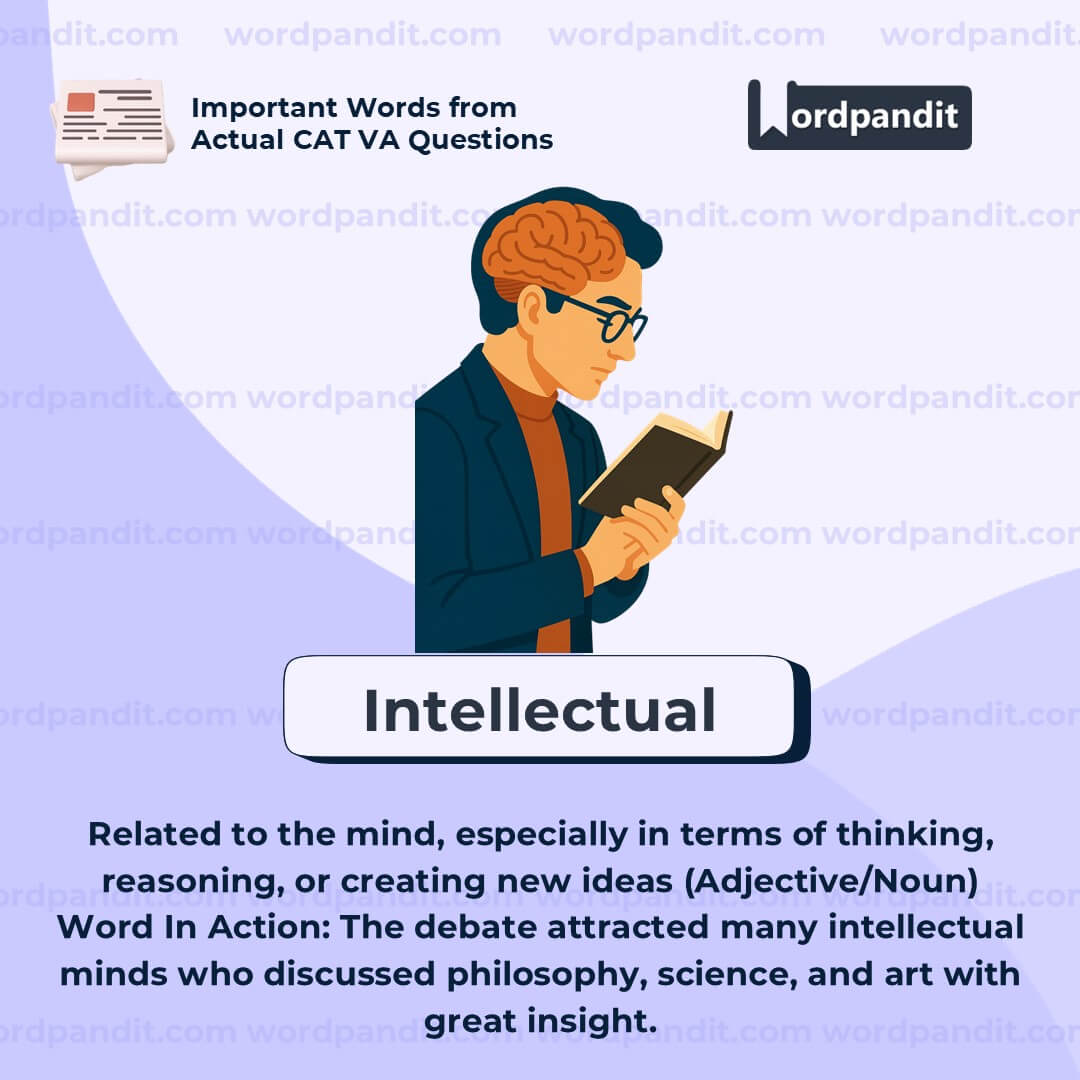
Word-3: Intellectual
Context:
"In 1962, Kenneth Arrow, the guru of mainstream economics, said that in a free market economy the purpose of inventing things is to create intellectual property rights." - Source Unknown
Explanatory Paragraph:
“Intellectual” refers to anything related to the use of the mind, especially in activities like reasoning, understanding, learning, and creating ideas. In this context, **intellectual property** refers to creations of the mind—like inventions, literary works, and designs—that can be owned and legally protected. Kenneth Arrow’s observation highlights how, in a capitalist economy, the value of innovation lies not just in the invention itself, but in the legal rights associated with it—**intellectual** rights that convert ideas into marketable assets.
Meaning: Related to the mind, especially in terms of thinking, reasoning, or creating new ideas (Adjective/Noun)
Pronunciation: in-tuh-LEK-choo-uhl
Difficulty Level: ⭐⭐ Beginner
Etymology: From Latin *intellectus* (understanding), from *intellegere* (to understand), combining *inter-* (between) and *legere* (to choose or read).
Prashant Sir's Notes:
“Intellectual” has two key uses: as an **adjective**, it describes mental or idea-based activities (e.g., intellectual effort); as a **noun**, it refers to someone who lives by ideas (e.g., a scholar or thinker). Very useful in academic, legal, and cultural discussions.
Synonyms & Antonyms:
Synonyms: cognitive, mental, academic, cerebral, thoughtful
Antonyms: physical, emotional, instinctive, manual
Usage Examples:
- The book sparked an important intellectual debate about technology and society.
- Patents protect intellectual property by giving creators exclusive rights to their inventions.
- She is known as a leading intellectual in the field of economic theory.
- The company’s most valuable assets are not physical, but intellectual—its algorithms and brand ideas.
Cultural Reference:
In global policy and economics, **intellectual property rights (IPR)** are a key issue—governing the legal protections for inventions, software, music, trademarks, and more. Disputes over IPR frequently arise in trade deals and innovation laws.
Think About It:
Should all ideas be turned into intellectual property, or does that limit creativity and access in the long run?
Quick Activity:
Make a list of three types of intellectual property you encounter in daily life (e.g., apps, books, logos). Who owns them?
Memory Tip:
“Intellectual” = “inter + legere” → Someone who “chooses between ideas” or uses **discerning thought**.
Real-World Application:
“Intellectual” is a key word in law, education, tech, and business. From copyrights to patents, understanding intellectual property is essential in today’s knowledge-driven economy.
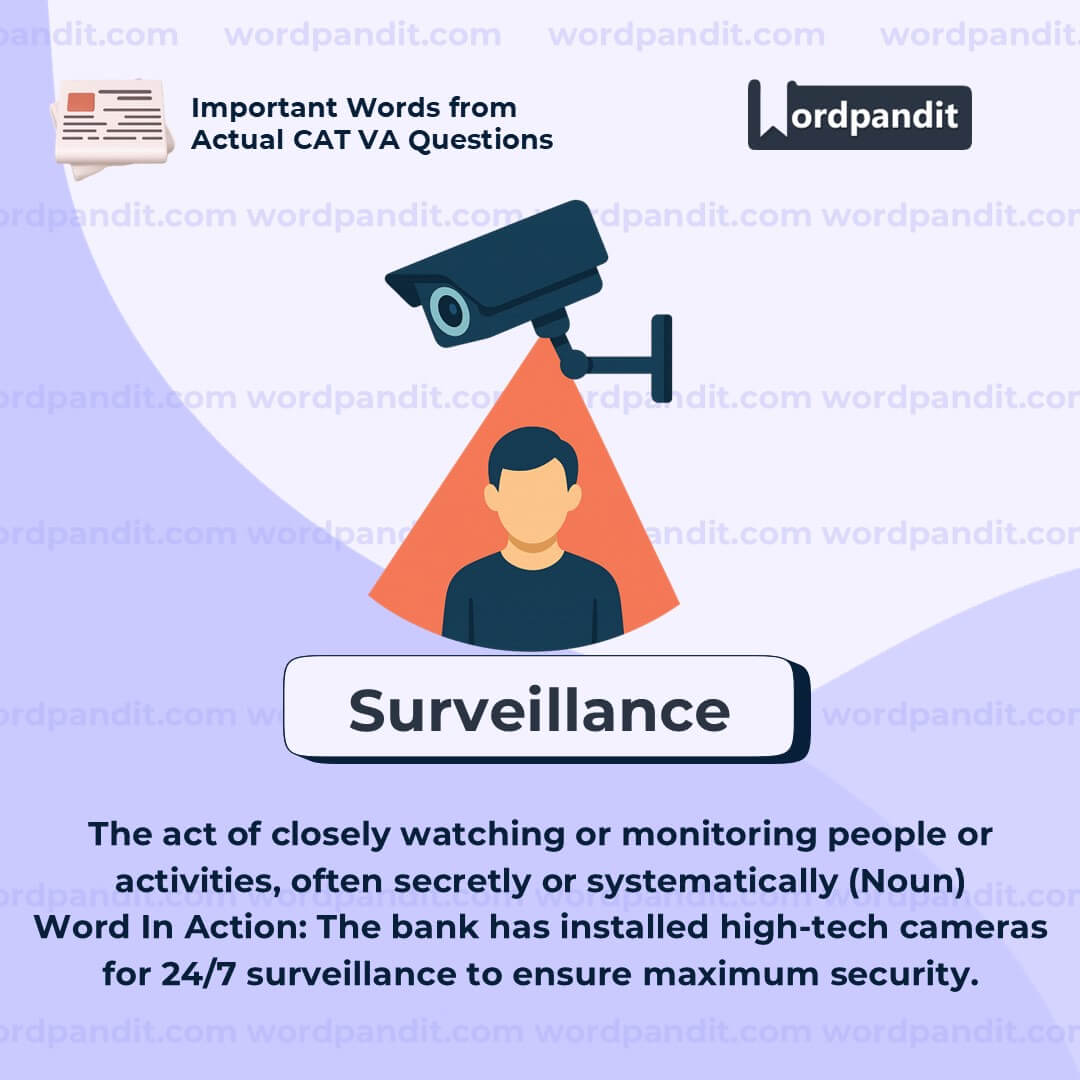
Word-4: Surveillance
Context:
"There is, alongside the world of monopolised information and surveillance, a different dynamic growing up: information as a social good, incapable of being owned or exploited or priced." - Source Unknown
Explanatory Paragraph:
“Surveillance” refers to the close observation or monitoring of people, behavior, or data—often for security, control, or intelligence purposes. In the digital age, **surveillance** is not limited to governments; corporations also monitor users through data tracking, facial recognition, location logs, and online behavior. In this context, surveillance is linked with monopolised information, implying a system where data is not only collected for profit, but also used to watch, influence, and possibly manipulate individuals or groups.
Meaning: The act of closely watching or monitoring people or activities, often secretly or systematically (Noun)
Pronunciation: sur-VAY-luns
Difficulty Level: ⭐⭐⭐ Intermediate
Etymology: From French *surveillance* (oversight), from *sur-* (over) + *veiller* (to watch), based on Latin *vigilare* (to stay awake, watch).
Prashant Sir's Notes:
“Surveillance” is a must-know term in digital literacy, politics, and sociology. It’s central to debates on privacy, freedom, and control. Surveillance isn't always visible—but it's increasingly embedded in the tech systems we use every day.
Synonyms & Antonyms:
Synonyms: monitoring, observation, tracking, oversight, spying
Antonyms: privacy, freedom, autonomy, secrecy
Usage Examples:
- Governments use surveillance to monitor public spaces and online communications.
- Mass surveillance has sparked global debates about civil liberties and human rights.
- The app’s terms allow it to conduct low-level surveillance on user activity.
- Surveillance capitalism describes how companies profit by tracking and analyzing personal data.
Cultural Reference:
Books like George Orwell’s 1984 popularized the fear of totalitarian **surveillance**. In today’s world, whistleblowers like Edward Snowden have exposed real-time digital surveillance programs, fueling global privacy movements.
Think About It:
At what point does surveillance shift from protection to oppression? Who watches the watchers?
Quick Activity:
List three technologies used for surveillance today. Then note one benefit and one risk of each.
Memory Tip:
“Surveillance” = **sur** (over) + **veiller** (to watch) → Imagine a drone watching everything from above.
Real-World Application:
Understanding surveillance is essential in today’s world of social media, smart devices, CCTV, and cybersecurity. It affects law enforcement, advertising, healthcare, and individual freedoms.
Word-5: Replicable
Context:
"Yet information is abundant. Information goods are freely replicable." - Source Unknown
Explanatory Paragraph:
“Replicable” refers to something that can be copied, reproduced, or repeated, especially with accuracy. In the digital age, **information goods**—such as software, e-books, videos, and databases—are considered **freely replicable** because they can be duplicated at virtually no cost and distributed instantly across the internet. This characteristic sets them apart from physical goods, which require materials, labor, and logistics to replicate. The replicability of information challenges traditional models of ownership and profit in a capitalist system that was designed around scarcity.
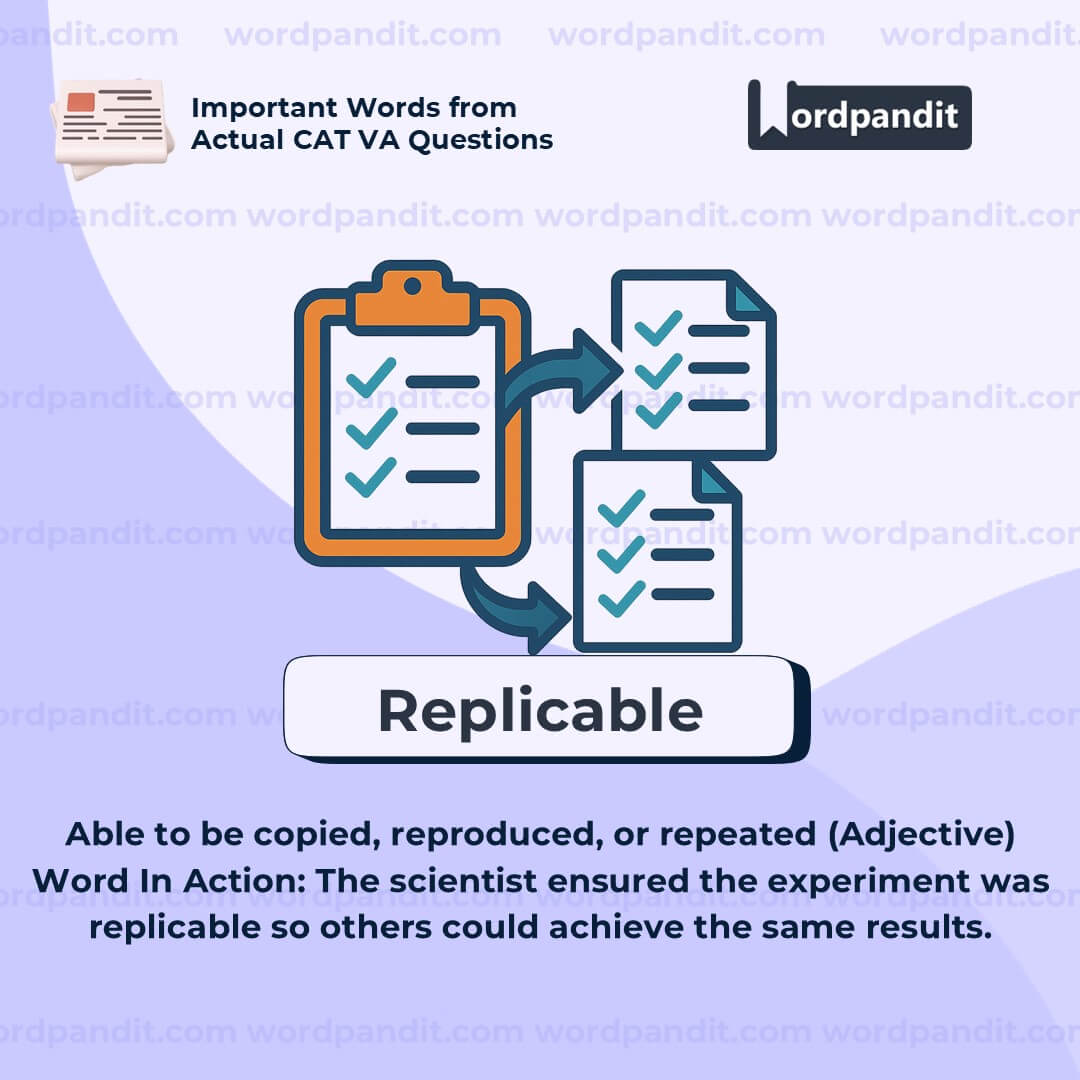
Meaning: Able to be copied, reproduced, or repeated (Adjective)
Pronunciation: REP-li-kuh-buhl
Difficulty Level: ⭐⭐ Intermediate
Etymology: From Latin *replicare* (to fold back, repeat), + English suffix *-able* (capable of).
Prashant Sir's Notes:
“Replicable” is frequently used in research, science, and digital technology. In academic contexts, a replicable experiment means one that can be reliably repeated. In tech and business, it refers to products or systems that can be scaled easily because they can be reproduced without much cost or variation.
Synonyms & Antonyms:
Synonyms: reproducible, copyable, duplicable, transferable, repeatable
Antonyms: unique, non-replicable, original, unrepeatable
Usage Examples:
- Digital content is easily replicable and can spread globally within seconds.
- Scientific findings must be replicable to be considered valid.
- The business model proved highly replicable and was adopted across regions.
- Information goods, unlike physical goods, are freely replicable and nearly costless to distribute.
Cultural Reference:
In the age of the internet, media like memes, songs, and educational resources are **replicable** at scale—fueling movements like open-source software, Creative Commons licensing, and knowledge sharing on platforms like Wikipedia.
Think About It:
How does the replicability of digital goods challenge traditional ideas of ownership, pricing, and intellectual property?
Quick Activity:
List three replicable digital goods you use regularly. What makes them different from non-replicable goods like handmade crafts or physical books?
Memory Tip:
“Replicable” = **replica** → If you can make a replica (an exact copy), it’s replicable!
Real-World Application:
“Replicable” is a key term in tech innovation, scientific research, and digital business—highlighting how easily something can be scaled, validated, or redistributed in modern systems.
