
📘 What’s Inside This CAT Misfit Sentence/Odd One Out Question Post?
📝 Authentic CAT Misfit Sentence/Odd One Out Question: Practice with a real CAT Para-jumble Question from a previous CAT exam.
✅ Detailed Question with Step-by-Step Solution: Each question is explained thoroughly for better understanding.
📚 Vocabulary Enhancement: Top 5 words explained from the paragraph
Misfit Sentence/Odd One Out Question
Question 24: Five jumbled up sentences, related to a topic, are given below. Four of them can be put together to form a coherent paragraph. Identify the odd one out and key in the number of the sentence as your Answer:
1. The victim’s trauma after assault rarely gets the attention that we lavish on the moment of damage that divided the survivor from a less encumbered past.
2. One thing we often do with narratives of sexual assault is sort their respective parties into different temporalities: it seems we are interested in perpetrators’ futures and victims’ pasts.
3. One result is that we don’t have much of a vocabulary for what happens in a victim’s life after the painful past has been excavated, even when our shared language gestures toward the future, as the term “survivor” does.
4. Even the most charitable questions asked about the victims seem to focus on the past, in pursuit of understanding or of corroboration of painful details.
5. As more and more stories of sexual assault have been made public in the last two years, the genre of their telling has exploded --- crimes have a tendency to become not just stories but genres.
Solution with Explanation
Answer: 4
The central theme in the paragraph revolves around the public and cultural treatment of sexual assault narratives. Specifically, it focuses on how attention is unevenly distributed between the futures of perpetrators and the pasts of victims, and how this affects the way we talk about trauma and survival.
- Sentence 5 introduces the rise in public storytelling about sexual assault and sets the context by noting that such narratives have become genre-like in structure.
- Sentence 2 builds on this by explaining how these stories tend to sort victims and perpetrators into different timelines—victims being defined by their pasts, while perpetrators are allowed to imagine futures.
- Sentence 3 explains the consequence of this imbalance: we lack a meaningful vocabulary to talk about the future of survivors, even when the term “survivor” implies forward movement.
- Sentence 1 deepens the discussion, noting how trauma experienced by the victim post-assault is neglected in favor of focusing on the moment of violence itself.
Sentence 4, while related in theme, takes a slightly different direction. It introduces the notion of “questions asked about victims,” which changes the focus from narrative structure and collective framing to individual interrogation. This line of thought is not seamlessly connected to the rest of the paragraph, which is more concerned with broad narrative patterns rather than personal questioning.
Final Answer: 4
Word-1: Trauma
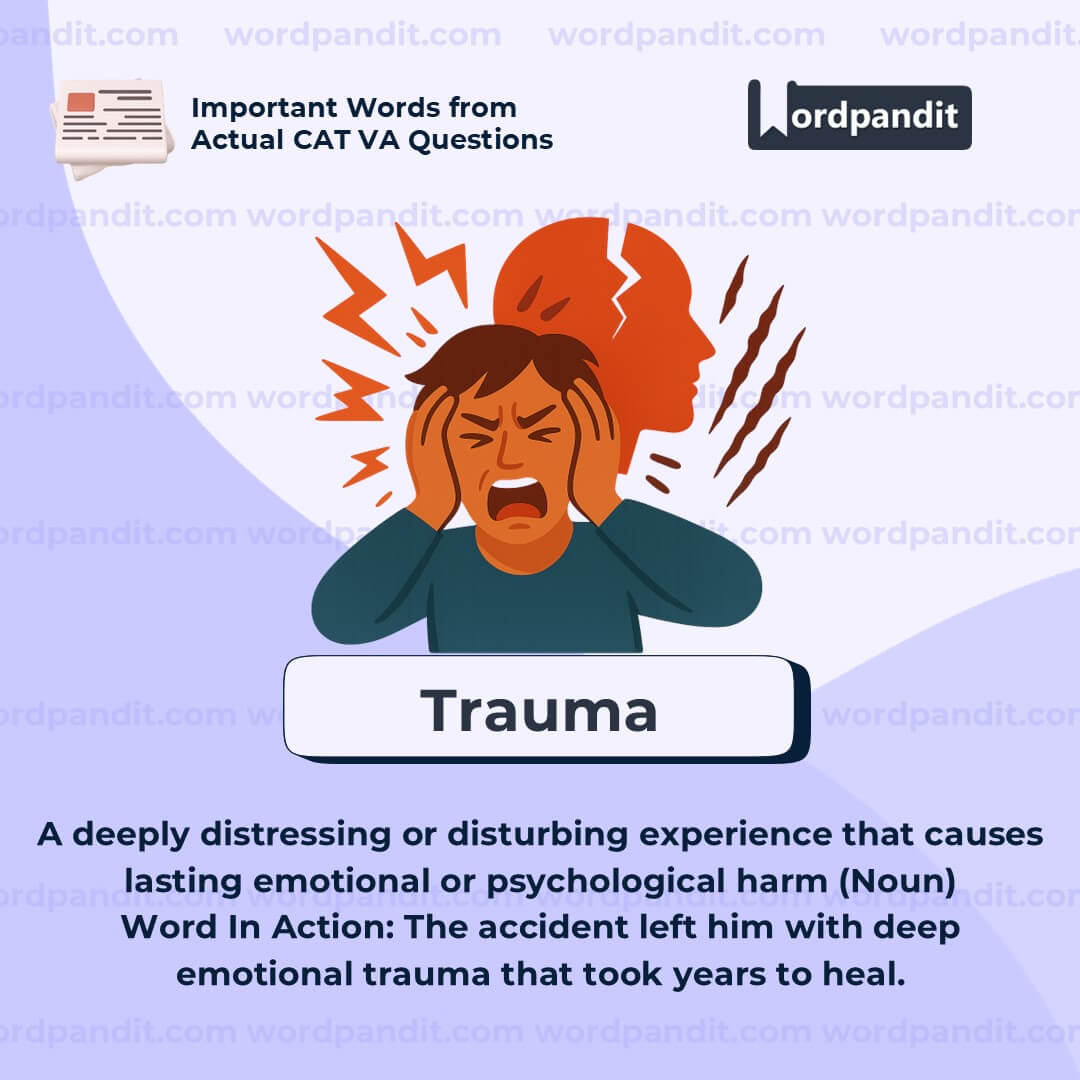
Context:
"The victim’s trauma after assault rarely gets the attention that we lavish on the moment of damage that divided the survivor from a less encumbered past." - Source Unknown
Explanatory Paragraph:
“Trauma” refers to a deeply distressing or disturbing experience, especially one that has lasting psychological, emotional, or physical effects. In this context, **trauma** describes the internal, long-term suffering that a survivor experiences after an assault—pain that often goes unnoticed in favor of dramatizing the moment of the incident itself. The sentence critiques how society focuses on the event of violence, rather than the lingering harm that trauma inflicts on a person’s sense of identity, memory, and everyday life.
Meaning: A deeply distressing or disturbing experience that causes lasting emotional or psychological harm (Noun)
Pronunciation: TRAW-muh
Difficulty Level: ⭐⭐ Beginner
Etymology: From Greek *trauma* meaning “wound,” originally used in medical contexts for physical injuries but later extended to emotional and psychological harm.
Prashant Sir's Notes:
This is a sensitive and powerful word, often used in psychology, literature, and activism. It is important to distinguish **trauma** from a temporary shock—trauma is long-lasting and deeply embedded. In writing, using this word adds emotional weight and seriousness to your argument or narrative.
Synonyms & Antonyms:
Synonyms: shock, anguish, distress, suffering, psychological wound
Antonyms: healing, peace, recovery, comfort, relief
Usage Examples:
- The trauma of war haunted the soldier long after he returned home.
- Therapy helped her process the trauma she had carried since childhood.
- Media coverage often overlooks the survivor’s trauma and focuses only on the crime.
- The trauma left her unable to trust others for years.
Cultural Reference:
In recent decades, **trauma studies** have become a major field in literature, psychology, and sociology—exploring how individuals and societies cope with events like war, genocide, abuse, and systemic violence. Works by Judith Herman and Bessel van der Kolk are central in this field.
Think About It:
Why do you think society pays more attention to the moment of violence than to the survivor’s long-term trauma? What does that reveal about our values?
Quick Activity:
Write one sentence describing a character’s trauma in a novel, film, or real-life story. What changed for them as a result?
Memory Tip:
“Trauma” = “wound” (in Greek) → Think of trauma as a **wound to the mind or heart**, not just the body.
Real-World Application:
Understanding trauma is essential in fields like healthcare, education, law, counseling, and social work. It helps professionals respond with empathy and develop systems that support healing and resilience.
Word-2: Temporalities
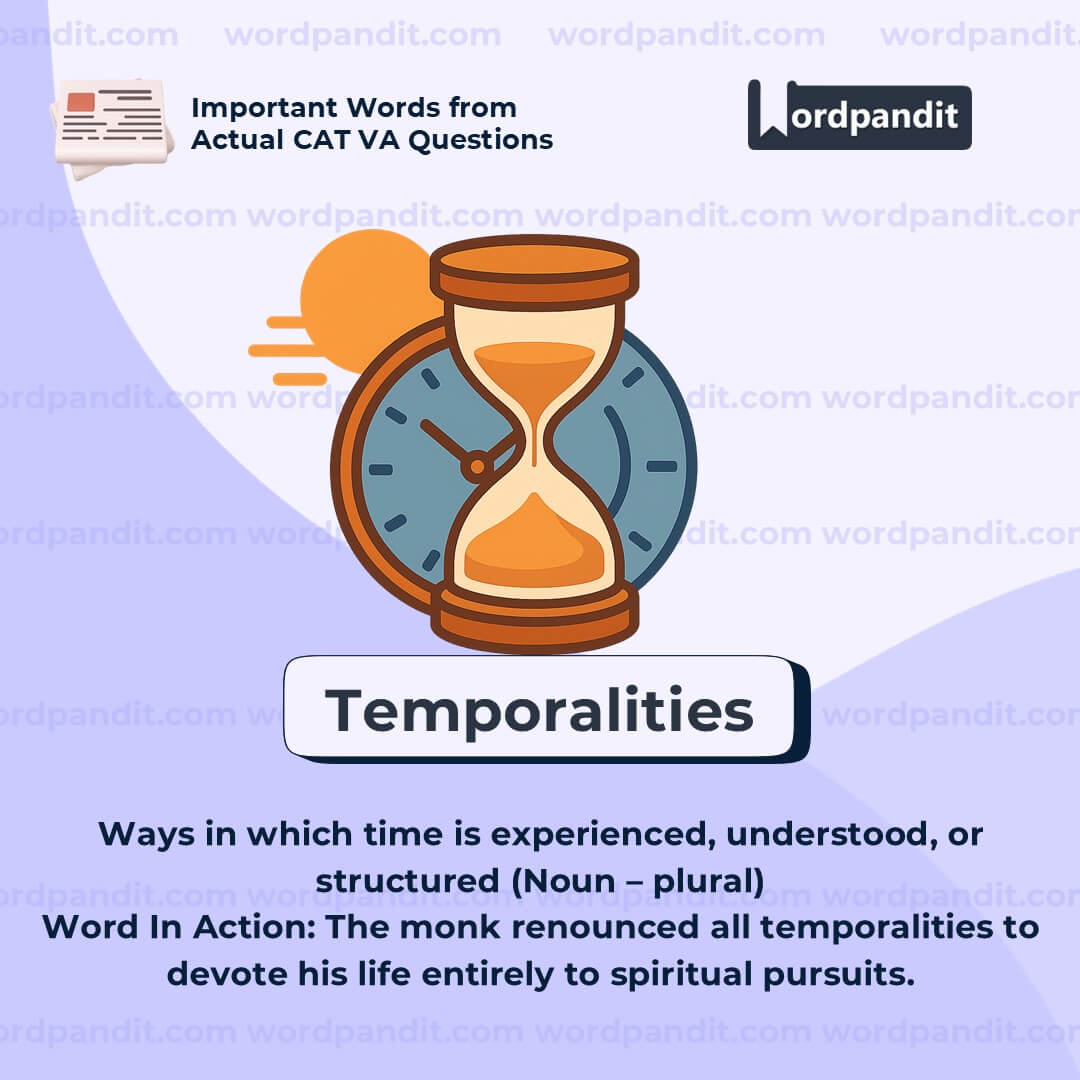
Context:
"One thing we often do with narratives of sexual assault is sort their respective parties into different temporalities: it seems we are interested in perpetrators’ futures and victims’ pasts." - Source Unknown
Explanatory Paragraph:
“Temporalities” refers to ways of experiencing or organizing time. It involves how different people or groups are situated in relation to the past, present, or future. In the provided context, **temporalities** are used to highlight an imbalance in how society treats victims and perpetrators of sexual assault: the former are tied to their traumatic past, while the latter are viewed in terms of their future potential. This framing influences empathy, justice, and public discourse—suggesting that time itself becomes a political and ethical tool.
Meaning: Ways in which time is experienced, understood, or structured (Noun – plural)
Pronunciation: tem-puh-RAL-uh-teez
Difficulty Level: ⭐⭐⭐ Advanced
Etymology: From Latin *temporalis* (of time), from *tempus* (time); “temporalities” is the plural form of *temporality*, often used in academic, philosophical, and literary discussions.
Prashant Sir's Notes:
This is a conceptual word used in philosophy, literary theory, and cultural studies. It's great for nuanced writing. Don’t confuse it with “temporary”—this is about the structure or experience of time itself, especially how different people relate to time based on context or identity.
Synonyms & Antonyms:
Synonyms: timeframes, timelines, time structures, chronological orders, time experiences
Antonyms: timelessness, simultaneity, permanence
Usage Examples:
- The novel explores the contrasting temporalities of colonial rule and postcolonial recovery.
- Different cultures perceive temporalities in distinct ways—some cyclic, some linear.
- Legal systems often fail to acknowledge the temporalities of trauma in survivors.
- Social narratives often place offenders in the future and victims in the past, reflecting unequal temporalities.
Cultural Reference:
Feminist and postcolonial theorists like **Sara Ahmed** and **Gayatri Spivak** often examine **temporalities** to understand how different groups are trapped or liberated by time-based narratives—e.g., how victims are bound to trauma while perpetrators are seen as moving on.
Think About It:
How do time-based narratives affect whose story is believed, validated, or dismissed in society? Whose temporality do we center?
Quick Activity:
Choose a current issue (e.g., climate change, incarceration, education). Describe how different temporalities affect the perspectives of various stakeholders.
Memory Tip:
“Temporalities” = **temporal + realities** → Think of different realities shaped by **how people are positioned in time**.
Real-World Application:
Understanding temporalities helps in storytelling, justice reform, trauma studies, and social advocacy—by shifting how we empathize with or prioritize people’s experiences over time.
Word-3: Vocabulary
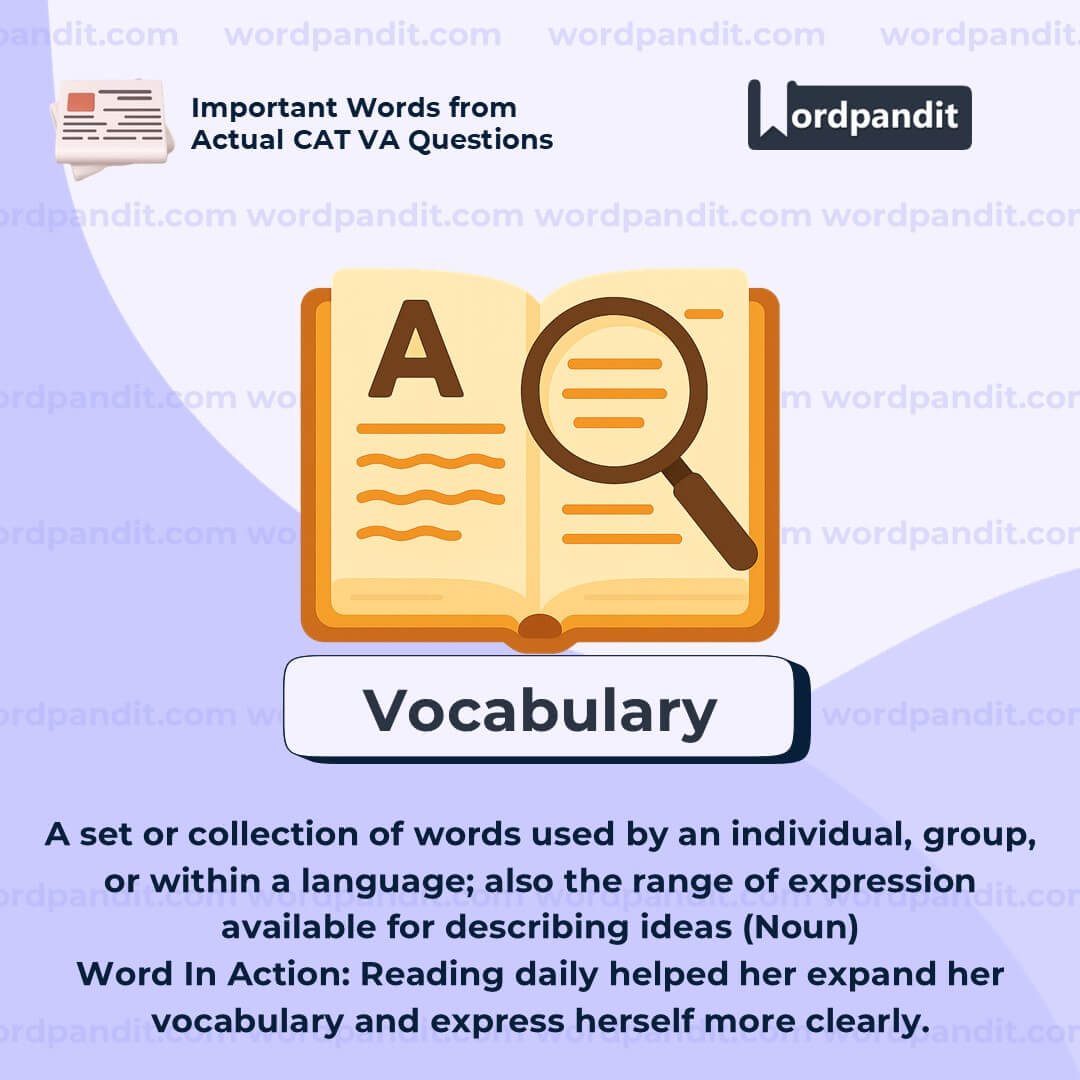
Context:
"One result is that we don’t have much of a vocabulary for what happens in a victim’s life after the painful past has been excavated, even when our shared language gestures toward the future, as the term 'survivor' does." - Source Unknown
Explanatory Paragraph:
“Vocabulary” generally refers to the set of words known and used by a person or shared within a language. In this context, the author uses the term metaphorically to highlight a cultural and linguistic gap: we lack adequate words or expressions to describe what happens in a survivor’s life beyond the trauma. While terms like “victim” and “survivor” exist, our **vocabulary** is limited when it comes to capturing the emotional, psychological, and everyday realities of healing, transformation, or resilience. This suggests that language shapes what we can acknowledge and validate in social discourse.
Meaning: A set or collection of words used by an individual, group, or within a language; also the range of expression available for describing ideas (Noun)
Pronunciation: voh-KAB-yuh-lair-ee
Difficulty Level: ⭐ Beginner
Etymology: From Latin *vocabulum* (name, word), from *vocare* (to call).
Prashant Sir's Notes:
While “vocabulary” is often used in language learning, it's also powerful in academic and cultural critique. A limited vocabulary can signal deeper silences in how we speak about race, gender, trauma, or identity. Expanding vocabulary is not just linguistic—it’s political and emotional.
Synonyms & Antonyms:
Synonyms: lexicon, terminology, word bank, expression set, language repertoire
Antonyms: silence, inarticulacy, wordlessness, muteness
Usage Examples:
- Children develop their vocabulary rapidly in early childhood.
- We lack the vocabulary to describe long-term emotional healing in public discourse.
- The vocabulary of medicine differs greatly from everyday speech.
- Poetry often invents new vocabulary for the unspeakable or abstract.
Cultural Reference:
Philosopher **Ludwig Wittgenstein** famously stated, “The limits of my language mean the limits of my world.” This idea supports the notion that if we don’t have a **vocabulary** for something, we struggle to think about or address it effectively.
Think About It:
What important human experiences do we still lack a vocabulary for? How might creating new language help shift cultural understanding?
Quick Activity:
Try inventing a new word or phrase that describes what comes after surviving trauma. What does this new vocabulary allow us to say or imagine?
Memory Tip:
“Vocabulary” comes from *vocare*—to call → Think of vocabulary as the **tools you use to call out ideas, emotions, and truths**.
Real-World Application:
Vocabulary is foundational in education, therapy, activism, and storytelling. Expanding vocabulary allows for greater inclusion, healing, precision, and creativity in communication.
Word-4: Excavated

Context:
"One result is that we don’t have much of a vocabulary for what happens in a victim’s life after the painful past has been excavated, even when our shared language gestures toward the future, as the term 'survivor' does." - Source Unknown
Explanatory Paragraph:
“Excavated” literally means to dig something out of the ground, often in the context of archaeology. In this sentence, the word is used metaphorically to describe the emotional or psychological process of uncovering or confronting a traumatic past. The phrase “the painful past has been excavated” suggests that memories or experiences have been brought to light—often through therapy, testimony, or narrative—but that there's still a lack of language or cultural understanding for what comes **after** that process of emotional unearthing.
Meaning: Dug up or uncovered something that was buried; revealed something hidden, especially from the past (Verb – past tense)
Pronunciation: EX-kuh-vay-tid
Difficulty Level: ⭐⭐ Intermediate
Etymology: From Latin *excavare*, from *ex-* (out) + *cavare* (to hollow out), from *cavus* (hollow).
Prashant Sir's Notes:
This is a powerful metaphorical word in literature, psychology, and trauma studies. It implies **careful, difficult work**—bringing something buried (emotionally or historically) to the surface. Often paired with themes of healing, memory, and reckoning.
Synonyms & Antonyms:
Synonyms: unearthed, uncovered, revealed, exposed, brought to light
Antonyms: buried, concealed, hidden, suppressed, covered
Usage Examples:
- The therapist helped her excavate the memories she had long suppressed.
- Ancient ruins were excavated from beneath layers of ash.
- In trauma recovery, emotions are often excavated before healing can begin.
- Her memoir excavated the pain of her childhood with raw honesty.
Cultural Reference:
In **trauma literature and psychoanalysis**, excavation is often a metaphor for processing memory—popularized by thinkers like **Sigmund Freud** and modern trauma theorists like **Cathy Caruth**, who describe the mind as holding buried truths that must be revealed to move forward.
Think About It:
Is excavation of the past always helpful, or can digging too deeply sometimes retraumatize rather than heal?
Quick Activity:
Write one sentence using “excavated” in a literal sense, and one in a metaphorical sense related to emotion or memory.
Memory Tip:
“Excavated” = think **ex-** (out) + **cave** → digging **out of a cave**, just like bringing buried feelings or truths to light.
Real-World Application:
“Excavated” is used in archaeology, memoir writing, therapy, and social justice work to describe the act of recovering what has been buried—whether physically, emotionally, or historically.
Word-5: Corroboration
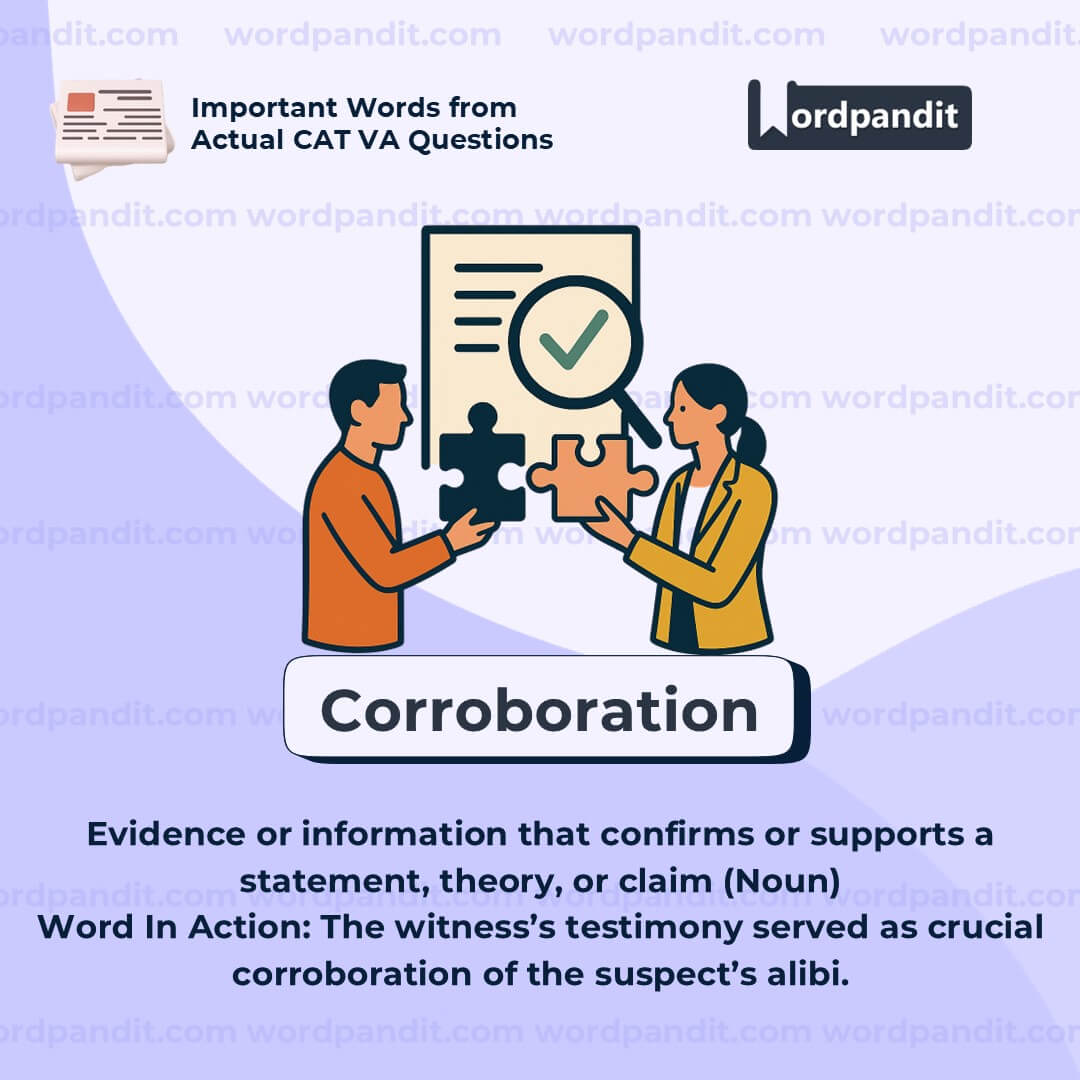
Context:
"Even the most charitable questions asked about the victims seem to focus on the past, in pursuit of understanding or of corroboration of painful details." - Source Unknown
Explanatory Paragraph:
“Corroboration” refers to the process of confirming or supporting a statement, claim, or piece of evidence with additional proof. In this context, the word is used critically to describe how inquiries into a victim’s story often center on verifying the painful aspects of their past, rather than focusing on their healing or future. The need for **corroboration** can sometimes become a barrier to empathy, as it suggests that belief is contingent on proof—even in deeply personal or traumatic cases where evidence may be incomplete or inaccessible.
Meaning: Evidence or information that confirms or supports a statement, theory, or claim (Noun)
Pronunciation: kuh-ROB-uh-RAY-shun
Difficulty Level: ⭐⭐⭐ Intermediate
Etymology: From Latin *corroborare* (to strengthen), from *com-* (together) + *robur* (strength).
Prashant Sir's Notes:
“Corroboration” is commonly used in legal, journalistic, and academic settings. It implies a standard of **proof** or verification. In sensitive contexts like assault or trauma, demanding corroboration can carry ethical implications—so use the word thoughtfully, especially when discussing credibility and belief.
Synonyms & Antonyms:
Synonyms: confirmation, verification, validation, support, authentication
Antonyms: contradiction, denial, disproof, refutation
Usage Examples:
- The witness’s testimony offered crucial corroboration of the victim’s account.
- Journalists sought corroboration before publishing the allegations.
- Corroboration is often difficult in trauma cases, especially when evidence is scarce.
- The lack of corroboration led some to doubt her experience, despite its emotional clarity.
Cultural Reference:
In legal systems, **corroboration** has historically been required in sexual assault cases—placing the burden of proof on victims. Activists and legal reformers have challenged this standard, arguing that it reinforces disbelief and retraumatization.
Think About It:
When is the need for corroboration justified, and when does it become a barrier to justice, healing, or empathy?
Quick Activity:
Think of a situation (real or fictional) where corroboration was difficult to obtain. How did that affect the outcome or perception of truth?
Memory Tip:
“Corroboration” = **co** (together) + **robust evidence** → Think of building strength in an argument by bringing in **supporting facts**.
Real-World Application:
Corroboration is essential in law, journalism, academic research, and policy-making—where accuracy, credibility, and fairness depend on solid, supporting evidence.
