
✨ Introduction
Mastering Reading Comprehension begins with mastering the words!
In this post, we dive deep into vocabulary taken directly from an actual CAT RC passage. Each word has been explained in a simple, easy-to-understand way, along with examples to help you grasp its usage in real contexts.
From words like "species" and "cognitive" to "subjection" and "paradise," strengthen your vocabulary one word at a time — and take your RC performance to the next level!
📚 What’s Inside This Vocabulary Post?
- 🔍 Words Sourced from an Actual CAT RC Passage: Directly pick up important vocabulary from real CAT exam material.
- 🧠 Meaningful Explanations: Understand the exact meaning and usage of each word in a simple, student-friendly way.
- ✍️ Context-Based Learning: Learn words with examples that reflect their actual usage in reading comprehension contexts.
- 🗂️ Quick Reference Format: Words are neatly listed with meanings, parts of speech, and example sentences for easy revision.
- 🚀 Boost Your RC and Verbal Ability Skills: Improve your understanding of tough passages by strengthening your vocabulary.
📝 Words Covered in This Article:
- Assertions
- Aesthetic
- Scrutinize
- Contemporaries
- Epistemological
- Eovenants
- Perceptual
- Perception
- Ethnography
- Beyond
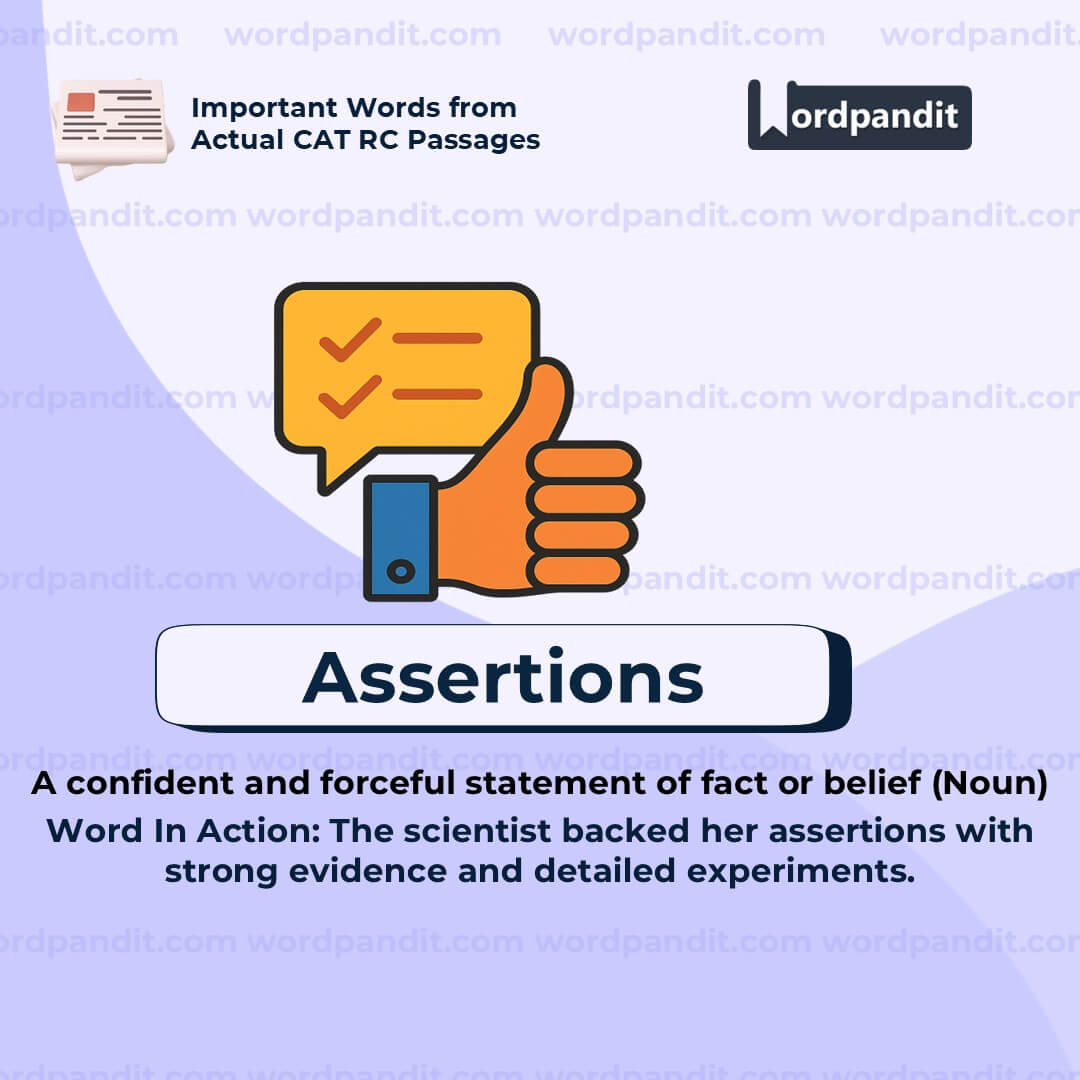
WORD-1: Assertions
Context:
"The claims advanced here may be condensed into two assertions: [first, that visual] culture is what images, acts of seeing, and attendant intellectual, emotional, and perceptual sensibilities do to build" - Academic Excerpt
Explanatory Paragraph:
The word "assertions" refers to confident statements or claims that someone puts forward as true. In academic or formal writing, assertions often serve as the foundational points that an argument or thesis builds upon. In the given context, the author is outlining two major claims or ideas that summarize the core argument about visual culture, implying these assertions are central to understanding the discussion.
Meaning: A confident and forceful statement of fact or belief (Noun)
Pronunciation: uh-SUR-shuhns
Difficulty Level: ⭐⭐ Beginner to Intermediate
Etymology: From Latin *assertio*, from *asserere* meaning "to claim, affirm".
Prashant Sir's Notes:
“Assertions” are more than just statements—they are claims that often demand proof or justification. Understanding this term is crucial for analyzing arguments in essays or debates.
Synonyms & Antonyms:
Synonyms: claim, statement, declaration, contention, affirmation
Antonyms: denial, question, doubt, retraction, concession
Usage Examples:
- Her assertions about climate change sparked a heated debate among the panelists.
- The scientist’s assertions were supported by extensive research and data.
- Despite the bold assertions in the report, many experts remained skeptical.
- The lawyer made several strong assertions during the closing arguments.
Cultural Reference:
"All men are created equal" — one of the most powerful assertions in the U.S. Declaration of Independence — reflects a foundational claim about human rights. - Historical Document
Think About It:
When does an assertion become convincing, and what role does evidence play in transforming a belief into an accepted truth?
Quick Activity:
Write two assertions about a topic you care deeply about. Then, list what kind of evidence you would need to support them.
Memory Tip:
Think of "assertions" as statements that someone is "certain" about — both words share the “sert” root.
Real-World Application:
In debates, courtrooms, essays, and policy discussions, assertions are often the first step in building an argument. Mastering how to recognize and challenge assertions is key in critical thinking and communication.
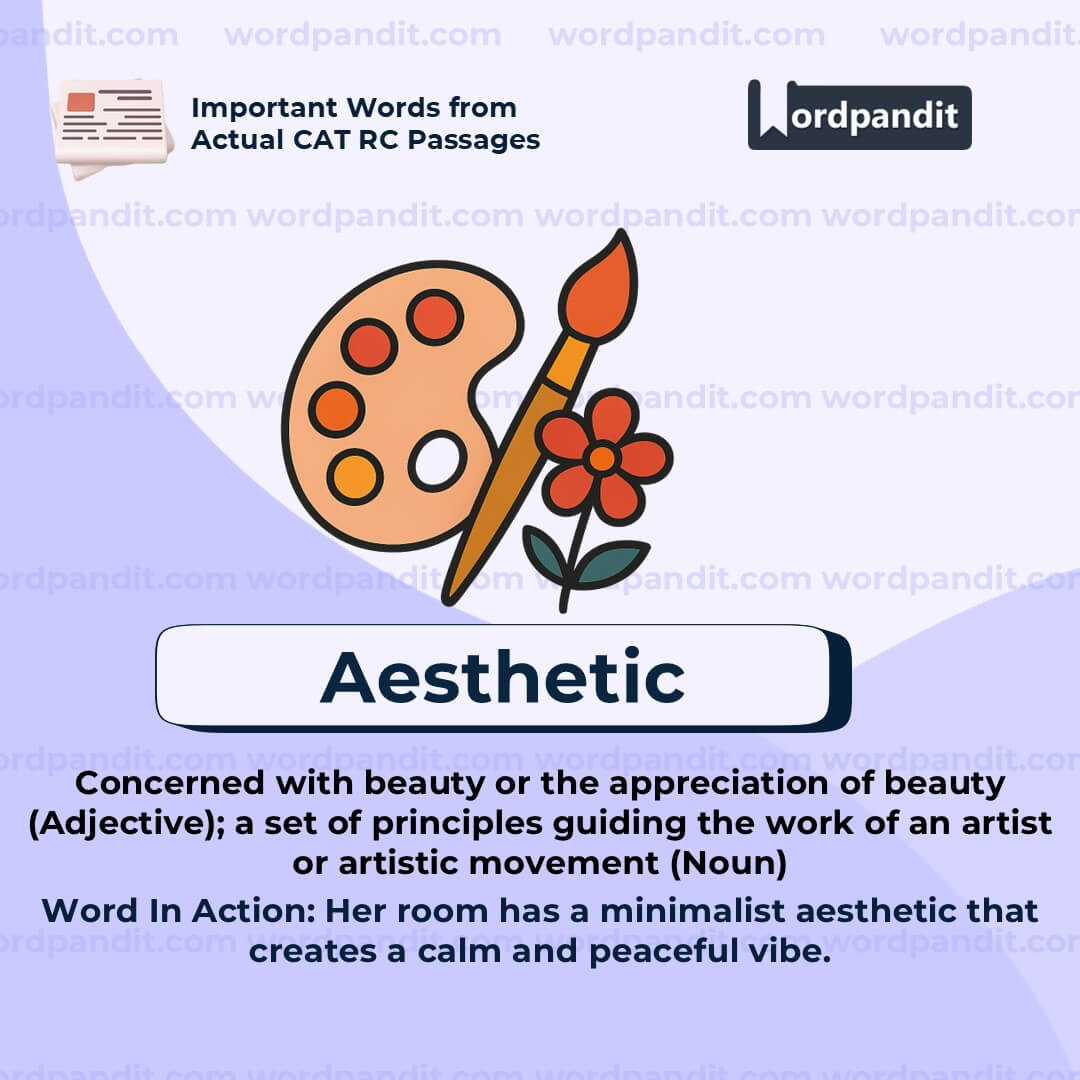
WORD-2: Aesthetic
Context:
"Aesthetic" - Context word as it appears in its standalone form, likely focusing on visual or sensory appreciation. (Source not specified)
Explanatory Paragraph:
"Aesthetic" refers to the principles or appreciation of beauty, especially in art, design, and nature. It's commonly used to describe things that are pleasing to look at or experience. Whether it's the elegance of a painting, the sleek lines of a car, or the harmony of colors in a room, the word "aesthetic" captures our sensory and emotional response to beauty and style.
Meaning: Concerned with beauty or the appreciation of beauty (Adjective); a set of principles guiding the work of an artist or artistic movement (Noun)
Pronunciation: es-THET-ik
Difficulty Level: ⭐⭐ Beginner to Intermediate
Etymology: From Greek *aisthētikos* meaning "perceptible by the senses"; related to *aisthanesthai*, "to perceive."
Prashant Sir's Notes:
This word appears frequently in visual arts, design, and even in social media culture. Remember, aesthetic isn’t just about looks—it’s about emotional and sensory appeal. Use it to describe vibes, moods, and styles.
Synonyms & Antonyms:
Synonyms: artistic, visual, tasteful, decorative, elegant
Antonyms: unaesthetic, tasteless, unappealing, unattractive
Usage Examples:
- The minimalist aesthetic of the room made it feel calm and orderly.
- She has a strong aesthetic sense and can instantly spot a well-composed photo.
- The film’s aesthetic is inspired by 1920s German expressionism.
- They chose the restaurant for its cozy aesthetic and soft lighting.
Cultural Reference:
In the digital age, the term “Instagram aesthetic” refers to the curated visual style users apply to their photo feeds to create a consistent and appealing appearance. - Pop Culture Lexicon
Think About It:
Can something be aesthetically pleasing but morally or socially troubling? How do beauty and ethics intersect?
Quick Activity:
Choose a photo or object near you and describe its aesthetic in 3 words. Then explain why you chose those words.
Memory Tip:
“Aesthetic” looks like “artistic”—both relate to beauty and visual experience. Think: ‘Aesthetic = Artistic Vibes’.
Real-World Application:
Whether in graphic design, branding, fashion, interior decoration, or even product packaging, understanding aesthetics helps professionals create visual appeal and connect emotionally with audiences.
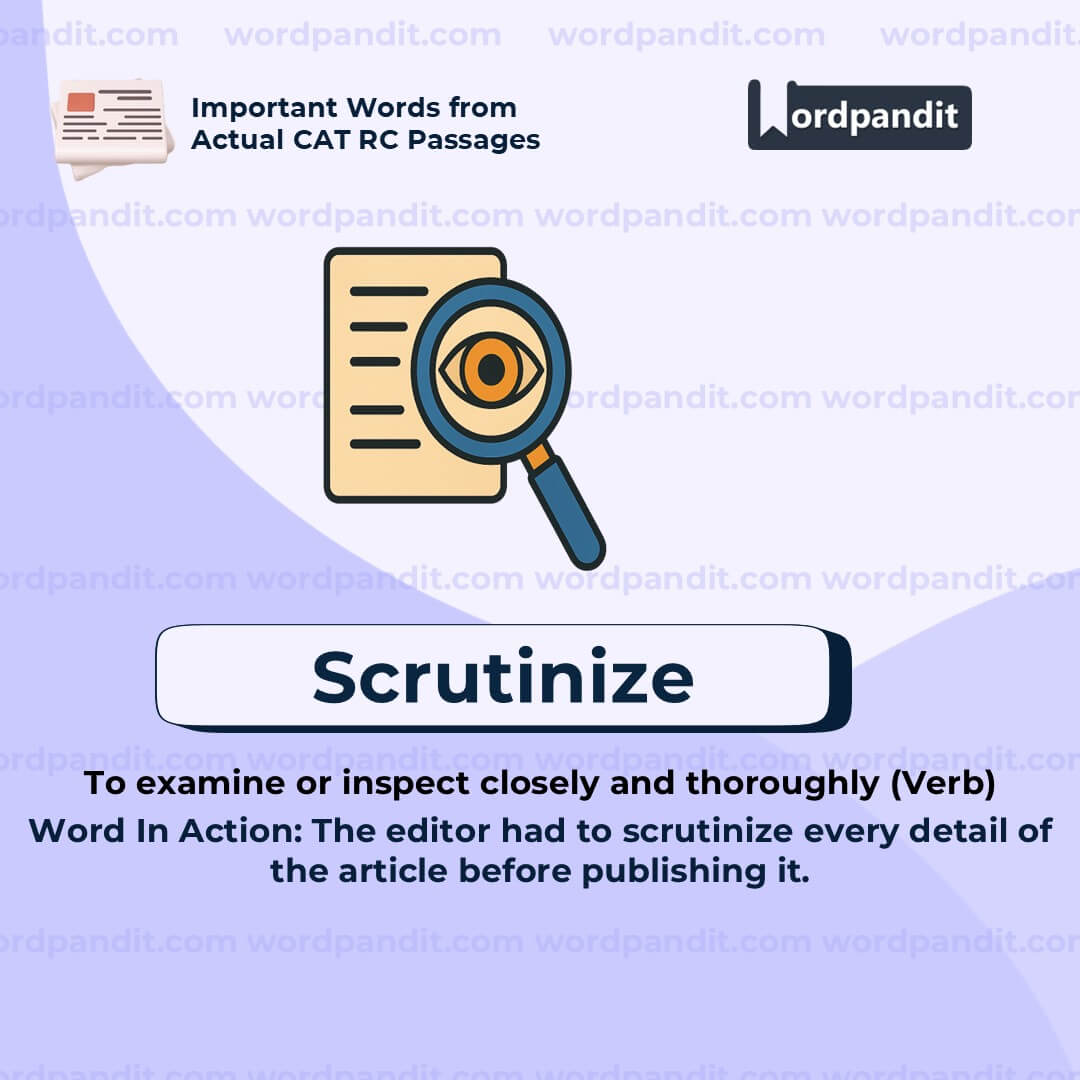
WORD-3: Scrutinize
Context:
"Second, the study of visual culture must scrutinize visual practice as much as images themselves, asking what images do when they are put to use" - Academic Excerpt
Explanatory Paragraph:
To "scrutinize" means to examine something very carefully and in great detail, often with a critical or analytical eye. In academic and professional contexts, scrutinizing involves breaking down a subject or practice to understand how it works, what it means, and what effects it has. In the context of visual culture, it refers to closely analyzing not just the images, but also the ways in which these images are created, presented, and used.
Meaning: To examine or inspect closely and thoroughly (Verb)
Pronunciation: SKROO-tuh-nize
Difficulty Level: ⭐⭐⭐ Intermediate
Etymology: From Latin *scrutinium* (a search or inquiry), from *scrutari* meaning "to examine."
Prashant Sir's Notes:
This is a strong academic and analytical word. Use it when you want to stress that something needs to be looked at carefully—not just seen, but truly examined. Perfect for critical essays or detailed evaluations.
Synonyms & Antonyms:
Synonyms: examine, inspect, analyze, investigate, study
Antonyms: glance, overlook, ignore, skim, disregard
Usage Examples:
- The manager scrutinized every line of the budget proposal before approval.
- Scientists continue to scrutinize the data for any signs of error.
- The artist’s work has been scrutinized by critics for its controversial themes.
- Before signing the contract, she scrutinized the fine print carefully.
Cultural Reference:
Journalists are often tasked with scrutinizing government actions to ensure accountability and transparency—this is a cornerstone of democratic societies. - Media Ethics Guide
Think About It:
How does scrutinizing something change our perception of it? Can too much scrutiny lead to distortion or loss of nuance?
Quick Activity:
Pick a photo, ad, or meme from social media. Scrutinize it: What message is it conveying? What techniques are used? Write 3 observations.
Memory Tip:
“Scrutinize” sounds like “screw-tighten-eyes”—imagine tightening your eyes to focus closely and inspect something deeply.
Real-World Application:
In professions such as auditing, journalism, research, and law, scrutinizing documents, data, or behavior is essential to uncover the truth, ensure accuracy, and maintain integrity.
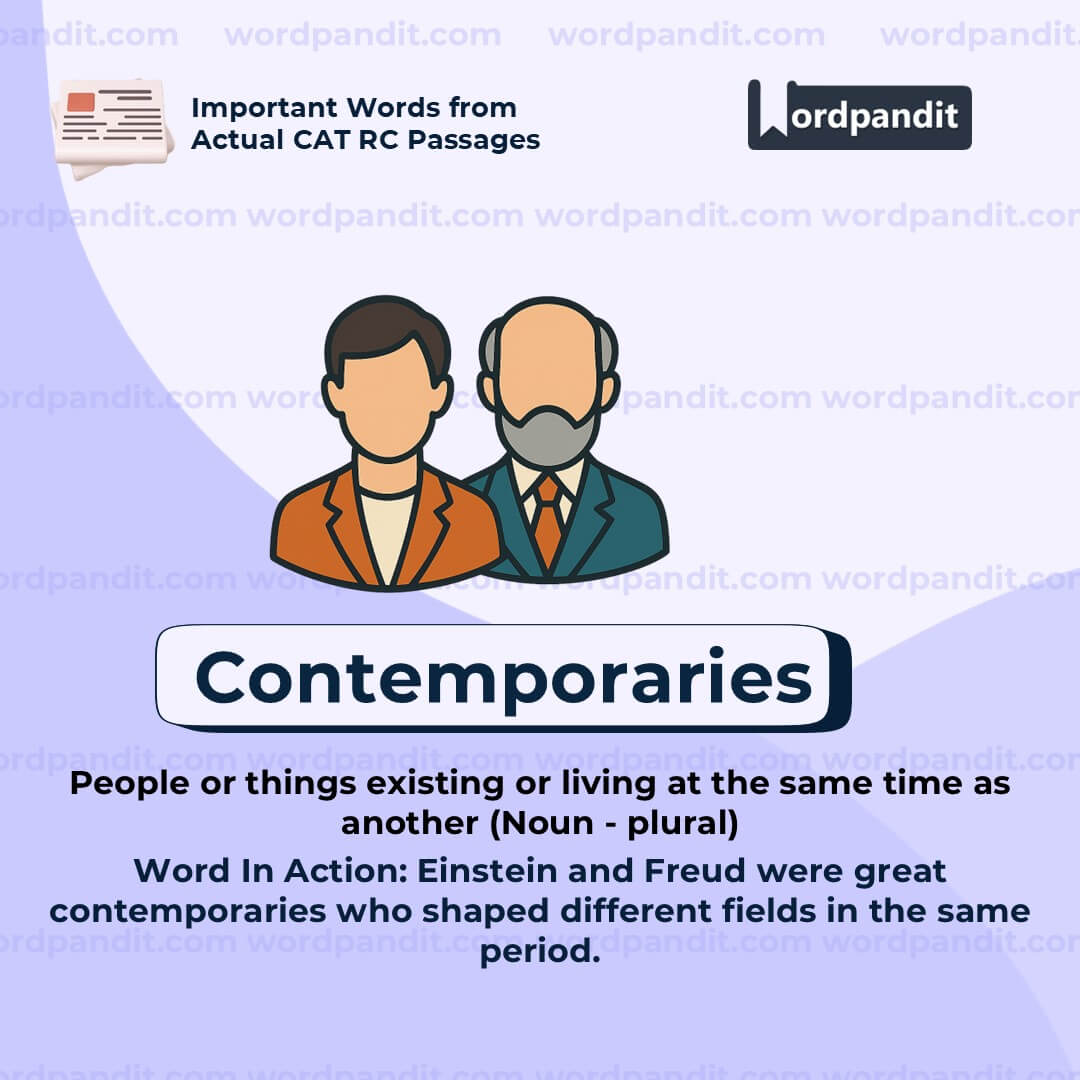
WORD-4: Contemporaries
Context:
"They were unique creators of images that changed the way their contemporaries thought and felt and have continued to shape the history of art, artists, museums, feeling, and aesthetic value." - Academic Excerpt
Explanatory Paragraph:
The term "contemporaries" refers to people who live or exist at the same time as someone else. In the context of this sentence, it highlights the influence of certain artists on the people of their own era—how their work affected the thoughts and emotions of their peers. The use of this word often draws attention to how individuals are situated within a particular historical or cultural moment alongside others who may be similarly influential or relevant.
Meaning: People or things existing or living at the same time as another (Noun - plural)
Pronunciation: kuhn-TEM-puh-rair-eez
Difficulty Level: ⭐⭐ Beginner to Intermediate
Etymology: From Latin *contemporarius*, from *con-* (together) + *temporarius* (of time), from *tempus* meaning "time."
Prashant Sir's Notes:
“Contemporaries” is a useful term in historical and comparative discussions. It allows you to position someone or something in time and analyze influence, interaction, or contrast among figures from the same period.
Synonyms & Antonyms:
Synonyms: peers, coevals, fellow citizens, cohabitants, colleagues
Antonyms: predecessors, ancestors, successors, forebears
Usage Examples:
- Shakespeare and Cervantes were literary contemporaries who transformed European literature.
- Her work stood out among her contemporaries for its boldness and originality.
- Einstein's theories challenged the ideas of many of his scientific contemporaries.
- The composer was praised not only by the public but also by his contemporaries.
Cultural Reference:
In the art world, Pablo Picasso and Henri Matisse were contemporaries—both pushing boundaries in modernist painting during the early 20th century. - Modern Art History
Think About It:
How do contemporaries shape each other’s legacies, and what does it mean to be remembered more—or less—than your peers?
Quick Activity:
List three famous people from any field who were contemporaries. What did they have in common, and how did they differ?
Memory Tip:
Think: “Contemporaries” share *time* — the root *temp* means time. So, contemporaries = people sharing the same time period.
Real-World Application:
Understanding who someone's contemporaries were can deepen our appreciation of their contributions, especially in fields like history, literature, and science, where time-based comparisons reveal influence and originality.
WORD-5: Epistemological
Context:
"Fourth, scholars may learn a great deal when they scrutinize the constituents of vision, that is, the structures of perception as a physiological process as well as the epistemological frameworks informing a system of visual representation." - Academic Excerpt
Explanatory Paragraph:
The word "epistemological" relates to epistemology, the branch of philosophy concerned with knowledge—its nature, sources, limits, and validity. In the given context, it refers to the frameworks or systems of thought that influence how visual representations are understood and interpreted. That is, it's not just about what we see, but how we come to know what we see, shaped by cultural, intellectual, and philosophical ideas.
Meaning: Relating to the theory of knowledge, especially with regard to its methods, validity, and scope (Adjective)
Pronunciation: eh-pis-tuh-muh-LOJ-i-kuhl
Difficulty Level: ⭐⭐⭐⭐ Advanced
Etymology: From Greek *epistēmē* meaning “knowledge” and *logos* meaning “study” or “discourse.”
Prashant Sir's Notes:
This is a high-level academic term used mostly in philosophy, critical theory, and cultural studies. Think of it as relating to the 'logic of knowing.' It helps frame not just what we know, but how we know and why we believe what we believe.
Synonyms & Antonyms:
Synonyms: philosophical, cognitive-theoretical, knowledge-based, conceptual
Antonyms: empirical, experiential (in contexts where unmediated experience is emphasized over theory)
Usage Examples:
- Her thesis explores the epistemological assumptions underlying medical diagnoses.
- The debate revealed a clash of epistemological perspectives on scientific truth.
- The film challenges the viewer's epistemological stance by blurring reality and fiction.
- Different cultures often have distinct epistemological traditions guiding how they interpret knowledge.
Cultural Reference:
Michel Foucault’s work is deeply rooted in epistemological critique—questioning how systems of knowledge shape power, perception, and identity. - Postmodern Theory Reader
Think About It:
Can we ever truly separate what we see from what we know—or think we know—about the world?
Quick Activity:
Define a belief you hold strongly. Now ask yourself: Where did this knowledge come from? Is it based on evidence, authority, tradition, or experience? Write your own “epistemological audit.”
Memory Tip:
Break it down: “episte-” = knowledge, “-logical” = about reasoning. So, epistemological = logic or study of how we know things.
Real-World Application:
In fields like science, journalism, education, and AI, understanding epistemological frameworks helps evaluate how facts are constructed, which sources are trusted, and how biases shape our understanding of truth.

WORD-6: Covenants
Context:
". operates on the foundation of covenants with images that establish the conditions for meaningful visual experience" - Academic Excerpt
Explanatory Paragraph:
The word "covenants" refers to formal agreements or binding promises between parties. Though often used in legal or religious contexts, in this academic sentence, it is used metaphorically to describe the implicit or conceptual agreements we form with images—expectations and shared understandings that shape how we perceive and interpret visual content. These “covenants” frame our visual culture and condition the meanings we derive from what we see.
Meaning: Formal agreements or promises, often solemn and binding (Noun - plural)
Pronunciation: KUH-vuh-nuhnts
Difficulty Level: ⭐⭐⭐ Intermediate
Etymology: From Old French *covenant*, from Latin *convenire*, meaning “to come together, agree.”
Prashant Sir's Notes:
This word has roots in law, theology, and philosophy. In modern writing, it’s often used to evoke seriousness or foundational principles. When reading this in abstract or theoretical texts, interpret it as a deep-seated commitment or structured relationship—especially in metaphorical use.
Synonyms & Antonyms:
Synonyms: agreements, pacts, contracts, accords, commitments
Antonyms: breaches, disagreements, violations, disputes
Usage Examples:
- The two nations signed covenants to maintain peace and mutual cooperation.
- Religious texts often refer to covenants made between God and humanity.
- In this theory, viewers form covenants with images that guide interpretation and emotional response.
- The property has covenants restricting commercial use and structural alterations.
Cultural Reference:
In the Bible, the “Covenant with Abraham” signifies a sacred promise, forming the basis of Jewish faith traditions. Similarly, the idea of social covenants is central to Enlightenment political philosophy. - Religious and Philosophical Sources
Think About It:
What unspoken covenants do we make with the images we see every day—on social media, in advertisements, or in art?
Quick Activity:
Think of a powerful image (photo, meme, or artwork) you’ve seen recently. Describe what “covenant” or agreement it seems to establish with its viewer—what does it assume or ask from us?
Memory Tip:
“Covenants” sounds like “co-venants” — think *co* = together, *venants* = agreements — a mutual promise to act or believe in a certain way.
Real-World Application:
Legal covenants appear in contracts, housing deeds, and business deals, while philosophical or metaphorical covenants help shape ethical conduct, cultural norms, and even how we engage with media and art.
WORD-7: Perceptual
Context:
"The claims advanced here may be condensed into two assertions: [first, that visual] culture is what images, acts of seeing, and attendant intellectual, emotional, and perceptual sensibilities do to build, maintain, or transform the worlds in which people live" - Academic Excerpt
Explanatory Paragraph:
"Perceptual" refers to anything related to perception—the process of using the senses to experience and interpret the world. It often emphasizes how individuals interpret visual, auditory, or tactile stimuli based on their mental and sensory processing. In the context provided, "perceptual sensibilities" means the ways in which people’s sensory experiences and perceptions contribute to their understanding and shaping of the world through visual culture.
Meaning: Relating to the ability to interpret or become aware of something through the senses (Adjective)
Pronunciation: per-SEP-choo-uhl
Difficulty Level: ⭐⭐⭐ Intermediate
Etymology: From Latin *percipere* meaning “to seize, understand” + *-al*, forming adjectives from nouns.
Prashant Sir's Notes:
This is a useful word in psychology, philosophy, and art criticism. It focuses on the experience of sensing and interpreting the world. Pair it with terms like “processes,” “biases,” or “frameworks” to discuss how we see and understand.
Synonyms & Antonyms:
Synonyms: sensory, cognitive, visual, interpretive, experiential
Antonyms: imperceptive, unconscious, unobservant, oblivious
Usage Examples:
- Artists often experiment with color and light to challenge the viewer’s perceptual habits.
- The optical illusion tricked his perceptual system into seeing movement where there was none.
- Perceptual development in children is closely linked to their exploration of the environment.
- Her writing offers a perceptual map of urban life, rich in sensory detail.
Cultural Reference:
Gestalt psychology, a theory of mind from the early 20th century, emphasizes how perceptual systems group visual elements to form unified wholes. This concept revolutionized how we understand human perception. - Psychology Texts
Think About It:
How much of what we believe to be 'real' is shaped not by facts but by our perceptual frameworks and experiences?
Quick Activity:
Stare at a detailed photograph or painting for 30 seconds. Then close your eyes and describe what you remember. What does your perceptual recall say about your focus and attention?
Memory Tip:
“Perceptual” contains “perceive” — so remember: it’s about how we *perceive* the world through our senses.
Real-World Application:
Perceptual awareness is essential in design, advertising, UX/UI, education, and therapy, where understanding how people sense and interpret information can guide more effective communication and experience building.
WORD-8: Perception
Context:
"Fourth, scholars may learn a great deal when they scrutinize the constituents of vision, that is, the structures of perception as a physiological process as well as the epistemological frameworks informing a system of visual representation." - Academic Excerpt
Explanatory Paragraph:
"Perception" refers to the process by which we become aware of and interpret sensory information, especially through sight, sound, touch, taste, and smell. In the given context, it emphasizes vision as not just a physical process but one that also involves mental and cultural frameworks. That means what we perceive visually is shaped both by how our eyes and brain work, and by the knowledge systems and beliefs we carry.
Meaning: The ability to see, hear, or become aware of something through the senses; the way in which something is understood or interpreted (Noun)
Pronunciation: per-SEP-shuhn
Difficulty Level: ⭐⭐ Beginner to Intermediate
Etymology: From Latin *perceptio(n)*, from *percipere* meaning “to seize, understand.”
Prashant Sir's Notes:
Perception bridges the gap between raw data and meaning. Whether you're analyzing visuals, sounds, or even ideas, remember: perception is both about sensing and interpreting. It's a powerful word in both science and philosophy.
Synonyms & Antonyms:
Synonyms: awareness, understanding, interpretation, insight, observation
Antonyms: ignorance, misunderstanding, unawareness, blindness
Usage Examples:
- Her perception of color was influenced by the lighting in the room.
- Public perception of the policy shifted dramatically after the debate.
- The artist's work challenges conventional perceptions of beauty.
- Human perception is limited by both our biology and our cultural conditioning.
Cultural Reference:
René Descartes famously questioned perception in his philosophical statement “I think, therefore I am,” arguing that even our senses could deceive us—thus emphasizing the need to scrutinize perception itself. - Classical Philosophy
Think About It:
Can we ever be sure that our perception reflects reality, or is everything we experience filtered through subjective interpretation?
Quick Activity:
Describe how your perception of a place or person changed over time. What influenced this shift? Was it based on new sensory input or changed interpretation?
Memory Tip:
“Perception” comes from “perceive” — think of a camera lens capturing an image. It’s not just what’s out there, but how it’s seen.
Real-World Application:
In advertising, politics, education, and personal interactions, shaping perception is key. Understanding how people interpret messages or visuals helps tailor more effective and ethical communication.
WORD-9: Ethnography
Context:
"The task is to understand how artifacts contribute to the construction of a world. . . . Important methodological implications follow: ethnography and reception studies become productive" - Academic Excerpt
Explanatory Paragraph:
"Ethnography" is a qualitative research method used in the social sciences, especially anthropology and sociology, that involves the systematic study of people and cultures from the point of view of the subject. It typically includes fieldwork, participant observation, interviews, and immersion in the everyday life of a community. In the provided context, ethnography is described as a productive tool for understanding how cultural artifacts—objects, practices, or artworks—help construct meaning in a particular world or community.
Meaning: The scientific description of the customs, habits, and mutual differences of human societies (Noun)
Pronunciation: eth-NAW-gruh-fee
Difficulty Level: ⭐⭐⭐ Intermediate to Advanced
Etymology: From Greek *ethnos* meaning “nation or people” and *graphein* meaning “to write.”
Prashant Sir's Notes:
Ethnography is about being a cultural detective—observing people in their natural settings to understand their behaviors and beliefs. It goes beyond surveys and statistics to uncover the deeper meanings behind cultural actions. Ideal for studying media, rituals, traditions, or even visual culture.
Synonyms & Antonyms:
Synonyms: cultural study, fieldwork, social research, anthropological research
Antonyms: laboratory experiment, theoretical analysis, abstract modeling (in academic methodology contexts)
Usage Examples:
- The researcher conducted an ethnography of street musicians in New York City.
- Ethnography requires time, patience, and deep cultural immersion.
- The ethnographic report provided insight into the ritual practices of the tribe.
- Her book is a brilliant ethnography of rural family life in contemporary India.
Cultural Reference:
Bronisław Malinowski’s ethnography of the Trobriand Islanders in the early 20th century remains a foundational text in anthropology, setting a standard for immersive fieldwork. - Anthropological Classics
Think About It:
Can an outsider ever truly understand a culture through ethnography, or is some knowledge always out of reach?
Quick Activity:
Spend 10 minutes observing a public place (e.g., a park, café, or classroom). Take notes like an ethnographer: What do people do? How do they interact? What hidden patterns emerge?
Memory Tip:
Break it down: “ethno” = people or culture, “graphy” = writing. So, ethnography = writing about people’s culture and life.
Real-World Application:
Ethnography is used in UX design, marketing, education, and healthcare to better understand user behavior, cultural needs, and community practices by getting close to real-world contexts and experiences.
WORD-10: Beyond
Context:
"The task is to understand how artifacts contribute to the construction of a world. . . . Important methodological implications follow: ethnography and reception studies become productive forms of gathering information, since these move beyond the image as a closed and fixed meaning-event" - Academic Excerpt
Explanatory Paragraph:
"Beyond" is a preposition or adverb that implies going further than a certain point—physically, conceptually, or metaphorically. In the given context, it suggests moving past the traditional or surface-level understanding of an image (as something static and self-contained) and instead engaging with broader and deeper interpretations. The idea is to open up new dimensions of meaning, context, and interaction that lie outside the immediate or obvious content of the image.
Meaning: At or to the further side of; more than; outside the scope or limits of (Preposition/Adverb)
Pronunciation: bee-YOND
Difficulty Level: ⭐ Beginner
Etymology: From Old English *beyondan*, meaning “on the farther side (of), further off.”
Prashant Sir's Notes:
“Beyond” is a common word, but in academic and analytical writing, it carries significant weight. It signals the expansion of scope or depth—often used to invite critical thinking, as in “beyond the surface,” “beyond traditional views,” or “beyond the obvious.”
Synonyms & Antonyms:
Synonyms: outside, past, above, surpassing, exceeding
Antonyms: within, inside, beneath, under, below
Usage Examples:
- The discussion moved beyond the facts to question deeper societal implications.
- The mountain range lies beyond the horizon.
- Her kindness went beyond what was expected.
- Philosophers often explore concepts beyond the physical world.
Cultural Reference:
The phrase "To infinity and beyond!" from *Toy Story* (Buzz Lightyear) became iconic for its expression of boundless aspiration and limitless possibility. - Pop Culture Quote
Think About It:
What does it mean to think “beyond” the obvious in everyday life? How often do we settle for the first layer of meaning?
Quick Activity:
Pick a simple object near you (like a cup or book). Now describe it not just as what it is, but what it *represents* or *suggests* beyond its basic function.
Memory Tip:
Imagine a “Beyond” sign on a road—always pointing past where you are now. It’s about what lies ahead, outside, or deeper.
Real-World Application:
In critical thinking, design, innovation, and research, going “beyond” the surface leads to richer insights, transformative ideas, and deeper understanding. It’s a key mindset for problem-solving and creativity.


