✨ Introduction
Mastering Reading Comprehension begins with mastering the words!
In this post, we dive deep into vocabulary taken directly from an actual CAT RC passage. Each word has been explained in a simple, easy-to-understand way, along with examples to help you grasp its usage in real contexts.
From words like "species" and "cognitive" to "subjection" and "paradise," strengthen your vocabulary one word at a time — and take your RC performance to the next level!
📚 What’s Inside This Vocabulary Post?
- 🔍 Words Sourced from an Actual CAT RC Passage: Directly pick up important vocabulary from real CAT exam material.
- 🧠 Meaningful Explanations: Understand the exact meaning and usage of each word in a simple, student-friendly way.
- ✍️ Context-Based Learning: Learn words with examples that reflect their actual usage in reading comprehension contexts.
- 🗂️ Quick Reference Format: Words are neatly listed with meanings, parts of speech, and example sentences for easy revision.
- 🚀 Boost Your RC and Verbal Ability Skills: Improve your understanding of tough passages by strengthening your vocabulary.
📝 Words Covered in This Article:
- Inflict
- Intended
- Hostile
- Predisposes
- Accumulation
- Tendencies
- Testosterone
- Hormonal
- circumstance
- Perspectives
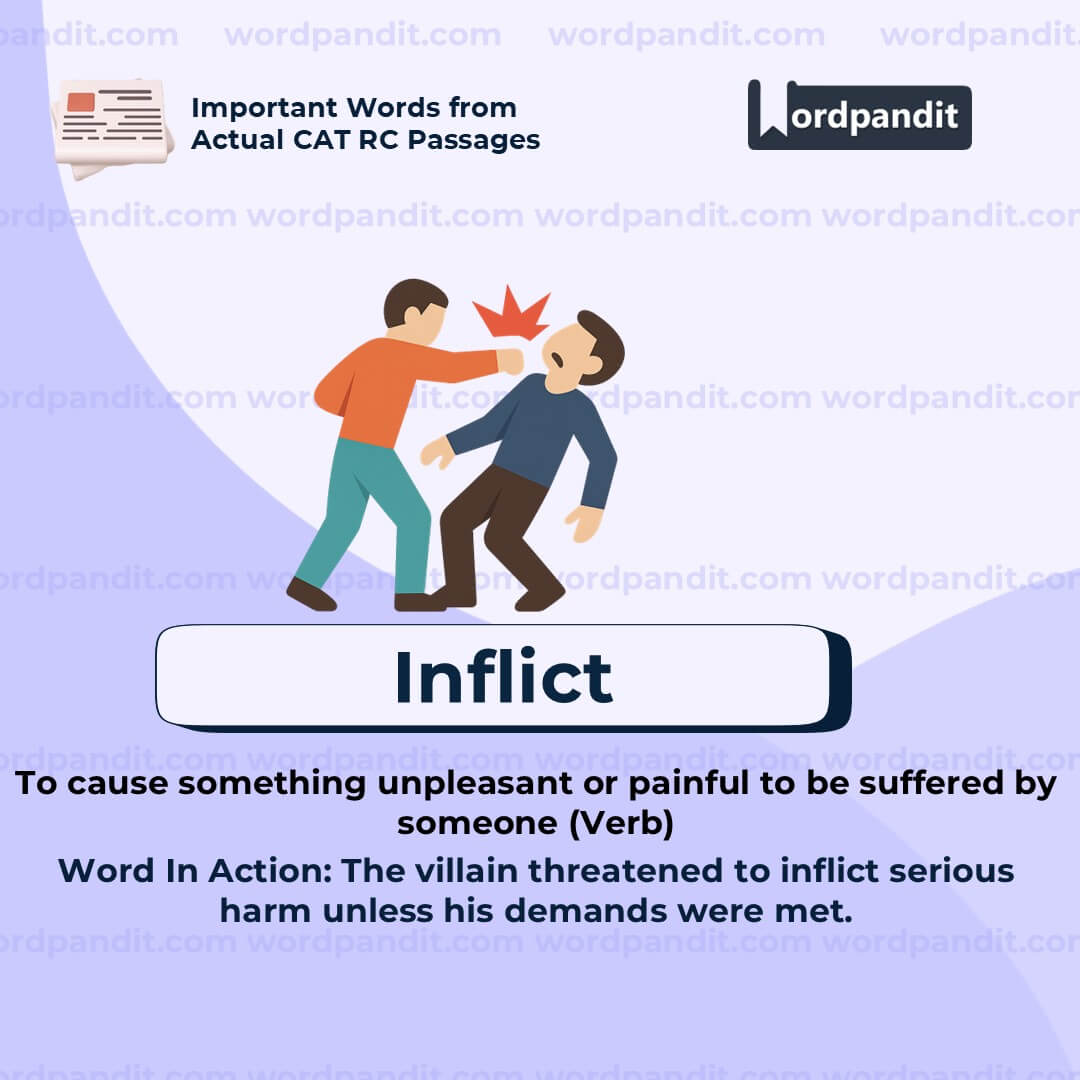
WORD-1: Inflict
Context:
"Hostile aggression is an aggressive act that results from anger, and is intended to inflict pain or injury because of that anger." - Psychology Textbook
Explanatory Paragraph:
The word "inflict" is typically used when someone causes something unpleasant or harmful to be felt by another. It implies a deliberate or forceful action, often resulting in physical or emotional damage. In the context of aggression, it emphasizes the intentional aspect of causing suffering or harm as a direct consequence of anger or conflict.
Meaning: To cause something unpleasant or painful to be suffered by someone (Verb)
Pronunciation: in-FLIKT
Difficulty Level: ⭐⭐ Beginner
Etymology: From Latin *inflictus*, past participle of *infligere*, meaning “to strike against.”
Prashant Sir's Notes:
Think of "inflict" as a word that brings action and consequence together—someone does something, and someone else suffers from it. The key idea is about transferring pain, damage, or suffering.
Synonyms & Antonyms:
Synonyms: impose, deliver, administer, exact, wreak
Antonyms: relieve, soothe, ease, heal, comfort
Usage Examples:
- The rebels inflicted heavy casualties on the enemy troops.
- She never intended to inflict emotional pain on her friend.
- Harsh punishments were inflicted to maintain order during wartime.
- His harsh words inflicted lasting damage to their relationship.
Cultural Reference:
"An eye for an eye will only make the whole world blind." – Often attributed to Mahatma Gandhi, this quote reflects the cyclical harm people inflict on each other in retaliation.
Think About It:
Is it ever justifiable to inflict harm on someone else? Under what circumstances, if any, could it be considered necessary?
Quick Activity:
Write two short sentences: one where someone inflicts physical harm and one where someone inflicts emotional pain. Identify the subject and the object in each.
Memory Tip:
Think of “inflict” as “in + flick” — like flicking pain or punishment *into* someone. You cause it, and they feel it.
Real-World Application:
The term “inflict” is commonly used in legal and psychological contexts, such as in cases of domestic violence, bullying, or warfare, where intentional harm is caused to another individual or group.
WORD-2: Intended
Context:
"Hostile aggression is an aggressive act that results from anger, and is intended to inflict pain or injury because of that anger." - Psychology Textbook
Explanatory Paragraph:
"Intended" refers to something that is planned or meant to happen. It indicates a clear purpose or goal behind an action. In the context of aggression, it suggests that the act is not accidental but deliberately done with the aim of causing harm, highlighting the conscious decision-making involved in such behavior.
Meaning: Done on purpose; planned or meant (Adjective)
Pronunciation: in-TEN-did
Difficulty Level: ⭐⭐ Beginner
Etymology: From Latin *intendĕre*, meaning "to stretch out, to aim at", through Old French *entendre* and Middle English *entenden*.
Prashant Sir's Notes:
The word "intended" always carries the sense of a clear goal or purpose. It distinguishes deliberate actions from those that are accidental or spontaneous. In usage, it often comes with an implied responsibility.
Synonyms & Antonyms:
Synonyms: deliberate, planned, purposeful, meant, calculated
Antonyms: accidental, unintentional, spontaneous, coincidental, incidental
Usage Examples:
- The damage to the artwork was not intended, but it still occurred.
- Her comment was intended as a compliment, not an insult.
- The law was intended to protect consumers from fraud.
- They carried out the mission with an intended outcome in mind.
Cultural Reference:
"The road to hell is paved with good intentions." – This popular proverb suggests that merely intending to do good is not enough if it doesn't lead to positive action.
Think About It:
How can you ensure that your intentions are aligned with the outcomes of your actions?
Quick Activity:
Write a sentence using the word “intended” and then rewrite it by changing it to “unintended.” How does the meaning change?
Memory Tip:
“Intended” sounds like “in-tend” — imagine you are “in” a plan and you “tend” toward a goal — you meant it to happen.
Real-World Application:
In legal and professional communication, "intended" plays a key role in determining liability or purpose, such as in contracts, policy documents, and even public apologies.
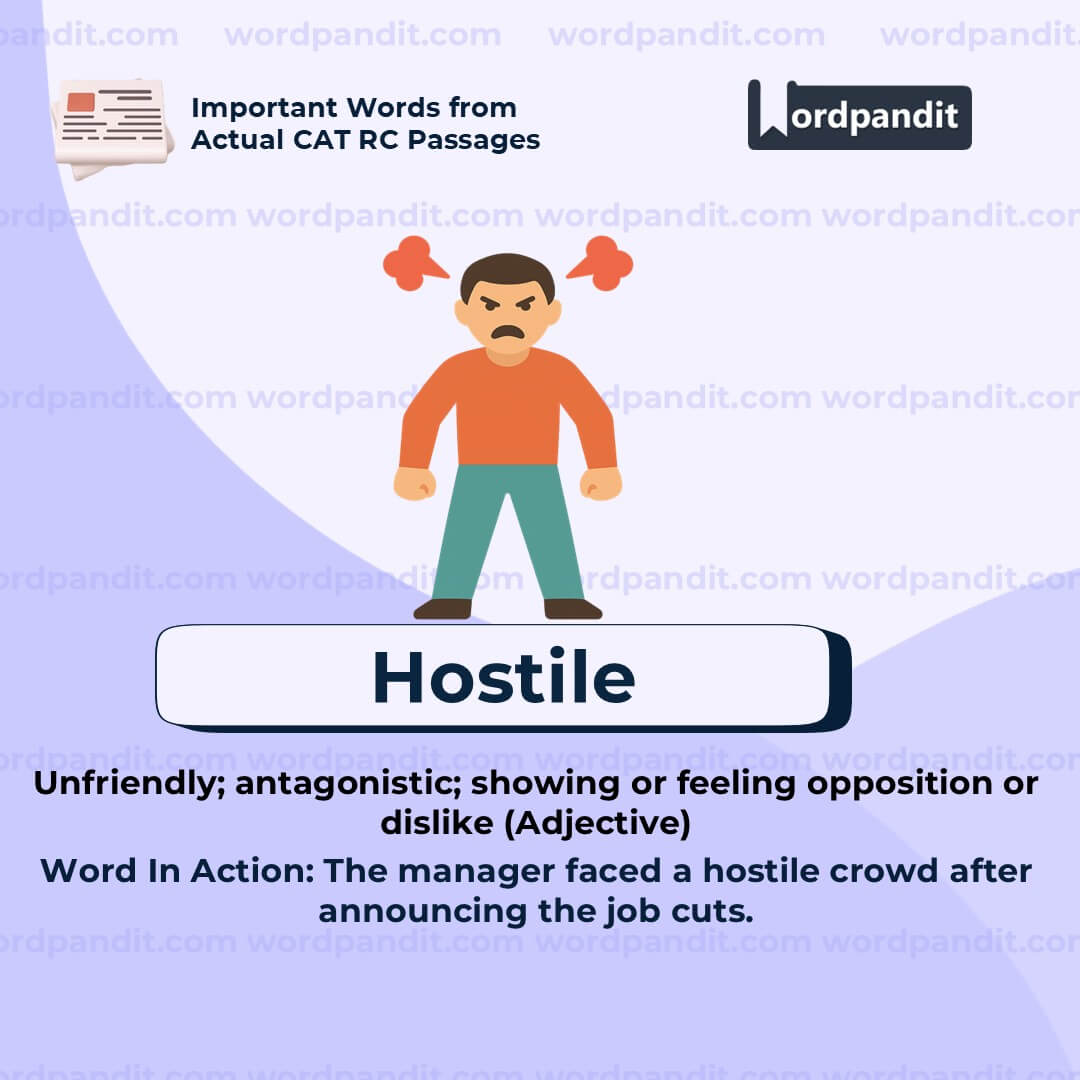
WORD-3: Hostile
Context:
"Aggression is also categorized according to its ultimate intent. Hostile aggression is an aggressive act that results from anger, and is intended to inflict pain or injury because of that anger." - Psychology Textbook
Explanatory Paragraph:
The word "hostile" refers to a strong sense of opposition, anger, or aggression. It is often used to describe attitudes, actions, or environments that are unfriendly, antagonistic, or actively harmful. In the psychological context, hostile aggression refers to behavior driven by anger with the goal of hurting someone, making "hostile" an emotionally charged word pointing to negativity and conflict.
Meaning: Unfriendly; antagonistic; showing or feeling opposition or dislike (Adjective)
Pronunciation: HOS-tyl or HOS-tl
Difficulty Level: ⭐⭐ Beginner
Etymology: From Latin *hostilis*, from *hostis* meaning “enemy.” The word entered English via Old French *hostile*.
Prashant Sir's Notes:
Think of "hostile" as the emotional temperature of a person or place — if someone is hostile, it’s like walking into a room where you immediately feel tension or threat. It’s more than unfriendly—it’s actively aggressive.
Synonyms & Antonyms:
Synonyms: aggressive, antagonistic, unfriendly, belligerent, confrontational
Antonyms: friendly, amicable, peaceful, warm, welcoming
Usage Examples:
- The crowd grew hostile after the controversial verdict was announced.
- She gave him a hostile glance and walked away without saying a word.
- Negotiations broke down in a hostile political climate.
- His hostile behavior made everyone in the office uncomfortable.
Cultural Reference:
In many war films, the term "hostile territory" is commonly used to describe areas controlled by the enemy, symbolizing danger and resistance.
Think About It:
Can someone act hostile without realizing it? How can we become more aware of our own hostile tendencies?
Quick Activity:
Write two sentences: one describing a hostile person and one describing a hostile environment. Compare the tone and emotional weight of both.
Memory Tip:
Remember “hostile” by thinking of a “host” at a party being rude or aggressive — that’s a "host-ile" host!
Real-World Application:
The word "hostile" is widely used in psychology, law enforcement, workplace conflict resolution, and even business (e.g., "hostile takeover") to describe adversarial or confrontational behavior or actions.
WORD-4: Predisposes
Context:
"Sigmund Freud (1930) proposed that all individuals are born with a death instinct that predisposes us to a variety of aggressive behaviors, including suicide (self directed aggression) and mental illness (possibly due to an unhealthy or unnatural suppression of aggressive urges)." - Psychology Textbook
Explanatory Paragraph:
The word "predisposes" refers to the idea of making someone more likely or susceptible to a certain condition, behavior, or outcome. It doesn’t guarantee the outcome but increases the chances of it happening under certain circumstances. In the psychological context, it is often used to describe factors—biological, emotional, or environmental—that make individuals more vulnerable to specific behaviors or mental states.
Meaning: To make someone more likely to behave in a particular way or to be affected by a particular condition (Verb)
Pronunciation: pree-dis-POHZ-iz
Difficulty Level: ⭐⭐⭐ Intermediate
Etymology: From Latin *prae-* meaning "before" and *disponere* meaning "arrange." The word literally means "to arrange beforehand."
Prashant Sir's Notes:
This is a great word for academic and scientific contexts. "Predispose" carries the nuance of setting the stage for something to happen later, especially in psychology, medicine, or behavioral science. It often relates to vulnerability or risk factors.
Synonyms & Antonyms:
Synonyms: incline, make susceptible, prime, sensitize, condition
Antonyms: protect, shield, immunize, prevent
Usage Examples:
- Genetics can predispose a person to certain health conditions like diabetes.
- Exposure to constant stress may predispose an individual to depression.
- Lack of proper nutrition predisposes children to a variety of illnesses.
- A violent upbringing can predispose someone to aggressive behavior.
Cultural Reference:
In modern medicine, it is commonly accepted that lifestyle choices such as smoking or poor diet can predispose individuals to chronic illnesses, making "predispose" a critical term in public health discourse.
Think About It:
To what extent can awareness of our predispositions help us avoid negative outcomes? Can predisposition ever be overcome entirely?
Quick Activity:
List three habits or environmental factors that you think might predispose someone to success or failure in school. Explain your reasoning in a short paragraph.
Memory Tip:
Break it down: "Pre" (before) + "dispose" (arrange or put in place). So, to predispose someone is to arrange them in a way that something is more likely to happen later.
Real-World Application:
"Predisposes" is a commonly used term in healthcare, psychology, and behavioral studies when explaining why some people are more likely to experience certain conditions than others, even before symptoms appear.
WORD-5: Accumulation
Context:
"Conclude that humans evolved with an abnormally low neural inhibition of aggressive impulses (in comparison to other species), and that humans possess a powerful instinct for property accumulation and territorialism." - Evolutionary Psychology Textbook
Explanatory Paragraph:
"Accumulation" refers to the gradual gathering or collection of things over time. It often implies that items, wealth, power, or even emotions are gathered in increasing amounts. In this context, it relates to the idea that humans have a natural drive to acquire and hoard property, marking a key evolutionary trait tied to ownership, security, and territorial dominance.
Meaning: The process of gradually gathering or acquiring more of something (Noun)
Pronunciation: uh-KYOO-myuh-LAY-shun
Difficulty Level: ⭐⭐ Beginner
Etymology: From Latin *accumulatio*, from *accumulare* meaning “to heap up or gather together.”
Prashant Sir's Notes:
Think of accumulation as a slow, steady pile-up. It can be wealth, possessions, data, or even stress. This word often has a neutral tone but can be used negatively when excess becomes a problem (e.g., accumulation of waste).
Synonyms & Antonyms:
Synonyms: gathering, amassing, collection, hoarding, aggregation
Antonyms: dispersal, distribution, dissipation, reduction
Usage Examples:
- The accumulation of dust in the corners revealed how long the house had been abandoned.
- She was concerned about the accumulation of unnecessary items in her storage unit.
- Over time, the accumulation of wealth gave him significant power in the industry.
- Stress accumulation can lead to serious mental and physical health issues.
Cultural Reference:
In capitalist societies, the accumulation of capital is seen as both a driving force and a point of criticism, as reflected in Karl Marx’s writings where accumulation of wealth is often tied to inequality and exploitation.
Think About It:
At what point does healthy accumulation turn into greed or obsession? How do societal values shape this perception?
Quick Activity:
Make a two-column list: one side for positive types of accumulation (e.g., knowledge, savings), and the other for negative ones (e.g., junk, debt). Reflect on what differentiates them.
Memory Tip:
Think of a snowball rolling downhill—it picks up more snow as it goes. That growing snowball is an accumulation!
Real-World Application:
“Accumulation” is commonly used in finance, environmental science, and health—whether referring to accumulating assets, pollutants, or stress. Understanding it helps in making decisions about balance and sustainability.

WORD-6: Tendencies
Context:
"Hormonal factors also appear to play a significant role in fostering aggressive tendencies." - Psychology Textbook
Explanatory Paragraph:
"Tendencies" refer to a pattern or inclination toward behaving in a certain way over time. It doesn't mean the behavior always happens, but it suggests a likelihood or natural leaning. In this context, "aggressive tendencies" mean an individual may be more likely to act aggressively under certain influences, like hormones, even if they don’t always behave that way.
Meaning: A natural or habitual inclination or pattern of behavior (Noun – plural)
Pronunciation: TEN-duhn-seez
Difficulty Level: ⭐⭐ Beginner
Etymology: From Medieval Latin *tendentia*, from Latin *tendere*, meaning “to stretch or aim toward.”
Prashant Sir's Notes:
Tendencies are like behavioral defaults — the actions we gravitate toward unless something changes. They help us understand patterns in behavior without implying certainty. Key word for psychology!
Synonyms & Antonyms:
Synonyms: inclination, proclivity, leaning, predisposition, pattern
Antonyms: aversion, disinclination, resistance, anomaly
Usage Examples:
- She has artistic tendencies that show up in everything she does.
- Children with hyperactive tendencies often need structured environments.
- His tendencies toward perfectionism make him detail-oriented but slow.
- The patient exhibited tendencies consistent with anxiety-related disorders.
Cultural Reference:
Sigmund Freud explored human tendencies like aggression and sexuality as part of his psychoanalytic theory, arguing that these impulses shape much of human behavior.
Think About It:
Are tendencies something we are born with, or are they shaped entirely by our environment and experiences?
Quick Activity:
Write down three of your own behavioral tendencies and next to each, describe a situation where this tendency becomes helpful or harmful.
Memory Tip:
Think of a “tendency” like a compass—it doesn’t force you in one direction, but it shows which way you’re likely to go.
Real-World Application:
Understanding tendencies helps in fields like psychology, marketing, and education—whether predicting consumer behavior, tailoring classroom strategies, or diagnosing mental health patterns.
WORD-7: Testosterone
Context:
"One explanation for higher levels of aggression in men is based on the assumption that, on average, men have higher levels of testosterone than women." - Psychology Textbook
Explanatory Paragraph:
"Testosterone" is a hormone primarily produced in the testes in males and, in smaller amounts, in the ovaries and adrenal glands in females. It plays a crucial role in developing male reproductive tissues and secondary sexual characteristics like increased muscle and bone mass. In behavioral psychology, testosterone is often studied in relation to aggression, dominance, and competitiveness. Higher levels of testosterone are statistically associated with increased aggressive behavior, though the relationship is complex and influenced by social and environmental factors.
Meaning: A hormone that stimulates development of male characteristics and is linked to aggression and dominance (Noun)
Pronunciation: tes-TOSS-tuh-rohn
Difficulty Level: ⭐⭐⭐ Intermediate
Etymology: From *testis* (Latin for “testicle”) + *sterol* (a type of organic molecule) + *-one* (a chemical suffix for ketones). Coined in the 1930s.
Prashant Sir's Notes:
This word is often used in both scientific and informal contexts. While scientifically accurate, be cautious of cultural stereotypes where “testosterone” is incorrectly equated with being aggressive or overly masculine. It's a biological term with psychological implications, not a judgment.
Synonyms & Antonyms:
Synonyms: androgen, male hormone (Note: these are broader or biochemical terms)
Antonyms: estrogen (a female sex hormone, commonly used in contrast)
Usage Examples:
- Testosterone levels tend to peak during adolescence and decline with age.
- Researchers are studying how fluctuations in testosterone affect mood and aggression.
- Some athletes take synthetic testosterone to enhance performance, though it is banned in professional sports.
- The patient showed abnormally low testosterone levels, which affected his energy and motivation.
Cultural Reference:
In pop culture, "testosterone-fueled" is often used (sometimes unfairly) to describe overly aggressive or macho behavior, particularly in action films or competitive environments.
Think About It:
To what extent should we attribute behavior to biology like hormones versus social conditioning or personal choice?
Quick Activity:
List three human behaviors commonly linked to testosterone. Then, research whether these links are scientifically supported or culturally assumed.
Memory Tip:
Think of “testosterone” as “testis + hormone” — it's the hormone made primarily in the testes, responsible for typical male traits and energy.
Real-World Application:
Testosterone is used in hormone therapy for men with low levels, and is studied in sports medicine, psychology, and even criminal justice to understand behavioral tendencies linked to aggression and risk-taking.
WORD-8: Hormonal
Context:
"Hormonal factors also appear to play a significant role in fostering aggressive tendencies." - Psychology Textbook
Explanatory Paragraph:
"Hormonal" refers to anything related to hormones—chemical substances in the body that regulate various physical and emotional functions. Hormones influence mood, energy, development, and behavior. In the context of aggression, hormonal refers to how changes or imbalances in hormones (like testosterone or cortisol) can trigger or amplify aggressive behavior. It emphasizes the biological and chemical influences on human actions.
Meaning: Relating to or affected by hormones (Adjective)
Pronunciation: hor-MOH-nuhl
Difficulty Level: ⭐⭐ Beginner
Etymology: From the word *hormone*, which originates from the Greek *horman*, meaning “to excite or set in motion.”
Prashant Sir's Notes:
We often hear “hormonal” in daily conversation to describe mood swings, especially during puberty or menstruation. Scientifically, though, it refers to any influence that hormones have on body and behavior — it’s broader than just emotions!
Synonyms & Antonyms:
Synonyms: endocrine-related, physiological, chemical (contextual)
Antonyms: non-hormonal, psychological (context-dependent), external
Usage Examples:
- Hormonal changes during adolescence often lead to mood fluctuations.
- The doctor explained that the patient’s weight gain was due to hormonal imbalance.
- She experienced hormonal shifts after starting the new medication.
- Hormonal influences can affect decision-making and emotional regulation.
Cultural Reference:
In media and casual conversation, “hormonal” is often used—sometimes inaccurately—to describe emotional women or teenagers, reflecting a misunderstanding of how hormones affect all people, not just women.
Think About It:
How much of our behavior is truly under our control if it is significantly influenced by hormonal changes?
Quick Activity:
Make a list of three hormones you’ve heard of (e.g., testosterone, cortisol, insulin). Write one sentence about what each one does.
Memory Tip:
“Hormonal” sounds like “hormone-al” — think of it as “all about hormones.” If it's hormonal, it’s driven by inner chemistry.
Real-World Application:
Understanding hormonal influences is vital in medicine, psychology, and health education — from diagnosing endocrine disorders to managing mood and behavior across life stages.
WORD-9: Circumstance
Context:
"The first variable is the aggressor him/herself. The second is the social situation or circumstance in which the aggressive act(s) occur." - Psychology Textbook
Explanatory Paragraph:
"Circumstance" refers to the specific conditions or factors surrounding an event or situation. These are the external influences that shape how something happens or is interpreted. In psychology, understanding the circumstance in which behavior occurs is crucial because it affects how we evaluate actions like aggression. For example, a person may act aggressively due to stress, peer pressure, or an emotionally charged environment—these are all part of the “circumstance.”
Meaning: A condition or fact that affects a situation or event (Noun)
Pronunciation: SUR-kuhm-stans
Difficulty Level: ⭐⭐ Beginner
Etymology: From Latin *circumstantia*, from *circumstare* meaning “to stand around”—literally the things that ‘stand around’ an event.
Prashant Sir's Notes:
We often hear “due to circumstances” or “under the circumstances.” Remember, a circumstance is not the main action—it's everything surrounding it. Always consider the setting when analyzing behavior.
Synonyms & Antonyms:
Synonyms: condition, situation, context, setting, background
Antonyms: certainty, plan, intention (contextual opposites)
Usage Examples:
- Given the difficult circumstances, she handled the situation well.
- The decision depends on the specific circumstances involved.
- He acted out of character, but the circumstances were extreme.
- They met under unusual and unfortunate circumstances.
Cultural Reference:
The phrase "Pomp and Circumstance" is often associated with graduation ceremonies, originally from a series of marches by Edward Elgar. It symbolizes tradition and formal occasion—fitting for how circumstances frame an event.
Think About It:
How much do our actions depend on our character versus the circumstances we're in? Can good people behave badly under the wrong circumstances?
Quick Activity:
Think of a time when you did something you normally wouldn’t do. What were the circumstances? Write a short reflection explaining how they influenced your behavior.
Memory Tip:
Break it into “circum” (around) + “stance” (stand)—think of everything that stands around a situation. That’s your circumstance!
Real-World Application:
In law, education, and psychology, “circumstances” are crucial for making judgments—whether evaluating a crime, a student’s behavior, or mental health concerns. They shape understanding and decisions.
WORD-10: Perspectives
Context:
"Other influential perspectives supporting a biological basis for aggression conclude that humans evolved with an abnormally low neural inhibition of aggressive impulses (in comparison to other species), and that humans possess a powerful instinct for property accumulation and territorialism." - Psychology Textbook
Explanatory Paragraph:
"Perspectives" refer to particular points of view or approaches to analyzing or understanding a topic. In academic and psychological contexts, perspectives represent different theoretical or conceptual lenses—such as biological, social, or cognitive views. Here, the word refers to interpretations or viewpoints that explain human aggression as biologically rooted, highlighting how scholars may reach different conclusions based on their perspective.
Meaning: Particular attitudes toward or ways of viewing something; viewpoints (Noun – plural)
Pronunciation: per-SPEK-tivs
Difficulty Level: ⭐⭐ Beginner
Etymology: From Latin *perspectiva*, meaning “science of optics,” derived from *perspicere*, “to look through.”
Prashant Sir's Notes:
Always remember: your perspective shapes what you see, not just how you see it. In psychology, perspectives are like different camera angles on human behavior. Biological, social, and cognitive views may all explain the same thing in very different ways.
Synonyms & Antonyms:
Synonyms: viewpoints, outlooks, standpoints, interpretations, angles
Antonyms: uniformity, singularity, narrow view (contextual)
Usage Examples:
- The debate brought together multiple perspectives on climate change.
- Her perspective as a teacher differs from that of a policymaker.
- Psychology examines human behavior from various perspectives, including biological and cognitive ones.
- It’s important to listen to different perspectives before forming an opinion.
Cultural Reference:
In Renaissance art, the development of linear perspective revolutionized how space and depth were perceived—reminding us that changing the way we look can change what we see entirely.
Think About It:
How do your personal experiences shape your perspective on controversial issues like aggression or violence?
Quick Activity:
Write one paragraph describing a situation from your perspective, then rewrite it from someone else’s. How do the interpretations differ?
Memory Tip:
“Perspective” is like a pair of glasses—change the lenses, and the view changes. More glasses = more perspectives!
Real-World Application:
In education, therapy, conflict resolution, and leadership, understanding different perspectives is essential for empathy, problem-solving, and making balanced decisions.