
📘 What’s Inside This CAT Para-jumble Question Post?
📝 Authentic CAT Para-jumble Question : Practice with a real CAT Para-jumble Question from a previous CAT exam.
✅ Detailed Question with Step-by-Step Solution: Each question is explained thoroughly for better understanding.
📚 Vocabulary Enhancement: Top 5 words explained from the paragraph
Para-jumble Sentences
Question 26: The four sentences (labelled 1, 2, 3, 4) below, when properly sequenced would yield a coherent paragraph. Decide on the proper sequencing of the order of the sentences and key in the sequence of the four numbers as your answer:
1. Each one personified a different aspect of good fortune.
2. The others were versions of popular Buddhist gods, Hindu gods and Daoist gods.
3. Seven popular Japanese deities, the Shichi Fukujin, were considered to bring good luck and happiness.
4. Although they were included in the Shinto pantheon, only two of them, Daikoku and Ebisu, were indigenous Japanese gods.
Solution with Explanation
Correct Answer: 3142
The passage centers around the Shichi Fukujin, or the Seven Gods of Fortune in Japanese tradition. The sequencing unfolds logically when we follow the thematic and factual flow of ideas:
- Statement 3 introduces the subject: the seven deities known for bringing good luck and happiness in Japanese culture.
- Statement 1 then explains that each of these deities symbolizes a distinct form of good fortune, building directly on the introduction.
- Statement 4 elaborates on the cultural background of these deities, pointing out that only two are native Japanese gods (Daikoku and Ebisu), implying the rest were imported.
- Statement 2 completes the explanation by identifying the origin of the other five deities—as derived from Buddhist, Hindu, and Daoist traditions.
This progression ensures a clear and coherent narrative, moving from identification and purpose to specific characteristics and cultural origins.
Thus, the correct and most logical sequence is 3-1-4-2.
Word-1: Personified
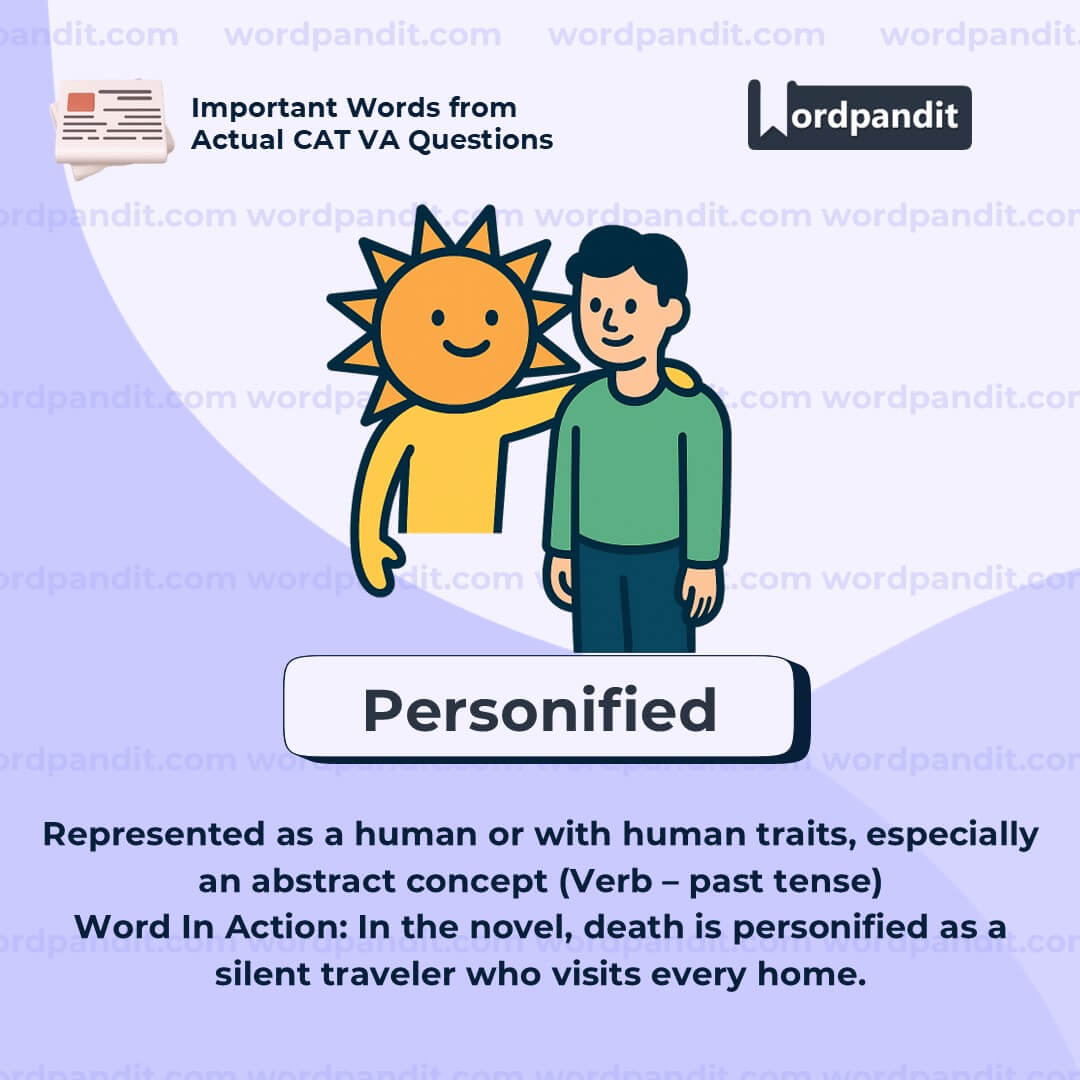
Context:
"Each one personified a different aspect of good fortune." - Mythological and Literary Text
Explanatory Paragraph:
"Personified" means represented in human form or with human qualities, especially when referring to abstract ideas or natural forces. In the given context, different aspects of good fortune are given human traits—each is imagined as a character that embodies a specific quality. This literary and symbolic technique helps make complex or invisible ideas more relatable and memorable. Personification is common in mythology, poetry, art, and storytelling, where virtues, emotions, or even seasons are brought to life as human-like figures.
Meaning: Represented as a human or with human traits, especially an abstract concept (Verb – past tense)
Pronunciation: pur-SON-uh-fide
Difficulty Level: ⭐⭐ Beginner
Etymology: From Latin *persona* (mask, character) + *facere* (to make), meaning "to give human form to something"
Prashant Sir's Notes:
To say something is “personified” means we’re giving it a face and personality. It’s like saying "Luck smiled on me"—you’re turning luck into a person who can smile. This is a powerful literary and cultural device!
Synonyms & Antonyms:
Synonyms: embodied, symbolized, represented, depicted, characterized
Antonyms: abstracted, depersonalized, dehumanized
Usage Examples:
- Justice is often personified as a blindfolded woman holding scales.
- The goddess Lakshmi personifies wealth and prosperity in Hindu mythology.
- In the poem, Death is personified as a gentle guide leading the speaker home.
- Each character in the story personified a different moral value.
Cultural Reference:
"In Greek mythology, the Muses personified the arts and inspired creativity among humans." – *Encyclopedia of World Mythology*
Think About It:
Why do humans so often personify abstract ideas like love, fear, or justice—and what does this tell us about the way we understand the world?
Quick Activity:
Pick an abstract concept (e.g., freedom, curiosity, fear). Write one sentence personifying it as if it were a human being.
Memory Tip:
“Personified” contains “person”—it means turning a non-person into something with human form or personality. Think of making an idea *a person in disguise*.
Real-World Application:
"Personified" is used in literature, religious symbolism, branding (e.g., mascots), and even public discourse—where values, companies, or causes are made human to connect emotionally with audiences.
Word-2: Deities
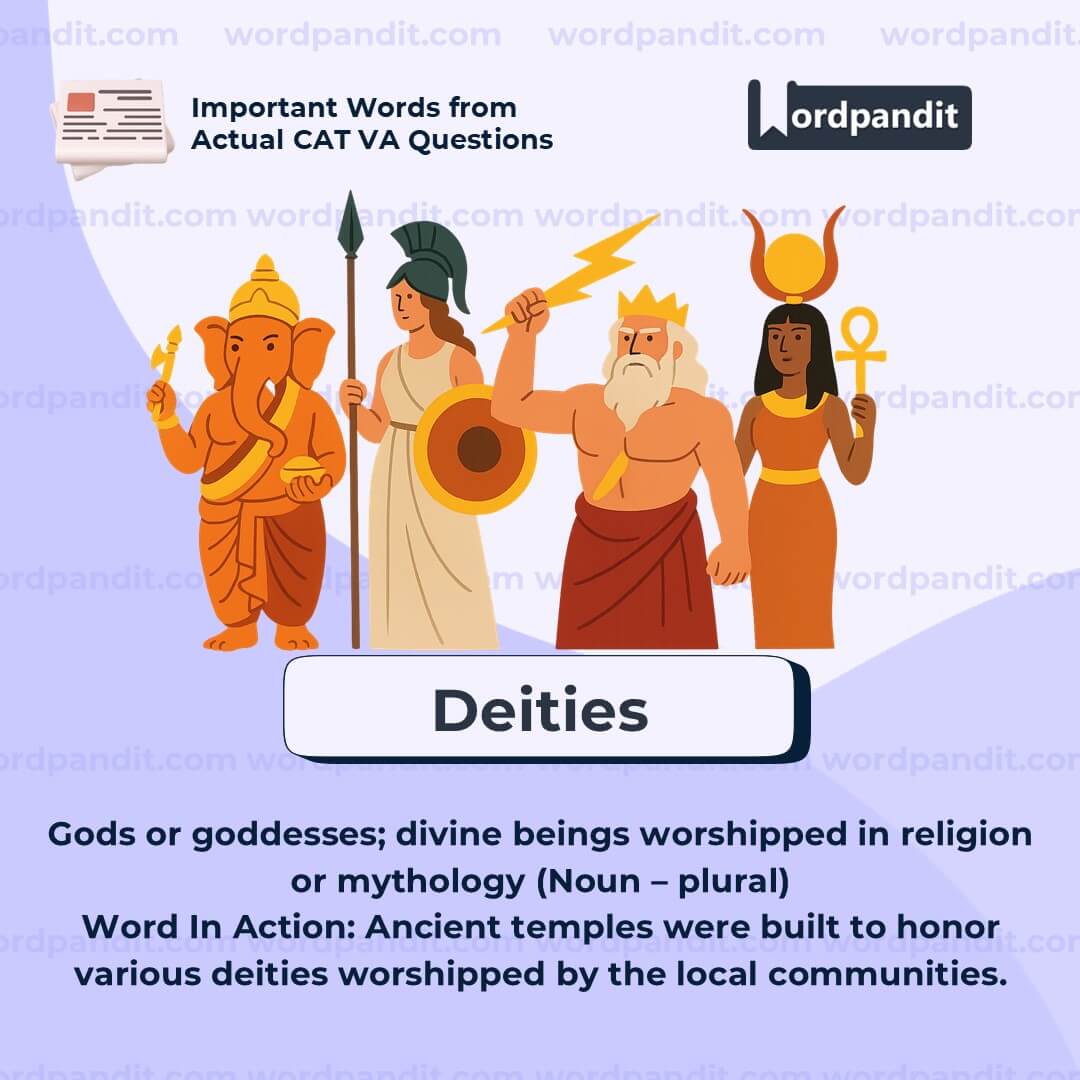
Context:
"Seven popular Japanese deities, the Shichi Fukujin, were considered to bring good luck and happiness." - Cultural and Religious Studies Text
Explanatory Paragraph:
"Deities" refers to gods or divine beings that are worshipped or revered in various religions and cultures. Each deity often represents specific aspects of life such as wisdom, fortune, war, or nature. In the given context, the Japanese deities called *Shichi Fukujin* symbolize different kinds of good fortune. The concept of deities exists across global traditions—from the Hindu pantheon to the Olympian gods of Greece—and often shapes religious rituals, cultural festivals, and mythologies.
Meaning: Gods or goddesses; divine beings worshipped in religion or mythology (Noun – plural)
Pronunciation: DEE-uh-teez
Difficulty Level: ⭐⭐ Beginner
Etymology: From Latin *deus* (god), through Old French *deité* → deity (singular), deities (plural)
Prashant Sir's Notes:
Deities aren’t just religious figures—they’re symbols. Each one teaches us something about human hopes, fears, or ideals. Whether it’s Lakshmi representing wealth or Thor wielding thunder, deities are how cultures make sense of the world.
Synonyms & Antonyms:
Synonyms: gods, goddesses, divinities, immortals, idols
Antonyms: mortals, humans, non-divine beings
Usage Examples:
- Ancient Egyptians worshipped many deities, including Ra, the sun god.
- In Greek mythology, deities like Athena and Apollo had human-like emotions and powers.
- The temple was dedicated to several deities representing nature and prosperity.
- Japanese culture honors seven deities believed to bring happiness and success.
Cultural Reference:
"The Shichi Fukujin—Seven Gods of Fortune—include deities such as Ebisu (prosperity), Daikokuten (wealth), and Benzaiten (art and music)." – *Japanese Folk Religion Archives*
Think About It:
Why do so many cultures throughout history create deities—and what human needs or values do these divine figures reflect?
Quick Activity:
Name one deity from any culture. Write a sentence explaining what they represent and how they are symbolically important.
Memory Tip:
“Deity” comes from *deus* = god. Think of deities as divine personalities who rule different aspects of life—love, wisdom, war, rain, and more.
Real-World Application:
"Deities" play vital roles in mythology, literature, comparative religion, anthropology, and cultural festivals. They shape rituals, moral stories, and how people view power, justice, and the natural world.
Word-3: Pantheon

Context:
"Although they were included in the Shinto pantheon, only two of them, Daikoku and Ebisu, were indigenous Japanese gods." - Cultural and Religious Studies Text
Explanatory Paragraph:
"Pantheon" refers to the full set or group of gods and goddesses worshipped in a particular religion or mythology. In the given context, the "Shinto pantheon" includes all the deities recognized within the Shinto belief system in Japan. The word can also be used more broadly to refer to a group of revered or influential figures, not just divine beings. Understanding a culture’s pantheon gives insight into its values, fears, ideals, and social structures.
Meaning: All the gods of a religion; a collective group of revered or significant figures (Noun)
Pronunciation: PAN-thee-on or PAN-thee-uhn
Difficulty Level: ⭐⭐⭐ Intermediate
Etymology: From Greek *pantheion* meaning "temple of all gods," from *pan-* (all) + *theos* (god)
Prashant Sir's Notes:
The “pantheon” is like the divine hall of fame. Every culture has its own pantheon—a lineup of gods who symbolize everything from war and wisdom to music and mischief. The word is also used metaphorically to describe groups of heroes, thinkers, or creators.
Synonyms & Antonyms:
Synonyms: group of gods, divine assembly, mythological figures, spiritual hierarchy
Antonyms: mortals, secular figures, non-divine entities
Usage Examples:
- The Greek pantheon includes gods like Zeus, Hera, and Athena.
- She was honored as part of the pantheon of great American poets.
- The Shinto pantheon blends indigenous and imported deities.
- Each deity in the Norse pantheon has a distinct domain and personality.
Cultural Reference:
"The Roman Pantheon, originally a temple for all gods, now stands as one of the most iconic architectural wonders of ancient Rome." – *National Geographic History Edition*
Think About It:
What does the composition of a culture’s pantheon tell us about its values, priorities, and worldview?
Quick Activity:
Name three deities from any cultural pantheon and describe the qualities or domains each one represents.
Memory Tip:
“Pan” = all, “theon” = gods. A *pantheon* is the complete cast of divine characters in a mythology—think of it as a godly ensemble!
Real-World Application:
"Pantheon" is used in religious studies, mythology, literature, and even pop culture—where the term might describe a group of legendary heroes or iconic figures across time and tradition.
Word-4: Indigenous
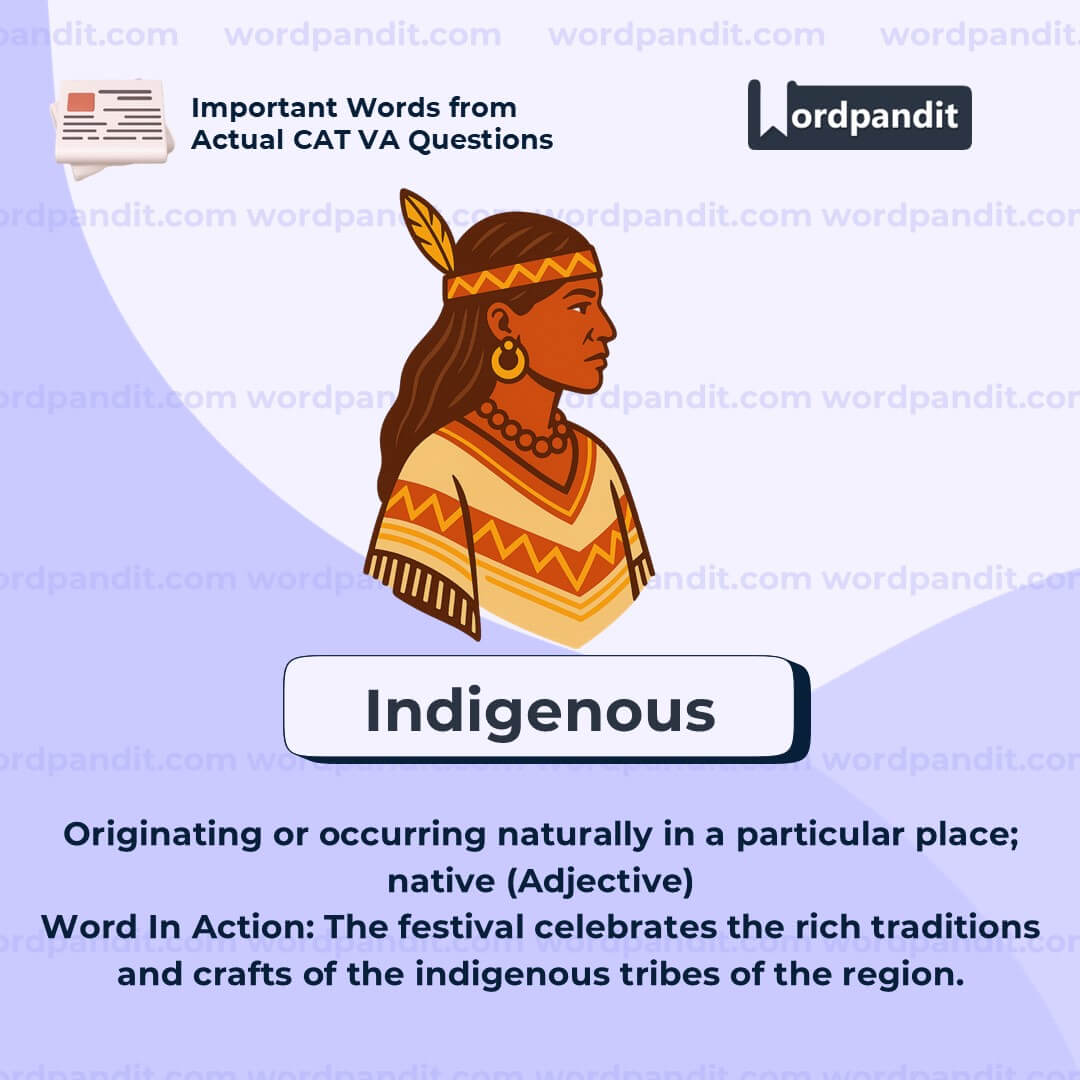
Context:
"Although they were included in the Shinto pantheon, only two of them, Daikoku and Ebisu, were indigenous Japanese gods." - Cultural and Religious Studies Text
Explanatory Paragraph:
"Indigenous" refers to something or someone that originates naturally in a specific place or environment. It often describes people, cultures, plants, animals, or beliefs that are native to a region and have not been introduced from elsewhere. In the context of religion or mythology, "indigenous" gods are those that emerged from the local traditions and culture, rather than being imported or adapted from foreign sources. The word is especially important in discussions of identity, heritage, and cultural preservation.
Meaning: Originating or occurring naturally in a particular place; native (Adjective)
Pronunciation: in-DIJ-uh-nuhs
Difficulty Level: ⭐⭐⭐ Intermediate
Etymology: From Latin *indigenus* ("native, born in a country"), from *indi-* (in, within) + *gignere* (to beget, produce)
Prashant Sir's Notes:
“Indigenous” is more than just “local”—it speaks to deep roots and long-standing presence. Whether it’s an indigenous tribe or an indigenous language, the word carries with it a sense of origin, authenticity, and identity that deserves respect and preservation.
Synonyms & Antonyms:
Synonyms: native, original, local, aboriginal, homegrown
Antonyms: foreign, imported, non-native, alien
Usage Examples:
- Only two of the deities were indigenous to Japanese spiritual traditions.
- The Amazon rainforest is home to many indigenous tribes with distinct languages and customs.
- This plant is indigenous to the Himalayan region and thrives in high altitudes.
- Efforts are being made to preserve indigenous cultures around the world.
Cultural Reference:
"The United Nations declared August 9 as the International Day of the World’s Indigenous Peoples to promote and protect the rights and heritage of native communities worldwide." – *UNESCO*
Think About It:
What are the risks when indigenous traditions or identities are overshadowed by dominant global cultures—and how can we help preserve them?
Quick Activity:
Choose a country or region and list one indigenous group, plant, or cultural tradition from that area. Briefly describe its importance.
Memory Tip:
“Indigenous” = *in* (within) + *genous* (born). Think: born and rooted *within* a land or culture—*not brought in* from elsewhere.
Real-World Application:
"Indigenous" is a key word in anthropology, environmental science, politics, and cultural studies—used when discussing native rights, biodiversity, heritage preservation, and social justice.
Word-5: Daoist
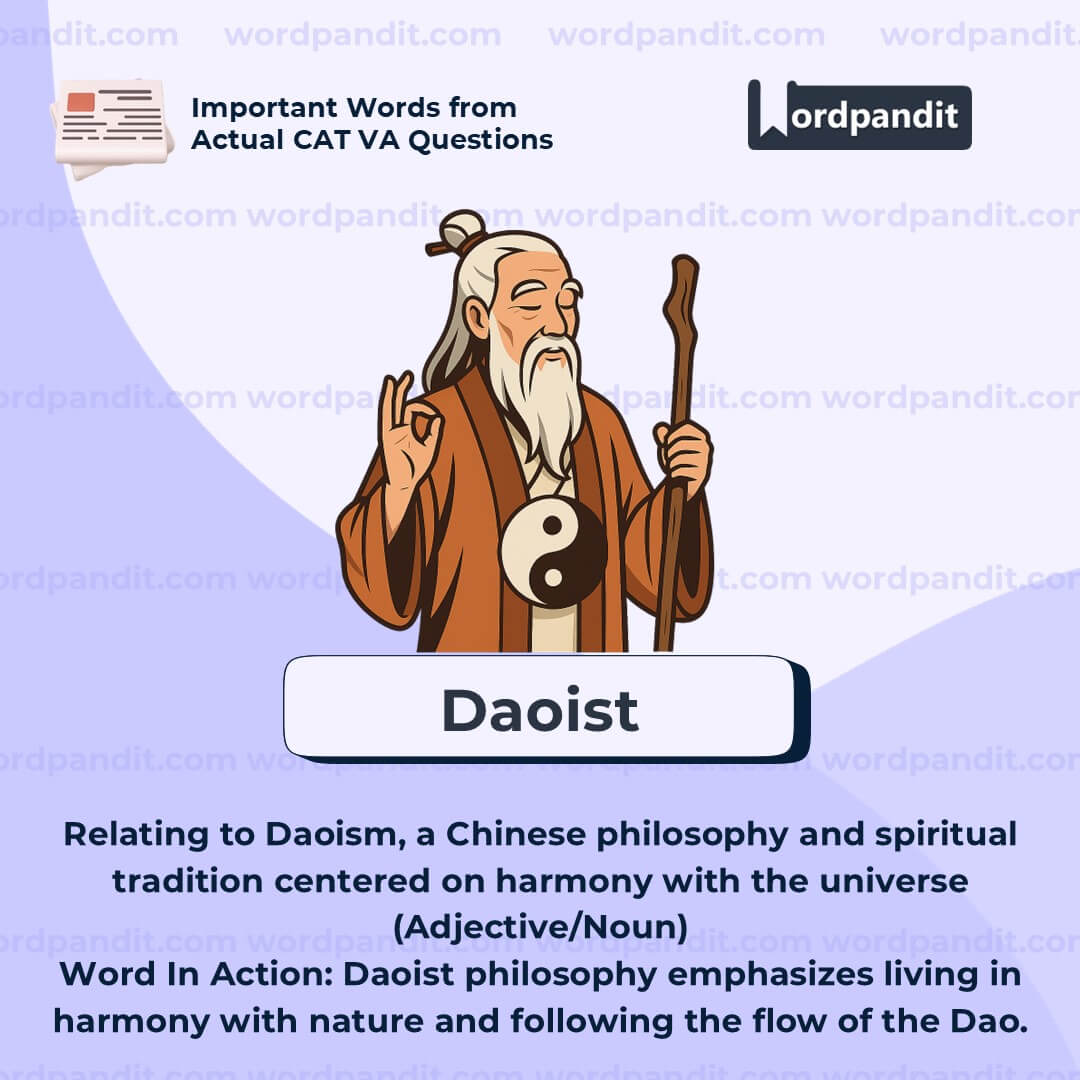
Context:
"The others were versions of popular Buddhist gods, Hindu gods and Daoist gods." - Comparative Religion and Mythology Text
Explanatory Paragraph:
"Daoist" refers to anything related to Daoism (also spelled Taoism), a philosophical and religious tradition that originated in ancient China. Daoism emphasizes living in harmony with the Dao (or Tao), which means "the Way" — the natural order of the universe. Daoist beliefs focus on balance, simplicity, and the interconnectedness of all things. In the context of the sentence, Daoist gods are divine figures worshipped or revered within Daoist traditions, often associated with nature, immortality, or cosmic forces.
Meaning: Relating to Daoism, a Chinese philosophy and spiritual tradition centered on harmony with the universe (Adjective/Noun)
Pronunciation: DOW-ist (rhymes with "now-ist")
Difficulty Level: ⭐⭐⭐ Intermediate
Etymology: From Chinese *Dao* (meaning “Way” or “Path”) + *-ist* (a person who practices or is related to an idea or tradition)
Prashant Sir's Notes:
Daoist thought is like flowing water—gentle but powerful. It teaches us to move with life, not against it. Daoist gods often symbolize cosmic principles like immortality, nature, and balance. Understanding Daoism gives deep insight into East Asian philosophy and spirituality.
Synonyms & Antonyms:
Synonyms: Taoist (alternative spelling), related to Chinese philosophy, Eastern spiritual
Antonyms: non-Daoist, Western rationalist, materialist (in philosophical contrast)
Usage Examples:
- Daoist monks often live in remote mountains to cultivate inner harmony and spiritual insight.
- She follows Daoist principles of balance and simplicity in her daily life.
- The temple housed statues of several Daoist gods associated with longevity and protection.
- Daoist texts like the *Tao Te Ching* emphasize effortless action and natural wisdom.
Cultural Reference:
"Laozi, the legendary author of the *Tao Te Ching*, is regarded as the founding figure of Daoism. His teachings shape Daoist philosophy and religious practice to this day." – *Stanford Encyclopedia of Philosophy*
Think About It:
In a world focused on speed and control, what can we learn from the Daoist idea of flowing with the rhythm of life instead of forcing outcomes?
Quick Activity:
Read a famous Daoist quote (e.g., “A journey of a thousand miles begins with a single step”). Reflect on its meaning and write one sentence about how it applies to your life.
Memory Tip:
Think “Dao” = “Way” or “Path.” A Daoist is someone who follows the *Way* of nature, balance, and flow—not control or resistance.
Real-World Application:
"Daoist" ideas influence traditional Chinese medicine, martial arts (like Tai Chi), feng shui, poetry, and environmental ethics. Understanding Daoism enriches cross-cultural understanding and offers timeless wisdom for personal growth.
