
✨ Introduction
Mastering Reading Comprehension begins with mastering the words!
In this post, we dive deep into vocabulary taken directly from an actual CAT RC passage. Each word has been explained in a simple, easy-to-understand way, along with examples to help you grasp its usage in real contexts.
From words like "species" and "cognitive" to "subjection" and "paradise," strengthen your vocabulary one word at a time — and take your RC performance to the next level!
📚 What’s Inside This Vocabulary Post?
- 🔍 Words Sourced from an Actual CAT RC Passage: Directly pick up important vocabulary from real CAT exam material.
- 🧠 Meaningful Explanations: Understand the exact meaning and usage of each word in a simple, student-friendly way.
- ✍️ Context-Based Learning: Learn words with examples that reflect their actual usage in reading comprehension contexts.
- 🗂️ Quick Reference Format: Words are neatly listed with meanings, parts of speech, and example sentences for easy revision.
- 🚀 Boost Your RC and Verbal Ability Skills: Improve your understanding of tough passages by strengthening your vocabulary.
📝 Words Covered in This Article:
- Protagonists
- Periphery
- Orientalism
- Imperialism
- Occident
- Essentialist
- Ethnocentric
- Masculinist
- Self-Development
- Post-Structural
WORD-1: Protagonists
Context:
"Such narratives highlight the experiences of mostly male protagonists “discovering themselves” on their journeys, emphasizing the independence of road travel and the value of rural folk traditions." - Literary Analysis Article
Explanatory Paragraph:
The term “protagonists” refers to the central characters in a story, around whom the main plot revolves. They are typically the ones who face challenges, undergo transformation, and drive the story forward. In many traditional narratives, especially in genres like road novels or hero’s journeys, protagonists are the individuals whose personal growth or discoveries are central to the theme of the tale.
Meaning: The main characters in a drama, novel, or narrative (Noun)
Pronunciation: pro-TAG-uh-nists
Difficulty Level: ⭐⭐ Beginner to Intermediate
Etymology: From Greek 'protagonistes', meaning ‘principal actor’, from ‘protos’ (first) + ‘agonistes’ (actor or competitor)
Prashant Sir's Notes:
Protagonists are not always “heroes” in the moral sense—they are just the primary focus of the story. Be careful not to confuse protagonists with only “good” characters; even an anti-hero can be a protagonist if the story is told from their perspective.
Synonyms & Antonyms:
Synonyms: main character, lead, hero, central figure, principal
Antonyms: antagonist, supporting character, villain, foil
Usage Examples:
- The protagonists of the novel face a series of moral dilemmas that shape their characters.
- In classic literature, the protagonist often goes through a significant transformation by the end.
- She wrote a story with dual protagonists who had opposing goals.
- The film’s protagonist challenges the societal norms of her time.
Cultural Reference:
"Holden Caulfield, the disenchanted protagonist of ‘The Catcher in the Rye’, became an icon for teenage rebellion." - Literary Journal
Think About It:
Can a story have more than one protagonist, and if so, how does it affect the narrative structure?
Quick Activity:
List three protagonists from books or movies you love and briefly describe their main conflict or goal.
Memory Tip:
Think of “pro” as in “primary” and “tag” as in “tagged” – the protagonist is the “tagged” main character of the story!
Real-World Application:
Understanding protagonists helps in analyzing stories more deeply in literature, film studies, and even marketing, where the customer is often treated as the 'protagonist' of the brand journey.
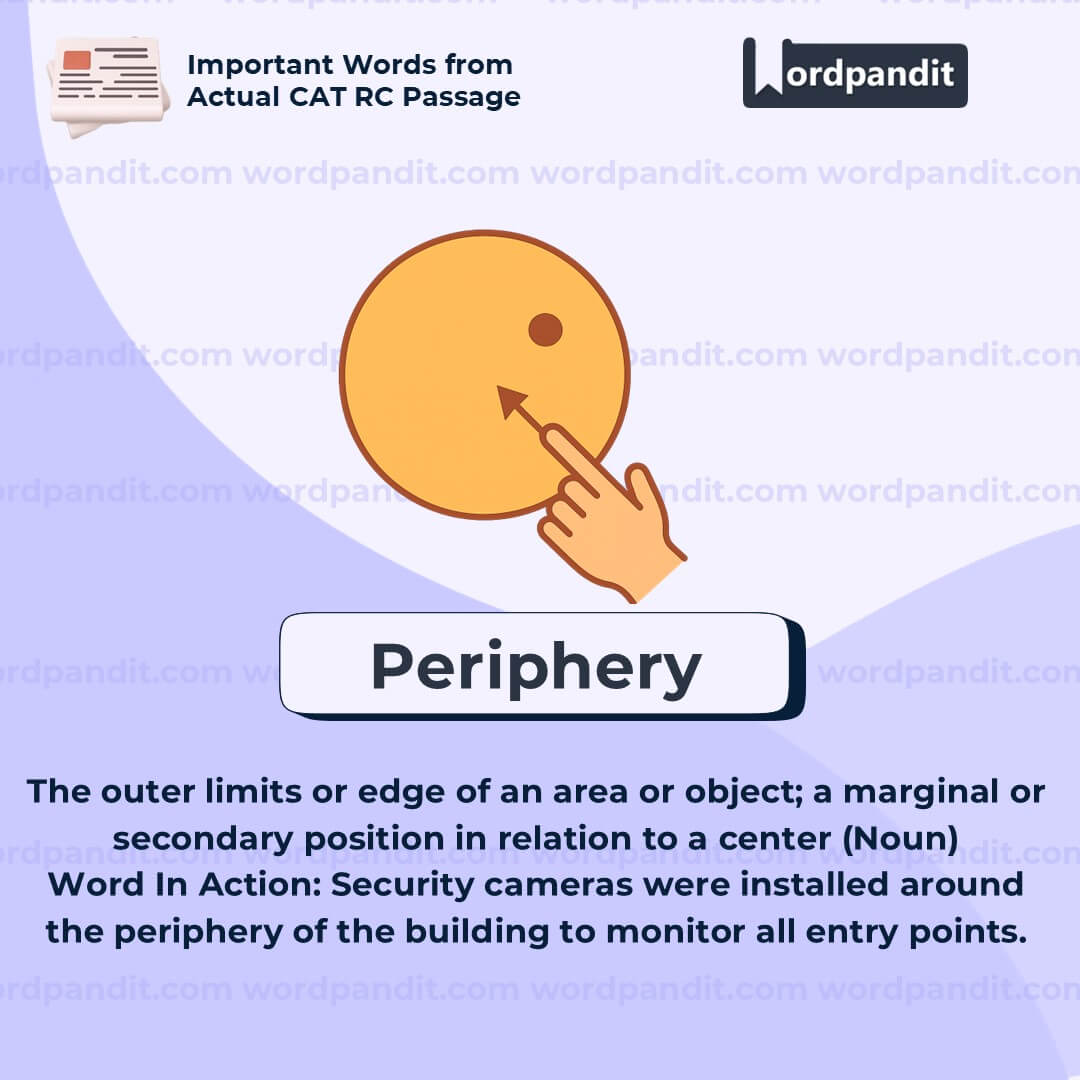
WORD-2: Periphery
Context:
"Mary Louise Pratt’s study of the genres and conventions of 18th- and 19th-century exploration narratives about South America and Africa (e.g., the “monarch of all I survey” trope) offered ways of thinking about travel writing as embedded within relations of power between metropole and periphery, as did Edward Said’s theories of representation and cultural imperialism." - Academic Literature Review
Explanatory Paragraph:
“Periphery” refers to the outer edge or boundary of something, but in political, social, or cultural contexts, it often signifies regions or groups that are marginalized or less powerful compared to a central authority or dominant culture—often referred to as the “metropole.” In postcolonial studies, it’s used to describe regions or societies that are considered subordinate to dominant Western centers of power and influence.
Meaning: The outer limits or edge of an area or object; a marginal or secondary position in relation to a center (Noun)
Pronunciation: puh-RIF-uh-ree
Difficulty Level: ⭐⭐⭐ Intermediate
Etymology: From Greek ‘peripheria’, from ‘peri’ (around) + ‘pherein’ (to carry)
Prashant Sir's Notes:
Don't think of “periphery” only in a geometric sense. It’s a powerful metaphor in political and cultural discussions. Always look at the context to judge whether it refers to physical space or socio-political status.
Synonyms & Antonyms:
Synonyms: edge, fringe, boundary, outskirts, margin
Antonyms: center, core, nucleus, heart, hub
Usage Examples:
- The tribe lived on the periphery of the modern city, maintaining its ancient customs.
- In global economics, many developing nations are still treated as part of the periphery.
- Artists working outside the mainstream often create from the periphery of cultural institutions.
- During the meeting, she remained on the periphery of the conversation, listening silently.
Cultural Reference:
"In world-systems theory, the globe is divided into core and periphery nations to explain the dynamics of economic dominance." - Immanuel Wallerstein, Sociologist
Think About It:
How does labeling something or someone as “peripheral” influence our perception of their importance or agency?
Quick Activity:
Draw a circle and label the “core” and the “periphery.” Then list three examples of groups or regions that might be considered peripheral in global history.
Memory Tip:
Think of “periphery” like the periphery of your vision — it’s there but not the focus. It’s the outer ring that surrounds the center.
Real-World Application:
Understanding the concept of periphery is key in fields like geopolitics, urban planning, and sociology, especially when discussing inequality, access to resources, or global power structures.
WORD-3: Imperialism
Context:
"Mary Louise Pratt’s study of the genres and conventions of 18th- and 19th-century exploration narratives about South America and Africa (e.g., the “monarch of all I survey” trope) offered ways of thinking about travel writing as embedded within relations of power between metropole and periphery, as did Edward Said’s theories of representation and cultural imperialism." - Academic Literature Review
Explanatory Paragraph:
“Imperialism” refers to a policy or ideology where a country extends its power and dominance over other territories through colonization, military force, or cultural influence. In historical contexts, it is associated with empires expanding their rule over distant lands, exploiting resources and imposing their own systems. In cultural or ideological discussions, such as in Edward Said’s work, imperialism includes how dominant nations represent and shape the identities of colonized people through literature, education, and media.
Meaning: A policy of extending a country's power and influence through diplomacy or military force (Noun)
Pronunciation: im-PEER-ee-uh-liz-uhm
Difficulty Level: ⭐⭐⭐⭐ Advanced
Etymology: From Latin ‘imperium’ (command, empire), through French ‘impérialisme’
Prashant Sir's Notes:
Imperialism is not just about colonizing land—it's also about controlling minds, languages, cultures, and economies. Think beyond war and flags; think about textbooks, trade, and television.
Synonyms & Antonyms:
Synonyms: colonialism, domination, expansionism, hegemony
Antonyms: self-determination, decolonization, independence, nationalism
Usage Examples:
- The British Empire's imperialism reshaped the political and cultural landscape of much of the world.
- Critics argue that economic globalization is a modern form of imperialism.
- Imperialism often involved the suppression of native languages and traditions.
- Writers like Chinua Achebe explore the impact of imperialism on African societies through literature.
Cultural Reference:
"They are not only the colonizers of our lands, but also of our minds." – Inspired by Frantz Fanon’s anti-imperialist writings.
Think About It:
How does imperialism continue to shape global power structures even after formal colonies have gained independence?
Quick Activity:
Choose one former colonial power and list three countries it colonized. Reflect on one lasting effect of this imperialism.
Memory Tip:
Think of “imperialism” like an “empire stretching its limbs”—reaching out to grab more power and land.
Real-World Application:
Understanding imperialism is essential in history, literature, and political science. It helps us analyze global inequalities, identity politics, and cultural representation in media and education.
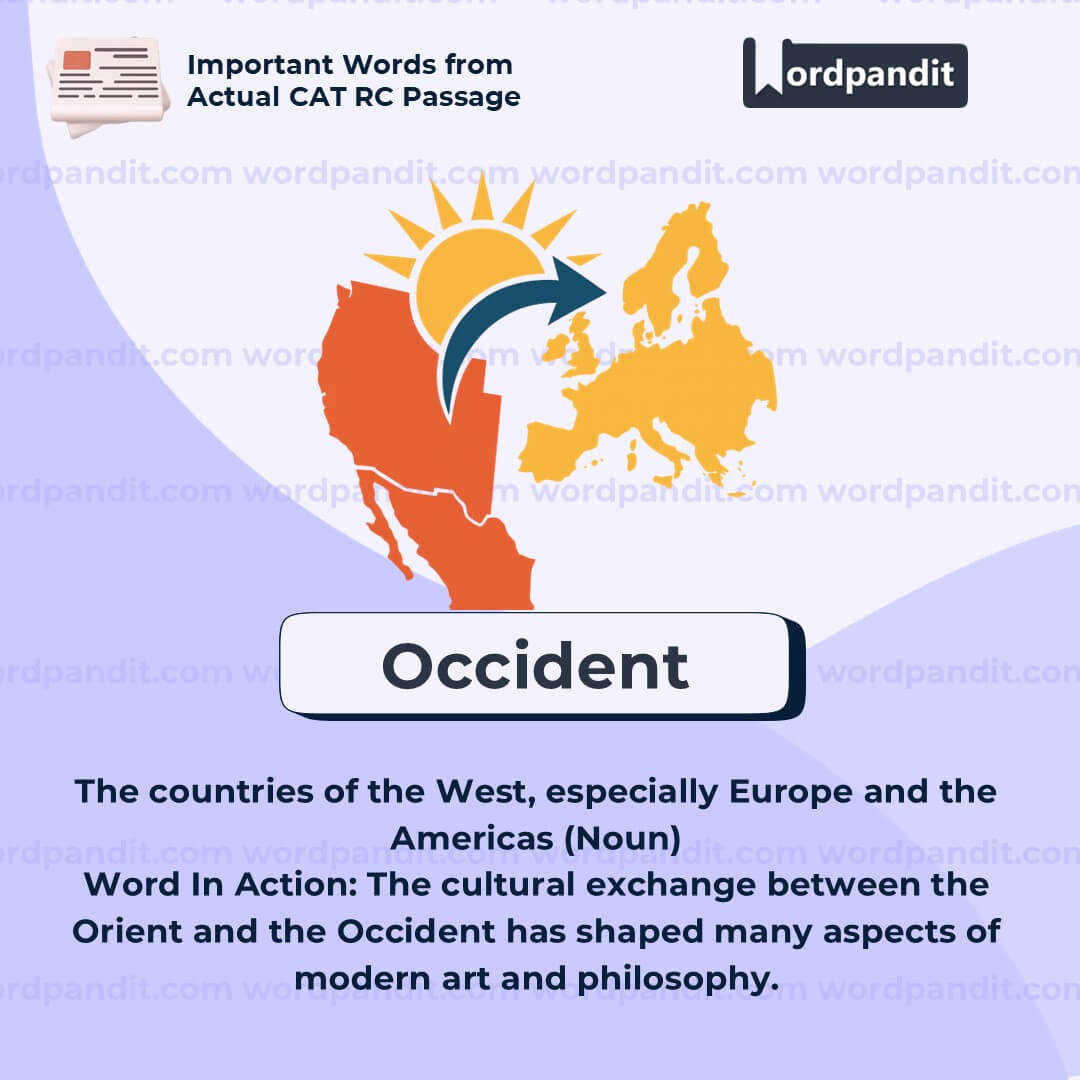
WORD-4: Occident
Context:
"Particularly Said’s book, Orientalism, helped scholars understand ways in which representations of people in travel texts were intimately bound up with notions of self, in this case, that the Occident defined itself through essentialist, ethnocentric, and racist representations of the Orient." - Postcolonial Studies Reading
Explanatory Paragraph:
“Occident” is a formal or literary term used to refer to the Western world, especially Europe and countries culturally influenced by Europe, such as the United States. It is often used in contrast to the “Orient,” or the East. In critical theory, especially in Edward Said’s work, the Occident is not just a geographic term but a cultural and ideological construct that positioned itself as superior by defining the “Orient” in stereotypical and reductive ways. The term is essential for understanding how Western identity and dominance have been constructed historically.
Meaning: The countries of the West, especially Europe and the Americas (Noun)
Pronunciation: OK-si-dent
Difficulty Level: ⭐⭐⭐ Intermediate
Etymology: From Latin ‘occidens’, meaning ‘setting (of the sun)’, from ‘occidere’ (to fall, to set)
Prashant Sir's Notes:
“Occident” and “Orient” are not neutral terms—they carry a lot of historical baggage. These words reflect power dynamics, and using them without context can oversimplify or perpetuate stereotypes. Be aware of their implications when using them in essays or discussions.
Synonyms & Antonyms:
Synonyms: the West, Western world, Western countries
Antonyms: the Orient, Eastern world, East
Usage Examples:
- The philosophical traditions of the Occident differ greatly from those of the Orient.
- In colonial discourse, the Occident often portrayed itself as enlightened and civilized.
- Art from the Occident was once considered the standard for global aesthetics.
- Said’s work critiques how the Occident constructed the Orient in literature and academia.
Cultural Reference:
"The Orient was almost a European invention, and had been since antiquity a place of romance, exotic beings, haunting memories and landscapes, remarkable experiences." - Edward Said, *Orientalism*
Think About It:
Why do you think the Occident felt the need to define itself in opposition to the Orient? What does that say about identity formation?
Quick Activity:
Research one major difference in how the Occident and Orient have been represented in 19th-century travel literature. Write a 2-sentence summary.
Memory Tip:
Think of the word “Occident” as connected to “sunset” — the West, where the sun sets. It’s the opposite of the “Orient,” where the sun rises.
Real-World Application:
Understanding terms like “Occident” is important in cultural studies, international relations, and postcolonial theory. It helps us see how global narratives are shaped and whose perspectives are prioritized or marginalized.
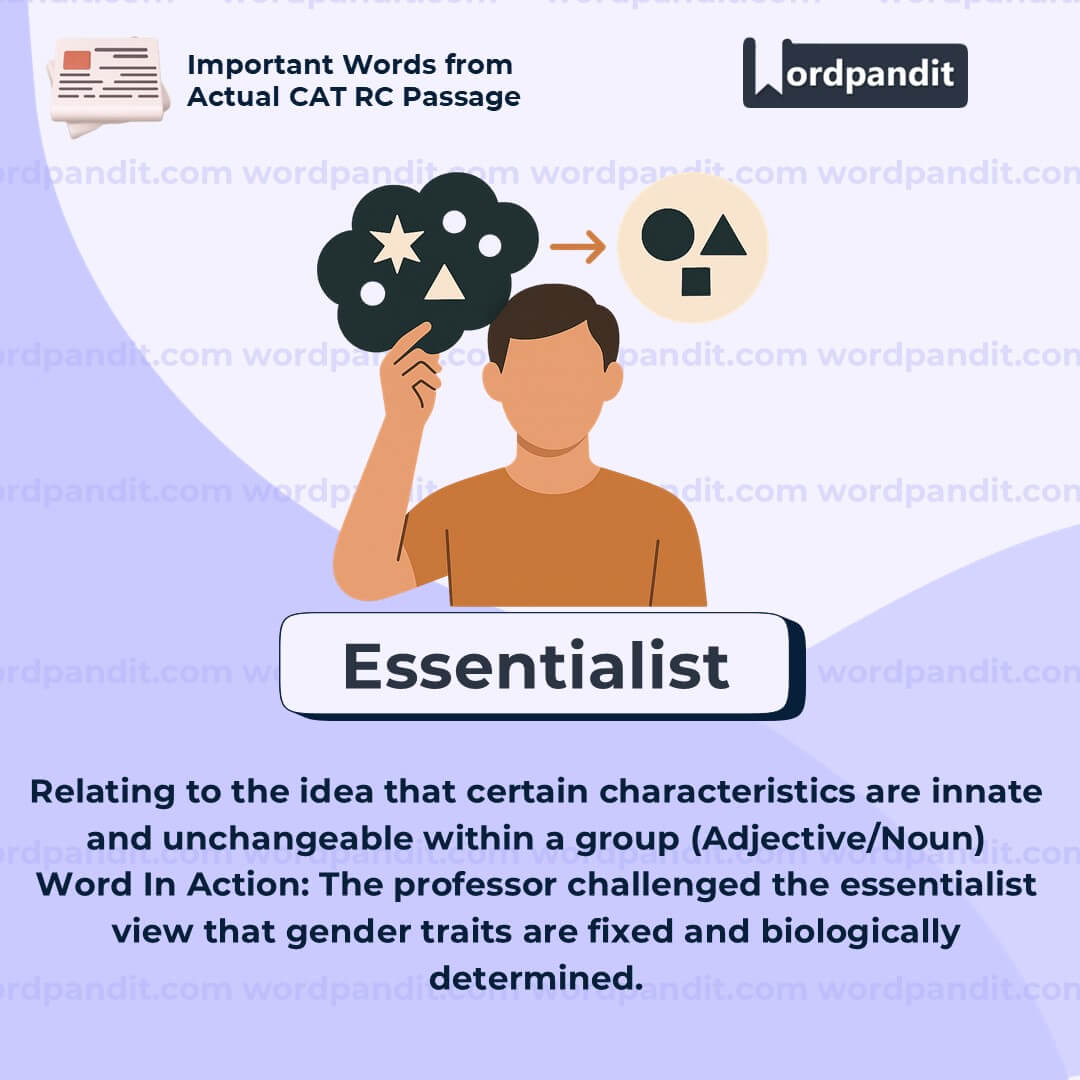
WORD-5: Essentialist
Context:
"Particularly Said’s book, Orientalism, helped scholars understand ways in which representations of people in travel texts were intimately bound up with notions of self, in this case, that the Occident defined itself through essentialist, ethnocentric, and racist representations of the Orient." - Postcolonial Studies Reading
Explanatory Paragraph:
“Essentialist” refers to a belief or approach that assumes certain groups of people have fixed, inherent characteristics that define them. In critical theory, particularly postcolonial studies, essentialism is criticized because it reduces individuals or cultures to simplistic, often stereotypical traits. When someone uses an essentialist perspective, they might say things like “all Eastern cultures are spiritual” or “Westerners are always logical,” ignoring the diversity and complexity within cultures. Edward Said critiqued such essentialist thinking in Orientalist representations.
Meaning: Relating to the idea that certain characteristics are innate and unchangeable within a group (Adjective/Noun)
Pronunciation: uh-SEN-shuh-list
Difficulty Level: ⭐⭐⭐ Intermediate
Etymology: Derived from “essentialism,” which comes from Latin ‘essentia’ (essence) + ‘-ism’
Prashant Sir's Notes:
Be careful not to confuse “essentialist” with “essential” in the general sense. An essentialist viewpoint simplifies the world into black-and-white categories, which is dangerous in intellectual and cultural discourse. Always be skeptical of overly general claims about people or cultures.
Synonyms & Antonyms:
Synonyms: reductionist, stereotypical, generalizing
Antonyms: relativist, pluralist, nuanced, contextual
Usage Examples:
- The novel was criticized for its essentialist depiction of indigenous people.
- Essentialist thinking leads to stereotypes and ignores cultural diversity.
- Her research challenges essentialist assumptions about gender and identity.
- Edward Said argued that Orientalist writers adopted an essentialist view of the East.
Cultural Reference:
"Essentialism is the belief that people and things have natural characteristics that make them what they are." - bell hooks, Cultural Critic
Think About It:
Can essentialist views ever be harmless, or do they always risk reinforcing stereotypes and social divisions?
Quick Activity:
Write down two common essentialist stereotypes you’ve heard. Now, write a counter-example that challenges each one.
Memory Tip:
Think of “essentialist” as someone who believes there’s only *one essential truth* about a group—often ignoring the bigger picture.
Real-World Application:
Recognizing and avoiding essentialist thinking is important in education, journalism, politics, and intercultural communication, where oversimplifications can lead to bias, discrimination, or flawed policy decisions.
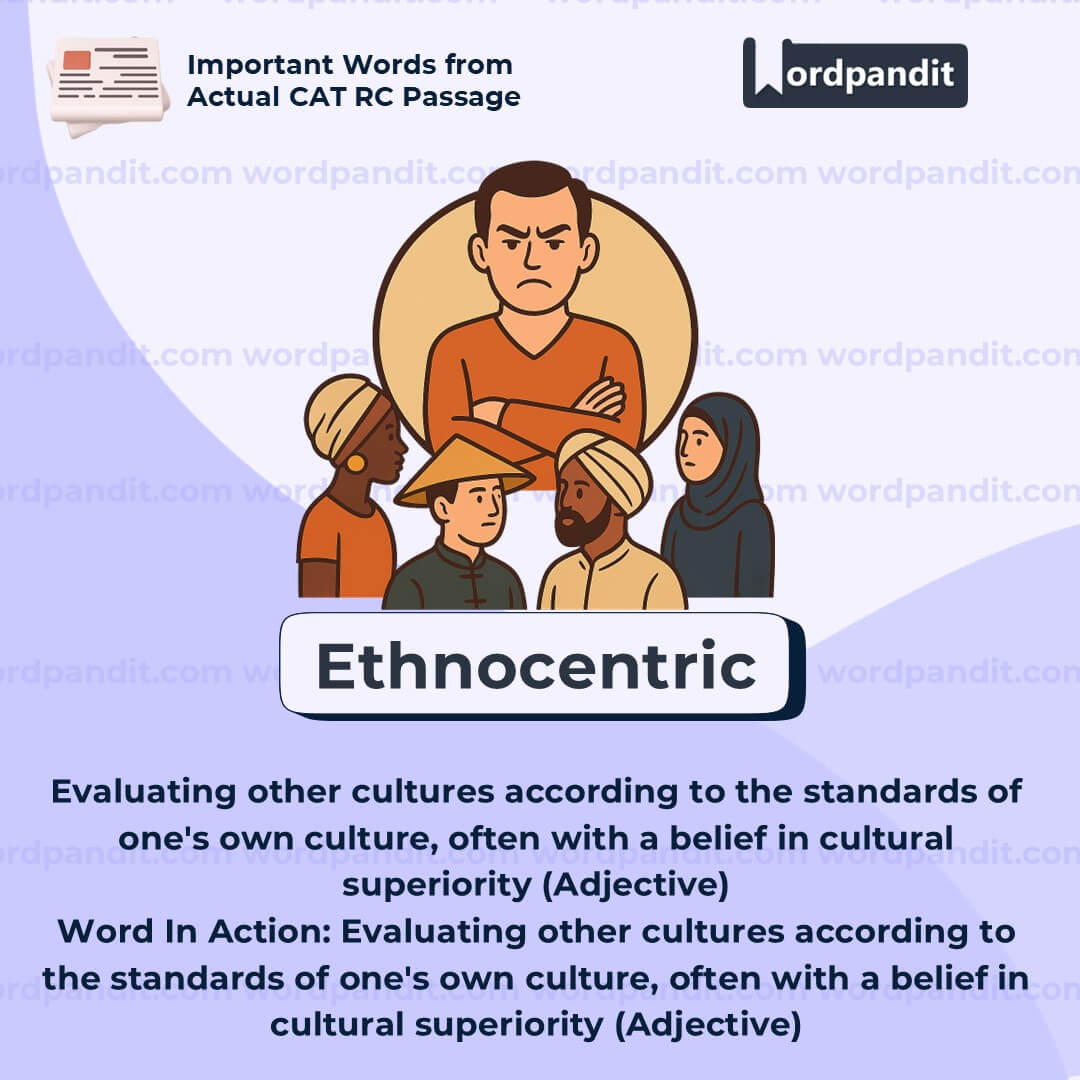
WORD-6: Ethnocentric
Context:
"Particularly Said’s book, Orientalism, helped scholars understand ways in which representations of people in travel texts were intimately bound up with notions of self, in this case, that the Occident defined itself through essentialist, ethnocentric, and racist representations of the Orient." - Postcolonial Studies Reading
Explanatory Paragraph:
“Ethnocentric” describes an attitude or perspective where one judges other cultures solely by the standards and values of their own culture. An ethnocentric viewpoint assumes that one’s own group is central or superior, often leading to misrepresentation, misunderstanding, and prejudice. In the context of Orientalism, the West (the Occident) portrayed Eastern societies as exotic, irrational, or backward, stemming from an ethnocentric worldview that measured all cultures by Western norms.
Meaning: Evaluating other cultures according to the standards of one's own culture, often with a belief in cultural superiority (Adjective)
Pronunciation: eth-no-SEN-trik
Difficulty Level: ⭐⭐⭐ Intermediate
Etymology: From Greek ‘ethnos’ (nation, people) + ‘centric’ (centered)
Prashant Sir's Notes:
Ethnocentrism is a mental trap—when you see everything through the lens of your own culture, you miss the richness and context of others. True understanding starts with empathy and curiosity, not judgment.
Synonyms & Antonyms:
Synonyms: culturally biased, xenophobic, nationalistic, insular
Antonyms: culturally aware, open-minded, multicultural, relativistic
Usage Examples:
- The textbook was criticized for its ethnocentric portrayal of non-Western societies.
- Ethnocentric attitudes can hinder international cooperation and understanding.
- Traveling helped her shed her ethnocentric views and appreciate cultural differences.
- Many colonial narratives reflect an ethnocentric belief in European superiority.
Cultural Reference:
"Ethnocentrism is the root of conflict, because it divides the world into 'us' and 'them'." – Intercultural Studies Framework
Think About It:
How can we recognize and challenge ethnocentric assumptions in the media, education, and daily life?
Quick Activity:
Write down three things that are considered “normal” in your culture. Then, try to find out how these same things are approached in two other cultures.
Memory Tip:
Think of “ethnocentric” as putting your own *ethnic group* in the *center*—and everything else on the outside looking in.
Real-World Application:
In today’s globalized world, identifying ethnocentric biases is crucial in diplomacy, education, travel, business, and cross-cultural communication to promote equity, inclusion, and mutual respect.
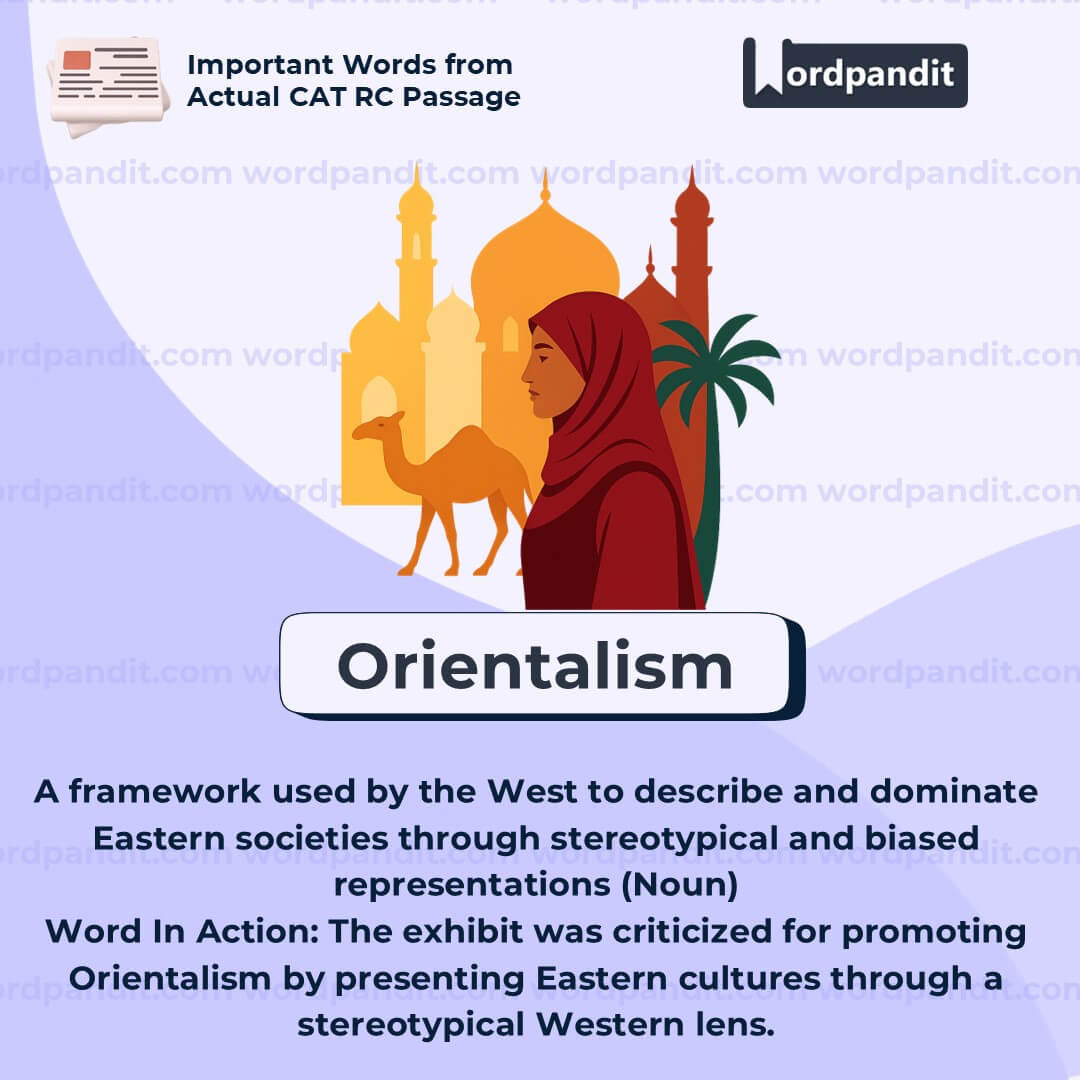
WORD-7: Orientalism
Context:
"Particularly Said’s book, Orientalism, helped scholars understand ways in which representations of people in travel texts were intimately bound up with notions of self, in this case, that the Occident defined itself through essentialist, ethnocentric, and racist representations of the Orient." - Postcolonial Studies Reading
Explanatory Paragraph:
“Orientalism” is a term popularized by Edward Said in his groundbreaking 1978 book of the same name. It refers to the way Western cultures have historically depicted Eastern societies—particularly those in the Middle East, Asia, and North Africa—in a stereotypical, patronizing, and often exoticized manner. Orientalism isn't just about cultural misunderstanding; it reflects a system of power where the West (Occident) defines itself as superior by portraying the East (Orient) as irrational, backward, and mysterious. This approach justified colonial domination and shaped public opinion and academic discourse for centuries.
Meaning: A framework used by the West to describe and dominate Eastern societies through stereotypical and biased representations (Noun)
Pronunciation: or-ee-EN-tuh-liz-um
Difficulty Level: ⭐⭐⭐⭐ Advanced
Etymology: From ‘Oriental’ (relating to the East) + ‘-ism’; redefined by Edward Said in modern academic discourse
Prashant Sir's Notes:
Orientalism isn't just about art or academic curiosity—it’s about power. Said’s work teaches us that how we “see” others reveals more about ourselves than about them. This concept is essential in cultural theory and postcolonial critique.
Synonyms & Antonyms:
Synonyms: exoticism (in biased contexts), cultural stereotyping, colonial discourse
Antonyms: cultural relativism, accurate representation, postcolonial critique
Usage Examples:
- Edward Said’s *Orientalism* transformed how scholars think about cultural representation and colonial power.
- Orientalism often portrays Eastern societies as timeless and unchanging, ignoring their modern realities.
- Movies and literature have long been criticized for their orientalist imagery and tropes.
- She studied the influence of Orientalism in 19th-century French painting.
Cultural Reference:
"The Orient was not (and is not) a free subject of thought or action." — Edward Said, *Orientalism*
Think About It:
In what ways does Orientalism still appear in today’s media, literature, and education systems?
Quick Activity:
Pick a film or book set in an Eastern country. Analyze one scene or passage for orientalist themes or imagery. What stereotypes are reinforced?
Memory Tip:
Link “Orientalism” to “Orient” + “-ism” — a system or belief about the East, often crafted by outsiders through a lens of power and superiority.
Real-World Application:
Understanding Orientalism is vital in global studies, literature, media analysis, and history. It helps individuals identify and challenge biased representations and support more balanced, respectful portrayals of diverse cultures.
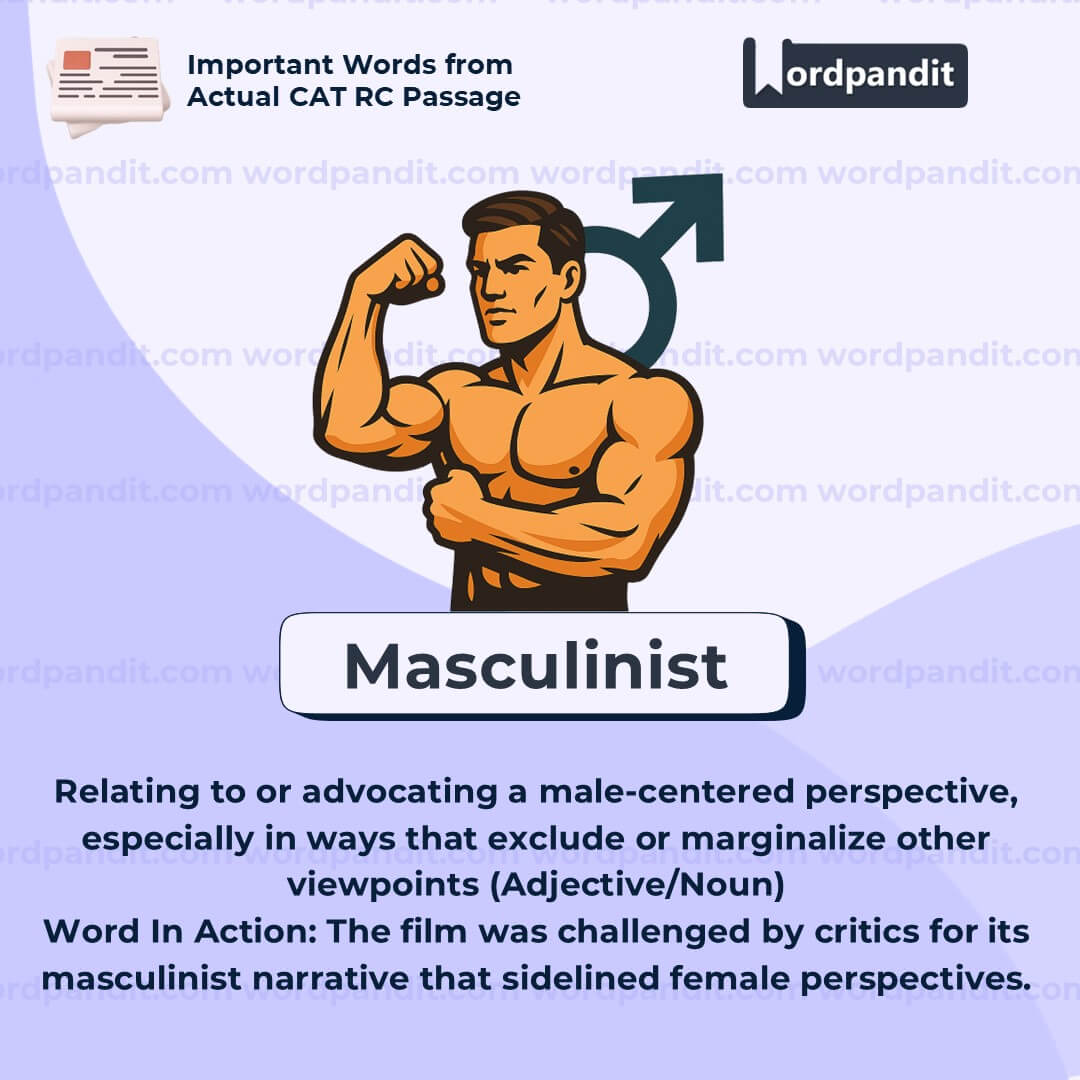
WORD-8: Masculinist
Context:
"Feminist geographers’ studies of travel writing challenge the masculinist history of geography by questioning who and what are relevant subjects of geographic study and, indeed, what counts as geographic knowledge itself." - Gender & Geography Studies
Explanatory Paragraph:
“Masculinist” refers to a perspective, ideology, or system that centers male experiences, values, or viewpoints as the default or norm, often marginalizing or ignoring those of other genders. In academic and cultural critique, calling something “masculinist” doesn't just mean “male-oriented” — it points to a structural bias that privileges masculine ways of knowing, being, or interpreting the world. For example, traditional geography often focused on conquest, mapping, and exploration—domains historically dominated by men—while neglecting more everyday, relational, or emotional experiences emphasized in feminist geography.
Meaning: Relating to or advocating a male-centered perspective, especially in ways that exclude or marginalize other viewpoints (Adjective/Noun)
Pronunciation: MAS-kyuh-luh-nist
Difficulty Level: ⭐⭐⭐⭐ Advanced
Etymology: From “masculine” + suffix “-ist”; modeled after “feminist” to indicate a particular worldview or approach
Prashant Sir's Notes:
Don’t confuse “masculinist” with simply being male. This term critiques systems and ideologies that assume male perspectives are universal or superior. It’s a key concept in gender studies and feminist critique.
Synonyms & Antonyms:
Synonyms: patriarchal, male-centered, androcentric
Antonyms: feminist, inclusive, egalitarian
Usage Examples:
- The textbook was criticized for presenting a masculinist view of history that ignored women's contributions.
- Her research challenges the masculinist assumptions of traditional science.
- Feminist scholars have long interrogated the masculinist foundations of academic disciplines.
- The conference aimed to deconstruct the masculinist bias in urban planning narratives.
Cultural Reference:
"Masculinist discourse often operates invisibly, presenting male norms as neutral or universal." — bell hooks, Feminist Theorist
Think About It:
What forms of knowledge or experience might be excluded when a field is shaped primarily by masculinist perspectives?
Quick Activity:
Choose a subject you’ve studied (like history, geography, or literature). List two ways it might reflect masculinist perspectives. Then brainstorm one way to make it more inclusive.
Memory Tip:
Link “masculinist” with “masculine + -ist” — it signals a belief system, not just a gender identity. Like a lens that filters the world through male assumptions.
Real-World Application:
Recognizing masculinist biases helps institutions—from academia to media to policymaking—become more inclusive, ensuring that diverse voices and experiences are represented and valued.
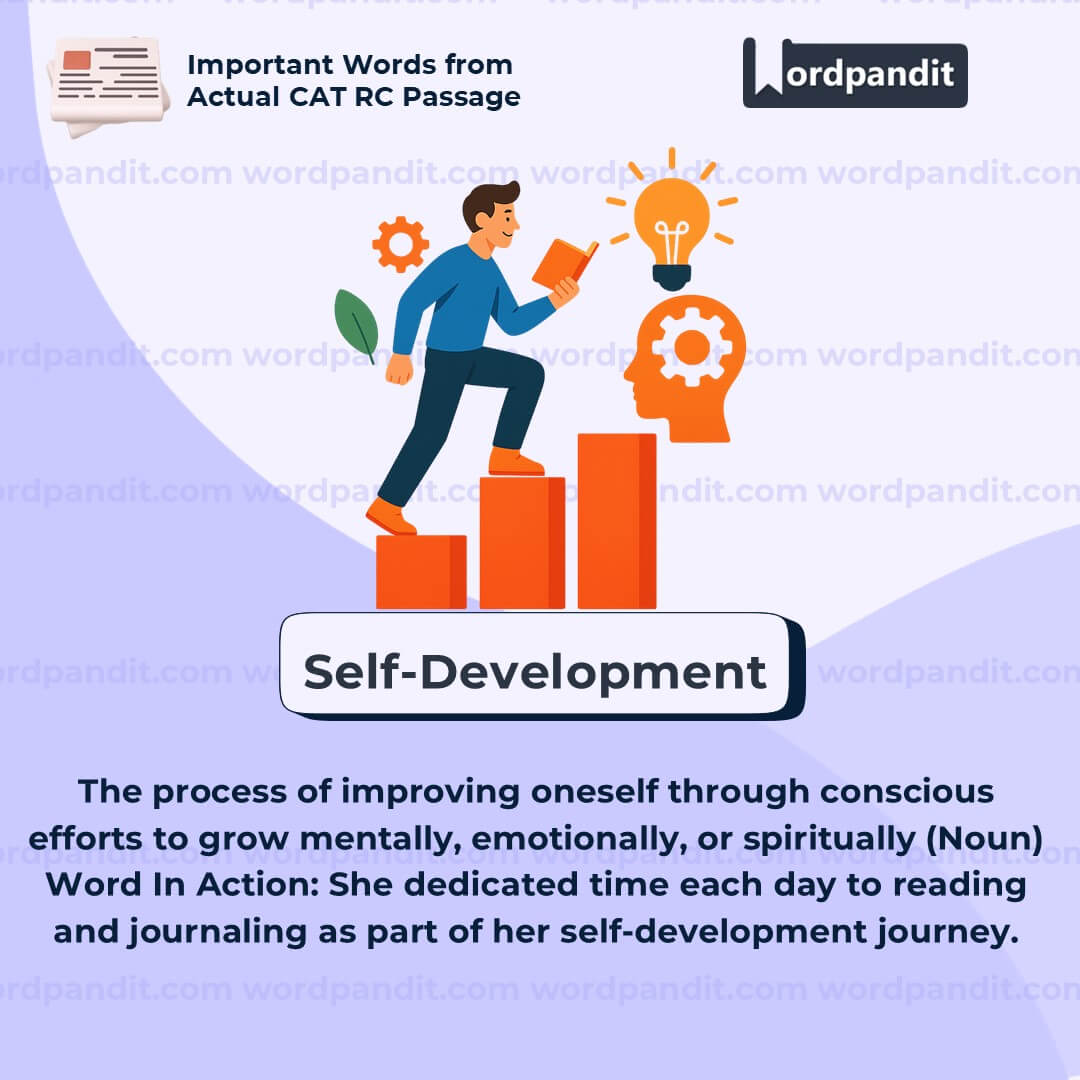
WORD-9: Self-Development
Context:
"Many studies from the 1970s onward demonstrated the ways in which women’s gendered identities were negotiated differently “at home” than they were “away,” thereby showing women’s self-development through travel." - Gender and Travel Studies
Explanatory Paragraph:
“Self-development” refers to the conscious process by which a person grows emotionally, intellectually, and spiritually. It involves increasing self-awareness, gaining confidence, learning new skills, and evolving one’s identity. In the context of travel and gender studies, self-development highlights how personal growth occurs in unfamiliar settings—when individuals, particularly women, step outside the expectations of their everyday environments and encounter new roles, challenges, and freedoms.
Meaning: The process of improving oneself through conscious efforts to grow mentally, emotionally, or spiritually (Noun)
Pronunciation: self-deh-VEL-up-ment
Difficulty Level: ⭐⭐ Beginner to Intermediate
Etymology: From “self” (referring to the individual) + “development” (growth, expansion)
Prashant Sir's Notes:
Self-development isn't only about reading books or attending workshops—it’s about any experience that shifts your mindset or sharpens your self-awareness. Travel is a classic catalyst for this because it pushes you out of your comfort zone.
Synonyms & Antonyms:
Synonyms: personal growth, self-improvement, self-realization, self-actualization
Antonyms: stagnation, regression, self-neglect
Usage Examples:
- Travel often plays a vital role in an individual's self-development.
- She invested in her self-development by learning new languages and volunteering abroad.
- Journaling helped him reflect on his journey of self-development.
- Self-development requires time, patience, and the willingness to step into discomfort.
Cultural Reference:
"Man’s main task in life is to give birth to himself, to become what he potentially is." – Erich Fromm, *The Art of Loving*
Think About It:
In what environments or situations do you experience the most self-development, and why?
Quick Activity:
Write down one recent experience that contributed to your self-development. What did it teach you about yourself?
Memory Tip:
Split the word into “self” + “development” — it's literally about *growing yourself*. Think of it as planting seeds within and nurturing them.
Real-World Application:
Self-development is key in personal life, education, and careers. It's what drives lifelong learning, emotional intelligence, and the ability to adapt and thrive in changing circumstances.
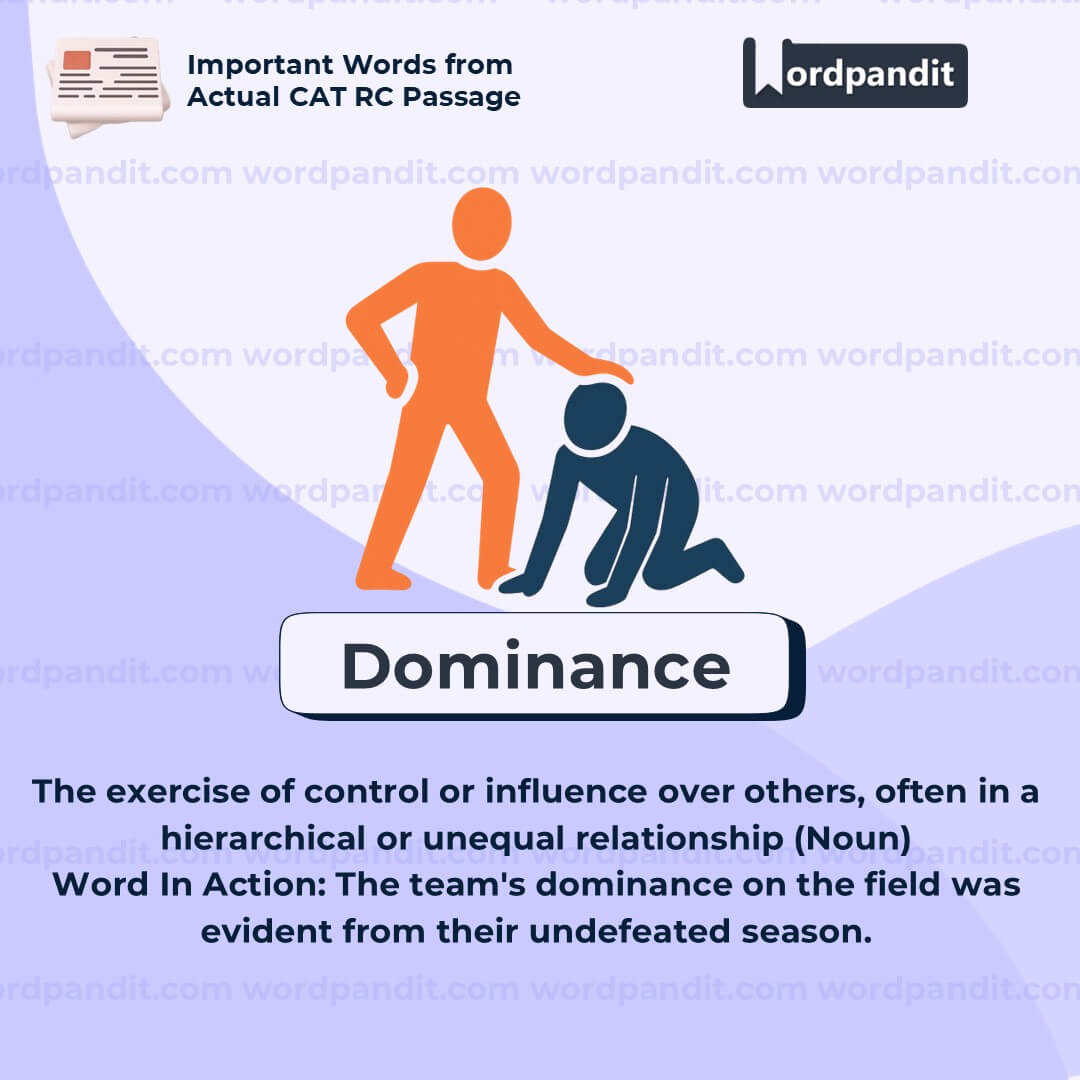
WORD-10: Dominance
Context:
"Said’s work became a model for demonstrating cultural forms of imperialism in travel texts, showing how the political, economic, or administrative fact of dominance relies on legitimating discourses such as those articulated through travel writing." - Postcolonial Theory Discussion
Explanatory Paragraph:
“Dominance” refers to a state or condition of having power, authority, or control over others. It can manifest in physical, political, cultural, or ideological forms. In postcolonial critique, dominance is not only exercised through direct rule or military control but also through narratives and representations. Said's *Orientalism* emphasizes how travel writing and scholarly discourse helped sustain Western dominance by portraying the East in ways that justified colonial control.
Meaning: The exercise of control or influence over others, often in a hierarchical or unequal relationship (Noun)
Pronunciation: DOM-uh-nuns
Difficulty Level: ⭐⭐ Beginner to Intermediate
Etymology: From Latin ‘dominari’ (to rule, dominate), from ‘dominus’ (master)
Prashant Sir's Notes:
Dominance doesn’t have to be physical. It often hides in soft power: language, media, education, or religion. Always ask—who’s telling the story, and what gives them the power to tell it that way?
Synonyms & Antonyms:
Synonyms: control, supremacy, authority, power, rule
Antonyms: submission, equality, subordination, dependence
Usage Examples:
- Colonial dominance was justified through literature, education, and travel narratives.
- The company maintains its dominance in the market through aggressive strategies.
- Gender studies often examine how cultural norms reinforce male dominance.
- Language can be a subtle tool of dominance in intercultural communication.
Cultural Reference:
"Power operates through dominance, but often disguises itself as reason or civilization." — Inspired by Edward Said’s *Orientalism*
Think About It:
What forms of dominance exist today that are not immediately visible but are deeply influential?
Quick Activity:
Identify one modern example of cultural or media dominance. How does it shape public opinion or reinforce inequalities?
Memory Tip:
“Dom” in dominance comes from “dominus” (master). Think of “dominance” as someone or something playing the master in a situation.
Real-World Application:
Understanding dominance is key in politics, sociology, business, and media literacy. Recognizing power structures allows individuals and societies to challenge inequality and promote justice.


