
✨ Introduction
Mastering Reading Comprehension begins with mastering the words!
In this post, we dive deep into vocabulary taken directly from an actual CAT RC passage. Each word has been explained in a simple, easy-to-understand way, along with examples to help you grasp its usage in real contexts.
From words like "species" and "cognitive" to "subjection" and "paradise," strengthen your vocabulary one word at a time — and take your RC performance to the next level!
📚 What’s Inside This Vocabulary Post?
- 🔍 Words Sourced from an Actual CAT RC Passage: Directly pick up important vocabulary from real CAT exam material.
- 🧠 Meaningful Explanations: Understand the exact meaning and usage of each word in a simple, student-friendly way.
- ✍️ Context-Based Learning: Learn words with examples that reflect their actual usage in reading comprehension contexts.
- 🗂️ Quick Reference Format: Words are neatly listed with meanings, parts of speech, and example sentences for easy revision.
- 🚀 Boost Your RC and Verbal Ability Skills: Improve your understanding of tough passages by strengthening your vocabulary.
📝 Words Covered in This Article:
- Stumbled
- Globalsystemic
- Sluggishness
- Stupefying
- Byways
- Psychology
- Mysteriously
- Priesthood
- Ironies
- Individualistic

WORD-1: Stumbled
Context:
"I began working on the subject as part of the background to a novel, and soon realized that I had stumbled across the most interesting story I’ve ever found." - Author Interview
Explanatory Paragraph:
“Stumbled” in this context refers to discovering something by chance or accident, rather than through a planned effort. It suggests a surprising and often fortunate encounter. While “stumbled” can literally mean to trip or lose balance while walking, it is frequently used metaphorically in writing or speech to describe unintentionally coming upon an idea, opportunity, or revelation. Here, the author unexpectedly came across a fascinating story while working on a different task.
Meaning: To find or encounter something unexpectedly (Verb – past tense of “stumble”)
Pronunciation: STUM-buhld
Difficulty Level: ⭐ Beginner
Etymology: From Middle English ‘stomblen’, of uncertain origin; related to Norwegian ‘stumla’ (to stagger)
Prashant Sir's Notes:
“Stumbled” is a versatile word that works both literally and figuratively. When used metaphorically, it adds a touch of surprise or serendipity. It’s great for storytelling—whether in writing or in interviews.
Synonyms & Antonyms:
Synonyms: came across, discovered, encountered, chanced upon
Antonyms: overlooked, missed, avoided, ignored
Usage Examples:
- She stumbled upon a hidden café while exploring the old part of town.
- He stumbled into the role of teacher after volunteering at a local school.
- While researching one topic, I stumbled across an entirely different and exciting lead.
- They stumbled over each other’s words, trying to explain the situation.
Cultural Reference:
"We often stumble upon our greatest insights when we least expect them." – Common reflection in creative writing workshops
Think About It:
Have you ever stumbled into a situation or discovery that changed your perspective or plans?
Quick Activity:
Write a 3-line story that includes the phrase “stumbled upon” and ends with a surprise.
Memory Tip:
Imagine physically tripping over something—and suddenly discovering it! That’s “stumbled” in action: accidental yet revealing.
Real-World Application:
“Stumbled” is commonly used in everyday conversation, journalism, and creative writing to describe serendipitous discoveries, making it a useful expression in both formal and informal contexts.
WORD-2: Globalsystemic
Context:
"While I was beginning to work on it, the British bank Northern Rock blew up, and it became clear that, as I wrote at the time, 'If our laws are not extended to control the new kinds of super-powerful, super-complex, and potentially super risky investment vehicles, they will one day cause a financial disaster of globalsystemic proportions.'" - Financial Commentary
Explanatory Paragraph:
“Globalsystemic” is a compound, non-standard but contextually clear term that refers to an issue or risk that affects the entire global system, particularly in finance, economics, or ecology. It implies interconnectedness, where a failure in one part of the system can trigger widespread consequences across the world. The use of this term in the quote emphasizes the potential for a financial crisis not limited to one country or market but capable of destabilizing the entire global financial system.
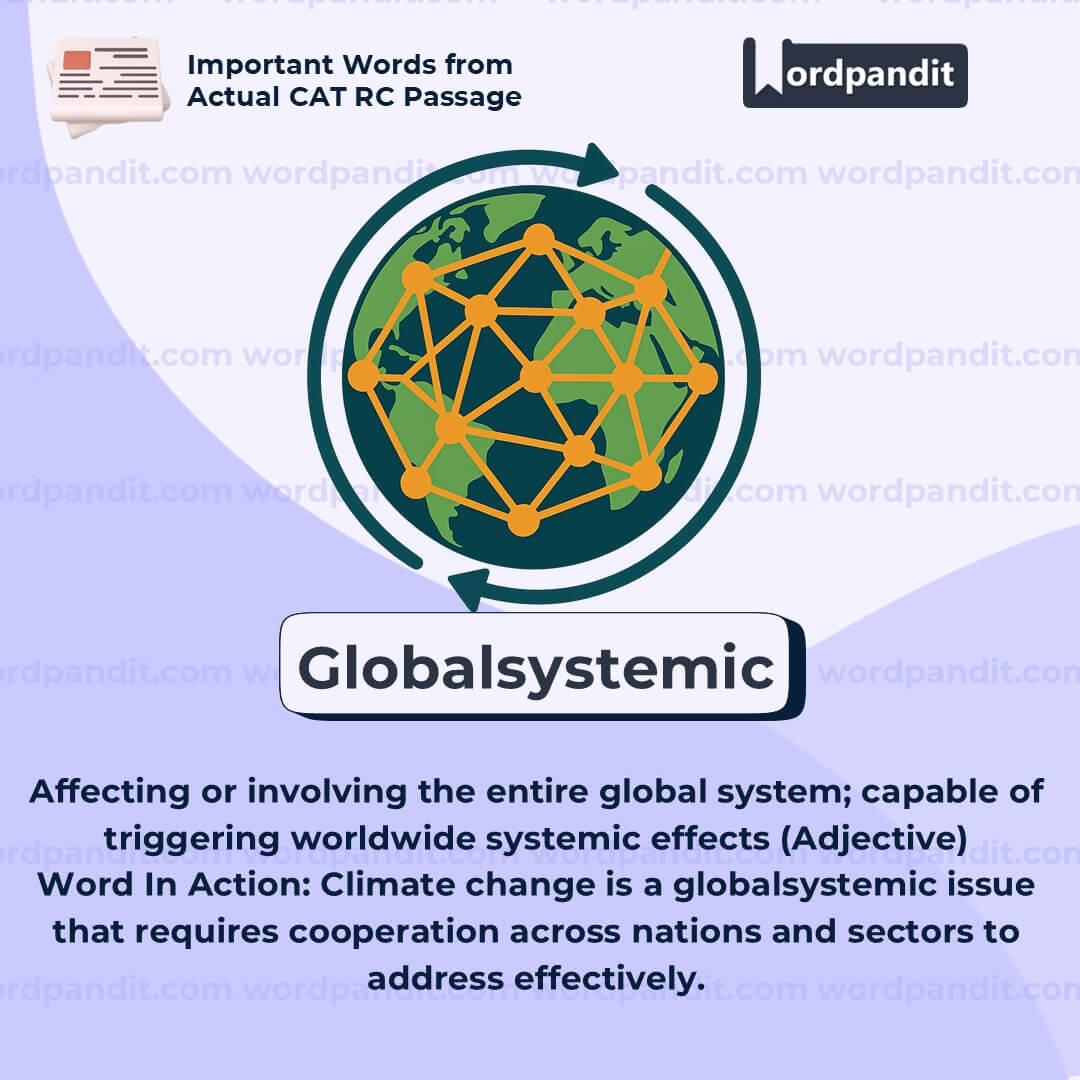
Meaning: Affecting or involving the entire global system; capable of triggering worldwide systemic effects (Adjective)
Pronunciation: GLOH-buhl-sis-TEM-ik
Difficulty Level: ⭐⭐⭐⭐ Advanced
Etymology: Blend of “global” (worldwide) + “systemic” (affecting an entire system); used in specialized contexts such as economics, finance, and ecology
Prashant Sir's Notes:
This is a great example of how language evolves to meet the demands of context. “Globalsystemic” may not be in traditional dictionaries, but it conveys powerful meaning in fields like economics and environmental science where global interdependence is crucial.
Synonyms & Antonyms:
Synonyms: worldwide, cross-border, interconnected, international systemic
Antonyms: local, isolated, contained, regional
Usage Examples:
- The collapse of a major bank could trigger a globalsystemic financial crisis.
- Climate change is a globalsystemic issue requiring coordinated international responses.
- Experts warned that cyber threats now pose globalsystemic risks to infrastructure.
- The pandemic revealed how health failures can become globalsystemic emergencies.
Cultural Reference:
"The 2008 financial crash was not a local event; it was globalsystemic in scope and impact." — Economic Crisis Retrospective
Think About It:
What kinds of modern risks—technological, environmental, or financial—could lead to globalsystemic consequences in the next decade?
Quick Activity:
Identify one global issue (e.g., climate change, cybersecurity, pandemics). Explain briefly why it qualifies as a globalsystemic concern.
Memory Tip:
Break it down: “global” (worldwide) + “systemic” (across systems). It’s about problems too big to be solved by just one nation or institution.
Real-World Application:
Recognizing globalsystemic risks is crucial for policy-makers, economists, and environmentalists. It encourages holistic, cooperative strategies to prevent or manage crises that affect the entire globe.
WORD-3: Sluggishness
Context:
"I was both right and too late, because all the groundwork for the crisis had already been done—though the sluggishness of the world’s governments, in not preparing for the great unraveling of autumn 2008, was then and still is stupefying." - Economic Memoir
Explanatory Paragraph:
“Sluggishness” refers to the quality of being slow, inactive, or lacking energy and responsiveness. In this context, it criticizes the delayed or inadequate response of global governments to looming financial dangers. The term conveys frustration with a lack of urgency or preparedness in the face of clear warning signs. It is commonly used to describe both physical and metaphorical slowness—in people, machines, economies, or bureaucracies.
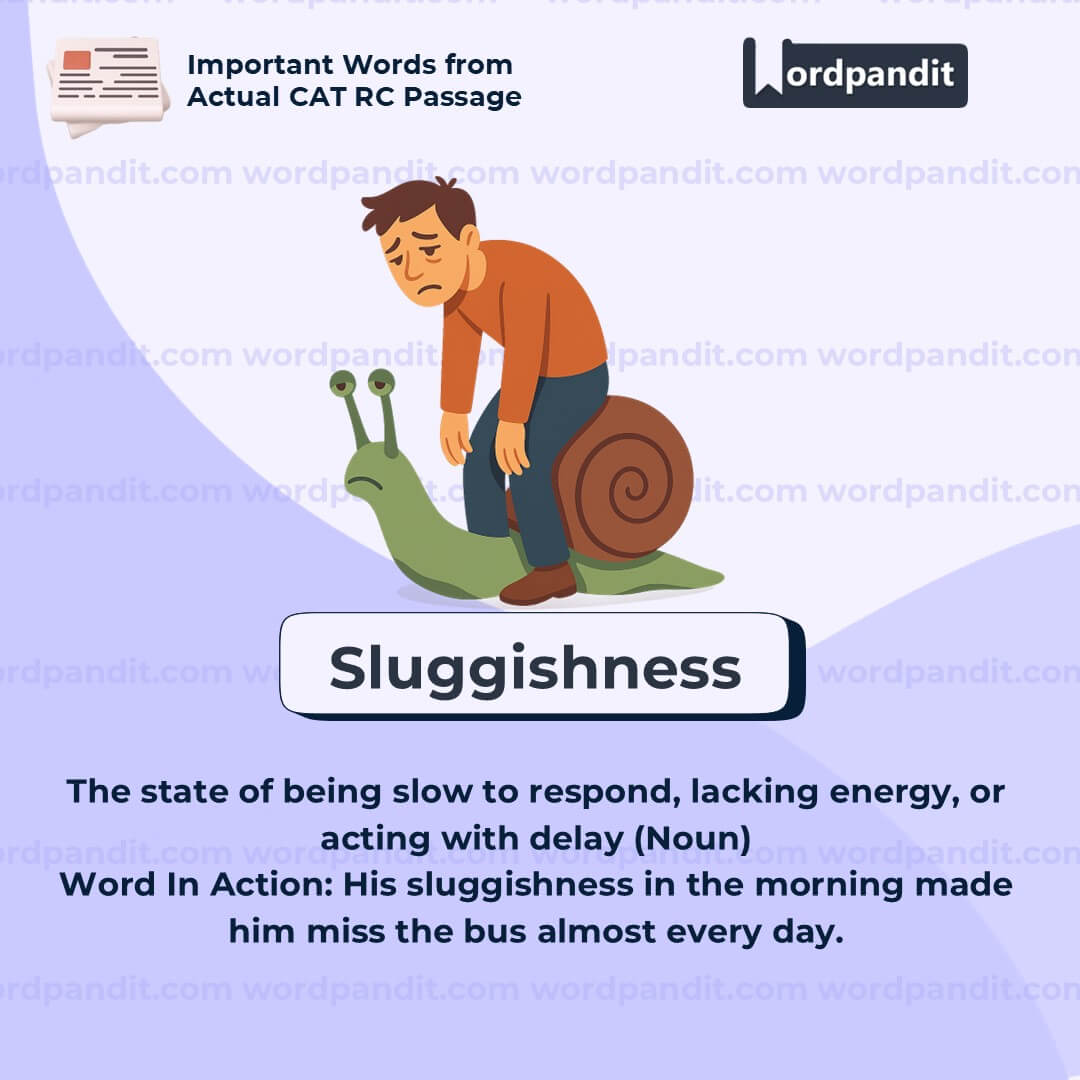
Meaning: The state of being slow to respond, lacking energy, or acting with delay (Noun)
Pronunciation: SLUHG-ish-ness
Difficulty Level: ⭐⭐ Beginner to Intermediate
Etymology: From “sluggish” (slow-moving, inactive) + “-ness” (a suffix forming nouns of quality or state)
Prashant Sir's Notes:
“Sluggishness” is a word you’ll often find in critiques—of governments, markets, or even people. It's simple but powerful when you want to describe unacceptable delays or lack of drive. Try pairing it with words like “response,” “economy,” or “thinking.”
Synonyms & Antonyms:
Synonyms: slowness, lethargy, inertia, delay, torpor
Antonyms: urgency, briskness, speed, agility, responsiveness
Usage Examples:
- The sluggishness of the emergency response led to widespread criticism.
- Economic sluggishness persisted for months after the initial crash.
- He blamed his sluggishness on a poor night’s sleep.
- The government’s sluggishness in acting on climate change is alarming.
Cultural Reference:
"In times of crisis, sluggishness is not just inefficient—it can be deadly." — Common critique in crisis management literature
Think About It:
Why do large institutions often fall into sluggishness, even when warning signs are clear?
Quick Activity:
Write a sentence comparing the sluggishness of two different systems (e.g., technology vs. bureaucracy).
Memory Tip:
Picture a slug slowly crawling along—that’s the root image of “sluggishness.” It’s all about being painfully slow.
Real-World Application:
“Sluggishness” is frequently used in news, finance, and policy debates to criticize slow decision-making or economic inactivity. Recognizing it can help spark reforms and demand greater efficiency.
WORD-4: Stupefying
Context:
"I was both right and too late, because all the groundwork for the crisis had already been done—though the sluggishness of the world’s governments, in not preparing for the great unraveling of autumn 2008, was then and still is stupefying." - Economic Memoir
Explanatory Paragraph:
“Stupefying” describes something so shocking, astonishing, or overwhelming that it leaves a person stunned, unable to react or think clearly. In this context, it conveys a sense of disbelief and frustration at the extreme slowness and inefficiency of governments during a major financial crisis. The term often implies that something is almost incomprehensibly bad or surprising, evoking strong emotional or intellectual reactions.
Meaning: So surprising or shocking that it stuns or confuses the mind (Adjective)
Pronunciation: STOO-puh-fy-ing
Difficulty Level: ⭐⭐⭐ Intermediate
Etymology: From Latin ‘stupere’ (to be stunned) + English suffix ‘-fy’ + ‘-ing’; related to “stupefy” (to astonish or shock)
Prashant Sir's Notes:
Use “stupefying” to show the magnitude of something beyond logic or belief. It’s a strong adjective—best used sparingly for maximum effect, especially in analytical or expressive writing.
Synonyms & Antonyms:
Synonyms: astonishing, shocking, mind-blowing, bewildering, breathtaking
Antonyms: unsurprising, expected, predictable, routine
Usage Examples:
- The stupefying complexity of the tax code leaves many citizens confused.
- It was stupefying to witness how little action was taken despite so many warnings.
- The magician’s final act was absolutely stupefying—no one could believe their eyes.
- Her stupefying indifference to the crisis shocked the entire panel.
Cultural Reference:
"Stupefying events demand bold reactions, not bureaucratic paralysis." – Commentary in *The Financial Times*
Think About It:
Can repeated exposure to stupefying events dull our ability to react with urgency or outrage?
Quick Activity:
Write two short sentences: one describing a stupefying personal experience, and another describing a stupefying historical event.
Memory Tip:
Think of “stupefying” as something so shocking it “stuns” your brain—like a verbal knockout punch!
Real-World Application:
“Stupefying” is useful in critiques, journalism, and persuasive writing when you need to express extreme surprise, disbelief, or criticism about events, policies, or behaviors.
WORD-5: Byways
Context:
"It is an absolutely amazing story, full of human interest and drama, one whose byways of mathematics, economics, and psychology are both central to the story of the last decades and mysteriously unknown to the general public." - Narrative Essay
Explanatory Paragraph:
“Byways” literally refers to minor or less-traveled roads or paths, as opposed to main roads or highways. Metaphorically, it describes the lesser-known or more obscure aspects of a subject. In this context, the “byways of mathematics, economics, and psychology” suggest hidden or underexplored elements that are crucial to understanding the full picture, yet often overlooked by the public. It adds a poetic tone, implying a journey through knowledge that leads away from the obvious routes.
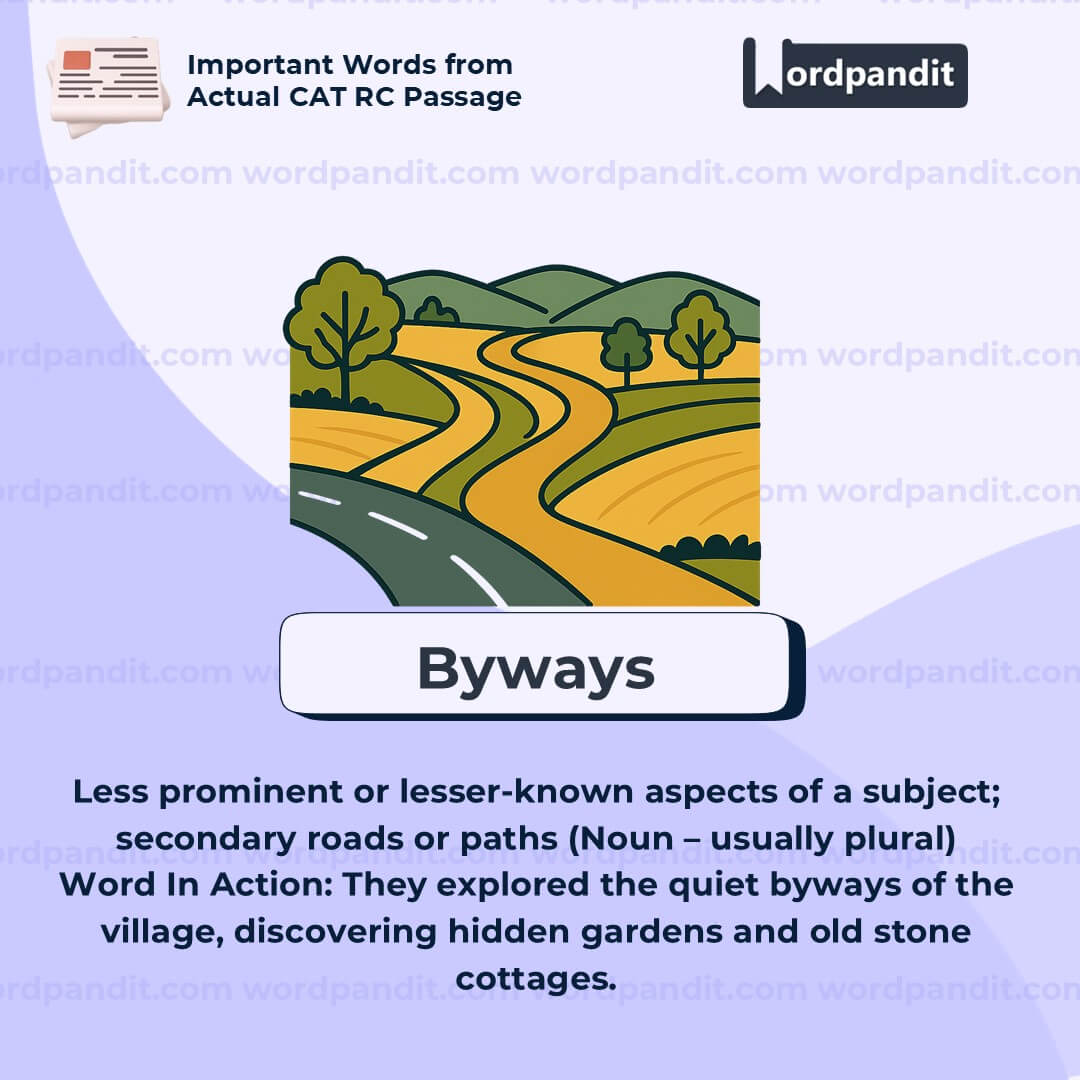
Meaning: Less prominent or lesser-known aspects of a subject; secondary roads or paths (Noun – usually plural)
Pronunciation: BYE-wayz
Difficulty Level: ⭐⭐ Beginner to Intermediate
Etymology: From “by” (side) + “way”; originally referred to side roads off the main path
Prashant Sir's Notes:
“Byways” is a beautiful metaphorical word for students of writing. It’s excellent for describing the hidden layers of a topic—those rich, often neglected corridors of thought that make your argument deeper.
Synonyms & Antonyms:
Synonyms: backroads, side paths, obscure aspects, hidden routes
Antonyms: highways, main roads, mainstream, well-trodden paths
Usage Examples:
- The book explores the byways of ancient philosophy that are often ignored in modern curricula.
- We wandered down the byways of the countryside, far from the tourist trails.
- The documentary shines light on the byways of political strategy seldom discussed publicly.
- He enjoys the byways of literature, diving into forgotten works and obscure authors.
Cultural Reference:
"Not all those who wander are lost." – J.R.R. Tolkien. This quote captures the spirit of exploring the byways—paths less taken that still hold value.
Think About It:
What byways of your own interests or career have you explored that others might overlook?
Quick Activity:
Name one subject you love. Now list two “byways” of that subject—ideas, topics, or perspectives that are often ignored but fascinate you.
Memory Tip:
Imagine a road trip—byways are those little scenic roads off the highway that take you somewhere unexpected and insightful.
Real-World Application:
“Byways” is a useful term in writing, research, and education when encouraging curiosity about niche, lesser-known, or hidden dimensions of any field.
WORD-6: Psychology
Context:
"It is an absolutely amazing story, full of human interest and drama, one whose byways of mathematics, economics, and psychology are both central to the story of the last decades and mysteriously unknown to the general public." - Narrative Essay
Explanatory Paragraph:
“Psychology” is the scientific study of the mind and behavior. It explores how people think, feel, act, and interact. In the context of the quote, psychology is one of the deeper, often overlooked layers that shape major historical and societal events—such as financial crises—by influencing human behavior, decision-making, and reactions. Psychology is not just about therapy or mental illness; it’s fundamental to understanding how people function individually and collectively in various settings.
Meaning: The scientific study of the human mind and behavior (Noun)
Pronunciation: sy-KOL-uh-jee
Difficulty Level: ⭐⭐ Beginner to Intermediate
Etymology: From Greek ‘psyche’ (soul, mind) + ‘-logia’ (study of); literally “study of the mind”
Prashant Sir's Notes:
Psychology is everywhere—from how we make financial choices to how we relate to others. Don’t box it into therapy or mental health alone. It’s key to unlocking human behavior, especially in high-stakes areas like politics, marketing, and leadership.
Synonyms & Antonyms:
Synonyms: behavioral science, mental science, cognitive science
Antonyms: (No direct antonym, but can contrast with) physiology, biology (in specific contexts)
Usage Examples:
- Understanding consumer psychology helps companies craft more effective advertisements.
- Her interest in human behavior led her to study psychology in college.
- The psychology behind groupthink helps explain how mass panic spreads.
- Psychology is a key factor in understanding both leadership and followership.
Cultural Reference:
"The mind is everything. What you think, you become." – Attributed to Buddha, often cited in psychological discussions
Think About It:
How much of your decision-making is driven by conscious thought—and how much by deeper psychological forces you may not even notice?
Quick Activity:
Write down one recent decision you made. Reflect on what psychological factors (emotion, habit, fear, logic) influenced it.
Memory Tip:
Link “psycho-” with mind and “-logy” with study. Psychology = the study of the psyche, or mind.
Real-World Application:
Psychology is foundational in fields like education, marketing, economics, health care, and even artificial intelligence. It helps us understand and improve how people think, feel, and behave in complex environments.
WORD-7: Mysteriously
Context:
"It is an absolutely amazing story, full of human interest and drama, one whose byways of mathematics, economics, and psychology are both central to the story of the last decades and mysteriously unknown to the general public." - Narrative Essay
Explanatory Paragraph:
“Mysteriously” is an adverb used to describe an action or condition that is difficult to explain or understand. In this context, it emphasizes that although mathematics, economics, and psychology are central to major developments in recent history, they remain strangely or inexplicably hidden from public awareness. The word adds a sense of intrigue or puzzlement, often suggesting that something important is being overlooked or concealed without clear reason.
Meaning: In a way that is difficult to explain or understand; strangely or inexplicably (Adverb)
Pronunciation: mis-TEER-ee-uhs-lee
Difficulty Level: ⭐⭐ Beginner to Intermediate
Etymology: From “mysterious” (from Latin ‘mysterium’ meaning secret rite) + “-ly” (adverbial suffix)
Prashant Sir's Notes:
“Mysteriously” adds narrative flair—it’s often used when something is unclear, hidden, or eerily unknown. Great for storytelling, especially when you want to create suspense or highlight gaps in knowledge.
Synonyms & Antonyms:
Synonyms: strangely, inexplicably, puzzlingly, oddly, enigmatically
Antonyms: clearly, obviously, plainly, evidently
Usage Examples:
- The treasure mysteriously disappeared from the vault without a trace.
- He mysteriously withdrew from the project at the last minute.
- Despite being highly relevant, this topic remains mysteriously absent from school curriculums.
- The machine mysteriously malfunctioned during the final test.
Cultural Reference:
"The most beautiful thing we can experience is the mysterious. It is the source of all true art and science." – Albert Einstein
Think About It:
Why do you think some of the most important knowledge remains mysteriously hidden from the general public?
Quick Activity:
Write a sentence beginning with “Mysteriously,…” and create a sense of suspense or curiosity in just one line.
Memory Tip:
Think of “mysteriously” as how a magician works—it leaves people puzzled, unsure of what really happened.
Real-World Application:
“Mysteriously” is useful in both fiction and nonfiction writing to introduce uncertainty, intrigue, or unexplained phenomena. It's common in journalism, storytelling, and even science communication when discussing gaps in knowledge or strange outcomes.
WORD-8: Priesthood
Context:
"...if the financial industry is not to be a kind of priesthood, administering to its own mysteries and feared and resented by the rest of us..." – Financial Critique
Explanatory Paragraph:
“Priesthood” literally refers to the office or position of being a priest, often associated with religious authority and exclusive access to sacred knowledge or rituals. In this metaphorical context, it critiques the financial industry as functioning like a closed group of elites who possess specialized knowledge, communicate in opaque terms, and remain unaccountable to the public. The comparison implies that, like ancient priesthoods, the financial sector risks becoming alienated from ordinary people, guarding its "mysteries" while being feared and mistrusted.
Meaning: A group or class of people who are seen as gatekeepers of exclusive knowledge or authority; literally, the body of priests (Noun)
Pronunciation: PREEST-huhd
Difficulty Level: ⭐⭐ Beginner to Intermediate
Etymology: From Old English ‘preosthād’ – ‘preost’ (priest) + ‘-hād’ (state or condition)
Prashant Sir's Notes:
Watch for metaphorical uses of words like “priesthood” in critiques. It’s not about religion here—it’s about exclusivity and power. Think of it as a call to demystify complex systems that affect everyone.
Synonyms & Antonyms:
Synonyms: clergy (literal), elite class, inner circle, gatekeepers
Antonyms: laypeople, public, general population, commoners
Usage Examples:
- Some critics view academia as a modern priesthood, guarding knowledge in complex language.
- The financial sector has become a kind of priesthood, understood only by insiders.
- He left the priesthood after years of service to pursue a secular path.
- The software industry sometimes resembles a priesthood, with jargon that excludes outsiders.
Cultural Reference:
"The computer priesthood" was a term used in the 1970s to describe the early elite programmers who controlled access to computing knowledge and systems.
Think About It:
In what modern fields or industries do you see a “priesthood” forming—where specialized knowledge creates power and distance from the public?
Quick Activity:
List two fields that often seem like “priesthoods” and write one sentence on how they could become more transparent or inclusive.
Memory Tip:
Think of “priesthood” as not just about religion—it’s any exclusive group guarding complex knowledge or rituals that others aren’t allowed to touch.
Real-World Application:
The metaphor of “priesthood” is often used in journalism and policy critiques to highlight the dangers of opaque systems. Understanding this term helps you spot when industries or groups might be distancing themselves from accountability.

WORD-9: Individualistic
Context:
"That’s one of the strangest ironies of this story: after decades in which the ideology of the Western world was personally and economically individualistic, we’ve suddenly been hit by a crisis which shows in the starkest terms that whether we like it or not—and there are large parts of it that you would have to be crazy to like—we’re all in this together." - Economic Analysis
Explanatory Paragraph:
“Individualistic” refers to a worldview or attitude that emphasizes personal independence, self-reliance, and the prioritization of individual goals and freedoms over collective or communal ones. In this context, it critiques the dominant Western ideology that focused on personal gain and autonomy, which was sharply contradicted by the collective consequences of a global crisis. The term is often used in discussions of politics, economics, culture, and ethics to contrast with more community-oriented or collectivist values.
Meaning: Characterized by the belief in the importance of individual independence and self-reliance (Adjective)
Pronunciation: in-duh-vij-oo-uh-LIS-tik
Difficulty Level: ⭐⭐⭐ Intermediate
Etymology: From “individual” + suffix “-istic”; relating to the qualities or values of the individual
Prashant Sir's Notes:
“Individualistic” often sounds positive in the context of personal freedom, but it can also carry criticism when it implies selfishness or lack of social responsibility. Context determines whether it’s a virtue or a vice.
Synonyms & Antonyms:
Synonyms: self-reliant, self-centered, independent, autonomous
Antonyms: collectivist, community-minded, cooperative, communal
Usage Examples:
- His individualistic style set him apart from the rest of the group.
- The society promoted an individualistic economy focused on personal success.
- Critics argued that the response to the crisis was hampered by overly individualistic thinking.
- She valued her freedom and independence, living an individualistic lifestyle by choice.
Cultural Reference:
"The rugged individualism of the American frontier has shaped the nation's identity, for better and worse." – Cultural History Analysis
Think About It:
Can an individualistic society truly handle crises that require collective action? Where should the line be drawn between personal freedom and shared responsibility?
Quick Activity:
Write a short sentence using “individualistic” to describe a character or nation. Then rewrite the sentence using a synonym with a more positive or negative connotation, depending on your intent.
Memory Tip:
Think of “individualistic” as someone saying, “I’ll do it my way”—it highlights the self as the center of action and value.
Real-World Application:
The concept of “individualistic” is central to debates about capitalism, education, social welfare, and public health. Understanding its implications helps us analyze policies and cultural values more clearly.
WORD-10: Ironies
Context:
"That’s one of the strangest ironies of this story: after decades in which the ideology of the Western world was personally and economically individualistic, we’ve suddenly been hit by a crisis which shows in the starkest terms that whether we like it or not—and there are large parts of it that you would have to be crazy to like—we’re all in this together." - Economic Analysis
Explanatory Paragraph:
“Ironies” refers to situations, outcomes, or statements where there is a striking contrast between expectations and reality—often in a way that is surprising, paradoxical, or even amusing. In the quoted context, the irony lies in the clash between decades of individualistic ideology and the sudden realization, brought about by a financial crisis, that society is inescapably interconnected. Irony draws attention to contradictions, making it a powerful rhetorical and analytical device in both literature and social commentary.
Meaning: Situations or expressions where the actual result is opposite to what was expected or intended (Noun – plural of irony)
Pronunciation: EYE-ruh-neez
Difficulty Level: ⭐⭐ Beginner to Intermediate
Etymology: From Latin *ironia*, from Greek *eirōneía* (dissimulation, feigned ignorance)
Prashant Sir's Notes:
“Irony” isn’t just about sarcasm. It’s often about life’s paradoxes—when outcomes betray expectations. In writing and argumentation, pointing out ironies can highlight deeper truths or hypocrisies.
Synonyms & Antonyms:
Synonyms: paradoxes, contradictions, twists, incongruities
Antonyms: predictabilities, certainties, consistencies, expected outcomes
Usage Examples:
- One of the ironies of fame is that celebrities often long for privacy.
- The ironies of history often teach the most profound lessons.
- It’s one of life’s ironies that the most generous people often have the least to give.
- The crisis revealed multiple ironies in the ideology of modern capitalism.
Cultural Reference:
"The supreme irony of life is that hardly anyone gets out of it alive." – Robert A. Heinlein
Think About It:
Can irony serve as a powerful tool to reveal hidden truths about society? Why do ironic situations often have such emotional or intellectual impact?
Quick Activity:
Think of a current event or recent situation in your life. Can you identify an irony in it? Write a two-line explanation.
Memory Tip:
Irony is when what you expect doesn’t happen—or when the opposite happens. Think: rain on your wedding day after months of planning for sunshine!
Real-World Application:
Understanding and recognizing ironies is vital in literature, media, political analysis, and everyday life. It sharpens critical thinking and helps us question surface-level truths.


