
✨ Introduction
Mastering Reading Comprehension begins with mastering the words!
In this post, we dive deep into vocabulary taken directly from an actual CAT RC passage. Each word has been explained in a simple, easy-to-understand way, along with examples to help you grasp its usage in real contexts.
From words like "species" and "cognitive" to "subjection" and "paradise," strengthen your vocabulary one word at a time — and take your RC performance to the next level!
📚 What’s Inside This Vocabulary Post?
- 🔍 Words Sourced from an Actual CAT RC Passage: Directly pick up important vocabulary from real CAT exam material.
- 🧠 Meaningful Explanations: Understand the exact meaning and usage of each word in a simple, student-friendly way.
- ✍️ Context-Based Learning: Learn words with examples that reflect their actual usage in reading comprehension contexts.
- 🗂️ Quick Reference Format: Words are neatly listed with meanings, parts of speech, and example sentences for easy revision.
- 🚀 Boost Your RC and Verbal Ability Skills: Improve your understanding of tough passages by strengthening your vocabulary.
📝 Words Covered in This Article:
- Premature
- Increasingly
- Curious
- Unappealing
- Thinning
- Behemoths
- Concerted
- Arguing
- Disturbingly
- Gathering
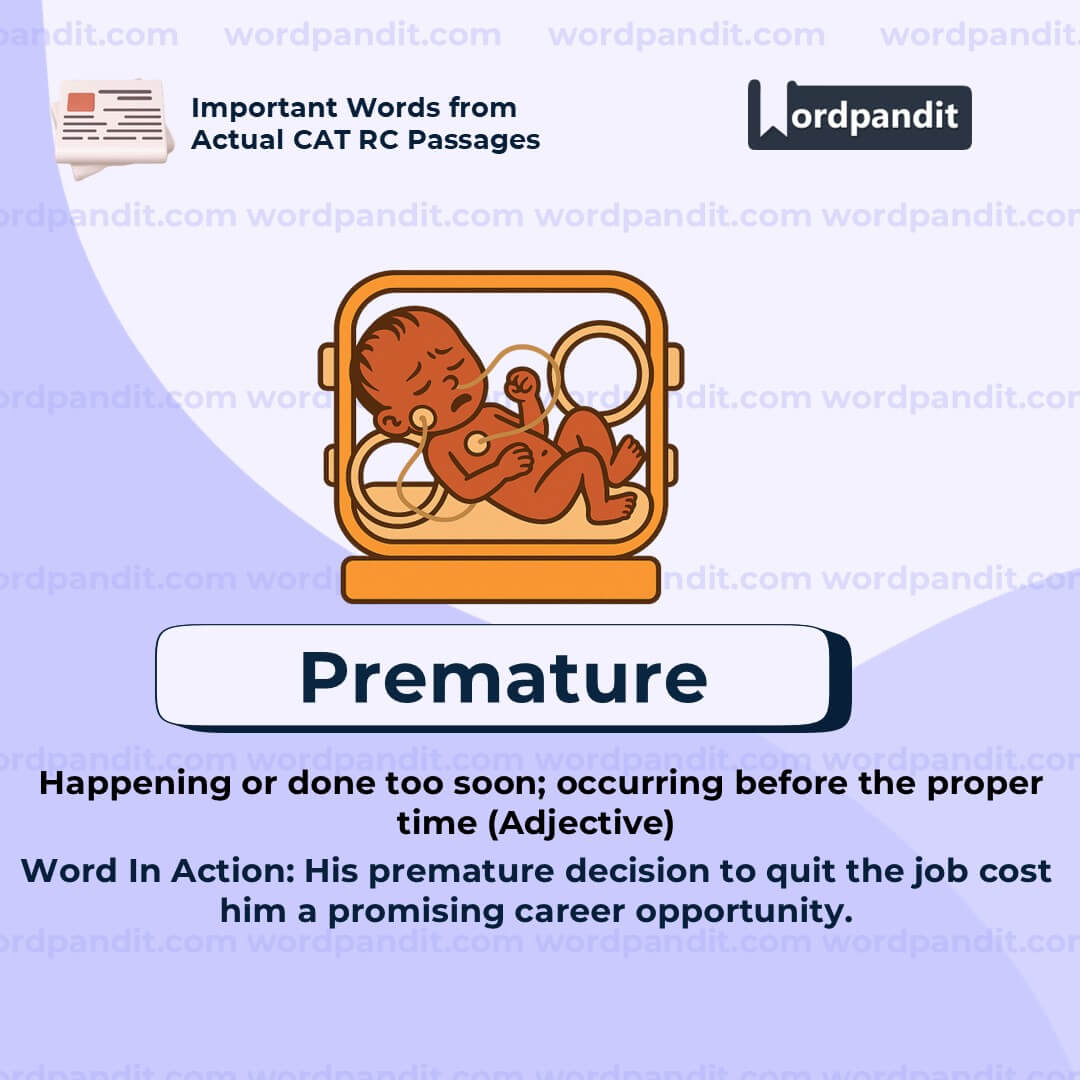
WORD-1: Premature
Context:
"...there is premature thinning of their cerebral cortex. In adults, one study found an association between screen time and depression" - Scientific Study on Neuroscience
Explanatory Paragraph:
The word "premature" refers to something that occurs before the expected or proper time. It often carries a negative connotation, suggesting that the event happened too early and may result in negative consequences. For example, in the given context, "premature thinning" of the brain's cortex implies that this physical change is happening earlier than is healthy or typical, potentially due to excessive screen time or environmental influences.
Meaning: Happening or done too soon; occurring before the proper time (Adjective)
Pronunciation: pree-muh-CHOOR
Difficulty Level: ⭐⭐ Basic
Etymology: From Latin *praematurus*, from *prae-* (before) + *maturus* (ripe, mature)
Prashant Sir's Notes:
Remember: "Pre" means before and "mature" relates to full development. So, anything premature is something that occurs before full development or readiness. It’s often used in medical, emotional, and strategic contexts.
Synonyms & Antonyms:
Synonyms: early, untimely, hasty, precipitate
Antonyms: timely, mature, overdue, well-timed
Usage Examples:
- The baby was born premature and had to stay in the neonatal ICU for several weeks.
- Announcing the product before it was ready was a premature move by the company.
- He faced premature hair loss in his twenties.
- Scientists warned about the premature lifting of lockdown restrictions.
Cultural Reference:
"Premature optimization is the root of all evil." - Donald Knuth, on software development
Think About It:
Can acting too early sometimes be more harmful than acting too late? Think of situations where patience would have led to better results.
Quick Activity:
Write down 3 real-life events or decisions that can be considered premature. What were the consequences in each case?
Memory Tip:
“Pre” means before and “mature” means fully developed. So "premature" = before maturity!
Real-World Application:
The term is commonly used in medical diagnoses (e.g., premature birth), product launches, or evaluations where an event has happened before its due time, often affecting results or outcomes negatively.
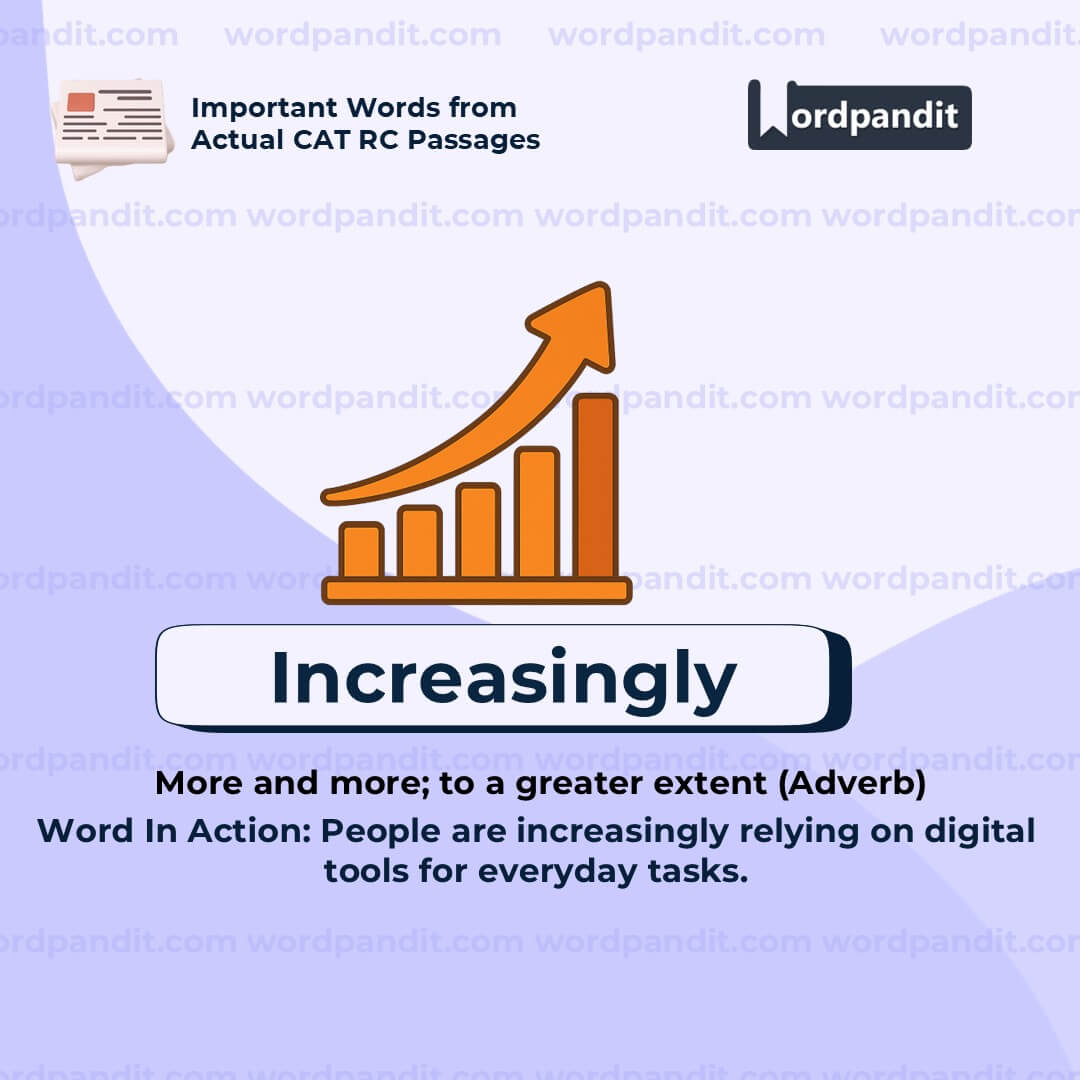
WORD-2: Increasingly
Context:
"...time on screens is increasingly seen as unhealthy. Here, the popular elementary school is the local Waldorf School, which promises a back-to-nature..." - Educational Commentary
Explanatory Paragraph:
The word "increasingly" is used to describe a trend or situation that is growing in frequency, intensity, or recognition. It emphasizes that something is becoming more common or more intense over time. In the provided context, "increasingly seen as unhealthy" suggests that more and more people or studies are recognizing screen time as harmful, especially for children. It signals a shift in public perception or awareness.
Meaning: More and more; to a greater extent (Adverb)
Pronunciation: in-KREE-sing-lee
Difficulty Level: ⭐⭐ Basic
Etymology: From the verb *increase* + *-ly* (adverbial suffix), dating back to Middle English from Old French *encres*, from Latin *increscere* (to grow)
Prashant Sir's Notes:
This is a classic adverb that helps show trends or progressions. Use it in essays or reports to indicate a rise in attention, importance, or occurrence of a subject. Perfect for analytical writing!
Synonyms & Antonyms:
Synonyms: progressively, more and more, steadily, gradually
Antonyms: decreasingly, less and less, diminishingly
Usage Examples:
- People are increasingly aware of climate change and its effects.
- Students are increasingly turning to online resources for learning.
- Working from home is increasingly preferred by professionals.
- He’s becoming increasingly frustrated with the slow progress.
Cultural Reference:
"Increasingly, the world belongs to those who are able to adapt." - Adapted from Alvin Toffler’s views on future learning
Think About It:
What trends do you see as increasingly important in your life or society today? Why do you think they are gaining momentum?
Quick Activity:
List five topics that are increasingly appearing in news headlines. Discuss how public perception may be changing about each.
Memory Tip:
Think of a rising graph 📈 — as time moves forward, something increases — hence, “increasingly”!
Real-World Application:
"Increasingly" is widely used in news articles, reports, essays, and speeches to show growing importance or trends. It's a useful adverb for discussing social, technological, and environmental developments.
WORD-3: Unappealing
Context:
"Facebook whether you are rich or poor. Gmail is the same Gmail. And it’s all free. There is something mass market and unappealing about that" - Tech & Society Commentary
Explanatory Paragraph:
The word "unappealing" describes something that lacks charm, attractiveness, or interest. It is used when something does not draw you in or excite you — it may even be off-putting. In the context provided, the writer criticizes the uniformity and mass-market feel of tech services like Facebook and Gmail. Though accessible to everyone, they are described as "unappealing" because of their generic, one-size-fits-all nature that lacks exclusivity or uniqueness.
Meaning: Not attractive or interesting (Adjective)
Pronunciation: un-uh-PEE-ling
Difficulty Level: ⭐⭐ Basic
Etymology: From the prefix *un-* (not) + *appealing* (attractive), from Old French *apeler* meaning to call or attract
Prashant Sir's Notes:
This is a good negative adjective to use when you want to diplomatically say something doesn’t attract interest or approval. Perfect for reviews, critiques, or subtle opinions.
Synonyms & Antonyms:
Synonyms: unattractive, dull, off-putting, bland
Antonyms: appealing, attractive, engaging, charming
Usage Examples:
- The food looked unappealing, but it actually tasted delicious.
- He found the color scheme of the website quite unappealing.
- There’s something unappealing about products that are too generic.
- The hotel room had an unappealing smell that made them check out early.
Cultural Reference:
Minimalist design, once considered dull and unappealing, has now become a popular aesthetic in modern art and tech interfaces.
Think About It:
Can something unappealing at first glance turn out to be valuable in the long run? Have you ever changed your mind about something after a deeper look?
Quick Activity:
List 3 things you've encountered that were unappealing initially. Why did they feel that way? Did your perception change?
Memory Tip:
“Un-appealing” = not appealing! Just remember: when something *doesn't appeal* to you, it's unappealing.
Real-World Application:
"Unappealing" is often used in product reviews, food critiques, and design discussions. It's a polite but clear way to express dissatisfaction without sounding harsh.
WORD-4: Curious
Context:
"[There is] a curious new reality: Human contact is becoming a luxury good. As more screens appear in the lives of the poor..." - Sociological Observation
Explanatory Paragraph:
The word "curious" can mean either having a desire to know or learn something, or describe something that is unusual, odd, or intriguing. In the provided sentence, it is used in the latter sense — to suggest that the new trend of human contact being rare and valuable is strange and surprising. The word here adds a tone of reflective surprise to the changing social reality.
Meaning: Strange or unusual; eager to know or learn something (Adjective)
Pronunciation: KYUR-ee-uhs
Difficulty Level: ⭐⭐ Basic
Etymology: From Latin *curiosus* meaning "careful, inquisitive," from *cura* meaning "care"
Prashant Sir's Notes:
This is a dual-purpose word — it can mean someone is inquisitive, or it can describe something odd or surprising. Always pay attention to the context to understand which meaning is intended.
Synonyms & Antonyms:
Synonyms: strange, peculiar, inquisitive, odd, intrigued
Antonyms: ordinary, indifferent, uninterested, normal
Usage Examples:
- She was curious about the noises coming from the attic.
- It’s curious how trends come and go in fashion.
- His curious behavior made everyone suspicious.
- The child looked at the magician with a curious expression.
Cultural Reference:
"Curiosity killed the cat, but satisfaction brought it back." — A famous proverb about the risks and rewards of being inquisitive.
Think About It:
In a world filled with information, is being curious still considered a strength? Why or why not?
Quick Activity:
Write two sentences using "curious" — one in the sense of being inquisitive, and one in the sense of being odd or unusual.
Memory Tip:
Think of a cat poking its nose into everything — a classic image of curiosity! Or think of a “curio” shop full of strange and curious objects.
Real-World Application:
"Curious" is a versatile word used in news, storytelling, and even everyday speech. It can spark a mood of wonder or subtly highlight something that doesn’t seem quite right.
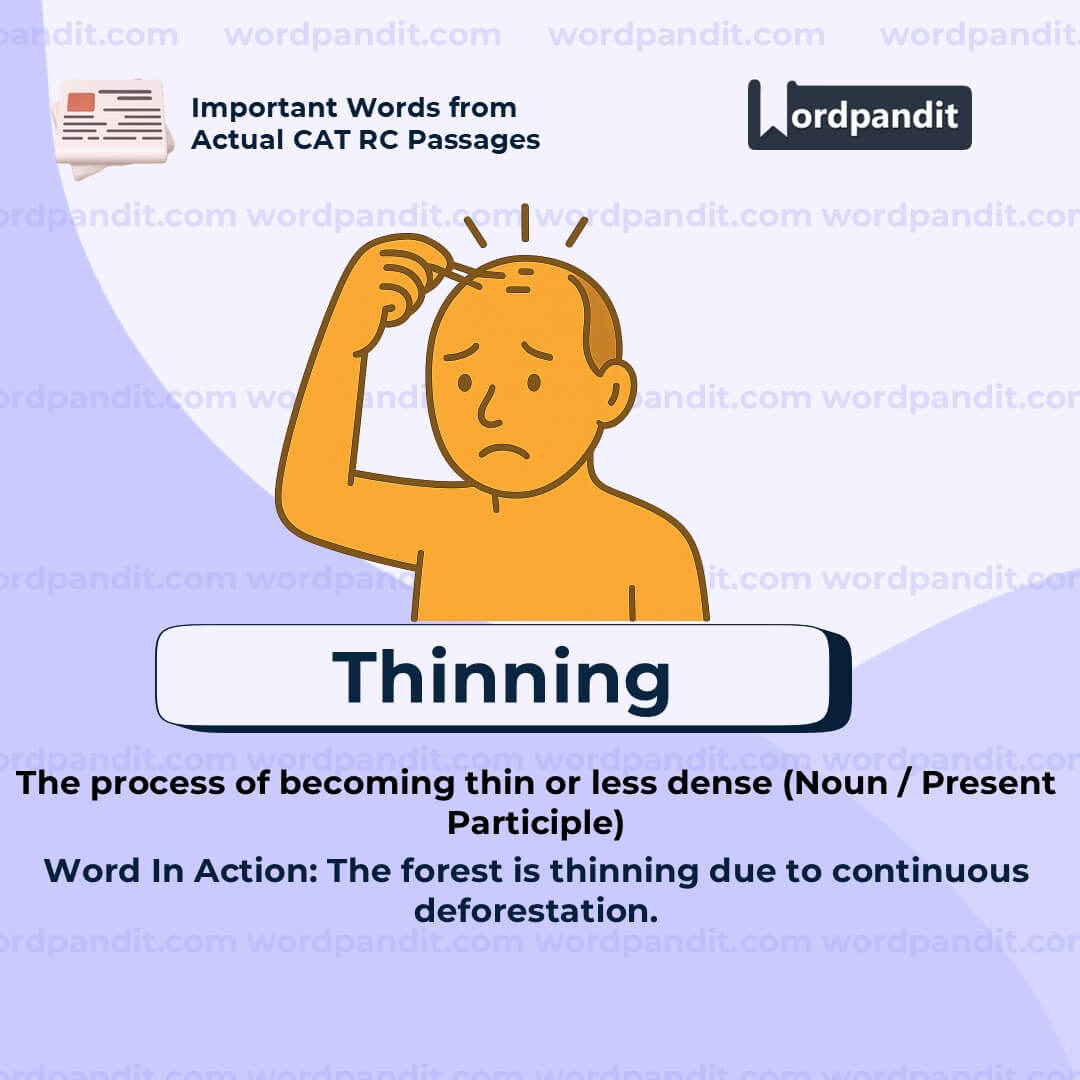
WORD-5: Thinning
Context:
"...there is premature thinning of their cerebral cortex. In adults, one study found an association between screen time and depression" - Neuroscientific Study
Explanatory Paragraph:
"Thinning" refers to the process of becoming thinner or less dense. It often implies a reduction in substance, strength, or quality. In the given context, "thinning of the cerebral cortex" refers to a decrease in the thickness of a part of the brain responsible for many cognitive functions. This neurological change is being linked to overexposure to screens, which may affect brain health negatively over time.
Meaning: The process of becoming thin or less dense (Noun / Present Participle)
Pronunciation: THIN-ing
Difficulty Level: ⭐⭐ Basic
Etymology: From Old English *þynne* (thin), with the suffix *-ing* to denote an action or process
Prashant Sir's Notes:
Thinning isn't just about hair or forests! In science and medicine, it's used to describe anything that reduces in density — including brain tissue. Context is key for understanding the seriousness of the term.
Synonyms & Antonyms:
Synonyms: reduction, weakening, narrowing, depletion
Antonyms: thickening, strengthening, expansion, buildup
Usage Examples:
- The thinning ozone layer is a major environmental concern.
- He noticed the thinning of his hair by his early thirties.
- Overuse of certain chemicals can lead to soil thinning.
- Researchers observed the thinning of the cerebral cortex in digital-heavy lifestyles.
Cultural Reference:
In climate change discussions, the “thinning of Arctic ice” is a common phrase symbolizing ecological decline and warming temperatures.
Think About It:
What are the long-term consequences of "thinning" — whether it’s hair, forests, or brain tissue? Why does a gradual loss often go unnoticed?
Quick Activity:
Write three areas of life or nature where thinning is a concern (e.g., forests, populations, hair). What causes thinning in each case?
Memory Tip:
Picture a thick book slowly losing pages — it’s “thinning” over time. That’s the visual cue for this word!
Real-World Application:
"Thinning" is used in medicine, environment, and even economics. Whether it’s thinning hair, ice sheets, or neural tissue, the term often signals a weakening or decline that warrants attention.
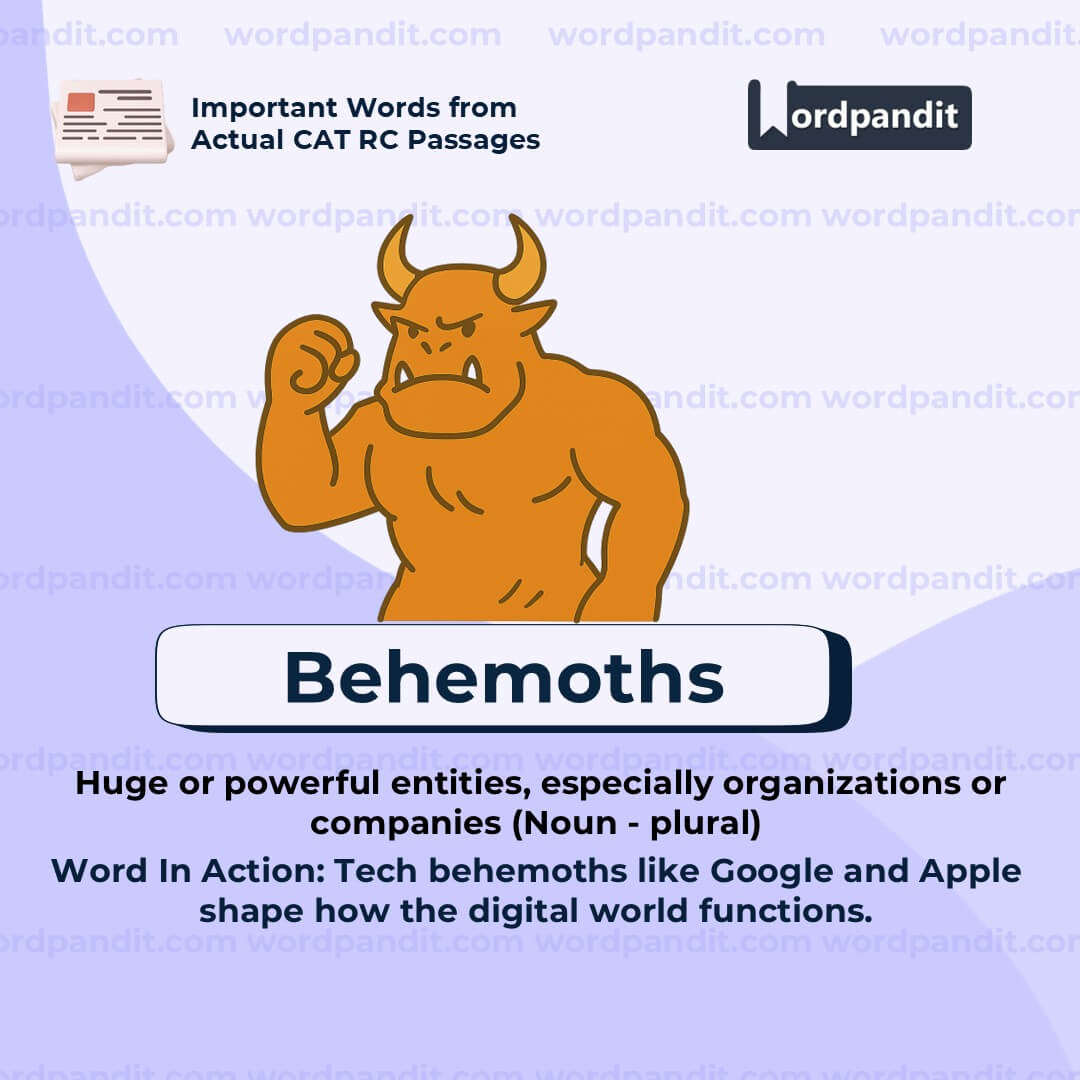
WORD-6: Behemoths
Context:
"Human contact is, of course, not exactly like organic food . . . . But with screen time, there has been a concerted effort on the part of Silicon Valley behemoths to confuse the public" - Media & Technology Commentary
Explanatory Paragraph:
The word "behemoths" refers to extremely large and powerful entities. Originally used to describe mythical beasts, the term now often refers to massive companies or organizations that dominate their industries. In the context provided, "Silicon Valley behemoths" refers to giant tech corporations like Google, Apple, or Meta, implying that they wield significant influence and have played a role in shaping — or confusing — public understanding around screen time and its impacts.
Meaning: Huge or powerful entities, especially organizations or companies (Noun - plural)
Pronunciation: buh-HEE-muhths
Difficulty Level: ⭐⭐⭐ Intermediate
Etymology: From Hebrew *bĕhēmōth*, meaning a huge beast, via Latin and Old English; popularized in modern English to describe enormous size or influence
Prashant Sir's Notes:
This is a great metaphorical word! Think of it as describing anything "gigantic in power or scale." Especially effective when writing about monopolies, industrial giants, or powerful governments.
Synonyms & Antonyms:
Synonyms: giants, titans, colossi, goliaths, juggernauts
Antonyms: minnows, lightweights, small fry, underdogs
Usage Examples:
- Amazon and Apple are considered behemoths in the tech industry.
- The financial behemoth acquired several smaller banks last year.
- Facing the legal behemoth alone was a daunting challenge.
- These social media behemoths have the power to shape public discourse.
Cultural Reference:
In the Bible, *Behemoth* is described as a primal, monstrous creature of massive strength — a symbol of overwhelming power. Modern usage often refers to dominant corporations or forces.
Think About It:
Should society allow modern behemoths like tech giants to operate with minimal regulation? Where should we draw the line between innovation and influence?
Quick Activity:
List three “behemoths” in different industries (e.g., tech, food, media). What makes them stand out in terms of power or influence?
Memory Tip:
Think: “Behemoth = Beast + Huge.” If it sounds like a monster, it probably refers to something massive and dominant.
Real-World Application:
“Behemoths” is a useful term in journalism, business analysis, and debate — it helps describe power structures in a vivid, often critical way. Great for talking about dominant corporations or overwhelming systems.
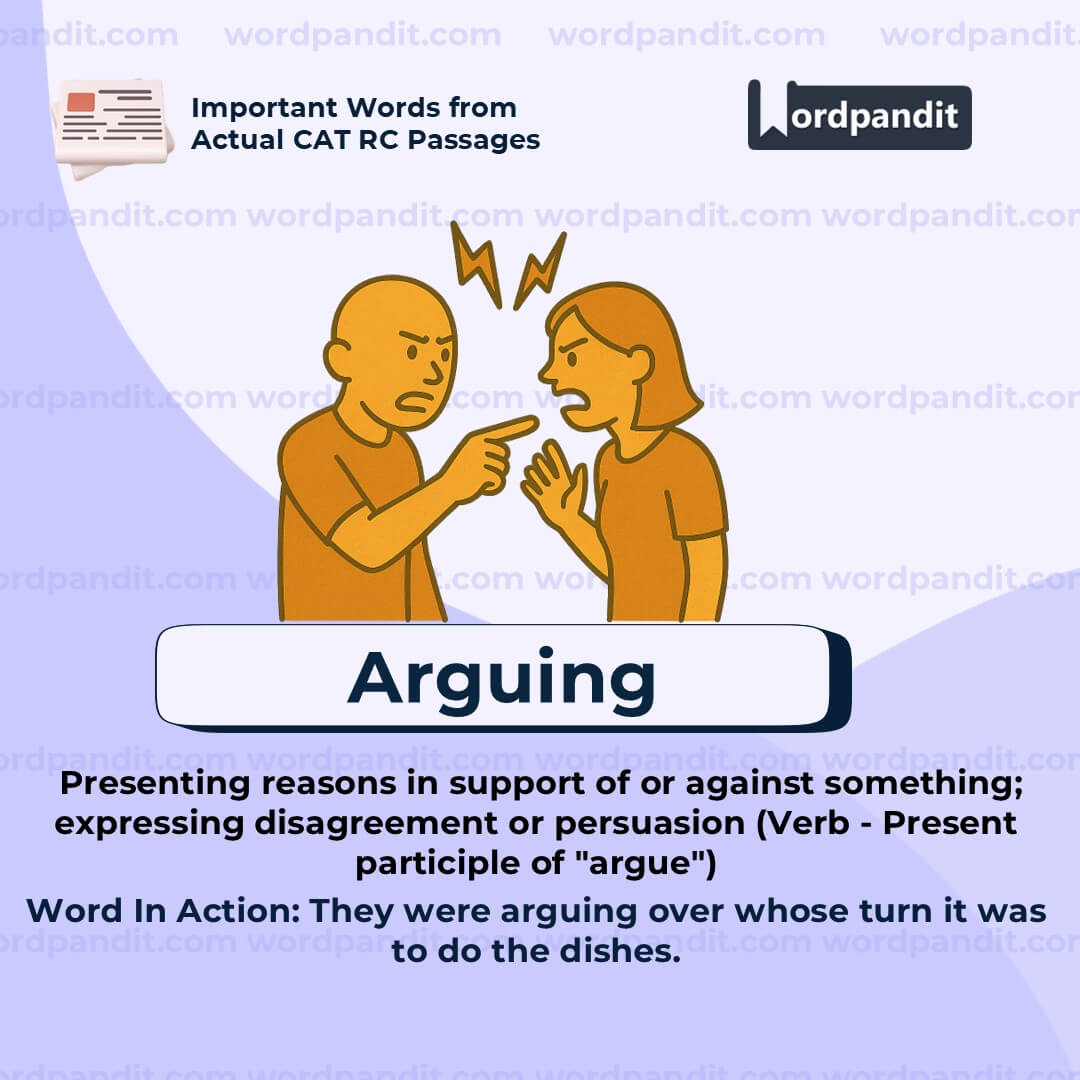
WORD-7: Arguing
Context:
"...arguing that it would better prepare children for their screen-based future. But this idea isn’t how the people who actually build the screen-based future raise their own children" - Commentary on Education and Technology
Explanatory Paragraph:
The word "arguing" refers to presenting reasons or evidence in support of an opinion, especially during a discussion or debate. In the context provided, it means that someone is putting forward a justification — namely, that early screen exposure prepares children for a digital future. It does not imply a heated dispute here, but rather a logical or persuasive reasoning effort.
Meaning: Presenting reasons in support of or against something; expressing disagreement or persuasion (Verb - Present participle of "argue")
Pronunciation: AHR-gyoo-ing
Difficulty Level: ⭐⭐ Basic
Etymology: From Latin *arguere* (to make clear, prove), through Old French *arguer*
Prashant Sir's Notes:
Don't confuse this with just fighting! "Arguing" in academic or persuasive writing means presenting a viewpoint with reasons. Always check the tone and context to understand its use correctly.
Synonyms & Antonyms:
Synonyms: asserting, reasoning, debating, claiming
Antonyms: agreeing, conceding, complying, yielding
Usage Examples:
- The teacher was arguing that more homework helps improve performance.
- They spent hours arguing about the best way to solve the problem.
- She’s arguing for a new policy that supports working mothers.
- The article is arguing that digital education has long-term benefits.
Cultural Reference:
In academic writing and debate culture, “arguing” forms the backbone of structured discourse — from Aristotle’s *rhetoric* to modern debate forums and essay writing styles.
Think About It:
When does arguing cross the line from constructive discussion to harmful conflict? How can we ensure our arguments stay respectful?
Quick Activity:
Write two short sentences: one where “arguing” means debating respectfully, and another where it means a quarrel. Identify the difference in tone.
Memory Tip:
Think “arguing = using arguments.” Arguments are not always loud — they can be thoughtful, like in an essay!
Real-World Application:
“Arguing” is central in essays, debates, courtrooms, and policymaking. Understanding its persuasive role helps in critical thinking and communication, especially in academic and professional environments.
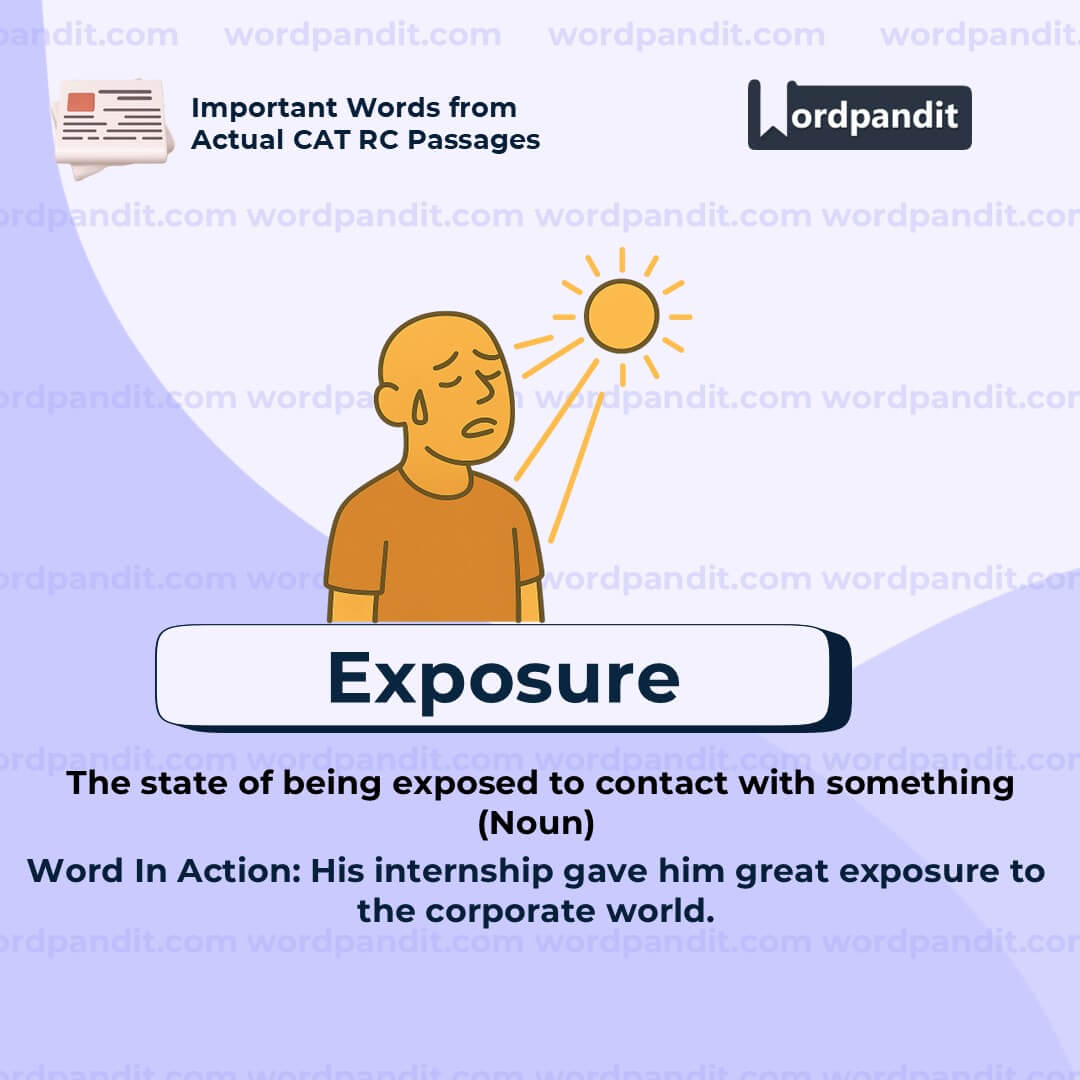
WORD-8: Exposure
Context:
"Screen exposure starts young. And children who spent more than two hours a day looking at a screen got lower scores on thinking and language tests" - Health and Education Study
Explanatory Paragraph:
The word "exposure" refers to the condition of being subjected to something, such as an experience, influence, or risk. In the given context, "screen exposure" means the amount of time children spend in front of screens (like TVs, phones, or tablets). The passage highlights how early and prolonged screen exposure can have a negative impact on cognitive development, particularly in areas like language and reasoning.
Meaning: The state of being exposed to contact with something (Noun)
Pronunciation: ik-SPOH-zher
Difficulty Level: ⭐⭐ Basic
Etymology: From Latin *exponere* (to put forth), via Old French *exposer*, later reshaped as *exposure* in English
Prashant Sir's Notes:
“Exposure” is a versatile word. It can refer to physical things (like sun or cold), but also to abstract ideas (media, experiences, risks). Use it with clarity depending on context — especially in health and educational writing.
Synonyms & Antonyms:
Synonyms: contact, experience, interaction, vulnerability
Antonyms: protection, isolation, shelter, concealment
Usage Examples:
- Prolonged exposure to loud noise can damage your hearing.
- The documentary gave viewers exposure to life in war-torn regions.
- Children need early exposure to books and stories to build literacy skills.
- Screen exposure for long hours may affect sleep and brain development.
Cultural Reference:
Media literacy programs often focus on reducing harmful exposure to violent or misleading content in digital media, especially for children and teens.
Think About It:
In today’s hyperconnected world, how can we balance beneficial exposure (like education) with harmful exposure (like screen addiction or misinformation)?
Quick Activity:
List three types of “exposure” you experience daily. Identify one that helps your growth and one that may be harmful.
Memory Tip:
“Expose” means to uncover or reveal. So “exposure” is what you’re revealed to — whether it’s sunlight ☀️, danger ⚠️, or new ideas 💡.
Real-World Application:
“Exposure” is key in fields like education, health, photography, and journalism. It measures influence — whether it’s light in a photo, contact with germs, or time spent with digital content.
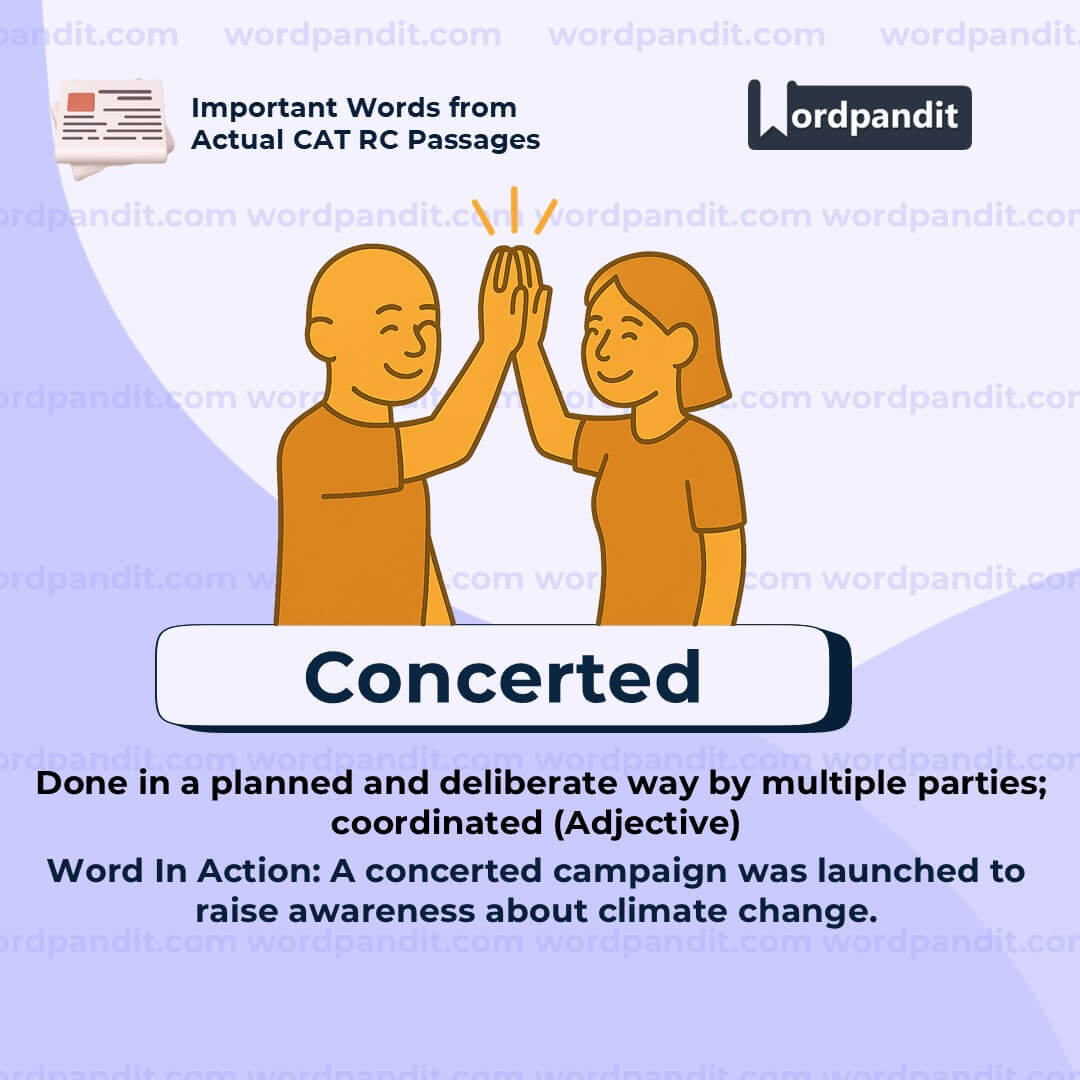
WORD-9: Concerted
Context:
"Human contact is, of course, not exactly like organic food . . . . But with screen time, there has been a concerted effort on the part of Silicon Valley behemoths to confuse the public" - Media and Technology Commentary
Explanatory Paragraph:
The word "concerted" describes something that is planned, coordinated, and carried out jointly by multiple people or groups. It often refers to unified or deliberate actions aimed at achieving a specific goal. In the provided context, "a concerted effort" implies that the major tech companies acted together or strategically to influence public opinion on screen time, suggesting intention and collaboration behind the scenes.
Meaning: Done in a planned and deliberate way by multiple parties; coordinated (Adjective)
Pronunciation: kun-SUR-tid
Difficulty Level: ⭐⭐⭐ Intermediate
Etymology: From French *concerté*, past participle of *concerter* (to agree, act together), from Italian *concertare*, from *concerto* (agreement, harmony)
Prashant Sir's Notes:
Think “concert” — when musicians play together in harmony. “Concerted” effort means multiple people or organizations working in sync toward a goal. Very useful in formal writing, especially for describing group strategies.
Synonyms & Antonyms:
Synonyms: coordinated, collaborative, joint, unified, combined
Antonyms: disjointed, scattered, isolated, uncoordinated
Usage Examples:
- The rescue was a concerted effort by the police, firefighters, and medics.
- There’s been a concerted campaign to raise awareness about mental health.
- A concerted push is being made to include women in leadership roles.
- The activists made a concerted effort to challenge misinformation online.
Cultural Reference:
“Concerted effort” is frequently used in political and corporate speeches to emphasize teamwork — e.g., “Through a concerted national response, we overcame the crisis.”
Think About It:
Do concerted efforts always lead to better outcomes? Can coordination among powerful groups sometimes be harmful instead of helpful?
Quick Activity:
Think of a problem (like pollution, bullying, or misinformation). Write a sentence describing how a concerted effort could solve it.
Memory Tip:
“Concerted” comes from “concert” — imagine a band playing together in harmony. A “concerted effort” means working in perfect sync toward a goal.
Real-World Application:
“Concerted” is often used in news reports, policy documents, and group project contexts to highlight planned, joint efforts — such as tackling climate change, economic reform, or public health crises.
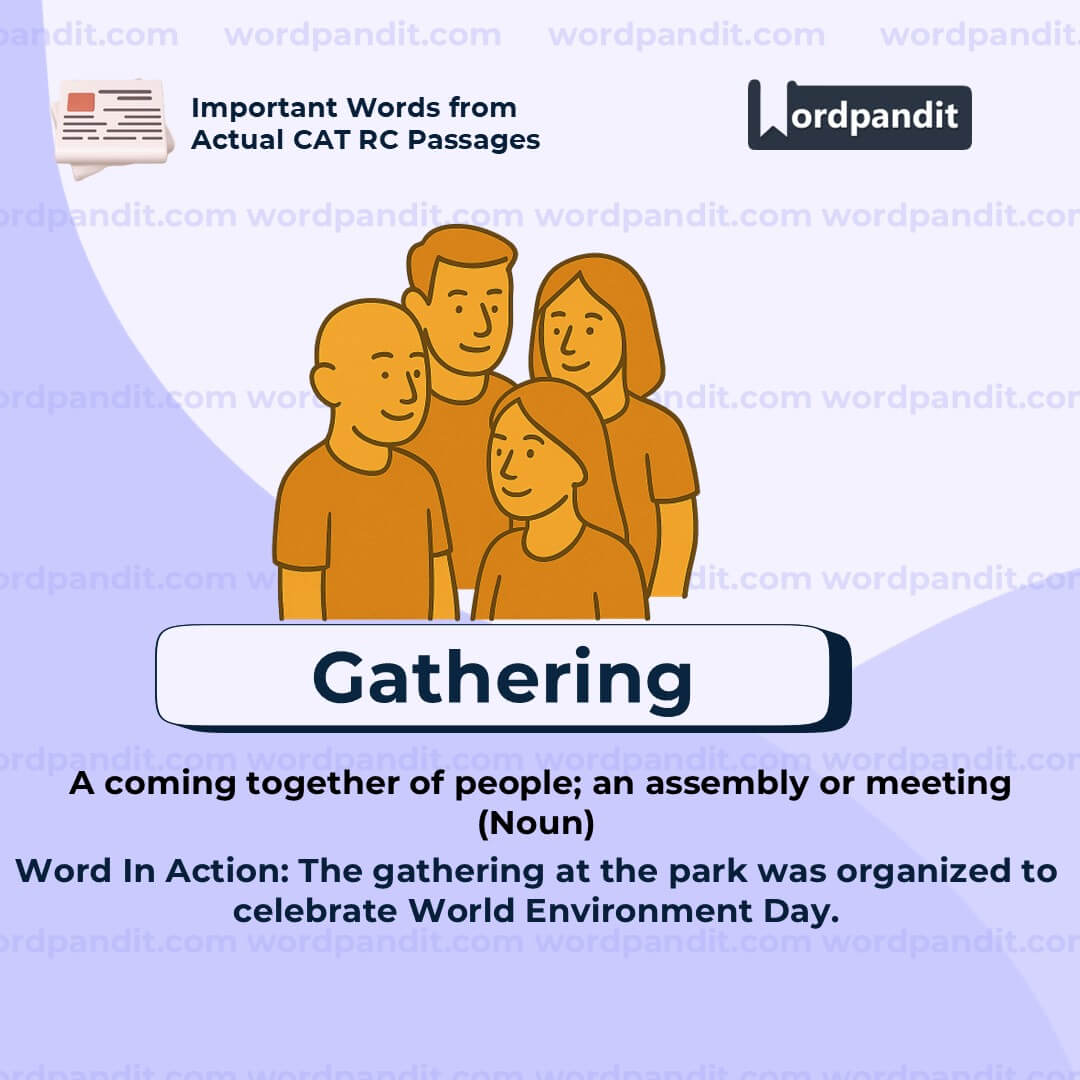
WORD-10: Gathering
Context:
"...the reality that in our culture of increasing isolation, in which so many of the traditional gathering places and social structures have disappeared, screens are filling a crucial void." - Social Trends Commentary
Explanatory Paragraph:
The word "gathering" refers to the act of bringing people together or a group of people who meet for a common purpose. In the context given, it is used to describe physical or social spaces — like parks, cafés, or community centers — where people used to connect. The disappearance of these traditional "gathering places" reflects how modern life has grown more isolated, with screens now substituting as digital venues for social interaction.
Meaning: A coming together of people; an assembly or meeting (Noun)
Pronunciation: GATH-uh-ring
Difficulty Level: ⭐ Basic
Etymology: From Old English *gadrian* (to unite, collect), related to *gaderian* meaning to gather or come together
Prashant Sir's Notes:
While "gathering" can describe events like a party or a protest, it also symbolizes connection and belonging. Especially important in cultural and sociological contexts — think beyond just the literal meaning!
Synonyms & Antonyms:
Synonyms: meeting, assembly, get-together, congregation
Antonyms: dispersal, separation, isolation, scattering
Usage Examples:
- The town square was once a popular gathering spot for families and friends.
- We’re planning a small gathering to celebrate her birthday.
- Traditional gatherings have declined in many urban areas.
- Virtual gatherings have become the new norm in a post-pandemic world.
Cultural Reference:
In many cultures, gatherings like festivals, weddings, and religious ceremonies serve as crucial touchpoints for social cohesion and shared identity. Their loss often signals deeper cultural shifts.
Think About It:
What kinds of gathering spaces have disappeared in your community? What has replaced them, and how do you feel about that change?
Quick Activity:
List three traditional gathering places you’ve visited. Describe the atmosphere and the types of interactions that took place there.
Memory Tip:
Think of “gathering” as pulling people together like magnets — whether it’s for a feast, a discussion, or just to spend time. A “gathering” is where togetherness lives!
Real-World Application:
“Gathering” is a key concept in community development, sociology, and event planning. Understanding it helps us recognize the role of social spaces — both physical and digital — in fostering human connection.


