
✨ Introduction
Mastering Reading Comprehension begins with mastering the words!
In this post, we dive deep into vocabulary taken directly from an actual CAT RC passage. Each word has been explained in a simple, easy-to-understand way, along with examples to help you grasp its usage in real contexts.
From words like "species" and "cognitive" to "subjection" and "paradise," strengthen your vocabulary one word at a time — and take your RC performance to the next level!
📚 What’s Inside This Vocabulary Post?
- 🔍 Words Sourced from an Actual CAT RC Passage: Directly pick up important vocabulary from real CAT exam material.
- 🧠 Meaningful Explanations: Understand the exact meaning and usage of each word in a simple, student-friendly way.
- ✍️ Context-Based Learning: Learn words with examples that reflect their actual usage in reading comprehension contexts.
- 🗂️ Quick Reference Format: Words are neatly listed with meanings, parts of speech, and example sentences for easy revision.
- 🚀 Boost Your RC and Verbal Ability Skills: Improve your understanding of tough passages by strengthening your vocabulary.
📝 Words Covered in This Article:
- Repression
- Relentless
- Transparency
- Curtailment
- Perilously
- Depraved
- Underpin
- Vanity
- Consensual
- Progeny
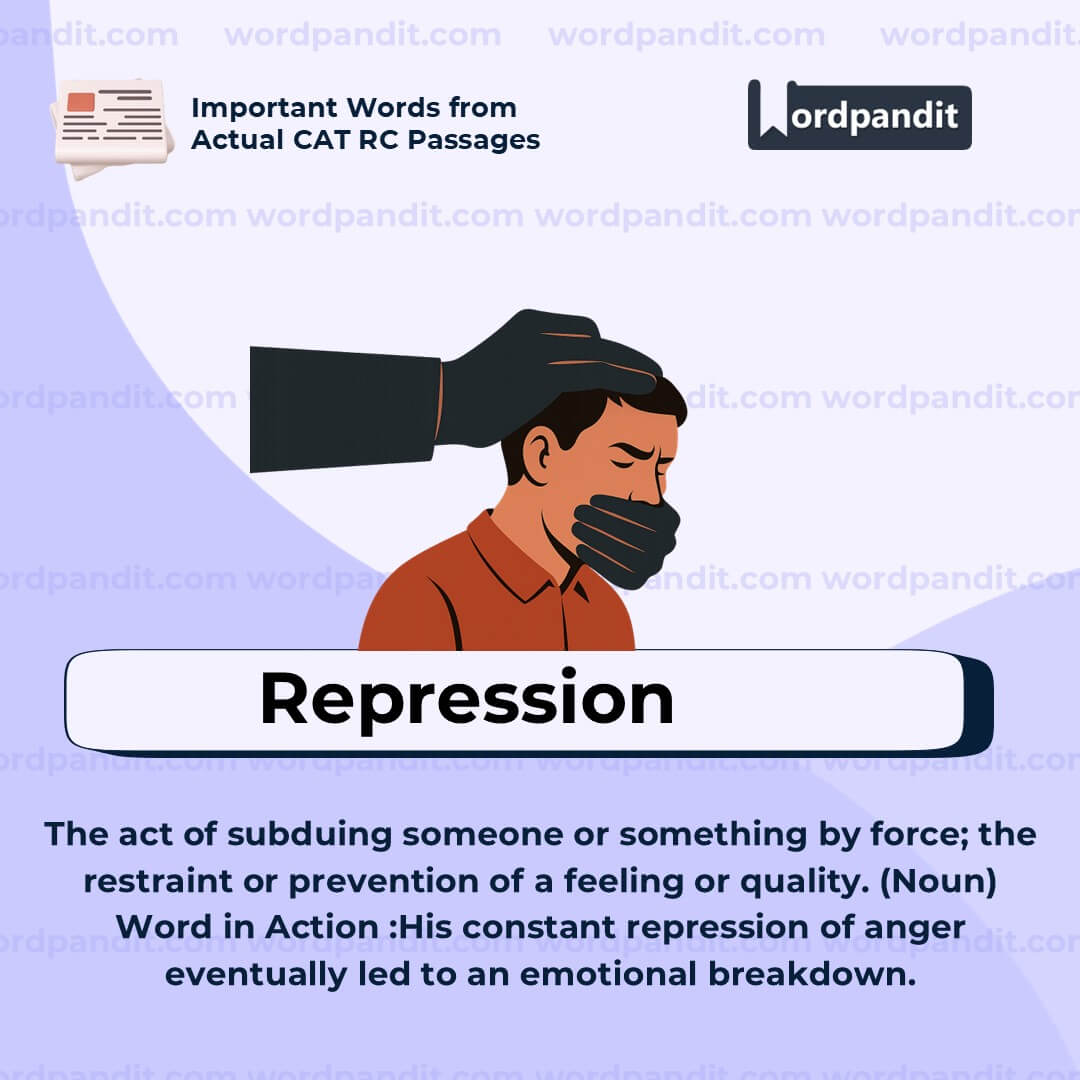
WORD-1: Repression
Context:
"Under the authoritarian regime, any form of political dissent was swiftly silenced through brutal repression." - International Affairs Journal
Explanatory Paragraph:
Repression refers to the act of subduing someone or something by force. It often describes situations where governments or institutions use power to control people's actions, emotions, or speech. The term can also relate to psychology, where it denotes the unconscious exclusion of distressing memories or desires from the conscious mind.
Meaning: The action of subduing someone or something by force (Noun)
Pronunciation: ruh-PRESH-un
Difficulty Level: ⭐⭐⭐ Intermediate
Etymology: From Latin "repressio," meaning "a pressing back," derived from "reprimere" (to press back)
Prashant Sir's Notes:
Connect repression with "pressing down emotions or voices." It shows up frequently in political and psychological contexts. Look for prefixes like "re-" (back) and base words like "press" to decode meaning.
Synonyms & Antonyms:
Synonyms: suppression, restraint, subjugation, control, crackdown
Antonyms: freedom, liberation, expression, release, encouragement
Usage Examples:
- The government faced international criticism for its violent repression of peaceful protests.
- In therapy, she began to understand how repression of childhood memories affected her behavior.
- Art flourished secretly under the repression of the totalitarian state.
- Repression of one's true feelings can lead to emotional instability.
Cultural Reference:
"The history of the 20th century is largely a history of repression and resistance." - Adapted from historical analysis essays
Think About It:
Why do you think repression is often used as a tool by those in power? Can it ever be justified?
Quick Activity:
Write a short paragraph about a society where repression is common. Highlight how it affects people’s daily lives.
Memory Tip:
Think of "repression" as "pressing back" emotions or actions — RE (back) + PRESS (push down) = REPRESSION.
Real-World Application:
Understanding repression helps in discussions about civil liberties, mental health, and even workplace culture where emotions or opinions may be silenced.
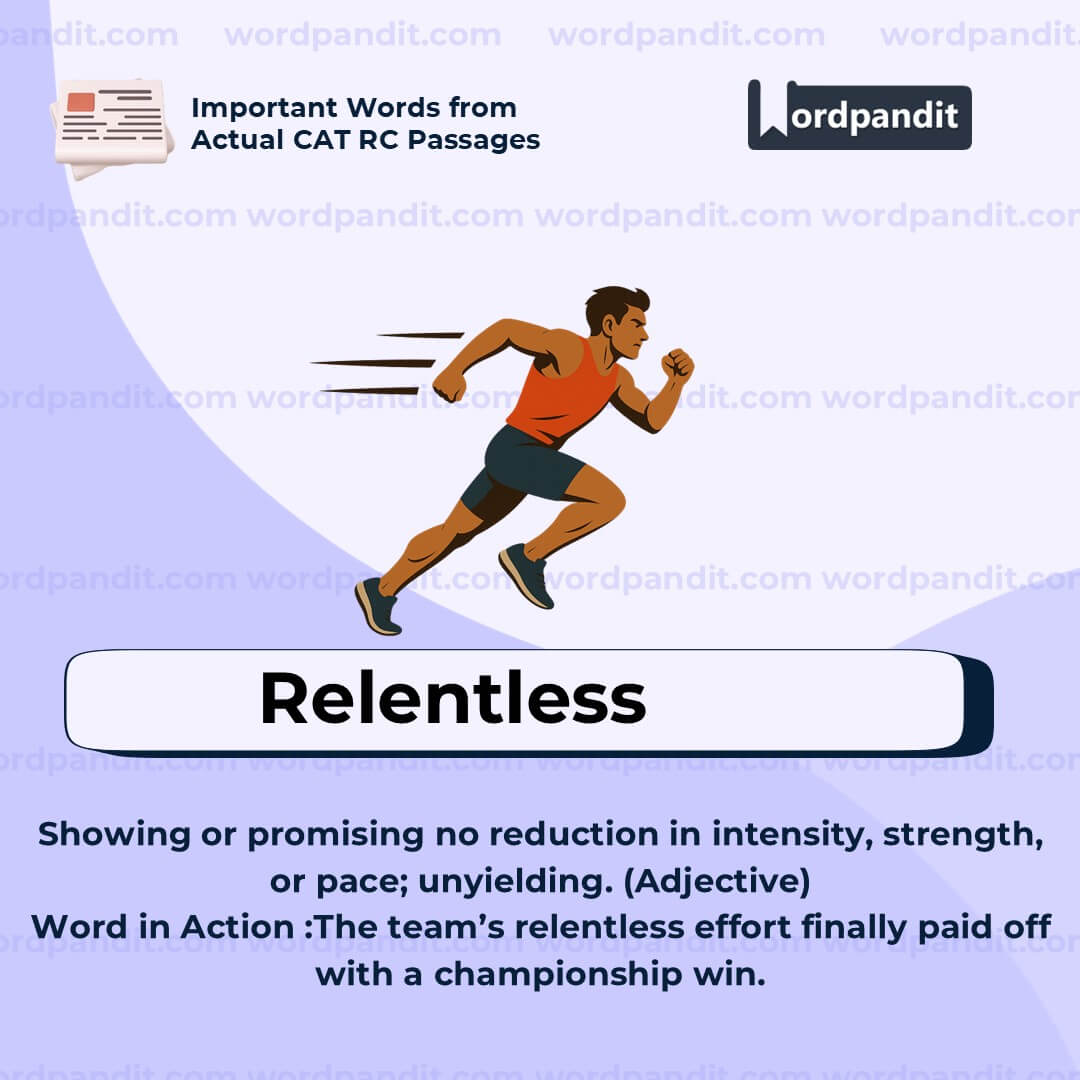
WORD-2: Relentless
Context:
"The relentless noise of construction made it impossible to concentrate on work." - The Guardian
Explanatory Paragraph:
Relentless describes something that is persistent and never-ending. It can refer to a person who refuses to give up, or to a force or condition that continues without pause or mercy. While it can be positive — as in relentless determination — it also carries a sense of intensity that can become overwhelming or exhausting.
Meaning: Persistent; continuing without giving up or becoming less intense (Adjective)
Pronunciation: rih-LENT-liss
Difficulty Level: ⭐⭐ Beginner-Intermediate
Etymology: From the prefix "re-" (again) + "lent" (from obsolete form of 'relent') + "-less" (without), meaning without relenting or softening
Prashant Sir's Notes:
Think of relentless as “never letting go.” Whether it’s someone pursuing a goal or bad weather that won’t stop, this word conveys a strong, forceful consistency.
Synonyms & Antonyms:
Synonyms: unyielding, persistent, tireless, unrelenting, dogged
Antonyms: lenient, yielding, merciful, soft, intermittent
Usage Examples:
- Her relentless pursuit of excellence made her a top performer in the company.
- The desert sun was relentless, beating down on the hikers all day.
- He faced relentless criticism from the media but stayed focused on his goals.
- Despite the relentless workload, she managed to stay calm and organized.
Cultural Reference:
"Relentless" is often used in motivational speeches and branding, such as in the book *Relentless* by Tim Grover, where it describes the mindset of elite performers like Michael Jordan and Kobe Bryant. - Book Reference
Think About It:
Can being relentless ever become a negative trait? When does persistence turn into obsession?
Quick Activity:
Make a list of five things in your life that require a relentless attitude. Write a sentence for each using the word.
Memory Tip:
Relentless = RE (again) + LENT (give in) + LESS (without) → someone who never gives in, never softens.
Real-World Application:
“Relentless” is commonly used in sports, self-help, and business contexts to describe an unbreakable drive or pressure. Recognizing this trait can help you channel your energy wisely or avoid burnout from external pressures.
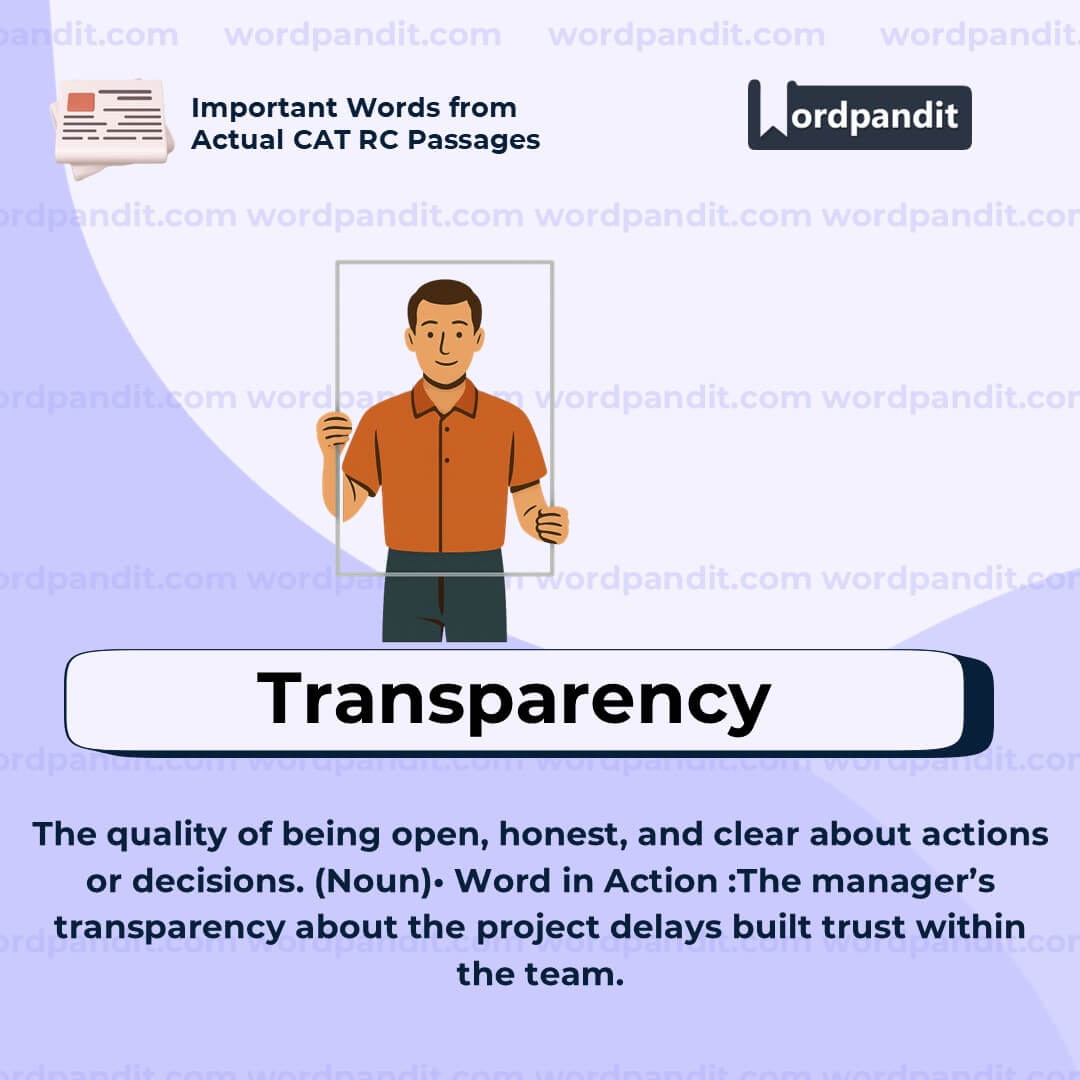
WORD-3: Transparency
Context:
"The company’s commitment to transparency has earned it the trust of its stakeholders and customers alike." - Harvard Business Review
Explanatory Paragraph:
Transparency means being open, honest, and straightforward about one’s actions and decisions. In business, politics, or relationships, transparency fosters trust by making information easily accessible and understandable. It’s the opposite of secrecy or deception and is often used to describe ethical behavior.
Meaning: The quality of being open and honest; easy to perceive or detect (Noun)
Pronunciation: trans-PAIR-uhn-see
Difficulty Level: ⭐⭐ Beginner-Intermediate
Etymology: From Latin "trans-" (through) + "parere" (to appear), meaning "to be seen through"
Prashant Sir's Notes:
Think of transparency like glass—you can see through it. When someone is transparent, nothing is hidden. Great for describing honesty in organizations, leadership, and governance.
Synonyms & Antonyms:
Synonyms: openness, clarity, candor, honesty, straightforwardness
Antonyms: secrecy, obscurity, dishonesty, deception, opacity
Usage Examples:
- Governments are urged to operate with transparency to prevent corruption.
- The teacher’s transparency about the grading system helped students feel more confident.
- She appreciated his transparency about past mistakes during their conversation.
- Companies with high transparency tend to perform better in the long run.
Cultural Reference:
“Transparency is the currency of trust.” – Inspired by a TED Talk on leadership ethics
Think About It:
Is complete transparency always beneficial, or can too much openness create new problems?
Quick Activity:
Think of a situation where someone was transparent with you. Write a short paragraph explaining how it made you feel and how it affected the outcome.
Memory Tip:
Transparency = "see-through behavior" — imagine someone wearing clear glasses to show they’re not hiding anything!
Real-World Application:
Transparency is vital in government, corporate governance, education, and even personal relationships. It builds trust, reduces misunderstandings, and fosters accountability.
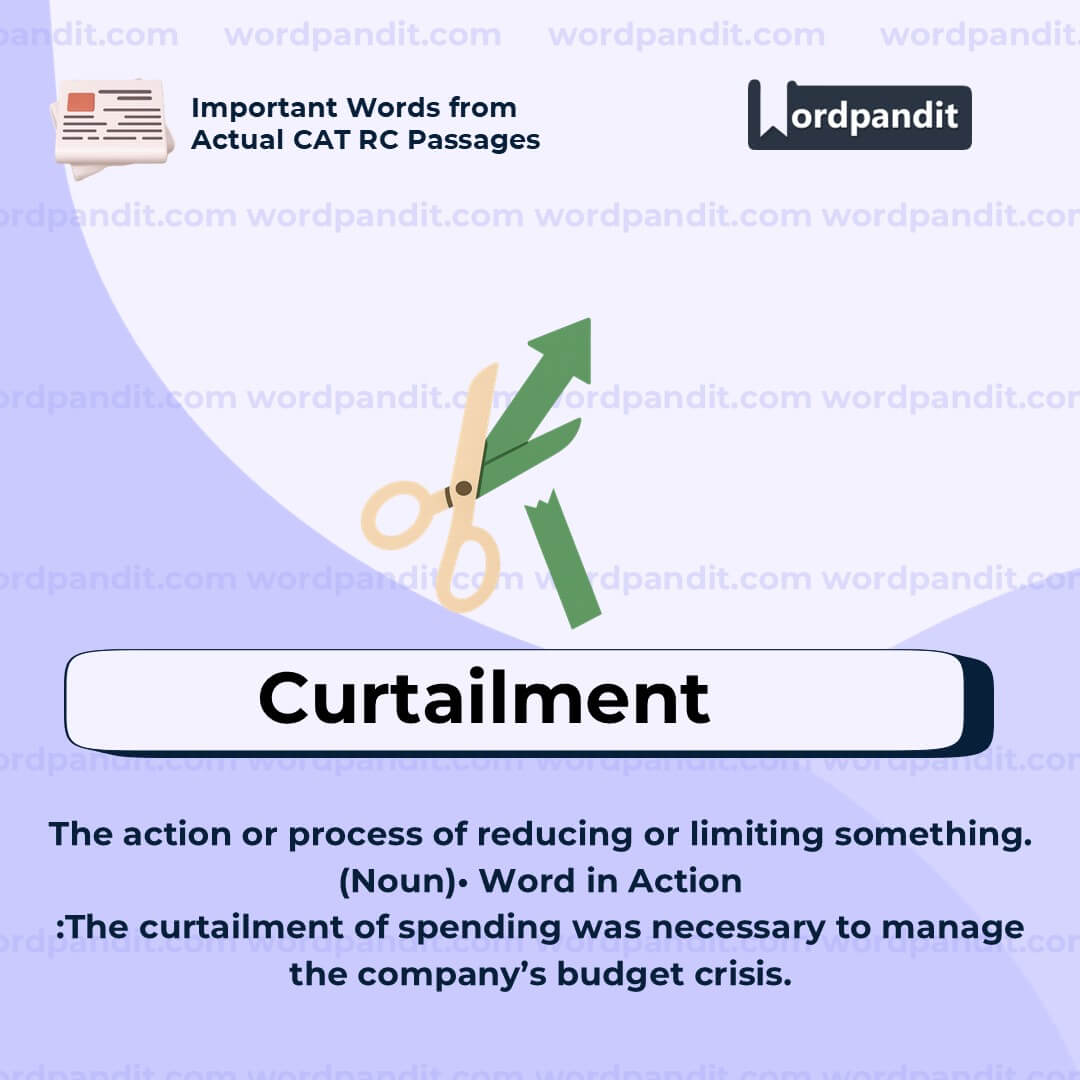
WORD-4: Curtailment
Context:
"The curtailment of civil liberties during the crisis sparked widespread public protests." - BBC News
Explanatory Paragraph:
Curtailment refers to the act of reducing, limiting, or cutting something short. It is often used in political, economic, or legal contexts where rights, privileges, or services are restricted. The word carries a sense of something being taken away or diminished, often leading to dissatisfaction or resistance.
Meaning: The action or process of reducing or restricting something (Noun)
Pronunciation: kur-TAIL-ment
Difficulty Level: ⭐⭐⭐ Intermediate
Etymology: From Middle English “curtailen,” derived from Old French “courtault” meaning “to shorten,” influenced by Latin “curtus” (shortened)
Prashant Sir's Notes:
Think of “curtailment” as someone taking a pair of scissors to your freedom, benefits, or access—something is literally being cut short. Common in legal or economic discussions.
Synonyms & Antonyms:
Synonyms: reduction, restriction, limitation, cutback, restraint
Antonyms: expansion, extension, increase, continuation, enlargement
Usage Examples:
- The curtailment of budget allocations led to delays in infrastructure projects.
- Citizens voiced concern over the curtailment of their digital privacy rights.
- Energy curtailment measures were introduced to deal with the power shortage.
- The company announced a curtailment of operations in non-profitable regions.
Cultural Reference:
During times of war or emergency, governments often justify the curtailment of freedoms as a necessary measure — a theme explored in books like *1984* by George Orwell. - Literature Reference
Think About It:
When does curtailment become a violation of rights, and who decides what must be curtailed in society?
Quick Activity:
Write a short paragraph describing a situation in school, work, or society where curtailment was necessary or controversial. Use the word accurately.
Memory Tip:
Think “curtailment” = “cut-tail-ment” — imagine trimming the tail of a kite to reduce its size or range.
Real-World Application:
Curtailment is relevant in public policy, where resources or freedoms are adjusted for security or efficiency. Recognizing its implications is crucial in debates about governance and civil rights.
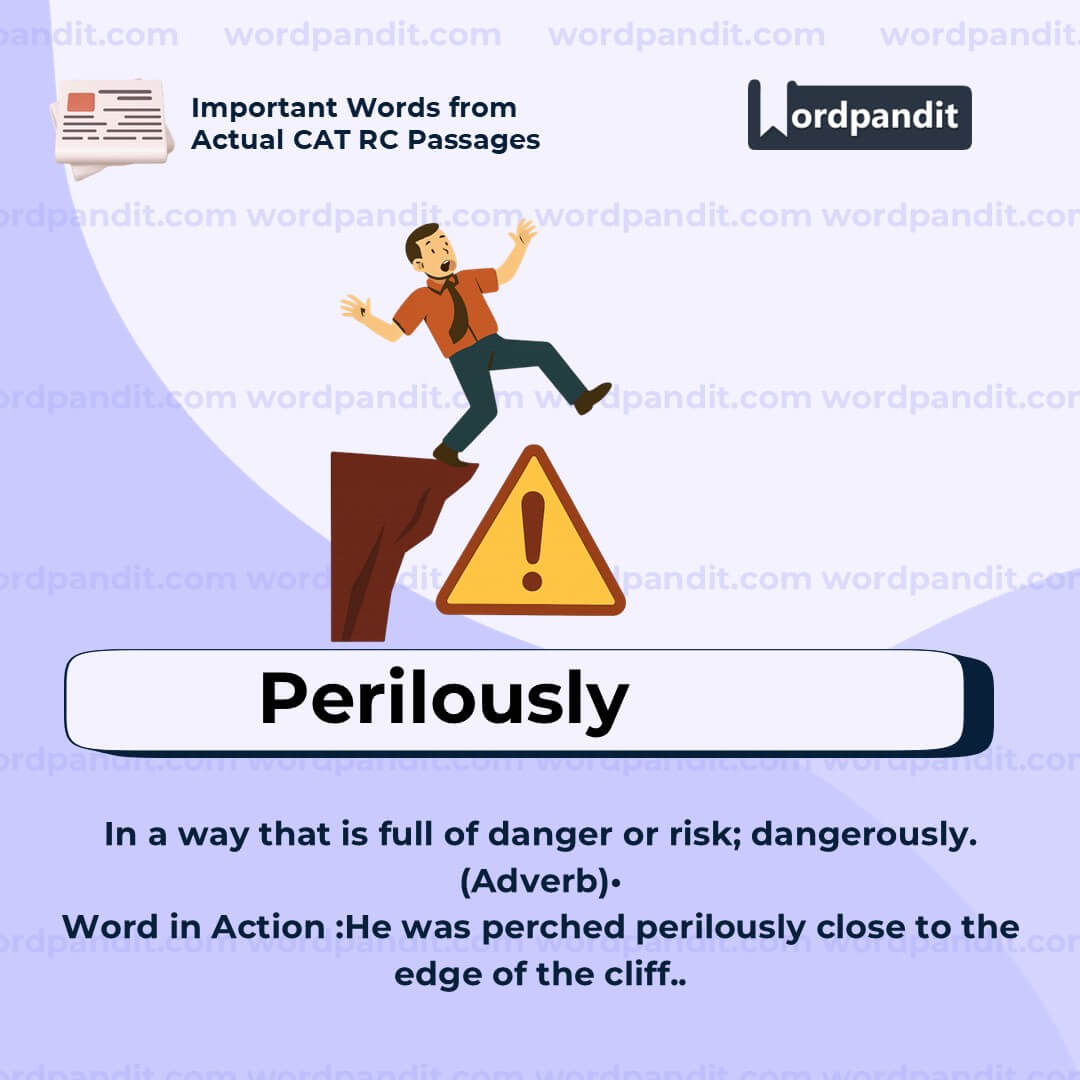
WORD-5: Perilously
Context:
"The climbers hung perilously from the icy ledge as the storm intensified." - National Geographic
Explanatory Paragraph:
Perilously is an adverb that describes an action done in a dangerous or risky way. It comes from the noun "peril," which means serious danger. When someone does something perilously, they're in a situation where harm or disaster is likely if things go wrong. It often adds drama or urgency to a description.
Meaning: In a way that involves or suggests danger or risk (Adverb)
Pronunciation: PEH-ruh-luss-lee
Difficulty Level: ⭐⭐⭐ Intermediate
Etymology: From Old French "perilleus," based on Latin "periculum" meaning danger or trial
Prashant Sir's Notes:
Think of “perilously” as a red warning sign—it signals that whatever’s happening is close to danger. It’s often used in writing to heighten suspense or describe near-disaster situations.
Synonyms & Antonyms:
Synonyms: dangerously, hazardously, riskily, precariously, alarmingly
Antonyms: safely, securely, cautiously, reliably, harmlessly
Usage Examples:
- The tightrope walker moved perilously above the city skyline without a safety net.
- The nation stood perilously close to economic collapse during the crisis.
- He balanced perilously on the edge of the chair, refusing to sit properly.
- The conversation veered perilously into personal territory.
Cultural Reference:
"Perilously close to disaster" is a phrase often used in journalism and war reporting to emphasize urgency or imminent threat, like in news coverage of natural disasters or conflicts. - Media Language Use
Think About It:
Why do humans often act perilously even when they know the risks? Is it courage, recklessness, or something else?
Quick Activity:
Write two sentences: one describing someone acting perilously out of bravery, and one out of foolishness. Compare the tone.
Memory Tip:
“Perilously” sounds like “peril” + “-ously” — so think of someone *obviously in peril*, doing something risky or unsafe.
Real-World Application:
Understanding the word “perilously” helps in interpreting news, literature, and historical accounts where danger is a central theme. It’s useful for adding descriptive power in writing or storytelling.
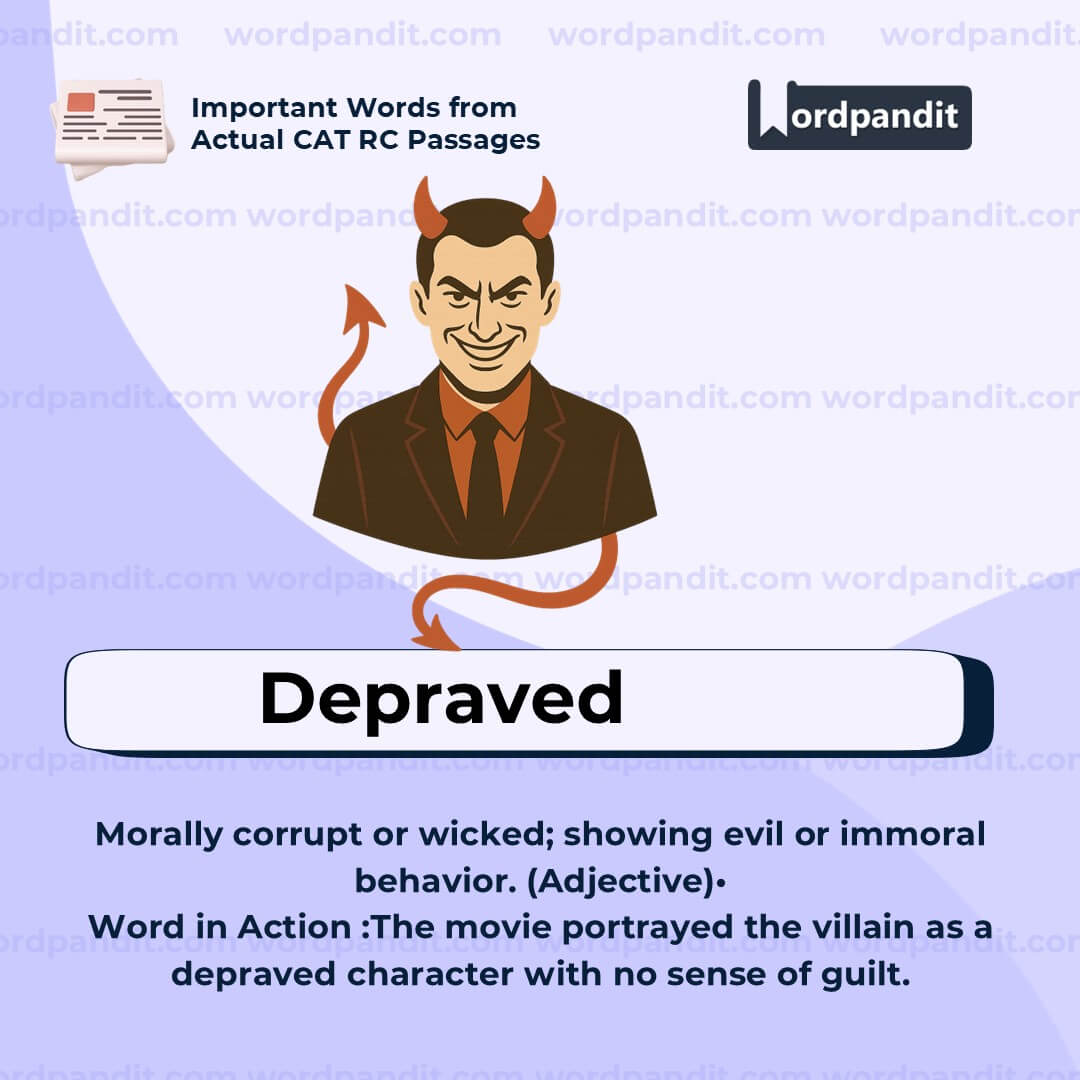
WORD-6: Depraved
Context:
"The novel depicts a depraved society where morality has all but disappeared." - The New Yorker
Explanatory Paragraph:
Depraved describes someone or something morally corrupt or wicked. It is often used for individuals, actions, or societies that have lost all sense of ethics or decency. The word has a very strong negative connotation, suggesting an extreme level of moral decay.
Meaning: Morally corrupt; wicked (Adjective)
Pronunciation: dih-PRAYVD
Difficulty Level: ⭐⭐⭐ Intermediate
Etymology: From Latin “depravare” meaning “to corrupt,” from “de-” (completely) + “pravus” (crooked)
Prashant Sir's Notes:
“Depraved” is the opposite of virtuous. Use it carefully—it often appears in serious or dark contexts, like crime, war, or literature that explores human evil.
Synonyms & Antonyms:
Synonyms: corrupt, wicked, vile, debased, immoral
Antonyms: virtuous, moral, pure, righteous, ethical
Usage Examples:
- The dictator's depraved acts shocked the international community.
- She wrote a thesis analyzing the depraved characters in Gothic literature.
- The film was banned for its portrayal of depraved violence and cruelty.
- In the absence of law and order, the town became a depraved haven for criminals.
Cultural Reference:
The character of Kurtz in Joseph Conrad’s *Heart of Darkness* is often cited as a symbol of depraved colonialism — a man who has lost all moral compass in the pursuit of power. - Literature Reference
Think About It:
What leads a person or society toward depravity? Can someone truly return to goodness after being labeled depraved?
Quick Activity:
Use “depraved” in a sentence describing a fictional villain. Then rewrite it with a synonym and notice the shift in tone.
Memory Tip:
“Depraved” sounds like “deprived of being brave” — a depraved person lacks the moral bravery to do what’s right.
Real-World Application:
“Depraved” is often used in discussions about criminal psychology, literature, or history when analyzing behaviors that are extremely immoral or inhumane.
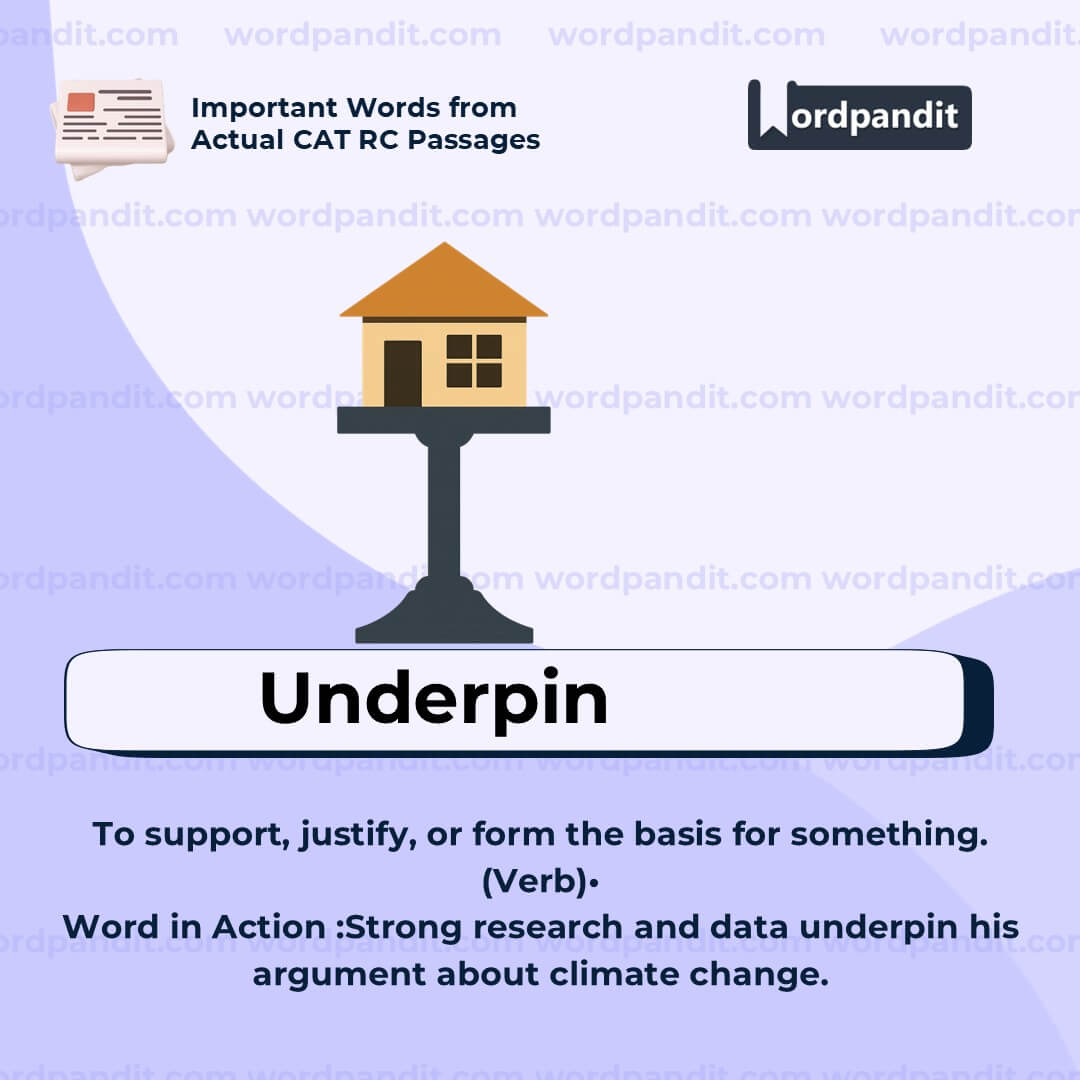
WORD-7: Underpin
Context:
"Strong research and clear data underpin the new educational reforms being proposed." - The Economist
Explanatory Paragraph:
To underpin something means to support it, both literally and figuratively. In physical structures, it refers to strengthening a foundation. In abstract contexts, such as arguments, systems, or ideas, it means to provide a basis or justification. It suggests that without this foundational support, the structure — physical or conceptual — may collapse.
Meaning: To support, justify, or form the basis for something (Verb)
Pronunciation: UN-der-pin
Difficulty Level: ⭐⭐⭐ Intermediate
Etymology: From Middle English, literally “to pin from beneath”; combining “under” + “pin”
Prashant Sir's Notes:
Visualize a building with beams under it — that’s what “underpin” means. Academically, it’s often used in arguments or policy where you “support” a claim or idea with logic or evidence.
Synonyms & Antonyms:
Synonyms: support, sustain, buttress, reinforce, uphold
Antonyms: weaken, undermine, destabilize, erode, collapse
Usage Examples:
- Scientific principles underpin modern medical treatments.
- The architect added steel beams to underpin the aging structure.
- Ethical values must underpin a society’s legal system.
- Her personal experience underpins her passion for mental health advocacy.
Cultural Reference:
In academic writing, phrases like “this theory underpins our understanding of...” are commonly used to indicate foundational ideas that support complex frameworks. - Academic Usage Reference
Think About It:
What core beliefs or principles underpin your decisions in life? Are they strong enough to support you in tough times?
Quick Activity:
Choose a belief or system (e.g., democracy, education, friendship). Write two sentences explaining what underpins it using the word accurately.
Memory Tip:
Think of “underpin” as a pin *under* something — it holds up ideas or buildings, giving them structure and support.
Real-World Application:
“Underpin” is commonly used in essays, presentations, and policy discussions. Mastering its use helps you sound logical and well-informed, especially in academic and professional settings.
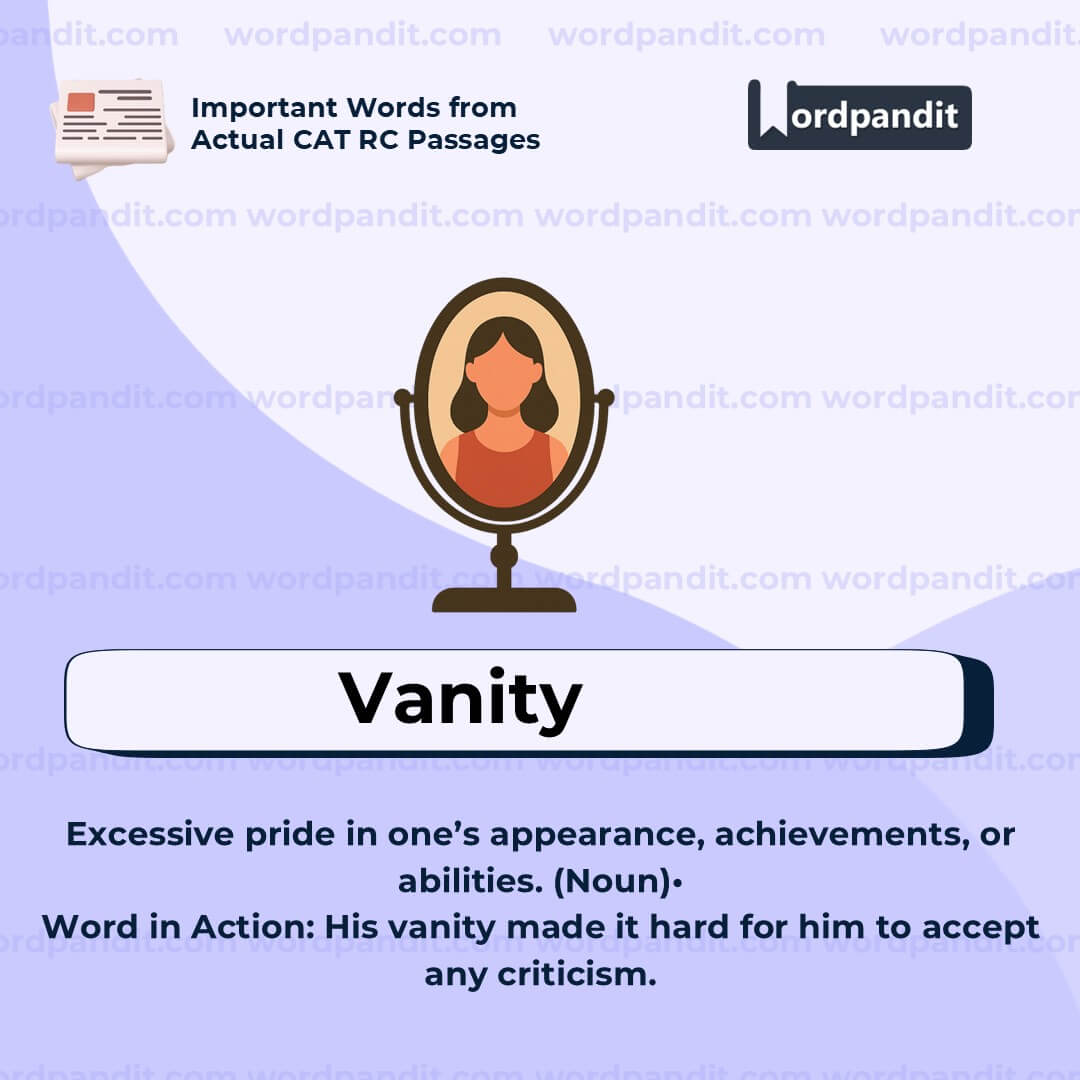
WORD-8: Vanity
Context:
"The influencer’s constant posting seemed driven more by vanity than by creativity." - The Atlantic
Explanatory Paragraph:
Vanity refers to excessive pride in or admiration of one's own appearance or achievements. It often implies a superficial or hollow sense of self-worth, based more on image than substance. Though everyone likes recognition, vanity suggests an unhealthy or obsessive preoccupation with it.
Meaning: Excessive pride in one’s appearance or accomplishments (Noun)
Pronunciation: VAN-ih-tee
Difficulty Level: ⭐⭐ Beginner-Intermediate
Etymology: From Latin “vanitas” meaning “emptiness,” from “vanus” (empty, without substance)
Prashant Sir's Notes:
Vanity is like a mirror that reflects only the surface — it’s often used in literature and philosophy to warn against self-obsession and meaningless pride. Connect this word to the idea of "hollow ego."
Synonyms & Antonyms:
Synonyms: conceit, pride, egotism, self-admiration, narcissism
Antonyms: humility, modesty, selflessness, humbleness, reserve
Usage Examples:
- Her vanity led her to spend hours each day perfecting her social media profile.
- The artist warned against vanity in the pursuit of fame over substance.
- He bought a luxury car more out of vanity than necessity.
- Classical literature often portrays vanity as a tragic flaw in heroes.
Cultural Reference:
In John Milton’s *Paradise Lost*, Satan’s vanity leads to his downfall — a classic literary theme where excessive pride causes ruin. - Literary Allusion
Think About It:
Where do we draw the line between healthy self-esteem and vanity? Can vanity ever be a positive force?
Quick Activity:
List three behaviors that could be considered acts of vanity. Then reframe each one in a more modest or humble way.
Memory Tip:
Vanity = Vain + Empty = Pride that’s hollow inside. Think of a balloon — inflated, but full of air.
Real-World Application:
“Vanity” is a useful word in analyzing characters, marketing culture, or social media behavior. It helps in discussions about self-image, ego, and the balance between confidence and arrogance.
WORD-9: Consensual
Context:
"The agreement was entirely consensual, with both parties willingly accepting the terms." - The Washington Post
Explanatory Paragraph:
Consensual refers to something that happens with the agreement or mutual consent of all involved parties. It emphasizes voluntary participation and mutual understanding. Often used in legal, social, and relational contexts, this word highlights the importance of agreement, especially in situations where power dynamics or boundaries are involved.
Meaning: Agreed to by all people involved; done with mutual consent (Adjective)
Pronunciation: kun-SEN-shoo-uhl
Difficulty Level: ⭐⭐ Beginner-Intermediate
Etymology: From Latin “consensus” (agreement, accord), from “consentire” (to feel together)
Prashant Sir's Notes:
Link “consensual” with the root word “consent.” It is key in both formal agreements and personal relationships. Always signals a shared and voluntary decision, not a forced one.
Synonyms & Antonyms:
Synonyms: voluntary, agreed, mutual, cooperative, accepted
Antonyms: forced, imposed, nonconsensual, coerced, compulsory
Usage Examples:
- The contract was consensual, with both sides fully informed of their rights.
- They entered into a consensual relationship built on respect and communication.
- Even in casual interactions, it's important to ensure actions are consensual.
- In a healthy society, all agreements—legal or personal—should be consensual.
Cultural Reference:
The importance of consensual interaction has become central in modern conversations about ethics and relationships, especially in the #MeToo era. - Social Commentary Reference
Think About It:
How does ensuring something is consensual shift the power dynamics in a relationship or negotiation?
Quick Activity:
Write three short scenarios—one consensual, one nonconsensual, and one ambiguous. Discuss what makes each one clear or unclear.
Memory Tip:
Think: “Consensual = with consent.” If everyone *says yes* and agrees freely, it’s consensual.
Real-World Application:
Understanding the word “consensual” is critical in legal, ethical, and personal settings. It reinforces respect, clarity, and the importance of mutual agreement in interactions.
WORD-10: Progeny
Context:
"The scientist was proud to see his intellectual progeny carry forward his groundbreaking research." - Nature Journal
Explanatory Paragraph:
Progeny refers to the offspring or descendants of a person, animal, or even idea. While it is commonly used in biology to denote literal children or animal young, it can also be used metaphorically to describe the outcomes or results of someone's work, thoughts, or actions. It has a formal tone and is often found in academic or literary texts.
Meaning: Offspring or descendants (Noun)
Pronunciation: PROJ-uh-nee
Difficulty Level: ⭐⭐⭐ Intermediate
Etymology: From Latin “progenies,” from “progignere” meaning “to beget,” formed from “pro-” (forth) + “gignere” (to beget)
Prashant Sir's Notes:
Use “progeny” not just for biological children but also for outcomes of ideas and legacies. A refined alternative to “children” in elevated writing.
Synonyms & Antonyms:
Synonyms: offspring, descendants, heirs, successors, lineage
Antonyms: ancestors, forebears, predecessors, originators
Usage Examples:
- The monarch’s progeny were trained from a young age to lead the kingdom.
- These books are the intellectual progeny of decades of philosophical debate.
- She considered her students her true progeny, carrying forward her values.
- The dog’s progeny all inherited its distinctive black-and-white coat.
Cultural Reference:
In literature, the idea of a “prodigal progeny” — a wayward child — appears in works like Shakespeare’s plays, highlighting the expectations and failures between generations. - Literary Motif
Think About It:
What do you consider your own “progeny” — the people, projects, or ideas you’ve influenced or created?
Quick Activity:
Write a sentence using “progeny” both in the biological and metaphorical sense. Try to show contrast in tone and use.
Memory Tip:
“Progeny” sounds like “project + gene” — think of it as the *genetic project* that continues your line or legacy.
Real-World Application:
“Progeny” is useful in academic writing, genetics, family law, and literature. It enriches the vocabulary used to discuss generations, legacy, and outcomes.


