
📘 What’s Inside This CAT Misfit Sentence/Odd One Out Question Post?
📝 Authentic CAT Misfit Sentence/Odd One Out Question: Practice with a real CAT Para-jumble Question from a previous CAT exam.
✅ Detailed Question with Step-by-Step Solution: Each question is explained thoroughly for better understanding.
📚 Vocabulary Enhancement: Top 5 words explained from the paragraph
Misfit Sentence/Odd One Out Question
19. Five jumbled up sentences, related to a topic, are given below. Four of them can be put together to form a coherent paragraph. Identify the odd one out and key in the number of the sentence as your answer:
1. The care with which philosophers examine arguments for and against forms of biotechnology makes this an excellent primer on formulating and assessing moral arguments.
2. Although most people find at least some forms of genetic engineering disquieting, it is not easy to articulate why: what is wrong with re-engineering our nature?
3. Breakthroughs in genetics present us with the promise that we will soon be able to prevent a host of debilitating diseases, and the predicament that our newfound genetic knowledge may enable us to enhance our genetic traits.
4. To grapple with the ethics of enhancement, we need to confront questions that verge on theology, which is why modern philosophers and political theorists tend to shrink from them.
5. One argument is that the drive for human perfection through genetics is objectionable as it represents a bid for mastery that fails to appreciate the gifts of human powers and achievements.
Solution with Explanation
Answer: 1
Detailed explanation by Wordpandit:
Upon examining the provided jumbled sentences, the central theme appears to revolve around the moral and ethical implications surrounding genetic interventions and advancements.
Statement 2 introduces the emotional discomfort many people experience when thinking about genetic engineering and the challenge of expressing what’s morally wrong about it.
Statement 3 expands the discussion by describing the dual nature of genetic advances—offering benefits like disease prevention but also introducing ethical dilemmas concerning enhancement.
Statement 4 continues the thread by explaining why these ethical challenges are difficult to confront, linking them to deep, almost theological questions.
Statement 5 offers one specific philosophical objection to genetic enhancement, rounding out the ethical debate introduced earlier.
Together, statements 2, 3, 4, and 5 form a logically connected argument focused specifically on the ethics of genetic engineering and enhancement.
Statement 1, however, diverges from this theme. It discusses the value of philosophical discourse in biotechnology in general, without tying directly into the flow about genetic enhancement ethics. It serves as a broader meta-commentary rather than being part of the discussion on genetic engineering’s moral implications.
Therefore, Statement 1 can be identified as the outlier, making it the correct choice in this context.
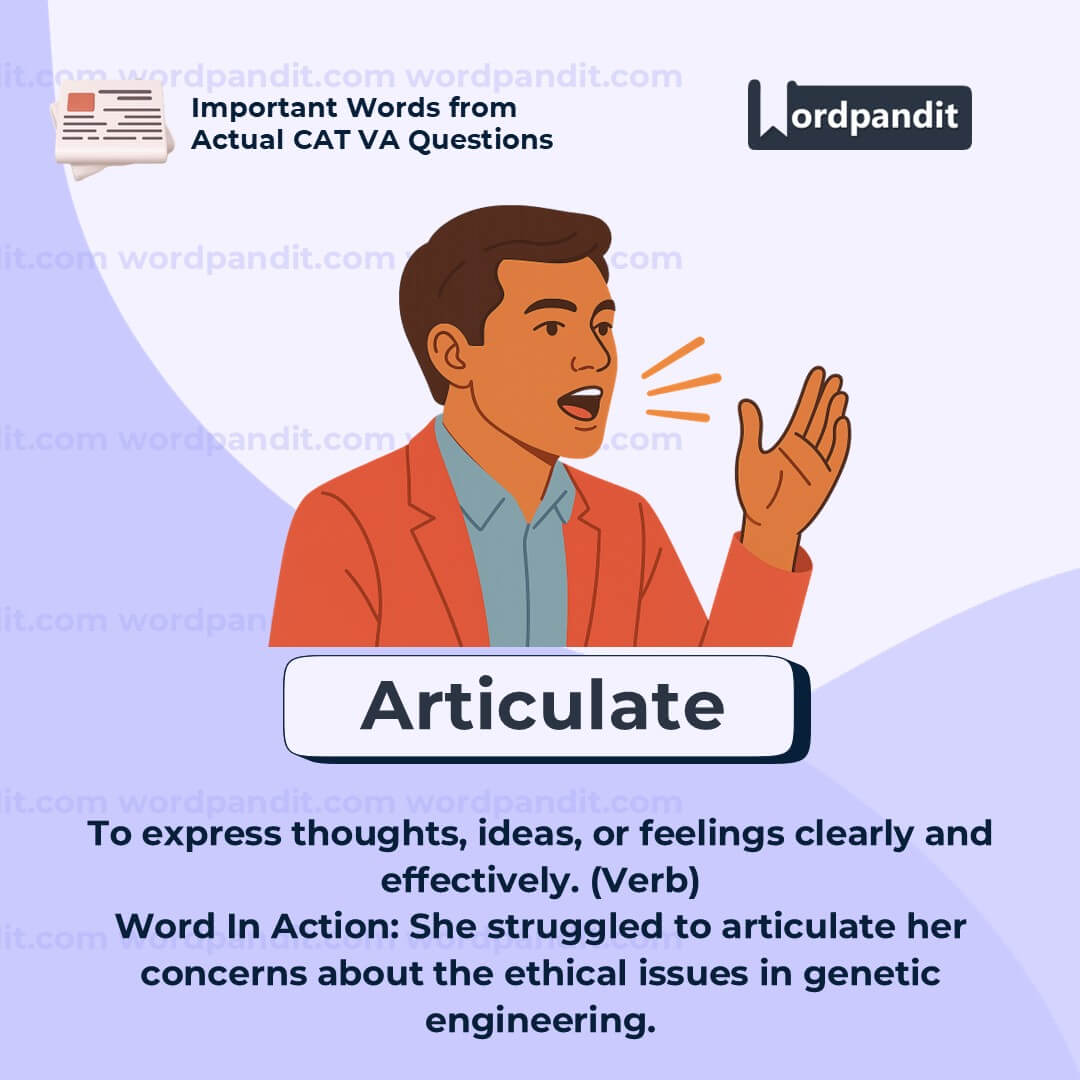
Word-1: Articulate
Context:
"Although most people find at least some forms of genetic engineering disquieting, it is not easy to articulate why: what is wrong with re-engineering our nature?"
Explanatory Paragraph:
"Articulate" in this context means to clearly express or explain one’s thoughts or feelings. The sentence suggests that although people instinctively feel discomfort about genetic engineering, they struggle to put that feeling into precise words. More generally, to articulate something is to express it fluently and coherently, whether in speech or writing.
Meaning: To express an idea or feeling clearly in words. (Verb)
Pronunciation: ar-TIK-yuh-layt
Difficulty Level: ⭐⭐ Beginner
Etymology: From Latin “articulare,” meaning “to divide into joints, utter distinctly,” derived from “articulus” (a small joint).
Prashant Sir's Notes:
“Articulate” is a powerful word both as a verb and as an adjective. To articulate is to give form to thought. As an adjective, if someone is described as "articulate," it means they are well-spoken. In either form, it's about clarity and effective communication. Great communicators don't just know what to say—they know how to articulate it well.
Synonyms & Antonyms:
Synonyms: express, convey, voice, communicate, enunciate
Antonyms: mumble, mutter, withhold, suppress, confuse
Usage Examples:
- She struggled to articulate her thoughts during the debate.
- The leader articulated a clear vision for the company's future.
- It’s important to articulate your needs in a relationship.
- He is an articulate speaker who captivates his audience.
Cultural Reference:
Barack Obama is widely regarded as one of the most articulate public speakers in modern political history. - The Atlantic
Think About It:
Why is the ability to articulate complex emotions or ethical concerns so essential in public discourse?
Quick Activity:
Choose a topic you care about (e.g., climate change, education, technology) and try to articulate your opinion in two clear sentences.
Memory Tip:
Articulate = “Art” + “Calculate” → Think of it as the *art of carefully expressing* your thoughts.
Real-World Application:
Being able to articulate ideas is crucial in interviews, presentations, negotiations, and leadership. Clear expression builds trust, prevents misunderstandings, and enhances influence.
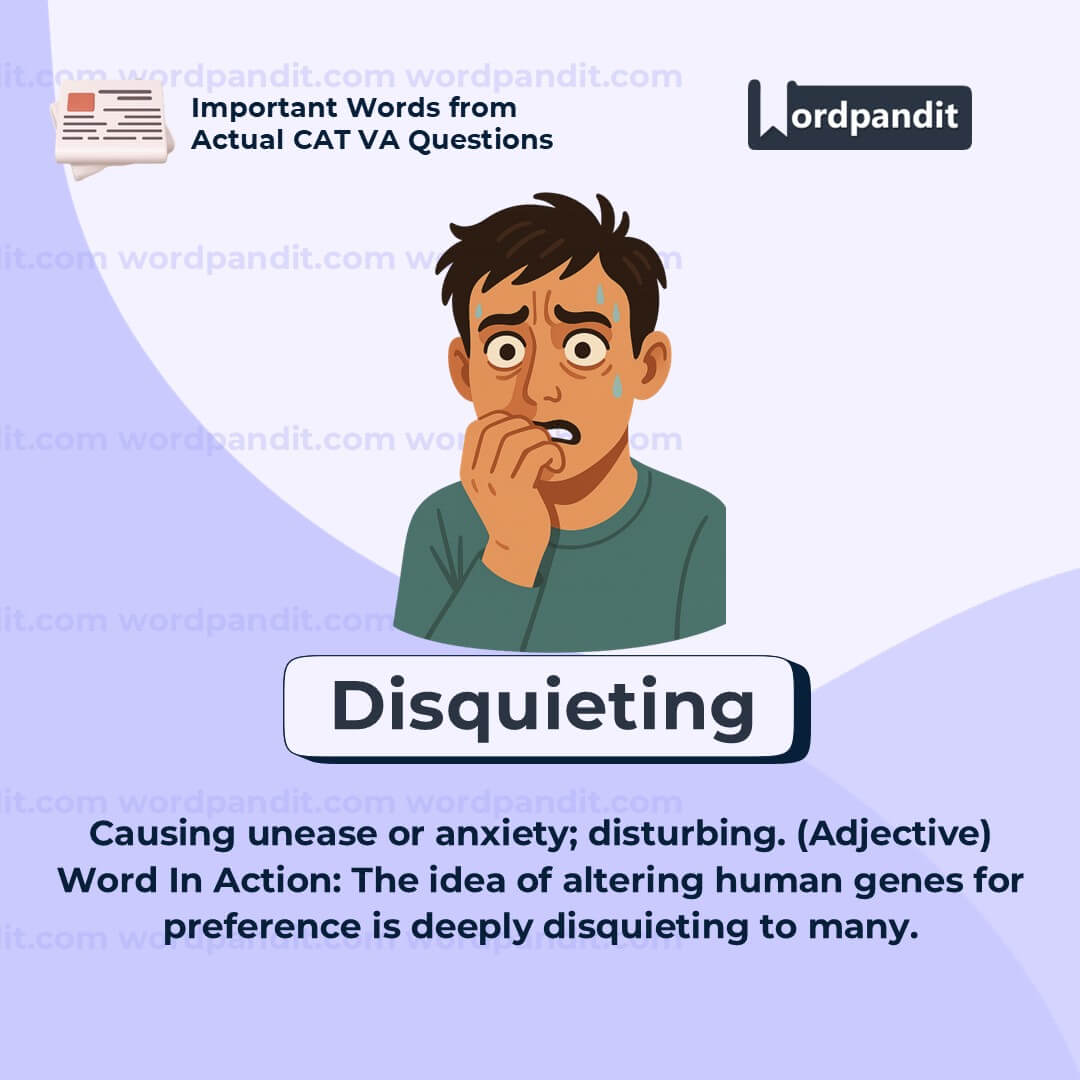
Word-2: Disquieting
Context:
"Although most people find at least some forms of genetic engineering disquieting, it is not easy to articulate why: what is wrong with re-engineering our nature?"
Explanatory Paragraph:
"Disquieting" describes something that causes unease, anxiety, or discomfort. In this context, it refers to how genetic engineering evokes an unsettling feeling in people—even if they can't fully explain why. The word emphasizes emotional or psychological disturbance, often tied to moral, ethical, or existential concerns. It's more subtle than outright fear—more like a deep, lingering concern.
Meaning: Causing anxiety, worry, or unease. (Adjective)
Pronunciation: dis-KWY-uh-ting
Difficulty Level: ⭐⭐⭐ Intermediate
Etymology: From Latin “dis-” (opposite) + “quietus” (quiet or calm), meaning "to disturb calmness."
Prashant Sir's Notes:
“Disquieting” is a subtle and intellectual word to describe things that trouble you—not in a loud or panicked way, but in a deep, thoughtful one. It's especially useful when discussing abstract or complex concerns like ethics, technology, or societal change. If something doesn't sit right with you, it’s probably disquieting.
Synonyms & Antonyms:
Synonyms: unsettling, disturbing, troubling, unnerving, alarming
Antonyms: comforting, reassuring, calming, soothing, peaceful
Usage Examples:
- The film’s ending was ambiguous and deeply disquieting.
- Her disquieting silence made everyone in the room uncomfortable.
- There is something disquieting about altering human DNA without fully understanding the consequences.
- He gave a disquieting account of life under an authoritarian regime.
Cultural Reference:
George Orwell's *1984* presents a disquieting vision of a totalitarian future where surveillance and control erase personal freedom. - Literary Classic
Think About It:
What kinds of technologies or trends do you personally find disquieting, and why?
Quick Activity:
Write a two-line paragraph using “disquieting” to describe a situation that feels morally or emotionally uncomfortable.
Memory Tip:
Disquieting = “disrupts your quiet” → It unsettles your peace of mind or emotional calm.
Real-World Application:
“Disquieting” is a precise word often used in journalism, academia, and ethics debates when addressing controversial issues—such as AI ethics, genetic manipulation, or climate inaction—to convey unease without alarmism.
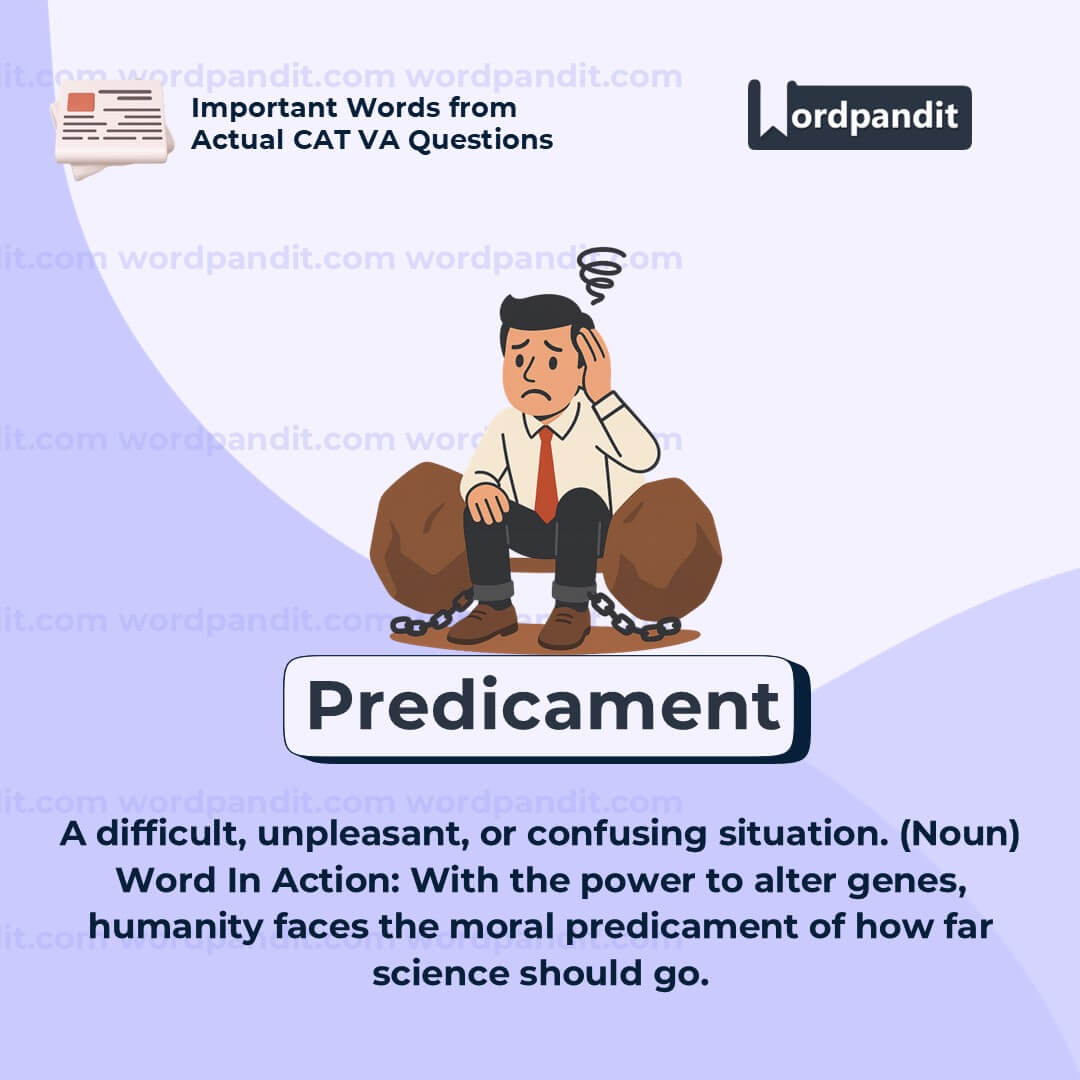
Word-3: Predicament
Context:
"Breakthroughs in genetics present us with the promise that we will soon be able to prevent a host of debilitating diseases, and the predicament that our newfound genetic knowledge may enable us to enhance our genetic traits."
Explanatory Paragraph:
"Predicament" refers to a difficult or unpleasant situation, especially one that is not easy to resolve. In this context, while scientific progress in genetics brings great promise, it also creates a complex moral dilemma—should we use this power to enhance human traits? This scenario puts us in a predicament: caught between potential benefit and ethical uncertainty.
Meaning: A difficult, unpleasant, or tricky situation that is hard to get out of. (Noun)
Pronunciation: pri-DIK-uh-muhnt
Difficulty Level: ⭐⭐ Beginner
Etymology: From Latin “praedicamentum,” meaning “category or assertion,” later evolving to mean a complicated or troubling situation in English.
Prashant Sir's Notes:
“Predicament” is a go-to word when describing sticky or complex situations, especially those with no clear solution. It’s often used in ethical, personal, or strategic contexts. In vocabulary usage, it's useful for describing not just problems, but *tricky dilemmas* where both choices may have consequences.
Synonyms & Antonyms:
Synonyms: dilemma, quandary, plight, bind, jam
Antonyms: solution, advantage, certainty, clarity
Usage Examples:
- He found himself in a financial predicament after losing his job.
- The company faced a legal predicament that could damage its reputation.
- It’s a moral predicament—should we use genetic editing just because we can?
- She called her friend for advice about her romantic predicament.
Cultural Reference:
In *Sophie's Choice*, the protagonist faces a heart-wrenching moral predicament—choosing between her children in a Nazi concentration camp. - William Styron
Think About It:
Have you ever faced a predicament where both options had major consequences? How did you decide?
Quick Activity:
Write a two-sentence scenario that includes a clear predicament. Then, explain which choice you'd make and why.
Memory Tip:
Think of “predicament” as a “pre-difficult-moment” — a tricky crossroads before making a hard choice.
Real-World Application:
In leadership, law, ethics, and even medicine, professionals often encounter predicaments where every option has trade-offs. Navigating such challenges requires empathy, reasoning, and sometimes courage.
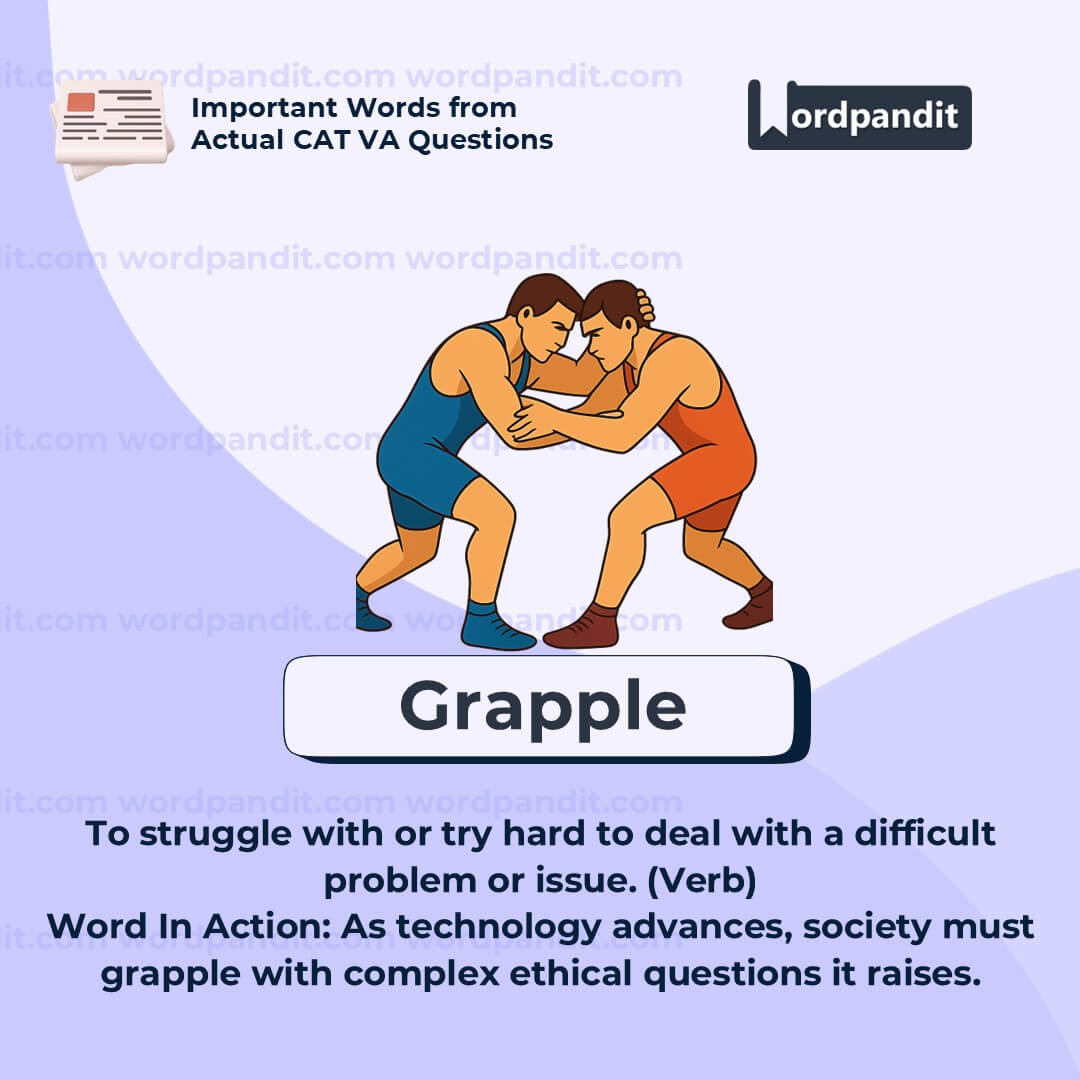
Word-4: Grapple
Context:
"To grapple with the ethics of enhancement, we need to confront questions that verge on theology, which is why modern philosophers and political theorists tend to shrink from them."
Explanatory Paragraph:
In this context, “grapple” means to struggle with or try hard to understand and deal with complex issues—particularly ethical questions about genetic enhancement. The word suggests not just passive reflection but an active and challenging intellectual effort, much like wrestling with a difficult problem or concept. It conveys seriousness, tension, and mental engagement with something weighty.
Meaning: To engage in a difficult struggle or attempt to understand or solve a complex issue. (Verb)
Pronunciation: GRAP-uhl
Difficulty Level: ⭐⭐⭐ Intermediate
Etymology: From Middle English “grapelen,” from Old French “grapel,” meaning “a hook” or “to seize.” Originally used in the context of physical combat or grasping, now also used figuratively.
Prashant Sir's Notes:
“Grapple” is a dynamic and powerful word—think of someone physically wrestling or mentally wrestling with a tough idea. It's very commonly used in academic writing, debates, and journalism when discussing ongoing societal struggles or unresolved debates. When you grapple with something, you don’t give up easily—you wrestle it to understand it or overcome it.
Synonyms & Antonyms:
Synonyms: wrestle with, struggle with, contend with, confront, deal with
Antonyms: ignore, avoid, dismiss, neglect
Usage Examples:
- Lawmakers continue to grapple with the implications of AI in criminal justice.
- She grappled with feelings of guilt after making a difficult decision.
- Scientists are grappling with the moral consequences of genetic editing.
- To truly understand history, we must grapple with its uncomfortable truths.
Cultural Reference:
Martin Luther King Jr. grappled with the challenge of fighting injustice through nonviolence, even in the face of hatred. - *Stride Toward Freedom*
Think About It:
What is one moral or social issue you’ve had to grapple with personally? How did it change your thinking?
Quick Activity:
Write two sentences about a recent global issue (e.g., climate change, AI, migration) and explain how society is grappling with it.
Memory Tip:
Picture two wrestlers grappling in the ring—that's what your mind does when it "grapples" with a hard idea.
Real-World Application:
Professionals in law, education, ethics, and science constantly grapple with issues like bias, responsibility, and innovation. The ability to grapple intellectually is key to leadership, policy-making, and personal growth.
Word-5: Objectionable
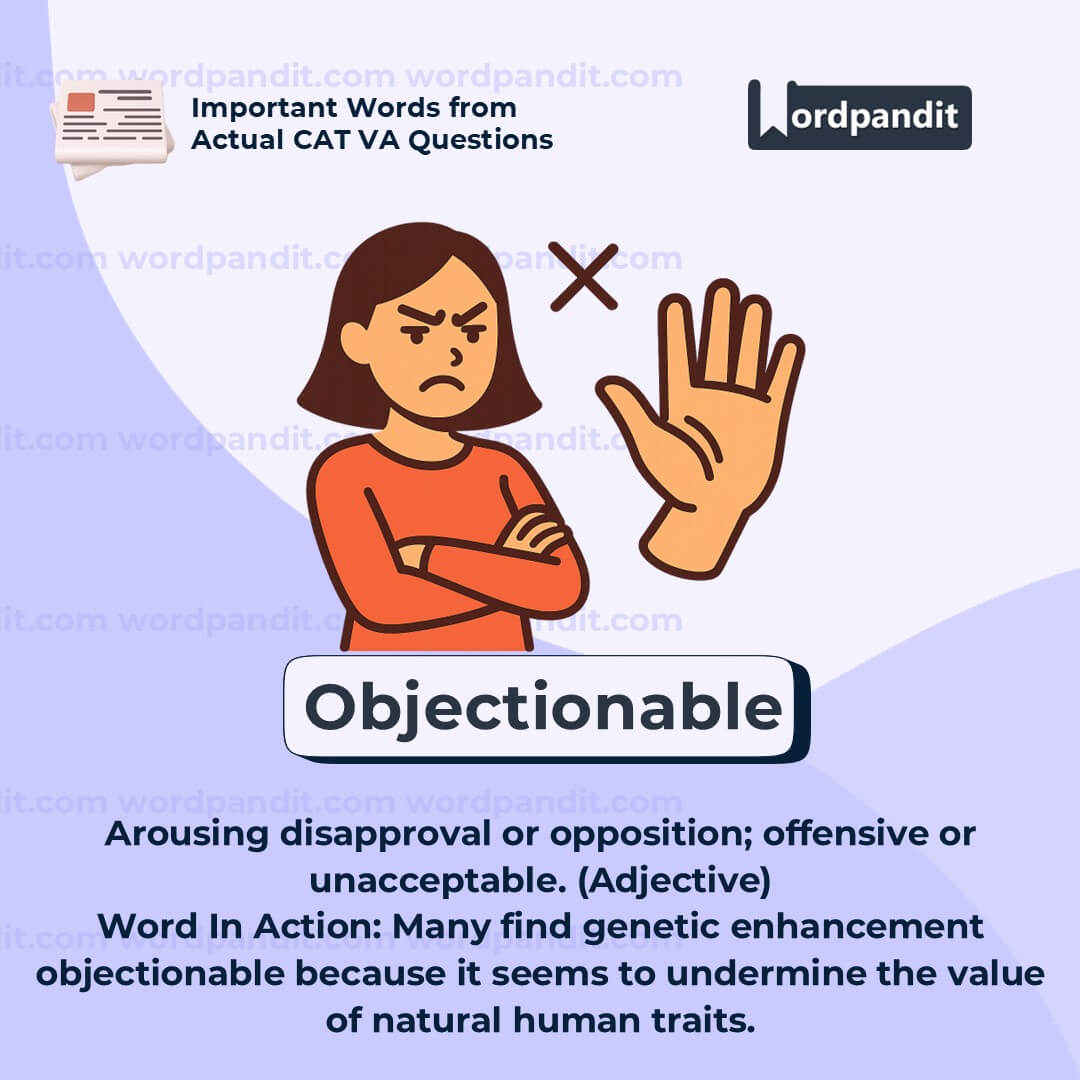
Context:
"One argument is that the drive for human perfection through genetics is objectionable as it represents a bid for mastery that fails to appreciate the gifts of human powers and achievements."
Explanatory Paragraph:
“Objectionable” refers to something that is offensive, morally or ethically unacceptable, or likely to cause disapproval. In this context, the author argues that attempting to perfect humanity through genetic engineering is objectionable because it reflects an arrogant attitude—one that ignores the natural gifts and limitations that define our humanity. The term expresses strong disapproval toward actions or ideas seen as inappropriate or problematic.
Meaning: Causing disapproval or offense; considered unacceptable. (Adjective)
Pronunciation: uhb-JEK-shuh-nuh-buhl
Difficulty Level: ⭐⭐⭐ Intermediate
Etymology: From Latin “objectio” (opposition), related to “object,” in the sense of “something thrown against” or “raised in protest.”
Prashant Sir's Notes:
Use “objectionable” when you want to label something as inappropriate, offensive, or ethically troubling. It’s often used in debates and formal arguments to critique policies, actions, or content. For example, offensive jokes, harmful ideologies, or unethical experiments can all be described as objectionable.
Synonyms & Antonyms:
Synonyms: offensive, unacceptable, inappropriate, disagreeable, distasteful
Antonyms: acceptable, agreeable, unobjectionable, pleasing, proper
Usage Examples:
- The advertisement was pulled from television for being culturally objectionable.
- Many people found the scientist’s remarks about genetic superiority deeply objectionable.
- Objectionable content on social media is often flagged and removed.
- He raised concerns about the objectionable nature of the proposed policy.
Cultural Reference:
The Hays Code, enforced in Hollywood from the 1930s to the 1960s, banned films from showing “morally objectionable” content—often defined by strict religious and political norms. - American Film History
Think About It:
Who decides what is “objectionable” in society—and how can cultural or historical context influence that judgment?
Quick Activity:
List two examples of ideas or practices you consider objectionable and explain why. Then, list two that others might find objectionable but you do not.
Memory Tip:
Objectionable = likely to be “objected to” — if something makes people raise objections, it’s probably objectionable.
Real-World Application:
Understanding what is considered objectionable in a given culture or profession is essential for effective communication, lawmaking, education, and media production. It helps avoid conflict and promote ethical behavior.
