
📘 What’s Inside This CAT Para-jumble Question Post?
📝 Authentic CAT Para-jumble Question : Practice with a real CAT Para-jumble Question from a previous CAT exam.
✅ Detailed Question with Step-by-Step Solution: Each question is explained thoroughly for better understanding.
📚 Vocabulary Enhancement: Top 5 words explained from the paragraph
Para-jumble Sentences
18. The four sentences (labelled 1, 2, 3, 4) below, when properly sequenced would yield a coherent paragraph. Decide on the proper sequencing of the order of the sentences and key in the sequence of the four numbers as your answer:
1. But today there is an epochal challenge to rethink and reconstitute the vision and practice of development as a shared responsibility - a sharing which binds both the agent and the audience, the developed world and the developing, in a bond of shared destiny.
2. We are at a crossroads now in our vision and practice of development.
3. This calls for the cultivation of an appropriate ethical mode of being in our lives which enables us to realize this global and planetary situation of shared living and responsibility.
4. Half a century ago, development began as a hope for a better human possibility, but in the last fifty years, this hope has lost itself in the dreary desert of various kinds of hegemonic applications.
Solution with Explanation
Answer: 2413
Solution by Wordpandit:
Upon an initial review of the sentences, it becomes evident that the overarching theme of the paragraph pertains to the evolving perspective on development. Sentence 2 sets the stage, indicating that we are currently at a pivotal juncture in our understanding and approach to development.
Sentence 4 provides a historical context, highlighting that development began as a hopeful vision but has since deviated into forms of dominance and control.
Sentence 1 responds to that deviation by proposing the need for a reimagined framework of development—one grounded in shared responsibility and mutual destiny between the developed and developing worlds.
Sentence 3 then logically concludes the paragraph by calling for an ethical transformation that aligns with the suggested shared global responsibility, thus tying the entire argument together.
Hence, the correct sequence is: 2-4-1-3
Word-1: Epochal
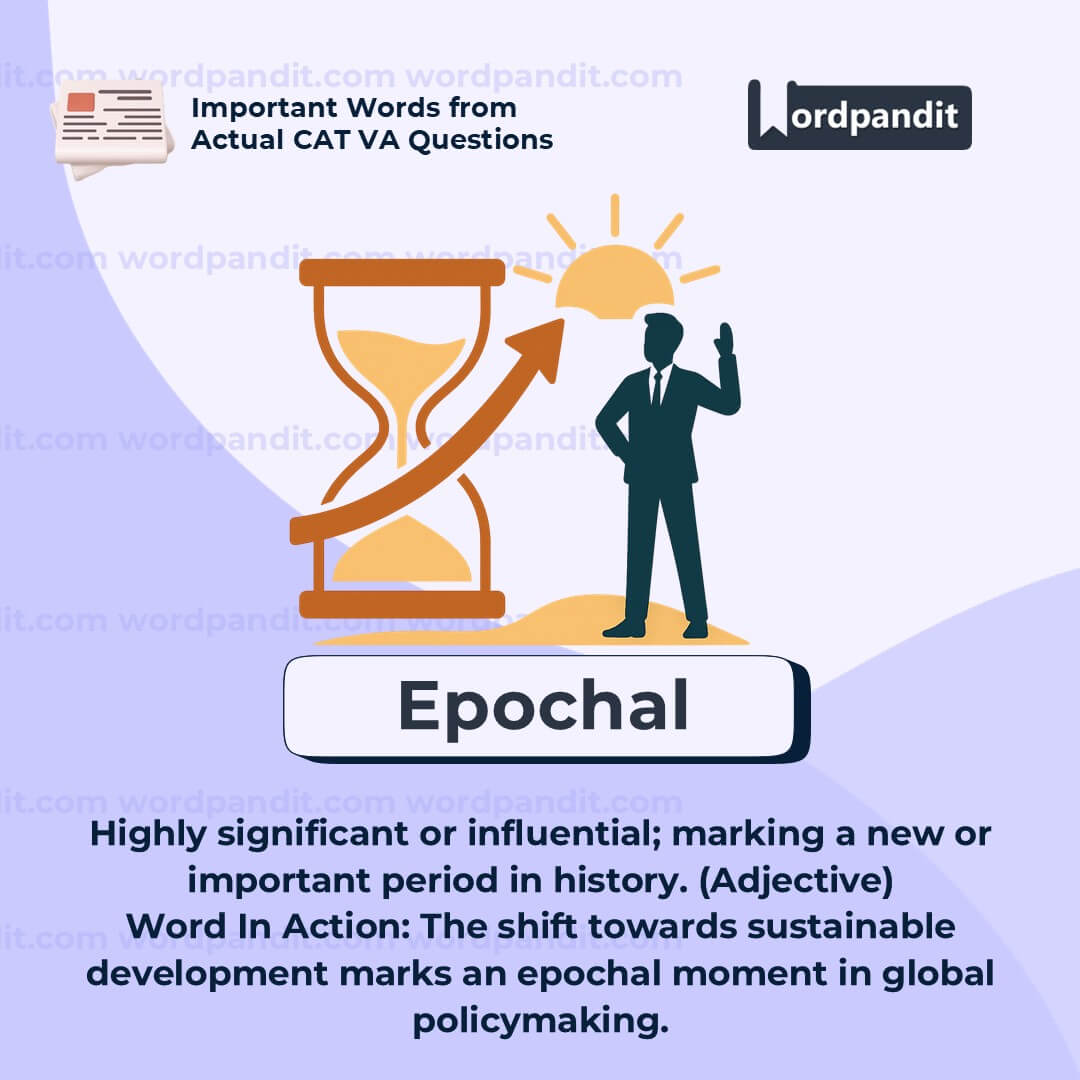
Context:
"But today there is an epochal challenge to rethink and reconstitute the vision and practice of development as a shared responsibility - a sharing which binds both the agent and the audience, the developed world and the developing, in a bond of shared destiny."
Explanatory Paragraph:
The word "epochal" is used to describe something so significant and groundbreaking that it defines an entire era or marks a major turning point in history. In the given context, the writer refers to a challenge that is not merely big but transformative—so important that it has the potential to reshape how we understand and practice global development. It implies a moment of critical change that could have long-lasting consequences for future generations.
Meaning: Extremely important, significant, or life-changing; marking a major moment in history. (Adjective)
Pronunciation: EH-puh-kul
Difficulty Level: ⭐⭐⭐⭐ Advanced
Etymology: From “epoch” (a particular period of time in history), which comes from Greek “epokhē” meaning “pause” or “fixed point in time.”
Prashant Sir's Notes:
"Epochal" is a high-impact adjective used to describe events or decisions that change the course of history. Think of the moon landing, the invention of the internet, or the fall of the Berlin Wall—these are all epochal events. Use this word when you want to emphasize magnitude and lasting importance.
Synonyms & Antonyms:
Synonyms: momentous, historic, monumental, transformative, revolutionary
Antonyms: insignificant, trivial, minor, unremarkable
Usage Examples:
- The invention of artificial intelligence may prove to be an epochal shift in how we live and work.
- Her speech marked an epochal moment in the movement for gender equality.
- The fall of the Soviet Union was one of the most epochal events of the 20th century.
- This discovery could usher in an epochal transformation in the field of medicine.
Cultural Reference:
The signing of the Paris Climate Agreement in 2015 was hailed as an epochal step toward global environmental cooperation. - United Nations
Think About It:
What current event or innovation do you believe future historians will describe as epochal? Why?
Quick Activity:
Write one sentence each about an epochal event in science, politics, and art. Try to explain why it deserves the label.
Memory Tip:
Think of “epochal” as describing an “epic” moment that defines an entire “epoch” or era.
Real-World Application:
In business or leadership, recognizing epochal moments—such as economic crises or technological revolutions—can help organizations adapt and thrive during periods of major transition.
Word-2: Reconstitute
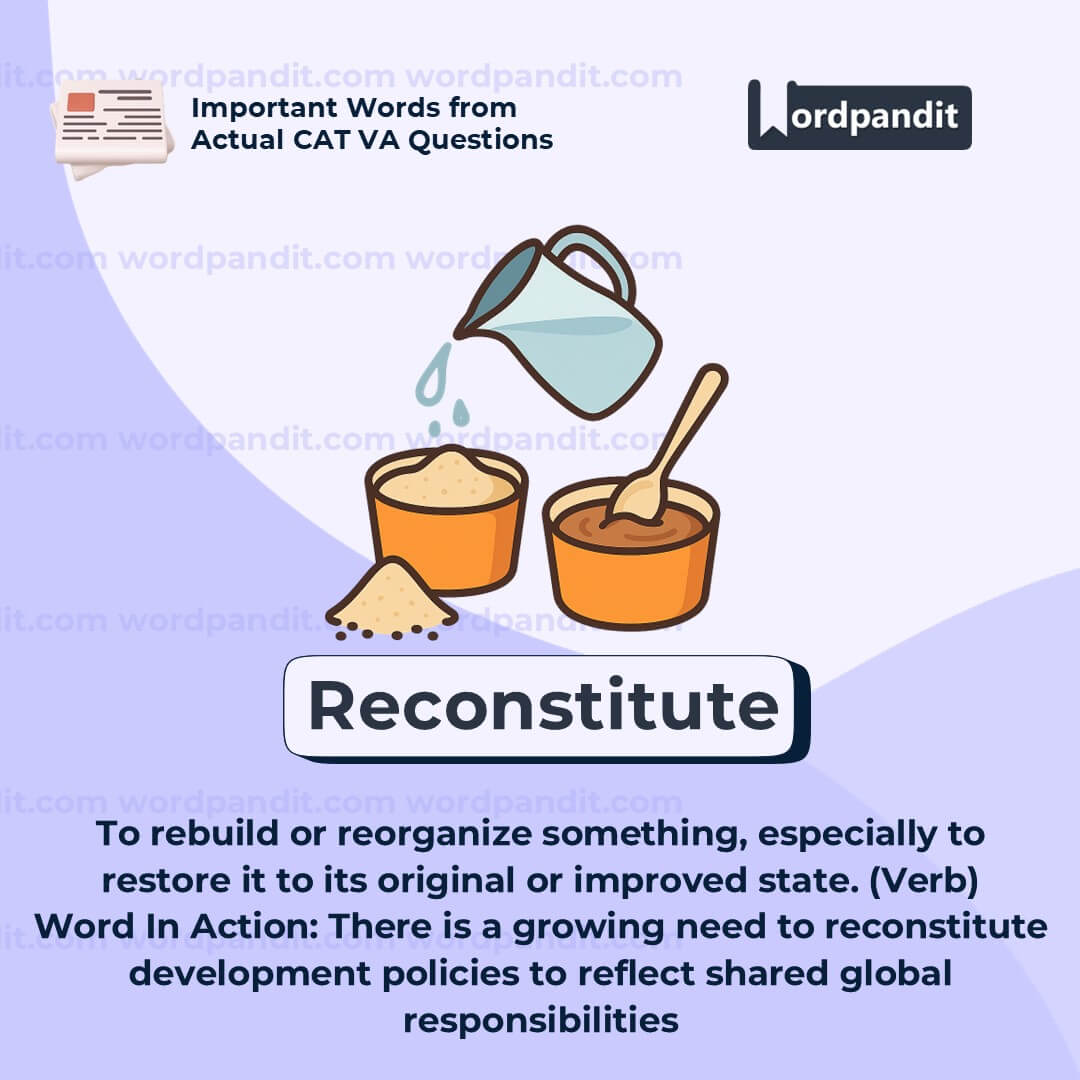
Context:
"But today there is an epochal challenge to rethink and reconstitute the vision and practice of development as a shared responsibility - a sharing which binds both the agent and the audience, the developed world and the developing, in a bond of shared destiny."
Explanatory Paragraph:
“Reconstitute” means to rebuild or reconstruct something that has changed, broken down, or lost its original form. In this context, it suggests the need to fundamentally reshape the existing concept and method of development. It is not just about minor tweaks but about creating a renewed structure—one that promotes shared responsibility between all stakeholders in a globally connected world.
Meaning: To rebuild or restore something to its original or new improved form; to reconstruct. (Verb)
Pronunciation: ree-KON-sti-toot
Difficulty Level: ⭐⭐⭐ Intermediate
Etymology: From Latin “re-” meaning “again” + “constituere” meaning “to set up or establish.”
Prashant Sir's Notes:
To "reconstitute" something is to give it new life or form. It often appears in political, social, and scientific contexts. For example, after a war, a government might be reconstituted. It's also used literally, like reconstituting powdered milk by adding water. In the vocabulary sense, it's about meaningful re-creation.
Synonyms & Antonyms:
Synonyms: reconstruct, rebuild, reform, restore, reorganize
Antonyms: dismantle, destroy, disorganize, dissolve
Usage Examples:
- After the crisis, the committee decided to reconstitute its mission and strategy.
- The soup mix can be reconstituted by simply adding hot water.
- The revolution aimed to reconstitute the nation's identity on democratic principles.
- They had to reconstitute the team after several members resigned.
Cultural Reference:
After World War II, Germany was reconstituted into two separate nations—East and West Germany—until reunification in 1990. - History Channel
Think About It:
What systems or institutions in today’s world do you think need to be reconstituted, and why?
Quick Activity:
Think of an outdated idea or system in your field of study. How would you reconstitute it to make it relevant for today’s world?
Memory Tip:
Reconstitute = RE (again) + CONSTITUTE (set up) → To set up again, often in a new or improved way.
Real-World Application:
Reconstituting organizations, policies, or partnerships is essential after major crises like natural disasters, wars, or pandemics—times that demand new approaches for rebuilding societies or economies.
Word-3: Dreary
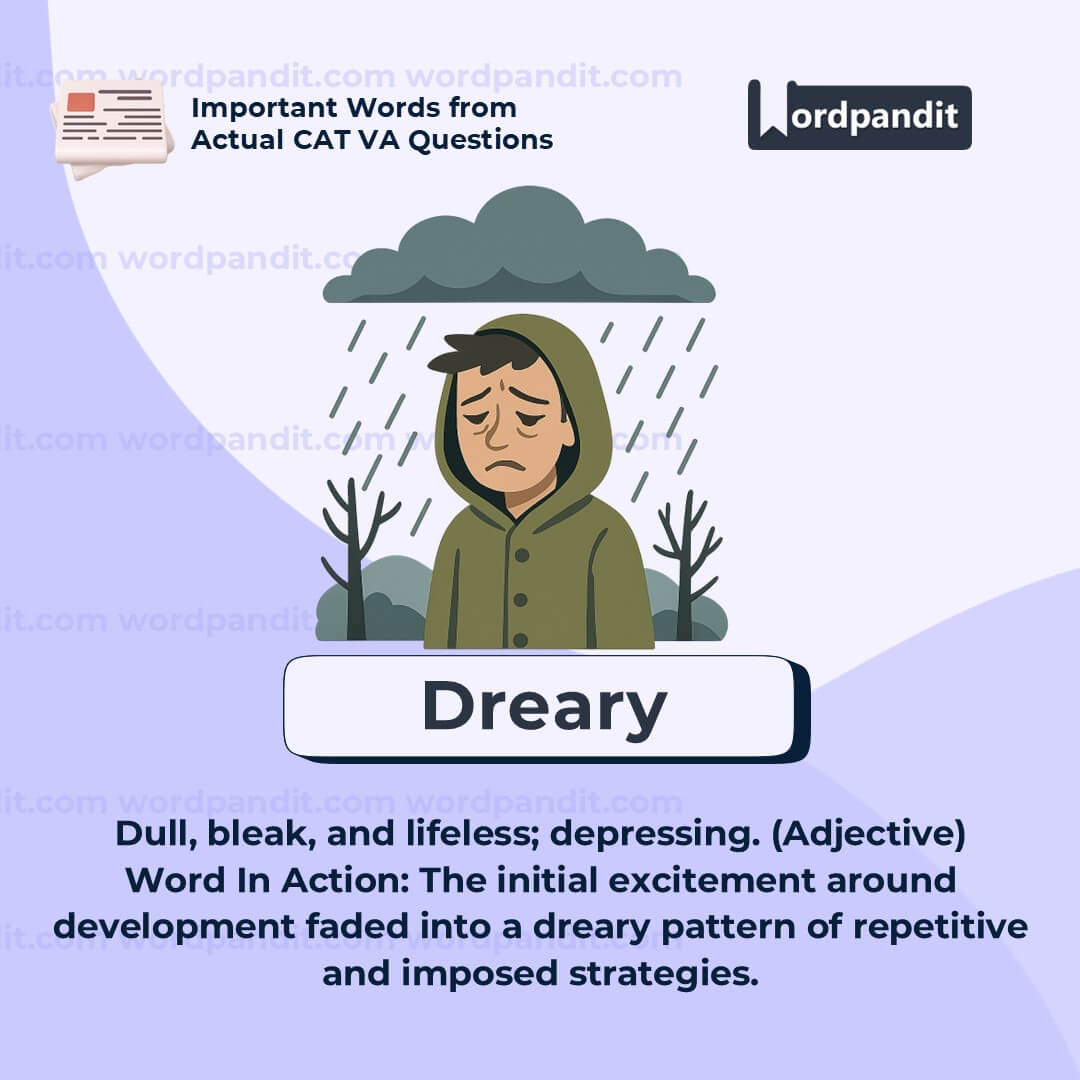
Context:
"Half a century ago, development began as a hope for a better human possibility, but in the last fifty years, this hope has lost itself in the dreary desert of various kinds of hegemonic applications."
Explanatory Paragraph:
“Dreary” is used here to emphasize the bleakness and lifelessness that development has come to symbolize due to dominance by power structures or hegemonic systems. What once sparked hope has now become monotonous, uninspiring, and disheartening. Generally, "dreary" describes something dull, bleak, and lacking in excitement or cheer—something that mentally or emotionally drains the spirit.
Meaning: Dull, bleak, and depressing; lacking in interest or excitement. (Adjective)
Pronunciation: DREER-ee
Difficulty Level: ⭐⭐ Beginner
Etymology: From Middle English “drery” meaning sorrowful or grievous; related to “drear” (gloomy or dreadful).
Prashant Sir's Notes:
“Dreary” is one of those emotional words that paints a vivid picture. Think gray skies, long boring lectures, or a lifeless routine. In literature, it's often used to set a gloomy mood. In this context, it shows how development has become a tedious and dispiriting idea, stripped of its original promise.
Synonyms & Antonyms:
Synonyms: dull, bleak, gloomy, depressing, monotonous
Antonyms: lively, cheerful, vibrant, exciting, inspiring
Usage Examples:
- The landscape was as dreary as the mood in the room after the announcement.
- She dreaded the dreary routine of her 9-to-5 office job.
- A cold, dreary afternoon kept everyone indoors and unmotivated.
- His voice had a dreary tone, as if life had drained all enthusiasm from him.
Cultural Reference:
“It was a dark and dreary night…” is a cliché opening in Gothic fiction, often setting the stage for mystery and gloom. - Common literary trope
Think About It:
What are some modern practices or systems that you find dreary—and how might they be revitalized?
Quick Activity:
Write a short paragraph describing a place or experience that felt “dreary” to you. Focus on using sensory details (sight, sound, mood).
Memory Tip:
“Dreary” sounds like “dry and weary”—and that’s exactly how something dreary feels.
Real-World Application:
The term “dreary” is often used in work evaluations, product reviews, or travel blogs to signal boredom or lack of engagement. Avoiding dreariness in design, education, or communication is key to maintaining interest and motivation.
Word-4: Hegemonic
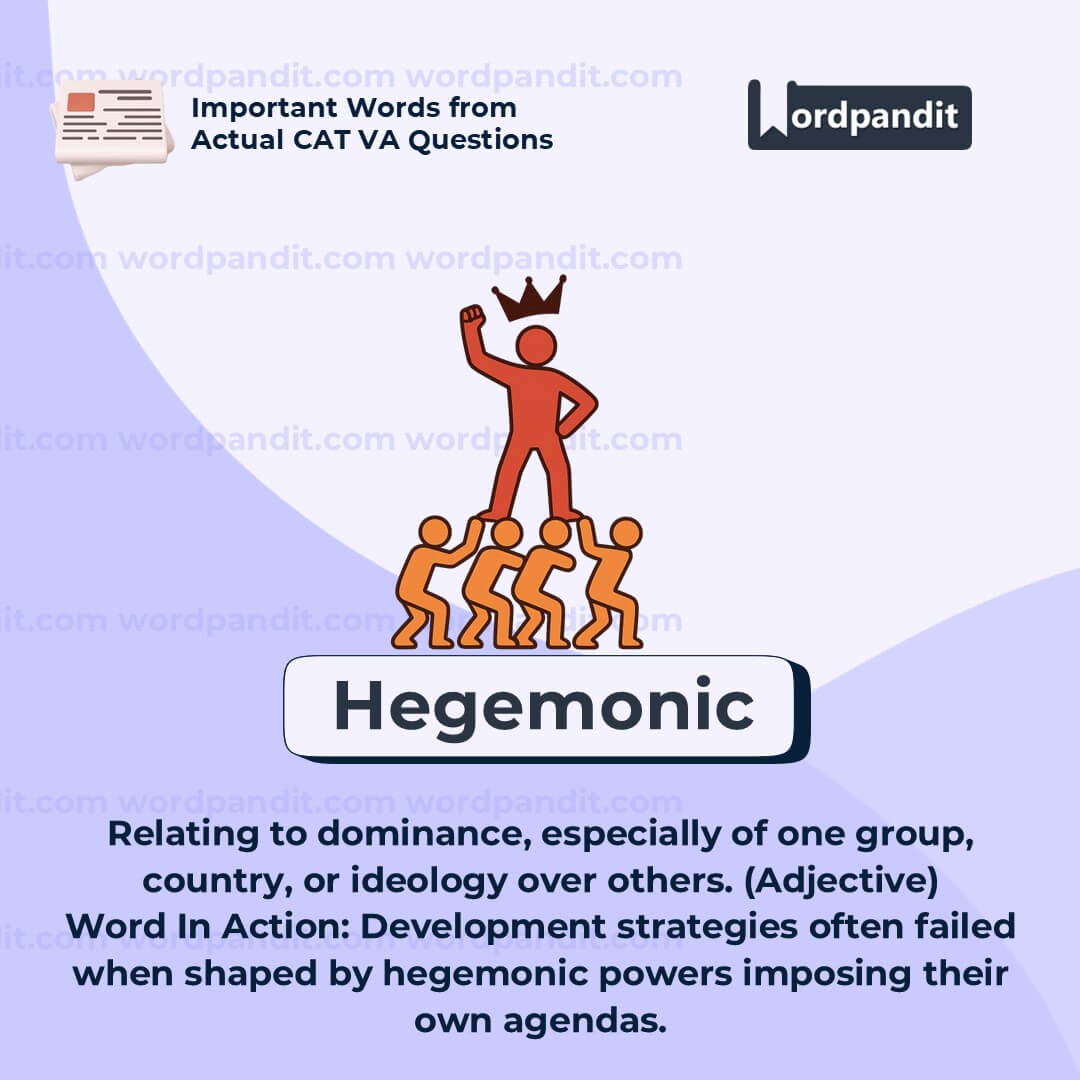
Context:
"Half a century ago, development began as a hope for a better human possibility, but in the last fifty years, this hope has lost itself in the dreary desert of various kinds of hegemonic applications."
Explanatory Paragraph:
“Hegemonic” refers to dominance or control, particularly of one group, nation, or ideology over others. In this context, it suggests that the original, hopeful idea of development has been overtaken by powerful forces—perhaps Western models or elite institutions—that impose their values or systems on others. These hegemonic applications reduce development to a one-sided process, suppressing diversity and shared global responsibility.
Meaning: Relating to dominance, especially of one group, nation, or ideology over others. (Adjective)
Pronunciation: heh-juh-MON-ik
Difficulty Level: ⭐⭐⭐⭐ Advanced
Etymology: From Greek “hēgemonia” meaning “leadership” or “dominance,” derived from “hēgeisthai” meaning “to lead.”
Prashant Sir's Notes:
“Hegemonic” is a word that often appears in political, academic, and cultural discussions. It’s used to critique systems where one power—whether a country, corporation, or ideology—dominates others, sometimes subtly, sometimes forcefully. Think of it as the invisible hand that shapes norms, priorities, and policies without always asking for consent.
Synonyms & Antonyms:
Synonyms: dominant, controlling, overpowering, authoritarian, imperial
Antonyms: egalitarian, cooperative, pluralistic, democratic
Usage Examples:
- The world order after World War II was shaped by a hegemonic Western influence.
- Critics argue that global trade policies are often hegemonic in favor of richer nations.
- The film industry has long been accused of promoting hegemonic beauty standards.
- Some educational systems impose hegemonic narratives, marginalizing local cultures.
Cultural Reference:
Antonio Gramsci, an Italian Marxist philosopher, introduced the idea of “cultural hegemony” to explain how societies maintain control through ideology rather than force. - *Prison Notebooks*
Think About It:
Can development be truly inclusive if it is shaped by hegemonic forces? How can marginalized voices be amplified?
Quick Activity:
Identify a modern example where one nation or company exerts hegemonic influence. Write two sentences explaining its impact.
Memory Tip:
Think “He-GEM-ony” = “He (the dominant power) has the gem (control) and won’t share it.”
Real-World Application:
Understanding hegemonic systems is essential in global studies, policy-making, and activism. Whether in trade, media, or education, challenging hegemonic norms helps ensure fairness, representation, and respect for diverse perspectives.
Word-5: Destiny
Context:
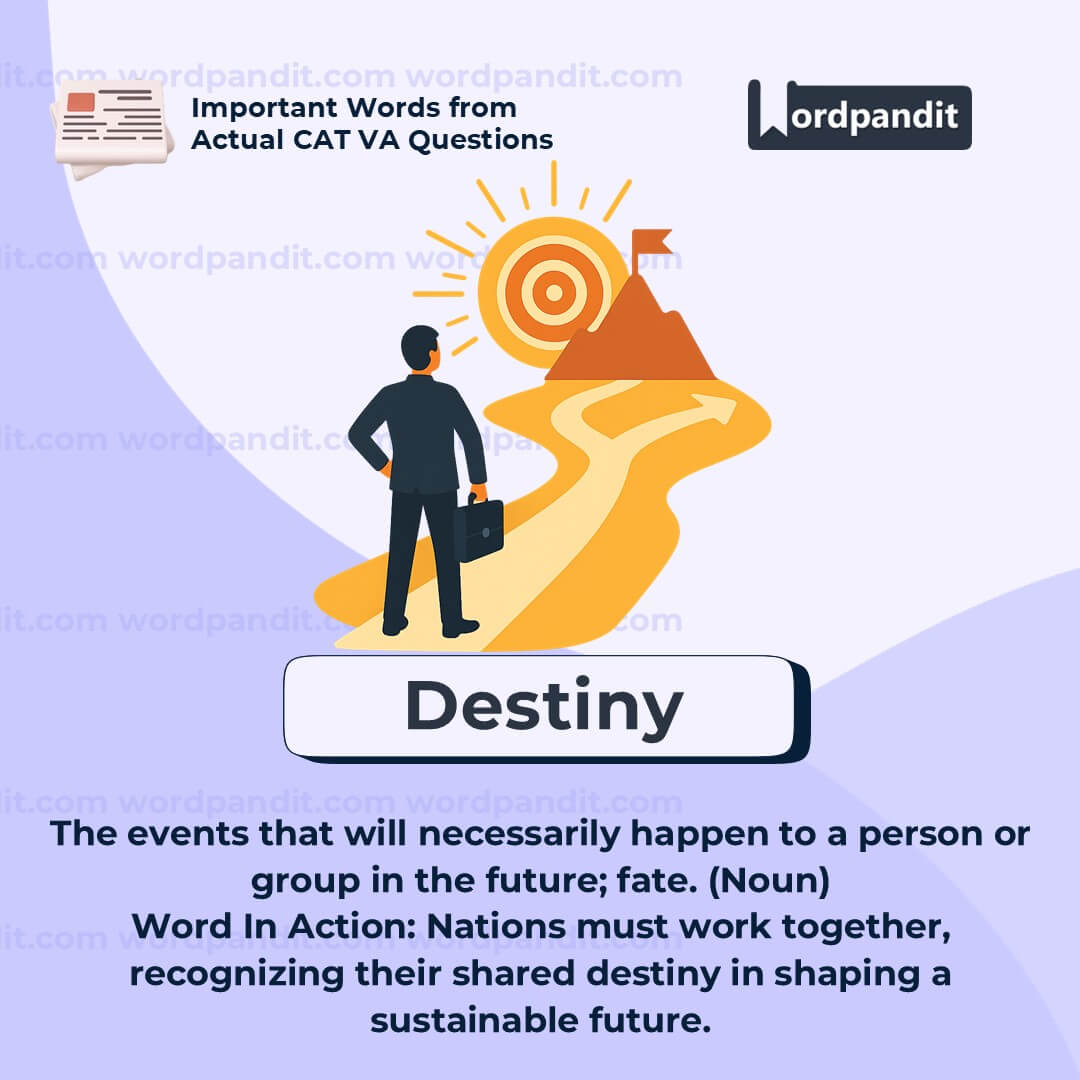
"But today there is an epochal challenge to rethink and reconstitute the vision and practice of development as a shared responsibility - a sharing which binds both the agent and the audience, the developed world and the developing, in a bond of shared destiny."
Explanatory Paragraph:
"Destiny" in this sentence suggests a future that is collectively shaped and experienced by both developed and developing nations. It highlights the interconnectedness of global societies—that the actions of one affect the future of all. Broadly, destiny refers to the idea of a predetermined or inevitable future, often seen as shaped by fate, choice, or a higher purpose.
Meaning: The events that will happen to someone or something in the future, especially viewed as predetermined or inevitable. (Noun)
Pronunciation: DES-tuh-nee
Difficulty Level: ⭐ Beginner
Etymology: From Latin “destinare” meaning “to make firm, establish,” evolving into Old French “destinée” (fate) and then English “destiny.”
Prashant Sir's Notes:
Destiny is a word rich with philosophical and emotional weight. While it can suggest fate beyond our control, in modern usage, it's often linked to the idea of purpose or long-term consequence. In global development discourse, a “shared destiny” reminds us that no nation is an island—we are bound by common challenges like climate change, inequality, and technology.
Synonyms & Antonyms:
Synonyms: fate, future, fortune, kismet, purpose
Antonyms: chance, accident, randomness, unpredictability
Usage Examples:
- They believed it was their destiny to bring about change in the world.
- Global cooperation is essential if we hope to shape a shared destiny.
- She felt her destiny lay beyond the borders of her small town.
- The speech emphasized the nation’s destiny as a leader in clean energy.
Cultural Reference:
“It is not in the stars to hold our destiny but in ourselves.” – William Shakespeare, *Julius Caesar*
Think About It:
Do you believe destiny is fixed, or can people shape their own futures through choices and actions?
Quick Activity:
Write a one-sentence definition of your personal destiny. How does it reflect your goals and values?
Memory Tip:
Destiny = “Destination” in life → where you’re meant to arrive, whether by fate or by effort.
Real-World Application:
In leadership and global policy, speaking of a “shared destiny” fosters unity and accountability, encouraging collaborative efforts on issues like sustainability, peace, and global health.
