
📘 What’s Inside This CAT Para-jumble Question Post?
📝 Authentic CAT Para-jumble Question : Practice with a real CAT Para-jumble Question from a previous CAT exam.
✅ Detailed Question with Step-by-Step Solution: Each question is explained thoroughly for better understanding.
📚 Vocabulary Enhancement: Top 5 words explained from the paragraph
Para-jumble Sentences
21. The four sentences (labelled 1, 2, 3 and 4) below, when properly sequenced would yield a coherent paragraph. Decide on the proper sequencing of the order of the sentences and key in the sequence of the four numbers as your answer:
1. Look forward a few decades to an invention which can end the energy crisis, change the global economy and curb climate change at a stroke: commercial fusion power.
2. To gain meaningful insights, logic has to be accompanied by asking probing questions of nature through controlled tests, precise observations and clever analysis.
3. The greatest of all inventions is the über-invention that has provided the insights on which others depend: the modern scientific method.
4. This invention is inconceivable without the scientific method; it will rest on the application of a diverse range of scientific insights, such as the process transforming hydrogen into helium to release huge amounts of energy.
Solution with Explanation
Answer: 3214
Solution by Wordpandit:
Upon analyzing the sentences, it's evident that the central theme of the paragraph is the significance of groundbreaking inventions, with a particular spotlight on the pivotal role of the scientific method. This method is portrayed not just as another invention, but as a cornerstone that has paved the way for subsequent revolutionary discoveries.
Statement 3 introduces the idea that the scientific method is the most important invention of all, as it underpins all others.
Statement 2 supports this by describing the components of the scientific method—logic, experimentation, observation, and analysis.
Statement 1 then shifts focus to a major future invention—commercial fusion power—that could drastically transform the world.
Statement 4 ties it back, explaining that fusion power would not be possible without the foundation laid by the scientific method and accumulated scientific insights.
This sequence—3-2-1-4—provides a coherent flow from the introduction of the scientific method, to its components, to an application of its power in the form of a future invention, and finally to its essential role in making that invention possible.
Therefore, the correct answer is 3214.
Word-1: Invention
Context:
"Look forward a few decades to an invention which can end the energy crisis, change the global economy and curb climate change at a stroke: commercial fusion power."
Explanatory Paragraph:
“Invention” refers to a novel device, method, or process that has been created through imaginative thinking, experimentation, or technological innovation. In the context above, it highlights the revolutionary potential of commercial fusion power—an innovation that could reshape the world’s energy systems, economy, and environmental policies. Inventions are central to human progress because they offer solutions to previously unsolved problems.
Meaning: A new device, method, or process developed from study and experimentation. (Noun)
Pronunciation: in-VEN-shuhn
Difficulty Level: ⭐⭐ Beginner
Etymology: From Latin *invenire* meaning "to come upon, discover," combining *in-* (upon) + *venire* (to come).
Prashant Sir's Notes:
Every invention begins with imagination but must be backed by practical application. “Invention” is not just limited to physical tools—it can also refer to systems, processes, or concepts. Think of the wheel, electricity, the internet—all inventions that dramatically changed the world.
Synonyms & Antonyms:
Synonyms: innovation, creation, breakthrough, development, discovery
Antonyms: imitation, copy, tradition, duplication
Usage Examples:
- The invention of the telephone revolutionized human communication.
- His latest invention helps blind people read printed text aloud.
- Fusion power may be the most important energy invention of the 21st century.
- Great inventions often arise from simple observations.
Cultural Reference:
Thomas Edison is often credited with the invention of the practical light bulb—a symbol of human ingenuity and innovation. - Smithsonian Institution
Think About It:
What is one invention that you think will define the next 50 years—and why?
Quick Activity:
Imagine a problem in your daily life. Now invent a product or solution to fix it. Write a sentence describing your invention and how it helps.
Memory Tip:
Invention = “in” + “venture” → You venture *into* the unknown to create something new!
Real-World Application:
Inventions drive technological progress, solve critical challenges, and form the foundation of industries—from health and education to energy and entertainment. Encouraging invention is key to entrepreneurship and global development.
Word-2: Insights
Context:
"To gain meaningful insights, logic has to be accompanied by asking probing questions of nature through controlled tests, precise observations and clever analysis."
Explanatory Paragraph:
“Insights” refer to deep and accurate understandings of complex topics or problems. In this context, insights are the valuable conclusions or realizations that emerge from scientific methods—like testing, observing, and analyzing nature. Unlike surface-level knowledge, insights reflect a deeper comprehension, often revealing the “why” behind the “what.” They are essential for innovation, discovery, and informed decision-making.
Meaning: Deep understanding or awareness of a person, situation, or problem. (Noun)
Pronunciation: IN-syts
Difficulty Level: ⭐⭐ Beginner
Etymology: From Middle English *insight* meaning “sight with the eyes of the mind”; from *in-* (inward) + *sight* (vision).
Prashant Sir's Notes:
Insights go beyond mere facts. They often come after reflection, investigation, or experience. In business, science, or personal growth, having insight means you don’t just see the data—you understand the implications. This word is especially common in research and analytics fields where gaining insights is the ultimate goal.
Synonyms & Antonyms:
Synonyms: understanding, awareness, realization, perception, wisdom
Antonyms: ignorance, misunderstanding, confusion, obliviousness
Usage Examples:
- The scientist’s insights into climate change were based on years of fieldwork.
- Her book offers valuable insights into human relationships and emotions.
- Data analysis tools can help companies gain customer insights more quickly.
- Through meditation, he developed insights into his own behavior and thoughts.
Cultural Reference:
In psychology, Carl Jung valued “insight” as a key part of personal growth, believing that deep awareness of one’s unconscious mind could lead to healing. – Jungian Psychology
Think About It:
Can insights be taught, or must they be discovered personally through experience and reflection?
Quick Activity:
Reflect on a recent decision you made. What insight did you gain from the outcome—positive or negative?
Memory Tip:
Insight = "In" + "Sight" → Seeing *into* something, not just looking *at* it.
Real-World Application:
In careers like data science, teaching, marketing, and counseling, gaining insights is critical to improving outcomes—whether it’s understanding customer behavior, student learning, or mental health patterns.
Word-3: Probing
Context:
"To gain meaningful insights, logic has to be accompanied by asking probing questions of nature through controlled tests, precise observations and clever analysis."
Explanatory Paragraph:
“Probing” refers to a deep, thoughtful, and often persistent effort to uncover information or understand something more clearly. In this context, “probing questions” are inquiries that dig beneath the surface to explore the fundamental nature of phenomena. Rather than accepting things at face value, probing involves curiosity and critical thinking—qualities essential for scientific discovery, research, and intellectual investigation.
Meaning: Thorough, in-depth, and searching (when used as an adjective); to investigate or examine closely (when used as a verb). (Adjective/Verb)
Pronunciation: PROH-bing
Difficulty Level: ⭐⭐ Beginner
Etymology: From Middle English *proben*, from Old French *prober*, from Latin *probare* meaning “to test or approve.”
Prashant Sir's Notes:
Think of a “probe” in science or space missions—it’s something designed to explore the unknown. Similarly, a “probing question” is meant to go beyond the surface and reveal hidden truths. Whether in journalism, teaching, or research, probing is about going deeper than what’s obvious.
Synonyms & Antonyms:
Synonyms: investigative, searching, analytical, penetrating, inquisitive
Antonyms: superficial, cursory, shallow, uncritical
Usage Examples:
- The detective asked probing questions to uncover the suspect's motives.
- Scientists must develop a probing mindset to challenge assumptions.
- Her probing gaze made him uncomfortable—it was as if she could see through him.
- The journalist’s probing interview revealed startling new information.
Cultural Reference:
NASA’s *Voyager* probes were launched in the 1970s to explore the outer planets and interstellar space—true examples of human curiosity and probing exploration. - NASA Archives
Think About It:
Why do you think many people avoid asking probing questions? What makes such questions powerful—and sometimes uncomfortable?
Quick Activity:
Take a common topic like “social media” or “climate change.” Now write one probing question that challenges assumptions or reveals a deeper layer.
Memory Tip:
Think of a “probe” as a scientific tool or needle—it penetrates to find what’s hidden. Similarly, “probing” questions uncover what’s beneath the surface.
Real-World Application:
Probing skills are essential in fields like science, journalism, law, counseling, and management—where uncovering root causes or hidden truths can lead to breakthroughs or resolutions.
Word-4: Inconceivable
Context:
"This invention is inconceivable without the scientific method; it will rest on the application of a diverse range of scientific insights, such as the process transforming hydrogen into helium to release huge amounts of energy."
Explanatory Paragraph:
“Inconceivable” refers to something so unlikely, complex, or extraordinary that it is difficult—or even impossible—to imagine or comprehend. In the context provided, the author emphasizes that without the scientific method, such a powerful invention (like fusion energy) would be unimaginable. The term underscores the importance of scientific processes in turning what once seemed impossible into reality.
Meaning: Impossible to imagine, comprehend, or believe. (Adjective)
Pronunciation: in-kuhn-SEE-vuh-buhl
Difficulty Level: ⭐⭐⭐ Intermediate
Etymology: From Latin *in-* (not) + *concipere* (to conceive, imagine); literally “not able to be imagined.”
Prashant Sir's Notes:
“Inconceivable” is a dramatic word—use it when something seems beyond all logic, reason, or current knowledge. It often adds a tone of awe or astonishment, and is common in discussions of futuristic technology, extreme events, or deeply emotional experiences. Remember, just because something seems inconceivable now doesn’t mean it always will be.
Synonyms & Antonyms:
Synonyms: unimaginable, unthinkable, incredible, mind-boggling, impossible
Antonyms: imaginable, believable, plausible, understandable
Usage Examples:
- It was inconceivable that humanity would one day walk on the moon—until it happened.
- The idea of curing all forms of cancer once seemed inconceivable, but research is making progress.
- Without the internet, today’s global connectivity would be inconceivable.
- Her strength in the face of tragedy was inconceivable to those around her.
Cultural Reference:
In the cult classic film *The Princess Bride*, the character Vizzini repeatedly uses the word “Inconceivable!”—often in situations that do, in fact, occur, highlighting human tendency to underestimate possibilities. - *The Princess Bride* (1987)
Think About It:
What is something that feels inconceivable to us today but might become normal in the next 50 years?
Quick Activity:
Write a sentence about a technological or social change you once thought was inconceivable but now accept as normal.
Memory Tip:
Inconceivable = *In* (not) + *conceivable* (able to be imagined) → Not even thinkable in your wildest dreams.
Real-World Application:
Words like “inconceivable” are often used in public speaking, journalism, and writing to emphasize breakthroughs, shifts in norms, or extreme scenarios—such as climate catastrophe, scientific revolutions, or global pandemics.
Word-5: Transforming
Context:
"This invention is inconceivable without the scientific method; it will rest on the application of a diverse range of scientific insights, such as the process transforming hydrogen into helium to release huge amounts of energy."
Explanatory Paragraph:
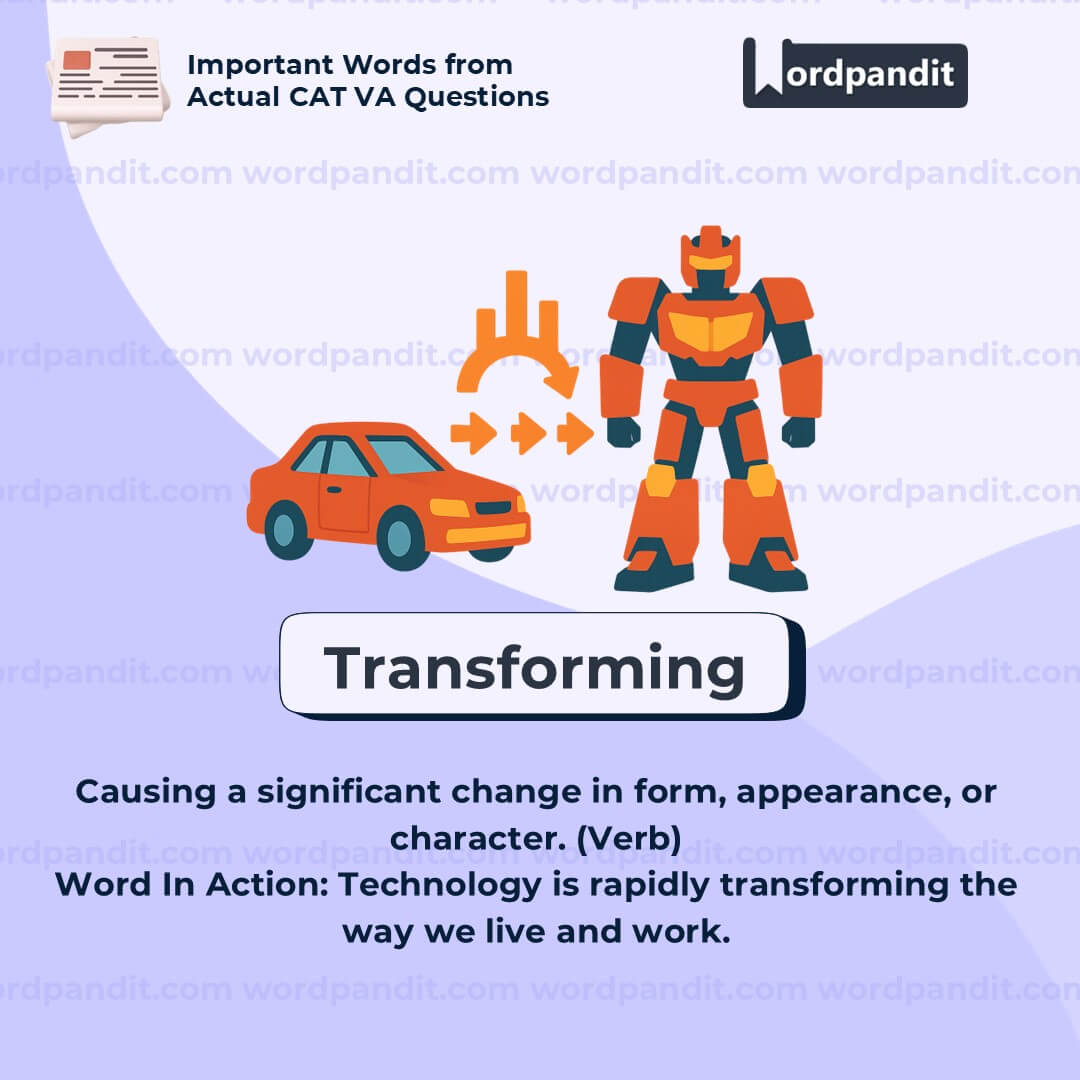
“Transforming” refers to the process of changing something significantly, often in form, function, or nature. In the scientific context here, it describes the nuclear fusion reaction that converts hydrogen into helium—a transformation that releases enormous energy. More generally, transforming implies a deep, meaningful change, whether it's physical, emotional, social, or technological.
Meaning: Causing a marked or significant change in someone or something. (Verb – present participle)
Pronunciation: trans-FOR-ming
Difficulty Level: ⭐⭐ Beginner
Etymology: From Latin *transformare* – *trans-* (across) + *formare* (to form or shape); literally, "to shape across or change form."
Prashant Sir's Notes:
Transformation is one of the most powerful concepts in language—used in everything from science and business to literature and spirituality. “Transforming” doesn’t mean a small tweak; it signals a major shift in essence or impact. Whether you're transforming data, energy, or yourself, it always indicates meaningful change.
Synonyms & Antonyms:
Synonyms: changing, converting, altering, reshaping, revolutionizing
Antonyms: preserving, maintaining, keeping, retaining, stagnating
Usage Examples:
- Fusion power works by transforming hydrogen atoms into helium, releasing massive energy.
- The internet is continuously transforming how we communicate and work.
- She is transforming her small startup into a global brand.
- Education has the power of transforming lives across generations.
Cultural Reference:
“Transformers,” the popular film and toy franchise, is based on machines that can transform from vehicles into powerful robots—symbolizing dramatic and dynamic change. - Hasbro/Paramount Pictures
Think About It:
What part of your life or society do you think is currently in the process of transforming—and what might it become?
Quick Activity:
Pick a topic like “education,” “technology,” or “healthcare” and write one sentence describing how it is transforming today.
Memory Tip:
Transforming = changing form → Imagine a caterpillar transforming into a butterfly—symbol of total change.
Real-World Application:
In business, innovation, science, and personal development, transformation is the key to growth. Understanding how things are transforming helps predict trends, adapt strategies, and inspire change.
