
📘 What’s Inside This CAT Paragraph Summary Question Post?
📝 Authentic CAT Paragraph Summary QuestionPractice with a real CAT Paragraph Summary Question from a previous CAT exam.
✅ Detailed Question with Step-by-Step SolutionEach question is explained thoroughly for better understanding.
🔍 In-Depth Paragraph AnalysisGain insights through line-by-line and paragraph-wise analysis
📚 Vocabulary Enhancement: Top 5 words explained from the paragraph
Paragraph Summary Questions
17. The passage given below is followed by four alternate summaries. Choose the option that best captures the essence of the passage.
Biologists who publish their research directly to the Web have been labelled as “rogue”, but physicists have been routinely publishing research digitally (“preprints”), prior to submitting in a peer-reviewed journal. Advocates of preprints argue that quick and open dissemination of research speeds up scientific progress and allows for wider access to knowledge. But some journals still don’t accept research previously published as a preprint. Even if the idea of preprints is gaining ground, one of the biggest barriers for biologists is how they would be viewed by members of their conservative research community.
A. One of the advantages of digital preprints of research is they hasten the dissemination process, but these are not accepted by most scientific communities.
B. Compared to biologists, physicists are less conservative in their acceptance of digital prepublication of research papers, which allows for faster dissemination of knowledge.
C. While digital publication of research is gaining popularity in many scientific disciplines, almost all peer-reviewed journals are reluctant to accept papers that have been published before.
D. Preprints of research are frowned on by some scientific fields as they do not undergo a rigourous reviewing process but are accepted among biologists as a quick way to disseminate information.
Solution with Explanation
Correct Answer: B
Detailed explanation by Wordpandit:- The paragraph underscores a noticeable difference in attitudes between physicists and biologists concerning the subject of preprints.
- One of the standout benefits of preprints is the expedited spread of knowledge they facilitate.
Option A: This option omits the essential comparison drawn between the attitudes of biologists and physicists towards preprints.
Option B: This choice adeptly encapsulates the main points laid out in the paragraph, making it the apt answer. It speaks to both the differential attitudes of the two disciplines and also the advantage of using preprints.
Option C: Like Option A, this too bypasses the crucial distinction in perspectives between biologists and physicists.
Option D: This statement errs in its presentation, suggesting that biologists, rather than physicists, are more receptive to preprints, which is inconsistent with the paragraph's central message.
Word 1: Rogue
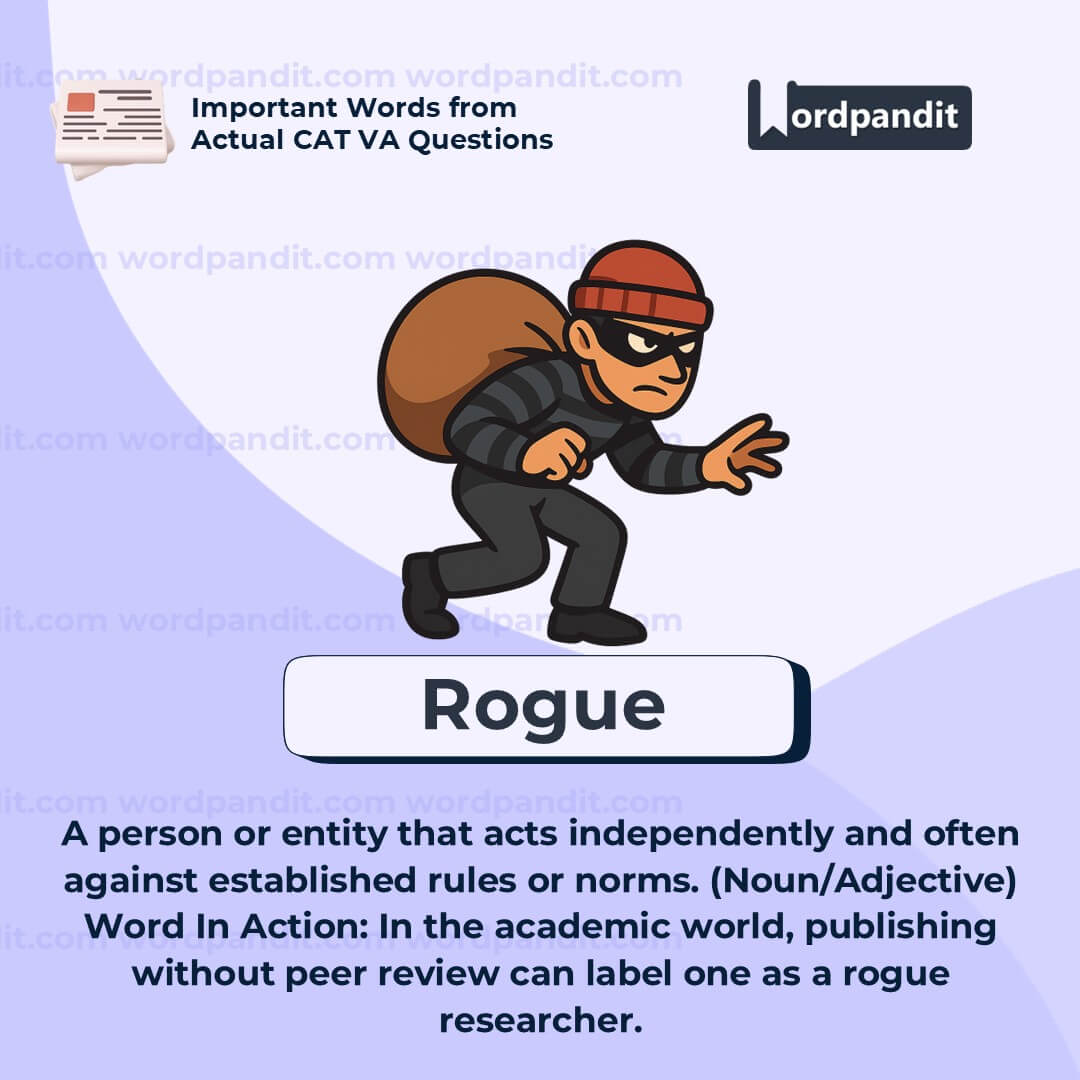
Context:
"Biologists who publish their research directly to the Web have been labelled as “rogue”, but physicists have been routinely publishing research digitally (“preprints”), prior to submitting in a peer-reviewed journal."
Explanatory Paragraph:
The word "rogue" is used here to describe biologists who choose to bypass traditional publication methods. Instead of following the standard peer-review process, they publish directly online. This approach is viewed as unorthodox or defiant by the mainstream academic community. The term often carries a slightly rebellious connotation, suggesting behavior that goes against expected norms or standards.
Meaning: A person or entity that behaves in an unpredictable, dishonest, or independent way, often breaking away from the rules. (Noun/Adjective)
Pronunciation: rohg
Difficulty Level: ⭐⭐ Beginner
Etymology: From Middle English “rogue,” meaning “idle vagrant” or “dishonest person”; possibly derived from Latin "rogare" meaning "to ask".
Prashant Sir's Notes:
"Rogue" often describes someone who defies convention or authority. In academic or professional settings, it may imply innovation, rebellion, or risk-taking. Whether it's positive or negative depends on context. In pop culture, think of “rogue agents” or “rogue nations”—actors operating independently and sometimes causing disruption.
Synonyms & Antonyms:
Synonyms: renegade, maverick, outlaw, rebel, dissenter
Antonyms: conformist, obedient, loyalist, follower
Usage Examples:
- The rogue scientist refused to wait for journal approval and published her findings independently.
- He acted like a rogue agent, ignoring his superior's orders and taking matters into his own hands.
- In a rogue move, the startup released its product without any prior announcement.
- Many admired the rogue artist for breaking boundaries and redefining his genre.
Cultural Reference:
"Rogue One" – a Star Wars movie title symbolizing a group of independent rebels acting outside the main alliance. - Lucasfilm
Think About It:
Is being a "rogue" in a professional field a sign of bravery and innovation, or recklessness and irresponsibility?
Quick Activity:
List two situations where acting "rogue" might be beneficial, and two where it could be harmful. Discuss with a peer.
Memory Tip:
Think of a “rogue elephant” that breaks away from the herd—wild, independent, and unpredictable.
Real-World Application:
In cybersecurity, a "rogue device" refers to unauthorized hardware connected to a network, posing potential risks. Similarly, in workplaces, a “rogue employee” might bypass company protocols, sometimes innovatively, sometimes problematically.
Word 2: Dissemination
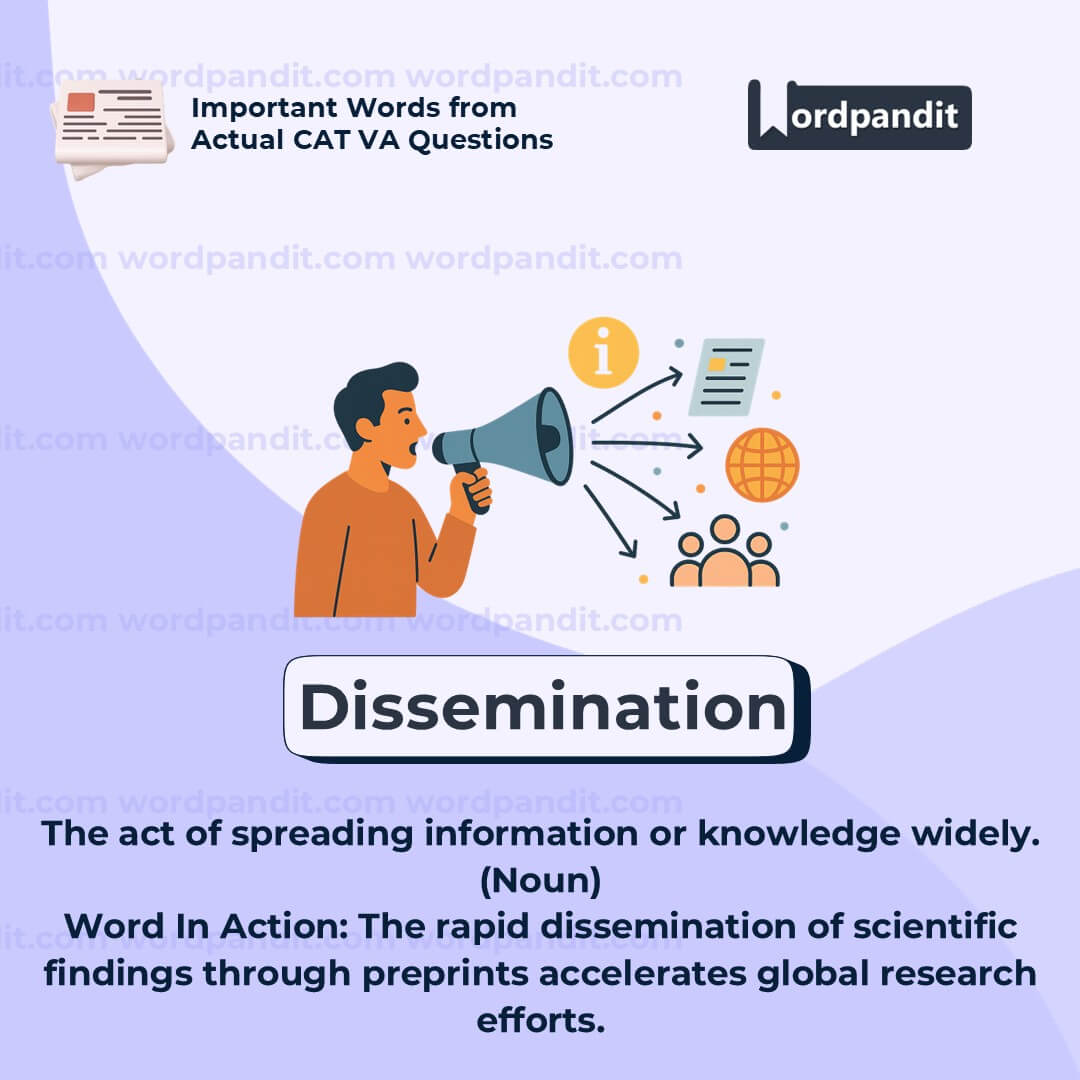
Context:
"Advocates of preprints argue that quick and open dissemination of research speeds up scientific progress and allows for wider access to knowledge."
Explanatory Paragraph:
"Dissemination" refers to the act of spreading information widely so that it reaches a broad audience. In this context, it highlights the importance of making scientific findings publicly available as quickly and openly as possible. The idea is that when research is shared early and broadly—without waiting for lengthy publication processes—other scientists can build on it, potentially accelerating discoveries and innovations.
Meaning: The act of spreading something, especially information, widely. (Noun)
Pronunciation: dih-sem-uh-NAY-shuhn
Difficulty Level: ⭐⭐⭐ Intermediate
Etymology: From Latin “disseminare” — dis- (“abroad”) + seminare (“to sow” or “scatter seeds”)
Prashant Sir's Notes:
This word is often used in academic, governmental, and organizational settings where ideas, policies, or findings are distributed to reach a target audience. It carries a formal tone and is commonly associated with knowledge, data, or propaganda. Think of it as “planting information seeds” into the world to grow awareness or understanding.
Synonyms & Antonyms:
Synonyms: distribution, circulation, propagation, diffusion, broadcasting
Antonyms: concealment, suppression, withholding, secrecy
Usage Examples:
- The university focuses on the dissemination of new research through open-access journals.
- Effective dissemination of public health information can save lives during a pandemic.
- Social media plays a key role in the rapid dissemination of news and opinions.
- Governments often struggle with the dissemination of policies to rural areas.
Cultural Reference:
“The revolution will not be televised”—Gil Scott-Heron’s lyric highlighting how dissemination of truth doesn't always occur through mainstream media channels. - 1970s Cultural Commentary
Think About It:
In the age of digital media, how do we ensure the dissemination of accurate information rather than misinformation?
Quick Activity:
Write a short paragraph using “dissemination” in a non-academic context, such as marketing or social activism.
Memory Tip:
Dissemination = “Distribute Seeds of Information” – just like a farmer spreads seeds to grow plants, you spread knowledge to grow awareness.
Real-World Application:
Organizations use newsletters, webinars, and social media for the dissemination of updates and training materials to employees and stakeholders, ensuring everyone is informed and aligned.
Word 3: Advocates
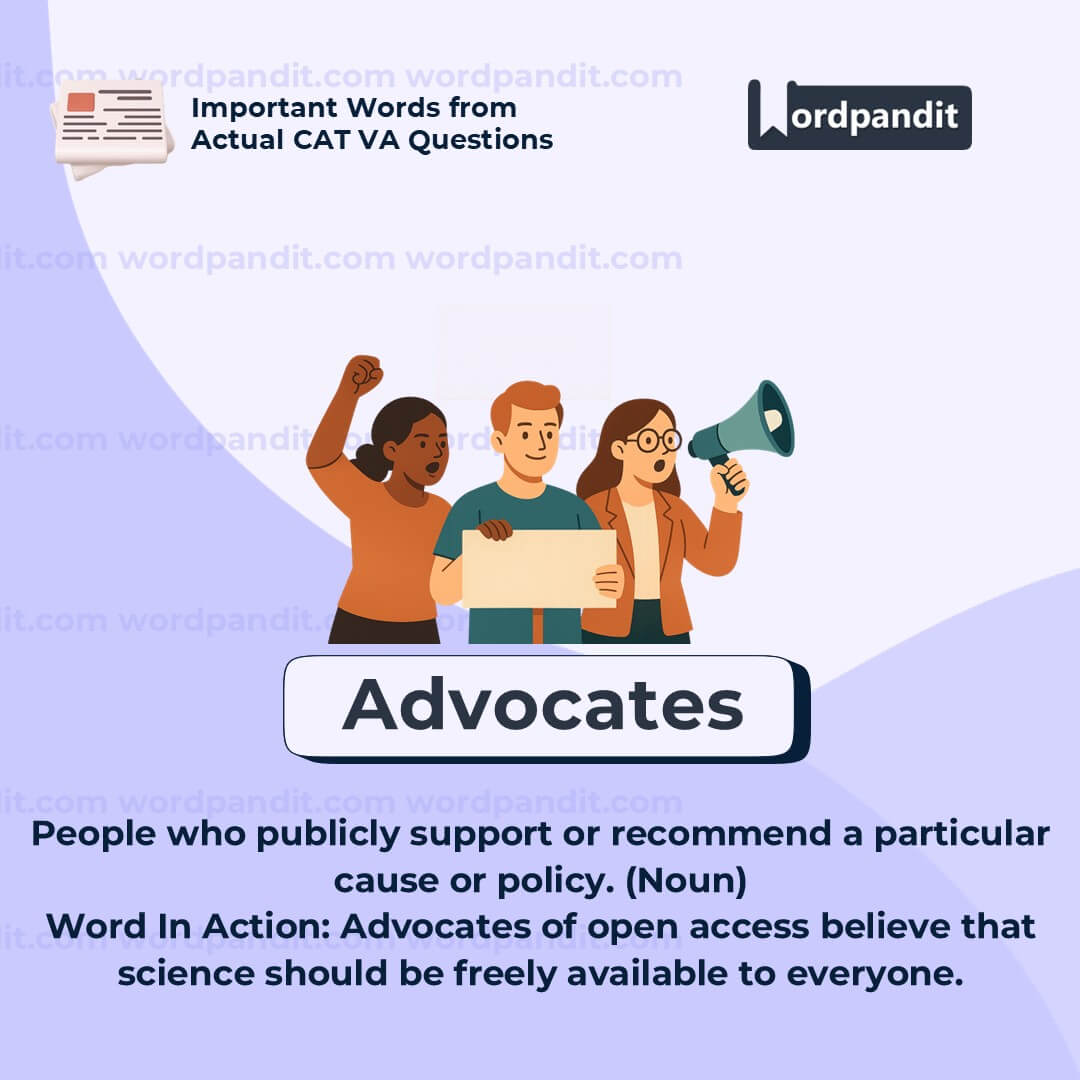
Context:
"Advocates of preprints argue that quick and open dissemination of research speeds up scientific progress and allows for wider access to knowledge."
Explanatory Paragraph:
In this context, "advocates" refers to people who strongly support or argue in favor of preprints—early versions of research papers shared publicly before formal peer review. These individuals believe that making research accessible at an early stage benefits the scientific community and the public. More broadly, the term refers to those who publicly support a cause, policy, or idea and may speak, write, or act to promote it.
Meaning: People who publicly support or recommend a particular cause or policy. (Noun; also used as a verb: to advocate)
Pronunciation: AD-vuh-kates (noun), AD-vuh-kayt (verb)
Difficulty Level: ⭐⭐ Beginner
Etymology: From Latin “advocatus,” meaning “one called to aid”; originally used for legal advisers or defenders.
Prashant Sir's Notes:
The word “advocate” is a powerful one—it doesn’t just mean to support but also to take action or speak out. Whether it’s human rights, environmental causes, or open science, advocates play a vital role in driving change. Also, don't confuse the noun (a supporter) with the verb (to support or argue for something).
Synonyms & Antonyms:
Synonyms: supporters, champions, proponents, defenders, campaigners
Antonyms: opponents, critics, adversaries, detractors
Usage Examples:
- Advocates of renewable energy believe it’s key to combating climate change.
- She has long been an advocate for children’s rights and education.
- The organization advocates for affordable healthcare for all.
- Animal rights advocates protested against the use of fur in fashion shows.
Cultural Reference:
Malala Yousafzai is a global advocate for girls' education, earning the Nobel Peace Prize for her fearless activism. - NobelPrize.org
Think About It:
What causes are you passionate about—and how could you become an advocate for them?
Quick Activity:
Write down one issue you care about and list three ways you could advocate for it in your school, workplace, or community.
Memory Tip:
Think of an advocate as someone who “adds their voice” (AD + VOCA) to support a cause.
Real-World Application:
Advocates play a critical role in policy change, social justice movements, education reform, and even technology adoption by raising awareness, influencing decision-makers, and rallying public support.
Word 4: Preprints
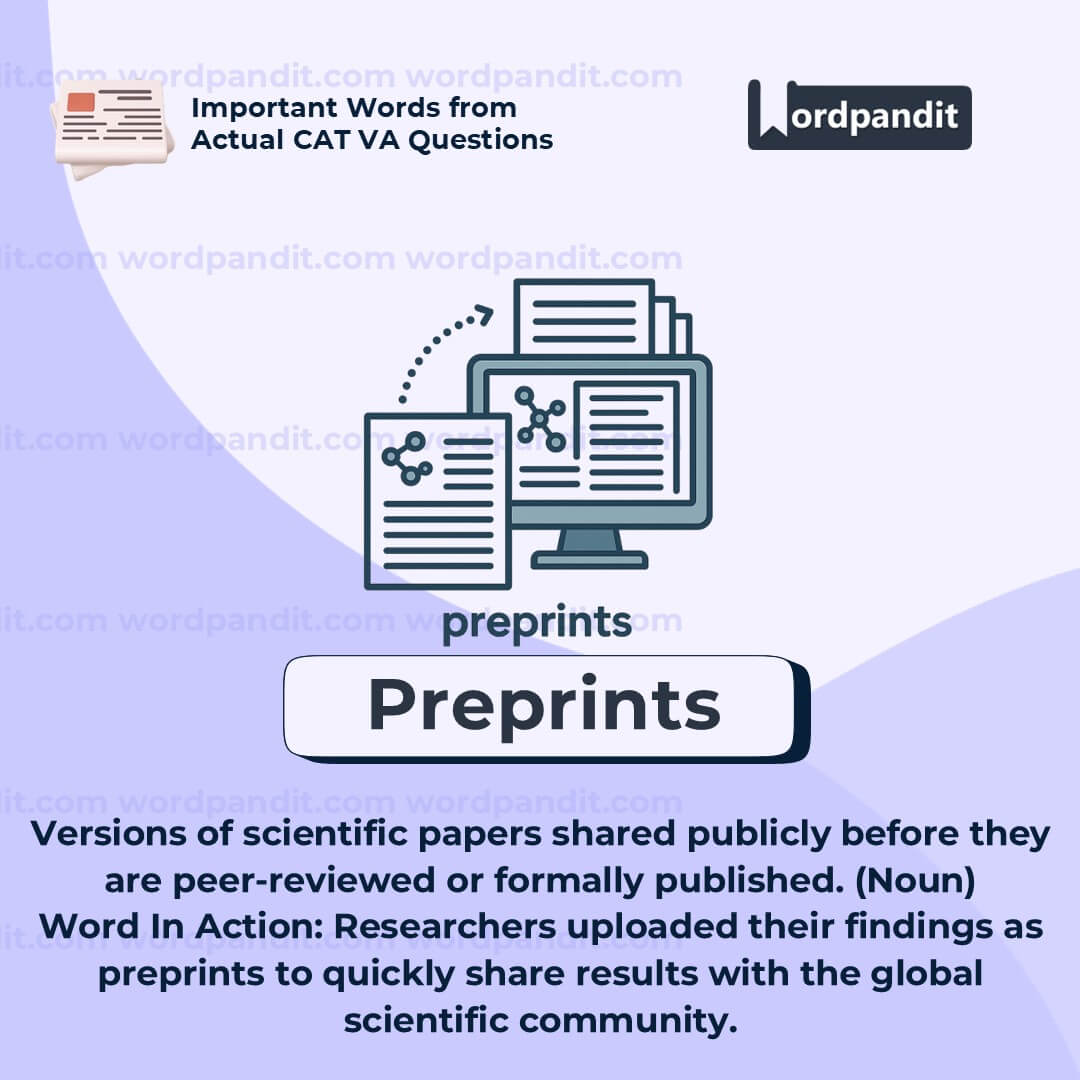
Context:
"Advocates of preprints argue that quick and open dissemination of research speeds up scientific progress and allows for wider access to knowledge."
Explanatory Paragraph:
"Preprints" are versions of research papers shared publicly before they undergo formal peer review and are published in academic journals. They allow researchers to get feedback early, make their work accessible, and accelerate the communication of new findings. While not yet certified by traditional review processes, preprints have become a valuable tool in the scientific community, particularly in fast-moving fields like medicine and physics.
Meaning: Research papers made publicly available before formal peer review and journal publication. (Noun)
Pronunciation: PREE-printz
Difficulty Level: ⭐⭐⭐ Intermediate
Etymology: From “pre-” meaning “before” + “print” (publication); literally “before printing” in an official journal.
Prashant Sir's Notes:
Preprints are an important concept in modern science. They allow for open science and early sharing of results but should be read with caution since they are not peer-reviewed. Think of them as drafts made public to invite feedback and improve transparency. In the COVID-19 pandemic, preprints played a critical role in rapid information sharing.
Synonyms & Antonyms:
Synonyms: draft paper, preliminary research, unreviewed manuscript, working paper
Antonyms: peer-reviewed article, published paper, finalized research, journal article
Usage Examples:
- The research team uploaded a preprint to share their results before journal submission.
- Preprints allow for faster dissemination of scientific findings during urgent crises.
- Many scientists use preprint servers like arXiv and bioRxiv to gain early visibility.
- While useful, preprints must be interpreted cautiously since they haven’t been peer-reviewed.
Cultural Reference:
During the COVID-19 pandemic, platforms like medRxiv and bioRxiv became essential for sharing preprints on emerging scientific findings rapidly. - Nature Journal, 2020
Think About It:
Should media outlets be allowed to report on preprints as if they are verified scientific facts? Why or why not?
Quick Activity:
Search for a recent preprint on a topic that interests you using a site like arXiv.org. Summarize its main idea in two sentences.
Memory Tip:
“Pre” + “print” = printed *before* it’s final. Think of it as a trailer before the full movie release.
Real-World Application:
Scientists use preprints to share urgent discoveries quickly, collaborate with others globally, and receive input that can improve their work before it undergoes the rigorous journal process.
Word 5: Conservative
Context:
"Even if the idea of preprints is gaining ground, one of the biggest barriers for biologists is how they would be viewed by members of their conservative research community."
Explanatory Paragraph:
In this context, "conservative" refers to a group that prefers traditional methods and is resistant to rapid change. The conservative research community is likely cautious about adopting new practices like preprints, fearing they might compromise quality or academic integrity. More generally, the word describes individuals or groups that are traditional, cautious, and slow to embrace innovation or reform.
Meaning: Favoring traditional views and values; resistant to change or innovation. (Adjective)
Pronunciation: kun-SUR-vuh-tiv
Difficulty Level: ⭐⭐ Beginner
Etymology: From Latin “conservare,” meaning “to preserve” or “to keep safe.”
Prashant Sir's Notes:
“Conservative” is not always political. In academic or scientific settings, it often describes a mindset that prefers the familiar and proven over the new and experimental. Being conservative isn't necessarily negative—it can reflect caution and adherence to rigor—but it may hinder progress if taken to an extreme.
Synonyms & Antonyms:
Synonyms: traditional, cautious, reserved, conventional, unadventurous
Antonyms: progressive, radical, liberal, innovative, experimental
Usage Examples:
- The conservative approach in that lab meant avoiding risky or unproven techniques.
- She dressed conservatively for the formal academic conference.
- Investors often turn to conservative strategies in uncertain economic times.
- His conservative mindset clashed with the startup’s dynamic culture.
Cultural Reference:
In Thomas Kuhn’s *The Structure of Scientific Revolutions*, he argues that scientific communities are often conservative, resisting paradigm shifts until overwhelming evidence forces change. - University of Chicago Press
Think About It:
When does being conservative become a strength, and when does it hinder necessary change?
Quick Activity:
Identify one field (e.g., medicine, education, politics) and list two ways being conservative could be both helpful and harmful in that context.
Memory Tip:
Think of “conserve” in “conservative”—someone who wants to *conserve* the old ways instead of embracing the new.
Real-World Application:
In professional environments, conservative attitudes can ensure stability and adherence to proven methods. However, they may also slow down innovation, particularly in industries where rapid change is crucial, such as technology or healthcare.
