
✨ Introduction
Mastering Reading Comprehension begins with mastering the words!
In this post, we dive deep into vocabulary taken directly from an actual CAT RC passage. Each word has been explained in a simple, easy-to-understand way, along with examples to help you grasp its usage in real contexts.
From words like "species" and "cognitive" to "subjection" and "paradise," strengthen your vocabulary one word at a time — and take your RC performance to the next level!
📚 What’s Inside This Vocabulary Post?
- 🔍 Words Sourced from an Actual CAT RC Passage: Directly pick up important vocabulary from real CAT exam material.
- 🧠 Meaningful Explanations: Understand the exact meaning and usage of each word in a simple, student-friendly way.
- ✍️ Context-Based Learning: Learn words with examples that reflect their actual usage in reading comprehension contexts.
- 🗂️ Quick Reference Format: Words are neatly listed with meanings, parts of speech, and example sentences for easy revision.
- 🚀 Boost Your RC and Verbal Ability Skills: Improve your understanding of tough passages by strengthening your vocabulary.
📝 Words Covered in This Article:
- Elaborated
- Contradictory pulls
- Nationalist ideology
- exception
- Colonialism
- Discourse
- Dichotomy
- Profane
- Paradigm
- Statecraft
- Treacherous terrain
WORD-1: Elaborated
Context:
"I have elaborated . . . a framework for analyzing the contradictory pulls on [Indian] nationalist ideology in its struggle against the dominance of colonialism and the resolution it offered to those contradictions."
Explanatory Paragraph:
"Elaborated" means to develop or present something in further detail. In this academic context, the author is saying they have created and clearly explained a structured framework to better understand the complexities of Indian nationalism as it grappled with colonial power. The word suggests thoughtful expansion and refinement of an idea, not just a brief mention.
Meaning: Developed or explained in detail (Verb – past tense)
Pronunciation: ih-LAB-uh-ray-ted
Difficulty Level: ⭐⭐⭐ Intermediate
Etymology: From Latin *elaborare* meaning "to work out," from *e-* (out) + *labor* (work)
Prashant Sir's Notes:
Think of "elaborated" as giving something shape and depth. When you elaborate on a point, you're not just stating it—you're unpacking it, analyzing it, and helping others see its full structure. Great for essays, arguments, frameworks, and theories!
Synonyms & Antonyms:
Synonyms: explained, developed, detailed, expanded, clarified
Antonyms: simplified, summarized, abbreviated, omitted
Usage Examples:
- She elaborated her thesis by providing several historical examples.
- The teacher elaborated on the concept to help the students understand it better.
- In his article, the author elaborated a theory of cultural hybridity in postcolonial societies.
- They elaborated a plan to reform the education system over the next five years.
Cultural Reference:
"The best thinkers do not just present ideas—they elaborate them with precision, care, and vision." – Inspired by academic writing principles
Think About It:
Why is it important to elaborate ideas in academic or political discourse? What risks arise when ideas are not fully developed?
Quick Activity:
Pick a simple sentence like “India struggled under colonialism.” Now elaborate it into a paragraph by adding causes, consequences, and specific examples.
Memory Tip:
“Elaborated” = worked out in detail. Think of it as "laboring over an idea" to make it fuller and clearer.
Real-World Application:
In writing, speaking, or problem-solving, elaborating your ideas makes your argument clearer and more persuasive. It’s a key skill in essays, presentations, teaching, and policy-making.
WORD-2: Contradictory Pulls
Context:
"A framework for analyzing the contradictory pulls on [Indian] nationalist ideology in its struggle against the dominance of colonialism and the resolution it offered to those contradictions."
Explanatory Paragraph:
"Contradictory pulls" refers to opposing forces or tensions that act on a person, idea, or movement, creating internal conflict. In the context of Indian nationalist ideology, these pulls might represent the clash between traditional values and modern aspirations, or between non-violence and militant resistance. The phrase suggests that the nationalist movement was being tugged in different directions, making its goals, actions, and philosophies complex and sometimes inconsistent.
Meaning: Conflicting pressures or influences pulling in different directions (Noun Phrase)
Pronunciation: kon-truh-DIK-tuh-ree pulls
Difficulty Level: ⭐⭐⭐ Intermediate
Etymology: "Contradictory" from Latin *contradictorius* (opposing), and "pulls" from Old English *pullian*, meaning to draw or tug.
Prashant Sir's Notes:
This phrase is excellent for describing complex ideologies, movements, or personal dilemmas. Imagine a rope being tugged from two sides—“contradictory pulls” creates that exact image. In politics, identity, or ethics, this kind of tension is very common and often shapes big decisions and directions.
Synonyms & Antonyms:
Synonyms: internal conflict, opposing forces, competing pressures, ideological tension
Antonyms: harmony, agreement, alignment, unity
Usage Examples:
- The reformers faced contradictory pulls between religious tradition and secular law.
- She felt contradictory pulls between pursuing personal happiness and fulfilling family duties.
- The contradictory pulls in postcolonial policy made it difficult to adopt a clear path.
- National movements often contain contradictory pulls that reflect the diverse groups involved.
Cultural Reference:
"The contradictory pulls of tradition and modernity are a hallmark of many post-independence societies." – Postcolonial Studies Reader
Think About It:
Can contradictory pulls ever be constructive, forcing a more balanced or inclusive solution?
Quick Activity:
Write down two contradictory pulls you’ve experienced in your personal or academic life. How did you navigate or resolve the tension?
Memory Tip:
Picture a tug-of-war with ideas instead of people. "Contradictory pulls" = two strong ideas pulling in opposite directions.
Real-World Application:
Understanding contradictory pulls is vital in political science, psychology, and everyday decision-making. It helps analyze movements, policies, or behaviors that seem inconsistent but are driven by competing influences or goals.
WORD-3: Colonialism
Context:
"Nationalist ideology in its struggle against the dominance of colonialism and the resolution it offered to those contradictions. Briefly, this resolution was built around a separation of the domain of culture."
Explanatory Paragraph:
"Colonialism" refers to the control or governing influence of a nation over a dependent country, territory, or people, usually for economic exploitation and political dominance. In the context of Indian nationalist ideology, it represents the oppressive system imposed by the British Empire, which triggered cultural, political, and social resistance. The word embodies both physical occupation and the deeper psychological and cultural impacts on the colonized people.
Meaning: The practice or policy of acquiring full or partial political control over another country, occupying it with settlers, and exploiting it economically (Noun)
Pronunciation: kuh-LOH-nee-uh-liz-uhm
Difficulty Level: ⭐⭐⭐ Intermediate
Etymology: From Latin *colonia* meaning "settlement, farm," from *colonus* meaning "farmer or settler," derived from *colere* meaning "to cultivate or inhabit."
Prashant Sir's Notes:
Colonialism is not just about conquest—it's also about cultural erasure, control over minds, and economic exploitation. To truly grasp postcolonial literature and theory, one must understand how colonialism shaped identity, language, education, and resistance movements.
Synonyms & Antonyms:
Synonyms: imperialism, occupation, subjugation, domination
Antonyms: independence, self-rule, sovereignty, decolonization
Usage Examples:
- Colonialism left deep scars on the economies and cultures of many Asian and African nations.
- The nationalist movement emerged as a response to centuries of British colonialism in India.
- Postcolonial literature explores themes of identity shaped by the legacy of colonialism.
- Colonialism often involved imposing foreign languages and dismantling local traditions.
Cultural Reference:
"The sun never sets on the British Empire"—a phrase that once symbolized the vast reach of colonialism and now serves as a reminder of its global consequences.
Think About It:
How does colonialism continue to shape the identities, education systems, and power structures of formerly colonized nations today?
Quick Activity:
List three effects of colonialism on a country you have studied. Categorize them as political, cultural, or economic.
Memory Tip:
“Colonialism” = think of “colony” + “control.” It’s when one nation builds colonies to control others for its own gain.
Real-World Application:
Understanding colonialism is crucial in disciplines like history, international relations, and cultural studies. It informs global inequality, migration patterns, identity politics, and debates on reparations and decolonization.
WORD-4: Discourse
Context:
"The discourse of nationalism shows that the material/spiritual distinction was condensed into an analogous, but ideologically far more powerful, dichotomy: that between the outer and the inner."
Explanatory Paragraph:
"Discourse" refers to structured communication, especially that which conveys a set of ideas, values, or ideologies. It goes beyond mere conversation to include the way certain topics are discussed, framed, and understood in a society. In the provided context, the "discourse of nationalism" means the body of narratives, arguments, and frameworks through which nationalism has been articulated and legitimized—shaping how people understand the struggle between colonial powers and national identity.
Meaning: Formal discussion or expression of ideas through language, often reflecting ideological positions (Noun)
Pronunciation: DIS-kors
Difficulty Level: ⭐⭐⭐⭐ Advanced
Etymology: From Latin *discursus* meaning "a running about," from *discurrere* – *dis-* (apart) + *currere* (to run)
Prashant Sir's Notes:
In academic writing—especially in critical theory, politics, and sociology—"discourse" is a powerful term. It captures not just what is said, but how ideas are organized, repeated, and embedded in power. For example, colonial discourse framed the colonized as inferior; nationalist discourse reframed them as proud, sovereign citizens.
Synonyms & Antonyms:
Synonyms: discussion, narrative, rhetoric, dialogue, ideology
Antonyms: silence, incoherence, disorganization, randomness
Usage Examples:
- The discourse around climate change has shifted dramatically over the past decade.
- Nationalist discourse often redefines cultural boundaries and historical narratives.
- Foucault emphasized that discourse is a tool of power, shaping what can be thought and said.
- The media plays a significant role in shaping public discourse on social justice issues.
Cultural Reference:
"Discourse is not simply a linguistic activity, but a political act." – Michel Foucault, French philosopher and discourse theorist
Think About It:
How does the way we talk about something (its discourse) influence what people believe is possible or acceptable?
Quick Activity:
Choose a modern issue (e.g., gender, climate, nationalism) and identify two key ideas or phrases that dominate its public discourse. Reflect on what they imply.
Memory Tip:
“Discourse” = how ideas “course” or run through society in conversation, media, and texts.
Real-World Application:
In fields like media, politics, and education, analyzing discourse helps reveal underlying ideologies and power structures. It’s a key tool for critical thinking and for challenging dominant narratives.
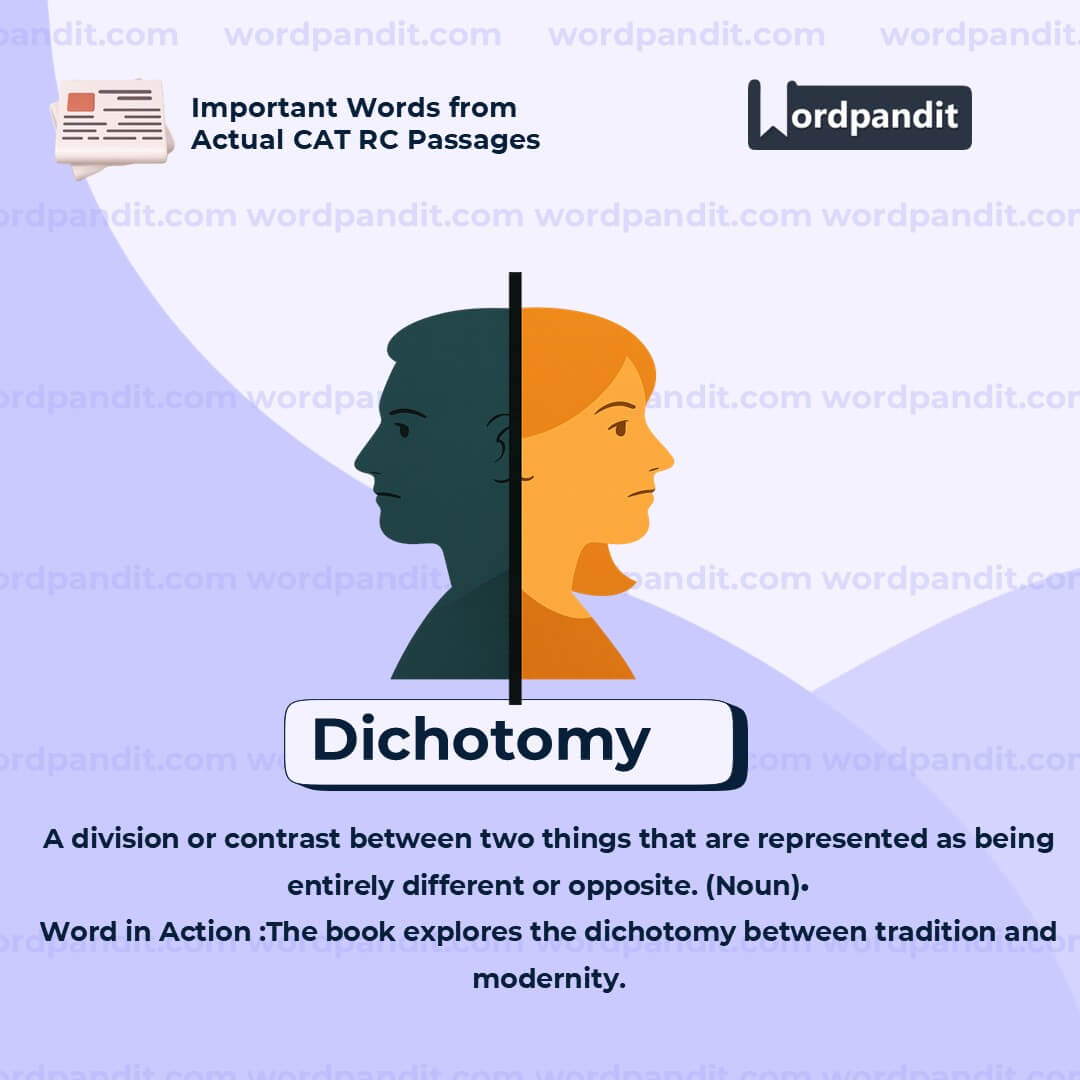
WORD-5: Dichotomy
Context:
"The discourse of nationalism shows that the material/spiritual distinction was condensed into an analogous, but ideologically far more powerful, dichotomy: that between the outer and the inner."
Explanatory Paragraph:
"Dichotomy" refers to a division or contrast between two things that are presented as completely different or opposite. In this context, it signifies a powerful conceptual split created within nationalist discourse—between the "outer" (perhaps political, colonial, material) and the "inner" (cultural, spiritual, national identity). Such dichotomies help organize thought and ideology but can also oversimplify complex realities.
Meaning: A division between two sharply contrasting groups, ideas, or things (Noun)
Pronunciation: dye-KOT-uh-mee
Difficulty Level: ⭐⭐⭐ Intermediate
Etymology: From Greek *dichotomia* – *dicha-* (in two) + *temnein* (to cut)
Prashant Sir's Notes:
“Dichotomy” is often used in academic and philosophical writing to indicate a deep conceptual divide—like mind vs. body, tradition vs. modernity, or self vs. other. It helps structure debates but can also mask nuances when treated as black-and-white truths.
Synonyms & Antonyms:
Synonyms: division, split, contrast, polarity, binary
Antonyms: unity, continuum, integration, blend
Usage Examples:
- The novel explores the dichotomy between public persona and private identity.
- There is often a false dichotomy presented between science and religion.
- Nationalist discourse relies heavily on the dichotomy of native vs. foreign.
- Social media blurs the traditional dichotomy between personal and professional life.
Cultural Reference:
"The East-West dichotomy has shaped global politics and identity debates for centuries." – Edward Said, *Orientalism*
Think About It:
Can dichotomies help us make sense of the world, or do they limit our ability to see complexity?
Quick Activity:
List three dichotomies commonly used in society (e.g., rich/poor, good/evil). Discuss one case where this division oversimplifies reality.
Memory Tip:
“Dichotomy” = *di-* (two) + *cut* → a sharp “cut into two” parts. Think of it as a conceptual split.
Real-World Application:
Dichotomies are widely used in politics, media, and philosophy to create strong narratives. Learning to recognize and critically assess them helps in avoiding simplistic thinking and fosters deeper analysis.
WORD-6: Profane
Context:
"The home in its essence must remain unaffected by the profane activities of the material world—and woman is its representation. And so one gets an identification of social roles by gender to correspond with the separation of the social space into ghar and bāhir."
Explanatory Paragraph:
"Profane" refers to things that are not sacred or spiritual—often associated with the ordinary, material, or even disrespectful aspects of life. In the context of the passage, "profane activities of the material world" contrasts with the purity and sanctity assigned to the home. Here, the home is idealized as a sacred space, shielded from the 'profane' outside world. This division often reinforces traditional gender roles, assigning women to the private (sacred) sphere and men to the public (profane) one.
Meaning: Relating to the ordinary or material world as opposed to the sacred or spiritual; sometimes also disrespectful to religious or sacred things (Adjective)
Pronunciation: proh-FAYN
Difficulty Level: ⭐⭐⭐ Intermediate
Etymology: From Latin *profanus*, meaning "outside the temple," from *pro-* (before) + *fanum* (temple)
Prashant Sir's Notes:
This is a powerful word for analyzing cultural binaries—sacred/profane, inner/outer, spiritual/material. It often appears in social theory, religious studies, and discussions about purity, domesticity, and gendered spaces. Don’t confuse “profane” with “profanity”—while related, the former is broader and more analytical in tone.
Synonyms & Antonyms:
Synonyms: secular, worldly, unholy, irreverent, impure
Antonyms: sacred, holy, spiritual, divine, consecrated
Usage Examples:
- The temple grounds were considered sacred, and profane behavior was not allowed.
- In traditional discourse, the workplace is seen as profane compared to the sanctity of the home.
- The novel explores how the sacred and profane coexist in everyday life.
- He viewed art as a spiritual practice, not something to be reduced to profane commercialism.
Cultural Reference:
"All societies make distinctions between the sacred and the profane, and these lines define much of their structure." — Emile Durkheim, *The Elementary Forms of Religious Life*
Think About It:
Who decides what is sacred and what is profane in a society? How do these labels influence gender, space, and power?
Quick Activity:
Write two examples each of what your culture considers sacred and profane. Are these boundaries shifting over time?
Memory Tip:
“Profane” = *pro* (outside) + *fane* (temple) → anything outside the temple = not sacred.
Real-World Application:
Understanding the sacred/profane divide is essential in sociology, religious studies, and cultural analysis. It helps unpack how societies structure gender, morality, space, and identity through symbolic distinctions.
WORD-7: Paradigm
Context:
"It would be a grave error to see in this, as liberals are apt to in their despair at the many marks of social conservatism in nationalist practice, a total rejection of the West. Quite the contrary: the nationalist paradigm in fact supplied an ideological principle of selection."
Explanatory Paragraph:
A "paradigm" is a typical example, model, or pattern of something—especially a framework of beliefs, values, or practices that shape how people think and act. In this context, the "nationalist paradigm" refers to the set of ideas and principles through which nationalism interpreted the world and made decisions—particularly about what to accept from the West and what to reject. It’s not about total acceptance or rejection but about filtering ideas through a particular ideological lens.
Meaning: A model or framework that shapes how something is understood or practiced (Noun)
Pronunciation: PAIR-uh-dyme
Difficulty Level: ⭐⭐⭐ Intermediate
Etymology: From Greek *paradeigma*, meaning "pattern, example," from *para-* (beside) + *deiknunai* (to show)
Prashant Sir's Notes:
Paradigm is a key concept in academic discourse, especially in philosophy, sociology, and science. It represents the dominant way of thinking at a particular time. The nationalist paradigm, for example, selects elements from colonial modernity and reinterprets them to suit its goals. Paradigm shifts occur when this dominant model is challenged and replaced.
Synonyms & Antonyms:
Synonyms: model, framework, worldview, pattern, example
Antonyms: anomaly, deviation, randomness, exception
Usage Examples:
- The scientific revolution marked a paradigm shift in how humans understood the universe.
- The nationalist paradigm allowed selective adaptation of Western institutions.
- In linguistics, a paradigm refers to a set of related grammatical forms.
- The education system operates under a traditional paradigm that may need reform.
Cultural Reference:
"The structure of scientific revolutions is a succession of paradigms and their inevitable collapse." – Thomas Kuhn, *The Structure of Scientific Revolutions*
Think About It:
What paradigms shape your thinking about culture, gender, education, or identity—and what would it take to shift them?
Quick Activity:
Identify a paradigm in your field of study (e.g., capitalism in economics, individualism in psychology). Briefly explain how it influences ideas and actions.
Memory Tip:
“Paradigm” = pair + a + dime = Imagine a pair of coins always together = a fixed model or set of rules always used together.
Real-World Application:
Understanding paradigms helps in critical thinking. Whether in policymaking, science, or activism, recognizing the dominant framework allows you to question assumptions and propose innovative alternatives.
WORD-8: Statecraft
Context:
"Science, technology, rational forms of economic organization, modern methods of statecraft—these had given the European countries the strength to subjugate the non-European people."
Explanatory Paragraph:
"Statecraft" refers to the skillful management of state affairs, particularly in governance, diplomacy, policy-making, and national strategy. It is the art and science of running a country effectively. In the context provided, European powers are said to have used advanced forms of statecraft—alongside science and technology—as tools to dominate non-European societies during the colonial period, highlighting how governance and administration were part of imperial power.
Meaning: The art of governing and managing the affairs of a state, especially in terms of diplomacy and political strategy (Noun)
Pronunciation: STATE-kraft
Difficulty Level: ⭐⭐⭐ Intermediate
Etymology: From "state" (referring to the government or nation) + "craft" (skill or art), meaning the skilled practice of government.
Prashant Sir's Notes:
Statecraft is a foundational term in political science and international relations. It's not just about politics—it's about strategic governance. Leaders with good statecraft know how to balance internal administration with foreign policy and long-term national goals. In historical contexts, it explains how empires were built and maintained.
Synonyms & Antonyms:
Synonyms: governance, diplomacy, leadership, political strategy, administration
Antonyms: misrule, anarchy, amateurism, political chaos
Usage Examples:
- Effective statecraft requires balancing national interests with global responsibilities.
- The rise of European colonial empires was as much about statecraft as military conquest.
- Good statecraft avoids war by employing intelligent diplomacy.
- Post-independence leaders had to develop new forms of statecraft suited to their societies.
Cultural Reference:
"Statecraft is soulcraft." — George F. Will, emphasizing how governance shapes national character and values.
Think About It:
Can strong statecraft exist without ethical leadership, or does power without values risk becoming oppressive?
Quick Activity:
Pick a historical leader known for exceptional statecraft (e.g., Nehru, Bismarck, Mandela). List two strategies they used that reflect skillful governance.
Memory Tip:
Think of "statecraft" like "crafting a state"—the skillful shaping and managing of a nation's destiny.
Real-World Application:
Understanding statecraft is crucial for policymakers, diplomats, and citizens alike. It allows for analyzing how governments function, how decisions are made, and how nations interact on the global stage—with consequences for democracy, development, and peace.
WORD-9: Nationalist Ideology
Context:
"I have elaborated . . . a framework for analyzing the contradictory pulls on [Indian] nationalist ideology in its struggle against the dominance of colonialism and the resolution it offered to those contradictions."
Explanatory Paragraph:
"Nationalist ideology" refers to a set of political and cultural beliefs that promote the interests, identity, and self-governance of a nation, especially in opposition to foreign domination. In the given context, it describes the framework of ideas that guided India's struggle for independence from colonial rule. This ideology was not uniform—it had internal tensions or "contradictory pulls"—but it nonetheless provided a guiding narrative of resistance, pride, and identity, aimed at reclaiming sovereignty and cultural autonomy.
Meaning: A system of beliefs centered around promoting national unity, identity, and independence, often in opposition to foreign rule or influence (Noun Phrase)
Pronunciation: NASH-uh-nuh-list eye-DEE-uh-loh-jee
Difficulty Level: ⭐⭐⭐⭐ Advanced
Etymology: "Nationalist" from *nation* (Latin *natio*, meaning "birth or people") + *-ist* (advocate), and "ideology" from Greek *idea* (form, pattern) + *logia* (study or discourse)
Prashant Sir's Notes:
Nationalist ideology plays a critical role in shaping the identity of a country during and after colonial rule. In India’s case, it involved selecting certain values from both tradition and modernity while resisting colonial cultural hegemony. It is never a monolith—different leaders and movements interpreted it in different ways, hence the "contradictory pulls" mentioned in the passage.
Synonyms & Antonyms:
Synonyms: patriotic belief system, pro-independence doctrine, national identity narrative
Antonyms: colonial ideology, cosmopolitanism, anti-nationalism, internationalism
Usage Examples:
- Nationalist ideology shaped India’s response to British colonial rule and influenced its path to independence.
- The nationalist ideology of the 20th century emphasized cultural pride and economic self-sufficiency.
- Contradictions within nationalist ideology often reflected class, caste, and gender divides.
- Postcolonial thinkers have critically examined the assumptions within nationalist ideologies.
Cultural Reference:
"Nationalist ideologies do not emerge in a vacuum—they are products of history, culture, and resistance." — Partha Chatterjee, *The Nation and Its Fragments*
Think About It:
Can a nationalist ideology balance inclusivity and pride without becoming exclusionary or rigid?
Quick Activity:
Identify two features of Indian nationalist ideology during the independence movement. Were they based more on tradition, modernity, or both?
Memory Tip:
“Nationalist ideology” = the *ideas* and *beliefs* that define what a *nation* is and why it should govern itself.
Real-World Application:
Understanding nationalist ideology is essential in history, political science, and cultural studies. It helps explain independence movements, constitution-making, and current political debates about identity, sovereignty, and citizenship.
WORD-10: Treacherous Terrain
Context:
"The world is the external, the domain of the material; the home represents one’s inner spiritual self, one’s true identity. The world is a treacherous terrain of the pursuit of material interests, where practical considerations reign supreme. It is also typically the domain of the male."
Explanatory Paragraph:
"Treacherous terrain" is a metaphorical phrase that suggests a space or situation that is dangerous, deceptive, or full of hidden risks. In the given context, it refers to the outer world—the sphere of material pursuits, competition, and pragmatism—as opposed to the inner sanctity of the home. The phrase emphasizes how the public sphere, particularly the economic and political world often associated with men, is viewed as unstable, morally perilous, and challenging to navigate.
Meaning: A dangerous and unpredictable environment or situation, often used metaphorically (Noun Phrase)
Pronunciation: TRECH-er-uhs tuh-RAIN
Difficulty Level: ⭐⭐⭐ Intermediate
Etymology: "Treacherous" from Old French *trecherous* meaning deceitful, and "terrain" from Latin *terra* meaning land or ground
Prashant Sir's Notes:
This phrase works beautifully as both literal and metaphorical language. Literally, it refers to rough or dangerous physical land. But metaphorically, it conveys emotional, ethical, or political instability. In literature and theory, it's used to critique how certain spaces (like the public world of men) are seen as morally compromising compared to the “purity” of the home.
Synonyms & Antonyms:
Synonyms: dangerous ground, hostile environment, risky territory, unstable setting
Antonyms: safe haven, secure space, stable environment, peaceful domain
Usage Examples:
- The political landscape was a treacherous terrain, filled with betrayals and shifting alliances.
- For women entering the male-dominated workforce, it often felt like navigating a treacherous terrain.
- Entrepreneurship is a treacherous terrain without a clear roadmap.
- The novel portrays the external world as a treacherous terrain in contrast to the purity of the domestic sphere.
Cultural Reference:
"The public world was imagined as a treacherous terrain for the moral self, especially in nationalist discourse." — From Partha Chatterjee’s analysis of gender and space in colonial India
Think About It:
How does labeling the public world as a "treacherous terrain" influence gender roles and societal expectations?
Quick Activity:
Describe a modern situation (e.g., social media, politics, business) that could be seen as a "treacherous terrain." What risks make it so?
Memory Tip:
“Treacherous terrain” = imagine a slippery mountain path—looks manageable, but every step hides a threat. It's about unseen danger.
Real-World Application:
This metaphor is widely used in literature, gender studies, and political discourse to critique how public life is framed. It helps reveal the narratives that assign safety and purity to the home while casting the outside world as dangerous, especially for marginalized groups.


