
📘 What’s Inside This CAT Paragraph Summary Question Post?
📝 Authentic CAT Paragraph Summary QuestionPractice with a real CAT Paragraph Summary Question from a previous CAT exam.
✅ Detailed Question with Step-by-Step SolutionEach question is explained thoroughly for better understanding.
🔍 In-Depth Paragraph AnalysisGain insights through line-by-line and paragraph-wise analysis
📚 Vocabulary Enhancement: Top 5 words explained from the paragraph
Paragraph Summary Questions
Question 22: The passage given below is followed by four alternate summaries. Choose the option that best captures the essence of the passage.
The human mind is wired to see patterns. Not only does the brain process information as it comes in, it also stores insights from all our past experiences. Every interaction, happy or sad, is catalogued in our memory. Intuition draws from that deep memory well to inform our decisions going forward. In other words, intuitive decisions are based on data, and not contrary to data as many would like to assume. When we subconsciously spot patterns, the body starts firing neurochemicals in both the brain and gut. These “somatic markers” are what give us that instant sense that something is right … or that it’s off. Not only are these automatic processes faster than rational thought, but our intuition draws from decades of diverse qualitative experience (sights, sounds, interactions, etc.) - a wholly human feature that big data alone could never accomplish.
A. Intuition is infinitely richer than big data which is based on rational thought and accomplishes more than what big data can.
B. Intuitions are automatic processes and are therefore faster than rational thought, and so decisions based on them are better.
C. Intuition draws from deep memory, and may not be related to data, but to decades of diverse qualitative experience.
D. Intuitions are neuro-chemical firings based on pattern recognition and draw upon a rich and vast database of experiences.
Solution with Explanation
Answer: D
Solution by Wordpandit:
Upon examining the main ideas presented in the paragraph, we can understand the following core concepts:
1. The basis for intuition is rooted in the vast collection of memories our brain retains over time.
2. When there's a recognition of familiar patterns stemming from these memories, our neurons activate. This process manifests as the intuitive feeling or "gut reaction" we often experience.
Given this understanding, let's assess the provided options:
A: This option introduces a misleading interpretation. The original paragraph does not establish a connection between big data and rational thought. Hence, this is a distorted representation of the main ideas.
B: This option ventures outside the main ideas presented in the paragraph. There's no mention or implication in the original content that decisions based on intuition are either superior or inferior in any way.
C: This representation is not aligned with the paragraph's content. While the original context acknowledges that intuition draws from the brain's stored memories (a kind of internal data), it doesn't categorically state that intuitive decisions are purely data-driven in the conventional sense of the word.
D: This option encapsulates the essence of the main ideas accurately. It touches upon the notion that intuition is anchored in our stored memories and is triggered by pattern recognition, leading to the phenomenon we commonly term as 'gut feeling'. Therefore, this is the most accurate representation.
Given these assessments, Option D stands out as the correct choice that faithfully captures the main ideas presented in the paragraph.
Word 1: Patterns
Context:
"The human mind is wired to see patterns."
Explanatory Paragraph:
"Patterns" refer to repeated or predictable forms, arrangements, or sequences in objects, behavior, or ideas. Our brains naturally detect patterns to help us make sense of the world—whether it's in visual designs, social behavior, language, or even numbers. Recognizing patterns allows us to anticipate outcomes, solve problems, and build knowledge. From art and music to science and mathematics, patterns are everywhere.
Meaning: Repeated designs, arrangements, or sequences observed in various contexts (Noun, plural)
Pronunciation: PAT-urns
Difficulty Level: ⭐ Basic
Etymology: From Middle French *patron* (“template, model”), from Latin *patronus*, meaning “model or example.”
Prashant Sir's Notes:
Pattern recognition is at the heart of learning. Whether you’re solving a math problem or understanding human behavior, spotting patterns helps you predict and respond more effectively. Train yourself to look for them—it’s a skill that sharpens over time.
Synonyms & Antonyms:
Synonyms: design, sequence, motif, structure, repetition
Antonyms: randomness, chaos, irregularity, disorder
Usage Examples:
- Scientists study weather patterns to predict climate changes.
- The fabric had a beautiful floral pattern in shades of blue and gold.
- There’s a pattern in how he responds to stress—he avoids confrontation.
- Recognizing spending patterns can help you manage your finances better.
Cultural Reference:
"Humans are pattern-seeking animals, and we are adept at finding meaning in chaos—even when there is none." – Michael Shermer, *The Believing Brain*
Think About It:
Can the human tendency to see patterns sometimes lead us to false conclusions, such as superstitions or conspiracy theories?
Quick Activity:
Look around your room and identify 3 patterns—visual or behavioral. Describe what repeats and why it might exist.
Memory Tip:
Think of "patterns" as things that “repeat in a pattern.” The rhythm or order is what makes something a pattern!
Real-World Application:
Pattern recognition is key in fields like coding, data analysis, design, education, and even psychology. Spotting patterns helps in predictions, creativity, and critical thinking.
Word 2: Insights
Context:
"Not only does the brain process information as it comes in, it also stores insights from all our past experiences."
Explanatory Paragraph:
"Insights" are deep understandings or realizations about something, often gained through experience, reflection, or study. These are not just surface-level observations—they reveal something meaningful or hidden beneath the obvious. In the context of the brain, insights represent the accumulated wisdom we’ve built from life events, helping us make better decisions or understand ourselves and others more clearly.
Meaning: Clear and deep understanding of a complicated problem or situation (Noun, plural)
Pronunciation: IN-sytes
Difficulty Level: ⭐⭐ Basic
Etymology: From Middle English *insight*, meaning "sight with the eyes of the mind," from *in-* ("inward") + *sight*.
Prashant Sir's Notes:
Insights are the “aha!” moments in your learning journey. They don’t come from cramming—they come from connecting ideas and reflecting on experience. Keep a journal or discuss ideas with others to strengthen your ability to gain insights.
Synonyms & Antonyms:
Synonyms: understanding, realization, awareness, perception, revelation
Antonyms: ignorance, misunderstanding, confusion, blindness
Usage Examples:
- Her insights into human behavior make her an excellent therapist.
- The book provides powerful insights into modern economic challenges.
- After years of experience, he shared his insights on leadership and resilience.
- Through meditation, one can gain deep personal insights.
Cultural Reference:
"A moment’s insight is sometimes worth a life’s experience." – Oliver Wendell Holmes Sr.
Think About It:
Can insights be taught, or must they always be discovered through personal experience?
Quick Activity:
Think of a mistake you made in the past. What insight did you gain from it? Write it in one clear sentence.
Memory Tip:
“In-sight” = seeing *into* something. Insights go deeper than the surface—they reveal the core truth.
Real-World Application:
Insights are crucial in psychology, business strategy, teaching, writing, and self-development. Leaders, creators, and learners all rely on insights to guide better actions and decisions.
Word 3: Intuition
Context:
"Intuition draws from that deep memory well to inform our decisions going forward."
Explanatory Paragraph:
"Intuition" is the ability to understand or know something immediately, without the need for conscious reasoning or evidence. It's that inner feeling or instinct that helps us make decisions quickly, often based on past experiences and accumulated insights, even if we can't explain exactly why. Intuition is especially important when time is limited or when a situation is too complex to analyze logically.
Meaning: The ability to understand something instinctively, without conscious reasoning (Noun)
Pronunciation: in-too-ISH-un
Difficulty Level: ⭐⭐⭐ Intermediate
Etymology: From Latin *intueri*, meaning "to look at or contemplate," through Late Latin *intuitio* ("a looking at, consideration").
Prashant Sir's Notes:
Intuition isn't magic—it’s rapid thinking powered by experience. Trust it, but also verify it. It's most valuable when supported by knowledge. Develop it through reflection and self-awareness, not guesswork.
Synonyms & Antonyms:
Synonyms: instinct, gut feeling, hunch, sixth sense, perception
Antonyms: logic, analysis, reasoning, calculation
Usage Examples:
- She had the intuition that something was wrong even before hearing the news.
- Good leaders often rely on both data and intuition when making big decisions.
- Intuition told him not to trust the offer, even though it seemed perfect on paper.
- Artists and designers often create their best work by following intuition.
Cultural Reference:
"The intuitive mind is a sacred gift and the rational mind is a faithful servant." – Often attributed to Albert Einstein
Think About It:
How can we distinguish between genuine intuition and irrational fear or bias?
Quick Activity:
Recall a time when you followed your intuition. What was the outcome? Reflect on whether it helped or misled you.
Memory Tip:
“In-tu-it” sounds like “in to it”—as if your mind is *into* something without needing a step-by-step path to get there.
Real-World Application:
Intuition plays a key role in areas like leadership, counseling, creative fields, and emergency decision-making. While not a replacement for logic, it complements analytical thinking for well-rounded judgment.
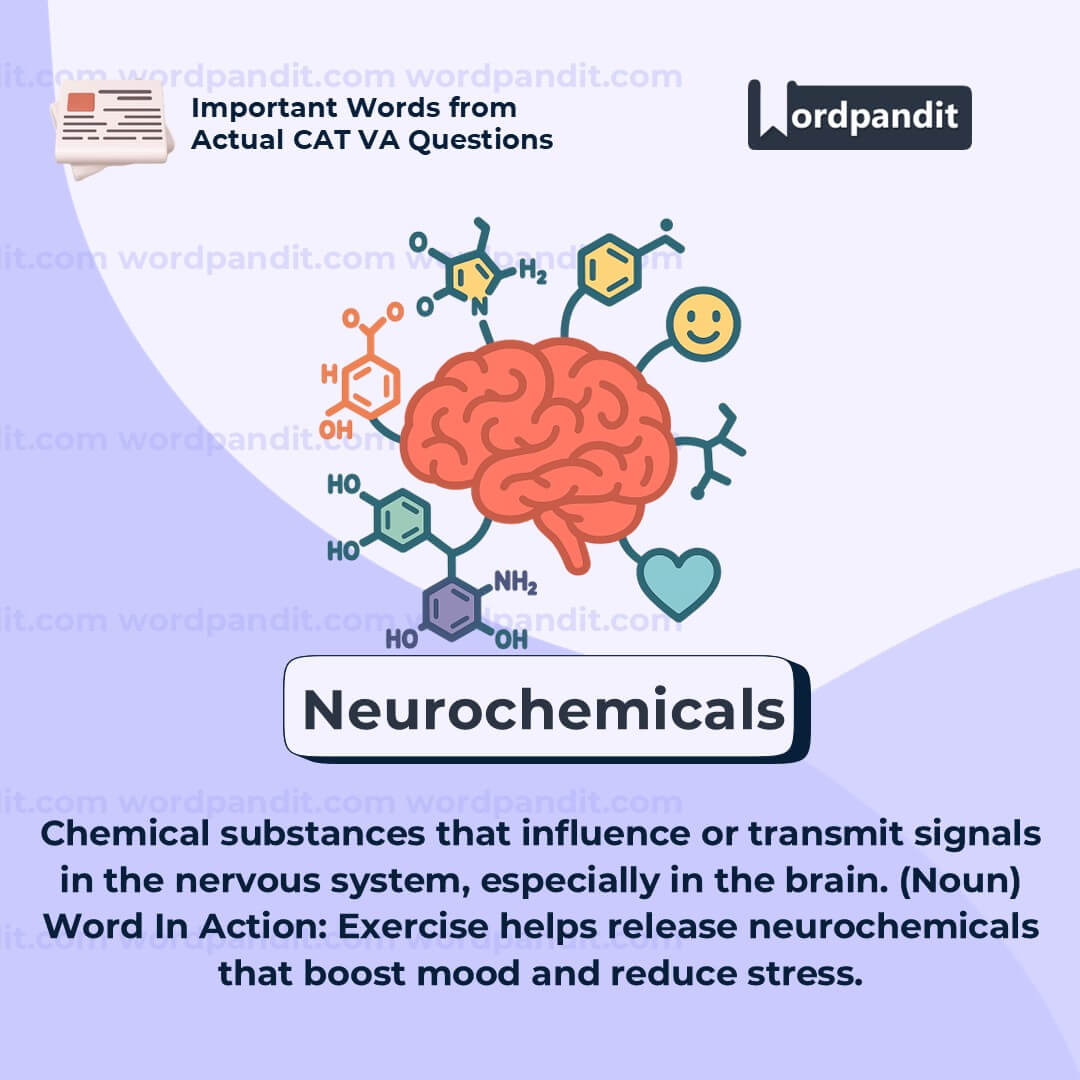
Word 4: Neurochemicals
Context:
"When we subconsciously spot patterns, the body starts firing neurochemicals in both the brain and gut."
Explanatory Paragraph:
"Neurochemicals" are chemical substances produced by the nervous system that influence brain function and bodily responses. These chemicals, such as dopamine, serotonin, and adrenaline, play a vital role in mood, cognition, attention, and emotional responses. When we recognize patterns or feel emotions, neurochemicals are released to signal and regulate the appropriate reactions, often without conscious awareness.
Meaning: Chemical substances in the brain and nervous system that affect mood, behavior, and bodily functions (Noun, plural)
Pronunciation: nyoo-ro-KEM-ih-kulz
Difficulty Level: ⭐⭐⭐ Intermediate
Etymology: From *neuro-* (relating to nerves or the nervous system) + *chemical* (a substance with a distinct molecular composition).
Prashant Sir's Notes:
Neurochemicals are your brain’s messengers. Think of them as the body’s natural "apps" running in the background—triggering focus, joy, fear, or calmness. Understanding them helps us understand human behavior better.
Synonyms & Antonyms:
Synonyms: brain chemicals, neurotransmitters, biochemical messengers
Antonyms: (Conceptual) – physical structures, mechanical responses, non-biological factors
Usage Examples:
- Stress triggers the release of neurochemicals like cortisol and adrenaline.
- Exercise boosts neurochemicals that improve mood and mental clarity.
- Neurochemicals help explain why we form emotional habits and preferences.
- The gut produces neurochemicals that directly influence the brain’s activity.
Cultural Reference:
"Happiness is not just a mindset—it’s also a neurochemical state shaped by serotonin, dopamine, and oxytocin." – *Scientific American*
Think About It:
Can awareness of your neurochemicals help you manage your emotions and decision-making more consciously?
Quick Activity:
Match the following neurochemicals with their effects: Dopamine – reward, Serotonin – mood, Adrenaline – alertness. Add one more neurochemical and research its function.
Memory Tip:
“Neuro” = brain/nerves + “chemical” = substance → Neurochemical = a chemical in the brain or nervous system that causes action.
Real-World Application:
Understanding neurochemicals is essential in fields like psychology, medicine, education, and wellness. It helps in designing better therapies, improving learning, and even boosting productivity through mood regulation.
Word 5: Qualitative
Context:
"Not only are these automatic processes faster than rational thought, but our intuition draws from decades of diverse qualitative experience (sights, sounds, interactions, etc.) — a wholly human feature that big data alone could never accomplish."
Explanatory Paragraph:
"Qualitative" refers to descriptions or evaluations based on the qualities or characteristics of something, rather than quantities or numerical data. It focuses on the *what* and *how* — like how something feels, looks, or behaves — instead of how much. In research, qualitative data includes things like interviews, observations, and sensory experiences. It provides depth, emotion, and context that numbers alone cannot capture.
Meaning: Relating to the quality or nature of something, rather than its quantity (Adjective)
Pronunciation: KWA-li-tay-tiv
Difficulty Level: ⭐⭐⭐ Intermediate
Etymology: From Latin *qualitas* ("quality") + English suffix *-ive* ("pertaining to").
Prashant Sir's Notes:
While “quantitative” gives you the numbers, “qualitative” tells you the story. In human behavior, art, culture, and emotions, qualitative experiences are invaluable. These are the rich details that AI or algorithms can’t always measure.
Synonyms & Antonyms:
Synonyms: descriptive, observational, subjective, experiential
Antonyms: quantitative, numerical, statistical, measurable
Usage Examples:
- Her research focused on the qualitative impact of social media on self-esteem.
- The study used interviews and case studies to gather qualitative insights.
- Qualitative feedback revealed emotional responses that numbers couldn’t show.
- Artists often express qualitative truths through colors, textures, and composition.
Cultural Reference:
"The humanities thrive on qualitative data—on meaning, nuance, and narrative rather than measurement." – Stanford Humanities Center
Think About It:
Can human decision-making ever be fully replaced by quantitative data, or do we always need qualitative insight?
Quick Activity:
List two situations where qualitative data is more useful than numbers. Briefly explain why numbers alone wouldn't work.
Memory Tip:
“Qualitative” starts with “qual-,” like “quality”—think of rich, descriptive details, not numbers.
Real-World Application:
Qualitative thinking is crucial in education, psychology, user experience design, and the arts. It brings in empathy, context, and insight where hard data falls short.
