
✨ Introduction
Mastering Reading Comprehension begins with mastering the words!
In this post, we dive deep into vocabulary taken directly from an actual CAT RC passage. Each word has been explained in a simple, easy-to-understand way, along with examples to help you grasp its usage in real contexts.
From words like "species" and "cognitive" to "subjection" and "paradise," strengthen your vocabulary one word at a time — and take your RC performance to the next level!
📚 What’s Inside This Vocabulary Post?
- 🔍 Words Sourced from an Actual CAT RC Passage: Directly pick up important vocabulary from real CAT exam material.
- 🧠 Meaningful Explanations: Understand the exact meaning and usage of each word in a simple, student-friendly way.
- ✍️ Context-Based Learning: Learn words with examples that reflect their actual usage in reading comprehension contexts.
- 🗂️ Quick Reference Format: Words are neatly listed with meanings, parts of speech, and example sentences for easy revision.
- 🚀 Boost Your RC and Verbal Ability Skills: Improve your understanding of tough passages by strengthening your vocabulary.
📝 Words Covered in This Article:
- Conceive
- Unconscious
- Realm
- Time-honored
- Hallucination
- Disequilibrium
- Magnetizer
- Stocktaking
- Diluting
- Catchwords
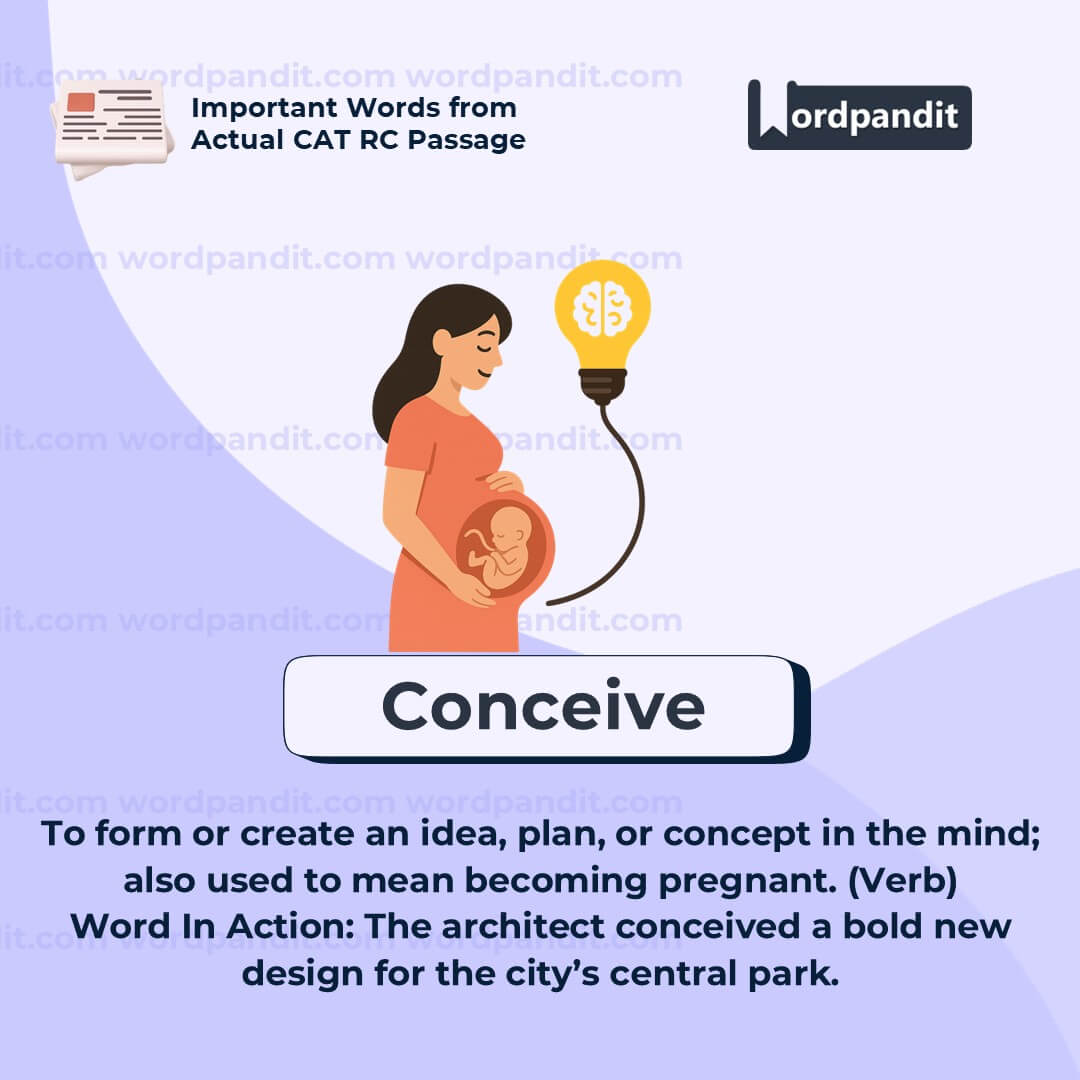
WORD-1: Conceive
Context:
"Today we can hardly conceive of ourselves without an unconscious." - Source Unknown
Explanatory Paragraph:
The word "conceive" in this context means to mentally imagine or form an idea of something. It refers to the cognitive ability to picture, conceptualize, or understand a particular reality or concept. When we say we can “hardly conceive of ourselves without an unconscious,” it implies that the idea of the unconscious mind has become so ingrained in our understanding of human identity that we find it difficult to even imagine our existence without it.
Meaning: To form or devise an idea or concept in the mind (Verb)
Pronunciation: kuhn-SEEV
Difficulty Level: ⭐⭐ Moderate
Etymology: From Latin *concipere*, meaning "to take in, grasp, become pregnant with" — from *com-* (together) + *capere* (to take)
Prashant Sir's Notes:
"Conceive" has multiple meanings. It can mean to imagine or mentally picture something, but it also refers to becoming pregnant. Context determines the intended meaning — here, it clearly refers to the act of forming a concept in the mind.
Synonyms & Antonyms:
Synonyms: imagine, envision, conceptualize, comprehend, picture
Antonyms: misunderstand, ignore, overlook, disbelieve
Usage Examples:
- It’s hard to conceive how ancient people navigated vast oceans without modern tools.
- She could not conceive of a world without music.
- The architect conceived an innovative design for the community center.
- Some theories are so abstract they’re difficult to conceive fully without diagrams.
Cultural Reference:
"In philosophy, thinkers like Descartes and Kant explored how we conceive of the self and consciousness — questions still debated today." - Introduction to Modern Philosophy
Think About It:
What are some ideas or realities that you find difficult — or even impossible — to conceive? Why do you think they challenge your imagination?
Quick Activity:
Write down three things you find hard to conceive of (e.g., infinity, time travel, life without technology) and explain why.
Memory Tip:
“Conceive” sounds like “concept” — both involve forming an idea in your mind. If you can conceive it, you can conceptualize it!
Real-World Application:
Understanding how people conceive of different ideas helps in communication, education, psychology, and design — it's key to tailoring ideas to different audiences.
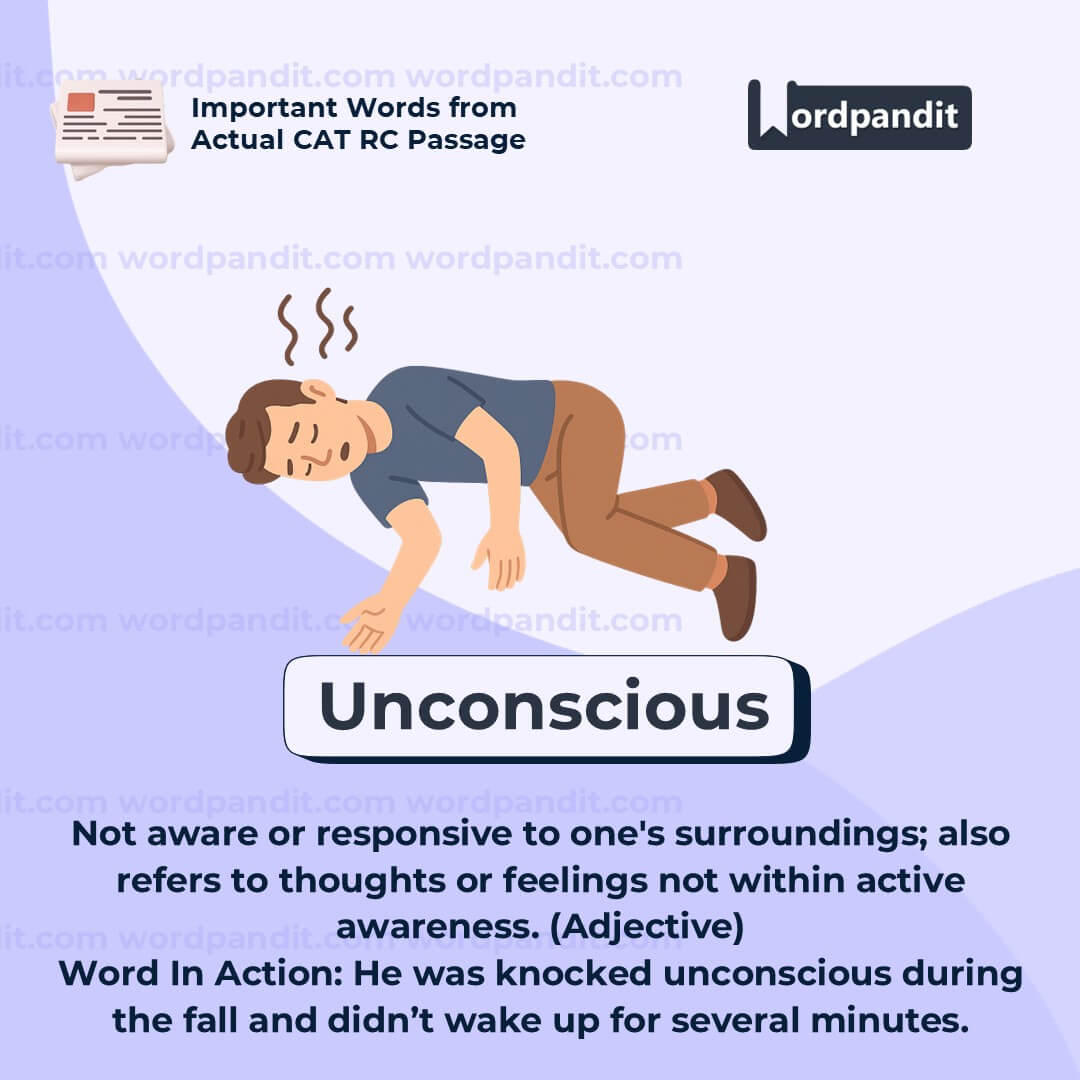
WORD-2: Unconscious
Context:
"Yet between 1700 and 1900, this notion developed as a genuinely original thought. The 'unconscious' burst the shell of conventional language, coined as it had been to embody the fleeting ideas and the shifting conceptions of several generations until, finally, it became fixed and defined in specialized terms within the realm of medical psychology and Freudian psychoanalysis." - Source Unknown
Explanatory Paragraph:
The word "unconscious" refers to the part of the mind that contains thoughts, memories, and desires that are not currently in our conscious awareness but still influence our behavior and emotions. In the context of the passage, it describes how this concept evolved over centuries and eventually gained a defined place in psychological theory, especially in Freudian psychoanalysis. It suggests that language and human understanding had to grow to accommodate this powerful and hidden aspect of the mind.
Meaning: The part of the mind that operates outside of conscious awareness but influences thoughts, feelings, and actions (Noun); also used as an adjective to describe a state of not being awake or aware
Pronunciation: un-KON-shuhs
Difficulty Level: ⭐⭐⭐ Intermediate
Etymology: From Latin *un-* (not) + *conscious*, from Latin *conscius*, meaning "knowing with oneself"
Prashant Sir's Notes:
In psychology, the “unconscious” is like the hidden engine room of the mind — it drives much of what we think, feel, and do without us being fully aware of it. Freud believed it held repressed memories, desires, and instincts.
Synonyms & Antonyms:
Synonyms: subconscious, unaware, unmindful, hidden mind
Antonyms: conscious, aware, intentional, deliberate
Usage Examples:
- Many of our fears are rooted in the unconscious, shaped by past experiences we barely remember.
- He fell unconscious after hitting his head during the accident.
- Dreams are often interpreted as windows into the unconscious mind.
- Freud believed the unconscious was a reservoir of repressed thoughts and desires.
Cultural Reference:
"The concept of the unconscious revolutionized psychology, especially through the work of Sigmund Freud, who proposed that repressed thoughts in the unconscious drive much of human behavior." - Encyclopedia of Psychology
Think About It:
How much of what we think we choose freely is actually influenced by unconscious motivations and past experiences?
Quick Activity:
Write down a habit you have. Then reflect: could there be an unconscious reason or early life experience behind it?
Memory Tip:
“Unconscious” = “not conscious” — the part of your mind that works silently in the background, like hidden software running your thoughts.
Real-World Application:
Understanding the unconscious is crucial in therapy, advertising, and decision-making research, where hidden beliefs and emotions often drive visible actions.
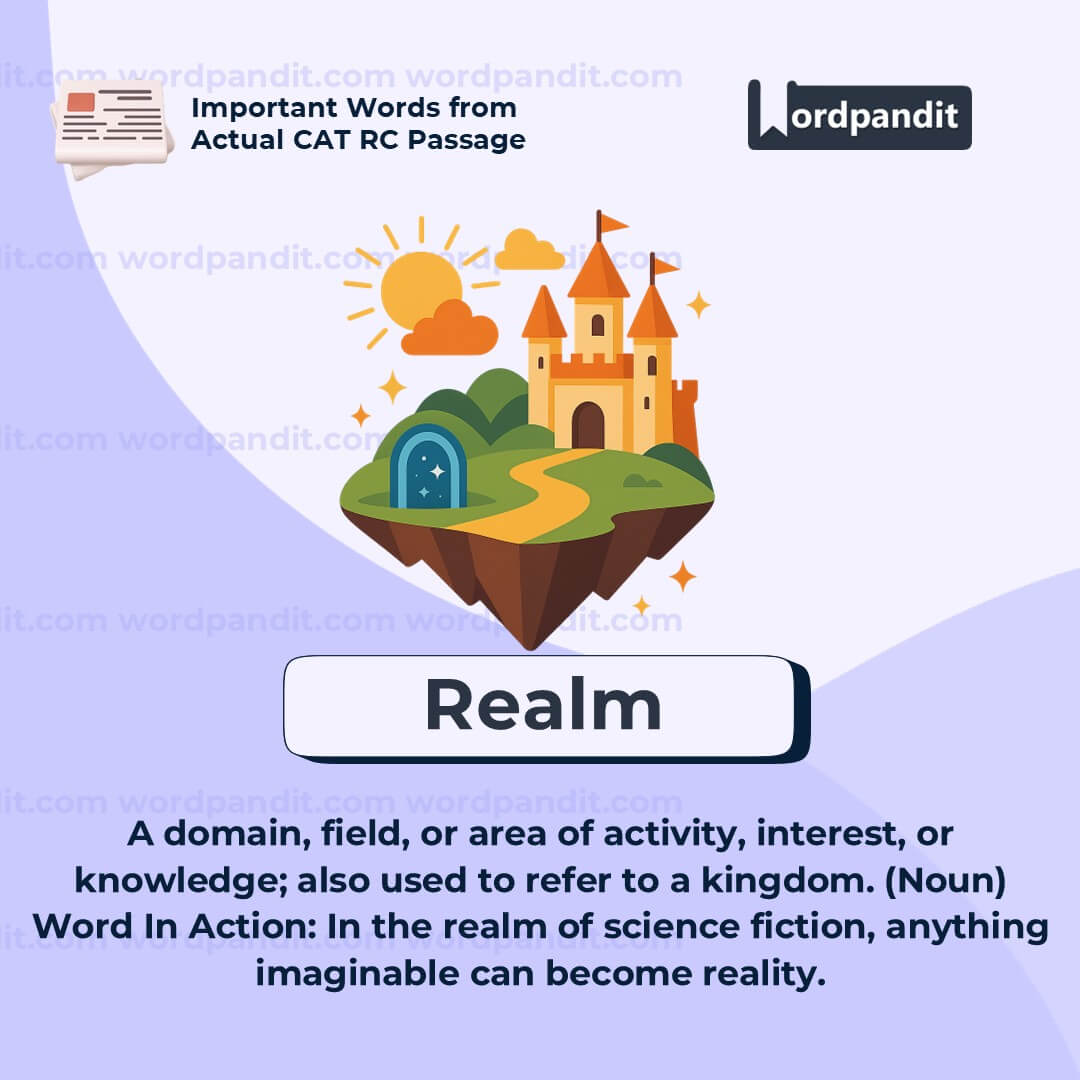
WORD-3: Realm
Context:
"It became fixed and defined in specialized terms within the realm of medical psychology and Freudian psychoanalysis." - Source Unknown
Explanatory Paragraph:
The word "realm" refers to a domain or area of expertise, influence, or activity. While it originally referred to a kingdom or territory ruled by a monarch, in modern usage it often represents an abstract field such as science, art, or psychology. In this context, the "realm of medical psychology and Freudian psychoanalysis" refers to the specialized academic and clinical field where the concept of the unconscious has been formally studied and established.
Meaning: A field or domain of activity, interest, or thought; also, a kingdom or territory (Noun)
Pronunciation: relm
Difficulty Level: ⭐⭐ Moderate
Etymology: From Old French *reaume*, from Latin *regimen* (rule, government), from *regere* (to rule)
Prashant Sir's Notes:
“Realm” is a powerful word — think of it as both a kingdom (literal) and a domain of knowledge or influence (figurative). In writing, it adds a sense of importance or authority to the subject it describes.
Synonyms & Antonyms:
Synonyms: domain, field, sphere, territory, kingdom
Antonyms: boundary, fringe, periphery, outside
Usage Examples:
- She is well-known in the realm of classical music.
- The idea belongs more in the realm of science fiction than reality.
- In the realm of medicine, innovation happens rapidly.
- The king ruled over a vast realm for nearly three decades.
Cultural Reference:
"In fantasy literature, the term 'realm' is often used to describe magical kingdoms or dimensions, as in 'The Realm of Narnia' or 'The Nine Realms' in Norse mythology." - Fantasy Worldbuilding Guide
Think About It:
What realms — intellectual, creative, or emotional — do you personally operate in, and how have they shaped your identity?
Quick Activity:
List three realms of knowledge you’re interested in (e.g., literature, science, psychology). For each, write one idea or fact you’ve recently learned.
Memory Tip:
“Realm” rhymes with “helm” — picture a king at the helm of a realm, ruling a domain of thought or territory.
Real-World Application:
In academic and professional writing, “realm” is often used to define the scope of a topic, helping readers understand the specific domain being discussed (e.g., "the realm of biotechnology").
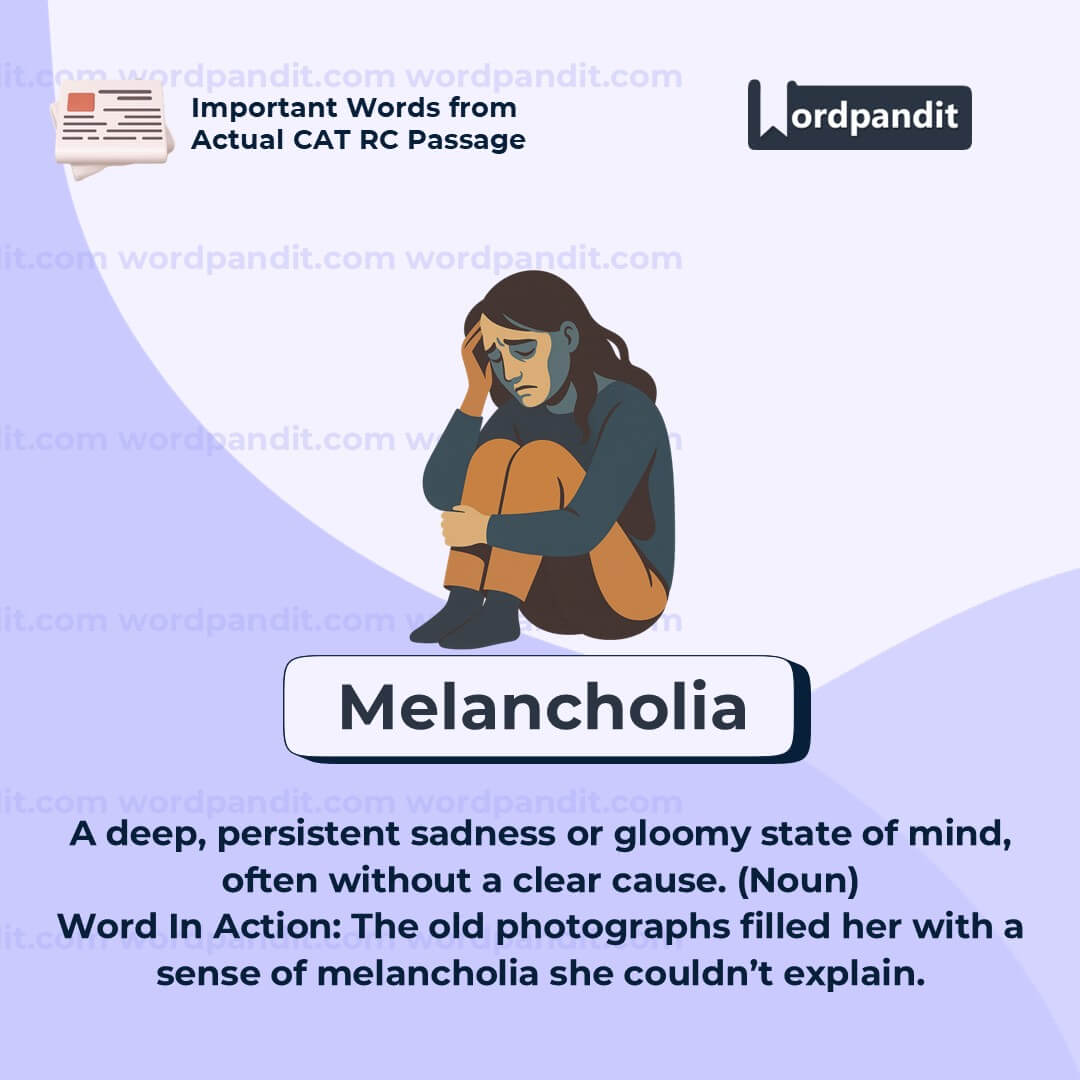
WORD-4: Melancholia
Context:
"...trance, automatic writing); the psychiatrist or alienist probing the nature of mental disease, of abnormal ideation, hallucination, delirium, melancholia, mania; the surgeon performing operations with the aid of hypnotism; the magnetizer claiming to correct the disequilibrium in the universal flow of magnetic fluids..." - Source Unknown
Explanatory Paragraph:
“Melancholia” refers to a profound, long-lasting state of sadness or depression, historically believed to be caused by an imbalance of bodily humors. In earlier psychiatric discourse, it described a specific mental condition marked by deep gloom, withdrawal, and inertia. In the given context, melancholia is one of several mental states studied by early psychiatrists and researchers of psychological phenomena, illustrating the era’s growing effort to classify and understand mental illness scientifically and medically.
Meaning: A severe and prolonged form of depression or sadness; historically considered a medical or philosophical condition (Noun)
Pronunciation: meh-lun-KOH-lee-uh
Difficulty Level: ⭐⭐⭐ Intermediate to Advanced
Etymology: From Greek *melankholia* — *melas* (black) + *kholē* (bile), referring to “black bile,” one of the four bodily humors thought to cause sadness
Prashant Sir's Notes:
Think of melancholia as an old, poetic word for deep sadness. It carries more weight and historical nuance than simply saying “depression.” Writers and thinkers often used it to describe a kind of soul-weariness or emotional fog.
Synonyms & Antonyms:
Synonyms: sorrow, gloom, sadness, despair, despondency
Antonyms: joy, happiness, elation, contentment
Usage Examples:
- The poet’s work was steeped in a quiet melancholia that reflected his personal struggles.
- In historical medicine, melancholia was attributed to an excess of black bile in the body.
- She lived in a state of melancholia, unable to find joy in anything.
- The novel explores themes of love, loss, and melancholia in a post-war setting.
Cultural Reference:
"The 2011 film *Melancholia* by Lars von Trier explores emotional depression through an apocalyptic metaphor, blending psychology and cosmic despair." - Film Theory Journal
Think About It:
Why do you think melancholia was once seen as both a medical condition and a poetic temperament? Can sadness ever be viewed as beautiful or meaningful?
Quick Activity:
List three literary characters or public figures known for their melancholic traits. How did this trait shape their identity or work?
Memory Tip:
“Melancholia” comes from “black bile” — imagine a heavy black fog weighing on the spirit. That’s the historical image behind the word.
Real-World Application:
Though the term is mostly historical now, understanding melancholia helps trace the evolution of how we treat mental health — from humoral theories to modern psychiatry and therapy.
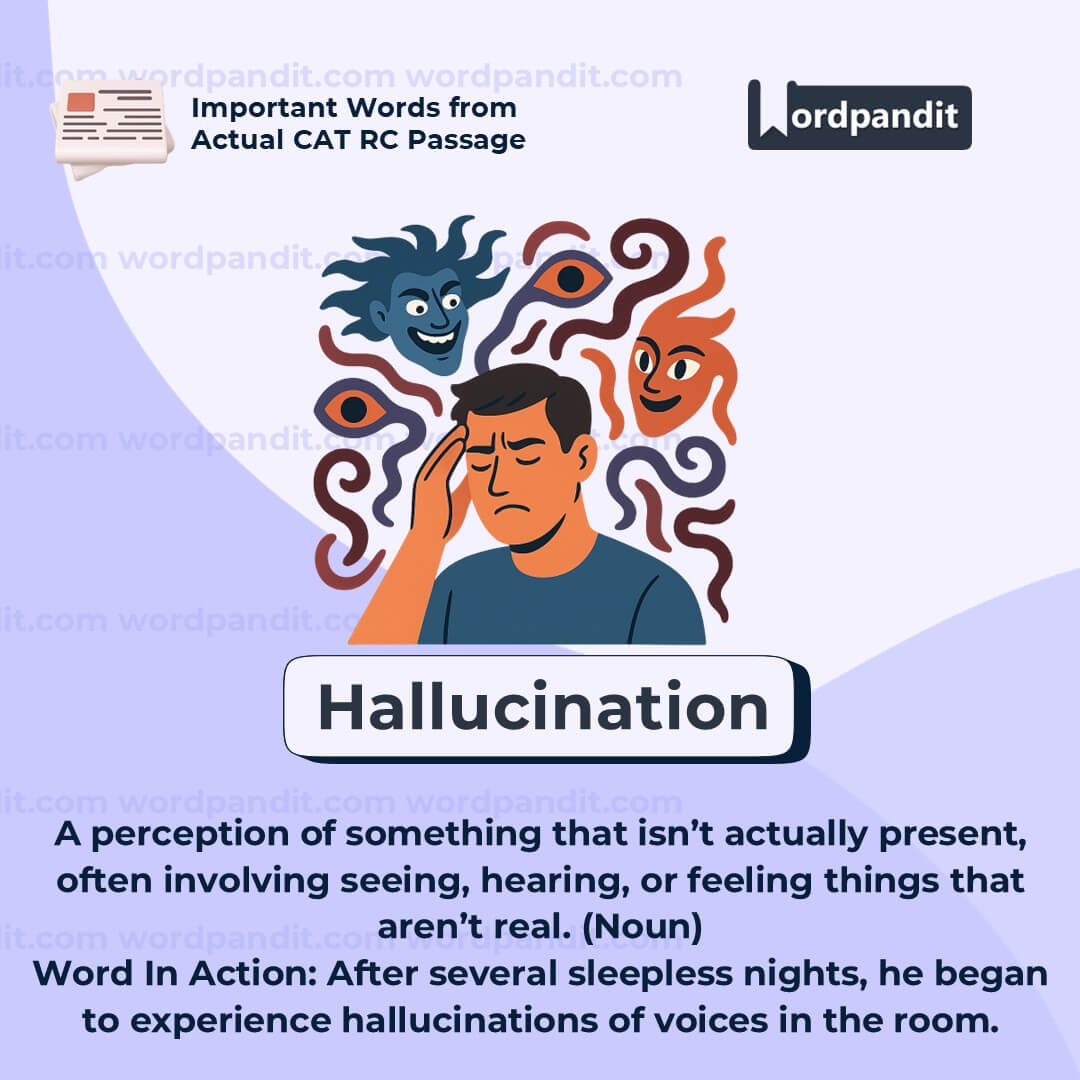
WORD-5: Hallucination
Context:
"The psychiatrist or alienist probing the nature of mental disease, of abnormal ideation, hallucination, delirium, melancholia, mania; the surgeon performing operations with the aid of hypnotism; the magnetizer claiming to correct the disequilibrium in the universal flow of magnetic fluids." - Source Unknown
Explanatory Paragraph:
“Hallucination” refers to a sensory experience that appears real but is created by the mind — seeing, hearing, or feeling things that are not actually present. It is often associated with mental disorders, neurological conditions, or the effects of drugs. In the context of the sentence, hallucination is listed among various psychological phenomena being studied by early psychiatrists and surgeons, reflecting the expanding understanding of how perception can be distorted by illness or suggestion.
Meaning: A false sensory perception — seeing, hearing, or sensing something that isn’t actually there (Noun)
Pronunciation: huh-loo-suh-NAY-shun
Difficulty Level: ⭐⭐⭐ Intermediate
Etymology: From Latin *hallucinari* (to wander in the mind, dream), later through French *hallucination*
Prashant Sir's Notes:
Hallucinations are not just about seeing “ghosts.” They can involve any of the senses and are often symptoms of serious mental or neurological issues. Always remember: hallucinations are internally generated but seem real to the person experiencing them.
Synonyms & Antonyms:
Synonyms: illusion, delusion, vision, mirage, false perception
Antonyms: reality, perception, awareness, clarity
Usage Examples:
- The patient described a vivid hallucination of voices speaking to him from the walls.
- Extreme dehydration can sometimes lead to hallucinations in healthy individuals.
- Hallucinations are a common symptom in severe cases of schizophrenia.
- The man’s hallucination made him believe he was being followed by invisible entities.
Cultural Reference:
"In literature and film, hallucinations often symbolize a breakdown in the boundary between reality and imagination — as seen in movies like *A Beautiful Mind*." - Film Psychology Journal
Think About It:
If a hallucination feels completely real to the person experiencing it, can it be considered a form of subjective truth? Why or why not?
Quick Activity:
Write a short scene describing someone experiencing a hallucination. Then, rewrite it from the perspective of someone watching them — what's the contrast?
Memory Tip:
“Hallucination” contains “illusion” — think of it as an internal illusion that tricks the brain into believing something is real when it’s not.
Real-World Application:
Understanding hallucinations is crucial in mental health care, where identifying and managing them can help diagnose conditions like psychosis, PTSD, or substance abuse disorders.
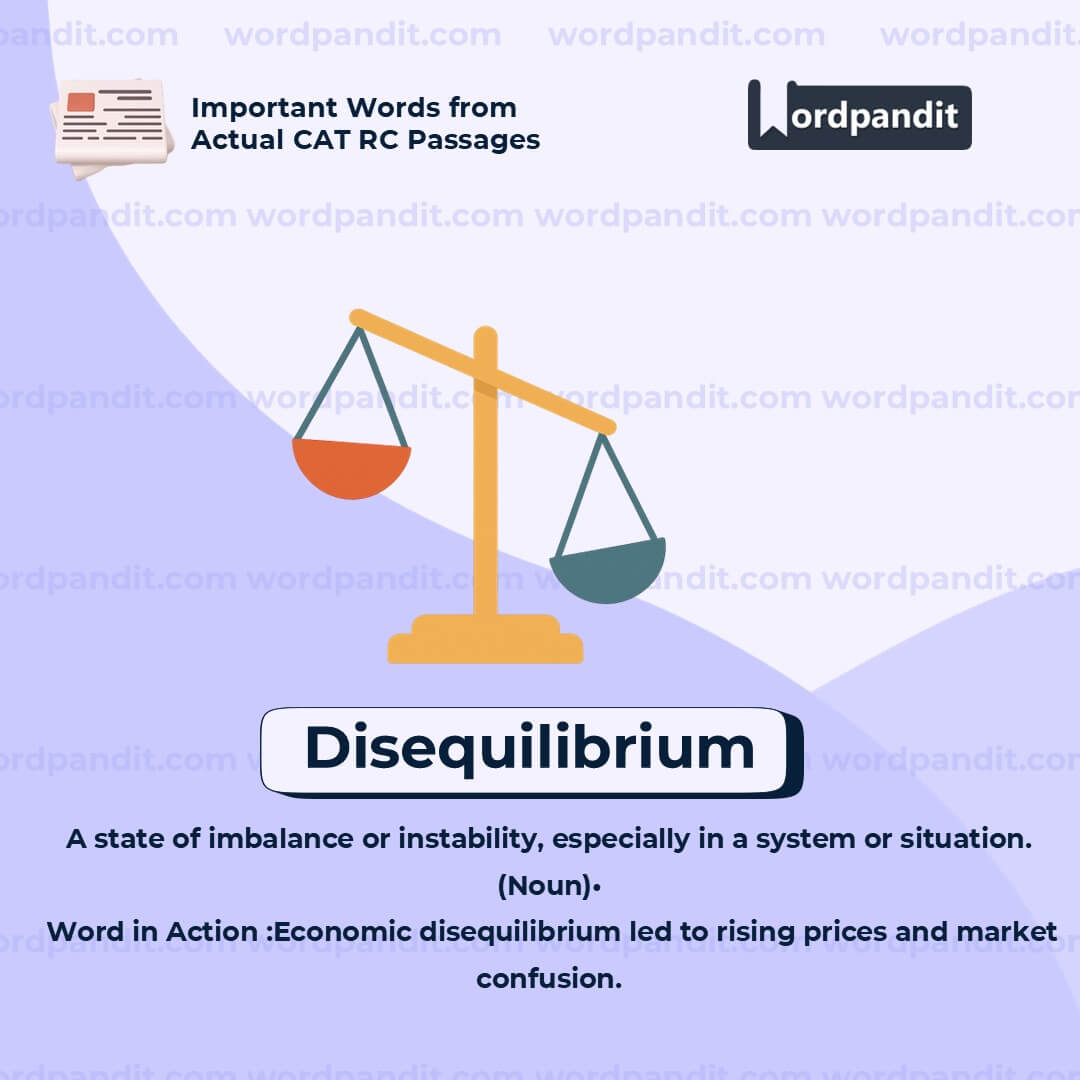
WORD-6: Disequilibrium
Context:
"The magnetizer claiming to correct the disequilibrium in the universal flow of magnetic fluids but who soon came to be regarded as a clever manipulator of the imagination; the physiologist and the physician who puzzled over sleep, dreams, sleepwalking, anesthesia, the influence of the mind on the body in health and disease." - Source Unknown
Explanatory Paragraph:
"Disequilibrium" refers to a state of imbalance or instability in a system. It can be physical, emotional, economic, or conceptual. In the given context, it metaphorically describes an imagined disruption in the “universal flow of magnetic fluids,” as believed by some early practitioners of mesmerism or magnetism. The magnetizer claimed to restore balance to this disrupted flow, suggesting that restoring equilibrium was key to health and well-being — though these claims were later discredited.
Meaning: A state of imbalance or instability, especially within a system (Noun)
Pronunciation: dis-ee-kwi-LIB-ree-um
Difficulty Level: ⭐⭐⭐ Intermediate to Advanced
Etymology: From Latin *dis-* (apart, away) + *aequilibrium* (balance), related to *aequus* (equal) + *libra* (balance, scale)
Prashant Sir's Notes:
“Disequilibrium” is simply the opposite of “equilibrium.” Whether in economics, biology, or psychology, it signals that something is out of sync and needs correction. In essays, this word can effectively describe tension or conflict in systems.
Synonyms & Antonyms:
Synonyms: imbalance, instability, disruption, unsteadiness
Antonyms: balance, stability, harmony, equilibrium
Usage Examples:
- The sudden rise in oil prices created economic disequilibrium across several markets.
- Motion sickness is often caused by a disequilibrium between visual and inner-ear signals.
- Stress can cause a psychological disequilibrium that affects one’s physical health.
- There was a clear disequilibrium in power between the two rival nations.
Cultural Reference:
"Disequilibrium" is commonly used in economics to describe when supply and demand are not in balance — a concept central to market theories like those of Keynes and Hayek. - The Economist’s Handbook
Think About It:
Can disequilibrium — whether emotional, political, or intellectual — be necessary for growth and innovation?
Quick Activity:
Choose a system you understand well (e.g., school, nature, your own body). Identify one type of disequilibrium that might occur in it and explain what would restore balance.
Memory Tip:
“Dis” = not, and “equilibrium” = balance. So, disequilibrium is simply “not in balance.” Easy to remember!
Real-World Application:
Understanding disequilibrium is essential in fields like medicine (inner ear issues), economics (inflation), and psychology (emotional distress), where balance is crucial for healthy functioning.
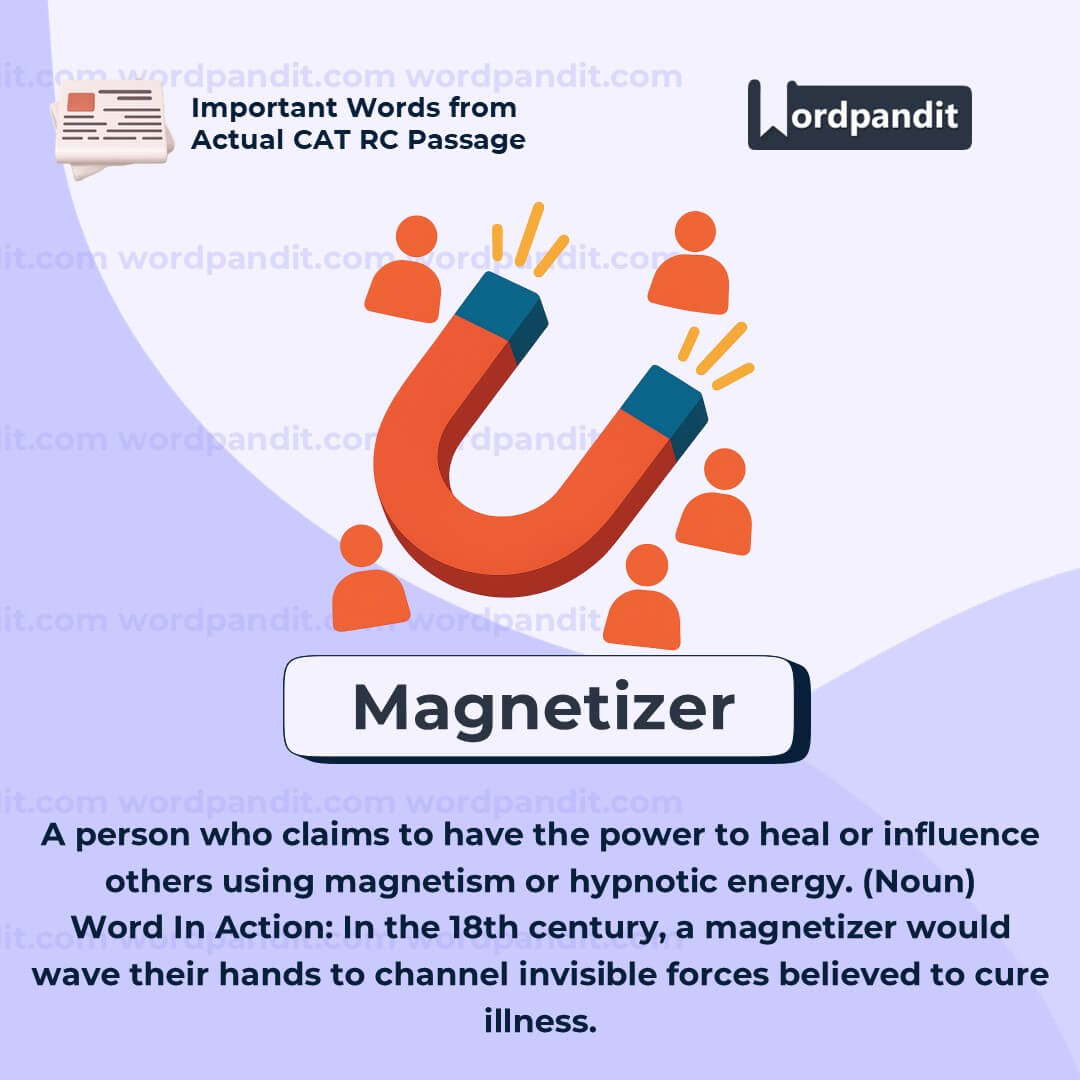
WORD-7: Magnetizer
Context:
"The psychiatrist or alienist probing the nature of mental disease, of abnormal ideation, hallucination, delirium, melancholia, mania; the surgeon performing operations with the aid of hypnotism; the magnetizer claiming to correct the disequilibrium in the universal flow of magnetic fluids but who soon came to be regarded as a clever manipulator of the imagination; the physiologist and the physician who puzzled over sleep, dreams, sleepwalking..." - Source Unknown
Explanatory Paragraph:
The word "magnetizer" refers to a practitioner of *animal magnetism*, a historical theory introduced by Franz Mesmer in the 18th century. Magnetizers claimed to influence the body’s internal “magnetic fluids” to heal illnesses or alter mental states, often through gestures, touch, or hypnotic suggestion. In this context, the magnetizer is portrayed as someone who believed they could restore balance to the body’s natural forces, though such practices were later dismissed as pseudoscience and seen more as theatrical manipulation of the mind than legitimate medical treatment.
Meaning: A historical healer who claimed to manipulate magnetic forces within the body to cure diseases or alter consciousness (Noun)
Pronunciation: MAG-nuh-ty-zur
Difficulty Level: ⭐⭐⭐ Advanced (archaic/technical)
Etymology: From “magnetize” (to attract or influence by magnetic force) + “-er” indicating a person who performs an action; tied to the theories of Franz Mesmer
Prashant Sir's Notes:
A “magnetizer” is not someone working with actual magnets, but rather someone from history who claimed mystical healing powers. Think of them like early hypnotists or energy healers, often blurring science and performance.
Synonyms & Antonyms:
Synonyms: mesmerist, hypnotist, healer, energy worker (historical)
Antonyms: skeptic, rationalist, physician (modern usage)
Usage Examples:
- The magnetizer claimed he could cure hysteria by restoring the natural magnetic flow in the body.
- Though once popular, the practices of 18th-century magnetizers are now seen as pseudoscientific.
- The crowd watched in awe as the magnetizer passed his hands over the patient’s body.
- Magnetizers laid the groundwork for the development of hypnotism in medical and psychological research.
Cultural Reference:
"Franz Mesmer, the father of 'animal magnetism,' inspired a wave of magnetizers in 18th-century Europe. Though eventually discredited, his work laid the foundation for the modern understanding of hypnosis." - History of Psychology Review
Think About It:
Why do certain pseudoscientific ideas — like magnetism or crystal healing — continue to appeal to people, even in an age dominated by medical science?
Quick Activity:
Research another outdated medical practice (e.g., bloodletting, phrenology) and compare it with the role of magnetizers. What do these practices reveal about the evolution of scientific thinking?
Memory Tip:
Think of “magnetizer” as someone who used *magnet-like* powers (imaginary ones!) to influence the body or mind — just like “mesmerize” comes from Mesmer’s magnetic theories.
Real-World Application:
While magnetizers are now considered outdated, their influence remains in modern hypnosis, psychosomatic medicine, and alternative therapies — showing the persistent human desire to connect mind, body, and healing energy.
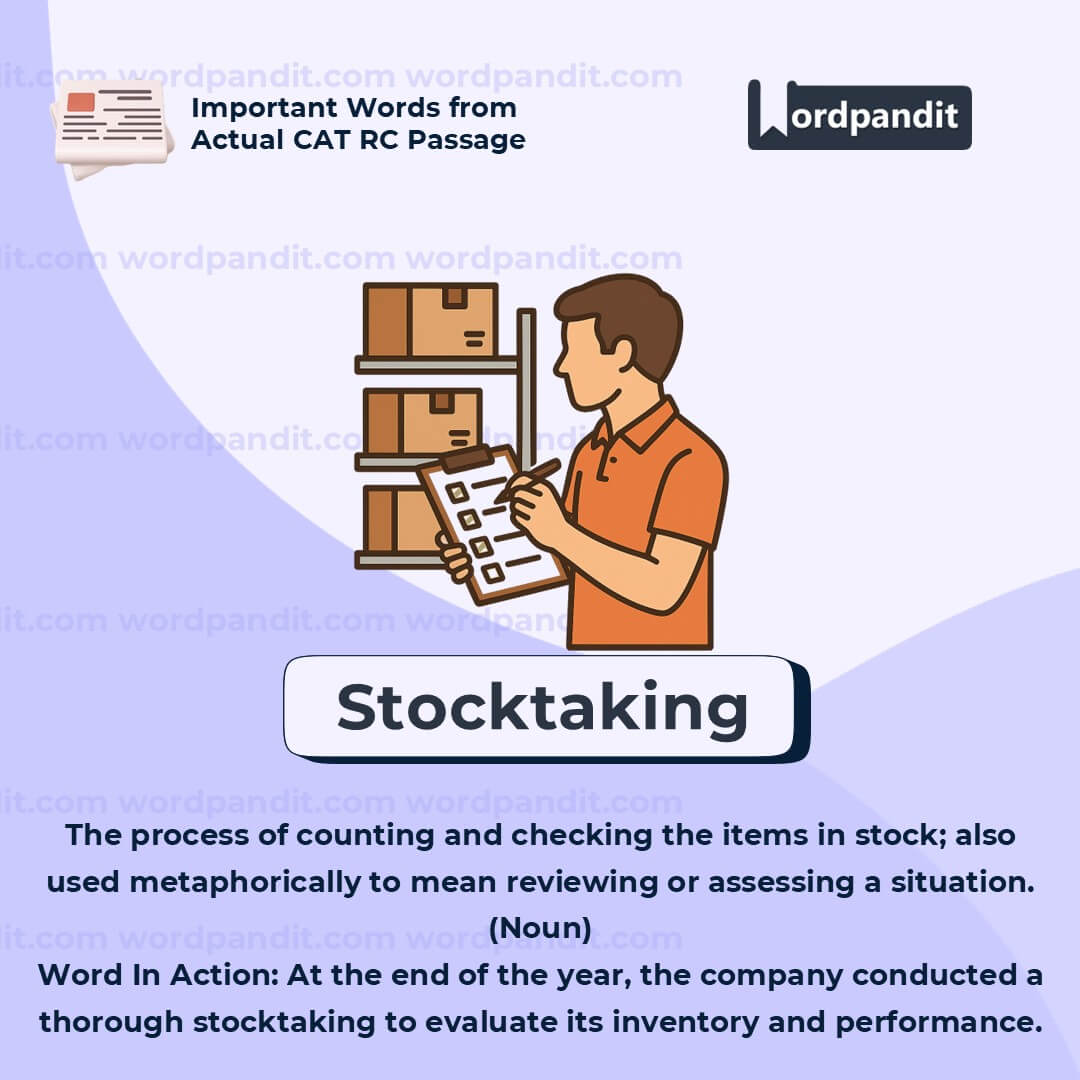
WORD-8: Stocktaking
Context:
"The new concept then serves as a kind of resting place or stocktaking in the development of ideas, giving satisfaction and a stimulus for further discussion or speculation." - Source Unknown
Explanatory Paragraph:
“Stocktaking” originally refers to the process of counting and evaluating the items in a store or inventory. In a more figurative or intellectual context, as used here, it means pausing to reflect, evaluate, and assess the progress of a particular line of thought or development. It implies a thoughtful moment of summary or consolidation before moving forward. In this sentence, it refers to a concept that marks a temporary stop in the evolution of ideas — offering clarity before continuing onward with more discussion or speculation.
Meaning: The act of reviewing or assessing progress, especially to summarize or evaluate before continuing (Noun)
Pronunciation: STOK-tay-king
Difficulty Level: ⭐⭐ Moderate
Etymology: From "stock" (inventory) + "taking" (from “take”), originally a business term referring to evaluating store items
Prashant Sir's Notes:
Stocktaking isn’t just for shopkeepers. In life and thought, it means taking a pause to assess where you are. Think of it as checking your intellectual or emotional “inventory” before progressing.
Synonyms & Antonyms:
Synonyms: evaluation, review, assessment, appraisal, audit
Antonyms: neglect, oversight, ignorance, disregard
Usage Examples:
- The company conducts an annual stocktaking to assess its financial health.
- After years of working non-stop, she paused for some personal stocktaking and re-evaluated her goals.
- The philosopher’s essay served as a moment of stocktaking in the evolution of ethical theory.
- Stocktaking at the midpoint of a project ensures that objectives are being met.
Cultural Reference:
"Stocktaking is not just a business practice; in literature and philosophy, it represents a moment of pause, like in T.S. Eliot’s poetry, where reflection paves the way for renewed insight." - Literary Review Journal
Think About It:
How often do you stop to take stock of your personal growth or the development of your ideas? What might you discover if you did?
Quick Activity:
Write a short paragraph reviewing your progress in a current project or habit. What would you label as a “stocktaking moment” in that journey?
Memory Tip:
Think of a shopkeeper “taking stock” of goods — now apply that to ideas, feelings, or progress. It’s the same logic: checking what’s there before you move on.
Real-World Application:
In education, leadership, and self-development, stocktaking is essential for long-term success. It allows individuals and organizations to reflect, realign, and refocus before taking the next step.
WORD-9: Delirium
Context:
"The psychical researcher of borderline phenomena (such as apparitions, spectral illusions, haunted houses, mediums, trance, automatic writing); the psychiatrist or alienist probing the nature of mental disease, of abnormal ideation, hallucination, delirium, melancholia, mania; the surgeon performing operations with the aid of hypnotism..." - Source Unknown
Explanatory Paragraph:
“Delirium” is a mental state characterized by confusion, disorientation, restlessness, and sometimes hallucinations. It is typically acute and temporary, often triggered by illness, trauma, or intoxication. In the context provided, "delirium" is grouped with other mental conditions and symptoms that were being studied by early psychiatrists and physicians. It represents a breakdown in normal cognitive functioning and is often seen in hospital settings or during severe infections like high fevers.
Meaning: A disturbed state of mind marked by confusion, agitation, and sometimes hallucinations; typically temporary (Noun)
Pronunciation: duh-LEER-ee-um
Difficulty Level: ⭐⭐⭐ Intermediate
Etymology: From Latin *delirare*, meaning "to go off the furrow," figuratively "to be deranged or crazy"
Prashant Sir's Notes:
Think of “delirium” as a storm in the mind — everything feels confused, disordered, and distorted. Unlike chronic mental conditions, delirium is usually short-lived but intense.
Synonyms & Antonyms:
Synonyms: confusion, hysteria, frenzy, disorientation, hallucination
Antonyms: clarity, lucidity, awareness, composure
Usage Examples:
- The patient experienced delirium during the night due to a high fever.
- In his delirium, he shouted random words and couldn’t recognize his family.
- Delirium is a common symptom among elderly patients with urinary tract infections.
- She wrote pages of nonsense while in a state of delirium brought on by dehydration.
Cultural Reference:
"Delirium" is also the title of the first book in Lauren Oliver’s dystopian trilogy, where love is portrayed as a dangerous disease — metaphorically linking the confusion of strong emotions with mental chaos. - YA Fiction Archive
Think About It:
Why do you think delirium has historically been viewed with fear or mystery? How might it blur the line between illness and imagination?
Quick Activity:
Read a medical or psychological article on delirium. List the causes, symptoms, and one real-life example of how it affects a patient. Reflect on how it differs from chronic mental disorders.
Memory Tip:
“Delirium” sounds like “delirious” — think of someone rambling in confusion or feverish excitement. That’s the essence of delirium.
Real-World Application:
In hospitals, recognizing delirium early can prevent serious complications, especially in elderly or ICU patients. It’s a key area of concern in geriatric and critical care medicine.
WORD-10: Catchwords
Context:
"The enrichments of literary and intellectual language led to an altered understanding of the meanings that underlie time-honored expressions and traditional catchwords." - Source Unknown
Explanatory Paragraph:
“Catchwords” are short, memorable phrases or expressions that capture a popular idea, belief, or slogan — often used in politics, advertising, or public discourse. In the provided context, the term refers to familiar phrases that have traditionally carried specific cultural or ideological meanings. The sentence suggests that as language becomes more intellectually enriched, these traditional catchwords begin to shift in meaning or are reinterpreted through a more thoughtful or nuanced lens.
Meaning: Memorable words or phrases commonly used to express ideas or rally support; slogans or buzzwords (Noun, plural)
Pronunciation: KATCH-wurds
Difficulty Level: ⭐⭐ Moderate
Etymology: From “catch” + “word” — originally a printer’s term used to describe repeated words at the bottom and top of pages to guide typesetting; later adopted for slogans or buzzwords
Prashant Sir's Notes:
Catchwords are like linguistic shortcuts — they carry a lot of emotional or ideological weight. But they can lose meaning over time or be reinterpreted. Always ask: what does this phrase *really* mean today?
Synonyms & Antonyms:
Synonyms: slogans, buzzwords, phrases, mantras, taglines
Antonyms: detailed arguments, explanations, original expressions
Usage Examples:
- Political campaigns are full of catchwords designed to appeal emotionally to voters.
- “Think different” was one of Apple’s most successful catchwords.
- Some catchwords like “freedom” or “progress” are so overused they lose specific meaning.
- The philosopher dissected traditional catchwords to reveal their deeper contradictions.
Cultural Reference:
"George Orwell warned against the use of empty catchwords in political speech, arguing that they conceal more than they reveal." - *Politics and the English Language*
Think About It:
Can catchwords be dangerous when they’re used without understanding? What role do they play in shaping public opinion?
Quick Activity:
Write down three popular catchwords you’ve heard recently (e.g., “innovation,” “empowerment,” “authenticity”). Define what each really means and whether it's being used meaningfully or as a buzzword.
Memory Tip:
Catchwords are “words that catch on” — quick, catchy, and widely repeated phrases that stick in your mind.
Real-World Application:
In advertising, politics, and media, catchwords are used to quickly convey complex ideas — but critical thinking helps distinguish meaningful messages from empty rhetoric.


