
📘 What’s Inside This CAT Para-Completion Question Post?
📝 Authentic CAT Para-Completion Question: Practice with a real CAT Para-Completion Question from a previous CAT exam.
✅ Detailed Question with Step-by-Step Solution: Each question is explained thoroughly for better understanding.
🔍 In-Depth Paragraph Analysis: Gain insights through line-by-line and paragraph-wise analysis
📚 Vocabulary Enhancement: Top 5 words explained from the paragraph
Para-Completion Questions
Question 17: There is a sentence that is missing in the paragraph below. Look at the paragraph and decide in which blank (option 1, 2, 3, or 4) the following sentence would best fit.
Sentence: Having made citizens more and less knowledgeable than their predecessors, the Internet has proved to be both a blessing and a curse.
Paragraph: Never before has a population, nearly all of whom has enjoyed at a least a secondary school education, been exposed to so much information, whether in newspapers and magazines or through YouTube, Google, and Facebook. ___(1)___. Yet it is not clear that people today are more knowledgeable than their barely literate predecessors. Contemporary advances in technology offered more serious and inquisitive students access to realms of knowledge previously unimaginable and unavailable. ___(2)___. But such readily available knowledge leads many more students away from serious study, the reading of actual texts, and toward an inability to write effectively and grammatically. ___(3)___. It has let people choose sources that reinforce their opinions rather than encouraging them to question inherited beliefs. ___(4)___.
Options:
A. Option 1
B. Option 2
C. Option 3
D. Option 4
Solution with Explanation
Answer: D
Solution by Wordpandit:
The ideal placement for the sentence would be in Blank 4, as it serves to synthesize the complex interplay between the Internet's positive and negative effects on human knowledge and learning. The paragraph initially sets the stage by questioning whether the abundance of information accessible today actually translates into a more knowledgeable population. It goes further to point out that this deluge of data could even be detrimental, leading students away from in-depth study and contributing to an erosion of effective writing skills.
The missing sentence, suggesting that the Internet has both beneficial and detrimental impacts on our learning and knowledge, acts as a thematic connector. It would smoothly transition into the paragraph's concluding point that the Internet, while offering a plethora of information, tends to encourage people to gravitate towards echo chambers where their pre-existing views are reinforced rather than critically examined. Thus, placing the sentence in Blank 4 would weave together the paragraph’s various threads, providing a comprehensive outlook on the double-edged nature of the Internet in relation to knowledge and learning. Therefore, Option 4 is the most fitting choice.
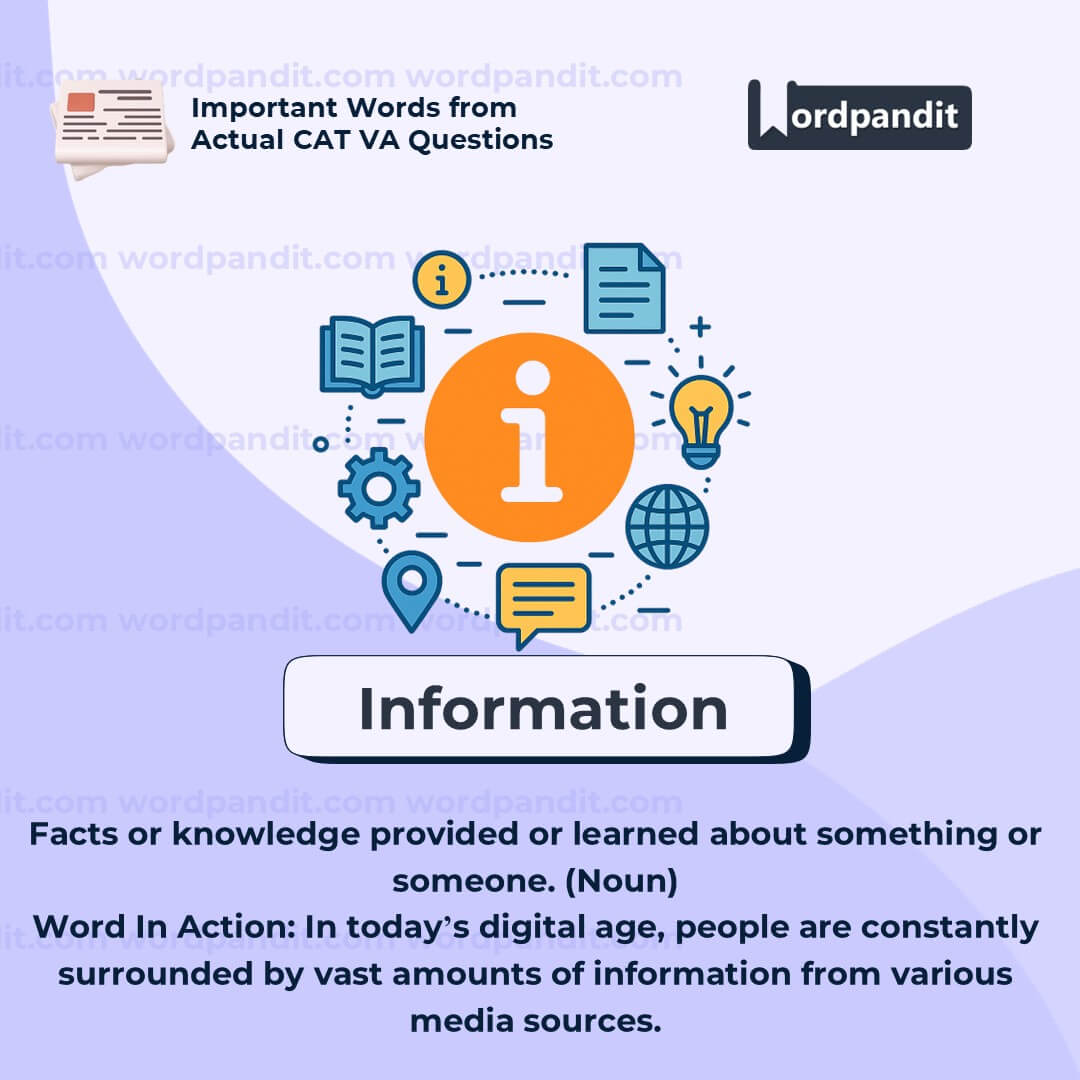
Word 1: Information
Context:
"Never before has a population, nearly all of whom has enjoyed at least a secondary school education, been exposed to so much information, whether in newspapers and magazines or through YouTube, Google, and Facebook."
Explanatory Paragraph:
"Information" refers to facts, knowledge, or data communicated or received about a particular topic. In today’s digital world, we are surrounded by information at an unprecedented level — from news articles and academic texts to social media posts and videos. The sentence emphasizes that access to information is now widespread, especially among educated populations, but also hints at the challenge of processing and making sense of such a large volume of content.
Meaning: Facts or knowledge provided or learned about something or someone (Noun)
Pronunciation: in-fer-MAY-shun
Difficulty Level: ⭐ Beginner
Etymology: From Latin *informatio*, meaning "a shaping or forming," from *informare* (to shape, form, describe).
Prashant Sir's Notes:
“Information” is more than just data—it’s data that has meaning. In exams, don’t just use the word vaguely; connect it with how it's used: “information overload,” “reliable information,” or “sharing information.”
Synonyms & Antonyms:
Synonyms: knowledge, data, facts, details, intelligence
Antonyms: misinformation, ignorance, confusion, disinformation
Usage Examples:
- We rely on accurate information to make informed decisions.
- The internet is a vast source of information — both helpful and misleading.
- The teacher provided background information before starting the lesson.
- Too much information can be overwhelming without proper filters.
Cultural Reference:
The phrase “information age” refers to our current era, where access to and control of information plays a central role in economics, politics, and everyday life — driven by digital technology.
Think About It:
In a world overflowing with information, how can we decide what to trust, and how do we avoid being misled?
Quick Activity:
List three sources of information you use regularly. Rank them by how much you trust them and explain why.
Memory Tip:
“Information” contains the word “inform” — so think of it as what helps you form ideas and decisions.
Real-World Application:
Understanding and evaluating information is a core skill in education, journalism, business, and everyday life. It's key to being informed, making decisions, and functioning in a knowledge-driven world.
Word 2: Knowledgeable
Context:
"Yet it is not clear that people today are more knowledgeable than their barely literate predecessors."
Explanatory Paragraph:
"Knowledgeable" describes someone who possesses a deep understanding or broad awareness of a subject. It goes beyond just having access to information — it implies internalizing and applying it wisely. In this sentence, the author questions whether having more access to information in the modern world actually makes people more informed or wise than earlier generations who may have had less access but possibly more focus or practical understanding.
Meaning: Well-informed and intelligent about a particular subject (Adjective)
Pronunciation: NAH-lij-uh-buhl
Difficulty Level: ⭐⭐ Beginner to Intermediate
Etymology: From “knowledge” + the adjective-forming suffix “-able” meaning “able to be.”
Prashant Sir's Notes:
Don't confuse “knowledgeable” with simply being educated. It's about real understanding, not just memorized facts. A person can be highly knowledgeable in one field and a novice in another. Focused learning builds deep knowledge.
Synonyms & Antonyms:
Synonyms: informed, educated, well-read, wise, intelligent
Antonyms: uninformed, ignorant, unaware, uneducated
Usage Examples:
- She is extremely knowledgeable about classical literature.
- You need to be knowledgeable in legal matters to handle contracts well.
- The tour guide was friendly and very knowledgeable about local history.
- Being knowledgeable doesn’t mean having an opinion about everything—it means understanding the facts.
Cultural Reference:
The term “knowledgeable” is often used to describe experts, such as professors, scientists, or historians, but in the age of the internet, it’s also a key quality in digital literacy — knowing how to separate truth from misinformation.
Think About It:
Does having access to endless information online make someone more knowledgeable, or does true knowledge require deeper engagement and reflection?
Quick Activity:
Pick a topic you're passionate about. Write three things that would make someone truly knowledgeable in that area (skills, experiences, or facts).
Memory Tip:
“Knowledgeable” = “knowledge” + “able” → able to use or apply knowledge!
Real-World Application:
Being knowledgeable is essential in professions, education, and civic life. It builds confidence, earns respect, and enables responsible decision-making in a world where critical thinking matters more than ever.
Word 3: Contemporary
Context:
"Contemporary advances in technology offered more serious and inquisitive students access to realms of knowledge previously unimaginable and unavailable."
Explanatory Paragraph:
"Contemporary" means belonging to the present time or occurring in recent history. It can describe anything that is modern, up-to-date, or currently relevant. In this context, "contemporary advances in technology" refers to recent developments—such as the internet, AI, or digital tools—that are transforming how students learn and explore knowledge. The term emphasizes the contrast between the limitations of the past and the opportunities of today.
Meaning: Existing or occurring at the present time; modern (Adjective)
Pronunciation: kuhn-TEM-puh-rair-ee
Difficulty Level: ⭐⭐ Beginner to Intermediate
Etymology: From Latin *contemporarius* — *con-* (with) + *temporarius* (of time), from *tempus* (time)
Prashant Sir's Notes:
“Contemporary” can refer to things of the present, but it’s also used to compare timelines. It’s common in art, literature, and history: e.g., “contemporary art,” “contemporary issues,” or “Shakespeare’s contemporaries.” Always check whether it means *modern* or *existing at the same time.*
Synonyms & Antonyms:
Synonyms: modern, current, present-day, up-to-date, recent
Antonyms: outdated, old-fashioned, ancient, obsolete, traditional
Usage Examples:
- Contemporary art challenges traditional aesthetics and often reflects current social issues.
- Many contemporary authors address the themes of technology and isolation.
- Contemporary advances in medicine have made surgeries safer and faster.
- Einstein and Picasso were contemporaries who redefined their respective fields.
Cultural Reference:
In museums, the “Contemporary Art” section typically showcases works created in the late 20th and 21st centuries, often dealing with social, political, and personal themes relevant to modern life.
Think About It:
What makes a piece of art, literature, or thought “contemporary”? Is it the time it was made, or the ideas it expresses?
Quick Activity:
List three contemporary technologies that have changed how people learn or communicate. Briefly explain their impact.
Memory Tip:
“Contemporary” = *con* (with) + *temporary* (time) → of the same or present time.
Real-World Application:
Understanding “contemporary” trends and technologies is essential in education, media, politics, and business—where staying current ensures relevance and adaptability in a fast-changing world.
Word 4: Inquisitive
Context:
"Contemporary advances in technology offered more serious and inquisitive students access to realms of knowledge previously unimaginable and unavailable."
Explanatory Paragraph:
"Inquisitive" describes someone who is eager to learn, curious, and interested in seeking out knowledge or understanding. It’s often associated with a healthy intellectual curiosity and a desire to ask questions. In this context, the word highlights a type of student who is not only serious about learning but also actively curious, exploring new areas made accessible by modern technology. An inquisitive mindset drives deeper learning and discovery.
Meaning: Eager for knowledge; curious and interested in learning (Adjective)
Pronunciation: in-KWIZ-uh-tiv
Difficulty Level: ⭐⭐ Beginner to Intermediate
Etymology: From Latin *inquirere* meaning "to seek or ask after," from *in-* (into) + *quaerere* (to seek)
Prashant Sir's Notes:
“Inquisitive” is a great word to describe a learner or thinker. It’s positive in educational contexts but can sound nosy in casual settings. For example, “an inquisitive student” is a compliment; “an inquisitive neighbor” might not be!
Synonyms & Antonyms:
Synonyms: curious, questioning, probing, investigative, eager to learn
Antonyms: uninterested, indifferent, apathetic, incurious
Usage Examples:
- The inquisitive child kept asking why the sky was blue.
- Inquisitive students tend to perform better because they engage deeply with the material.
- She had an inquisitive nature that led her to explore new subjects constantly.
- His boss appreciated his inquisitive mind and willingness to learn.
Cultural Reference:
Socrates, the Greek philosopher, is remembered for his inquisitive method of teaching, which involved asking continual questions — a technique now known as the “Socratic method.”
Think About It:
Is being inquisitive always positive, or are there times when too many questions can hinder progress or irritate others?
Quick Activity:
Write down three questions an inquisitive person might ask after reading a news article about a new discovery.
Memory Tip:
“Inquisitive” comes from “inquire” — to inquire is to question, so an inquisitive person loves to ask and learn!
Real-World Application:
Inquisitiveness is a valuable trait in science, journalism, research, and education — any field where asking the right questions can lead to innovation, insight, or truth.
Word 5: Inability
Context:
"But such readily available knowledge leads many more students away from serious study, the reading of actual texts, and toward an inability to write effectively and grammatically."
Explanatory Paragraph:
"Inability" refers to the lack of power, skill, or means to do something. It is the opposite of “ability.” In the context of the sentence, the word highlights a concerning outcome: although students have access to more knowledge than ever before, many are not engaging deeply with it, resulting in a failure—or inability—to master essential skills like writing clearly and correctly. This suggests that access alone is not enough; disciplined learning is still crucial.
Meaning: The state of being unable to do something; lack of skill or capacity (Noun)
Pronunciation: in-uh-BIL-ih-tee
Difficulty Level: ⭐ Beginner
Etymology: From Latin *in-* (not) + *habilitas* (ability, fitness), meaning "not having the skill or power."
Prashant Sir's Notes:
“Inability” is a negative noun—use it to describe what someone *can’t* do. Common academic uses include “inability to focus,” “inability to express,” or “inability to analyze.” It's different from refusal; inability is about lacking the skill, not the will.
Synonyms & Antonyms:
Synonyms: incapacity, incompetence, weakness, powerlessness
Antonyms: ability, skill, competence, proficiency
Usage Examples:
- The student's inability to organize his thoughts clearly hurt his essay score.
- Many fear public speaking due to an inability to express themselves under pressure.
- The device's inability to connect to the internet made it practically useless.
- Her inability to understand the assignment was due to a lack of background knowledge.
Cultural Reference:
In education debates, there is ongoing concern about the growing **inability** of students to read deeply or write effectively despite widespread access to digital resources—a phenomenon often linked to “surface learning.”
Think About It:
What’s more dangerous: the inability to access information, or the inability to use it well?
Quick Activity:
Write two sentences: one with “ability” and one with “inability.” Make sure each clearly contrasts the level of skill involved.
Memory Tip:
“In-” means “not,” and “ability” is a skill — so “inability” = not having the skill.
Real-World Application:
Recognizing areas of inability is the first step toward growth in education, career development, and personal improvement. It helps focus training and support where it’s most needed.
