
📘 What’s Inside This CAT Para-jumble Question Post?
📝 Authentic CAT Para-jumble Question : Practice with a real CAT Para-jumble Question from a previous CAT exam.
✅ Detailed Question with Step-by-Step Solution: Each question is explained thoroughly for better understanding.
📚 Vocabulary Enhancement: Top 5 words explained from the paragraph
Para-jumble Sentences
21. The four sentences (labelled 1, 2, 3 and 4) below, when properly sequenced, would yield a coherent paragraph. Decide on the proper sequencing of the order of the sentences and key in the sequence of the four numbers as your Answer:
1. The more we are able to accept that our achievements are largely out of our control, the easier it becomes to understand that our failures, and those of others, are too.
2. But the raft of recent books about the limits of merit is an important correction to the arrogance of contemporary entitlement and an opportunity to reassert the importance of luck, or grace, in our thinking.
3. Meritocracy as an organising principle is an inevitable function of a free society, as we are designed to see our achievements as worthy of reward.
4. And that in turn should increase our humility and the respect with which we treat our fellow citizens, helping ultimately to build a more compassionate society.
Solution with Explanation
Answer: 3214
Explanation:
The paragraph discusses the cultural dominance of meritocracy, its critique, and the potential positive societal impact of embracing a more humble view of achievement and failure.
- Sentence 3 opens the discussion by framing meritocracy as a natural by-product of a free society where personal achievements are seen as deserving of reward.
- Sentence 2 follows logically, referencing a wave of books that critique this dominant view and suggest reintroducing the role of luck or grace.
- Sentence 1 builds on that critique by suggesting that recognizing the role of chance helps us better understand both success and failure, in ourselves and others.
- Sentence 4 concludes the paragraph by highlighting the broader societal benefits of this shift in mindset: increased humility and compassion.
Thus, the best sequence is 3-2-1-4.
Word-1: Achievements
Context:
"The more we are able to accept that our achievements are largely out of our control, the easier it becomes to understand that our failures, and those of others, are too."
Explanatory Paragraph:
The word "achievements" refers to the successful completion of goals, tasks, or milestones—especially those gained through effort, skill, or courage. In this context, it challenges the conventional notion of individual control over success by suggesting that external factors play a significant role. Recognizing this broader view of achievement can lead to greater humility and empathy toward others’ failures and successes.
Meaning: Things accomplished successfully, often through effort, courage, or skill (noun – plural)
Pronunciation: uh-CHEEV-muhnts
Difficulty Level: ⭐⭐ Basic
Etymology: From Old French *achever*, meaning “to bring to a head” or “to complete,” which stems from Latin *ad caput* (to the head, or to a conclusion).
Prashant Sir's Notes:
Achievements aren't always trophies and certificates—they can also be quiet, personal wins like overcoming fear or building consistency. Keep in mind that true achievement often involves resilience, persistence, and learning from failure.
Synonyms & Antonyms:
Synonyms: accomplishments, successes, triumphs, attainments, milestones
Antonyms: failures, setbacks, defeats, shortcomings
Usage Examples:
- Graduating from university was one of her proudest achievements.
- The company celebrated the team's achievements at the annual gala.
- Despite many obstacles, his achievements in science were groundbreaking.
- We should measure our achievements by effort, not just outcomes.
Cultural Reference:
"We are what we repeatedly do. Excellence, then, is not an act, but a habit." — Attributed to Aristotle, often cited in discussions about consistent achievement.
Think About It:
Are our achievements truly our own, or are they a product of opportunities, support systems, and circumstances?
Quick Activity:
List three personal achievements—big or small—and write down what factors (internal and external) contributed to each one.
Memory Tip:
Think “achieve” = “a chief” — like a leader who completes goals. Achievements are what a ‘chief’ or champion creates!
Real-World Application:
The word "achievements" is common in résumés, motivational speaking, goal-setting, and educational assessments. It represents a way of tracking and celebrating progress in personal, academic, and professional life.
Word-2: Merit
Context:
"But the raft of recent books about the limits of merit is an important correction to the arrogance of contemporary entitlement and an opportunity to reassert the importance of luck, or grace, in our thinking."
Explanatory Paragraph:
The word "merit" refers to the quality of being good, worthy, or deserving of praise or reward—typically based on ability, effort, or achievement. It is a central concept in education, employment, and societal values, often linked with the idea of a “meritocracy,” where success is supposedly earned through talent and hard work. In this context, the quote challenges an overreliance on the idea of merit, suggesting that luck and grace also play a significant role in life outcomes, and that humility should accompany success.
Meaning: The quality of being particularly good, deserving reward or praise (noun)
Pronunciation: MEH-rit
Difficulty Level: ⭐⭐ Basic
Etymology: From Latin *meritum* meaning “due reward,” from *mereri*, “to earn or deserve.”
Prashant Sir's Notes:
"Merit" is often used to justify decisions, awards, or opportunities—yet it's important to remember that context, privilege, and access shape outcomes too. Recognize merit, but also question what systems define it and who gets to benefit from it.
Synonyms & Antonyms:
Synonyms: value, worthiness, excellence, credit, distinction
Antonyms: fault, deficiency, weakness, demerit
Usage Examples:
- Scholarships are awarded based on academic merit and financial need.
- Each idea was judged on its own merit during the meeting.
- They debated whether success comes from merit or privilege.
- Her promotion was earned purely on merit, not favoritism.
Cultural Reference:
Michael Sandel’s book The Tyranny of Merit critiques the belief that success is always earned, arguing that such thinking fosters arrogance and ignores the role of luck and social advantage.
Think About It:
Is it fair to judge people solely on merit, or should circumstances and privilege also be considered?
Quick Activity:
Write down one area where you believe you've succeeded due to merit and another where luck played a significant role. Reflect on the difference.
Memory Tip:
Think: “Merit” = “You earn it.” It’s about what you *deserve* through effort or excellence.
Real-World Application:
"Merit" is often discussed in education (merit-based scholarships), hiring (merit-based hiring), and social justice (the myth of meritocracy). Understanding it helps in navigating debates about fairness, opportunity, and recognition.
Word-3: Entitlement
Context:
"But the raft of recent books about the limits of merit is an important correction to the arrogance of contemporary entitlement and an opportunity to reassert the importance of luck, or grace, in our thinking."
Explanatory Paragraph:
The word "entitlement" refers to the belief or feeling that one inherently deserves special treatment, privileges, or rewards—often without earning them. In the provided context, it critiques a modern mindset in which people assume they are owed success or recognition simply by virtue of their position or effort, without acknowledging the roles of chance, privilege, or external support. The sentence suggests that such entitlement should be balanced with humility and an understanding of life's unpredictable nature.
Meaning: The belief that one is inherently deserving of privileges or special treatment (noun)
Pronunciation: en-TITLE-ment
Difficulty Level: ⭐⭐⭐ Intermediate
Etymology: From Old French *entitler*, based on Latin *titulus* meaning “title or claim.”
Prashant Sir's Notes:
“Entitlement” is a double-edged word. While legal entitlements (like pensions or rights) are justifiable, psychological entitlement—where someone believes they deserve more than others—can lead to arrogance and resentment. Always look at the context in which it’s used.
Synonyms & Antonyms:
Synonyms: privilege, right, claim, presumption, expectation
Antonyms: humility, unpretentiousness, modesty, forfeiture
Usage Examples:
- His sense of entitlement made it hard for him to accept failure.
- The program grants entitlement to healthcare for all citizens over 65.
- She walked into the meeting with an air of entitlement, expecting special treatment.
- Modern parenting debates often mention the risks of raising entitled children.
Cultural Reference:
In psychology, "entitlement" is a trait associated with narcissistic personality disorder, where individuals overestimate their importance and expect preferential treatment regardless of merit.
Think About It:
When does a legitimate right become a sense of entitlement? How can we ensure gratitude doesn’t get replaced by expectation?
Quick Activity:
Write two short sentences: one describing a healthy entitlement (like access to education), and one describing an unhealthy one (like expecting praise without effort).
Memory Tip:
“Entitlement” contains “title”—think of someone acting like they have a title or claim to something they haven’t earned.
Real-World Application:
"Entitlement" is used in legal, psychological, and social discussions. It helps frame conversations around rights, benefits, workplace culture, and generational attitudes toward success and effort.
Word-4: Meritocracy
Context:
"Meritocracy as an organising principle is an inevitable function of a free society, as we are designed to see our achievements as worthy of reward."
Explanatory Paragraph:
The word "meritocracy" refers to a system or society where success, power, and rewards are distributed based on individual merit—typically measured through talent, ability, and effort—rather than wealth, status, or privilege. In the provided context, it is presented as a natural outcome of a free society, where people are conditioned to associate personal achievements with deserved recognition. However, the term is also debated in modern discourse, as real-world inequalities often undermine the ideal of true merit-based progress.
Meaning: A system in which people are chosen or move ahead based on their abilities and achievements (noun)
Pronunciation: meh-ri-TOCK-ruh-see
Difficulty Level: ⭐⭐⭐ Intermediate
Etymology: Coined in 1958 by British sociologist Michael Young in his satirical book *The Rise of the Meritocracy*, from *merit* (worthiness) + *-cracy* (rule or power).
Prashant Sir's Notes:
"Meritocracy" is an ideal concept, but it's important to remember that access to opportunities can be uneven. While it sounds fair, the real test is whether the system genuinely gives everyone equal chances to prove their merit. Watch for how the term is used—sometimes to praise fairness, sometimes to critique hidden inequality.
Synonyms & Antonyms:
Synonyms: talent-based system, ability-based rule, reward-by-effort
Antonyms: nepotism, favoritism, aristocracy, plutocracy
Usage Examples:
- Many argue that a true meritocracy is still an ideal rather than a reality.
- The tech industry often promotes itself as a meritocracy, where skill trumps background.
- Critics claim that the education system favors the privileged, even in so-called meritocracies.
- In a functioning meritocracy, the most qualified individuals rise regardless of social class.
Cultural Reference:
Michael Sandel’s book The Tyranny of Merit argues that modern meritocracy can breed arrogance and fail to account for systemic inequality and luck in life outcomes.
Think About It:
Is a society truly meritocratic if not everyone starts from the same place? Can meritocracy unintentionally reinforce inequality?
Quick Activity:
List two benefits and two drawbacks of a meritocratic system. Consider how access, privilege, and fairness play into each point.
Memory Tip:
“Merit” + “cracy” (rule) = rule by merit. Think of it as a society where merit gets you to the top.
Real-World Application:
"Meritocracy" is widely used in discussions on education, politics, workplace fairness, and social mobility. It’s a key concept in debates about equal opportunity, privilege, and justice in modern democracies.
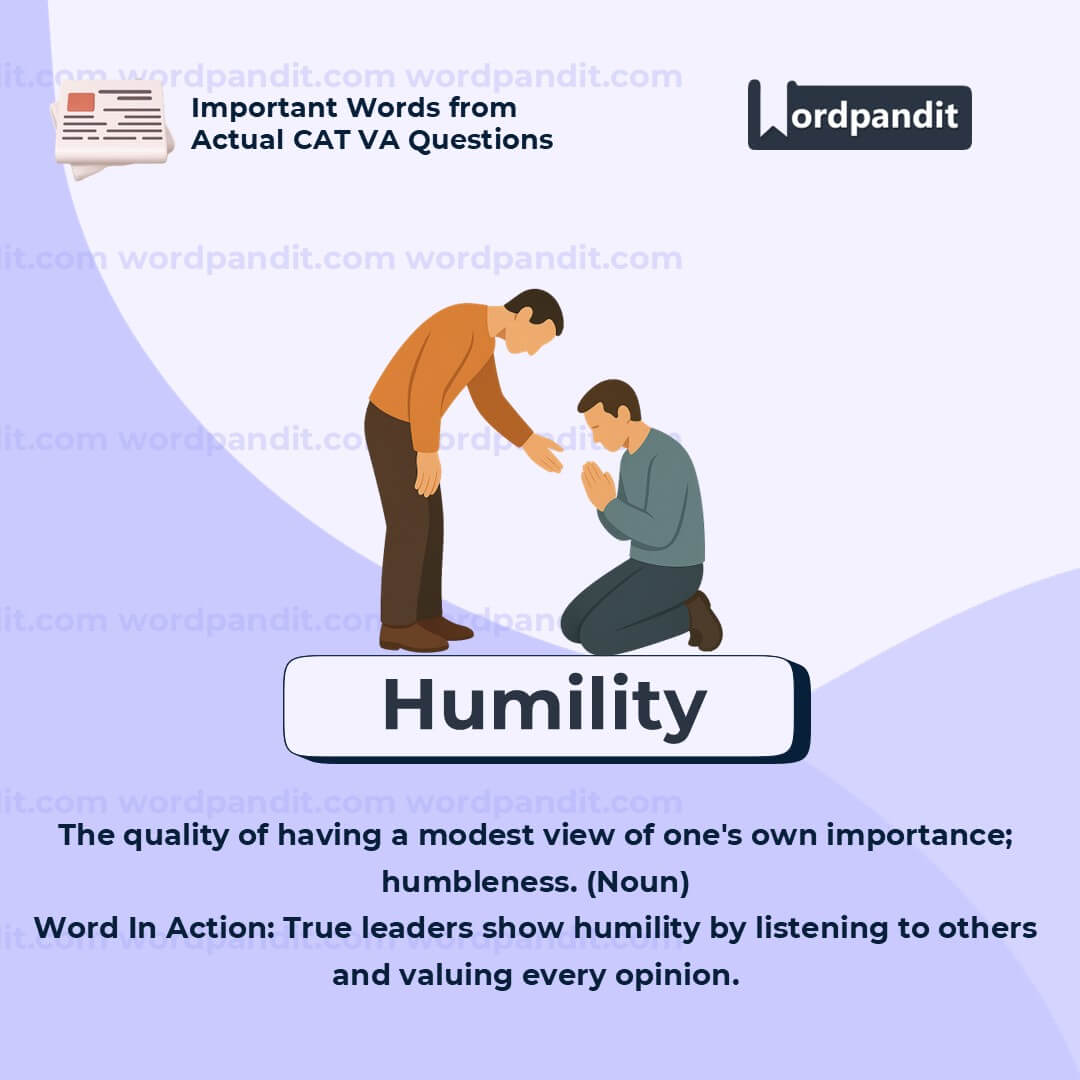
Word-5: Humility
Context:
"And that in turn should increase our humility and the respect with which we treat our fellow citizens, helping ultimately to build a more compassionate society."
Explanatory Paragraph:
"Humility" is the quality of being modest and respectful, without arrogance or pride in one's accomplishments or status. It involves recognizing one's limitations and showing a willingness to learn from others. In the given context, humility is seen as a social virtue—acknowledging that many successes (or failures) result from circumstances beyond our control. By cultivating humility, individuals can foster mutual respect and empathy, contributing to a more compassionate and united society.
Meaning: A modest view of one's importance; lack of arrogance or pride (noun)
Pronunciation: hyoo-MIL-uh-tee
Difficulty Level: ⭐⭐ Basic
Etymology: From Latin *humilitas*, from *humilis* meaning “lowly” or “grounded.”
Prashant Sir's Notes:
Humility is not about putting yourself down—it's about knowing your strengths without exaggeration, and acknowledging the role of others and circumstances. It’s a quiet strength, often associated with wisdom, maturity, and grace.
Synonyms & Antonyms:
Synonyms: modesty, meekness, unpretentiousness, self-effacement
Antonyms: arrogance, pride, conceit, egotism
Usage Examples:
- True leadership requires humility and the ability to listen to others.
- Her humility was evident in how she praised the entire team for their success.
- Success should be celebrated with humility, not boastfulness.
- The experience taught him humility and gave him a new perspective on life.
Cultural Reference:
In many spiritual traditions, such as Buddhism and Christianity, humility is considered a foundational virtue—essential for inner peace, learning, and harmonious living.
Think About It:
Can someone be confident and humble at the same time? How do you recognize genuine humility?
Quick Activity:
Write down one personal achievement and then list two people or circumstances that helped you reach it. How does this reflect humility?
Memory Tip:
“Humility” comes from “humus” (earth) — think of someone who stays grounded, no matter how high they rise.
Real-World Application:
"Humility" is valued in leadership, education, healthcare, and diplomacy. It’s a quality that strengthens collaboration, builds trust, and opens the door to continuous growth and better relationships.
