
📘 What’s Inside This CAT Para-Completion Question Post?
📝 Authentic CAT Paragraph Para-Completion:Practice with a real CAT Para-Completion Question from a previous CAT exam.
✅ Detailed Question with Step-by-Step SolutionEach question is explained thoroughly for better understanding.
🔍 In-Depth Paragraph AnalysisGain insights through line-by-line and paragraph-wise analysis
📚 Vocabulary Enhancement: Top 5 words explained from the paragraph
Para-Completion Questions
Q.17 There is a sentence that is missing in the paragraph below. Look at the paragraph and decide where (option 1, 2, 3, or 4) the following sentence would best fit.
Sentence: This philosophical cut at one’s core beliefs, values, and way of life is difficult enough.
Paragraph: The experience of reading philosophy is often disquieting. When reading philosophy, the values around which one has heretofore organised one’s life may come to look provincial, flatly wrong, or even evil. ___(1)___ When beliefs previously held as truths are rendered implausible, new beliefs, values, and ways of living may be required. ___(2)___ What’s worse, philosophers admonish each other to remain unsutured until such time as a defensible new answer is revealed or constructed. Sometimes philosophical writing is even strictly critical in that it does not even attempt to provide an alternative after tearing down a cultural or conceptual citadel. ___(3)___ The reader of philosophy must be prepared for the possibility of this experience. While reading philosophy can help one clarify one’s values, and even make one self-conscious for the first time of the fact that there are good reasons for believing what one believes, it can also generate unremediated doubt that is difficult to live with. ___(4)___
1. Option 1
2. Option 2
3. Option 3
4. Option 4
Solution with Explanation
Answer: 2
Here’s the analysis for the placement of the given sentence:
The sentence, "This philosophical cut at one’s core beliefs, values, and way of life is difficult enough," reflects a transition from introducing the challenging nature of philosophy to acknowledging the difficulty of enduring these fundamental shifts. Let’s examine each blank to see which position creates the most coherent flow:
- Option 1: This blank follows a sentence that describes how philosophy can disturb long-held beliefs. Placing the given sentence here would break the continuity, as the paragraph hasn’t yet emphasized the need for new beliefs or ways of living.
- Option 2: This blank is a strong candidate because it follows the idea of questioning previously held truths. Inserting the sentence here effectively bridges the shift from recognizing philosophy’s unsettling impact to highlighting the need for new beliefs, values, and ways of living. It provides a natural transition, emphasizing the difficulty of this philosophical experience before moving on to the potential need for new values.
- Option 3: This position follows a description of philosophy’s sometimes strictly critical approach without offering alternatives. However, the sentence would be less fitting here, as the idea of enduring doubt and difficulty is better addressed in connection with the questioning of core beliefs, making option 2 more appropriate.
- Option 4: This blank follows a summary about the reader’s need to be prepared for the unsettling effects of philosophy. The sentence would not fit here, as it would be redundant following the summary of philosophy’s impact.
Based on these observations, Option 2 is the most appropriate placement. The sentence provides a smooth transition between the unsettling nature of philosophical inquiry and the subsequent steps of forming new beliefs, making Option 2 the correct answer.
Word 1: Disquieting
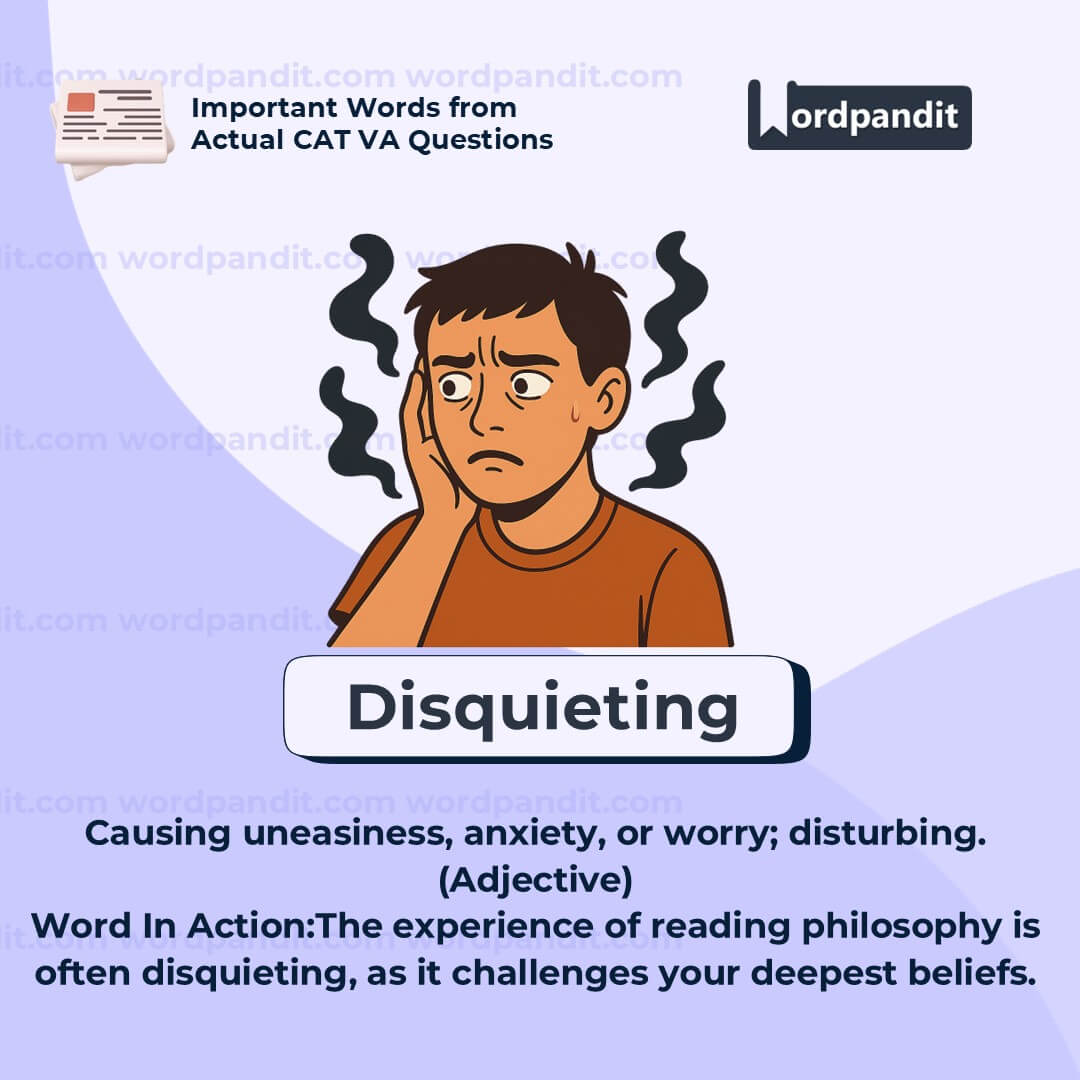
Context:
"The experience of reading philosophy is often disquieting." - Original Source
Explanatory Paragraph:
“Disquieting” refers to something that causes unease, anxiety, or a sense of mental disturbance. When something is disquieting, it disrupts our peace of mind, often prompting deeper reflection or concern. For example, reading complex or paradoxical philosophical ideas may shake our assumptions, making us feel intellectually or emotionally unsettled — hence, disquieted.
Meaning: Causing unease or anxiety; unsettling (Adjective)
Pronunciation: dis-kwai-uh-ting
Difficulty Level: ⭐⭐⭐ Intermediate
Etymology: From the prefix “dis-” (not) + “quiet” + “-ing,” meaning the act of removing peace or quiet.
Prashant Sir's Notes:
This word is perfect for describing situations, thoughts, or even art that stirs inner discomfort. Philosophy, critical thinking, or even horror films can be disquieting — pushing us to confront truths or feelings we might otherwise ignore.
Synonyms & Antonyms:
Synonyms: unsettling, disturbing, troubling, alarming, unnerving
Antonyms: calming, comforting, reassuring, soothing, peaceful
Usage Examples:
- The documentary's disquieting revelations left the audience in stunned silence.
- There’s something disquieting about the way he smiles when he's angry.
- Her dreams were filled with disquieting images that lingered through the morning.
- The silence in the room was disquieting, as if something terrible was about to happen.
Cultural Reference:
"George Orwell’s *1984* presents a disquieting vision of a surveillance state that eerily mirrors aspects of our current digital world." - Cultural Commentary
Think About It:
What kinds of ideas or truths have you encountered that felt disquieting, and how did they challenge your existing beliefs?
Quick Activity:
List 3 experiences (books, movies, news events) that you found disquieting. Briefly describe what made them so.
Memory Tip:
Think of “disquieting” as the opposite of “quieting” — instead of bringing peace, it removes it, causing mental noise or unease.
Real-World Application:
Use “disquieting” to describe news articles, personal realizations, or events that provoke discomfort or serious thought — especially in writing or speaking contexts that demand emotional depth.
Word 2: Provincial
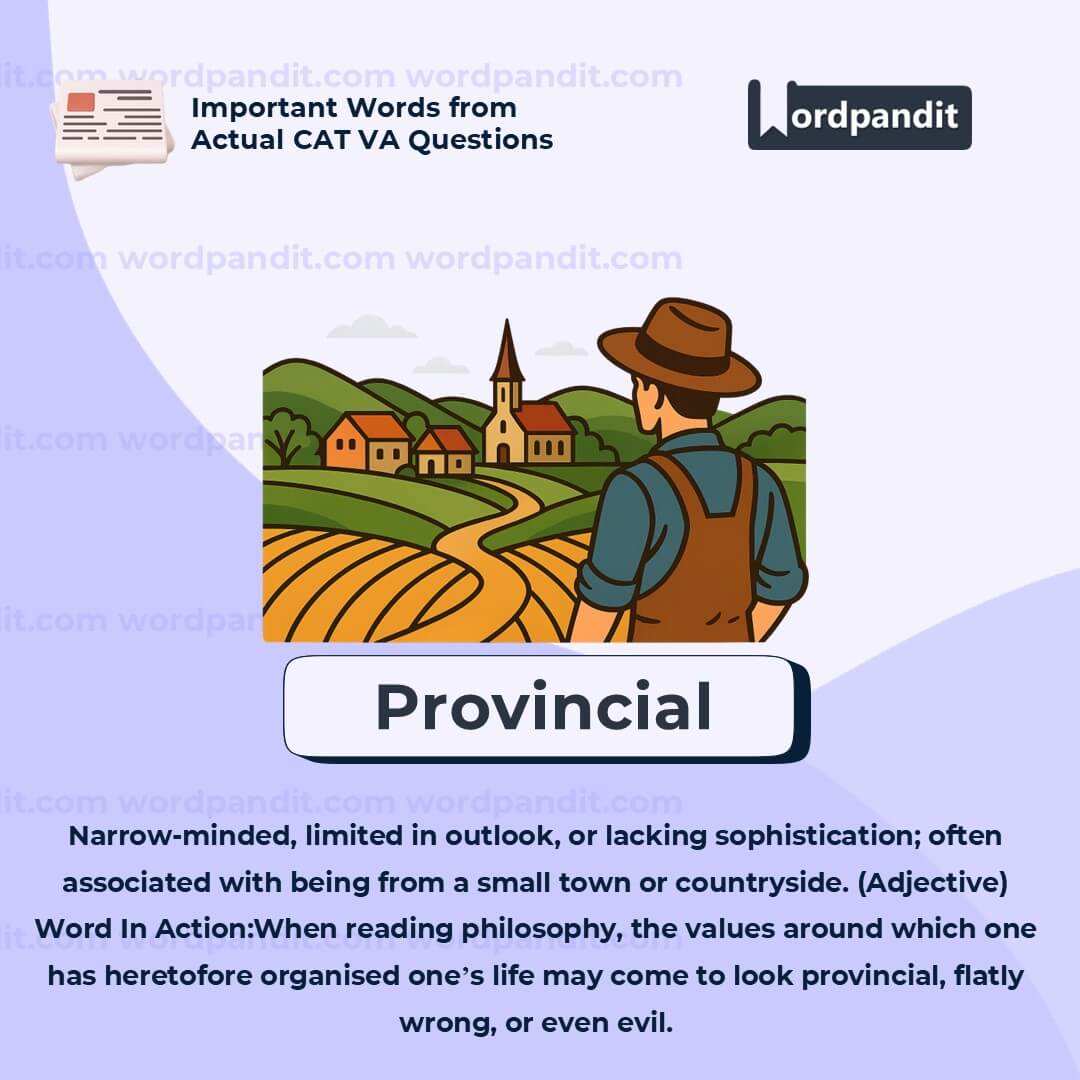
Context:
"When reading philosophy, the values around which one has heretofore organised one’s life may come to look provincial, flatly wrong, or even evil." - Original Source
Explanatory Paragraph:
“Provincial” describes someone or something that is narrow-minded, unsophisticated, or limited in outlook — often because of being confined to a particular locale or traditional perspective. In this context, it conveys how deeply personal values might appear parochial or outdated when exposed to broad, philosophical critique. It suggests a smallness or limitation of perspective that is challenged by more universal or critical thinking.
Meaning: Narrow-minded or limited in perspective; unsophisticated (Adjective)
Pronunciation: pruh-vin-shuhl
Difficulty Level: ⭐⭐⭐ Intermediate
Etymology: From Latin *provincia* (territory), originally referring to rural areas or people from the provinces, as opposed to cosmopolitan city dwellers.
Prashant Sir's Notes:
“Provincial” is a sharp word for challenging someone’s limited viewpoint. It's ideal when discussing ideas, habits, or beliefs that seem rooted in a narrow context. Especially useful when describing contrasts between open-minded or cosmopolitan perspectives and more rigid, local ones.
Synonyms & Antonyms:
Synonyms: narrow-minded, parochial, unsophisticated, insular, small-town
Antonyms: cosmopolitan, worldly, sophisticated, open-minded, broad
Usage Examples:
- Her provincial views on gender roles clashed with the modern workplace culture.
- The book criticizes the provincial mentality of people unwilling to embrace global perspectives.
- He was mocked for his provincial taste in fashion, which hadn’t changed in decades.
- Traveling exposed her to new cultures and helped her break free from her provincial upbringing.
Cultural Reference:
"In *Pride and Prejudice*, Elizabeth Bennet confronts the provincial attitudes of her neighbors and even her own family, highlighting the tension between local traditions and personal growth." - Literary Analysis
Think About It:
What beliefs or assumptions might seem provincial in light of global or philosophical perspectives?
Quick Activity:
Think of three opinions you held five years ago. Would you consider any of them provincial now? Reflect on what changed.
Memory Tip:
Think of “provincial” as being stuck in a “province” — away from the broader, more open city of ideas. It’s like seeing the world only through a village window.
Real-World Application:
Use “provincial” in critiques of attitudes, policies, or cultural practices that appear outdated or overly local in a globalized, connected world.
Word 3: Implausible
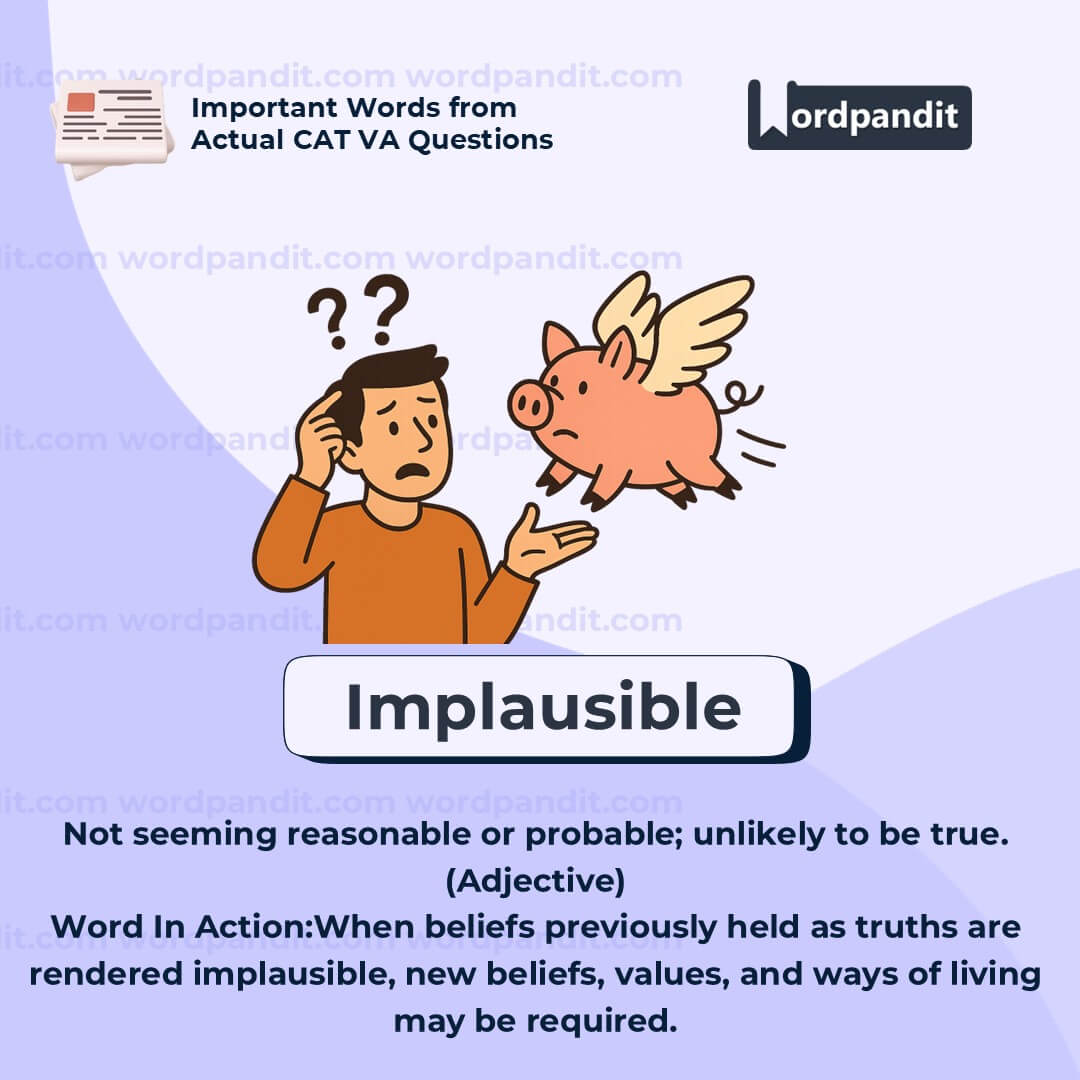
Context:
"When beliefs previously held as truths are rendered implausible, new beliefs, values, and ways of living may be required." - Original Source
Explanatory Paragraph:
“Implausible” refers to something that is not believable or likely to be true. When a belief or idea is labeled as implausible, it suggests that it lacks logical support or seems highly unlikely. In this philosophical context, the word captures how certain long-standing convictions may crumble under scrutiny, leaving behind a need for new understandings and ways of thinking.
Meaning: Not believable or realistic; unlikely to be true (Adjective)
Pronunciation: im-plaw-zuh-buhl
Difficulty Level: ⭐⭐ Beginner to Intermediate
Etymology: From Latin *in-* (not) + *plausibilis* (deserving applause, acceptable), from *plaudere* (to clap or approve).
Prashant Sir's Notes:
This word is extremely useful when analyzing arguments or ideas. In essays or discussions, calling something "implausible" is a precise way to challenge its credibility without being too aggressive. Ideal for critical thinking and debate contexts.
Synonyms & Antonyms:
Synonyms: unlikely, unbelievable, far-fetched, doubtful, unconvincing
Antonyms: plausible, believable, credible, likely, reasonable
Usage Examples:
- The plot of the movie became increasingly implausible after the second act.
- His excuse for missing the meeting was so implausible that no one believed him.
- As science progresses, certain traditional beliefs may appear implausible in light of new evidence.
- She found the politician’s promises implausible and voted for someone else.
Cultural Reference:
"In detective fiction, the culprit’s identity must not be implausible — readers demand clever, but believable resolutions." - Literary Insight
Think About It:
What belief or assumption did you once hold that now seems completely implausible? What changed your mind?
Quick Activity:
Write two short statements — one plausible and one implausible — about a recent event. Swap with a friend and try to guess which is which!
Memory Tip:
“Implausible” starts with “im-” meaning “not” and sounds like “not applause-worthy.” If an idea doesn’t deserve applause, it probably isn’t believable!
Real-World Application:
Use “implausible” in academic writing, debates, or daily conversation to question the likelihood or credibility of arguments, events, or claims.
Word 4: Admonish
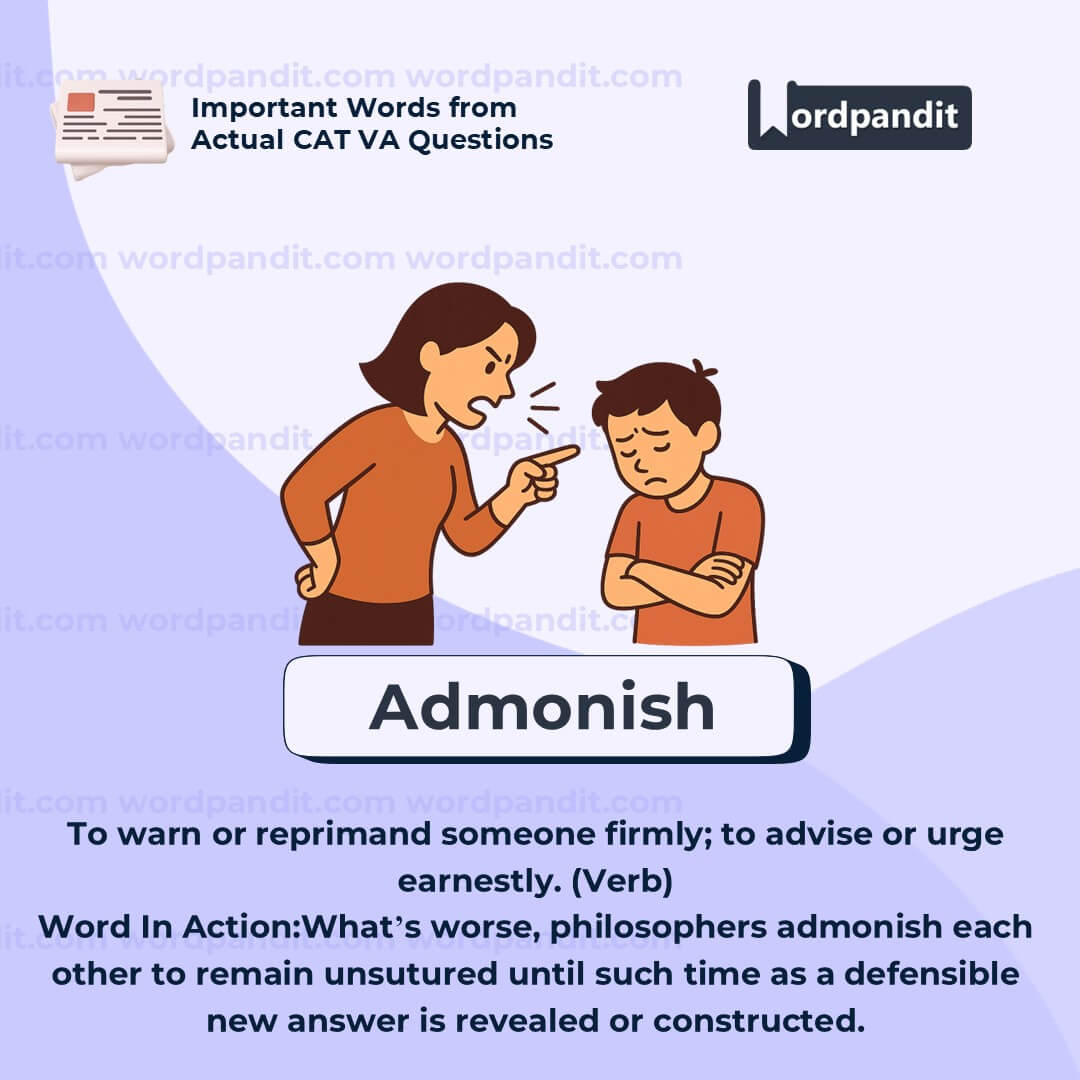
Context:
"What’s worse, philosophers admonish each other to remain unsutured until such time as a defensible new answer is revealed or constructed." - Original Source
Explanatory Paragraph:
To “admonish” means to caution, warn, or gently reprimand someone — usually with the intent of guiding or correcting them. In this philosophical context, it refers to thinkers urging one another to stay open, unsettled, or intellectually raw until a new, well-supported answer arises. The word carries an undertone of serious guidance, suggesting both care and authority in the communication.
Meaning: To warn, counsel, or reprimand someone firmly but gently (Verb)
Pronunciation: ad-mon-ish
Difficulty Level: ⭐⭐⭐ Intermediate
Etymology: From Latin *admonere*, meaning “to remind, advise, warn,” from *ad-* (to) + *monere* (warn).
Prashant Sir's Notes:
This is a great word to describe a formal or serious kind of advice — stronger than “suggest” but not as harsh as “scold.” Often used when the speaker has moral or intellectual authority, like a teacher, parent, or philosopher.
Synonyms & Antonyms:
Synonyms: warn, reprimand, caution, advise, rebuke
Antonyms: praise, compliment, approve, encourage
Usage Examples:
- The teacher admonished the student for not submitting the assignment on time.
- She gently admonished her friend for making assumptions without evidence.
- The manager admonished the team to stay focused during the final week of the project.
- He was admonished by the committee for breaching protocol.
Cultural Reference:
"In many religious texts, prophets admonish the people to turn away from wrongdoing and embrace righteousness." - Theological Commentary
Think About It:
How do you respond to being admonished — with resistance, reflection, or change?
Quick Activity:
Write a two-line imaginary dialogue in which a mentor admonishes a student. Try to show care and firmness in the tone.
Memory Tip:
“Admonish” sounds like “add a mon-ish” — imagine a wise “monk” giving serious advice or correction. He doesn’t yell — he calmly warns.
Real-World Application:
“Admonish” is a great word to use in academic writing, parenting discussions, leadership contexts, or when discussing moral or ethical critique in a respectful tone.
Word 5: Citadel
Context:
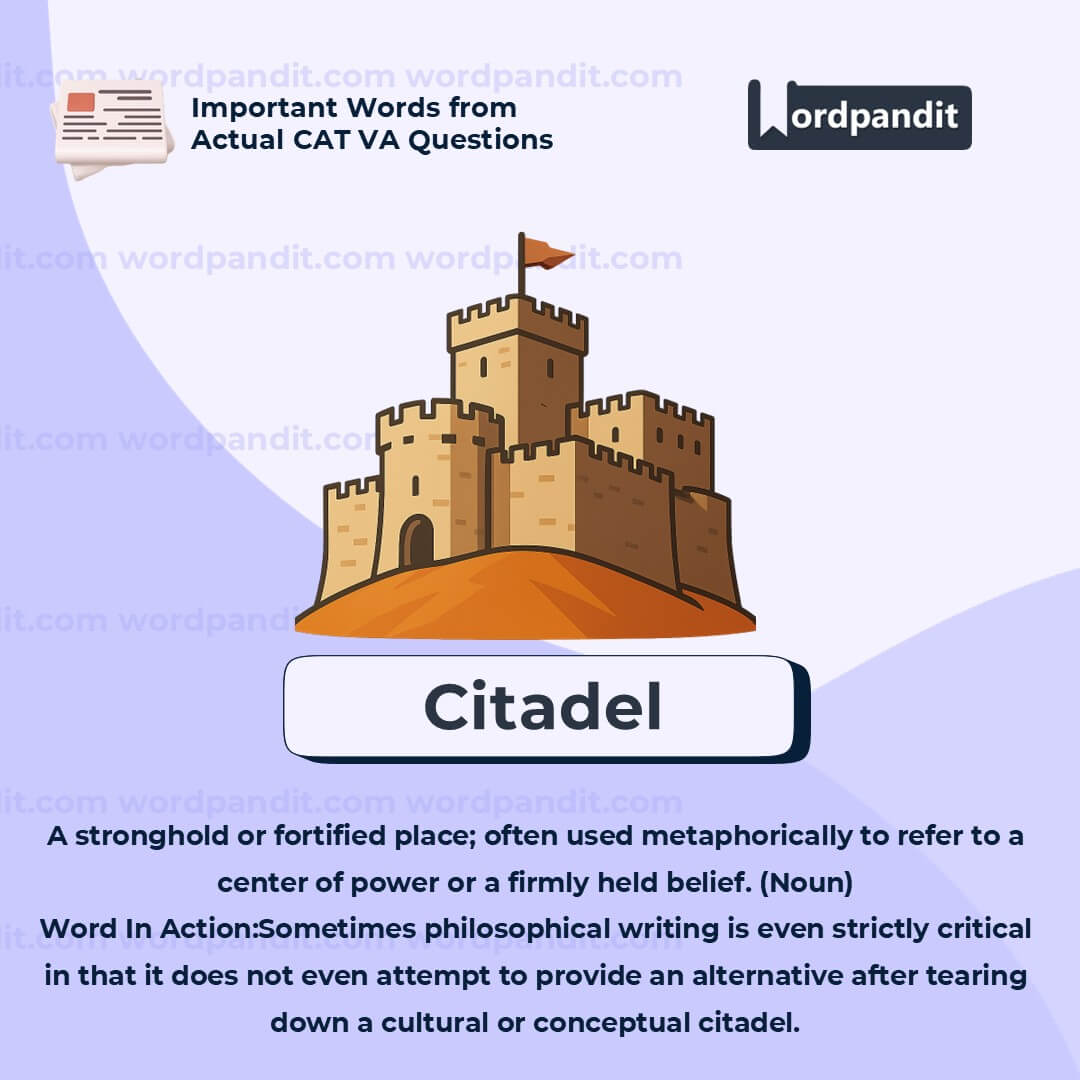
"Sometimes philosophical writing is even strictly critical in that it does not even attempt to provide an alternative after tearing down a cultural or conceptual citadel." - Original Source
Explanatory Paragraph:
“Citadel” originally refers to a fortress that protects a city, especially one positioned high up. Metaphorically, it signifies a stronghold of beliefs, traditions, or ideologies — something heavily defended and central to a particular worldview. In the context of philosophy, a “conceptual citadel” suggests deeply entrenched systems of thought or societal norms that writers aim to dismantle or critique without necessarily offering a replacement.
Meaning: A fortress protecting a city; a stronghold of beliefs or principles (Noun)
Pronunciation: sit-uh-del
Difficulty Level: ⭐⭐ Beginner to Intermediate
Etymology: From Middle French *citadelle*, from Italian *cittadella* (little city), based on Latin *civitas* (city).
Prashant Sir's Notes:
This word is fantastic when used metaphorically. Don’t just associate it with castles or battles — think about belief systems, traditions, or institutions as “citadels” of power or influence that can be challenged or defended.
Synonyms & Antonyms:
Synonyms: fortress, bastion, stronghold, fortification, strong center
Antonyms: vulnerability, openness, weak point, exposed area
Usage Examples:
- The rebels stormed the ancient citadel at dawn, breaking the final line of defense.
- For centuries, the church acted as a moral citadel in the community.
- She built a citadel of confidence around her ideas, making them hard to challenge.
- The university became a citadel of progressive thought during the civil rights movement.
Cultural Reference:
"The Citadel," a 1937 novel by A.J. Cronin, highlights the medical establishment as both a physical and ideological citadel, challenging traditional ethics in medicine. - Literary Overview
Think About It:
What personal or societal “citadels” do you think should be questioned or dismantled — and why?
Quick Activity:
Identify one belief, tradition, or institution you see as a “citadel.” Describe in 1-2 lines what makes it so protected or difficult to challenge.
Memory Tip:
Think of “citadel” as a “city + shell” — a protected shell around a city or belief system. It’s where the strongest defenses lie.
Real-World Application:
Use “citadel” metaphorically in debates, essays, and discussions about institutions, ideologies, or entrenched norms — especially when discussing their resistance to change or critique.
