
📘 What’s Inside This CAT Para-Completion Question Post?
📝 Authentic CAT Para-Completion Question: Practice with a real CAT Para-Completion Question from a previous CAT exam.
✅ Detailed Question with Step-by-Step Solution:Each question is explained thoroughly for better understanding.
🔍 In-Depth Paragraph Analysis:Gain insights through line-by-line and paragraph-wise analysis
📚 Vocabulary Enhancement: Top 5 words explained from the paragraph
Para-Completion Questions
Q.17 There is a sentence that is missing in the paragraph below. Look at the paragraph and decide where (option 1, 2, 3, or 4) the following sentence would best fit.
Sentence: Dualism was long held as the defining feature of developing countries in contrast to developed countries, where frontier technologies and high productivity were assumed to prevail.
Paragraph: ___(1)___. At the core of development economics lies the idea of ‘productive dualism’: that poor countries’ economies are split between a narrow ‘modern’ sector that uses advanced technologies and a larger ‘traditional’ sector characterized by very low productivity. ___(2)___. While this distinction between developing and advanced economies may have made some sense in the 1950s and 1960s, it no longer appears to be very relevant. A combination of forces have produced a widening gap between the winners and those left behind. ___(3)___. Convergence between poor and rich parts of the economy was arrested and regional disparities widened. ___(4)___. As a result, policymakers in advanced economies are now grappling with the same questions that have long preoccupied developing economies: mainly how to close the gap with the more advanced parts of the economy.
Options:
1. Option 1
2. Option 2
3. Option 3
4. Option 4
Solution with Explanation
Answer: 2
Explanation:
The sentence, “Dualism was long held as the defining feature of developing countries in contrast to developed countries, where frontier technologies and high productivity were assumed to prevail,” introduces the concept of economic dualism as a distinguishing characteristic of developing versus developed economies. This sentence would work well as a foundation for the rest of the paragraph, setting up the idea of dualism and contrasting it between developing and developed economies.
Let’s consider each option:
- Option 1: This blank could potentially work as it is the paragraph’s opening, but placing the sentence here would make the subsequent transition to the core concept of “productive dualism” a bit abrupt, as there’s no specific setup for “productive dualism” as a term yet.
- Option 2: This blank is the most fitting because it follows the initial introduction of “productive dualism” as a central idea in development economics. The sentence would reinforce the historical perspective on dualism, highlighting how it was traditionally used to differentiate developing and developed countries. This placement also prepares readers for the upcoming discussion on the changing relevance of this dualism in contemporary economies.
- Option 3: This blank would not be ideal because it follows a shift to how this distinction has lost relevance over time. Placing the sentence here would disrupt the logical progression, as it would reintroduce the initial concept after it’s already been questioned.
- Option 4: This blank is also unsuitable, as it appears too late in the paragraph, after the focus has shifted toward the convergence and regional disparities in advanced economies.
Therefore, Option 2 is the correct answer, as it provides a cohesive and logical flow by reinforcing the background idea of dualism and contrasting developing and developed countries before discussing its changing relevance.
Word 1: Development
Context:
"At the core of development economics lies the idea of ‘productive dualism’: that poor countries’ economies are split between a narrow ‘modern’ sector that uses advanced technologies and a larger ‘traditional’ sector characterized by very low productivity" - The Economist
Explanatory Paragraph:
The word "development" refers to the process of growth, progress, or improvement. In the economic context, it typically denotes the advancement of economic structures, institutions, and living standards. This often involves a transition from traditional agriculture-based economies to more modern, industrialized, and service-oriented systems. The word is also used more broadly to signify enhancement in areas such as technology, education, healthcare, and governance.
Meaning: The process of improvement or growth, especially in a country or organization (Noun)
Pronunciation: dih-vel-uhp-muhnt
Difficulty Level: ⭐⭐ Basic
Etymology: From Old French *desveloper* meaning "unwrap, unfurl", later evolved into “develop” and its noun form “development”.
Prashant Sir's Notes:
“Development” is a foundational word in social sciences, particularly in economics and politics. It often appears in exams in the context of “economic development”, “sustainable development”, and “human development index (HDI)”. Understand both its general and technical usage across domains.
Synonyms & Antonyms:
Synonyms: progress, advancement, growth, evolution, expansion
Antonyms: decline, stagnation, regression, deterioration
Usage Examples:
- The country has seen rapid development in infrastructure over the past decade.
- Human development is about expanding the richness of human life, not just the economy.
- Software development is one of the fastest-growing job sectors today.
- His development as a musician was influenced by classical and jazz traditions.
Cultural Reference:
"The Human Development Index is a summary measure of average achievement in key dimensions of human development." - United Nations Development Programme (UNDP)
Think About It:
Can a country be considered developed if its economic growth is not inclusive or sustainable?
Quick Activity:
List three sectors (education, healthcare, infrastructure, etc.) and write a sentence for each explaining how development can be measured in that sector.
Memory Tip:
Think of “development” as *de-veloping* or unwrapping potential — it’s about growth unfolding step-by-step like opening a package.
Real-World Application:
The concept of development is crucial in policymaking, particularly in designing programs for education, healthcare, and poverty alleviation. International bodies like the UN and World Bank use it to assess and guide global aid and reform.
Word 2: Productive
Context:
"At the core of development economics lies the idea of ‘productive dualism’: that poor countries’ economies are split between a narrow ‘modern’ sector that uses advanced technologies and a larger ‘traditional’ sector characterized by very low productivity" - The Economist
Explanatory Paragraph:
The word "productive" describes someone or something that generates results, especially in terms of output or efficiency. In economics, it often refers to the ability of individuals, systems, or sectors to produce goods or services effectively. A productive sector contributes significantly to growth and development, whereas an unproductive one yields little value despite effort or resources. The word can also be used in daily life to describe fruitful activities, such as a productive meeting or study session.
Meaning: Capable of producing large amounts of goods, results, or ideas; efficient (Adjective)
Pronunciation: pruh-duhk-tiv
Difficulty Level: ⭐⭐ Basic
Etymology: From Latin *productivus*, meaning “fit for production,” derived from *producere* ("to bring forth")
Prashant Sir's Notes:
“Productive” is a versatile word used across multiple contexts—economic, academic, and personal. In exams and essays, it’s valuable when discussing efficiency, growth, or time management. Always pair it with a clear subject: a productive sector, a productive individual, a productive strategy, etc.
Synonyms & Antonyms:
Synonyms: efficient, fruitful, effective, industrious, high-yielding
Antonyms: unproductive, inefficient, idle, barren, wasteful
Usage Examples:
- The factory became more productive after upgrading its machinery.
- She had a productive weekend and finished all her assignments.
- Modern farming techniques have made agriculture more productive.
- A productive team meeting can save hours of confusion later.
Cultural Reference:
"Productivity isn’t about being a workhorse, keeping busy or burning the midnight oil… it’s about priorities and fiercely protecting your time." – Margarita Tartakovsky, Psychology Today
Think About It:
Is being busy always the same as being productive? How can we distinguish the two in our daily lives?
Quick Activity:
Make a list of three things you did yesterday. Label each as “productive” or “not productive” and explain why.
Memory Tip:
Think of "productive" as "producing something active"—when you’re productive, you’re actively creating results.
Real-World Application:
Being productive is crucial in professional environments, where results often matter more than effort. Tools like calendars, task lists, and time-tracking apps help improve personal productivity, while economic productivity is tracked through indicators like GDP and output per worker.
Word 3: Technologies
Context:
"At the core of development economics lies the idea of ‘productive dualism’: that poor countries’ economies are split between a narrow ‘modern’ sector that uses advanced technologies and a larger ‘traditional’ sector characterized by very low productivity" - The Economist
Explanatory Paragraph:
"Technologies" refers to the various tools, systems, and methods developed through scientific knowledge to solve problems or perform specific functions. Technologies can be physical (like machines), digital (like software), or procedural (like manufacturing techniques). In economics and development, advanced technologies often represent innovation and efficiency that distinguish modern, high-output sectors from traditional, low-productivity sectors. These tools not only improve productivity but also shape how societies evolve over time.
Meaning: Scientific methods, tools, or systems used to solve problems or achieve objectives (Noun, plural of "technology")
Pronunciation: tek-nol-uh-jeez
Difficulty Level: ⭐⭐ Basic
Etymology: From Greek *tekhnologia* — “systematic treatment of an art or skill”; from *techne* (art, skill) + *logia* (study)
Prashant Sir's Notes:
“Technologies” often appears in discussions about growth, development, and change. The word is plural, so always use plural verbs with it. It’s useful across topics—science, education, agriculture, and business. When analyzing essays or articles, think about what kinds of technologies are being discussed: digital, mechanical, biological, etc.
Synonyms & Antonyms:
Synonyms: innovations, tools, systems, devices, machinery
Antonyms: manual methods, outdated tools, primitive techniques
Usage Examples:
- New agricultural technologies have boosted crop yields dramatically.
- Many traditional industries are now being transformed by digital technologies.
- Access to clean water has improved thanks to advanced filtration technologies.
- Educational technologies help make learning more interactive and personalized.
Cultural Reference:
"Any sufficiently advanced technology is indistinguishable from magic." – Arthur C. Clarke
Think About It:
Are technologies always beneficial, or can they sometimes create new problems for society?
Quick Activity:
Choose one area (healthcare, education, transportation, etc.) and list two technologies that have significantly changed it in the last 10 years.
Memory Tip:
Remember: "Tech" + "Knowledge" = Technology — using knowledge to build or improve tools and systems.
Real-World Application:
Technologies are key drivers of economic and social progress. From mobile phones in rural villages to AI in modern offices, they reshape how we communicate, work, and live. Understanding technologies helps us prepare for future careers and global challenges.
Word 4: Disparities
Context:
"Convergence between poor and rich parts of the economy was arrested and regional disparities widened." - The Economist
Explanatory Paragraph:
"Disparities" refers to noticeable and often unfair differences between groups, areas, or individuals. These differences can be in terms of income, access to services, quality of life, opportunities, and more. The word is commonly used in discussions around inequality — such as economic, social, regional, and health disparities — highlighting gaps that hinder inclusive growth and justice in society.
Meaning: Inequalities or great differences between things or groups (Noun, plural)
Pronunciation: dih-spair-uh-teez
Difficulty Level: ⭐⭐⭐ Intermediate
Etymology: From Latin *disparitas* meaning “inequality,” from *dis-* (not) + *par* (equal)
Prashant Sir's Notes:
This word often appears in exam passages and essays relating to social and economic inequality. When analyzing the word, think about what specific kind of disparity is being discussed—economic, gender-based, geographic, or educational. It's always linked with contrast and inequality.
Synonyms & Antonyms:
Synonyms: inequalities, gaps, imbalances, contrasts, divergences
Antonyms: equalities, uniformities, similarities, consistencies
Usage Examples:
- There are stark disparities in healthcare access between urban and rural areas.
- Gender-based disparities in pay still persist across many industries.
- The new policy aims to reduce economic disparities across regions.
- Educational disparities often reflect broader social inequalities.
Cultural Reference:
"Of all the forms of inequality, injustice in health care is the most shocking and inhumane." – Martin Luther King Jr.
Think About It:
What are some root causes of disparities in modern societies, and can policy alone solve them?
Quick Activity:
Identify one major disparity (economic, social, or regional) in your country. Write two sentences explaining its causes and effects.
Memory Tip:
Remember: "Dis" means apart or not, and "par" means equal — so "disparities" are things that are not equal.
Real-World Application:
Understanding disparities is crucial in areas like public policy, urban planning, education, and healthcare. Policymakers use data on disparities to target aid, design reforms, and promote equity across social and regional lines.
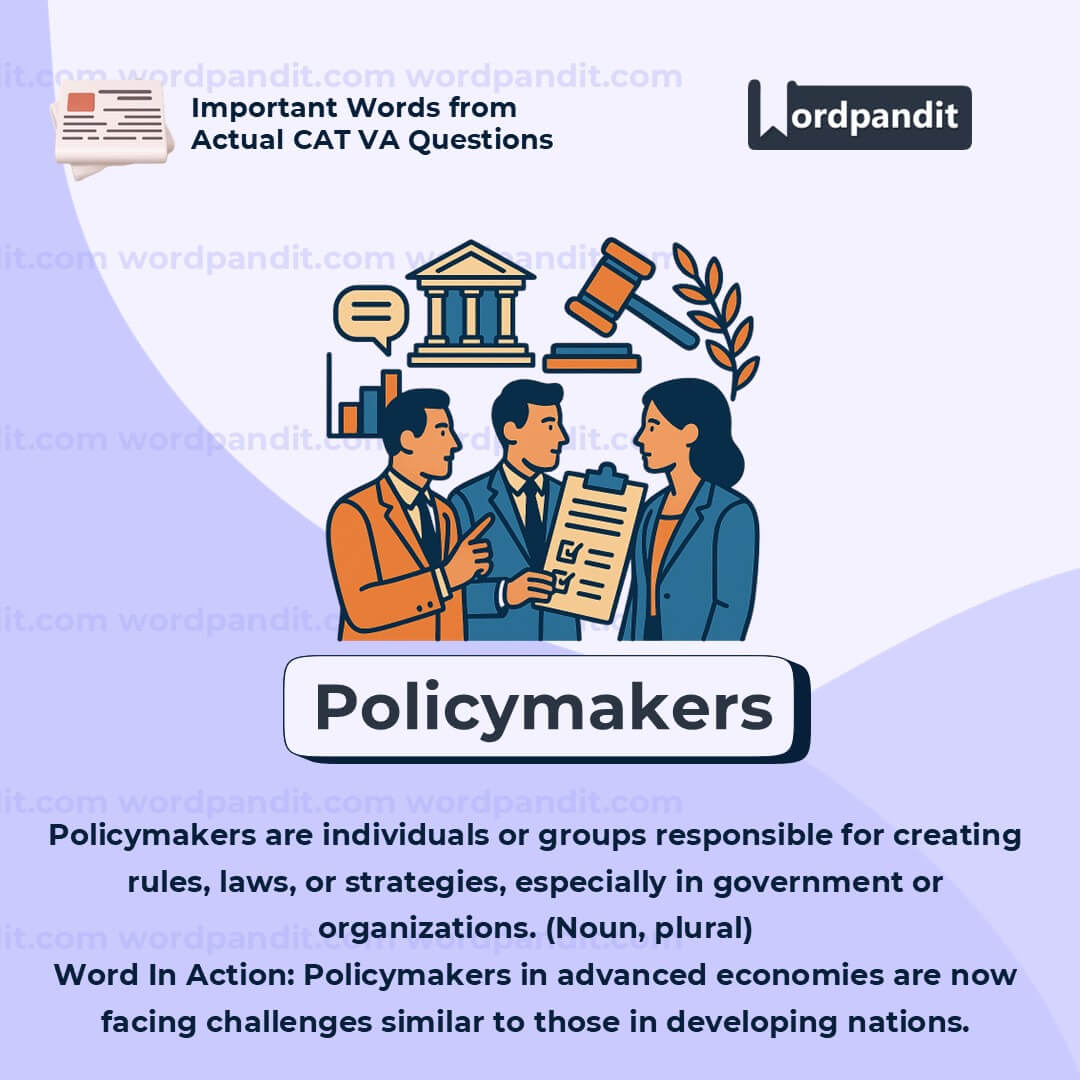
Word 5: Policymakers
Context:
"As a result, policymakers in advanced economies are now grappling with the same questions that have long preoccupied developing economies: mainly how to close the gap with the more advanced parts of the economy." - The Economist
Explanatory Paragraph:
"Policymakers" are individuals or groups who create rules, laws, or strategies to guide the functioning of societies, organizations, or systems. In government and economics, they play a crucial role in deciding how resources are allocated, what regulations are enforced, and which priorities are pursued. Policymakers aim to address issues like inequality, education, healthcare, or economic growth by designing frameworks and interventions that influence real-world outcomes.
Meaning: Individuals or groups responsible for creating rules, strategies, or laws (Noun, plural)
Pronunciation: paw-li-see-may-kurz
Difficulty Level: ⭐⭐⭐ Intermediate
Etymology: From “policy” (from Greek *politeia*, meaning government or citizenship) + “maker” (one who makes or creates)
Prashant Sir's Notes:
This word appears frequently in editorial reading passages, especially related to economics, governance, and public health. When analyzing a passage, ask yourself: What decisions are policymakers making? What are the outcomes or challenges they face?
Synonyms & Antonyms:
Synonyms: legislators, decision-makers, regulators, officials, administrators
Antonyms: citizens, followers, constituents, implementers
Usage Examples:
- Policymakers are debating new strategies to combat climate change.
- Effective policymakers consider long-term impacts, not just short-term gains.
- Health policymakers face the challenge of making vaccines accessible to all.
- Local policymakers implemented reforms to improve public transportation.
Cultural Reference:
"Good policy is grounded in good evidence. Policymakers must bridge the gap between science and society." – The Lancet
Think About It:
What qualities should an ideal policymaker possess to make decisions that benefit society as a whole?
Quick Activity:
Choose one issue (e.g., education, environment, health). Write a sentence proposing what a policymaker should do to improve the situation.
Memory Tip:
Split the word: “Policy” + “Maker” — someone who *makes policies*. Simple and intuitive!
Real-World Application:
Policymakers shape our daily lives — from the price of petrol to the quality of education. Understanding their role helps citizens hold them accountable and engage more meaningfully in democracy.
