
📘 What’s Inside This CAT Para-jumble Question Post?
📝 Authentic CAT Para-jumble Question : Practice with a real CAT Para-jumble Question from a previous CAT exam.
✅ Detailed Question with Step-by-Step Solution: Each question is explained thoroughly for better understanding.
📚 Vocabulary Enhancement: Top 5 words explained from the paragraph
Para-jumble Sentences
Q.21 The four sentences (labelled 1, 2, 3 and 4) given below, when properly sequenced, would yield a coherent paragraph. Decide on the proper sequencing of the order of the sentences and key in the sequence of the four numbers as your answer.
1. Like the ants that make up a colony, no single neuron holds complex information like self-awareness, hope or pride.
2. Although the human brain is not yet understood enough to identify the mechanism by which emergence functions, most neurobiologists agree that complex interconnections among the parts give rise to qualities that belong only to the whole.
3. Nonetheless, the sum of all neurons in the nervous system generate complex human emotions like fear and joy, none of which can be attributed to a single neuron.
4. Human consciousness is often called an emergent property of the human brain.
Solution with Explanation
Correct Answer: 4132
The sentences discuss the concept of emergence in the human brain, where complex qualities like emotions and consciousness arise from the interconnectedness of neurons rather than any single neuron.
- Sentence 4 serves as the best opening sentence, introducing the concept of "emergence" by stating that human consciousness is considered an emergent property of the brain. This sets up the topic for the paragraph.
- Sentence 1 logically follows, providing an analogy with ants in a colony to illustrate how individual neurons, like individual ants, do not hold complex information or qualities on their own.
- Sentence 3 builds on this idea by explaining that the combined activity of all neurons results in complex human emotions, reinforcing the concept introduced in Sentences 4 and 1.
- Sentence 2 concludes the paragraph by acknowledging the current limitations in understanding the exact mechanism of emergence while noting the consensus among neurobiologists about the role of complex interconnections.
The most coherent sequence for the paragraph is 4-1-3-2.
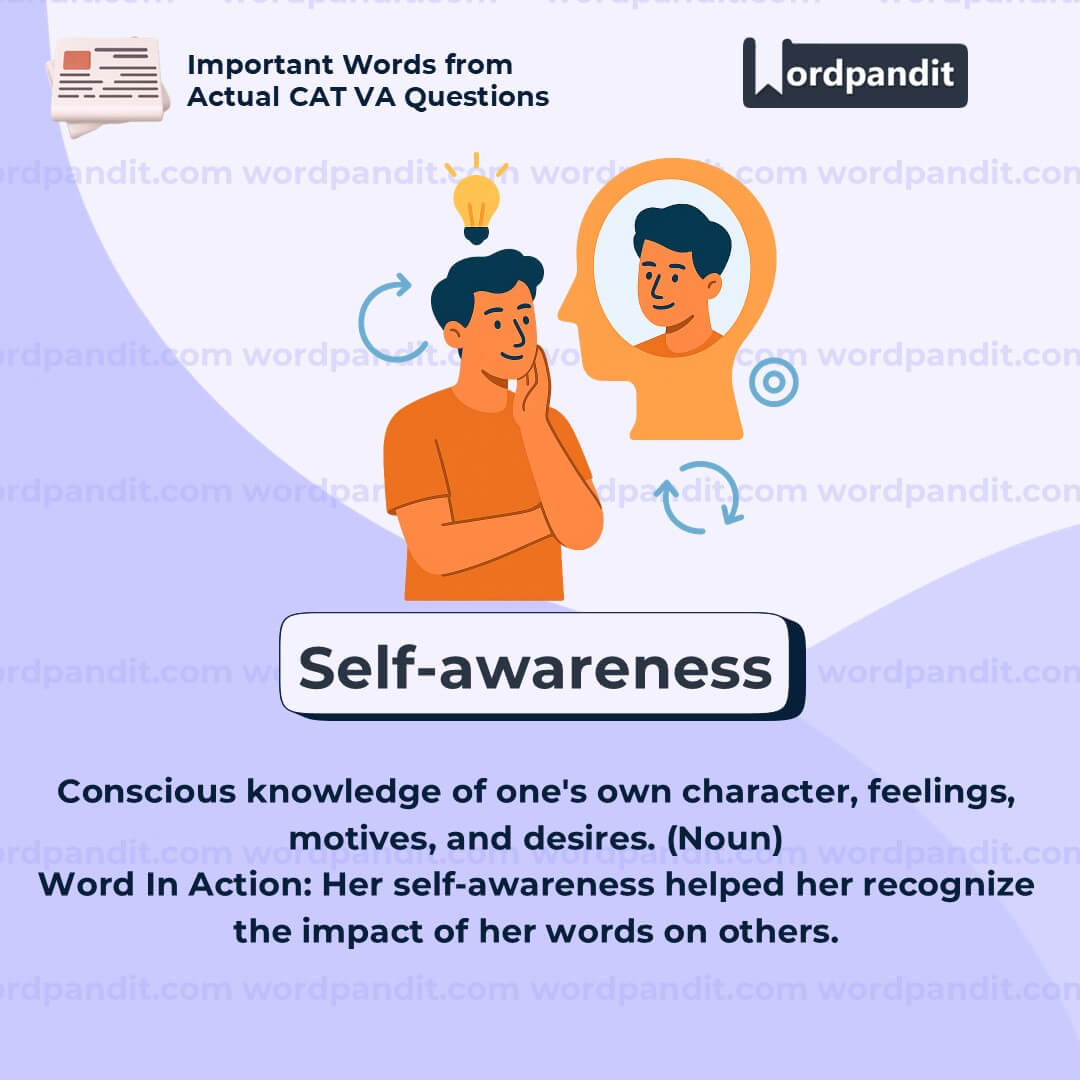
Word-1: Self-awareness
Context:
"Like the ants that make up a colony, no single neuron holds complex information like self-awareness, hope or pride." - The Guardian
Explanatory Paragraph:
"Self-awareness" refers to the conscious knowledge and understanding that a person has of their own character, feelings, motives, and desires. It means being able to observe oneself objectively and recognize one’s strengths, weaknesses, emotions, and actions. In the context above, it is presented as a complex mental phenomenon—not housed in a single brain cell, but emerging from the brain's collective processes.
Meaning: Conscious understanding of one’s own character, emotions, and behaviors (Noun)
Pronunciation: self-uh-wair-ness
Difficulty Level: ⭐⭐⭐ Intermediate
Etymology: From “self” (one’s own person) + “awareness” (conscious perception or recognition); became prominent in psychological literature in the mid-20th century.
Prashant Sir's Notes:
“Self-awareness” is a key term in emotional intelligence and psychological well-being. It's often discussed in exams and interviews involving leadership, personal growth, or character analysis. Look for it in passages about mindfulness, identity, or consciousness.
Synonyms & Antonyms:
Synonyms: self-knowledge, introspection, mindfulness, consciousness
Antonyms: obliviousness, ignorance, unawareness, insensitivity
Usage Examples:
- Self-awareness is the first step toward emotional intelligence and personal growth.
- Through meditation, she developed greater self-awareness and control over her reactions.
- Good leaders exhibit self-awareness, recognizing their strengths and limitations.
- Children gradually develop self-awareness as they grow and begin to recognize themselves in mirrors.
Cultural Reference:
"Knowing yourself is the beginning of all wisdom." – Attributed to Aristotle, a timeless idea tied closely to self-awareness.
Think About It:
Why is self-awareness often considered more important than knowledge or talent in achieving personal or professional success?
Quick Activity:
Write down two strengths and two weaknesses of your own that you've observed. What situations helped you discover them?
Memory Tip:
Split the word: “Self” (you) + “Awareness” (knowing or noticing) = knowing yourself. Easy to remember as looking inward like a mirror.
Real-World Application:
Self-awareness is essential in leadership, education, therapy, and conflict resolution. It allows individuals to adapt, manage relationships better, and improve decision-making through greater understanding of their own motivations and biases.
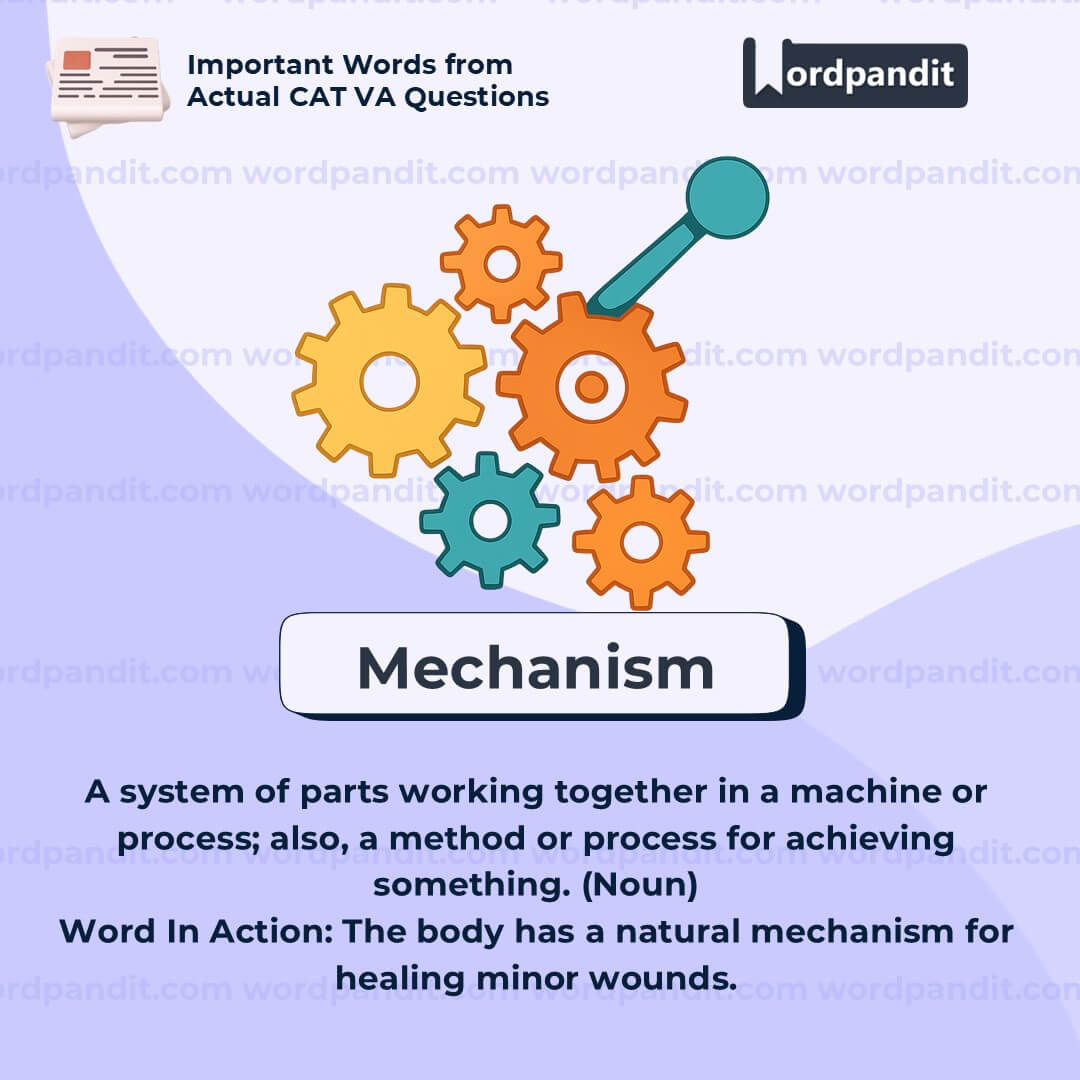
Word-2: Mechanism
Context:
"Although the human brain is not yet understood enough to identify the mechanism by which emergence functions, most neurobiologists agree that complex interconnections among the parts give rise to qualities that belong only to the whole." - The Guardian
Explanatory Paragraph:
"Mechanism" refers to the process, system, or structure through which something works or operates. In both science and everyday language, it often describes how a particular effect is produced or how a system functions. In the context of neuroscience here, the "mechanism" is the still-unknown way by which individual neurons give rise to complex thoughts, like consciousness or self-awareness. The word emphasizes the need to understand the 'how' behind a function or phenomenon.
Meaning: A system of parts working together; the process or structure by which something operates or is achieved (Noun)
Pronunciation: mek-uh-niz-uhm
Difficulty Level: ⭐⭐⭐ Intermediate
Etymology: From Greek *mēkhanē* (machine), passed into Latin *mechanisma* and French *mécanisme*; originally meaning a device or machine.
Prashant Sir's Notes:
“Mechanism” is an academic favorite—seen in biology, psychology, economics, and engineering. It’s about the underlying structure or explanation behind how something happens. In RC passages, it usually refers to the process or chain of causation behind an idea or system.
Synonyms & Antonyms:
Synonyms: process, system, method, procedure, structure
Antonyms: randomness, chaos, spontaneity (contextual)
Usage Examples:
- Scientists are still trying to understand the mechanism of memory formation in the brain.
- Vaccines work through a biological mechanism that trains the immune system.
- The mechanism behind economic inflation involves multiple interrelated factors.
- The clock’s mechanism is made up of dozens of tiny gears and springs.
Cultural Reference:
In psychology, "defense mechanisms" are unconscious strategies the mind uses to protect itself from anxiety—popularized by Freud and still widely studied.
Think About It:
Why do we often seek a mechanism to explain things, even if the outcomes are already observable?
Quick Activity:
Choose any everyday process (like how a fridge cools or how a phone works). Write a sentence describing the mechanism behind it.
Memory Tip:
Think “mechanism” = *machine-ism* — it's like the internal engine or method that makes something run or happen.
Real-World Application:
Mechanisms are crucial in fields like medicine, engineering, psychology, and economics. Understanding them helps professionals identify causes, solve problems, and innovate solutions across all areas of life.
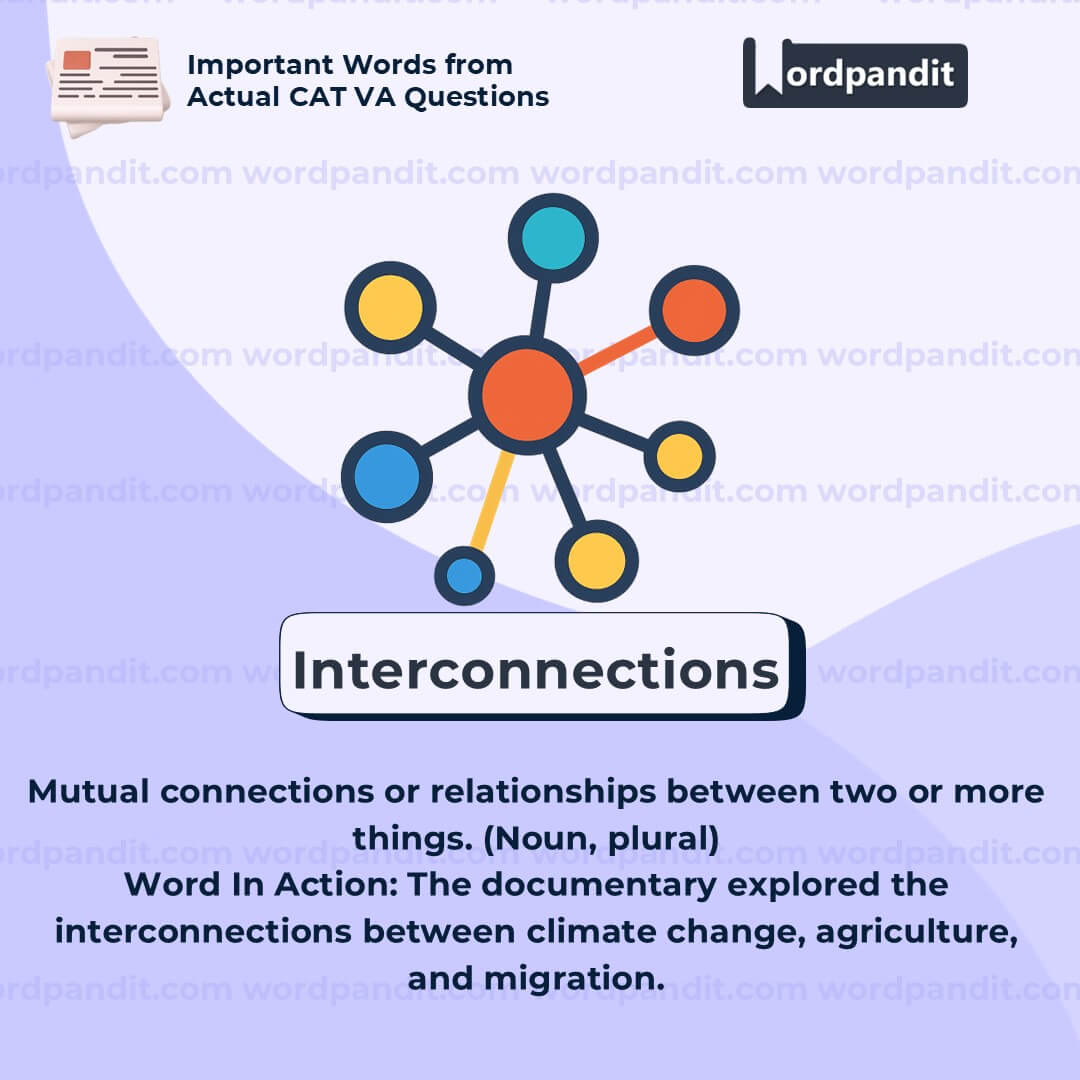
Word-3: Interconnections
Context:
"Although the human brain is not yet understood enough to identify the mechanism by which emergence functions, most neurobiologists agree that complex interconnections among the parts give rise to qualities that belong only to the whole." - The Guardian
Explanatory Paragraph:
"Interconnections" refers to the mutual links or relationships between different elements in a system. These links can be physical (like brain cells connected by synapses), social (like networks of people), or conceptual (like interconnected ideas). In this context, the word is used to describe how the parts of the brain communicate and interact in complex ways, giving rise to high-level functions like consciousness, which cannot be explained by any single part alone.
Meaning: Mutual connections or relationships between parts of a system (Noun, plural)
Pronunciation: in-ter-kuh-nek-shunz
Difficulty Level: ⭐⭐⭐ Intermediate
Etymology: From Latin *inter* (between) + *connectere* (to bind together), evolved into "interconnect" and its noun form "interconnection"
Prashant Sir's Notes:
“Interconnections” is a high-utility word across subjects — from biology to economics to global politics. It often signals complexity and systems thinking. Always ask: *what is being connected, and how do those links matter to the bigger picture?*
Synonyms & Antonyms:
Synonyms: links, associations, networks, relationships, ties
Antonyms: separations, disconnections, isolations, divisions
Usage Examples:
- The interconnections between different ecosystems affect global climate stability.
- Modern economies are built on complex interconnections among countries, companies, and technologies.
- Neural interconnections allow the brain to perform advanced cognitive tasks.
- Effective teamwork depends on strong interconnections between members.
Cultural Reference:
“We are all connected.” — A central idea in ecology, spirituality, and even global politics, emphasizing the interconnections between human actions and wider systems.
Think About It:
In a world increasingly driven by networks—technological, social, and ecological—how can we strengthen the right interconnections while avoiding harmful ones?
Quick Activity:
List three areas of your life (school, family, digital life) and write one sentence showing how they are interconnected.
Memory Tip:
“Inter” = between, “connections” = links → Think of tangled wires or a spider web, showing how everything is linked together.
Real-World Application:
Understanding interconnections is key in systems thinking — a vital approach in science, business, education, and policy-making. It helps solve complex problems by recognizing how parts influence one another within a whole.
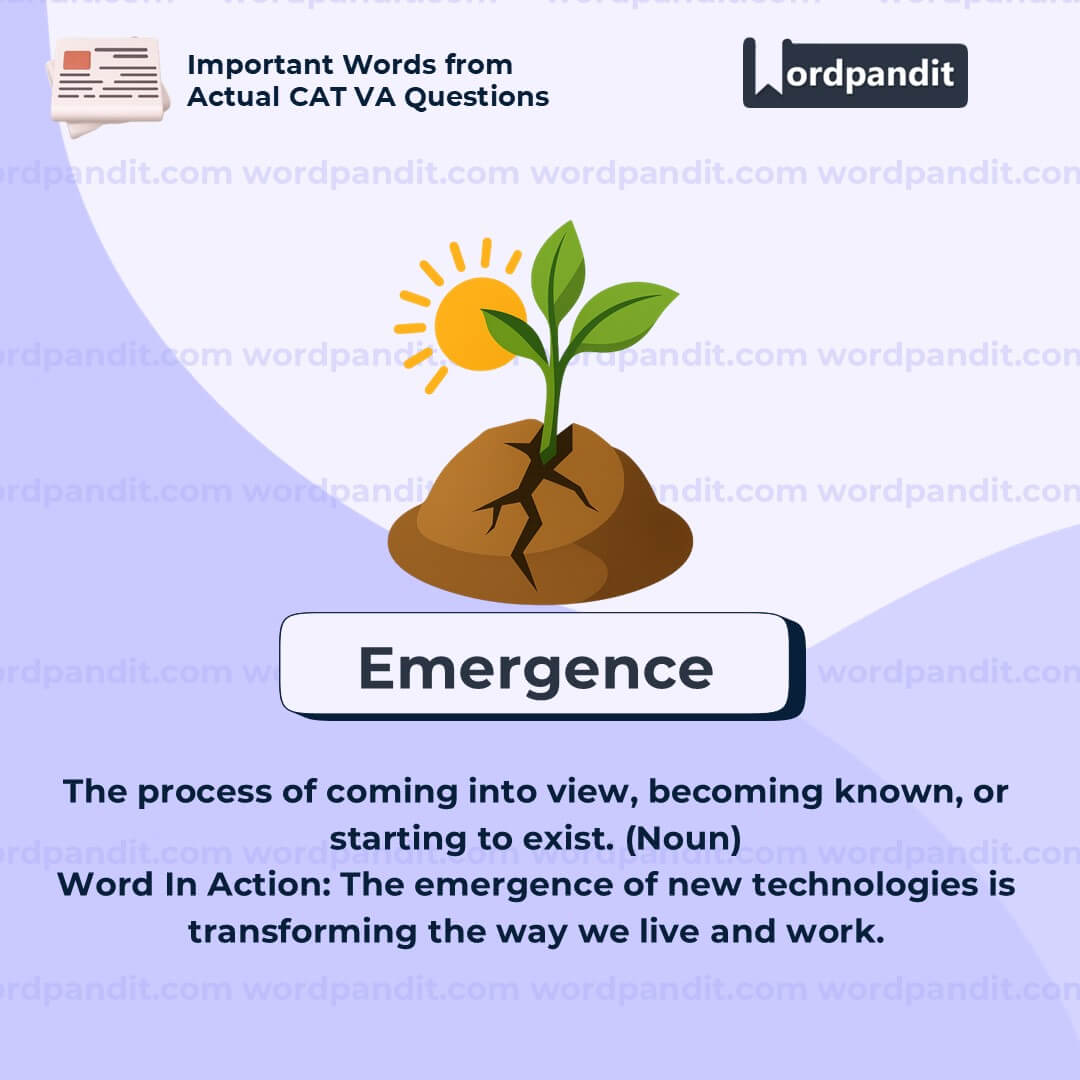
Word-4: Emergence
Context:
"Although the human brain is not yet understood enough to identify the mechanism by which emergence functions, most neurobiologists agree that complex interconnections among the parts give rise to qualities that belong only to the whole." - The Guardian
Explanatory Paragraph:
"Emergence" refers to the process by which complex systems and patterns arise out of relatively simple interactions. It’s a concept used across science, philosophy, and systems thinking to describe how the whole becomes greater than the sum of its parts. In the brain, for instance, individual neurons don’t hold consciousness, but through their interactions, consciousness—or self-awareness—emerges. This makes “emergence” a powerful concept for understanding everything from biological systems to societies.
Meaning: The process of coming into existence or becoming visible, especially when complex properties arise from simple parts (Noun)
Pronunciation: ih-mur-jens
Difficulty Level: ⭐⭐⭐ Intermediate
Etymology: From Latin *emergere*, meaning "to rise out or up"; *e-* (out) + *mergere* (to dip or sink)
Prashant Sir's Notes:
"Emergence" is a key term in modern science and philosophy. It's used when discussing consciousness, ecosystems, AI, and group behavior. Think of it as the surprising result when many simple elements interact in just the right way.
Synonyms & Antonyms:
Synonyms: rise, appearance, development, evolution, formation
Antonyms: disappearance, decline, dissolution, collapse
Usage Examples:
- The emergence of language in early humans marked a turning point in evolution.
- Scientists study the emergence of consciousness through brain networks.
- The emergence of new technologies has transformed the way we communicate.
- Group intelligence is often an example of emergence—no single individual is in control, yet order appears.
Cultural Reference:
In complex systems theory, “emergence” is the central idea explaining how birds flock, traffic jams form, and even how consciousness arises—without a central controller.
Think About It:
Can truly complex things—like creativity, love, or consciousness—ever be fully explained by science, or will their emergence always remain somewhat mysterious?
Quick Activity:
List one example of emergence you’ve observed in real life (e.g., group behavior, weather systems, viral trends). Describe how individual parts contributed to a surprising whole.
Memory Tip:
“Emergence” = *emerge* + *-ence* (state of). Picture something rising or forming unexpectedly—like a pattern emerging from chaos.
Real-World Application:
Understanding emergence is vital in fields like neuroscience, ecology, artificial intelligence, and social science. It helps explain how innovation, order, or intelligence can arise without a top-down plan—purely through local interactions.
Word-5: Consciousness
Context:
"Human consciousness is often called an emergent property of the human brain." - The Guardian
Explanatory Paragraph:
"Consciousness" refers to the state of being aware of and able to think about oneself and the surrounding environment. It includes the capacity for perception, thought, emotion, and intentional action. In science and philosophy, consciousness is considered one of the most complex and mysterious phenomena—how does a physical brain generate the rich inner world of experiences? In the context above, it is described as an *emergent property*—meaning it arises from the brain's complex structure and function rather than existing in any one part.
Meaning: The state of being aware of and able to think and perceive; the experience of awareness (Noun)
Pronunciation: kon-shuhs-nis
Difficulty Level: ⭐⭐⭐⭐ Advanced
Etymology: From Latin *conscientia* (“knowledge within oneself”); from *con-* (with) + *scire* (to know)
Prashant Sir's Notes:
This is a central concept in philosophy, neuroscience, psychology, and literature. It's often used in exams and critical essays to discuss self-awareness, identity, or higher cognitive functions. It's abstract, but crucial—understanding it adds depth to discussions about the mind and human nature.
Synonyms & Antonyms:
Synonyms: awareness, sentience, perception, mindfulness, alertness
Antonyms: unconsciousness, ignorance, oblivion, insensibility
Usage Examples:
- Philosophers have debated the nature of consciousness for centuries.
- After the accident, he drifted in and out of consciousness.
- Meditation helps increase self-awareness and consciousness of the present moment.
- The film explored the idea of machines developing human-like consciousness.
Cultural Reference:
“I think, therefore I am.” — René Descartes’ famous declaration ties directly into the concept of consciousness as proof of existence and identity.
Think About It:
If machines ever develop true consciousness, how would we define what it means to be human?
Quick Activity:
Reflect for one minute. Then write one sentence about something you are consciously aware of right now—emotionally, mentally, or physically.
Memory Tip:
Link “consciousness” to “conscious” — being alert, aware, and thinking. Imagine a light turning on in the mind.
Real-World Application:
Consciousness studies impact fields like artificial intelligence, medicine (e.g., coma recovery), ethics, and spirituality. It also helps us understand human experience, identity, and the boundaries of intelligence and life.
