📘 What’s Inside This CAT Paragraph Summary Question Post?
📝 Authentic CAT Paragraph Summary QuestionPractice with a real CAT Paragraph Summary Question from a previous CAT exam.
✅ Detailed Question with Step-by-Step SolutionEach question is explained thoroughly for better understanding.
🔍 In-Depth Paragraph AnalysisGain insights through line-by-line and paragraph-wise analysis
📚 Vocabulary Enhancement: Top 5 words explained from the paragraph
Paragraph Summary Questions
Q.23 The passage given below is followed by four alternate summaries. Choose the option that best captures the essence of the passage.
People spontaneously create counterfactual alternatives to reality when they think “if only” or “what if” and imagine how the past could have been different. The mind computes counterfactuals for many reasons. Counterfactuals explain the past and prepare for the future, they implicate various relations including causal ones, and they affect intentions and decisions. They modulate emotions such as regret and relief, and they support moral judgments such as blame. The ability to create counterfactuals develops throughout childhood and contributes to reasoning about other people's beliefs, including their false beliefs.
1. Counterfactual alternatives to reality are created for a variety of reasons and is part of one's developmental process.
2. People create counterfactual alternatives to reality for various reasons, including reasoning about other people's beliefs.
3. Counterfactuals help people to prepare for the future by understanding intentions and making decisions.
4. Counterfactual thinking helps to reverse past and future actions and reason out false beliefs.
Solution with Explanation
Answer: 1
Explanation:
The passage discusses the human tendency to create counterfactual scenarios—alternatives to reality that explore "what if" or "if only" situations. It describes the multiple purposes these counterfactuals serve, including explaining the past, preparing for the future, affecting emotions, supporting moral judgments, and contributing to developmental reasoning about beliefs, including false ones.
- Option 1 is the best choice as it captures the full range of reasons for creating counterfactuals, highlighting that it is part of developmental processes.
- Option 2 focuses on "reasoning about other people's beliefs," which, while mentioned, is only one part of the broader function of counterfactuals.
- Option 3 narrows the purpose of counterfactuals to future preparation and decision-making, omitting other key aspects such as emotions and moral judgments.
- Option 4 inaccurately suggests that counterfactuals reverse actions, which is not implied in the passage.
Thus, Option 1 is the correct answer as it comprehensively reflects the range of reasons and developmental role of counterfactual thinking described in the passage.
Word 1: Counterfactuals
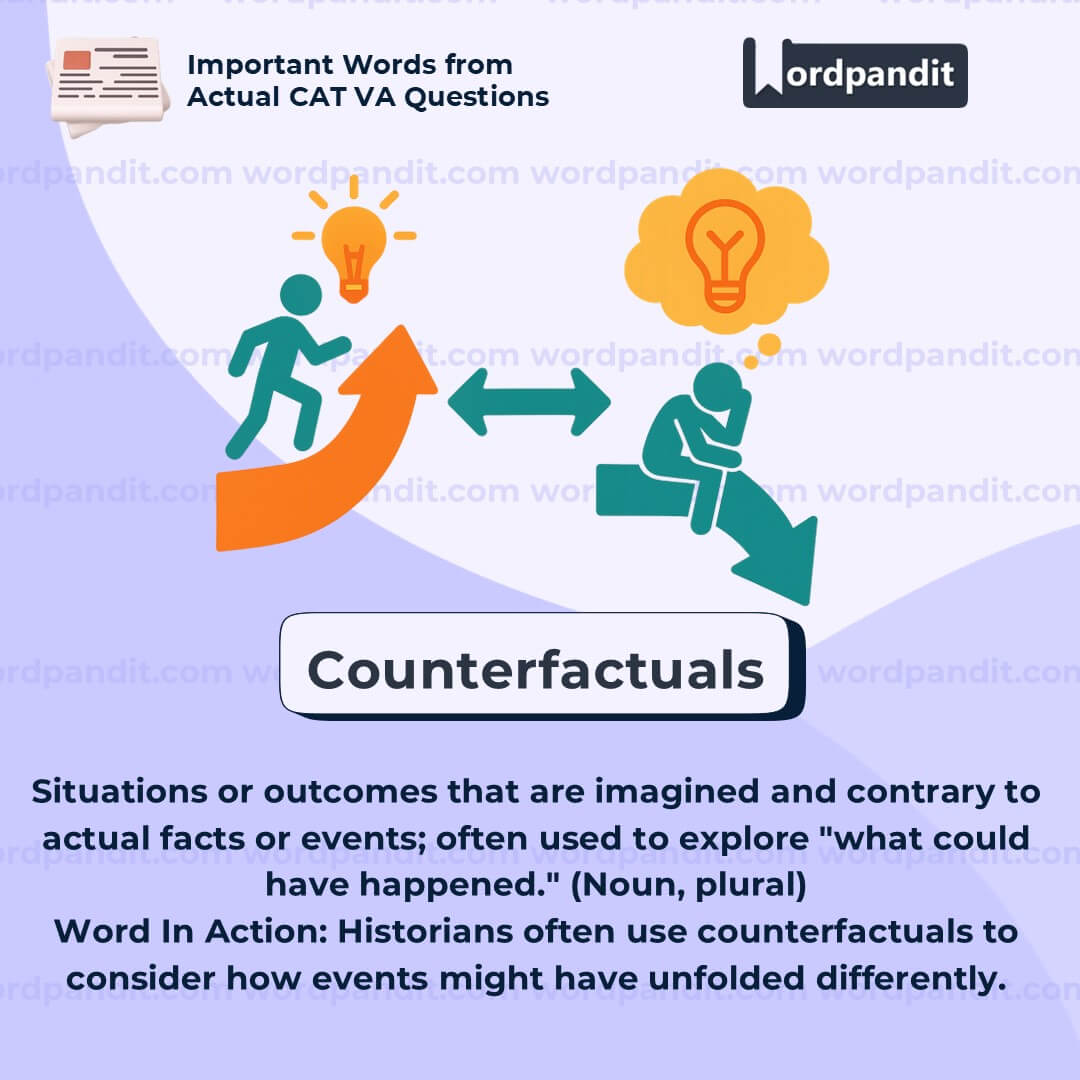
Context:
"The mind computes counterfactuals for many reasons." - Unknown Source
Explanatory Paragraph:
“Counterfactuals” are imagined alternatives to events that have already happened—what could have occurred if something had been different. They help us reflect on past decisions, learn from mistakes, and plan better for the future. This mental exercise can influence emotions like regret or relief and is deeply tied to how we process causality and make judgments about actions and outcomes.
Meaning: Hypothetical scenarios or outcomes that differ from actual events (noun)
Pronunciation: kown-ter-fak-choo-uhls
Difficulty Level: ⭐⭐⭐⭐ Advanced
Etymology: From Latin roots: “counter-” meaning “against” and “factual” from “factum,” meaning “something done.”
Prashant Sir's Notes:
“Counterfactuals” are particularly useful in understanding human cognition, storytelling, and historical analysis. They highlight how our minds naturally play out “what if” situations to make sense of events or to prepare better outcomes next time.
Synonyms & Antonyms:
Synonyms: hypothetical, imagined scenario, what-if, conjecture
Antonyms: reality, certainty, truth
Usage Examples:
- Historians often engage in counterfactuals to explore how different actions might have changed the course of history.
- Her mind was filled with counterfactuals, wondering how life might have been if she had taken that job abroad.
- Counterfactual thinking can enhance learning by encouraging us to reflect on past mistakes.
- Science fiction frequently deals in counterfactuals, imagining alternative timelines or outcomes.
Cultural Reference:
"The concept of counterfactuals plays a central role in many time-travel narratives, such as the film *The Butterfly Effect*, where small changes in the past drastically alter the future." - Popular Culture Reference
Think About It:
How do counterfactuals help us learn from failure, and can they also trap us in regret?
Quick Activity:
Write down three things that happened this week. Then, for each, write a short counterfactual: “If X hadn’t happened, then Y might have…”
Memory Tip:
Think of “counter” as “opposite” and “factual” as “real”—so a counterfactual is the “opposite of what really happened.”
Real-World Application:
Counterfactuals are used in behavioral economics, psychology, law, and even artificial intelligence to simulate decision-making, improve judgments, and understand human reasoning patterns.
Word 2: Computes
Context:
"The mind computes counterfactuals for many reasons." - Unknown Source
Explanatory Paragraph:
“Computes” refers to the act of calculating or processing information logically, either by a machine or a person. In the context of the human mind, it suggests the brain’s ability to analyze data, assess possibilities, or generate predictions using mental processes. It’s not always about numbers—sometimes it means evaluating outcomes or forming judgments through systematic thought.
Meaning: To calculate or process something logically or mathematically (verb)
Pronunciation: kum-pyoots
Difficulty Level: ⭐⭐ Basic
Etymology: From Latin “computare,” meaning “to count, sum up, reckon,” formed by “com-” (together) and “putare” (to prune, settle, reckon).
Prashant Sir's Notes:
Though often associated with computers, the word “computes” can describe any logical mental process. In psychological or philosophical discussions, it implies the brain’s capacity to simulate or solve problems, even abstract ones like possibilities or emotions.
Synonyms & Antonyms:
Synonyms: calculate, reckon, evaluate, process
Antonyms: guess, estimate, ignore, overlook
Usage Examples:
- The machine computes thousands of equations in seconds.
- Her brain instantly computes the risks and rewards of every move in chess.
- He computes his expenses weekly to stay within budget.
- The software computes the shortest path using GPS algorithms.
Cultural Reference:
"In the film *The Imitation Game*, Alan Turing builds a machine that computes possible cipher combinations to crack the Enigma code during World War II." - Movie Reference
Think About It:
Do you think human intuition is a form of computing based on past experiences?
Quick Activity:
Pick a daily decision you made (e.g., what to eat, where to go). Break it down logically—what factors did your mind compute to make the choice?
Memory Tip:
Think of “compute” as something a computer does—calculate, process, and deliver results. Your brain can “compute” too!
Real-World Application:
“Computes” is widely used in tech, data analysis, finance, and cognitive sciences to describe how systems or people handle complex information or numerical tasks.
Word 3: Causal
Context:
"Counterfactuals explain the past and prepare for the future, they implicate various relations including causal ones, and they affect intentions and decisions." - Unknown Source
Explanatory Paragraph:
“Causal” refers to the connection between a cause and its effect. When we say something is causal, we mean it plays a role in producing a specific result. In both everyday thinking and scientific inquiry, understanding causal relationships helps us explain why things happen and predict what might occur next. It’s the backbone of reasoning, from simple observations to complex theories.
Meaning: Relating to or acting as a cause (adjective)
Pronunciation: kaw-zuhl
Difficulty Level: ⭐⭐⭐ Intermediate
Etymology: From Latin “causa,” meaning “a cause or reason.” The word entered English via Late Latin “causalis.”
Prashant Sir's Notes:
Understanding causal relationships is essential in logic, science, and decision-making. Without identifying what causes what, our interpretations and predictions would remain vague and uncertain. Words like "because" or "due to" often point to causal links in language.
Synonyms & Antonyms:
Synonyms: causal-related, causative, influential, determining
Antonyms: unrelated, incidental, coincidental
Usage Examples:
- The study aimed to find a causal link between screen time and sleep quality.
- Her illness had no clear causal explanation, puzzling the doctors.
- Causal reasoning helps children understand consequences from a young age.
- Economists debate whether inflation has a direct causal relationship with wage increases.
Cultural Reference:
"The principle of causality underpins the entire field of science—without assuming that events have causes, experiments and theories would have no predictive power." - Scientific Worldview
Think About It:
Can we always be sure of a causal connection, or are we sometimes fooled by coincidence?
Quick Activity:
Think of a recent event in your life. Write down the possible causes of that event, and try to identify the most likely causal factor.
Memory Tip:
“Causal” comes from “cause”—so anything causal *causes* something to happen!
Real-World Application:
Causal thinking is used in fields like medicine, law, science, and business to determine how actions or conditions lead to specific outcomes—e.g., identifying what caused a disease outbreak or what factors led to a drop in sales.
Word 4: Modulate
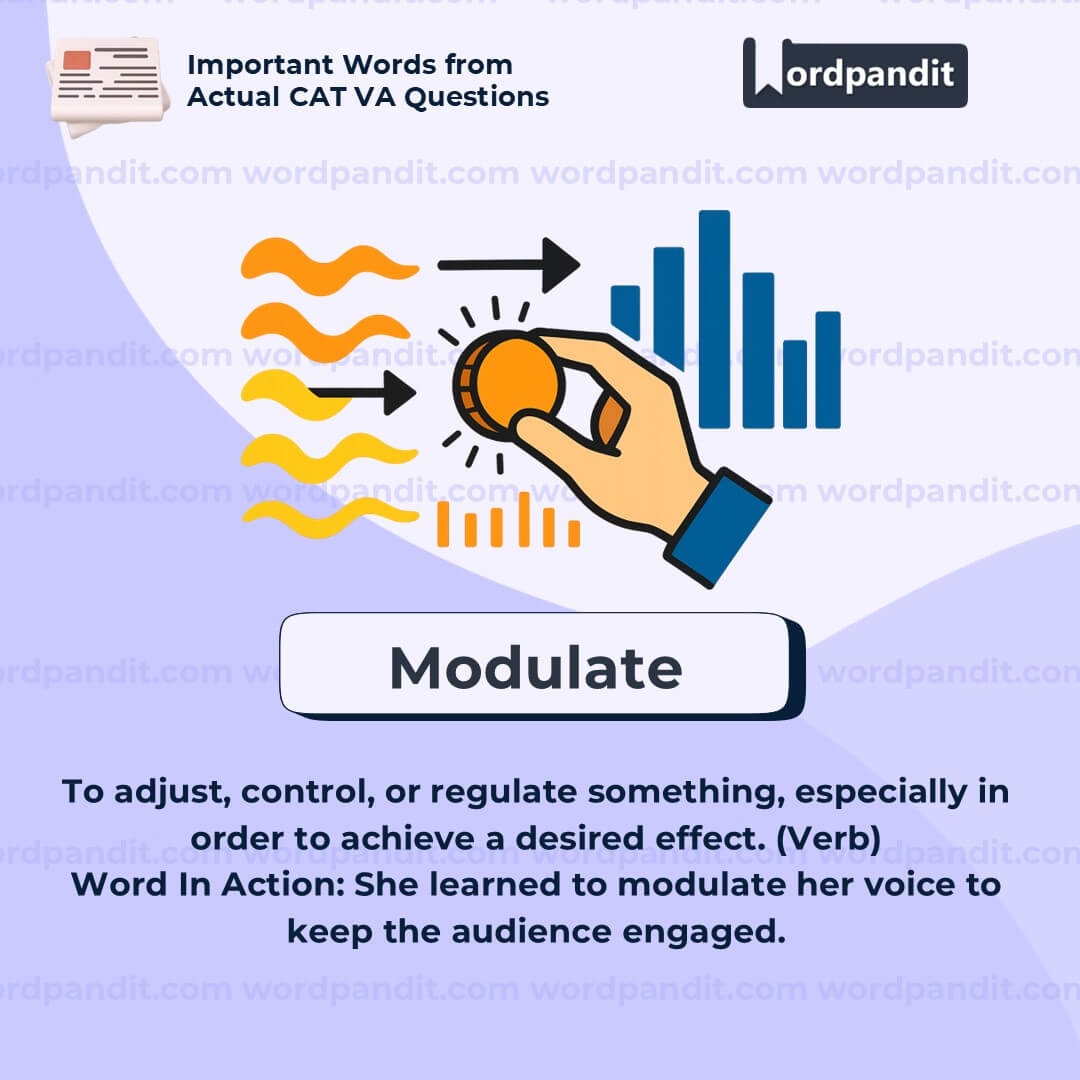
Context:
"They modulate emotions such as regret and relief, and they support moral judgments such as blame." - Unknown Source
Explanatory Paragraph:
To “modulate” means to adjust, regulate, or fine-tune something. In the context of emotions, it refers to the way our minds manage or control the intensity and expression of feelings. This can include dampening strong emotions or amplifying subtle ones depending on the situation. Modulation helps us respond appropriately in social and personal situations by keeping our emotional reactions balanced.
Meaning: To adjust or regulate the degree or intensity of something (verb)
Pronunciation: mod-yuh-layt
Difficulty Level: ⭐⭐⭐ Intermediate
Etymology: From Latin “modulatus,” past participle of “modulari” meaning “to measure, regulate,” from “modulus” (a small measure or standard).
Prashant Sir's Notes:
“Modulate” is a subtle but powerful word. It shows how small adjustments in tone, emotion, or behavior can have a significant impact. In speech, it means adjusting your tone; in biology, it can mean regulating bodily responses. Always link it to balance and control.
Synonyms & Antonyms:
Synonyms: adjust, regulate, control, tune
Antonyms: intensify, exaggerate, ignore, neglect
Usage Examples:
- She tried to modulate her voice to sound more reassuring.
- Mindfulness practices help people modulate stress responses.
- The teacher modulated his feedback to encourage the struggling student.
- Therapies aim to help individuals modulate emotions like anger or anxiety.
Cultural Reference:
"Opera singers are trained to modulate their voices to express subtle shifts in emotion and intensity." - Performing Arts Insight
Think About It:
In what areas of your life could better emotional modulation improve your relationships or decision-making?
Quick Activity:
Think of an emotion you often experience. Write down three ways you can consciously modulate it in different scenarios (e.g., home, work, public).
Memory Tip:
“Modulate” sounds like “module”—think of adjusting a module on a control panel to turn an emotion up or down.
Real-World Application:
In real life, we modulate our behavior and speech in professional settings, during conflict resolution, or in parenting—ensuring our tone and emotions match the situation appropriately.
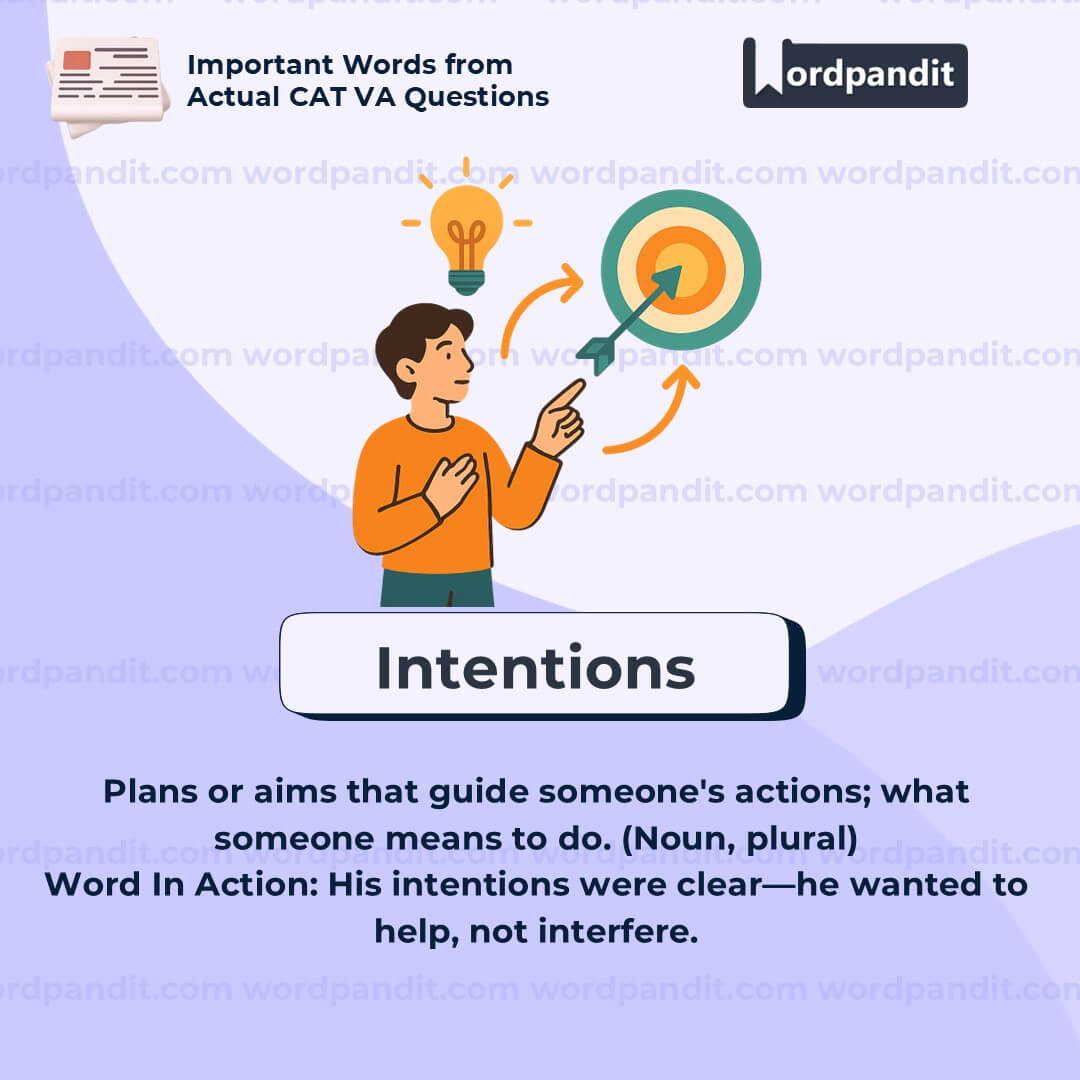
Word 5: Intentions
Context:
"Counterfactuals explain the past and prepare for the future, they implicate various relations including causal ones, and they affect intentions and decisions." - Unknown Source
Explanatory Paragraph:
“Intentions” are the mental plans or aims that guide our actions. They reflect what a person hopes, plans, or means to do. Whether simple, like intending to call a friend, or complex, like planning a career change, intentions reveal the purpose behind our choices. They are often shaped by desires, beliefs, emotions, and even counterfactual thinking—what we imagine could happen if we act in certain ways.
Meaning: Mental plans or aims that direct behavior or decision-making (noun)
Pronunciation: in-ten-shuhns
Difficulty Level: ⭐⭐ Basic
Etymology: From Latin “intentio” meaning “a stretching out, a purpose,” derived from “intendere” (to stretch out, direct one's attention).
Prashant Sir's Notes:
Intentions are central to moral and psychological evaluations. We often judge someone not just by what they did, but by what they intended to do. Intentions are also key in goal-setting and motivation—clarity in intention often leads to clarity in action.
Synonyms & Antonyms:
Synonyms: purpose, aim, goal, plan, objective
Antonyms: accident, chance, randomness, spontaneity
Usage Examples:
- Her intentions were clear—she wanted to help, not criticize.
- Good intentions don’t always lead to good outcomes.
- He set his intentions for the new year with a calm and focused mind.
- Before judging someone, try to understand their intentions.
Cultural Reference:
"The road to hell is paved with good intentions" is a famous proverb highlighting how well-meaning plans can have negative outcomes if not followed through effectively. - Traditional Saying
Think About It:
Is a person more responsible for the result of their actions or the intention behind them?
Quick Activity:
List three intentions you have for the upcoming week. For each, note one action you’ll take to make it happen.
Memory Tip:
“Intentions” sound like “in tension”—think of your mind being in tension, pulling toward a goal or plan.
Real-World Application:
Intentions play a vital role in therapy, leadership, education, and ethics. Whether writing a mission statement, setting goals, or resolving conflict, clearly stated intentions provide direction and trust.