
📘 What’s Inside This CAT Paragraph Summary Question Post?
📝 Authentic CAT Paragraph Summary QuestionPractice with a real CAT Paragraph Summary Question from a previous CAT exam.
✅ Detailed Question with Step-by-Step SolutionEach question is explained thoroughly for better understanding.
🔍 In-Depth Paragraph AnalysisGain insights through line-by-line and paragraph-wise analysis
📚 Vocabulary Enhancement: Top 5 words explained from the paragraph
Paragraph Summary Questions
Q.24 The passage given below is followed by four alternate summaries. Choose the option that best captures the essence of the passage.
The weight of society's expectations is hardly a new phenomenon but it has become particularly draining over recent decades, perhaps because expectations themselves are so multifarious and contradictory. The perfectionism of the 1950s was rooted in the norms of mass culture and captured in famous advertising images of the ideal white American family that now seem self-satirising. In that era, perfectionism meant seamlessly conforming to values, behaviour and appearance: chiselled confidence for men, demure graciousness for women. The perfectionist was under pressure to look like everyone else, only more so. The perfectionists of today, by contrast, feel an obligation to stand out through their idiosyncratic style and wit if they are to gain a foothold in the attention economy.
1. The image of perfectionism is reflected in and perpetuated by the media; and people do their best to adhere to these ideals.
2. Though long-standing, the pressure to appear perfect and thereby attract attention, has evolved over time from one of conformism to one of non-conformism.
3. The pressure to appear perfect has been the cause of tension and conflict because the idea itself has been in a state of flux and hard to define.
4. The desire to attract attention is so deep-rooted in individual consciousness that people are willing to go to any lengths to achieve it.
Solution with Explanation
Correct Answer: 2
Detailed explanation by Wordpandit:The passage contrasts two forms of perfectionism: the 1950s ideal that valued conformity to societal norms and today’s version, which emphasizes standing out to capture attention in a competitive environment. This shift reflects how the pressures to be "perfect" have evolved from conformism to non-conformism.
- Option A focuses on media perpetuating ideals, which does not capture the main comparison between conformist and non-conformist perfectionism.
- Option B accurately reflects the passage’s essence by highlighting the shift from a conformist form of perfectionism to one centered around individualism and attention-seeking.
- Option C suggests that the changing and undefined nature of perfectionism is the central theme, which does not fully capture the passage’s focus on the evolution in perfectionism styles.
- Option D overgeneralizes by focusing on a deep-rooted desire for attention, which does not convey the key comparison between different forms of perfectionism.
Thus, Option B best captures the essence of the passage, accurately reflecting the transition from conformism to non-conformism in societal expectations of perfection.
Word 1: Phenomenon
Context:
"The weight of society's expectations is hardly a new phenomenon but it has become particularly draining over recent decades." - Anonymous Opinion Article
Explanatory Paragraph:
"Phenomenon" refers to an observable event, occurrence, or situation—especially one that is unusual or significant. In the sentence, it describes the ongoing societal pressure as something persistent and recognizable. The word can be used in both scientific and general contexts to denote something that draws attention or warrants discussion due to its distinct nature.
Meaning: An observable fact or event, especially one that is unusual or interesting (Noun)
Pronunciation: fuh-NOM-uh-non
Difficulty Level: ⭐⭐ Moderate
Etymology: From Greek "phainomenon" (appearance), from "phainein" meaning "to show"
Prashant Sir's Notes:
A go-to word for describing events or trends, especially when they are remarkable or wide-reaching. Great for both essays and scientific descriptions.
Synonyms & Antonyms:
Synonyms: occurrence, event, development, spectacle, anomaly
Antonyms: normality, regularity, usualness
Usage Examples:
- The northern lights are a breathtaking natural phenomenon.
- Global warming is a complex phenomenon that impacts every aspect of life on Earth.
- The sudden popularity of the app became a viral phenomenon overnight.
- He dedicated his life to studying psychological phenomena in children.
Cultural Reference:
"The Beatles were not just a band; they were a cultural phenomenon that transformed music forever." - Music Historian Commentary
Think About It:
Can something be considered a phenomenon if it is only experienced by a small group of people? Why or why not?
Quick Activity:
List three phenomena (natural or social) that you observe in your daily life. Describe what makes them noteworthy.
Memory Tip:
Think of “phenomenon” as something that “shows” itself — just like a light “shows” in the dark, a phenomenon stands out in reality.
Real-World Application:
Use “phenomenon” when writing about trends in society, nature, or behavior. It’s a strong, formal word suitable for academic and professional settings alike.
Word 2: Multifarious
Context:
"Perhaps because expectations themselves are so multifarious and contradictory." - Opinion Essay
Explanatory Paragraph:
"Multifarious" is used to describe something that has many different parts, forms, or types. It highlights diversity and complexity within a single category. In the given context, the word is applied to "expectations," suggesting that the pressures society imposes are not only numerous but also varied and conflicting, making them hard to manage or satisfy.
Meaning: Having many different parts or aspects; diverse or varied (Adjective)
Pronunciation: mul-tuh-FAIR-ee-us
Difficulty Level: ⭐⭐⭐ Advanced
Etymology: From Latin "multifarius" (of many kinds), from "multi-" meaning "many" and "varius" meaning "varied"
Prashant Sir's Notes:
This is a high-utility word for essays and critical analysis, especially when you want to express complexity or layered meaning. Great to use in contrast with “simplistic.”
Synonyms & Antonyms:
Synonyms: diverse, manifold, heterogeneous, assorted, eclectic
Antonyms: uniform, homogeneous, singular, simple
Usage Examples:
- She had multifarious interests ranging from astrophysics to classical ballet.
- The organization tackles multifarious challenges in education and health.
- His writing reflects the multifarious nature of human experience.
- Modern cities are hubs of multifarious cultures and identities.
Cultural Reference:
"India is a multifarious country with languages, traditions, and customs that vary every few hundred kilometers." - Travel Documentary Voiceover
Think About It:
Can a multifarious approach to life be more rewarding than a singular focus? Why or why not?
Quick Activity:
Write down five multifarious qualities or hobbies you or someone you admire possesses. Reflect on how they contribute to their personality.
Memory Tip:
Break it into “multi” (many) + “various” — something that contains many various parts.
Real-World Application:
Use “multifarious” in essays, debates, or articles when you want to emphasize variety, diversity, or complexity in opinions, issues, or approaches.
Word 3: Conforming
Context:
"In that era, perfectionism meant seamlessly conforming to values, behaviour and appearance: chiselled confidence for men, demure graciousness for women." - Social Commentary Article
Explanatory Paragraph:
"Conforming" refers to the act of adjusting one’s behavior, beliefs, or appearance to align with the expectations, rules, or standards set by society or a group. In the context given, it suggests a pressure to fit into rigid societal norms, where individuals felt compelled to portray a specific ideal — strong and confident for men, gentle and graceful for women — to be perceived as perfect.
Meaning: Acting in accordance with societal norms, rules, or expectations (Verb - Present participle of "conform")
Pronunciation: kuhn-FORM-ing
Difficulty Level: ⭐⭐ Moderate
Etymology: From Latin "conformare" meaning "to fashion, to form" – from "com-" (together) + "formare" (to form)
Prashant Sir's Notes:
This is a must-know word in discussions about identity, social pressure, and individuality. Use it in essays on cultural norms, peer influence, and personal growth.
Synonyms & Antonyms:
Synonyms: complying, adapting, obeying, aligning, following
Antonyms: rebelling, resisting, deviating, defying, dissenting
Usage Examples:
- She spent her teenage years conforming to peer expectations to avoid standing out.
- In some cultures, conforming to family traditions is seen as a mark of respect.
- He was tired of conforming to a lifestyle that didn’t reflect his true self.
- Conforming to corporate culture is often necessary to thrive in the workplace.
Cultural Reference:
"The opposite of courage in our society is not cowardice, it is conformity." – Rollo May, existential psychologist
Think About It:
Is conforming always negative, or can it sometimes promote social harmony? Where should we draw the line?
Quick Activity:
List two scenarios where conforming helped you and two where it limited your individuality. Reflect on what you learned from each.
Memory Tip:
Think of “conforming” as "forming together" — you shape yourself to fit into a group or standard.
Real-World Application:
"Conforming" is commonly used in psychology, sociology, and workplace discussions — especially when exploring social norms, team behavior, or the pressure to 'fit in.'
Word 4: Demure
Context:
"In that era, perfectionism meant seamlessly conforming to values, behaviour and appearance: chiselled confidence for men, demure graciousness for women." - Social Commentary Article
Explanatory Paragraph:
"Demure" describes someone—typically a woman—who is reserved, modest, and shy in a way that is perceived as graceful or delicate. It often carries connotations of traditional femininity. In the context, it refers to the societal ideal imposed on women to appear polite, gentle, and understated as a form of perfection. The word can be neutral, positive, or even slightly critical depending on how it's used and perceived.
Meaning: Quiet, modest, and reserved in manner or behavior (Adjective)
Pronunciation: dih-MYOOR
Difficulty Level: ⭐⭐ Moderate
Etymology: From Old French "demure" (serious, grave), possibly from Latin "maturus" (mature)
Prashant Sir's Notes:
Often used to describe traditional ideals of femininity. Be aware of tone—it can imply elegance or critique stereotypes, depending on context.
Synonyms & Antonyms:
Synonyms: modest, reserved, shy, timid, unassuming
Antonyms: bold, outgoing, brazen, assertive, flamboyant
Usage Examples:
- She gave a demure smile when complimented on her performance.
- Her demure attire contrasted sharply with the extravagant costumes around her.
- In public, she appeared demure and soft-spoken, but close friends knew her lively personality.
- The actress played the role of a demure village girl with great finesse.
Cultural Reference:
"Audrey Hepburn’s style was often described as demure—graceful, minimalistic, and modest, yet powerfully elegant." - Fashion Historian
Think About It:
Does society still expect women to appear demure in certain situations? How does that affect gender roles today?
Quick Activity:
Write two sentences: one where “demure” is a compliment and another where it suggests repression. Reflect on how tone changes meaning.
Memory Tip:
Think of "demure" as someone “murmuring” quietly—soft, modest, and not seeking attention.
Real-World Application:
“Demure” is often used in literature, fashion commentary, and social analysis. It’s a useful word when discussing behavior, appearances, or gender expectations.
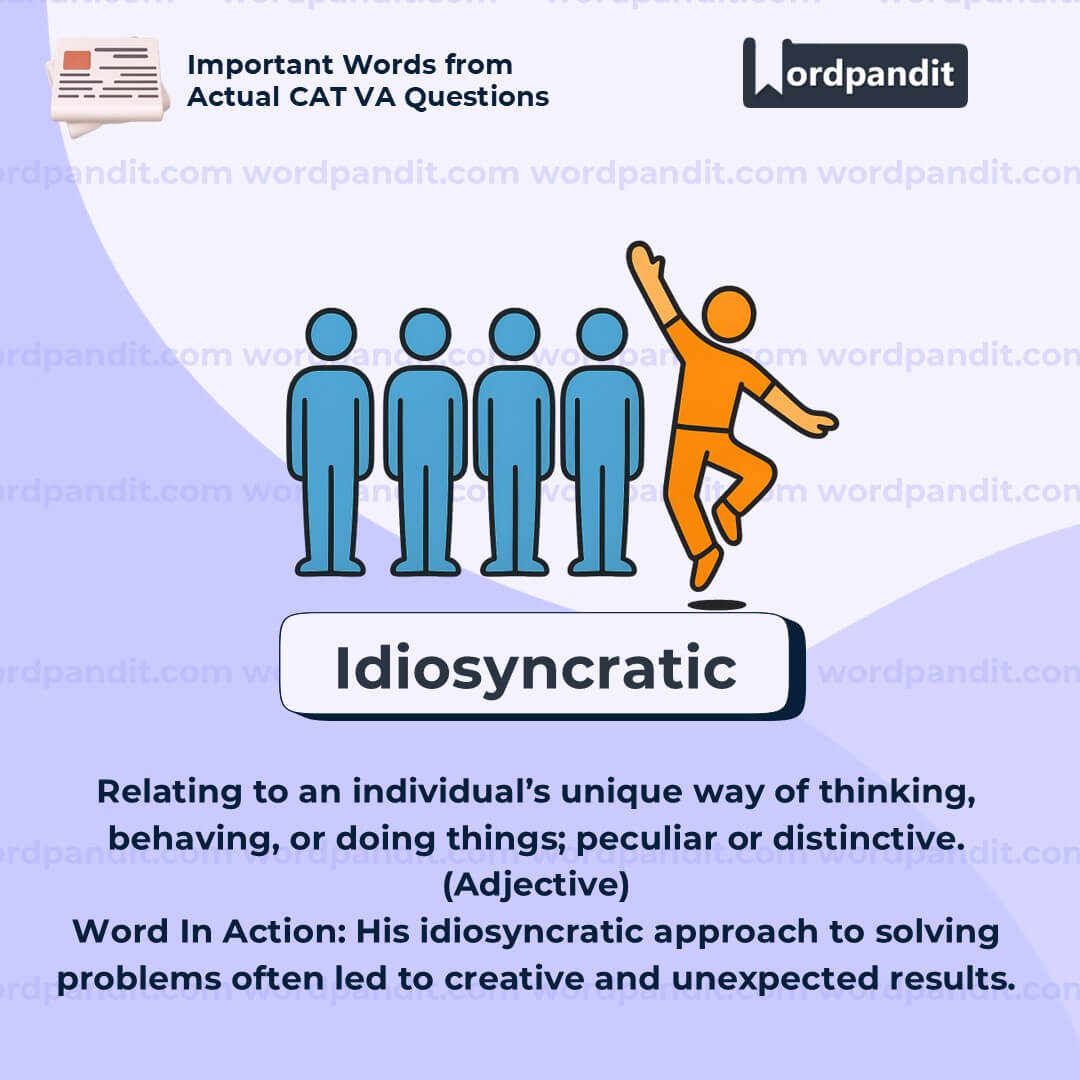
Word 5: Idiosyncratic
Context:
"The perfectionists of today, by contrast, feel an obligation to stand out through their idiosyncratic style and wit if they are to gain a foothold in the attention economy." - Cultural Commentary
Explanatory Paragraph:
"Idiosyncratic" refers to characteristics or behaviors that are peculiar or unique to an individual. It often describes personal quirks, styles, or habits that make someone stand out from the crowd. In this context, the word suggests that modern perfectionists strive to differentiate themselves through originality and uniqueness — rather than blending in, they aim to be distinctive in their appearance, expression, or thinking.
Meaning: Distinctively individual or peculiar; unique in character or behavior (Adjective)
Pronunciation: id-ee-oh-sin-KRAT-ik
Difficulty Level: ⭐⭐⭐ Advanced
Etymology: From Greek "idiosynkrasia" (a peculiar temperament), from "idios" (one’s own) + "synkrasis" (mixture)
Prashant Sir's Notes:
One of the best adjectives to describe someone or something truly unique. Use it to convey individuality or creative distinction—great for essays, fiction, and critiques.
Synonyms & Antonyms:
Synonyms: quirky, eccentric, distinctive, peculiar, unconventional
Antonyms: conventional, ordinary, typical, standard, mainstream
Usage Examples:
- Her idiosyncratic fashion sense made her a style icon on social media.
- The author’s idiosyncratic voice gave the novel a fresh and unexpected tone.
- He had an idiosyncratic way of organizing his desk — with everything in diagonal lines.
- The film was praised for its idiosyncratic blend of humor and tragedy.
Cultural Reference:
"Wes Anderson is celebrated for his idiosyncratic filmmaking style — symmetrical shots, pastel colors, and whimsical characters." - Film Review
Think About It:
Can idiosyncrasy be a strength in a world that often rewards conformity? How do you express your uniqueness?
Quick Activity:
List three idiosyncratic traits of yours or someone you know well. Reflect on how they affect personal or professional life.
Memory Tip:
Break it down: "idio" (individual) + "syncratic" (mix) = your personal mixture — your quirks!
Real-World Application:
Use "idiosyncratic" in personality analyses, art and film critiques, or when describing brands and individuals who stand out due to their originality.
