✨ Introduction
Mastering Reading Comprehension begins with mastering the words!
In this post, we dive deep into vocabulary taken directly from an actual CAT RC passage. Each word has been explained in a simple, easy-to-understand way, along with examples to help you grasp its usage in real contexts.
From words like "species" and "cognitive" to "subjection" and "paradise," strengthen your vocabulary one word at a time — and take your RC performance to the next level!
📚 What’s Inside This Vocabulary Post?
- 🔍 Words Sourced from an Actual CAT RC Passage: Directly pick up important vocabulary from real CAT exam material.
- 🧠 Meaningful Explanations: Understand the exact meaning and usage of each word in a simple, student-friendly way.
- ✍️ Context-Based Learning: Learn words with examples that reflect their actual usage in reading comprehension contexts.
- 🗂️ Quick Reference Format: Words are neatly listed with meanings, parts of speech, and example sentences for easy revision.
- 🚀 Boost Your RC and Verbal Ability Skills: Improve your understanding of tough passages by strengthening your vocabulary.
📝 Words Covered in This Article:
- Prevailing
- Worsened
- Nutmeg
- Depopulate
- Genocide
- Colonialists
- Substantive
- Sabotaging
- Terraforming
- Negotiations
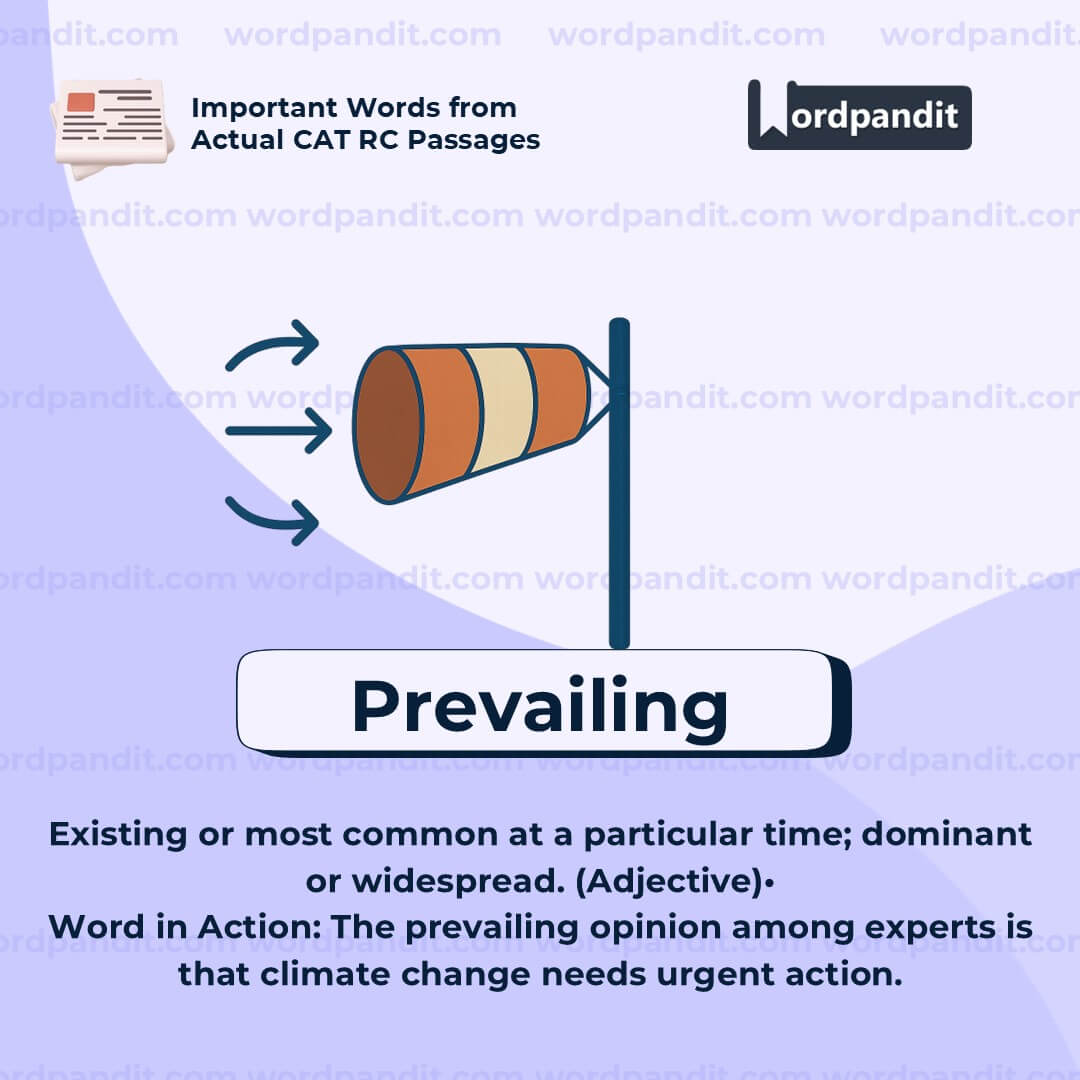
WORD-1: Prevailing
Context:
"The biggest challenge [The Nutmeg's Curse by Ghosh] throws down is to the prevailing understanding of when the climate crisis started." - The Nutmeg's Curse by Amitav Ghosh
Explanatory Paragraph:
The word "prevailing" refers to something that is dominant, widely accepted, or most frequent at a given time. In the given context, it highlights the mainstream or commonly held belief or interpretation — in this case, regarding the origin of the climate crisis. The book is challenging that dominant narrative and offering an alternative perspective.
Meaning: Existing or most common at a particular time (Adjective)
Pronunciation: pri-VAY-ling
Difficulty Level: ⭐⭐ Moderate
Etymology: From the Latin word "praevalēre," meaning "to be stronger or superior," which passed into Old French as "prévaloir" and Middle English as "prevail."
Prashant Sir's Notes:
Focus on the root "prevail" which means to win or dominate — the adjective "prevailing" captures something that has won out or dominates in terms of acceptance, opinion, or presence.
Synonyms & Antonyms:
Synonyms: dominant, current, widespread, established, accepted
Antonyms: rare, unusual, obsolete, unpopular, outdated
Usage Examples:
- The prevailing winds in this region blow from the northwest.
- She challenged the prevailing notion that success requires conformity.
- During the 19th century, the prevailing attitude toward nature was one of conquest and control.
- The prevailing fashion trends change with every season.
Cultural Reference:
"The prevailing mood of the 1960s was one of rebellion and change." - A common interpretation of the counterculture era in historical studies
Think About It:
Can challenging prevailing beliefs lead to meaningful societal change, or does it more often lead to conflict and resistance?
Quick Activity:
List two prevailing beliefs in your society today. Then write one sentence challenging each belief using evidence or reasoning.
Memory Tip:
Think of "prevailing" as “pre (before) + vailing (value/win)” — something that comes before and wins over others in thought or trend.
Real-World Application:
The term "prevailing" is often used in news, science, and policy discussions to describe dominant theories, trends, or forces — for instance, prevailing market conditions or prevailing medical advice.
WORD-2: Worsened
Context:
"Most of us have accepted ... that it started with the widespread use of coal at the beginning of the Industrial Age in the 18th century and worsened with the mass adoption of oil and natural gas in the 20th." - The Nutmeg's Curse by Amitav Ghosh
Explanatory Paragraph:
The word "worsened" indicates that a condition or situation became more severe, difficult, or unpleasant over time. In this context, it refers to how the environmental and climate-related impacts grew more damaging with the large-scale use of fossil fuels like oil and natural gas after coal had already set the problem in motion. It's a cause-and-effect word, showing deterioration.
Meaning: Became worse; deteriorated in condition or quality (Verb – Past Tense)
Pronunciation: WUR-suhnd
Difficulty Level: ⭐ Basic
Etymology: Derived from the Old English comparative form "wyrs," meaning "worse." The verb form evolved later to describe the act of becoming worse.
Prashant Sir's Notes:
This is the simple past form of the verb “worsen.” It’s commonly used to track negative progression — a useful word for essays and descriptions where decline or deterioration is being narrated.
Synonyms & Antonyms:
Synonyms: deteriorated, declined, degraded, degenerated, intensified
Antonyms: improved, recovered, healed, stabilized, enhanced
Usage Examples:
- Her health worsened after she stopped taking the medication.
- The political crisis worsened following the resignation of key leaders.
- Relations between the two countries worsened over trade disputes.
- The flood situation worsened as continuous rain lashed the region.
Cultural Reference:
"The situation worsened by the hour as the Titanic took on more water." - Retelling of the Titanic tragedy in history documentaries
Think About It:
When we talk about something worsening, are we acknowledging our role in its decline — or merely observing it passively?
Quick Activity:
Write two sentences: one showing how something improved over time and another showing how something worsened. Compare the structure of both.
Memory Tip:
Think of “worsened” as “made worse.” Just replace “better” with “worse” in your mind and think of something turning bad.
Real-World Application:
"Worsened" is frequently used in news reporting, healthcare updates, and environmental assessments to indicate that a condition or situation has become more severe — for instance, "air quality worsened overnight" or "economic conditions have worsened this quarter."
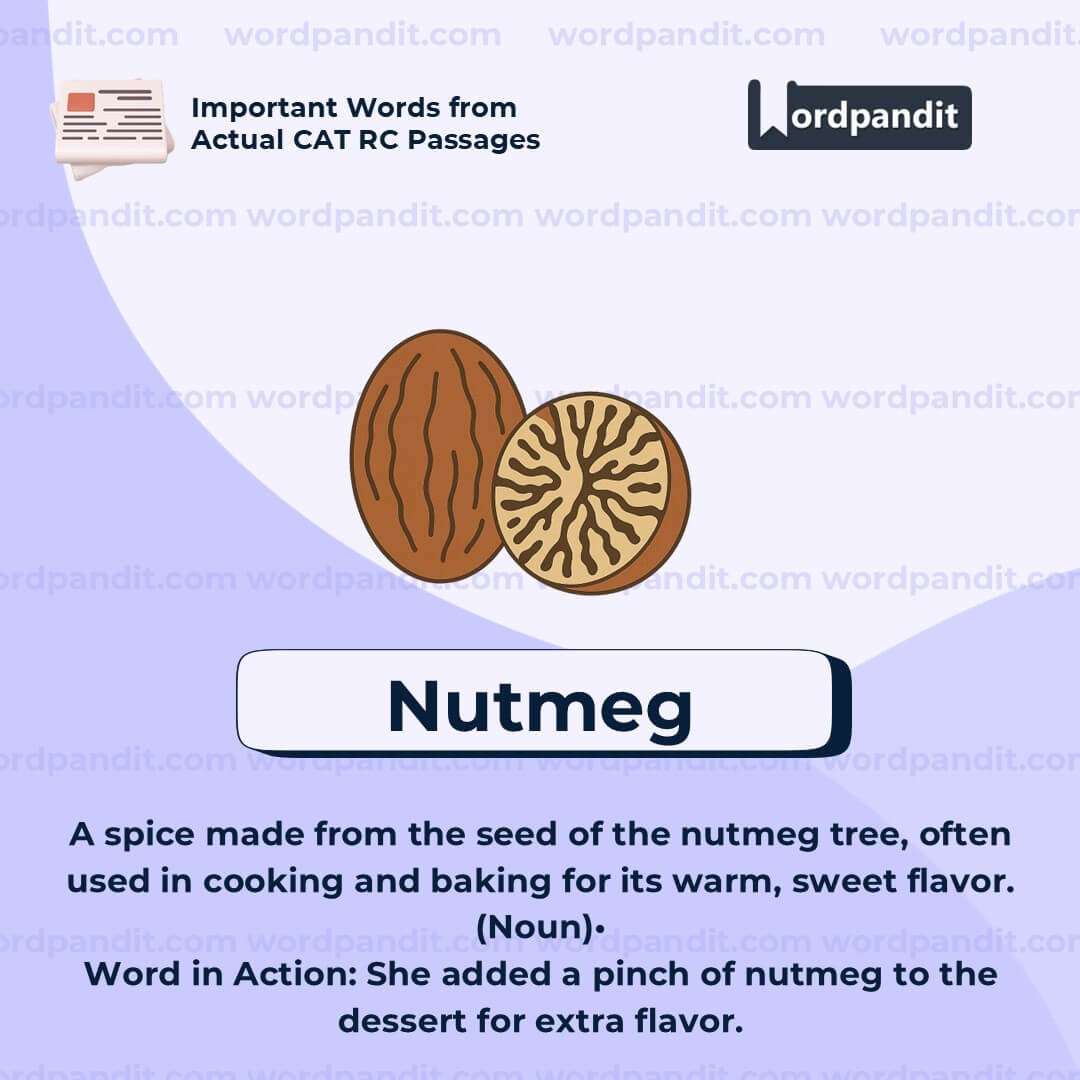
WORD-3: Nutmeg
Context:
"He [starts] the book with a 1621 massacre by Dutch invaders determined to impose a monopoly on nutmeg cultivation and trade in the Banda islands in today’s Indonesia." - The Nutmeg's Curse by Amitav Ghosh
Explanatory Paragraph:
"Nutmeg" refers to a spice made from the seed of the nutmeg tree, native to the Banda Islands of Indonesia. It has a warm, slightly sweet flavor and is used in both sweet and savory dishes worldwide. In this context, the word signifies far more than a spice — it symbolizes colonial greed, power struggles, and the violent pursuit of economic dominance in the spice trade during the 17th century. Thus, "nutmeg" carries historical and political weight beyond its culinary use.
Meaning: A spice made from the seed of a tropical tree, used in cooking and baking (Noun)
Pronunciation: NUT-meg
Difficulty Level: ⭐ Basic
Etymology: From Old Provençal *noz moscada* meaning “musky nut,” which passed into Middle English as "notemuge" and eventually "nutmeg."
Prashant Sir's Notes:
Nutmeg seems like an innocent kitchen ingredient, but history reveals it was once a global obsession — so prized that empires went to war over it. Think of this word as symbolic of how something small can lead to something monumental.
Synonyms & Antonyms:
Synonyms: spice, seed spice, culinary spice
Antonyms: (No direct antonyms, but contrasting items include) salt, pepper (in culinary context)
Usage Examples:
- She added a pinch of nutmeg to the custard for extra warmth and aroma.
- Nutmeg was once so valuable that it was worth more than its weight in gold.
- Colonial powers fought over the control of nutmeg-producing islands.
- The aroma of cinnamon and nutmeg filled the holiday kitchen.
Cultural Reference:
"Nutmeg wars" were part of the 17th-century spice trade rivalries — the Dutch and British clashed violently over control of nutmeg-producing regions, which shaped the colonial history of Southeast Asia.
Think About It:
How can something as simple as a spice hold the power to shape global empires and rewrite history?
Quick Activity:
Research three everyday items (like nutmeg) that have played key roles in historical conflicts. Write one line about each.
Memory Tip:
Picture a “nut” wearing a “megaphone” — shouting out how one small seed changed the world. "Nut-meg": a tiny seed with a loud history!
Real-World Application:
Nutmeg is a staple in kitchens worldwide, especially in baking, eggnog, and spice blends like garam masala. Historically, it’s also a case study in colonialism, trade, and globalization — relevant in history, economics, and political science.
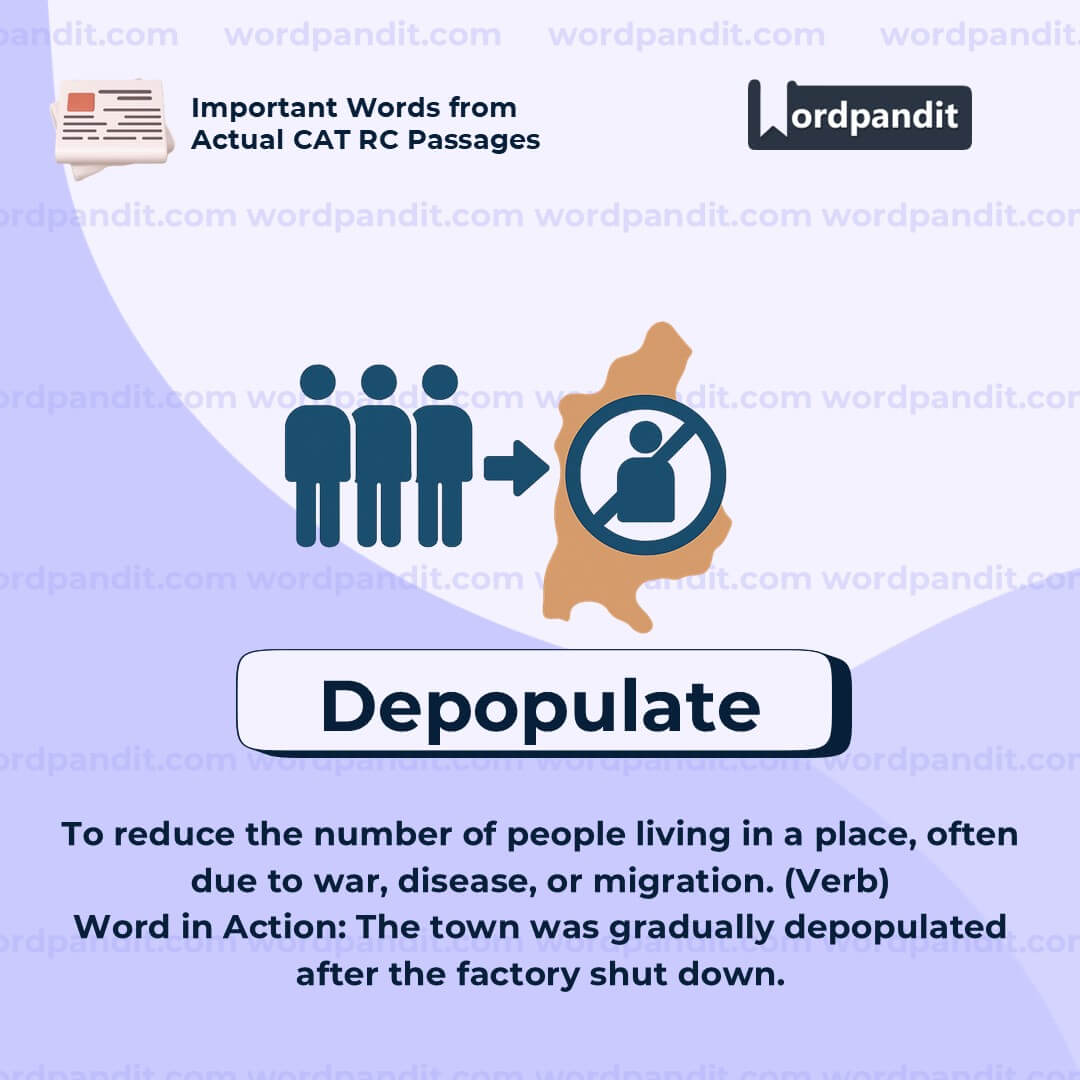
WORD-4: Depopulate
Context:
"Not only do the Dutch systematically depopulate the islands through genocide, they also try their best to bring nutmeg cultivation into plantation mode." - The Nutmeg's Curse by Amitav Ghosh
Explanatory Paragraph:
The word "depopulate" refers to the reduction or removal of people from a particular area, often by force or through catastrophic events like war, disease, or genocide. In the quoted context, it conveys the brutal actions of Dutch colonizers who systematically removed or exterminated the native population of the Banda Islands to gain control over nutmeg cultivation. This term carries a heavy historical and ethical charge, especially when tied to violent colonial acts.
Meaning: To reduce or remove the population of an area (Verb)
Pronunciation: dee-POP-yoo-layt
Difficulty Level: ⭐⭐⭐ Intermediate
Etymology: From Latin *de-* meaning "down, away" + *populus* meaning "people" — literally, "to remove the people."
Prashant Sir's Notes:
Use this word when discussing large-scale human removal, whether due to war, environmental disasters, or colonization. It's a powerful verb — don't use it lightly. It often implies violence, tragedy, or forced migration.
Synonyms & Antonyms:
Synonyms: evacuate, empty, clear out, decimate, exile
Antonyms: populate, repopulate, resettle, inhabit, colonize
Usage Examples:
- Wars often depopulate regions, leaving cities abandoned.
- The plague depopulated many parts of Europe in the 14th century.
- Authorities had to depopulate the village due to the threat of an erupting volcano.
- Colonial forces sought to depopulate native areas to establish plantations.
Cultural Reference:
The depopulation of indigenous communities in the Americas and Asia due to European colonization is a tragic chapter in global history — often caused by violence, disease, and forced displacement.
Think About It:
Can the act of depopulating an area ever be justified — and who gets to decide what “justification” means in such contexts?
Quick Activity:
Find two examples from history where regions were depopulated, and briefly describe who caused it and why.
Memory Tip:
Break it down: “de” (remove) + “populate” (people) = to remove the people. Imagine a city being drained of its people — that’s depopulate!
Real-World Application:
“Depopulate” is often used in discussions about conflict zones, environmental evacuation, colonial history, and dystopian literature or films where entire populations vanish or are displaced.
WORD-5: Genocide
Context:
"Not only do the Dutch systematically depopulate the islands through genocide, they also try their best to bring nutmeg cultivation into plantation mode." - The Nutmeg's Curse by Amitav Ghosh
Explanatory Paragraph:
"Genocide" refers to the deliberate and systematic extermination of a national, ethnic, racial, or religious group. It is one of the gravest crimes against humanity. In the context provided, the Dutch carried out acts of genocide to gain control of the Banda Islands, killing the local population to monopolize the valuable nutmeg trade. The term carries a deeply serious and tragic connotation, often associated with historical atrocities and legal proceedings in international courts.
Meaning: The deliberate killing of a large group of people, especially those of a particular nation or ethnic group (Noun)
Pronunciation: JEN-uh-side
Difficulty Level: ⭐⭐⭐⭐ Advanced
Etymology: Coined in 1944 by Raphael Lemkin from Greek *genos* ("race, people") + Latin *-cide* ("killing")
Prashant Sir's Notes:
This is one of the most powerful and painful words in global vocabulary. When you use "genocide," you refer not just to mass killings but to intentional efforts to erase a people. Always use this word with precision and historical awareness.
Synonyms & Antonyms:
Synonyms: mass killing, ethnic cleansing, holocaust, extermination
Antonyms: protection, preservation, coexistence, reconciliation
Usage Examples:
- The international community recognized the events in Rwanda in 1994 as a genocide.
- The book details the genocide committed by colonizers against the indigenous people of the island.
- Preventing genocide is a key mission of the United Nations and human rights organizations.
- Historical records show evidence of genocidal intent during the conquest of many territories.
Cultural Reference:
The Holocaust, during which six million Jews were killed by the Nazi regime, is the most widely recognized example of genocide and led to the formal adoption of the term under international law.
Think About It:
Why do societies often remain silent or passive in the face of genocidal violence — and what does that reveal about global politics and ethics?
Quick Activity:
Research and list three events in history that have been officially recognized as genocides. Note the location, time period, and targeted group.
Memory Tip:
Break it down: “geno-” (people) + “-cide” (killing) = killing of a people. Think of “genocide” as a horrifying attempt to erase a group completely.
Real-World Application:
"Genocide" is used in international law, journalism, human rights advocacy, and education to identify and respond to atrocities. Understanding the term is key to global awareness and promoting justice.
WORD-6: Colonialists
Context:
"These are the two points to which Ghosh returns through examples from around the world. One, how European colonialists decimated not only indigenous populations but also indigenous understanding of the relationship between humans and Earth." - The Nutmeg's Curse by Amitav Ghosh
Explanatory Paragraph:
"Colonialists" refers to individuals or groups who support, practice, or benefit from colonialism — the control and exploitation of one territory or people by another, usually more powerful nation. In this context, Ghosh critiques European colonialists for not only violently reducing native populations but also for dismantling indigenous ecological philosophies, replacing them with extractive and profit-driven ideologies. The term carries strong historical and political implications, often linked to domination, exploitation, and cultural erasure.
Meaning: People who support or are involved in establishing colonies and exploiting them for their home country's benefit (Noun – plural)
Pronunciation: kuh-LOH-nee-uh-lists
Difficulty Level: ⭐⭐⭐ Intermediate
Etymology: From the Latin *colonia* (“settlement”), through the French *colonial*, and English *colonialist* meaning a person engaged in colonial expansion.
Prashant Sir's Notes:
Important to distinguish between “colonizers” (those who carry out colonization directly) and “colonialists” (those who support the ideology or benefit from it). The term includes both actors and enablers of the colonial system.
Synonyms & Antonyms:
Synonyms: imperialists, settlers, colonizers, empire-builders
Antonyms: indigenous peoples, anti-colonialists, nationalists, decolonizers
Usage Examples:
- Colonialists imposed new systems of governance that erased native traditions.
- The colonialists viewed the land as a resource to be exploited, not a living ecosystem.
- Resistance to the colonialists grew as more indigenous leaders emerged.
- Colonialists often justified their actions through claims of racial superiority.
Cultural Reference:
The Age of Colonialism (15th–20th centuries) saw European colonialists spread across Asia, Africa, and the Americas, shaping global power dynamics and histories that continue to affect postcolonial societies today.
Think About It:
What might the world look like today if colonialists had respected indigenous knowledge systems instead of erasing them?
Quick Activity:
Identify two colonialist powers from history and list one major impact each had on the native populations of the regions they controlled.
Memory Tip:
Remember: “Colonialists” are the people behind colonies. Think of "C for control" — colonialists seek to control and reshape new lands in their image.
Real-World Application:
The term "colonialists" is used in historical analysis, political discourse, and decolonization studies to critique or understand the lingering effects of colonial rule on current global inequalities, identity struggles, and environmental degradation.
WORD-7: Substantive
Context:
"They also know how such a framing is just provided lip service and is ignored in the substantive portions of the negotiations." - The Nutmeg's Curse by Amitav Ghosh
Explanatory Paragraph:
"Substantive" refers to something that has real, significant, or practical importance. In the context of negotiations or discussions, it highlights the core or meaningful parts, as opposed to superficial or symbolic gestures. Ghosh here criticizes how important ideas (like justice or climate equity) are often praised rhetorically but excluded from the actual, impactful sections of negotiations — meaning the parts that really shape policy or decisions.
Meaning: Having a firm basis in reality and therefore important, meaningful, or considerable (Adjective)
Pronunciation: SUB-stan-tiv
Difficulty Level: ⭐⭐⭐ Intermediate
Etymology: From Latin *substantivus*, from *substantia* meaning “substance.” Originally used in grammar, later adapted for broader usage relating to real or essential content.
Prashant Sir's Notes:
Often confused with “substantial,” which refers to quantity or size. “Substantive” emphasizes *importance or content*. Use it in academic writing to highlight core ideas or meaningful action (e.g., "substantive change" vs. cosmetic change).
Synonyms & Antonyms:
Synonyms: essential, meaningful, important, core, significant
Antonyms: superficial, trivial, minor, symbolic, insubstantial
Usage Examples:
- The speech lacked any substantive proposals for solving the crisis.
- She made a substantive contribution to the debate on education reform.
- Although symbolic changes were introduced, no substantive reforms took place.
- Only substantive evidence will be considered during the trial.
Cultural Reference:
In political discourse, critics often call out governments for substituting symbolic gestures for substantive action — for instance, issuing statements without implementing meaningful policy change.
Think About It:
How often do public debates focus on style or symbolism rather than the substantive issues that truly affect people's lives?
Quick Activity:
Write one sentence each that uses “substantive” and “symbolic.” Then, explain how their meanings differ in your sentences.
Memory Tip:
Think of “substantive” as having *substance* — something that matters, not fluff. If it’s substantive, it’s the real deal.
Real-World Application:
In business, law, and international negotiations, "substantive" is used to describe the parts of conversations or agreements that carry real weight — not just formalities or statements for show.
WORD-8: Sabotaging
Context:
"Oil prices and oil movement around the world. Many of us know power utilities are sabotaging decentralised solar power generation today because it hits their revenues and control. And how the other points of view are so often drowned out." - The Nutmeg's Curse by Amitav Ghosh
Explanatory Paragraph:
"Sabotaging" refers to the act of deliberately destroying, damaging, or obstructing something — usually to weaken a system, protest against it, or maintain power. In the provided context, power utilities are accused of sabotaging decentralized solar energy efforts because such initiatives threaten their centralized business model and profit margins. The word implies underhanded or covert efforts to hinder progress or change that disrupts established power structures.
Meaning: Deliberately damaging or obstructing something to weaken or stop it (Verb – Present participle/gerund)
Pronunciation: SAB-uh-tah-jing
Difficulty Level: ⭐⭐⭐ Intermediate
Etymology: From French *sabotage*, from *sabot* (wooden shoe), associated with workers throwing shoes into machinery to halt production as a form of protest
Prashant Sir's Notes:
This is a strong word — use it when there's intentional harm or disruption, especially in political, industrial, or technological contexts. It goes beyond mere opposition — it implies calculated interference.
Synonyms & Antonyms:
Synonyms: undermining, disrupting, obstructing, disabling, wrecking
Antonyms: supporting, aiding, facilitating, promoting, assisting
Usage Examples:
- Competitors were accused of sabotaging the company’s software launch.
- He kept sabotaging the team’s efforts by leaking information.
- Some large firms are actively sabotaging climate reforms behind the scenes.
- By cutting funding, the government was seen as sabotaging public healthcare.
Cultural Reference:
The term “sabotage” became widely known during the industrial revolution and World Wars, where resistance groups would sabotage railways, factories, and supply chains to undermine enemy operations or corporate control.
Think About It:
When does resistance become sabotage — and can sabotage ever be ethically justified?
Quick Activity:
List two examples — one where sabotage might be used for negative purposes (e.g., business rivalry), and one where it might be used to resist injustice (e.g., political protest).
Memory Tip:
Think of “sabotaging” as secretly throwing a wrench into someone’s plans. If it’s being secretly or intentionally broken, it’s probably being sabotaged.
Real-World Application:
"Sabotaging" is often used in business, politics, and activism to describe actions that covertly interfere with progress, especially when power or profits are at stake. It’s relevant in conversations around whistleblowing, corporate lobbying, and resistance movements.
WORD-9: Terraforming
Context:
"We know our expansion through deforestation, dam building, canal cutting — in short, terraforming, the word Ghosh uses — has brought us repeated disasters ... Are these the responses of an angry Gaia who has finally had enough?" - The Nutmeg's Curse by Amitav Ghosh
Explanatory Paragraph:
"Terraforming" is originally a science fiction term that refers to modifying a planet’s environment to make it habitable for humans. Ghosh cleverly adapts this word to describe the massive human-driven changes to Earth’s natural landscapes — such as cutting down forests, building dams, and altering rivers — that reshape the planet to suit industrial goals. The term, in this context, is critical: it suggests hubris, or overreach, in humans’ attempts to “engineer” nature on a planetary scale, often with disastrous consequences.
Meaning: The process of modifying a planet or environment to resemble Earth and make it suitable for human life (Noun)
Pronunciation: TAIR-uh-form-ing
Difficulty Level: ⭐⭐⭐ Intermediate
Etymology: From Latin *terra* (“earth”) + *forming* (“shaping or structuring”) — coined in mid-20th century science fiction literature.
Prashant Sir's Notes:
Though born in sci-fi, “terraforming” is now used metaphorically to describe how humans forcibly reshape Earth. It’s powerful in eco-critical writing. Ghosh uses it to expose how our "progress" often damages the planet's integrity.
Synonyms & Antonyms:
Synonyms: geoengineering, landscape modification, planetary engineering
Antonyms: preservation, rewilding, conservation, ecological restoration
Usage Examples:
- Science fiction often imagines terraforming Mars to support human colonization.
- Ghosh argues that humans have been terraforming Earth itself, often destructively.
- The new canal project is yet another act of terraforming that could harm local ecosystems.
- Some climate proposals suggest large-scale terraforming as a response to global warming.
Cultural Reference:
Terraforming features prominently in works like *The Martian*, *Dune*, and *Interstellar*, where humans alter alien planets to survive. Ghosh reclaims it to critique how humans reshape *this* planet with unintended, often violent, consequences.
Think About It:
Are we “terraforming” Earth in ways that serve us temporarily but doom future generations?
Quick Activity:
List three real-world activities that could be considered forms of terraforming. For each, write whether the impact is mostly beneficial or harmful — and explain why.
Memory Tip:
“Terra” means Earth, and “forming” means shaping — so terraforming = shaping Earth (or another world). Picture bulldozers, dams, and satellites shaping landscapes — for better or worse.
Real-World Application:
Though born in fiction, “terraforming” is increasingly used in environmental discourse to critique massive alterations to ecosystems — such as mega-dams, deforestation, and even geoengineering plans to fight climate change.
WORD-10: Negotiations
Context:
"They also know how such a framing is just provided lip service and is ignored in the substantive portions of the negotiations." - The Nutmeg’s Curse by Amitav Ghosh
Explanatory Paragraph:
"Negotiations" refers to formal discussions held between two or more parties in order to reach an agreement or resolve a conflict. These can happen in political, business, legal, or even personal contexts. In the provided sentence, the term emphasizes high-level talks—likely about climate change or policy—where important ideas are superficially acknowledged but not seriously addressed in the core content. Ghosh critiques how meaningful concerns are often sidelined in these so-called negotiations.
Meaning: Formal discussions aimed at reaching an agreement (Noun – plural)
Pronunciation: neh-GO-shee-ay-shunz
Difficulty Level: ⭐⭐ Moderate
Etymology: From Latin *negotiatio* (“business, trade”), from *negotium* ("business"), from *nec* (“not”) + *otium* (“leisure”)
Prashant Sir's Notes:
This is a foundational word in discussions about diplomacy, business, and conflict resolution. Note that not all negotiations are sincere or balanced — some may be symbolic or manipulated, which is what Ghosh is hinting at here.
Synonyms & Antonyms:
Synonyms: talks, discussions, deliberations, consultations, bargaining
Antonyms: refusal, deadlock, disagreement, breakdown
Usage Examples:
- The peace negotiations between the two countries lasted several months.
- Labor unions entered into negotiations with the company over wages.
- Despite long negotiations, no resolution was reached at the summit.
- Successful negotiations require empathy, clarity, and compromise.
Cultural Reference:
Major international events like the Paris Climate Agreement or World Trade Organization summits are shaped by complex, often contentious negotiations involving dozens of stakeholders and nations.
Think About It:
Are most negotiations truly fair, or do they often reflect existing power imbalances between the parties involved?
Quick Activity:
Write a short dialogue between two people negotiating a shared responsibility (e.g., group project, roommate duties). Show how compromise is reached.
Memory Tip:
“Negotiations” has “go” in it — imagine both sides needing to “go back and forth” to reach a deal. No deal happens in just one move.
Real-World Application:
Negotiations are crucial in diplomacy, business contracts, job offers, and conflict resolution. Knowing how to negotiate effectively is a key life and career skill.